UNILATERAL NEGLECT SYNDROME
CLINICAL AND TOPOGRAPHIC STUDY OF 20 SUBJECTS
LUCIANO RIBEIRO PINTO JR.* — SYLVIO SARAIVA ** WILSON LUIZ SANVITO ***
SUMMARY — Twenty patients with unilateral neglect syndrome were studied. They were 10 males and 10 females, and they ranged from 29 to 76 years of age. All were submitted to a CAT scan of the brain. Based on the findings in our sample we drew the following conclusions: the extinction phenomenon was a constant manifestation of unilateral neglect; the line crossing test proved to be most efficient for the identification of visual neglect; the right parietal lobe was the anatomical region most often involved in the unilateral neglect syndrome.
Síndrome da negligência unilateral: estudo clínico e topográfico de 20 C A S O S .
RESUMO — Foram estudados 20 pacientes com a síndrome da negligência unilateral (SNU),
de idades variáveis entre 29 e 76 anos, sendo 10 do sexo masculino e 10 do sexo feminino,
todos submetidos à tomografia axial computadorizada do crânio. Baseados nesta casuística, concluímos: o fenômeno de extinção foi manifestação constante da SNU; a prova da secção de traços foi a que se revelou mais eficaz na identificação da negligência visual; o lobo parietal direito foi a região anatômica mais freqüentemente comprometida na SNU.
The right hemisphere takes part especially in the function of higher level ner-vous activities related to the visual-spatial recognition and body image. The distur-bance of these functions are at the center of the unilateral neglect syndrome ( U N S ) . Because of the controversial aspects of the U N S we decided to do a prospective study aimed at characterizing the syndrome and establishing the location of the lesions. With this purpose in mind we studied 20 U N S patients.
The first report in the literature to come closes to what is presently called neglect syndrome is the one of Jackson 36 jn 1876, when the author described a case
of visual imperceptiveness in a patient who had a right temporal lobe glioma. The first reference to the extinction phenomenon was made by Bender & F u r l o w8
in 1945; they described a patient who would not identify one of the images when given a double visual stimulus. The same phenomenon may occur after the general sensitivity is stimulated. The most recent systematic studies that brought new contributions to the clinical and physiopathological aspects of the U N S are the ones from Heilman's and Watson's school 30-34,57,5«. Beginning in the 1970's there have been some studies linking the physiopathlogy of U N S to biochemical mechanisms, especially the dopa-minergic circuits 24,40-42,55,56. Unilateral lesions of the dopadopa-minergic paths may cause the neglect to manifest itself in the form of a k i n e s i a2 4
.4 0
-4 1
. The U N S is characterized by the presence of the extinction phenomenon, spatial neglect, somatic neglect, and unilateral akinesia. It can present itself in a complete or partial form, and it may be accompanied by other neurological manifestations 5,6,8,18,28. Generically, the
extinc-Disciplina de Neurologia da Faculdade de Ciências Médicas da Santa Casa de São Paulo: * Professor Assistente; *** Professor Pleno. Departamento de Neurologia da Facul-dade de Medicina da UniversiFacul-dade de São Paulo: ** Professor Livre-Docente.
tion phenomenon consists of the lack of perception of one sensitive or sensory stimulus when two stimuli are provided simultaneously. The perception of each stimulus separately must take place as a condition to establish the existence of extinction. In the spatial neglect the patient ignores the existence of half of the spatial field, on the opposite side of the lesion. This deficiency of recognition may reach the visual, auditory, and tactile spheres. In the somatic neglect the patient ignores the existence of half of his body. This phenomenon is also called hemiasomatog-nosia 2,13,25,39 an d depersonalization. It can be observed in certain patients's actions
such as shaving, putting on glasses, putting on shoes or gloves, when he acts only in relation to the non-affected half of his body. The anosognosia, the motor extinction, the motor and sensitive aloesthesia may also be manifestations of somatic neglect. Unilateral akinesia is the inability or delay presented by the patient upon starting or trying to start a movement directed to a specific half of the space, and which cannot be due to a lesion of the peripheral motor neuron or of the pyramidal tract 32,55. It is also called intentional n e g l e c t3 2
.
SUBJECTS AND METHOD
Our subjects were 20 patients examined either in the Neurology Infirmary of the Department of Medicine of the Santa Casa of São Paulo or in our private practice office.
After the exam of the higher nervous activity we proceeded to the evaluation of the UNS components. The evaluation steps were the followings: 1. Extinction phenomenon — Utilization of the tactile, painful, visual, and auditory double stimuli on the limbs and faces, bilaterally, simultaneously and symmetrically. 2. Spatial neglect — 2.1. Direct obser-vation of patient or report from patient's family. 2.2. Patient's orientation evaluated through his attitud and walking. 2.3 Patient's reading of newspapers, magazines, and sentences. 2.4. Patient's identification of a two-digit number. 2.5. Patient's drawings. 2.6. Line and number crossing. Line crossing: the patient was presented with a piece of paper with 50 vertical lines drawn, and was asked to cross them. Number crossing: the patient was presented with a piece of paper with several numbers written at random on it, and was asked to cross a specific digit. 2.7. Matchsticks retrieval: the patient was presented with matchsticks placed vertically and horizontally on a table, and was asked to retrieve the ones in a certain position only. 2.8 Exam of visual and auditory aloesthesia. 3. Somatic neglect — 3.1. Direct observation of patient or report from patient's family. 3.2. Test for sensitive and motor aloesthesia. 3.3. Test for the presence of anosognosia in cases with hemiplegia. 4. Uni-lateral akinesia: evaluation through the observation of voluntary movements of each limb separately, or during the simultaneous extension of the upper limbs.
All patients were submitted to a CAT scan of the brain.
RESULTS
All patients had left hemisphere dominance. The extinction phenomenon was observed in all patients: painful extinction in 15 cases, tactile extinction in 12 cases, visual extinction in 11 cases, and auditory extinction in 8 cases. Spatial neglect was present in 16 cases, and somatic neglect in 5 cases (Table 1).
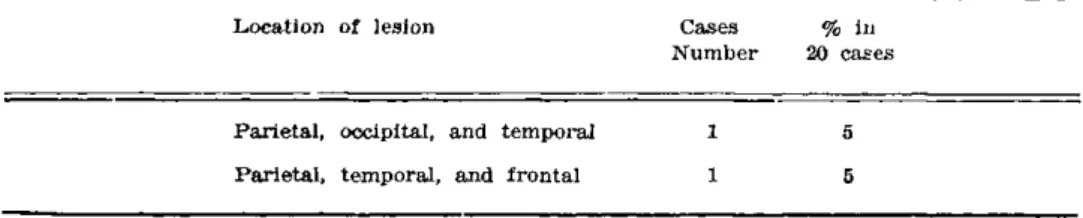
In the CAT scan of the brain, localized abnormalities of the parietal lobe were observed in 13 cases, and of these 11 were on the right parietal lobe and 2 on the left parietal lobe (Tables 3, 4 and 5 ) . In regard to the nature of the lesions, the tomographic image was one of ischemia in 11 cases, of hemorrhage in 5 cases, and of neoplasm in 3 cases. In jne case there was no evidence of localized lesions in the parenchyma.
Fig. 1 — Case 12: left visual'spatial neglect observed in the lime crossing test (A) and (B) in the specific digit crossing test (number 1). Case 6: left visual-spatial neglect observed in the drawing of a daisy and a doll ( C ) .
COMMENTS
The studies found in the literature generally do not analyse the U N S in its totality. The majority of these studies emphasize the visual-spatial aspects 1,10-12,15,20,
23,27,33,38,44,46,47,50. The extinction phenomenon, and the lateralized alterations of the
In terms of frequency, the visual neglect was the second manifestation found in our patients. The tests of line and number crossing were the ones that demons-trated visual-spatial neglect best. The identification of a two-digit number proved not to be so sensitive a test; however, it has the advantages of being a test of quick execution, and of stablishing the differential diagnosis between visual neglect and hemianopia. In its execution it is unlikely that each digit of a pair will be in different visual fields. Furthermore, the spatial neglect results from the relative position of the objects in space, and not from their location in a specific half of the visual field 37.
In the U N S the lesion is often located on the right cerebral hemisphere 3,4,14,18,
21,27,44. in our patients there was a predominance of right hemisphere involvement.
Our results also agree with the findings in the literature regarding a higher parietal lobe involvement 11.16.17.19,23,29,35,43,45,47-49,51,52,54. The higher incidence of right hemis-phere lesions is interpreted as being due to the specialization of the two hemishemis-pheres, for the right hemisphere takes part especially in the tridimensional visual mechanisms, in the construction of space 26,27, an d in the body image 4,28,51.
In the genesis of the U N S , the predominance of lesions on the right cerebral hemisphere can also be attributed to other factors. The cortical-limbic-reticular circuit is less organized in the right hemisphere; thus, right hemisphere lesions produce a more pronounced asymmetry in response to orientation than left hemisphere lesions 3 4
. The influence of language was the subject of a few studies 14.54. The process of verbalization, upon activating the left hemisphere, can increase a neglect that already exists due to right hemisphere lesion.
R E F E R E N C E S
1. Albert ML — A simple test of visual neglect. Neurology 23:658, 1973.
2. Babinski MJ — Contribution à 1'étude des troubles mentaux dans 1'hemiplégie organique cérébrale (anosognosie). Rev Neurol 27:845, 1974.
3. Barbizet J — Le monde de 1'hémiplégique gauche: essai de théorization. In Barbizet J, Ben Hamida M, Duizabo P ( e d s ) : Le Monde de 1'Hémiplégique Gauche. Masson, Paris, 1972, pg 99.
4. Ben Hamida M — Rôle de l'hemisphère droit dans la somatoenosie: l'anosognosie, syndro-me d'Anton-Babinski et troubles associes. In Ben Hamida M, Duizabo P : Le Monde de 1'Hémiplégique Gauche. Masson, Paris, 1945, pg 19.
5. Bender MB — Extinction and preciptation of cutaneous sensations. Arch Neurol Psychiat 54:1, 1945.
6. Bender MB — Perceptual interactions. In Willians D ( e d ) : Modern Trends in Neurology. Butterworths, London, 1970, pg 1.
7. Bender MB, Feldman DS — Extinction of taste sensation: double simultaneous stimulation. Neurology 2:195, 1952.
8. Bender MB, Furlow L T — Phenomenon of visual extinction in homonymous fields and psychologic principles involved. Arch Neurol Psychiat 53:29, 1945.
9. Bender MB, Wortes SB, Cramer J — Organic mental syndrome with prenomena of extinction and allesthesia. Arch Neurol Psychiat 59:273, 1948.
10. Bisiach E, Luzzatti C — Unilateral neglect of representation space. Cortex 14:129, 1978. 11. Bisiach E. Luzzatti C, Perani D — Unilateral nesrlect representational schema and
cons-ciousness. Brain 102:609, 1979.
12. Brain W R — Visual disorientation with special reference t o lesions of the cerebral hemisphere. Brain 64:244, 1914.
13. Cambier J, Elghozi D, Graveleau P, Lebetzki C — Hémiasomatognosie droite et sentiment d'amputation par lesion gauche sous-corticale: rôle de la disconnexion calleuse. Rev Neurol 140:256, 1984.
15. Colombo A, DeRenzi E, Faglioni P — The occurrence of visual neglect in patients with unilateral cerebral disease. Cortex 12:221, 1976.
16. Critchley M — The prenomenon of tactile inattention with special reference to parietal lesion. Brain 72:538, 1949.
17. Critchley M — The Parietal Lobes. Edward Arnold, London, 1953.
l8. Denny-Brown D, Meyer JS, Horenstein S — The significance of perceptual rivalry resul-ting from parietal lesion. Brain 75:433, 1952.
19. Deuel RK, Regan DJ — Parietal hemineglect and motor deficits in the monkey. Neu¬ ropsychologia 23:305, 1985.
20. Diller L, Weinberg J P — Hemi-inattention in rehabilitation: the evolution of a retional remediation program. Adv Neurol 18:63, 1977.
21. Duizabo P — Rôle de 1'hémisphère droit dans les perceptions visuelles et visuospatiales. In Barbizet J, Ben Hamida M, Duizabo P ( e d s ) : Le Monde de 1'Hémiplégique Gauche. Masson, Paris, 1972, p g 47.
22. Eidelberg E, Schwartz AS — Experimental analysis of the extinction phenomenon in monkeys. Brain 94:91, 1971.
23. Ettlinger G, Warrington E, Zangwill OL — A further study of visual-spatial agnosia. Brain 80:335, 1957.
24. Feeney DM, Wier CS — Sensory neglect after lesions of substantia nigra or lateral hypothalamus: differential severity and recovery of function. Brain Res 178:329, 1979. 25. Fredericks JAM — Disorders of the body schema. In Vinken PJ, Bruyn GW (eds): Handbook of Clinical Neurology: Disorders of the Speech, Perception and Symbolic Behaviour. North-Holland, Amsterdam, 1969, vol 4, pg 207.
26. Gainotti G — Les manifestations de neglicence et d'inattention pour l'hemispace. Cortex 4:64, 1968.
27. Gainotti G, Messerli P. Tissoti R — Qualitative analysis of unilateral spatial neglect in relation to laterality of cerebral lesions. J Neurol Neurosurg Psychiat 35:545, 1972. 28. Gerstmann J — Problem of imperception of disease and impaired body scheme and its
disorders. Arch Neurol Psychiat 48:890, 1942.
29. Goldberg ME, Robinson DL — Visual responses of neurons in monkey inferior parietal lobule: the physiologic substrate of attention and neglect. Neurology 27:350, 1977. 30. Heilman KM, Bowers D, Coslett B, Watson R T — Directional hypokinesia in neglect.
Neurology 33:104, 1983.
31. Heilman KM, Valenstein E — Mechanism underlying hemispatial neglect. Ann Neurol 5:166. 1979.
32. Heilman KM, Valenstein E, Watson R T — The neglect syndrome. In Vinken PJ, Bruyn GW (eds): Handbook of Clinical Neurology: Clinical Neuropsychology. North-Holland, Amsterdam, 1985. vol 45, pg 153.
33. Heilman KM, Van Den Abell T — Right hemisphere dominance for attention: the mechanism underlying hemispheric asymmetries of inattention (neglect). Neurology 30:327, 1980.
34. Heilman KM. Watson R T — Mechanism underlying the unilateral neglect syndrome. Adv Neurol 18:93, 1977.
35. Heilman KM, Watson R T — The neglect syndrome: a unilateral defect of the orienting response. In Harnard S ( e d ) : Lateralization in the nervous system. Academic Press, New York, 1977, pg 285.
37. Kinsbourne M — Hemi-neslect and hemisphere rivalry. Adv Neurol 18:41, 1977. 38. Lawson IR — Visual-spacial neglect in lesions of the right cerebral hemisphere. Neurolgy
12:23, 1962.
39. Lhermitte J — De l'image corporalle. Rev Neurol 74:20, 1942.
40. Ljungberg T, Ungerstedt U — Sensory inattention produced by 6-hydroxidopamine--induced degeneration of ascending dopamine neurons in the brain. Exp Neurol 53:585, 1976.
41. Marshall JF — Somatosensory inattention after dopamine depleting intracerebral 6-OHDA injections: spontaneous recovery and pharmacological control. Brain Res 177:311, 1979. 42. Marshall JF, Turner BH, Teitelbaum P — Sensory neglect produced by lateral
hypotha-lamic damage. Science 174:523, 1978.
43. Mcfie J, Piercy MF, Zangwill OL — Visual-spacial agnosia associated with lesions of the rierht cerebral hemisphere. Brain 73:167. 1950.
44. Mazzucchi A, Pasteraro AM. Nuzzi G. Parma M — Unilateral visual agnosia. Cortex 21:309. 1975.
45. Nathan P W — On simultaneous bilateral stimulation of the body in a lesion of the parietal lobe. Brain 69:325, 1946.
46. Ogden JA — Contralesional neglect of constructed visual images in right and left brain¬ -demaged patients. Neuropsychologia 23:273, 1985.
47. Oxbury JM, Campbell DC, Oxbury SM — Unilateral spatial neglect and impairments of spatial analysis and visual perception. Brain 97:551, 1974.
48. Reider MN — Phenomena of sensory supression. Arch Neurol Psychiat 55:583, 1946. 49. Rosenberger PB — Discriminative aspects of visual hemi-inattention. Neurology 24:17,
1974.
50. Rosenfield DB, Kinsbourne M — Neurologic aspects of behaviour. In Appel SH ( e d ) : Current Neurology. Wiley, New York, 1981, vol 3, pg 503.
51. Roth M — Disorders of the body image caused by lesions of the right parietal lobe. Brain 72:89, 1949.
52. Sandifer P H — Anosognosia and disorders of body scheme. Brain 69:122, 1946.
53. Schwartz AS, Marchok PL, Flynn R E — A sensitive test for tactile extinction: results in patients with parietal and frontal lobe disease. J Neurol Neurosurg Psychiat 40:228, 1977.
54. Schwartz AS, Marchok PL, Kreinick CJ, Flynn R E — The asymetric lateralization of tactile extinction in patients with unilateral cerebral dysfunction. Brain 102:669, 1979. 55. Valenstein E, Heilman K M — Unilateral hypokinesia and motor extinction. Neurology
31:445, 198L
56. Valenstein E, Van Den Abell T, Tankle R, Heilman K M — Apomorphine-induced turning after recovery from neglect induced by cortical lesions. Neurology 30:358, 1980. 57. Watson R T , Heilman K M — Thalamic neglect. Neurology 29:690, 1979.
58. Watson R T , Valenstein E, Heilman K M — Thalamic neglect: possible role of the medial thalamus and nucleus reticulares in behaviour. Arch Neurol 38:501, 1981.