Factors associated with smoking cessation
in Brazil
Fatores associados à cessação do tabagismo
no Brasil
Factores asociados con el abandono del
tabaquismo en Brasil
1 Programa de Pós-graduação em Organizações e Mercados, Universidade Federal de Pelotas, Pelotas, Brasil. 2 Programa de Pós-graduação em Epidemiologia, Universidade Federal de Pelotas, Pelotas, Brasil. 3 Universidade Federal de Alagoas, Santana do Ipanema, Brasil. Correspondence C. A. O. Tejada
Programa de Pós-graduação em Organizações e Mercados, Universidade Federal de Pelotas.
Rua Gomes Carneiro 1, Pelotas, RS
96010-610, Brasil.
Cesar Augusto Oviedo Tejada 1 Fernanda Ewerling 2
Anderson Moreira Aristides dos Santos 3 Andréa Dâmaso Bertoldi 2
Ana Maria Menezes 2
Abstract
Tobacco has been identified as the drug with the highest addiction rate and the leading cause of avoidable deaths. The current study thus aimed to identify the determinants of smoking cessation in a Brazilian population sample based on data from the National Household Sample Survey for 2008. The study analyzed socioeconomic, resi-dential, and health-related data as well as indi-vidual habits. Data analysis used Poisson regres-sion. The following factors were associated with smoking cessation: age 45 years or older, higher income, medical consultation in the previous 12 months, private health plan, physical exercise, believing that smoking is bad for one’s health and that cigarette smoke is harmful to passive smokers, and Internet access in the household. Subjects with heart conditions, diabetes, and cancer were also more prone to quit smoking.
Tobacco Use Cessation; Tobacco; Socioeconomic Factors;
Resumo
O tabaco é apontado como a droga com maior porcentual de dependência entre as drogas adi-tivas e, também, como o maior causador de mor-tes evitáveis. Nesse sentido, este estudo visou a encontrar os determinantes de cessação do taba-gismo para a população brasileira com base nos dados da Pesquisa Nacional por Amostra de Do-micílios de 2008. Foram analisadas informações socioeconômicas, de zona e região de residência, de saúde e hábitos dos indivíduos. A análise dos dados envolveu estimações utilizando-se a re-gressão de Poisson. Os resultados mostram que fatores como ter 45 anos ou mais, possuir renda mais elevada, ter consultado médico nos últimos 12 meses, ter plano de saúde, praticar exercícios físicos, acreditar que o tabaco faz mal à saúde, que a fumaça do cigarro compromete a saúde dos fumantes passivos, e ter Internet no domicí-lio se relacionam positivamente com a cessação do tabagismo. Além disso, pessoas com proble-mas cardíacos, diabetes e câncer mostraram uma maior propensão a deixar de fumar.
Introduction
Tobacco use, formerly considered a “lifestyle”, is now recognized for the harm it causes to health due to the exposure to numerous toxic substanc-es 1. With nicotine as the main psychoactive
com-ponent of tobacco, smoking shows the highest addiction rate among legal and illicit drugs 2 and
is further identified as the leading cause of avoid-able mortality, causing some 6 million deaths ev-ery year and huge damage to the world economy. If the current trend continues, by 2030 smoking will cause an estimated 8 million deaths per year in the world 3.
In Brazil in 2008, there were some 24.6 million smokers in the adult population, or 17.2% of this age bracket. Prevalence of tobacco use was 21.6% in men and 13.1% in women 4. As for the desire
to stop smoking, 45.6% of Brazilian smokers had made some attempt to quit in the previous 12 months 4. Among those that try, it is known that
few succeed because of various factors, includ-ing work stress 5. Evidence also shows that
smok-ing cessation is associated with: more schoolsmok-ing
6,7,8,9, older age 6,7,8, medical consultation at least
once a year 6,7, marital status (married) 6,8, male
gender 8,10,11,12, and white skin color 8. Research
has also shown that price increases for cigarettes increase the quit rates 13. According to estimates,
a permanent increase of 10% in future cigarette prices would reduce the mean duration of smok-ing by 11%-13% 14.
Various studies have attempted to identify psychological 2,15,16 and/or work and
house-hold-related factors 5 that lead individuals to
quit smoking, but there are few analyses of the socioeconomic factors associated with this out-come, especially in the Brazilian population 6.
Other studies have sought evidence of an asso-ciation between smoking and certain diseases 2,
but few have attempted to determine whether these diseases are relevant motivating factors to quit smoking. In order to fill this knowledge gap, the current study aimed to identify the socioeco-nomic, health-related, and residential determi-nants associated with smoking cessation in the Brazilian population.
Methods
Data were obtained from the Brazilian National Household Sample Survey (PNAD), 2008. The PNAD is a nationwide survey conducted by the Brazilian Institute of Geography and Statistics (IBGE). The survey publishes periodic supple-ments on specific themes, including smoking in 2008.
For this supplement of PNAD 2008, the IBGE and Ministry of Health joined to conduct the Special Survey on Smoking (PETab), using the in-ternational methodology from the Global Adult Tobacco Survey (GATS); the latter has evaluated smoking in various developing countries to sup-port the international Tobacco Free Initiative 17.
PETab studied individuals 15 years or older on consumption of tobacco and tobacco prod-ucts, attempts at cessation, indirect exposure to cigarette smoke, access to awareness-raising campaigns concerning the risks associated with smoking, and perception of these risks 18.
In 2008, the Brazilian survey included 391,868 individuals and 150,591 households in all States of the country and the Federal District.
The following inclusion criterion was used, adopting definitions from the World Health Orga-nization (WHO) 19: self-reported current smoker
or former daily smoker. WHO defines smokers as individuals that smoke at least one cigarette per day and former smokers as those who previ-ously smoked at least one cigarette a day but quit smoking at least six months before. Thus, for the analyses in the current article, the sample result-ed in 11,933 smokers and former daily smokers 15 years or older.
The following independent variables were used to analyze determinants of smoking cessa-tion: per capita household income (in quartiles, with lowest income as the 1st quartile), schooling
in years (grouped in five categories: zero, 1-3, 4-7, 8-10, and ≥ 11 years), age (15-29, 30-59, and ≥ 60 years), age at smoking onset (< 18 years and ≥ 18 years), gender, and self-rated health (very good or good versus fair, poor, or very poor).
The study also used three indicators on healthcare and two on knowledge of harm from smoking: medical consultation in the last 12 months (yes/no), private health plan (yes/no), and physical exercise or sports at least one or two days a week in the previous three months (yes/no); believing that smoking causes serious diseases (yes/no) and believing that cigarette smoke causes serious diseases in passive smok-ers (yes/no).
The study also analyzed self-report of the fol-lowing diseases based on a medical diagnosis: heart disease, hypertension, depression, diabe-tes, bronchitis, or cancer; possessing the follow-ing items (markers for access to information) in the household: TV, internet, or radio; region of the country (North, Northeast, South, Southeast, and Central-West); and area of residence (urban versus rural).
ratios, using Poisson regression. Multivariate analysis included all the independent variables and indicators for healthcare and knowledge on harm from smoking.
All the analyses used Stata 11.0 (Stata Corp., College Station, USA). Considering that the PNAD is a complex sample, svyset command was used to define the sample weights and clusters and svy for the analyses to contemplate this sam-pling design.
Results
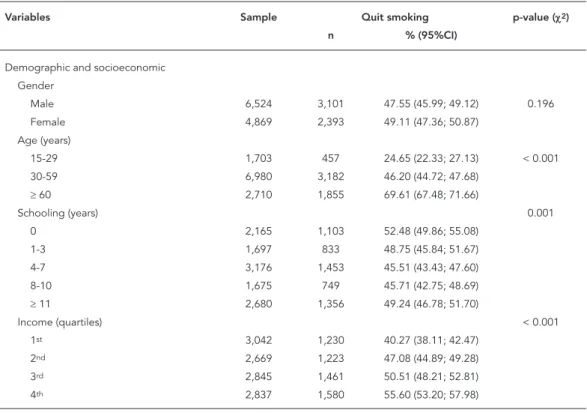
Prevalence of smoking cessation among the 11,393 individuals included in the analysis was 48.18% (95%CI: 47.02; 49.32). Table 1 shows the percentage of subjects that quit smoking ac-cording to demographics, socioeconomic status, place of residence, self-rated health, and sources of information in the household.
Some 49.1% of women in the sample had quit smoking more than 6 months previously, as com-pared to 47.6% in men (difference not statistically significant). Individuals 60 years or older showed
a much higher cessation rate (69.6%), nearly three times that of younger individuals (24.6%). Cessation rates also increased in direct propor-tion to income.
Table 2 shows the crude and adjusted preva-lence ratios for factors associated with smoking cessation and respective confidence intervals, obtained by Poisson regression. The results of the crude analysis were quite similar to those found in the preliminary analysis shown in Table 1. Gender continued not to show statistical signifi-cance, and older individuals continued to pres-ent a higher propensity to quit smoking.
Individuals with 4-10 years of schooling showed lower smoking cessation rates than those with no schooling. However, income still showed a positive relationship with the outcome.
As for place of residence, urban dwellers were more prone to quit smoking than rural residents. There was no significant difference according to geographic region of the country.
Individuals that rated their health as very good or good showed lower cessation rates than those who rated their health as fair, poor, or very poor. Individuals with heart disease, diabetes,
hyper-Table 1
Prevalence of smoking cessation according to individual characteristics in the Brazilian population 15 years or older. Brazilian National Household Sample Survey (PNAD), Brazil, 2008-2009 (N = 11,393).
Variables Sample Quit smoking p-value (χ2)
n % (95%CI)
Demographic and socioeconomic Gender
Male 6,524 3,101 47.55 (45.99; 49.12) 0.196
Female 4,869 2,393 49.11 (47.36; 50.87)
Age (years)
15-29 1,703 457 24.65 (22.33; 27.13) < 0.001
30-59 6,980 3,182 46.20 (44.72; 47.68)
≥ 60 2,710 1,855 69.61 (67.48; 71.66)
Schooling (years) 0.001
0 2,165 1,103 52.48 (49.86; 55.08)
1-3 1,697 833 48.75 (45.84; 51.67)
4-7 3,176 1,453 45.51 (43.43; 47.60)
8-10 1,675 749 45.71 (42.75; 48.69)
≥ 11 2,680 1,356 49.24 (46.78; 51.70)
Income (quartiles) < 0.001
1st 3,042 1,230 40.27 (38.11; 42.47)
2nd 2,669 1,223 47.08 (44.89; 49.28)
3rd 2,845 1,461 50.51 (48.21; 52.81)
4th 2,837 1,580 55.60 (53.20; 57.98)
Table 1 (continued)
Variables Sample Quit smoking p-value (χ2)
n % (95%CI)
Residence
Area of residence 0.019
Rural 1,963 867 45.25 (42.56; 47.96)
Urban 9,430 4,627 48.80 (47.52; 50.08)
Region of residence 0.392
North 1,207 591 47.41 (43.35; 51.52)
Northeast 3,343 1,640 49.27 (47.20; 51.34)
South 2,055 947 46.58 (43.88; 49.30)
Southeast 3,453 1,651 47.90 (45.96; 49.85) Central-West 1,335 665 50.17 (46.93; 53;40) Health-related variables
Self-rated health < 0.001
Fair, poor, or very poor 4,359 2,366 54.09 (52.28; 55.89) Very good or good 7,034 3,128 44.54 (43.06; 46.04)
Heart disease < 0.001
No 10,525 4,910 46.64 (45.41; 47.87)
Yes 868 584 66.90 (62.85; 70.72)
Depression
No 10,521 5,071 48.26 (47.05; 49.48) < 0.618
Yes 872 423 47.20 (43.21; 51.22)
Diabetes
No 10,636 4,960 46.71 (45.51; 47.92) < 0.001
Yes 757 534 69.12 (64.71; 73.21) < 0.001
Hypertension
No 8,471 3,625 42.76 (41.41; 44.12)
Yes 2,992 1,869 63.80 (61.56; 65.97)
Bronchitis 0.191
No 10,835 5,213 48.01 (46.81; 49.21)
Yes 558 281 51.51 (46.41; 56.59) < 0.001
Cancer
No 11,259 5,398 47.89 (46.71; 49.07)
Yes 134 96 73.05 (63.10; 81.12)
Physician consultation in previous year < 0.001
No 3,442 1,304 38.44 (36.31; 40.60)
Yes 7,951 4,190 52.53 (51.20; 53.87)
Private health plan < 0.001
No 8,939 4,105 45.90 (44.58; 47.22)
Yes 2,454 1,389 55.91 (53.39; 58.40)
Physical exercise or sports < 0.001
No 9,005 4,666 46.57 (45.28; 47.86)
Yes 2,388 828 54.26 (51.76; 56.74)
Believes smoking causes diseases < 0.001
No 10,786 192 30.26 (26.05; 34.83)
Yes 607 5,302 49.22 (48.01; 50.44)
Believes cigarette smoke causes diseases in passive smokers
< 0.001
No 1,298 475 35.14 (32.05; 38.36)
Yes 10,095 5,019 49.86 (48.62; 51.09)
Age at smoking onset (years) 0.813
< 18 7,283 3,534 48.09 (46.67; 49.51)
≥ 18 4,110 1,960 48.37 (46.45; 50.28)
Table 1 (continued)
Variables Sample Quit smoking p-value (χ2)
n % (95%CI)
Access to information
TV in the household 0.014
No 823 356 42.99 (38.87; 47.22)
Yes 10,570 5,138 48.49 (47.28; 49.69)
Radio in the household 0.001
No 1,506 658 42.50 (39.30; 45.77)
Yes 9,887 4,836 48.85 (47.61; 50.09) < 0.001
Internet in the household
No 9,439 4,422 46.51 (45.28; 47.75)
Yes 1,954 1,072 54.42 (51.64; 57.18)
95%CI: 95% confi dence interval.
Table 2
Crude and adjusted * prevalence ratios (PR) for factors associated with smoking cessation in the Brazilian population 15 years or older. Brazilian National Household Sample Survey (PNAD), Brazil, 2008-2009 (N = 11,393).
Variables Crude PR (95%CI) Adjusted PR (95%CI)
Demographic and socioeconomic
Gender p = 0.196 p = 0.469
Male 1.00 1.00
Female 1.03 (0.98; 1.08) 1.02 (0.97; 1.07)
Age (years) p < 0.001 p < 0.001
15-29 1.00 1.00
30-59 1.87 (1.69; 2.07) 1.80 (1.63; 1.99)
≥ 60 2.82 (2.55; 3.12) 2.60 (2.33; 2.90)
Schooling (years) p < 0.001 p = 0.450
0 1.00 1.00
1-3 0.93(0.86; 1.01) 1.00 (0.93; 1.08)
4-7 0.87(0.81; 0.93) 0.99 (0.92; 1.06)
8-10 0.87 (0.80; 0.94) 1.03 (0.95; 1.12)
≥11 0.94(0.88; 1.01) 0.95 (0.94; 1.12)
Income (quartiles) p < 0.001 p = 0.0142
1st 1.00 1.00
2nd 1.17(1.09; 1.26) 1.10 (1.03; 1.18)
3rd 1.25 (1.17; 1.34) 1.07 (1.01; 1.14)
4th 1.38(1.29; 1.48) 1.13 (1.04; 1.22)
Residence
Area of residence p = 0.022 p = 0.839
Rural 1.00 1.00
Urban 1.08(1.01; 1.15) 1.01(0.94; 1.08)
Region of residence p = 0.392 p = 0.001
North 1.00 1.00
Northeast 1.04(0.94; 1.14) 0.98 (0.89; 1.07)
South 0.98 (0.89; 1.09) 0.88 (0.79; 0.97)
Southeast 1.01 (0.92; 1.11) 0.87 (0.80; 0.95)
Central-West 1.06 (0.95; 1.18) 0.97 (0.88; 1.07)
Table 2 (continued)
Variables Crude PR (95%CI) Adjusted PR (95%CI)
Health-related variables
Self-rated health p < 0.001 p = 0.442
Fair, poor, or very poor 1.00 1.00
Very good or good 0.82(0.79; 0.86) 0.98 (0.93; 1.03)
Heart disease p < 0.001 p = 0.012
No 1.00 1.00
Yes 1.44 (1.34; 1.53) 1.09 (1.02; 1.17)
Depression p = 0.621 p = 0.002
No 1.00 1.00
Yes 0.98 (0.90; 1.07) 0.87 (0.80; 0.95)
Diabetes p < 0.001 p = 0.001
No 1.00 1.00
Yes 1.48 (1.39; 1.58) 1.12 (1.05; 1.19)
Hypertension p < 0.001 p < 0.001
No 1.00 1.00
Yes 1.49 (1.42; 1.56) 1.17 (1.11; 1.24)
Bronchitis p = 0.177 p = 0.674
No 1.00 1.00
Yes 1.07 (0.97; 1.19) 0.98 (0.89; 1.08)
Cancer p < 0.001 p = 0.047
No 1.00 1.00
Yes 1.53 (1.34; 1.73) 1.13 (1.01; 1.28)
Physician consultation in previous year p < 0.001 p < 0.001
No 1.00 1.00
Yes 1.37 (1.29; 1.45) 1.18 (1.11; 1.25)
Private health plan p < 0.001 p = 0.036
No 1.00 1.00
Yes 1.22 (1.16; 1.29) 1.06 (1.01; 1.13)
Physical exercise or sports p < 0.001 p < 0.001
No 1.00 1.00
Yes 1.17 (1.11; 1.23) 1.18 (1.12; 1.24)
Believes smoking causes diseases p < 0.001 p < 0.001
No 1.00 1.00
Yes 1.63 (1.40; 1.89) 1.40 (1.19; 1.64)
Believes cigarette smoke causes diseases in passive smokers p < 0.001 p < 0.001
No 1.00 1.00
Yes 1.42 (1.29; 1.56) 1.28 (1.16; 1.41)
Age at smoking onset (years) p = 0.813 p = 0.001
< 18 1.00 1.00
≥ 18 1.01 (0.96; 1.06) 0.93 (0.88; 0.97)
Access to information
TV in household p = 0.019 p = 0.494
No 1.00 1.00
Yes 1.13 (1.02; 1.25) 1.04 (0.94; 1.15)
Radio in household p = 0.001 p = 0.182
No 1.00 1.00
Yes 1.15 (1.06; 1.25) 1.05 (0.98; 1.13)
Internet in household p < 0.001 p = 0.002
No 1.00 1.00
Yes 1.17 (1.11; 1.24) 1.10 (1.04; 1.17)
tension, and cancer also showed higher quit rates than those not reporting these diseases. Those who had consulted a physician in the previous 12 months, had a health plan, and practiced physi-cal exercise also showed a higher proportion of former smokers.
As for knowledge of harm from smoking, subjects that did not believe that cigarettes cause diseases or that cigarette smoke causes diseases in passive smokers showed lower cessation rates. Individuals with TV, radio, or internet in the household showed higher quit rates than those without.
As for the results of the multivariate analysis, there were few changes in the adjusted preva-lence ratios as compared to the crude rates, but some factors were no longer statistically signifi-cant, e.g., the schooling variable, where the group with 4 to 10 years no longer showed a statistically significant difference as compared to the group with no schooling. The association with the out-come also disappeared for area of residence, self-rated health, and presence of TV and radio in the household.
Meanwhile, after adjusted analysis, the fol-lowing variables showed a statistically significant association with lower smoking cessation preva-lence ratios: the South and Southeast regions of the country compared to the North; individuals with self-reported depression as compared to without; and individuals that had begun smok-ing at 18 years or older as compared to those who had started smoking younger.
Discussion
Smoking cessation has been assessed in relation to various factors, but some factors explored in this study have received little attention in the lit-erature. In addition, no other article was found with such an analysis using nationwide Brazil-ian data. Our results indicate that factors such as older age, higher income, living in the South and Southeast regions of the country, heart disease, hypertension, diabetes, and cancer and absence of self-reported depression, medical consulta-tion in the previous 12 months, having a health plan, physical exercise at least one or two days a week in the previous three months, believing that smoking is harmful to health and that ciga-rette smoke causes health problems in passive smokers, and internet access in the household are positively related to smoking cessation.
Data from the PNAD 2008 survey allowed evaluating smoking cessation in a nationally rep-resentative sample, but despite the advantage of its scope, its design imposes a limitation that
should be considered when assessing the results. The fact that this was a cross-sectional study, where exposure and outcome were collected at the same moment for each individual, could lead to a reverse causality bias, i.e., for individuals that are already ill, those with worse self-rated health, or those with self-reported heart disease, diabe-tes, or cancer, we have no way of knowing wheth-er the pwheth-ersons became ill and then quit smoking, or vice versa. Therefore, conclusions on higher smoking cessation rates in these groups should consider the possibility that such a bias can dis-tort the interpretations.
Gender did not prove to be a determinant fac-tor for smoking cessation in our study, thus con-tradicting the findings in other countries, show-ing significant differences between the sexes
8,10,11,12, describing women as less prone to quit
smoking. In Brazil there is evidence in the litera-ture that this difference does not exist 6, which
corroborates our findings.
As for age, other studies have also shown that older individuals are more likely to quit smok-ing 6,8,20,21, arguing that with advancing age these
individuals gain a greater perception of the harm from cigarettes, besides a greater concern for dis-ease prevention.
Schooling was not associated with smoking cessation in this study. This finding disagrees with the literature, which has shown that indi-viduals with more schooling present higher ces-sation rates when compared to those with less education 6,7,8,9,21,22. However, such studies do
not analyze income and schooling together, and smoking cessation may be more related to in-come than to schooling, as our results show after adjustment. In addition, some Brazilian studies have not found an association between school-ing and smokschool-ing among the elderly 23,24.
Meanwhile, income was a significant fac-tor for the outcome (the higher the income, the higher the cessation rate). Other studies have shown similar results 25,26. A study on the profile
of smokers attending the Program for Tobacco Cessation at the Outpatient Clinic on Smoking at the University Hospital in Botucatu, São Paulo State University (UNESP) found that financial status had a large impact on the choice of therapy for smoking cessation (medication, nicotine re-placement therapy, or therapy sessions); the high cost of some therapeutic resources makes their use more difficult and in some cases impossible, especially when the individual’s income is jeop-ardized by the chosen treatment 27.
VIGITEL system (Telephone-Based Surveillance of Risk and Protective Factors for Chronic Diseas-es) 29 provided results that corroborate our study,
with the South and Southeast of Brazil showing lower women’s smoking cessation rates as com-pared to the North. Among men, only the South showed statistically significant results, and in the same direction.
Despite a possible reverse causality bias in this study, other studies corroborate our findings in relation to individuals with heart disease, hy-pertension, diabetes, or cancer showing higher smoking cessation rates. The fact that less healthy individuals show higher quit rates 30 can be
ex-plained by the fact that they are more aware of the harm from cigarettes and also receive closer medical follow-up, and thus receive more cessa-tion counseling aimed at improving their health status. In addition, persons with cancer or heart disease that continue to smoke are subject to greater risk of death 31,32,33. The literature also
in-dicates that cancer patients are more motivated and interested in quitting smoking 34.
Having consulted a physician in the previ-ous 12 months was also a significant factor for smoking cessation. The basic approach, namely brief counseling (3-5 minutes) with follow-up to prevent relapses and encouragement for behav-ioral change in patients that smoke is the duty of all physicians 2; therefore, persons that consult
a physician are more likely to have been asked about their interest in quitting. Evidence shows that medical counseling significantly increases the smoking cessation rate as compared to no in-tervention 35. In addition, individuals with health
plans receive counseling on alcohol consump-tion and smoking more often than those not cov-ered by such plans 36, which is consistent with
our findings; after all, as mentioned previously, counseling increases the smoking quit rate 35, so
health insurance policy-holders would tend to show higher smoking cessation rates.
Our results show greater propensity to smok-ing cessation among individuals that practice physical exercise. Similar results were found for sedentary women smokers that were introduced into an aerobic training program combined with a cognitive-behavioral program 37, where this
evidence points to an increase in cessation rates and maintenance of tobacco abstinence among those that participate in the physical exercise program. Other articles in the literature 38,39 also
corroborate our findings.
According to the results, individuals that be-lieved that cigarettes are harmful to one’s own health or to that of passive smokers are more prone to quit smoking. Periods in which persons are experiencing health problems are favorable
to interventions, since certain beliefs, such as the perception of vulnerability, can serve as moti-vation to adopt a healthier lifestyle; perception of the problem’s severity is a determinant fac-tor in openness to the therapeutic process and change 40. In addition, some regular smokers fail
to perceive the risks associated with smoking. Even knowing that some diseases are associated with tobacco use, these individuals do not be-lieve they will become sick. This characteristic is common among persons that have attempted to quit smoking, but without success 40.
Persons that started smoking ≥ 18 years of age and those diagnosed with depression experience greater difficulty in quitting. With depression, this may be due to the psychological dependency on tobacco, where smoking serves to relieve inter-nal tension such as feelings of emptiness, anxi-ety, fear, and stress 2. Various studies have shown
this same exposure as significant in the decision to quit smoking 15,16. As for age at smoking
ini-tiation, studies identify this factor as related to smoking cessation 9,21; however, these studies
generally state that individuals who start smok-ing earlier have more difficulty quittsmok-ing, which goes against the current study’s findings.
Considering information sources, internet access in the home was positively associated with smoking cessation. Ease in access to information and the availability of various websites display-ing educational materials on smokdisplay-ing and its harm can facilitate an increase in the popula-tion’s knowledge and thus in the control of the tobacco epidemic 41. Thus, persons with online
access can increase their awareness of the need to stop smoking in order to avoid jeopardizing their health.
Tobacco is known to cause various diseases, often leading to death. To change the current sit-uation in which more than 17% of the Brazilian population smokes 4, in addition to policies that
have already been implemented for some time, other more specific plans should be designed in order for more vulnerable groups to obtain great-er chances of success in their attempts to quit the habit. It is hoped that smokers will become more aware of the potential harm to their health, and that they will quit smoking before their health problems develop into chronic diseases.
This study’s results provide an important contribution to the literature on smoking in Bra-zil, where studies on smoking cessation are still scarce 6. Most of the existing articles deal with
smoking initiation and the factors and harm as-sociated with tobacco use 2,23,24,28. In addition, as
Resumen
El tabaco es considerado como la droga con el porcen-taje más alto de dependencia entre las drogas adictivas y principal causa de muertes evitables. Por consiguien-te, este estudio tuvo como objetivo encontrar los deter-minantes en el abandono del tabaco por parte de la po-blación brasileña, usando datos de la PNAD de 2008. Se analizó información socioeconómica, zona y región de residencia, salud y hábitos de la población. El análisis de los datos se realizó mediante la regresión de Poisson. Los resultados muestran que factores tales como: edad avanzada, mayores ingresos, consulta a un médico en los últimos 12 meses, plan privado de salud, hacer ejer-cicio, creencia en que el tabaco es malo para la salud, y tener Internet en casa, se relacionan positivamente con el abandono del hábito de fumar. Por otra parte, las personas con problemas del corazón, hipertensión, diabetes y cáncer mostraron una mayor propensión a dejar de fumar. Por lo tanto, deben diseñarse planes más específicos de manera que los grupos con mayor vulnerabilidad tengan mejores posibilidades de éxito en el intento para abandonar la adicción.
Cese del Uso de Tabaco; Tabaco; Factores Socioeconómicos
Contributors
C. A. O. Tejada, F. Ewerling, and A. M. A. Santos partici-pated in the project design, writing of the article, criti-cal review of the relevant literature and revision of the intellectual content, data analysis and interpretation, and approval of the final version for publication. A. D. Bertoldi and A. M. Menezes participated in the writing of the article, data analysis and interpretation, and ap-proval of the final version for publication.
Acknowledgments
Fernanda Ewerling wishes to thank CNPq for the scien-tific initiation grant (121972/2012-7).
References
1. Instituto Nacional de Câncer. Prevalência de ta-bagismo no Brasil: dados dos inquéritos epide-miológicos em capitais brasileiras. Rio de Janeiro: Coordenação de Prevenção e Vigilância, Instituto Nacional de Câncer; 2004.
2. Araújo AJ, Menezes AMB, Dórea AJPS, Torres BS, Viegas CAA, Silva CAR, et al. Diretrizes para cessa-ção do tabagismo. J Bras Pneumol 2004; 30 Suppl 2:S1-76.
3. World Health Organization. WHO report on the global tobacco epidemic, 2011: warning about the dangers of tobacco. Geneva: World Health Organi-zation; 2011.
4. Facina T. Pesquisa especial de tabagismo (PETab) – relatório Brasil. Rev Bras Cancerol 2011; 57:429-30.
5. Ayyagari P, Sindelar JL. The impact of job stress on smoking and quitting: evidence from the HRS. B E J Econom Anal Policy 2010; 10:article 27.
6. Peixoto SV, Firmo JOA, Lima-Costa MF. Fatores as-sociados ao índice de cessação do hábito de fumar em duas diferentes populações adultas (Projetos Bambuí e Belo Horizonte). Cad Saúde Pública 2007; 23:1319-28.
7. García M, Schiaffino A, Twose J, Borrell C, Saltó E, Peris M, et al. Abandono del consumo de tabaco en una cohorte de base poblacional. Arch Bronco-neumol 2004; 40:248-354.
9. Breslau N, Peterson EL. Smoking cessation in young adults: age at initiation of cigarette smok-ing and other suspected influences. Am J Public Health 1996; 86:214-20.
10. Mackay J, Amos A. Women and tobacco. Respirol-ogy 2003; 8:123-30.
11. Wetter DW, Kenford SL, Smith SS, Fiore MC, Joren-by DE, Baker TB. Gender differences in smoking cessation. J Consult Clin Psychol 1999; 67:555-62. 12. Osler M, Prescott E, Godtfredsen N, Hein HO,
Schnohr P. Gender and determinants of smoking cessation: a longitudinal study. Prev Med 1999; 29:57-62.
13. Tauras JA, Chaloupka FJ. Determinants of smok-ing cessation: an analysis of young adult men and women. Cambridge: National Bureau of Econom-ic Research; 1999 (NBER Working Paper Series, 7262).
14. Douglas S. The duration of the smoking habit. Eco-nomic Inquiry 1998; 36:49-64.
15. Paperwalla KN, Levin TT, Weiner J, Saravay SM. Smoking and depression. Med Clin North Am 2004; 88:1483-94, x-xi.
16. McClave AK, Dube SR, Strine TW, Kroenke K, Cara-ballo RS, Mokdad AH. Associations between smok-ing cessation and anxiety and depression among U.S. adults. Addict Behav 2009; 34:491-7.
17. World Health Organization. GATS (Global Adult Tobacco Survey). http://www.who.int/tobacco/ surveillance/gats/en/index.html (accessed on 08/ May/2012).
18. Instituto Brasileiro de Geografia e Estatística. Ta-bagismo. Rio de Janeiro: Instituto Brasileiro de Ge-ografia e Estatística; 2008.
19. World Health Organization. Guidelines for con-trolling and monitoring the tobacco epidemic. Ge-neva: World Health Organization; 1998.
20. Raherison C, Marjary A, Valpromy B, Prevot S, Fos-soux H, Taytard A. Evaluation of smoking cessation success in adults. Respir Med 2005; 99:1303-10. 21. Khuder SA, Dayal HH, Mutgi AB. Age at smoking
onset and its effect on smoking cessation. Addict Behav 1999; 24:673-7.
22. Broms U, Silventoinen K, Lahelma E, Koskenvuo M, Kaprio J. Smoking cessation by socioeconom-ic status and marital status: the contribution of smoking behavior and family background. Nico-tine Tob Res 2004; 6:447-55.
23. Barros MBA, Francisco PMSB, Lima MG, César CLG. Social inequalities in health among the elder-ly. Cad Saúde Pública 2011; 27 Suppl 2:S198-208. 24. Silva GA, Valente JG, Almeida LM, Moura EC, Malta
DC. Tabagismo e escolaridade no Brasil, 2006. Rev Saúde Pública 2009; 43:48-56.
25. Hymowitz N, Cummings KM, Hyland A, Lynn WR, Pechacek TF, Hartwell TD. Predictors of smoking cessation in a cohort of adult smokers followed for five years. Tob Control 1997; 6 Suppl 2:S57-62. 26. Hyland A, Li Q, Bauer JE, Giovino GA, Steger C,
Cummings KM. Predictors of cessation in a cohort of current and former smokers followed over 13 years. Nicotine Tob Res 2004; 6 Suppl 3:S363-9. 27. Luppi CHB, Alves MVMFF, Santos AA. Programa de
cessação ao tabagismo: perfil e resultados. Revista Ciência em Extensão 2006; 2(2). http://ojs.unesp. br/index.php/revista_proex/article/view/196.
(ac-28. Silva GA, Valente JG, Malta DC. Tendências do ta-bagismo na população adulta das capitais Brasi-leiras: uma análise dos dados de inquéritos tele-fônicos de 2006 a 2009. Rev Bras Epidemiol 2011; 14:103-14.
29. Secretaria de Gestão Estratégica e Participativa, Secretaria de Vigilância em Saúde, Ministério da Saúde. Vigitel Brasil 2006: vigilância de fatores de risco e proteção para doenças crônicas por inqué-rito telefônico. Brasília: Ministério da Saúde; 2007. (Série G. Estatística e Informação em Saúde). 30. McKee SA, Maciejewski PK, Falba T, Mazure CM.
Sex differences in the effects of stressful life events on changes in smoking status. Addiction 2003; 98:847-55.
31. Critchley JA, Capewell S. Mortality risk reduction associated with smoking cessation in patients with coronary heart disease: a systematic review. JAMA 2003; 290:86-97.
32. Videtic GM, Stitt LW, Dar AR, Kocha WI, Tomiak AT, Truong PT, et al. Continued cigarette smoking by patients receiving concurrent chemoradiotherapy for limited-stage small-cell lung cancer is associ-ated with decreased survival. J Clin Oncol 2003; 21:1544-9.
33. Tammemagi CM, Neslund-Dudas C, Simoff M, Kvale P. Smoking and lung cancer survival: the role of comorbidity and treatment. Chest 2004; 125: 27-37.
34. Gritz ER, Vidrine DJ, Cororve Fingeret M. Smoking cessation: a critical component of medical man-agement in chronic disease populations. Am J Prev Med 2007; 33(6 Suppl):S414-22.
35. Presman S, Carneiro E, Gigliotti A. Tratamentos não-farmacológicos para o tabagismo. Rev Psi-quiatr Clín (São Paulo) 2005; 32:267-75.
36. Lima-Costa MF. Estilos de vida e uso de serviços preventivos de saúde entre adultos filiados ou não a plano privado de saúde (inquérito de saúde de Belo Horizonte). Ciênc Saúde Coletiva 2004; 9:857-64.
37. Marcus BH, Albrecht AE, King TK, Parisi AF, Pinto BM, Roberts M, et al. The efficacy of exercise as an aid for smoking cessation in women: a random-ized controlled trial. Arch Intern Med 1999; 159: 1229-34.
38. Horn K, Dino G, Branstetter SA, Zhang J, Noerach-manto N, Jarrett T, et al. Effects of physical activ-ity on teen smoking cessation. Pediatrics 2011; 128:e801-e811.
39. Ussher MH, Taylor A, Faulkner G. Exercise inter-ventions for smoking cessation. Cochrane Data-base Syst Rev 2008; (4):CD002295.
40. Trigo M, Rocha E. Cessação de hábitos tabági-cos em doentes coronários. Acta Méd Port 2002; 15:337-44.
41. Tanni SE, Iritsu NI, Tani M, Camargo PAB, Sampaio MGE, Godoy I, et al. Avaliação do conhecimento sobre tabagismo em pacientes internados. J Bras Pneumol 2010; 36:218-23.
Submitted on 17/Aug/2012