RAFAEL MAGNUS BARBOSA MOSER [email protected]
Master’s in European and
International Studies from the Scuola di Studi Internazionali, Università degli Studi di Trento – Trento – Italy
LAURO GONZALEZ [email protected]
Professor at Fundação Getulio Vargas, Escola de Administração de Empresas de São Paulo – São Paulo – SP, Brazil
ESSAY
Submitted 04.25.2015. Approved 09.28.2015
Evaluated by double blind review process. Scientiic Editor: Luciano Barin Cruz
GREEN MICROFINANCE: A NEW FRONTIER
TO INCLUSIVE FINANCIAL SERVICES
Green microinance is a new research ield that has emerged from the combination of two a priori distinct concepts: microinance (MF) and climate change (CC). For many decades, climate change seemed a luxury that the microinance industry could not aford or dream of (McKee, 2008, p. 2). However, the last decade witnessed a growing perception that “incorporating a climate change lens to microinance is essential and urgent […] as well as critical to the future of the sector” (McKee, 2008). In fact, due to their low adaptive ability, the millions of microinance clients globally are the most vulnerable to climate variability and their “plight is linked to the ability of microinance institutions (MFIs) to adapt to the consequences arising from climate change” (Dowla, 2009, p. 1). It is then in this a priori alien terrain that green microinance comes to light as an attempt to supplement microinanced products and services with tailored pro-poor climate change strategies with a view to enhancing the adaptive capacity of millions of MF clients worldwide. But should microinance or, more broadly, inclusive inancial services really be used to achieve such purposes? In other words, why should microinance actors care about weather extremes and CC at all, and what can they do to alleviate the climatic burden on the poor, which are after all their main target?
Over the last decades, microinance has gained momentum at the international stage as a inancial market closely linked to [poor] local communities, working towards the needs of such communities while generating social empowerment—e.g. social capital and social trust—and allowing for innovative models to take place. As pro-poor inancial actions perpetuate in poor corners, global warming and associated changes in Earth’s climate pattern appear as a new risk source for microinance’s mission. Due to their geographic position in low-latitude regions, most developing countries and their populations already struggle with instances of climate extremes – e.g. torrential rains and storms, monsoons, severe droughts; and, as temperatures rise, such events will occur more
frequently, placing an additional burden on the world’s poorest populations. The Global Climate Risk Index 2015 suggests that “of the 10 most weather related afected countries through 1994–2013, nine were developing countries in the low income or lower-middle income country group” (Kreft, Eckstein, Junghans, Kerestan, & Hagen, 2014). It is likewise argued that substantial increase in precipitation variability will further reduce GDP and increase poverty in many developing countries (World Bank, 2010).
Paradoxically, those who contributed least to global warming happen to be most vulnerable to a changing climate (Ahmed, Difenbaugh, & Hertel, 2009; Stren, 2007), in particular the rural poor (Food and Agri-culture Organization of the United Nations, 2015). Because the poor rely greatly on nat-ural and ecosystem resources for their live-lihoods and have limited resources, assets, and coping mechanisms in hand, such as savings and insurance schemes, they have the lowest adaptive ability to cope with the efects of extreme weather events and, more broadly, climate change. Moreover, there is growing evidence that poor coun-tries have slower asset, income growth, and human capital recovery ahead of climatic shocks (World Bank, 2010).
In Brazil alone, more than 16 million people living on less than one dollar a day [accounting for 8% of total population] (In-stituto Brasileiro de Geograia e Estatística – IBGE, 2010) are very likely to be hit hard by climate change adversities, especially in the northern and north-eastern regions, as well as in poor settlements – in partic-ular in the favelas – in all regions. The Cen-tro Universitário de Estudos e Pesquisas so-bre Desastres (CEPED) of the Universidade de Santa Catarina (UFSC) estimates that in the last two decades more than 120 million Brazilians were afected by weather-related events [either CC-related or not] which in-licted major life and economic losses, par-ticularly due to droughts and lood events (CEPED-UFSC, 2013).
But, as economist Asif Dowla put it: “What do all these issues actually mean for microinance institutions (MFIs)?” (Dowla, 2009, p. 9). Global climate change is like-ly to afect both directlike-ly and indirectlike-ly MFIs and their clients. The ecosystem and natu-ral resources most MF clients depend on for their livelihoods will be hit hard by altered climatic conditions, and this will compro-mise their ability to pay back their loans. Likewise, increased incidence of tropi-cal disease outbreaks, water scarcity in drought-prone areas, and injuries sufered during climate extremes will likely afect cli-ents’ health, making it harder for them to meet their inancial obligations. In the lack of sound adaptation actions, climate-re-lated asset losses and health issues may cause default rates to rise substantially, and if occurred in larger scales, may lead several MFIs to face solvency problems. Put simply, natural disasters, declined crop productiv-ity, increased incidence of pests and tropi-cal diseases, water scarcity, more frequent instances of climate extremes—long-last-ing droughts, torrential rains, loodextremes—long-last-ing, hur-ricanes—as a result of global warming are likely to endanger clients’ health and their asset base—homes, crops, equipment, and livestock—and, ultimately, afect both di-rectly and indidi-rectly the inancial perfor-mance of a number of MFIs.
As an attempt to address this salient is-sue from an academic viewpoint, a few au-thors, in particular in the Global North, have built on the linkages between the increased incidence of weather-related events and microinance actions to better understand why, how and what microinance can do to better respond to a new climatic reality (see for instance, Agrawala & Maëlis, 2010; Dow-la, 2009; Hammill, Matthew, & McCarter, 2008; McKee, 2008; Rippey, 2012). From an empirical standpoint, a few examples of mi-croinance attempts to supplement its ac-tions with adaptation and mitigation have also emerged, as in the case of a pilot pro-gramme in Cambodia aimed to increase
re-silience of poor rural households against extreme weather events by fostering sav-ings, income generating activities, insur-ance in kind (rice), and technical assistinsur-ance among clients (Forcella, 2013). Another ex-ample comes from EcoMicro, co-inanced by the Multilateral Investment Fund (MIF) and the Nordic Development Fund (NDF), whose objective is to promote green inance prod-ucts at the microinance level so as to al-low micro, small, and medium enterpris-es and low-income households in Central and South America to access cleaner ener-gy, increase their energy eiciency, or adapt to climate change (Inter-American Develop-ment Bank, 2013).
In Brazil, albeit some practitioners al-ready provide products and services im-bued in environmental concerns, Brazilian scholars have been virtually absent in un-derstanding the impacts of CC and extreme weather events on MF and its clients, as well as what MF actors can do in order to miti-gate and/or alleviate such impacts, with a few exceptions (see, for instance, Gonzalez & Moser; 2015; Moser & Gonzalez, 2015).
The objective of this paper is, there-fore, to frame the key issues and current knowledge in this new frontier to inclusive inance, bringing to light the Brazilian em-pirical experience, as well to provide inputs to practitioners, academicians and stake-holders so they can research deeper into this incipient, yet intriguing theme. With a booming microinance sector and being in the frontline of the climate change phenom-enon, we believe that Brazil can ofer valu-able insights into the combination of these two a priori apparently distinct realms.
poten-tial synergies between the two realms, before concluding with some inal remarks.
WHAT CAN MICROFINANCE
ACTORS DO?
With regard to climate change and its asso-ciated disturbances, there are two core con-cepts: adaptation and mitigation. Adaptation refers to adjustments in natural and/or hu-man systems in response to actual or expect-ed climatic stimuli or their efects, with a view to moderating harms and/or exploiting ben-eits and opportunities arising from climate change (Intergovernmental Panel on Climate Change, 2001). In turn, mitigation involves hu-man interventions to reduce greenhouse gas (GHG) emissions at their sources and/or en-hance their removal from the atmosphere by sinks [e.g. forests, oceans, and plants absorb-ing CO2] (United Nations Framework
Conven-tion on Climate Change, 2009).
Even though mitigation instruments perform better at the national and/or inter-national level, MFIs can promote low-scale clean energy inancing [e.g. biofuels, so-lar energy, etc.] and engage in the carbon credit market to inance site-speciic mitiga-tion projects, also by calling on specialised agencies for project preparation through strategic partnerships.
MFIs also have a stake in fostering ad-aptation strategies to clients. These actions combine both inancial and non-inancial services aimed at aiding families accumu-late and diversify assets, as well as cop-ing mechanisms over time [e.g. savcop-ings and microinsurance policies], whilst shar-ing knowledge and information to inluence customer’s behaviours towards more sus-tainable practices.
Core to such strategies is the develop-ment of a proactive approach to weather-re-lated impacts. Various MFIs have already experienced instances of natural disaster whereby they had to deal with large-scale losses and covariate risks. With a few ex-ceptions, these MFIs have developed a
re-active approach to natural disaster-related losses, i.e. limiting the scope of actions to respond to speciic events and restore pre-vious conditions. However, if MFIs are to se-cure and protect their assets and their bor-rowers from the adversities arising from a changing climate on a sustainable basis they need to adopt a proactive approach to climate change (Dowla, 2009, p. 17). Agrawala and Maëlis (2010) refer to this ap-proach as a “climate-proof” strategy. Ac-cording to the authors, climate-prooing mi-croinance products is imperative for MFIs to withstand environmental/weather risks as weather conditions worsen. MFIs can, for example, take forward plans and perform risk management assessments on their product portfolio in light of localised weath-er/climate change vulnerabilities and risks so as to devise targeted adaptation initia-tives perceived as most relevant and ur-gent. Albeit this process may seem costly to many MFIs, management might consider it as an investment measure to avoid worse, more expensive consequences in the future (Dowla, 2009; Rippey, 2012).
Likewise, added to encouraging crop and income diversiication, rural MFIs can also promote targeted loans for hybrid or more weather resistant crops at lower in-terest rates. For example, inancing maize crops in a drought-prone area may be coun-terproductive in the long term once maize is known to be highly sensitive to dry cli-mates, and as such, may lower the adaptive ability of clients.
As for savings schemes, although many MFIs do ofer compulsory savings schemes coupled with loan products, most of them impose withdrawal restrictions on such sav-ings schemes during large-scale shocks or crisis. In Bangladesh, for instance, the Grameen Bank faced liquidity problems in the wake of the 1998 looding due to a rising tide of withdrawals, and decided to prohibit compulsory savings withdrawals during cri-sis. Dowla (2009) argues that MFIs need in-stead to foster voluntary savings from
bor-rowers so that they can use these funds whenever climate-related shocks arise.
Remittance services can also be used by MFI clients as a countercyclical safety net during shocks. Latest World Bank data indi-cate that developing countries have received over US$410 billion in remittances in 2013, representing an increase of 6.3% compared to 2012 (World Bank, 2013). Among families receiving remitting earnings from migrants are several MFI clients in the global south. How-ever, this represents an incipient arena for many MFIs worldwide, still leaving 30 to 40% of their remittance-recipient clients receiv-ing these funds from costly outside sources (International Fund for Agricultural Develop-ment, n.f.). The IFAD argues that MFIs have a comparative advantage in ofering remittance services to their clients. Firstly, they have local knowledge and thus understand the needs of their clients. Secondly, they are trusted by lo-cal communities, and thirdly, they can act as a “recycling channel” through which remit-tances are either stored or reinvested in in-come-generating projects (IFAD, n.d.).
insurance claims (Barnett & Mahul, 2007). Accordingly, whenever the threshold is ex-ceeded, policyholders automatically receive an indemnity up to the amount insured and to the established limit.
In a nutshell, examples of adaptation actions that can be delivered at the custom-er-level [i.e. at the microbusiness and house-hold level] include climate-proofed products, lexible contracts ahead of disaster events, asset and resource diversiication and accu-mulation, savings boosting and the promo-tion of index-based insurance schemes, tar-geted and environmental conditional loans, awareness raising, dissemination and ex-change of local best practices such as in sus-tainable agriculture and eco-friendly micro-business management, capacity-building and training for clients concerning how to best adapt to CC, as well product innovations such as remittances services.
MFIs also can be used as a distribution-al channel for donors to deliver adaptation to millions of poor people worldwide, espe-cially women which are particularly vulner-able to climate change impacts (Agrawala & Maelis, 2010; Hammil et al., 2008), as in the case of EcoMicro in Latin America.
Also, at the managerial level, there are many ways in which microinance providers can promote climate change actions. For in-stance, management can assess an MFI’s own ecological footprint in order to esti-mate its impact in terms of Greenhouse Gas (GHGs) emissions and, upon that, devise ofsetting strategies (Dowla, 2009). MFIs can also promote risk management plans, such as environment-based SWOT analysis, in order to unveil its strengths and weak-nesses in terms of environmental impacts and shocks with a view to better respond-ing to and beneitrespond-ing from climate change. Further, they can strengthen personnel ca-pacity to deal with climate change and weather-related shocks through training ac-tivities. One could also argue that MFIs have a more intrinsic impetus steering them to engage in diferent approaches towards
en-vironmental protection, e.g. ethical respon-sibility. In fact, the mission of most MFIs worldwide is anchored in social and ethical values (see, for instance, Schmidt, 2010). Environmental protection has been increas-ingly presented as a moral obligation and a fundamental ethical duty in the attainment of the well-being and development of com-munities and societies – e.g. the notion of sustainable development and the triple bot-tom line approach: people, planet and prof-it. Allet and Hudon (2013), studying data from over 160 MFIs worldwide, showed that the most proactive in environmental man-agement among these MFIs were primarily motivated by social and ethical responsibil-ities, with the primacy of the more social-ly-oriented MFIs.
However, MFIs should not be seen as silo agents in the promotion of climate change adaptation and, to a lesser extent, mitigation. “It is important to look at mi-croinance coupled with education, or co-ordinated with other country growth strat-egies or market interventions that promote a longer-term view to sustainable econom-ic development” (Hammil et al., 2008, p. 115). In fact, as CC is multidimensional and cross-sectoral, MF will need to partner and promote synergies with other public and private institutions and programmes to forge tailored CC products and actions.
GREENING MICROFINANCE IN
BRAZIL
The integration of CC with microinance is particularly relevant to Brazil. On the one hand, being home to the ‘world’s lung’, Brazil is both a prominent actor in the ight against climate change and a major victim of its adversities (see, for instance, Loiselle, Graham, Goerck, & Ribeiro, 2010; Marengo, Jones, Alves, & Valverde, 2009; Marengo et al., 2010). In fact, the Amazon rainforest plays central role in the maintenance and conservation of natural ecosystems in the South American continent since it absorbs
and recycles nearly half the total rainfalls of the whole region (Chou et al., 2011, p. 11), and, as such, any alteration in that sys-tem [e.g. land use change, decreased pre-cipitation] would impact weather patterns all over South America. At the same time, Brazil is ranked among the world’s top 10 greenhouse gas emitters, particularly due to land-use change (Ge, Friedrich, & Damas-sa, 2014), placing the country as a central player in the ight against CC.
On the other hand, Brazil’s microi-nance sector has experienced a boom in the last couple of years, ignited mainly by governmental actions. The prominent role played by governmental institutions, such as development banks [e.g. Banco Nacio-nal de Desenvolvimento Econômico e So-cial (BNDES [National Bank for Economic and Social Development]) and the Banco do Nordeste do Brasil (BNB [Bank of North-east of Brazil])], is the main feature of the Brazilian microinance ecosystem. As a whole, outstanding loans increased from some US$27 million in 2001 to around US$ 2.9 billion and the number of borrow-ers jumped from nearly 100,000 in 2001 to around 3.1 million in the last couple of years (Mix Market, 2014). Yet, with 4,96 out of 21.5 million micro-entrepreneurs still working in the informal sector and some 10 million informal microenterprises still lack-ing credit access in the country (Sebrae, 2010, 2013), much of the potential for mi-croinance to expand still remains un-tapped in Brazil.
When these two realms are combined, they ofer an attractive and yet overlooked ve-hicle to deliver climate change strategies [ad-aptation and mitigation] to the poorest seg-ments of Brazil’s society, paving the way for a salient Brazilian green MF industry to lourish.
Impacts of climate change on
Brazilian MFIS and their target
that from 1991 to 2012 more than 120 million Brazilians have been afected by natural and climate-related disasters in the country, mainly due to drought episodes (CEPED-UFSC, 2013), although linkages between such events and climate change are not certain. In 2005, for instance, northern states in the Amazon region recorded two long-lasting droughts which inlicted several life and economic losses all over the region (Marengo & Valverde, 2007), and more recently, the State of Rondonia saw its main river, Madeira, reach 20 meters from a regular lower than 17 m threshold, afecting more than 12,000 people. Also, in the last decade, southern and south-eastern regions experienced looding and drought episodes as well as the irst tropical cyclone to ever make landfall in South America, causing extensive damages to local communities, agriculture, as well cattle and dairy productivity.
In semiarid Northeast, increased fre-quency and intensity of droughts and as-sociated stresses in water access will inlict major risks to the livelihood of many poor households and smallholder farmers, put-ting added pressure on already high lev-els of regional rural poverty (Painel Bra-sileiro de Mudanças Climáticas, 2013). In south-eastern and southern regions, higher incidence of looding and precipitation vari-ability, as well as extreme weather events [e.g. cyclones and storms] will bring entire low-income communities [such as the fave-las] to their knees. This was precisely what happened in 2011 when torrential rains and landslides in mountainous towns near Rio de Janeiro killed about 300 people and left over 1,000 people homeless (Phillips, 2011). The event was considered one of Bra-zil’s worst and deadliest natural disasters ever recorded.
Albeit it may be early to associate the water crisis in Sao Paulo with the climate change phenomenon, this event did show the extent to which even Brazil’s major and
richest cities are exposed to climate-related impacts, afecting mainly poor areas.
As cyclical variations in past tempera-ture and rainfall patterns are conirmed and intensiied over the 21th century, the ev-er-changing climate will bring further nat-ural and socioeconomic impacts to Brazil. Throughout the country, abrupt oscillations in seasonal temperature and precipitation distribution, as a result of expected CC, may ignite major climatic events—e.g. in-creased incidence of consecutive dry days, hot waves, drought, loods, as well as ex-treme weather events such as cyclones, ty-phoons, and storms—that will exacerbate the climate change burden upon Brazil’s so-ciety and its rich natural biodiversity (PBMC, 2013). In addition, 40% of Brazilian coastal areas are vulnerable to an 89cm sea level rise resulting from global warming project-ed by the Intergovernmental Panel on Cli-mate Change (IPCC), being the cities of Re-cife and Rio the most vulnerable (Muehe, 2006).
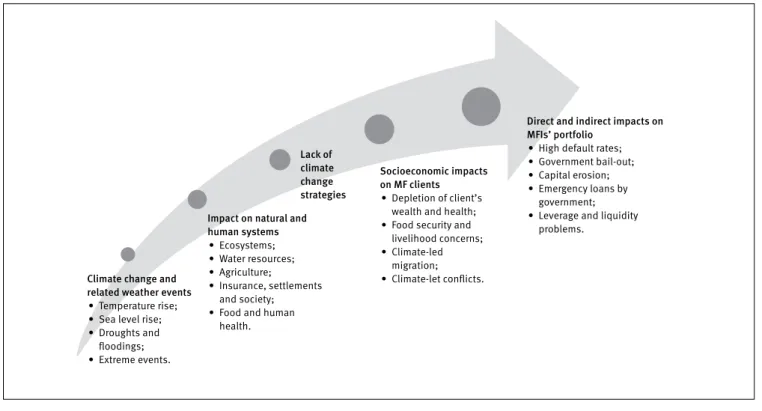
From a microinance viewpoint, sea lev-el rise, long-lasting droughts, looding, ex-treme weather events, as well as high rain-fall variability are likely to endanger the assets—such as homes, crop yields, micro-businesses, and livestock— and health of many microinance clients throughout the country. Figure 1 depicts, on a schemat-ic manner, how climate change and weath-er-related events may impact Brazilian MFIs and their target. As the Earth warms up, nat-ural and human systems will be hit hard by changes in the climate system, in particular by an increase in intensity and recurrence of weather extremes such as droughts and loods. Among these systems are water re-sources, crop production, forests, coastal zones, human health, societal settlements, specially the poor ones. Albeit these sys-tems have diferent levels of vulnerability to CC, thus varying from region to region and by socioeconomic and environmental set-ting, they are particularly sensitive to
cli-mate variations, and as such, may undergo important and irrevocable damages.
Because microinance clients usu-ally depend heavily on natural ecosys-tems and lack actions aimed at mitigat-ing their vulnerability to CC, a reduction in quality and quantity of water sources compounded with increased incidence of vector-borne diseases and declined crop yields, for instance, would afect direct-ly the health and eventualdirect-ly wealth of Bra-zilian MFI clients, both in rural and urban areas and in all regions. Moreover, great-er stresses on natural resources in climate extreme-prone areas, such as the North-ern and North-eastNorth-ern regions, may lead to forced migration and perhaps impact sev-eral MFI clients in these regions.
Ultimately, if no adaptation strategy is put in place, climate change may well af-fect, both directly and indirectly, the portfo-lio of many Brazilian MFIs, particularly the smallest Brazilian MFIs, and even the gov-ernment itself. As clients struggle to meet their inancial obligations ahead of repeat-edly and intense climatic shocks, default rates will eventually go up, bringing about liquidity problems to a number of MFIs, par-ticularly the private-led ones, undermining then their inancial sustainability. For some of Brazil’s major public microinanced pro-grammes, even though they might not see their default rates soar abruptly, because the government will eventually step in to provide emergency loans and bailouts, this practice may fall short if extreme events oc-cur more frequently and with more intensi-ty over time.
In Brazil’s microinance hub, the North-eastern region, warmer and drier cli-mate and associated runof decline in the
São Francisco basins will likely place greater stress on the livelihood of the 2.2 million cli-ents of the two major Brazilian microinance providers, namely Crediamigo and Agroami-go. The latter, particularly, operating in a cli-mate-change hot spot and in inancing rural activities, is exceptionally exposed to im-pacts arising from climate change (Moser & Gonzalez, 2015). In fact, during the 2011-2013 intense droughts, the BNB, Agroami-go’s host institution, had to reschedule ma-turing loans and grant an 80% debt write-of for clients living in semiarid zones, as well allocate about R$3.5 billion [about US$ 1.49 billion] in emergency loans to help clients cope with hazy climatic conditions and to prevent default rates from soaring abrupt-ly. As the region heats up and becomes in-creasingly drier, agricultural and dairy cattle productivity is likely to decline accordingly, which exacerbates food security and liveli-hood concerns for several Agroamigo’s cli-ents and their families, potentially
afect-ing the Programmes’ inancial sustainability pillar.
In the southern and south-eastern re-gions, increased incidence of heavy rains and natural disasters may directly afect the physical infrastructure—such as oices, re-cords and information systems—owned by MFIs, as well as clients’ signiicant as-sets—e.g. homes and equipment—in par-ticular those living in informal settlements constructed on unstable hillsides or near dump/ sewage canals. Examples of large-scale economic and life losses such as Rio de Janeiro’s 2011 landslides are but one in-stance of what could be like if, in the ab-sence of adaptive measures, climate ex-tremes become more frequent and intense in the future. From a microinance perspec-tive, among the victims of such drastic events there could be hundreds of Brazilian MFI borrowers.
Another two areas worth attention in terms of vulnerability to CC are the poten-tial impacts of tides of savings withdrawals and insurance mechanisms on an MFI’s i-nancial performance after climate shocks.
As clients deliberately turn to their micro-savings as a self-protection mechanism against weather shocks, e.g. smoothing livelihood consumption needs ahead of a weather extreme event, MFIs, which use a portion of collected deposits to increase their credit outreach, may undergo liquid-ity issues. Likewise, covariate risks, espe-cially when related to family farming activ-ities, may prove troublesome and costly for microinsurers to bear, ultimately caus-ing insurance rationcaus-ing for those who most need to be insured. However, evaluating the level of vulnerability of Brazilian MFIs to CC in these two realms needs caution. Although most recent data estimate that Brazilian MFIs have collected USD 450 mil-lion in savings, equivalent to 15% of to-tal loan portfolio, i.e. USD 2.9 billion (Mix Market, 2015), various MFIs in the country are bound by statutory legislation that re-strict savings collection by certain types of MFIs. As for microinsurance, with the ex-ception of governmental crop insurance schemes, the sector still represents an in-cipient terrain for most Brazilian MFIs.
Figure 1. Potential climate change impacts on Brazilian mfis and their target
Direct and indirect impacts on MFIs’ portfolio
• High default rates; • Government bail-out; • Capital erosion; • Emergency loans by
government; • Leverage and liquidity
problems. Socioeconomic impacts
on MF clients • Depletion of client’s
wealth and health; • Food security and livelihood concerns; • Climate-led
migration; • Climate-let conlicts. Lack of
climate change strategies
Impact on natural and human systems • Ecosystems; • Water resources; • Agriculture;
• Insurance, settlements and society;
• Food and human health. Climate change and
related weather events • Temperature rise; • Sea level rise; • Droughts and
Synergies between Brazilian
MFIS actions and climate change
As discussed elsewhere, Brazilian MFIs al-ready ofer important synergies with climate related actions. Under the Programa Nacion-al de FortNacion-alecimento da Agricultura Familiar (Pronaf [National Programme for Strength-ening Family Farming]), most of Brazilian ru-ral microcredit institutions already provide loans directed to environmental protection projects. These are subsidised rural cred-it lines designed to meet environmental i-nancing and mitigation/adaptation activ-ities, such as renewable energy, forestry, water storage, etc., at below market interest rates to smallholder farmers. Pronaf Eco, for example, inances techniques that min-imise impact of rural activities on local en-vironment, Pronaf Agroindústria provides loans for investments in micro agro-indus-tries, Pronaf Floresta inances tree planting and silviculture systems, and Pronaf Agro-ecologia inances agro-ecological produc-tion and/or organic systems.
Coupled with Pronaf’s lending is the Programa de Garantia da Atividade Agro-pecuária (Proagro Mais [Programme for Guaranteeing Agricultural Activity]), a gov-ernmental crop insurance scheme. Proag-ro Mais is aimed at pProag-roviding smallholder farmers with a low-cost insurance mecha-nism so that they can cope with basic live-lihood needs after eventual harvest loss-es. Livestock investment loans, however, are not covered by these public insurance schemes, being limited to cover agricultur-al working capitagricultur-al/investment loan losses. In 2013, more than R$ 190 million (approxi-mately USD 60 million) were paid to small-holder farmers as indemnity claims (Banco Central do Brasil – BACEN, 2015).
Brazil already has several mechanisms that can help rural MFIs inance more adapt-ed crops without increasing administration costs. Under Pronaf, for instance, Brazilian rural MFIs have free access to agricultural zoning on more adapted crops for speciic
geographic areas. Also, the Empresa Bra-sileira de Pesquisa Agropecuária (EMBRA-PA [Brazilian Agricultural Research Corpo-ration]) has an extensive body of study on adapted and more resilient/tolerant crops that can be accessed free of charge by Bra-zilian microinance providers intended to boost targeted conditional loans.
The “Big Five” Brazilian MFIs, i.e. Cre-diAmigo, AgroAmigo, Central Cresol Baser, Cresol Central and Santander Microcrédi-to, already ofer environmental education and training for clients, and credit unions and cooperatives, such as Cresol Baser and Cresol Central, already include in their pool of products Pronaf’s eco-friendly credit lines. Also, the Big Five MFIs in the country already include in their product range low cost voluntary savings.
In the northeast, Agroamigo, during ini-tial sessions with prospective clients, per-form environmental training on how to best employ and practice sustainable agriculture and farming production, such as the use of organic fertilisers and on measures to lim-it soil degradation. Such inlim-itiatives can pro-mote greater environmental responsibility among clients and, as such, constitute an additional and cheap tool in terms of climate change actions that can be ofered by MFIs.
Some smaller MFIs, such as the case of Empresta Capital, in Sao Paulo, have been studying ways to implement and i-nance residential energy eiciency proj-ects to poor households. Donor institutions have also started to implement products at-tached to environmental concerns, such as the case of Oikocredit, an international co-operative and social investor. More specii-cally, they have set up a funding programme speciically designed to inance non-GMOs farming production to smallholder farmers.
FINAL CONSIDERATIONS AND
FUTURE RESEARCH
In attempting to respond our initial query, one could also reckon what microinance,
or more broadly, inclusive inance can do to realise its linkages with CC actions. For in-stance, synergies between the various gov-ernmental microcredit lines – e.g. Pronaf B, the Programa Nacional de Microcrédi-to Produtivo Orientado (PNMPO [National Programme of Oriented Productive Micro-credit]), the CRESCER [which provides mi-croloans capped at an annual interest rate of 8% and operationalised via public inan-cial institutions] and the Microcredit Pro-gramme of the BNDES – and microinance actions could be realised and strengthened towards the promotion of a vibrant Brazil-ian green microinance industry. More spe-ciically, Pronaf’s eco credit lines could be extended to beneit poor agrarian reform settlers and rural smallholder farmers liv-ing on less than USD 6,000/year, allowliv-ing a “third wave” revolution in pro-poor rural inancing in Brazil to take hold. The termnology “waves” in pro-poor agricultural i-nancing in Brazil was brought up by the di-rector of the Banco do Nordeste (Bank of the Northeast of Brazil), as an allusion to the milestones achieved since the estab-lishment of Pronaf – irst wave – in 1996. The second wave refers to innovative mi-croinance methodologies that were incor-porated into Pronaf’s lending since the cre-ation of Agroamigo in 2005 that contributed signiicantly to reduce default rates and to forge products more commensurate with clients’ needs. During the irst Internation-al Seminar on Green Microinance in Brazil held in Sao Paulo, in 2015, it was discussed that a third wave in Pronaf may stem from the linkage between weather related ac-tions, aimed at mitigating CC related im-pacts and enhancing the adaptive capaci-ty of clients and MF providers, with Pronaf’s lending. The government too could play a vi-tal role in delivering environmenvi-tal capacity building for microinance providers.
in-strument in the promotion of adaptation and mitigation strategies. By establishing a productive, trustful relationship with cli-ents, and by performing regular monitoring and supervision during the entire loan term, prerogatives of such approach, Brazilian MFIs, via their credit agents, are placed in a strategic position to share knowledge and best [local] practices, and leverage infor-mation to inluence customer’s behaviours towards the establishment of speciic ad-aptation and, to a lesser scope, mitigation initiatives, on a case-by-case basis. Brazil-ian smallest MFIs also have a major role in promoting environmental sustainability and CC actions particularly because of their abil-ity to reach out the poorest of the poor.
Nonetheless, there remain tradeofs to be considered in microinance actions in terms of climate change. While microinance seems to thrive in the provision of inan-cial and non-inaninan-cial services to the active poor, it struggles to reach the poorest of the poor, which are, after all, the most vulnera-ble to climate change. This is in fact a major challenge for the sector in Brazil as smaller MFIs, combined, have an outstanding loan portfolio that accounts for less than 6% of the market share, and takes up approximate-ly 10% of total active borrowers (Mix Market, 2014). Scaling up their outreach would be of utmost importance in the delivery of CC ac-tions to Brazil’s poorest MF clients. Also, dif-ferently from other contexts, microinance in Brazil has evolved mainly due to public stim-ulus and public banks, and therefore, inno-vation has usually emerged from the public sector, e.g. the rural microinance method-ology developed by Agroamigo. However, a more proactive role from the private sector should also be enhanced since reliance on governmental incentives to boost the sector may represent discontinuity in the delivery of MF programmes, particularly sensitive for the establishment of green programmes that run over the medium to long-terms. Recent examples of private banks downscaling their services to the poor, such as the
Santand-er Microcrédito, showed the enormous po-tential for this segment to enter massively the sector in Brazil, and so to promote green products and services to the poor.
Brazilian MFIs will need to weigh up the balance between short-term microi-nance and developmental/livelihood needs and the long-term costlier actions need-ed for adaptation and mitigation (see, for instance, Hammil, Matthew, & McCarter, 2008; Rippey, 2012; Forcella, 2013). Addi-tionally, client over-indebtedness due to re-current emergency loans may increase the climate burden on customers, and as such, place added pressure on their adaptive abil-ity (Hammil, Matthew, & Mccarter, 2008). Besides, climate change actions at the cos-tumer and MFI/institutional level may also entail risks for MFIs’ portfolio as they seek to adapt products and forge new competen-cies in terms of adaptation and/or mitiga-tion (Rippey, 2012). Lastly, a climate-proof MFI would require additional skills and ca-pacities that many MFIs, especially the smallest ones, simply lack.
Therefore, in responding to climate change, Brazilian MFIs will need to balance between costs and beneits entailed in foster-ing CC strategies, always bearfoster-ing in mind that their actions in this new realm are certainly no panacea but may be taken into account as part of institutions’ strategic planning.
Future research
This article introduced a new frontier for scholars and practitioners of microinance and pro-poor inancial services to explore. As an incipient arena, green microinance ofers new opportunities both for scholars and practitioners to deepen understanding of how the sector can have a positive efect on mitigating the plight of millions of mi-croinance clients sufering from weather shocks. Scholars, in particular, have much to investigate about the impact of microin-surance on alleviating climate-related loss-es and how it can be scaled-up to help
se-cure the poor’s assets ahead of covariate risks. The same holds true for impact stud-ies on the contribution of microsavings as potential ex-post coping mechanisms to weather related shocks. More speciical-ly, shedding light on mechanisms in which MFIs can scale up savings schemes to cli-ents, in particular to the most vulnerable, so that they can, ex-ante, save up money to be potentially used as a bufer in bad times, ex-post. Also, in the Brazilian agricultural mi-croinance, scholars may consider advanc-ing research on how the rural microinance sector can downscale their actions to em-brace the environmental pillar, paving the way for the third wave in rural microinance to unleash its potential.
In addition to these nodes, there is also the need to better develop and structure a broadly accepted theoretical framework for green microinance. To date, only a handful of academicians have dealt with the combi-nation of climate change and microinance, with most studies being of a qualitative na-ture. Accordingly, as the sector evolves, we hope quantitative and impact studies in this ield will become more attractive to scholars, helping ultimately consolidate a theoretical understanding of potential linkages between the two. Therefore, in unfolding this new, in-cipient, and somewhat alien ield, microi-nance scholars will bring further light on the opportunities and challenges for MFIs in pro-moting adaptation and mitigation to climate change and weather-related events.
REFERENCES
Agrawala, S., & Maëlis, C. (Org.). (2010). As-sessing the role of microinance in fostering adaptation to climate change [Working Pa-per No 15], OECD Environmental, Paris.
Ahmed, S. A., Difenbaugh, N. S., & Hertel, T. W. (2009). Climate volatility deepens pov-erty vulnerability in developing countries.
Environmental Research Letters, (4), 1-8.
Banco Central do Brasil. (2015). Programa de Garantia da Atividade Agropecuária PROA-GRO Relatório Circunstanciado 2011 a 2014. Brasilia: Bacen.
Barnett, B. J., & Mahul, O. (2007). Weather in-dex insurance for agriculture and rural areas in lower-income countries. American Jour-nal of Agricultural Economics, 89(5), 1241– 1247. doi:10.1111/j.1467-8276.2007.01091.x
Bhattamishra, R., & Barrett, C. B. (2008). Com-munity-based risk management arrange-ments: An overview and implications for so-cial fund program design. Social Protection and Labor. Washington: The World Bank. Centro Universitário de Estudos e Pesquisas
sobre Desastres-Universidade Federal de Santa Catarina (2013). Atlas brasileiro de desastres naturais 1991-2012. Volume Bra-sil. Florianópolis: CEPED-UFSC.
Chou, C., Marengo, J. A., Nobre, S. C., To-masella, J., Sampaio, G., Alves, L., & Kay, G. (2011). Riscos das mudanças climáticas no Brasil: Análise conjunta Brasil-Reino Unido sobre os impactos das mudanças climáticas e do desmatamento na Amazônia. São Pau-lo: CCST/INPE&Met Oice Hadley Centre. Dowla, A. (2009). Climate change and
micro-finance. Washington: Grameen Foundation. Food and Agriculture Organization of the Unit-ed Nations. (2015). The impact of natural hazards and disasters on agriculture and food and nutrition security a call for action to build resilient livelihoods. Rome: FAO. Forcella, D. (2013, 4-5 July). Microinance and
adaptation to climate change. UMM Work-shop Report: New challenges in microi-nance – Mobile banking, remittances and green microinance, Frankfurt School of Fi-nance & Management, Frankfurt, 10. Ge, M., Friedrich, J., & Damassa, T. (2014).
6 graphs explain the world’s top 10 emit-ters. World Resources Institute. Retrieved from http://www.wri.org/blog/2014/11/6- graphs-explain-world%E2%80%99s-top-10-emitters
Gonzalez, L., & Moser, R. (2015). Green mi-croinance in Brazil: The case of the Cresol System in Southern Brazil. RAP-Revista de Administração Pública, 49(4), 1039-1058. doi:10.1590/0034-7612134039
Hammill, A., Matthew, R., & McCarter, E. (2008). Microinance and climate change adaptation. IDS Bulletin, 39(4), 113–122. doi:10.1111/j.1759-5436.2008.tb00484.x
Instituto Brasileiro de Geograia e Estatística. (2010). Censo 2010. IBGE. Retrieved from
http://censo2010.ibge.gov.br/
Inter-American Development Bank (2013). EcoMicro: Private sector with purpose. Washington: Multilateral Investment Fund.
International Fund for Agricultural Develop-ment. (n.d.). Financing facility for remittanc-es: Remittances and microfinance networks. Rome: IFAD.
Intergovernmental Panel on Climate Change (2001). Climate change 2001: Working group ii: Impacts, adaptation and vulnera-bility. Geneva: IPCC.
Kreft, S., Eckstein, D., Junghans, L. Kerestan, C., & Hagen, U. (2014). Global climate risk index 2015. Who sufers most from ex-treme weather events? Weather-related loss events in 2013 and 1994 to 2013. Bonn: Ger-manwatch.
Loiselle, B. A., Graham, C. H., Goerck, J. M., & Ribeiro, M. C. (2010). Assessing the im-pact of deforestation and climate change on the range size and environmental niche of bird species in Atlantic forests, Brazil.
Journal of Biogeography, 37(7), 1288–1301. doi:10.1111/j.1365-2699.2010.02285.x Marengo, J. A., & Valverde, M. C. (2007).
Carac-terização do clima no século XX e cenário de mudanças de clima para o Brasil no século XXI usando os modelos do IPCC-AR4. Revis-ta Multiciência, (8), 5–28.
Marengo, J. A., Jones, R., Alves, L. M., & Valverde, M. C (2009). Future change of temperature and precipitation extremes in South America as derived from the PRECIS regional climate modelling system. Interna-tional Journal of Climatology, 29(15), 2241– 2255. doi:10.1002/joc.1863
Marengo, J. A., Ambrizzi, T., Rocha, R. P., Alves, L. M., Cuadra, S. V., Valverde, M. C., … Fer-raz, S. E. T. (2010). Future change of climate in South America in the late twenty-irst century: Intercomparison of scenarios from three regional climate models. Climate Dy-namics, 35(6), 1073–1097. doi:10.1007/ s00382-009-0721-6
McKee, K. (2008). Microinance: Climate change connections. Development Out-reach, 10(1), 35–37. doi:10.1596/1020-797X-10-1_35
Mix Market (2014). Brazil market proile. Mix Market. Retrieved from http://www.mixmar-ket.org/mi/country/Brazil
Moser, R., & Gonzalez, L. (2015). Microinance and climate change impacts: The case of Agroamigo in Brazil. RAE-Revista de Ad-ministração de Empresas, 55(4), 397-407 doi:10.1590/S0034-759020150404
Moser, R., Forcella, D., & Gonzalez, L. (2015). Microinance and climate change: Threats and opportunities, the case of Brazil’s larg-est rural MFIs [SSRN Working Paper]. Agroa-migo and Cresol.
Muehe, D. (Ed.) (2006). Erosão e progradação do litoral brasileiro. Brasília: Ministério do Meio Ambiente.
Painel Brasileiro de Mudanças Climáticas. (2013). Sumário executivo do volume 1 – base científica das mudanças climáticas. Contribuição do grupo de trabalho 1 para o 1° relatório de avaliação nacional do painel brasileiro de mudanças climáticas (Volume Especial para a Rio+20). Rio de Janeiro: PBMC.
Phillips, T. (2011). Brazil landslides leave hun-dreds of people dead. The Guardian. Re-trieved from http://www.theguardian.com/ world/2011/jan/12/brazil-landslide-leaves-115-dead
Rippey, P. (2012). Microinance and climate change: Threats and opportunities. In
Greening the Financial Sector (pp. 215– 239). Berlin: Springer Berlin Heidelberg.
Schmidt, R. H. (2010). Microinance, com-mercialization and ethics. Poverty & Public Policy, 2(1), 99–137. doi:10.2202/1944-2858.1020
Serviço Brasileiro de Apoio às Micro e Pequenas Empresas. (2010). Inclusão inanceira. Brasília, SEBRAE. Retrieved from http://www. agenciasebrae.com.br/noticia/10965415/ economia/para-organizacoes-internacio- nais-microfinancas-tem-grande-poten-cial-de-crescimento-no-brasil/
Serviço Brasileiro de Apoio às Micro e Pequenas Empresas. (2013). Nota conjun-tural: Formalização dos pequenos negócios no estado do Rio de Janeiro. Rio de Janeiro: Observatório das Micro e Pequenas Empre-sas no Estado do Rio de Janeiro.
Skees, J., & Barnett, B. (2006). Enhanc-ing microinance usEnhanc-ing index based risk-transfer products. Agricultur-al Finance Review, 66(2), 235–250. doi:10.1108/00214660680001189
Stern, N. (2007). The economics of climate change: The Stern review. Cambridge: Cam-bridge University Press.
United Nations Framework Convention on Cli-mate Change. (2009). Fact sheet: The need for mitigation. Bonn: UNFCCC.
Wang, H. H., Karuaihe, R. N., Young, D. L., & Zhang, Y. (2013). Farmers’ demand for weather-based crop insurance contracts: The case of maize in South Africa. Agrekon: Agricultural Economics Research, Policy and Practice in Southern Africa, 52(1), 87–110. doi:10.1080/03031853.2013.778468
World Bank (2010). Understanding the links between climate change and development in World Development Report 2010. Wash-ington, DC: The World Bank.