
E
NERGY AND
E
NVIRONMENT
Volume 5, Issue 4, 2014 pp.403-418
Journal homepage: www.IJEE.IEEFoundation.org
A green supply chain network design model for enhancing
competitiveness and sustainability of companies in high
north arctic regions
Hao Yu
1, Wei Deng Solvang
1, Chen Chen
21
Department of Industrial Engineering, Narvik University College, Postboks 385 Lodve gate 2, NO-8505 Narvik, Norway.
2
Northern Research Institute Narvik AS.Postboks 250, NO-8504 Narvik, Norway.
Abstract
To survive in today’s competitive and ever-changing marketplace, companies need not only to engage in their products and/or services, but also to focus on the management of the whole supply chain. Effectively managing and balancing the profitability and interconnection of each player in the supply chain will improve the overall supply chain surplus as well as individual profit. However, it is extremely difficult to simultaneously optimize several objectives in design and planning of a supply chain, i.e., cost-minimization, risk-minimization, responsiveness-maximization, etc., which are somehow conflict with one another. Furthermore, the natural and infrastructural challenges in high north arctic regions make it become much more difficult and complicated to design and develop cost-efficient, highly responsive, environmentally friendly, and sustainable supply chain network. In order to provide companies in high north arctic regions with decision support tool for the design and planning of theirs supply chain networks, a green supply chain network design (GrSCND) model is formulated in this study based on multi-objective mixed integer programming (MIP). The optimal trade-off among several conflicting objectives is the focus of this GrSCND model aiming to enhance both competitive competence and sustainability of companies and supply chains operated in high north regions. In addition, a numerical experiment is also given to present a deep insight of the GrSCND model.
Copyright © 2014 International Energy and Environment Foundation - All rights reserved.
Keywords: Green supply chain; Network model; Competitiveness; Sustainability; High north Arctic regions.
1. Introduction
should be applied, which sacrifices economies of scale and results in high production and transportation costs. The break-even point which optimizes the overall supply chain performance in terms of both cost and responsiveness has been extensively addressed in previous studies through bi-objective programming.
However, for the companies and supply chains operated in high north arctic regions, more challenges, i.e., inhospitable and extreme climate, absence or poor infrastructure [2], and complicated terrain and environment, make it very difficult to deliver high responsive products and/or services with low costs, and relatively high supply chain risks are imposed as well. Besides, environmental issues, i.e., vulnerable eco-environmental system and higher sensitivity to greenhouse gas emissions, must be taken into account in the decisional process of supply chain network design (SCND) considering that CO2 emissions have
increased rapidly over past decades. Furthermore, population density in high north arctic regions is extremely low (For instance, the population density in three counties located in northern Norway is 7/km2 in Nordland, 6/km2 in Tromsø, and 2/km2 in Finnmark [3]), hence, the transportation of small amount of raw materials and/or finished products over very long distance is quite common in this sparsely populated area, which dramatically increases the costs of transportation. Due to the aforementioned reasons, the supply chain network faces more challenges than those which are operated in densely populated areas [4].
In order to tackle those challenges and provide decision supporttool for the companies and supply chains operated in high north arctic regions, we aim in our study to develop the theoretical framework and computational model for green supply chain network design (GrSCND) in order to enhance both competitive competence and sustainability of companies of this area. The proposed theoretical framework and computational model aim to optimize the overall supply chain performance through balancing the trade-off among costs, risks, and greenhouse gas (GHG) emissions. In addition, the adopted methodology for model formulation is based on multi-objective mixed integer programming (MIP), and an numerical experiment is also given to present a deep insight and applicability of the GrSCND model developed in this research.
The rest of this article is organized as follows. Section 2 provides an extensive literature review of green supply chain management (GrSCM) and GrSCND models. Section 3 formulates the theoretical framework and computational model for GrSCND in high north arctic regions, and the method for model solution is also given in this section. Section 4 presents the numerical experiment, and section 5 concludes this article with a future outlook.
2. Literature review
The concept of green supply chain management (GrSCM) has been introduced and extensively studied for almost two decades. The first attempts to define GrSCM can be found in late 1990s (see ref. [5]), and
the most cited definition of GSCM [6] is given by Srivastava [7] which defines GrSCM as “Integrating
environmental thinking into supply-chain management, including product design, material sourcing and selection, manufacturing processes, delivery of the final product to the end customers as well as end-of-life management of the product after its useful life.” GrSCM is also referred as environmental logistics [8], green logistics [9], sustainable supply chains [10], and sustainable supply network management [11, 12], and a number of review articles contributed to both theoretical and practical development of GrSCM are recently published by Seuring and Muller [13], Carter and Rogers [14], Sarkis et al. [15], Ali and Searcy [6], and Ashby et al. [16]. To achieve GrSCM, two types of “greenness” are divided by researchers [7]: green product design [17] and green operations, and the green operations, i.e., network design problem [18-20], sustainable waste management [20-22], and material flow [22] of a supply chain, are the focus of this research.
Network design is the logical place at which strategic decisions should be made for GrSCM [23]. Designing the physical network structure of a supply chain is called supply chain network design
(SCND) [24]. Due to its significant influence on supply chain’s performance, resilience, profits, and
competitive competence [25], SCND is believed to be one of the most important strategic decisions in supply chain management, which affects the long-term profitability and sustainability of a supply chain.
To take into account environmental or “green” thinking in SCND, a large number of articles have contributed to develop both theoretical and computational models for green supply chain network design (GrSCND). Wang et al. [26] develop a bi-objective optimization model for GrSCND, which aims to balance the trade-off between overall costs and environmental influence in terms of CO2 emissions. The
experiment is also conducted in this study. Elhedhli and Merrick [23] propose a mathematical model for reducing carbon emissions in GrSCND. The carbon emissions are monetized and converted into environmental pollution costs, and the model aims to minimize the overall system costs including fixed and variable facility costs, production costs, as well as environmental pollution costs. Govindan et al. [27] introduce a two-stage bi-objective location-routing model with time-windows for GrSCND, and the optimal balance of costs and greenhouse gas emissions is the goal of this model. The optimal supply chain network configuration is determined through selecting appropriate number and locations of facilities as well as the route within each stage. A large number of GrSCND models and practices incorporating cost objective with emission objective of greenhouse gas (GHG) can also be found in Yu and Solvang [20], Quariguasi-Frota-Neto et al. [28], Harris et al. [29], Ulbeda et al. [30], and Adballah et al. [31].
To consider different influencing factors in GrSCND other than GHG emissions, Jamshidi et al. [32] develop a bi-objective mathematical model for GrSCND, which simultaneously minimizes the overall system costs and environmental impacts. The environmental impacts in this study are measured by the amount of hazardous gases, i.e., CO, NO2 and volatile organic particles, generated by facility operations
and transportation of goods within the supply chain. Latha Shankar et al. [33] pose a bi-objective optimization model for strategic planning and material flow decisions of a three-echelon supply chain network. The focus of this model is the optimal balance between system operating costs and the fill rate of customer demands. Sheu and Lin [34] incorporate multi-objective mixed integer programming (MIP) and hierarchical cluster analysis method to configure and optimize global logistics network. The proposed model aims to minimize the network investments, while maximize the total profits generated by the supply chain and satisfaction rate of customer demands, and the weighted sum utility method is employed in this research for model computation.
To take into account of the changes in input parameters with time horizon, Yu et al. [22] formulate a multi-period dynamic model for managing and operating the reverse network of waste management system in an environmentally friendly manner. The proposed model aims to simultaneously minimize the system operating costs and environmental risks imposed by waste recycling and disposal through optimally managing the material flow between different facilities at each time period. A three-stage dynamic model for open-loop reverse supply chain and logistics network planning is developed by Ene and Ozturk [35], which aims to maximize the overall network costs of product recovery and disposal. Zeballos et al. [36] propose a multi-product and multi-period mathematical model for optimal planning of closed-loop supply chains through the minimization of net costs (expected costs minus expected revenue through recycling and remanufacturing), and both forward flows and reverse flows are formulated in this model. It is noted that the input parameters in this model are assumed to be stochastic in nature and therefore exist great uncertainties, and a reduced scenario tree is applied to achieve a reasonable representation of the original problem so that the model can be resolved.
Dealing with uncertainties in input parameters is another focus in GrSCND. Pishvaee and Razmi [37] formulate a fuzzy mathematical programming for GrSCND. This model aims to balance the trade-off between costs and environmental impact, and the environmental impact is measured by eco-indicator 99 which is a life cycle assessment-based (LCA-based) method. Further, an interactive fuzzy solution approach is also established for model computation. Ramezani et al. [38] develop a stage, multi-period and multi-product optimization model for closed-loop SCND with fuzzy environment, and the goal of this model is to simultaneously minimize the costs, delivery time, and defects of raw materials acquired from suppliers. Amin and Zhang [39] propose a bi-objective model for closed-loop SCND with inexact input information on demands and return, and the balance between the minimization of costs and maximization of the use of environmentally friendly materials is the focus of this research.
and extreme climate (e.g. the road transportation may be closed for several days due to avalanche), etc., bring more complexities in GrSCND. A poorly planned supply chain network without considering supply chain risks in this area will result in extremely high costs, high risks, high GHG emissions and poor responsiveness, which will then lead to the failure of a company or a supply chain in pursuing long-term profitability and sustainability. Therefore, it is of significant importance to account supply chain risks in the decisional process of GrSCND in high north arctic regions, however, it is extremely difficult to find such an instance from previous researches. Therefore, in order to fill the literature gap, the theoretical framework and mathematical model for GrSCND of a three-stage supply chain operated in high north arctic regions are formulated in this paper so that the supply chain costs, GHG emissions and risks are simultaneously considered in GrSCND.
3. Model
3.1 Theoretical framework
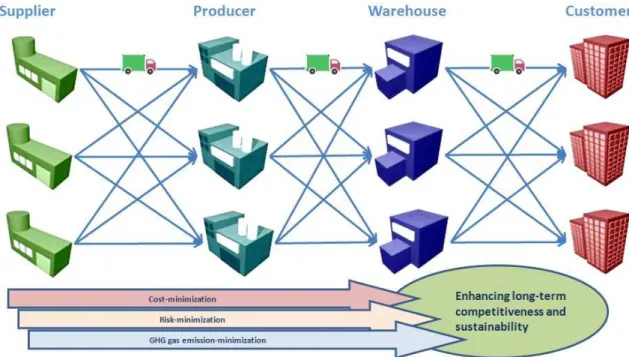
In this section, the theoretical framework of a general three-stage forward supply chain is first formulated in Figure 1. As shown in the figure, the proposed theoretical supply chain network is comprised of four levels of entities: supplier, producer, warehouse and customer, and those entities are communicated and connected through three flows: material flow, information flow and capital flow. The material flow in this supply chain network starts from upstream raw material suppliers and moves via intermediate production plants and warehouses towards end customers, and the information and capital flow in opposite direction from end customers towards suppliers.
Figure 1. Theoretical framework of GrSCND of a three-stage supply chain operated in high north arctic regions
Conventionally, the focus of GrSCND is to simultaneously minimize the costs and GHG emissions of a supply chain, however, it is also of great significance to decrease the risks and increase reliability of a supply chain operated in high north arctic regions due to the complex natural and infrastructural challenges discussed in previous section. Therefore, in order to tackle this challenge, the optimal trade-off among cost-minimization, risk-minimization and GHG emission-minimization will be focused in this research so that long-term competitive competence, profitability and sustainability can be achieved.
3.2 Mathematical model
Indices
s The set of suppliers (s=1, 2, 3,…, S)
p The set of candidate locations for production plants (p=1, 2, 3,…, P) w The set of candidate locations for warehouses (w=1, 2, 3,…, W)
c The set of customers (c=1, 2, 3,…, C)
Input parameters
PCs The unit purchasing costs for raw materials and components at supplier s
FCp, FCw The fixed costs for production plant p and warehouse w
Cp, Cw The unit operational costs (e.g. production costs, inventory costs, packaging
costs, etc.) of production plant p and warehouse w
TCsp, TCpw, TCwc The unit transportation costs between supplier s and production plant p,
production plant p and warehouse w, warehouse w and customer c
EMSsp, EMSpw, EMSwc The GHG emission factor between supplier s and production plant p,
production plant p and warehouse w, warehouse w and customer c
DISsp, DISpw, DISwc The transport distance between supplier s and production plant p, production
plant p and warehouse w, warehouse w and customer c
LDsp, LDpw,LDwc The average load of transport vehicles between supplier s and production
plant p, production plant p and warehouse w, warehouse w and customer c
RKs The risk index of suppler s
RKsp, RKpw, RKwc The risk index of the transportation between supplier s and production plant
p, production plant p and warehouse w, warehouse w and customer c
CDc The demands of customer c
IF An infinite positive number
MPRp The material-to-product rate at production plant p which specifies how many
materials are needed for producing one product
ITRw The inventory turnover rate at warehouse w which specifies the ratio of
outgoing products and incoming products
CAPs, CAPp, CAPw The capacity of supplier s, production plant p, and warehouse w
Decision variables
Ss If Ss=1, supplier s is selected, and if Ss=0, otherwise
Xp If Xp=1, candidate location p is selected for opening production plant, and if
Xp=0, otherwise
Xw If Xw=1, candidate location w is selected for opening warehouse, and if Xw=0,
otherwise
ATsp, ATpw, ATwc The amount of raw materials or finished products transported between
supplier s and production plant p, production plant p and warehouse w, warehouse w and customer c
Min OBJ1= � �( ��)
�=1
�=1
+ �( �+ � ��
�=1
)
�=1
+ ( + �
�=1
)
=1
+ �� ��
�=1
�=1
+ � �
=1
�=1
+ � �
�=1
=1 (1)
Min 2= �� �� ��
�� �=1
�=1
+ � � �
�
=1
�=1
+ � � �
� �=1
Min 3 = � �( ��)
�=1
�=1
+ �� ��
�=1
�=1
+ � �
=1
�=1
+ � �
�=1
=1 (3)
Eqs.(1), (2) and (3) are objective functions of this multi-objective MIP model for GrSCND in high north arctic regions. Eq. (1) is the cost-minimization objective function which takes into account the costs for supplier selection. The first part of this equation represents the purchasing costs of the raw materials from suppliers, and the second and third parts represent the fixed and operational costs of potential production plant and warehouse, and the last three parts represent the transportation costs in each stage. The purchasing costs and operational costs are directly proportional to the amount of raw materials and components purchased, and the transportation costs are directly proportional to the quantity transported in each stage. Eq. (2) is the GHG emission-minimization objective function. GHG emissions are very important environmental indicator especially for high north arctic regions where the GHG emissions have more negative influence on the ozone. In this model, the GHG emissions are directly proportional to the distance and amount transported, and it is inversely proportional to the load of transport vehicle. It is noted that the emission factor is applied for quantifying the equivalent GHG emissions, and it is determined by the type of transport vehicle, road condition as well as other influencing factors. Eq. (3) is the risk-minimization objective function in which the methodology developed by Yu and Goh [40] to quantify supply chain risks is employed and adapted accordingly. The first part of this equation represents the potential risks of supplier in fulfilling the demands of producer, and the other parts represent the potential transportation risks. The risk index of supplier is determined by inherent risks,
supplier’s capacity, supplier’s reliability and reputation, and the risk index of transportation is influenced by transporter’s reliability, probability of infrastructural risks, probability of natural disaster, etc.
Besides, in order to fulfill the requirement for material flow, facility capacity as well as other restrictions, thirteen sets of model constraints are also formulated as follows.
Subject to:
� = �
=1
, For�= 1,…, (4)
� �=1
= �
�=1
, For = 1,…, (5)
�� �=1
= �
=1
, For�= 1,…, (6)
�� ≤ �=1
�, For�= 1,…, (7)
�� ≤ �=1
�, For�= 1,…, (8)
� ≤
=1
� ≤ �� �=1
, For�= 1,…, (10)
� ≤ ��
�=1
, For�= 1,…, (11)
≤ �
�=1
, For = 1,…, (12)
�� ≤ � � , For�= 1,…, ,�= 1,…. (13) � ≤ � , For�= 1,…, , = 1,…. (14)
� ≤ , For = 1,…, ,�= 1,…. (15)
�, �, ∈ 0, 1 , For�= 1,…, ,�= 1,…, , = 1,…, (16)
Eq. (4) restricts the demands of each customer must be fulfilled. Eqs. (5) and (6) are the requirements of material flow balance, which specify the relationship between the amount of incoming raw materials and the quantity of outgoing finished products at production plant p and warehouse w. It is noted that the defect rate should be taken into consideration in determining the value of MPR at production plant p. Eqs. (7), (8) and (9) are capacity constraints, which restrict the maximum quantity served by supplier s, production plant p, and warehouse w cannot exceed their corresponding capacities. Eq. (10) restricts supplier s will not be selected if it doesn’t supply raw materials or components to any producers. Eqs. (11) and (12) ensure the candidate locations for production plant p and warehouse w will not be selected if they do not perform any functions. Eq. (13) guarantees the producer p can be served by supplier s only when both supplier sand candidate location p for opening production plant are selected. Eq. (14) restricts the finished products from producer p can be stored at warehouse w only when both candidate location p for opening production plant and candidate location w for opening warehouse are chosen. Eq. (15) ensures the demands of customer c can be served by warehouse w only when candidate location w is selected for building new warehouse. Eq. (16) is the binary constraint of decision variables. In addition, all the indices and input parameters of this multi-objective MIP model for GrSCND belong to non-negative domain.
3.3 Model solution
In order to composite multiple objective functions with different measures of units, the weighted sum utility method developed by Sheu and Lin [34] is employed in this research to composite the three objective functions of this GrSCND model, and similar practices of this method can also be found in Yu et al. [22], Nema and Gupta [41], and Sheu [42]. Before the weighted sum utility method is formulated, the notations of some adjustable parameters, benchmark parameters and response variables are first given as follows.
Adjustable parameters
WTOBJ1, WTOBJ2, WTOBJ3 The weight of cost-utility, GHG emission-utility, and risk-utility
Benchmark parameters
OBJ1min, OBJ2min, OBJ3min The individual minimum achievable value of cost-minimization objective,
GHG emission-minimization objective, and risk-minimization objective OBJ1max, OBJ2max, OBJ3max The individual maximum achievable value cost-minimization objective,
Response variables
OBJ1, OBJ2, OBJ3 The actual value of cost-minimization objective, GHG emission-minimization objective, and risk-emission-minimization objective
UTOBJ1, UTOBJ2, UTOBJ3 The individual cost-utility, GHG emission-utility, and risk-utility
UT The composite utility
Min = 1 1+ 2 2+ 3 3 (17)
Eq. (17) is the objective function of the weighted sum utility method and aims to minimize the weighted sum utility of each objective function. The weight of each individual utility presents the relative importance of each objective function determined by decision-makers. Eqs. (18), (19) and (20) illustrate the method for calculating the individual utility of each objective function. In Eq. (18), OBJ1max minus
OBJ1min denotes the theoretically maximum deviation between the maximum achieve costs and the
minimum achievable costs, which can be used as the benchmark for calculating the individual utility, and OBJ1 minus OBJ1min represents the deviation between actual value and minimum achievable value. The
numerator and denominator in this equation share the same unit, and the unit can then be eliminated, and this method also applies for Eqs. (19) and (20).Therefore, the individual utility of each objective function becomes unit less and can be directly summed by giving the corresponding weights. The summation of the weights of those three objectives in this model is regulated to 1, so the theoretically minimum achievable individual utility is 0 when the actual value OBJ equals to the minimum achievable value OBJmin, and the theoretical achievable maximum individual utility is 1 when the actual value OBJ equals
to the maximum achievable value OBJmax.
1 =
1− 1 �
1 � − 1 � (18)
2 =
2− 2 � 2 � − 2 �
(19)
3 =
1− 1 � 1 � − 1 �
(20)
4. Numerical experiment
In this section, a numerical experiment is given to present a deep insight of the proposed multi-objective MIP model for GrSCND in high north arctic regions. The numerical experiment is performed based upon a hypothetical case of a three-stage supply chain network, including supplier, producer, warehouse and customer, operated in high north arctic regions, and the producer sources from domestic and international suppliers, and it mainly serves local customers. In order to design and maintain an efficient and sustainable supply chain with relatively low risks, the supply chain manager has to make several crucial decisions, i.e., the number and locations of production plants and warehouses to be opened, selection of suppliers, the amount purchased from each selected supplier, the amount of finished products stored in which warehouse, and the customer demands are served from which warehouse. The proposed GrSCND model is applied for decision support in this case.
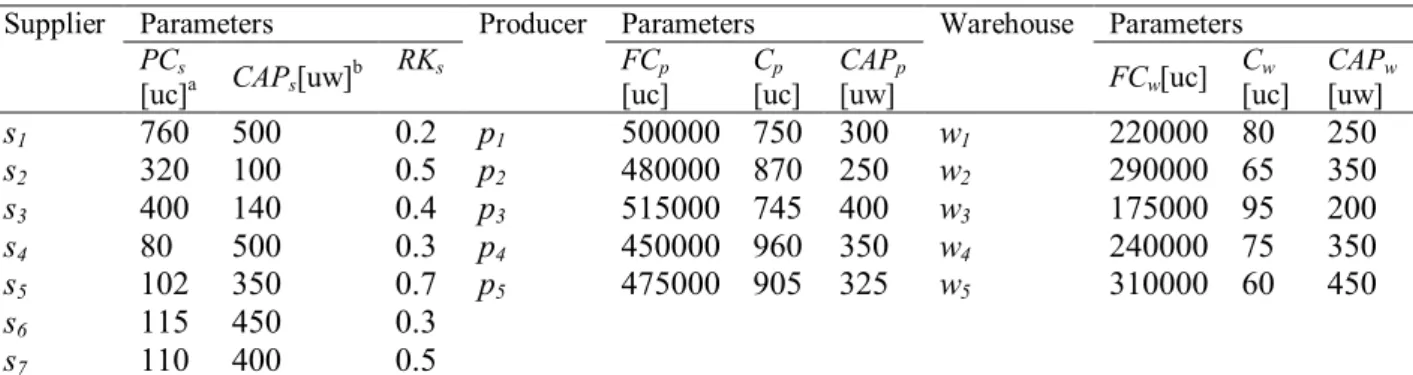
The hypothetical supply chain network is comprised of 7 raw material suppliers, 5 candidate locations for production plant, 5 candidate locations for warehouse, and 4 end customers. Table 1 gives the unit purchasing costs, capacity and risk index of each supplier s, and the fixed costs, unit operational costs and capacity of the candidate locations for production plant p and warehouse w are presented in this table as well. The material-to-production rates MPRp of candidate location p1, p2, p3, p4, p5 are 0.8, 0.7, 0.8,
0.6 and 0.7, respectively. The inventory turnover rate ITRw of each potential warehouse is assumed to be
equal, and it is 0.8. It is noted that the units of input parameters are given as unit cost (uc), unit weight (uw) and unit distance (ud) to represent the genericity, and they can easily and accordingly specified into a certain measure of units in a real world case study.
suppliers’ responsibility in this supply chain. Because the same type of vehicles are used for transporting raw materials from one supplier to all the producers, the GHG emission factor EMSsp and average load
LDsp are assumed to be equal in all the outbound transportation of supplier s, where EMSs1p=0.7 1/ud,
EMSs2p=0.81/ud, EMSs3p=0.8 1/ud, EMSs4p=0.7 1/ud, EMSs5p=0.9 1/ud, EMSs6p=0.75 1/ud, EMSs7p=0.6
1/ud, and LDs1p=4 uw, LDs2p=6 uw, LDs3p=8 uw, LDs4p=6 uw, LDs5p=12 uw, LDs6p=8 uw and LDs7p=12
uw, respectively. The transportation of finished products in stages 2 and 3 is outsourced to a 3rd party logistics (3PL) company, and the same type of transport vehicles are used to perform the transportations, so all the GHG emission factors and average load in 2nd and 3rd stage inter-facility transportation are assumed to be equal, where EMSpw=EMSwc=0.8 1/ud and LDpw=LDwc=4 uw, respectively. It is noted that
the GHG emission-minimization objective function OBJ2 and risk-minimization objective function OBJ3 are quantified through calculating the emission index and risk index, which are relative value. The optimal solution of objective function OBJ2 and OBJ3 are achieved through comparing different scenarios, and the absolute value of individual scenario is meaningless. Furthermore, objective function OBJ2 and OBJ3 are unitless, and the unit 1/ud of emission factors EMSsp, EMSpw and EMSwc, and 1/uw of
risk index RKsp, RKpw and RKwc are applied in order to eliminate the units of Eqs. 2 and 3, respectively.
Table 1. Input parameters of supplier s, candidate locations for production plant p, and candidate locations for warehouse w
Supplier Parameters Producer Parameters Warehouse Parameters
PCs
[uc]a CAPs[uw]
b RKs FCp
[uc]
Cp [uc]
CAPp
[uw] FCw[uc]
Cw [uc]
CAPw [uw]
s1 760 500 0.2 p1 500000 750 300 w1 220000 80 250
s2 320 100 0.5 p2 480000 870 250 w2 290000 65 350
s3 400 140 0.4 p3 515000 745 400 w3 175000 95 200
s4 80 500 0.3 p4 450000 960 350 w4 240000 75 350
s5 102 350 0.7 p5 475000 905 325 w5 310000 60 450
s6 115 450 0.3
s7 110 400 0.5
a
uc=unit currency, the same abbreviation is also applied in subsequent parts of this section. b
uw=unit weight, the same abbreviation is also applied in subsequent parts of this section.
Table 2. The unit transportation costs, distance and risk index of the 1st stage inter-facility transportation between supplier s and producer p
Supplier Parameter TCsp[uc] Parameter DISsp [ud]
c
Parameter RKsp [1/uw]
d
p1 p2 p3 p4 p5 p1 p2 p3 p4 p5 p1 p2 p3 p4 p5
s1 80 75 95 45 60 8 7.5 9 3 5.5 0.8 0.6 0.85 0.5 0.55
s2 102 90 75 40 65 9.2 7 6 3.5 5 0.95 0.8 0.7 0.5 0.55
s3 55 60 70 65 65 4.5 5 6.5 5.5 5.7 0.45 0.75 0.6 0.65 0.55
s4 80 90 95 40 75 8.2 8.7 9 3.2 9 0.65 0.85 0.9 0.5 0.65
s5 55 105 95 45 75 4.5 9.7 8.8 3.2 6.5 0.45 0.95 0.8 0.55 0.8
s6 58 90 75 102 70 5.9 8.8 7.2 9.8 6.4 0.6 0.7 0.8 0.95 0.65
s7 75 45 60 95 55 7.1 3.8 6.2 10.1 6.7 0.7 0.5 0.75 0.85 0.6
c
ud=unit distance, the same abbreviation is also applied in subsequent parts of this section. d
1/uw=1/unit weight, the same abbreviation is also applied in subsequent parts of this section.
Table 3. The unit transportation costs, distance and risk index of the 2nd stage inter-facility transportation between producer p and warehouse w
Producer Parameter TCpw[uc] Parameter DISpw [ud] Parameter RKpw [1/uw]
w1 w2 w3 w4 w5 w1 w2 w3 w4 w5 w1 w2 w3 w4 w5
p1 65 55 40 50 55 7 6 5.5 6.5 6 0.8 0.6 0.5 0.5 0.55
p2 45 75 55 50 45 5 5.5 4.5 5 4.5 0.4 0.9 0.6 0.6 0.5
p3 75 45 50 55 65 7.5 5 5.3 6 6.5 0.8 0.5 0.5 0.5 0.7
p4 70 55 45 65 75 7.2 6 4.8 6.2 7.3 0.8 0.7 0.5 0.6 0.7
Table 4. The unit transportation costs, distance and risk index of the 3rd stage inter-facility transportation between warehouse w and customer c
Warehouse Parameter TCwc[uc] Parameter DISwc [ud] Parameter RKwc [1/uw]
c1 c2 c3 c4 c1 c2 c3 c4 c1 c2 c3 c4
w1 80 82 75 65 9 9.5 8 7.5 0.9 0.8 0.7 0.6
w2 55 90 95 45 6 9.5 10 4.5 0.6 0.85 0.9 0.55
w3 75 60 55 65 7.5 5.5 5 6 0.7 0.6 0.6 0.6
w4 65 70 75 95 7 6.5 7.2 9 0.65 0.65 0.7 0.85
w5 45 55 85 80 5 6 9.5 9 0.5 0.55 0.9 0.85
In order to test the performance of the proposed multi-objective GrSCND model, the model is coded and resolved by using Lingo solver, and all the model computations are performed on a Inter(R) Core(TM)2 2.13 GHz computer with 2 GB RAM and 150 GB hard drive capacity under Windows 7 operating system. The tested weights of cost utility, GHG emission utility and risk utility are set to 0.4, 0.3 and 0.3, respectively. The time consumed and iterations performed to calculate individual maximum and minimum costs, individual maximum and minimum GHG emissions, individual maximum and minimum risks, and minimum overall utility are presented in Table 5, and the objective value of those scenarios are also given in this table. It is illustrated from the result, the calculation of individual cost-minimization objective and overall utility are much more complicated and time consuming than the calculation of GHG emission-minimization objective and risk-minimization objective due to the larger number of integer variables and nonlinear variables. Besides, it is also shown from the table that, in this GrSCND model, the calculation of maximum achievable value is much easier and less time consuming than the calculation of minimum achievable value.
Table 5. The objective value, time consumed and iterations performed of each scenario
Scenario Objective value Time (s) Iterations
Maximum individual costs 5246727 uc 4 1421
Minimum individual costs 2859436 uc 8 58513
Maximum individual GHG emissions 3010.529 1 549
Minimum individual GHG emissions 1462.585 1 332
Maximum individual risks 2320.375 1 437
Minimum individual risks 1335.4 1 1247
Minimum weighted sum utility 0.0914942 14 32474
Table 6 presents the selection of suppliers, selection of candidate locations for production plants and warehouses, as well as the value of corresponding weighted sum utility of four selected scenarios: individual minimum costs, individual minimum GHG emissions, individual minimum risks and minimum overall sum weighted utility. It is noted that the maximum value of each individual scenario is not taken into consideration in this comparison, because they are introduced in weighted sum utility method as bench mark parameters to represent the “worst solution” and determine maximum achievable
of raw materials are increased dramatically, and the value of cost utility will then be increased to 0.3831 which takes the largest share of the overall weighted utility. Furthermore, the GHG emission utility increases to 0.3594 due to the increased numbers of transportation of raw materials and finished products in this scenario. If the system performance of optimal overall weighted sum utility is converted to 100%, the system performance of individual minimum costs, individual minimum GHG emissions and individual minimum risks can accordingly be converted to 71.6%, 40.7% and 25.5%, respectively, which is illustrated in Figure 2.
Table 6. The value of weighted sum utility, and selection of suppliers and candidate locations of the four selected scenarios
Scenario Weighted sum utility
Supplier Producer Warehouse
s1 s2 s3 s4 s5 s6 s7 p1 p2 p3 p4 p5 w1 w2 w3 w4 w5
MinICe 0.127762 ■ ■ ■ ■ ■ ■ ■ ■
MinIGEf 0.223926 ■ ■ ■ ■ ■ ■ ■ ■ ■ ■ ■
MinIRg 0.359397 ■ ■ ■ ■ ■ ■ ■ ■ ■ ■ ■
MinWSUh 0.0914942 ■ ■ ■ ■ ■ ■ ■
e
MinIC=minimum individual costs, the same abbreviation is also applied in subsequent parts of this section. f
MinIGE=minimum individual GHG emissions, the same abbreviation is also applied in subsequent parts of this section.
g
MinIR=minimum individual risks, the same abbreviation is also applied in subsequent parts of this section. h
MinWSU=minimum weighted sum utility, the same abbreviation is also applied in subsequent parts of this section.
Figure 2. Comparison of the overall system performance of the four selected scenarios
The optimal number, locations and inter-facility transportation of raw materials and/or finished products are determined by using the proposed GrSCND model, and the result is achieved through balancing the trade-off among cost utility, GHG emission utility and risk utility. The result is quite convincing, and further sensitive analysis can also be performed, if necessary, to test how and to what extend the optimal supply chain network configuration can be affected by different objectives.
Table 7. The amount of raw materials and/or finished products transported between different facilities at each stage
` s6 s7 p1 p2 p3 w3 w5
ATsp [uw] p1 300
p2 250
p3 143.75 150
ATpw [uw] w3 200
w5 240 175 35
ATwc [uw] c1 120
c2 10 240
c3 40
c4 110
5. Conclusion
This work has presented a novel research on GrSCND model for companies and supply chains operated in high north arctic regions, where natural and infrastructural challenges bring more complexities in GrSCND than other regions, in order to enhance both competitive competence and sustainability. Compared with previous researches, the formulation and minimization of supply chain risks and reliability are taken into consideration in this study, which is an extremely important influencing factor accounted in the design and planning of supply chains operated in this region. The proposed computational model is formulated based upon multi-objective MIP method which aims to determine the number, locations and inter-facility transportation of raw materials and/or finished products through simultaneously minimizing the overall supply chain costs, GHG emissions and risks, and weighted sum utility method is employed to composite those objectives with different measures of units. A numerical experiment is performed as well to explicitly present the applications of the proposed multi-objective MIP model for GrSCND in high north regions, and Lingo solver is applied in coding and resolving the computational optimization problems.
The model is developed primarily for the design and planning of supply chains operated in high north regions, however, it is also perfectly applicable for the supply chains operated in other regions where the consideration of supply chain risks plays an important role. Besides, the selection of suppliers is also taken into account in this model, which is another crucial influencing factor for GrSCND. For example, in a global supply chain network, the reliability and safety of suppliers in some countries or regions may be significantly affected by some influencing factors, i.e., political stability, tax and tariff, infrastructure, etc., so it is of great importance to account the selection of suppliers in the decisional process of GrSCND so as to minimize the supply chain risks.
The mathematical model is formulated and developed under certain input parameters, however, the design and planning of supply chain network is always a strategic decision which has significant influence on long-term profitability, competitiveness and sustainability of a supply chain, and some input parameters may have great changes within its life span, furthermore, some parameters are stochastic in nature and impossible to be quantified accurately, and this will dramatically increase the level of difficulty in dealing with uncertainties. Therefore, the appropriate treatment of uncertain and stochastic input parameters are suggested for further improvement of the multi-objective MIP model for GrSCND in high north arctic regions.
Acknowledgements
References
[1] Brooks, M.R., Frost, J.D. Providing freight services to remote arctic communities: Are there lessons for practitioners from service to Greenland and Canada’s northeast? Research in Transportation Business & Management 2012, 4, 69-78.
[2] Chopra, S., Meindl, P. Supply chain management-Strategy, planning and operation (5th edition). Pearson, 2013.
[3] Solvang, W.D., Hakam, M.H. Sustainable logistics network in sparsely populated areas. Journal of Service Science & Management 2010, 3, 72-77.
[4] Statistical yearbook of Norway. SSB, 2013. Available from: https://www.ssb.no/en/befolkning/artikler-og-publikasjoner/statistical-yearbook-of-norway-2013 (Accessed on: 14. 03. 14).
[5] Handfield, R.B., Walton, S.V., Swwgers, L.K., Melnyk, S.A. “Green” value chain practices in the
future industry. Journal of Operations Management 1997, 15 (4), 293-315.
[6] Ali, P., Searcy, C. A comparative literature analysis of definitions for green and sustainable supply chain management. Journal of Cleaner Production 2013, 52, 329-341.
[7] Stivastava, S.K. Green supply-chain management: a state-of-the art literature review. International Journal of Management Reviews 2007, 9 (1), 53-80.
[8] Gonzalez-Benito, J., Gonzalez-Benito, O. The role of stakeholder pressure and managerial values in the implementation of environmental logistics practices. International Journal of Production Research 2006, 44 (7), 1353-1373.
[9] Murphy, P.R., Poist, R.F. Green logistics strategies: an analysis of usage patterns. Transportation Journal 2000, 40 (2), 5-16.
[10] Linton, J.D., Klassen, R., Jayaraman, V. Sustainable supply chains: an introduction. Journal of Operations Management 2007, 25 (6), 1075-7082.
[11] Young, A., Kielkiewicz-Yong, A. Sustainable supply chain network management. Corporate Environmental Strategy 2001, 8 (3), 260-268.
[12] Cruz, Z.M., Matsypura, D. Supply chain networks with corporate social responsibility through integrated environmental decision-making. International Journal of Production Research 2009, 47 (3), 621-648.
[13] Seuring, S., Muller, M. From a literature review to a conceptual framework for sustainable supply chain management. Journal of Cleaner Production 2008, 16 (15), 1699-1710.
[14] Carter, R.C., Rogers, D.S. A framework of sustainable supply chain management: moving toward new theory. International Journal of Physical Distribution & Logistics Management 2008, 38 (5), 360-387.
[15] Sarkis, J., Zhu, Q., Lai, K.-H. An organizational theoretic review of green supply chain management literature. International Journal of Production Economics 2011, 130, 1-15.
[16] Ashby, A., Leat, M., Hudson-Smith, M. Making connections: a review of supply chain management and sustainability literature. Supply Chain Management: An International Journal 2012, 17 (5), 497-516.
[17] Kuo, T.C., Huang, S., Zhang, H. Design for manufacture and design for “X”: concepts, applications and perspectives. Computers & Industrial Engineering 2001, 41, 241-260.
[18] Zhu, Q., Sarkis, J., Lai, K.H. Green supply chain management implications for closing the loop. Transportation Research Part E 2008, 44 (1), 1-18.
[19] Fleischmann, M., Beullens, P., Bloemhof-Ruwaard, J.M., Van Wassenhove, L.N. The impact of product recovery on logistics network design. Production & Operations Management 2001, 10, 156-173.
[20] Yu, H., Solvang, W.D. A reverse logistics network design model for sustainable treatment of multi-sourced waste of electrical and electronic equipment (WEEE). Proceeding of the 4th IEEE International Conference on Cognitive Infocommunications. Budapest, Hungary, 2013, pp: 595-600.
[21] Cheng, S., Chan, C.W., Huang, G.H. An integrated multi-criteria decision analysis and inexact mixed integer linear programming approach for solid waste management. Engineering Applications of Artificial Intelligence 2003, 16, 543-554.
[23] Elhedhli, S., Merrick, R. Green supply chain network design to reduce carbon emissions. Transportation Research Part D 2012, 17, 370-379.
[24] Farahani, R.Z., Rezapour, S., Drezner, T., Fallah, S. Competitive supply chain network design: An overview of classification, models, solution techniques and applications. Omega 2014, 45, 92-118. [25] Shen, Z.J. Integrated supply chain models: a survey and future research directions. Journal of
Industrial Management and Optimization 2007, 3 (1), 1-27.
[26] Wang, F., Lai, X.F., Shi, N. A multi-objective optimization for green supply chain network design. Decision Support System 2011, 51, 262-269.
[27] Govindan, K., Jafarian, A., Khodaverdi, R., Devika, K. Two-echelon multiple-vehicle location-routing problem with time windows for optimization of sustainable supply chain network of perishable food. International Journal of Production Economics 2014, http://dx.doi.org/10.1016/j.ijpe.2013.12.028.
[28] Quariguasi-Frota-Neto, J., Bloemhof-Ruwaard, J.M., Van Nunen, J.A.E.E., Van Heck, E. Designing and evaluating sustainable logistics networks. International Journal of Production Economics 2008, 111, 195-208.
[29] Harris, I., Naim, M., Palmer, A., Potter, A., Mumford, C. Assessing the impact of cost optimization based on the infrastructure modelling on CO2 emissions. International Journal of
Production Economics 2011, 131, 313-321.
[30] Ubeda, S., Arcelus, F.J., Faulin, J. Green logistics at eroski: a case study. International Journal of Production Economics 2011, 131, 44-51.
[31] Abdallah, T., Farhat, A., Diabat, A., Kennedy, S. Green supply chains with carbon trading and environmental sourcing: formulation and life cycle assessment. Applied Mathematical Modelling 2012, 36, 4271-4285.
[32] Jamshidi, R., FatemiGhomi, S.M.T., Karimi, B. Multi-objective green supply chain optimization with a new hybrid memetic algorithm using the Taguchi method. ScientiaIranica E 2012, 19 (6), 1876-1886.
[33] Latha Shankar, B., Basavarajappa, S., Kadadevaramath, R.S., Chen, J.C.H. A bi-objective optimization of supply chain design and distribution operations using non-dominated sorting algorithm: A case study. Expert Systems with Applications 2013, 40, 5730-5739.
[34] Sheu, J.-B., Lin, A.Y.-S. Hierarchical facility network planning model for global logistics network configuration. Applied Mathematical Modelling 2012, 36, 3053-3066.
[35] Ene, S., Ozturk, N. Open loop reverse supply chain network design. Procedia – Social and Behavioral Sciences 2014, 109, 1110-1115.
[36] Zeballos, L.J., Mendez, C.A., Barbosa-Povoa, A.P., Novais, A.Q. Multi-period design and planning of closed-loop supply chains with uncertain supply and demand. Computers and Chemical Engineering 2014, http://dx.doi.org/10.1016/j.compchemeng.2014.02.027.
[37] Pishvaee, M.S., Razmi, J. Environmental supply chain network design using multi-objective fuzzy mathematical programming. Applied Mathematical Modelling 2012, 36, 3433-3446.
[38] Ramezani, M., Kimiagari, A.M., Karimi, B., Hejazi, T.H. Closed-loop supply chain network design under a fuzzy environment. Knowledge-Based Systems 2014, 59, 108-120.
[39] Amin, S.H., Zhang, G.Q. A multi-objective facility location model for closed-loop supply chain network under uncertain demand and return. Applied Mathematical Modelling 2013, 37, 4165-4176.
[40] Yu, M.-C., Goh, M. A multi-objective approach to supply chain visibility and risk. European Journal of Operational Research 2014, 233, 125-130.
[41] Nema, A.K., Gupta, S.K. Optimization of regional hazardous waste management systems: an improved formulation. Waste Management 1999, 19, 441-451.
Hao Yu received his B.Eng degree in Environmental Engineering from Beijing Institute of Petrochemical Technology, P.R. China, in 2008, and his M.Sc degree in Industrial Engineering from Narvik University College, Norway, in 2012. He is currently working as a research assistant at Department of Industrial Engineering, Narvik University College. His research interests include computational optimization, operational research, mathematical modelling as well as their applications in supply chain management, transportation and logistics network design, and waste management. E-mail address: [email protected]
Wei Deng Solvang received her M.Sc. in the field of Production Engineering at Narvik University
College, Norway in 1997. In 2001, she received her Ph.D. from Norwegian University of Science and Technology, Norway, in the field of performance measurement in managing supply chains. Dr. Solvang is currently working as Associated Professor at Narvik University College, Norway. She has over extensive publications at peer-reviewed international conferences and journals. Her main interest fields are supply chain management and sustainable logistics. She is a member of the Nordic Logistics Research Network (NOFOMA), Production and Operations Management Society (POMS) and the Association of European Operational Research Society as well as the Supply Chain Council. Dr. Solvang is also the Department Head of Industrial Engineering at Narvik University College, Norway. E-mail address: [email protected]
Chen Chen received her Bachelor degree in Biology from Faculty of Life Science in Hubei University,
P.R. China, in 2008, and her M.Sc degree in Energy and Environmental Technology from Telemark University College, Norway, in 2011. She started a PhD work at Norut Narvik AS since then. The main task of her PhD work is to optimize a conceptual designed integrated chemical complex with natural gas and locally sourced minerals as the main raw materials.


![Table 7. The amount of raw materials and/or finished products transported between different facilities at each stage ` s6 s7 p1 p2 p3 w3 w5 AT sp [uw] p1 300 p2 250 p3 143.75 150 AT pw [uw] w3 200 w5 240 175 35 AT wc [uw] c1 1](https://thumb-eu.123doks.com/thumbv2/123dok_br/16466970.198741/12.892.148.751.267.466/table-materials-finished-products-transported-different-facilities-stage.webp)
