
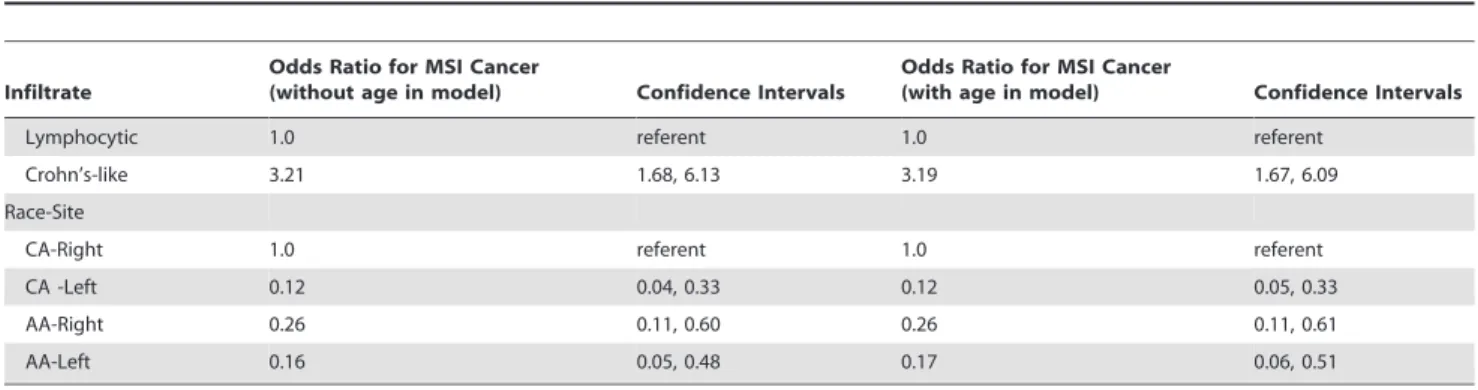
Influence of race on microsatellite instability and CD8+ T cell infiltration in colon cancer.
Texto
Imagem

Documentos relacionados
The International Workshop on Microsatellite Instability and Replication Error Repair (RER) Phenotypes in Cancer Detection and Familial Predisposition has recommended that MS
Polymorphic variation of mononucleotide microsatellites in healthy humans and its implication for microsatellite instability screening. leia-se: Grant Support: CNPq, CAPES,
gastric samples with microsatellite instability, our results indicate that genetic alterations of the APC gene commonly present in colorectal tumors are infrequent in sporadic
The structurally complex MYCL1 microsatellite marker is often used to determine microsatellite instability in colorectal cancers but the allelic variation of this marker has
Here, we investigated MSI and loss of heterozygosity (LOH) frequencies at the microsatellite loci BAT-26, D7S486, D8S135, ANK1, IFNA, TP53 and bcr of 19 Brazilian patients with
In order to evaluate the importance of this process in myeloid leukemias, we studied five loci in different chromosomes of 43 patients, 22 with chronic myelocytic leukemia (CML) in
Immunohistochemistry versus microsatellite instability testing for screening colorectal cancer patients at risk for hereditary nonpolyposis colorectal cancer syndrome. Part 1:
The existing cross–sectional studies on men- tal health outcomes and race identified in this review suggest that the prevalence of mental health disorders is higher
