GUILHERME CARVALHO ANDRADE
NATIVE LEGUMES FROM THE ATLANTIC RAINFOREST
AND THEIR POTENTIAL FOR BIOMONITORING URBAN AIR POLLUTION
Dissertation submitted to Federal University of Viçosa in partial fulfillment of the requirements of the Graduate Program in Botany for the degree of Magister Scientiae
VIÇOSA
Ficha catalográfica preparada pela Biblioteca Central da Universidade Federal de Viçosa - Câmpus Viçosa
T
Andrade, Guilherme Carvalho, 1987-A553n
2015
Native legumes from the Atlantic Rainforest and their potential for biomonitoring urban air pollution / Guilherme Carvalho Andrade. – Viçosa, MG, 2015.
ix, 60f. : il. (algumas color.) ; 29 cm.
Inclui anexos.
Orientador: Luzimar Campos da Silva.
Dissertação (mestrado) - Universidade Federal de Viçosa. Referências bibliográficas: f. 24-35.
1. Plantas - Anatomia. 2. Folhas - Anatomia. 3. Análise foliar. 4. Indicadores biológicos. 5. Ar - Poluição - Ipatinga (MG). 6. Poluição urbana - Ipatinga (MG). I. Universidade Federal de Viçosa. Departamento de Biologia Vegetal. Programa de Pós-graduação em Botânica. II. Título.
GUILHERME CARVALHO ANDRADE
NATIVE LEGUMES FROM THE ATLANTIC RAINFOREST
AND THEIR POTENTIAL FOR BIOMONITORING URBAN AIR POLLUTION
Dissertation submitted to Federal University of Viçosa in partial fulfillment of the requirements of the Graduate Program in Botany for the degree of Magister Scientiae
APPROVED: November 27, 2015
________________________________ Cléberson Ribeiro
________________________________ Sukarno Olavo Ferreira
______________________________________ Luzimar Campos da Silva
ii Dedication
To my nephew Vitor Gabriel, a pleasant arrival which I shall enjoy more from now on,
after the conclusion of this work.
iii
iv
ACKNOWLEDGEMENTS
I would like to thank:
Federal University of Viçosa, for the laboratorial support and high-level academic formation.
Graduate Program in Botany of UFV, for partially financing field expeditions and experimental materials through CAPES/PROAP and FAPEMIG grants.
Conselho Nacional de Desenvolvimento Científico e Tecnológico (National Coun-cil for Scientific and Technological Development, CNPq), for the Masters Scholarship.
Coordenação de Aperfeiçoamento de Pessoal do Ensino Superior (Coordination for the Improvement of Higher Education Personnel, CAPES), for covering expenses of attending a workshop for presenting the project (CAPES/PNADB project nº 1399/2010).
Financiadora de Estudos e Projetos (Financier of Studies and Projects, FINEP), for financing laboratory equipment through the Sistema de Laboratórios em Nanotecnologias (System of Laboratories on Nanotechnologies, SisNANO), thus enabling the performance of Scanning Electron Microscopy, Atomic Force Microscopy and Profilometry analyses.
The chief director of Sociedade de Investigações Florestais (Society for Forestry Investigations, SIF), Professor Ismael Eleotério Pires, for subsidizing the price of saplings.
Insituto Estadual de Florestas de Minas Gerais (Minas Gerais State Institute for Forests, IEF/MG) for granting the research permit.
Professor Luzimar Campos da Silva, for her advising along my Scientific Initiation and Masters, and for the trust deposited in me to carry out this work.
Dr. Mirian Cilene Spasiani Rinaldi, from the São Paulo Botanical Institute (IBt/SP), for her priceless contribution to this work, to the project conception and to my formation.
Dr. Silvia Ribeiro de Souza and Dr. Marisa Domingos, from the same institute, for their contributions to the elaboration of the project in its preliminary stage.
Daniel Rodrigues da Silva, for the partnership along the experiment performance.
v
Isabel Reis for their friendship, assistance, emotional support and affection; and Lorena Bastista, not only for her friendship, but also for the assistance with statistical analyses.
Ivan Becari Viana, for his precious friendship, invaluable advices, ever-present support and, notwithstanding, for assistance with field collections.
Brenda Vila Nova Santana, for her also precious friendship, all the laughter, emotional support, patience and availability in helping. Once again notwithstanding, I also thank her for her extensive assistance with field collections, performance of laboratorial analyses, idea exchange, and sharing critical thinking concerning the intellectual and technical parts of this study along its entire execution.
Marco Antônio Padilha for his extensive help, affection, care and patience. Mirlaine Soares Barros, Coordinator of Scientific Research at Rio Doce State Park (RDSP), for her extensive and precious help along the experiment execution; and the personnel from RDSP plant nursery, for assistance along the experiment, particularly concerning watering the plants and operating the high-volume air sampler.
Júlia Gabriela Macedo, head of the Department of Environmental Affairs of the Ipatinga City Hall, for her availability in providing logistical support to execute the project.
Professor Isabela Crespo Caldeira from Unileste University for providing operational support during field collections, by kindly providing laboratorial infrastructure.
Luciana Cerqueira Souza Solimani and Mônica Marques Lima, for their contributions to the experiment execution; and Márcio Alves Canedo for his precious assistance with field work, especially in watering the plants.
Diego Carlos Rodriguez Hernandez, Nilton Cesar Ribeiro, José Luiz Pereira and Ricardo Marques Montanari, for their assistance in the wax chemical analyses.
Professor Renê Chagas da Silva (DPF/UFV). I am enormously grateful for his trust and confidence, due to granting me full access to his Laboratory of Electron Microscopy.
Professor Sukarno Olavo Ferreira (DPF/UFV), for performing the AFM analyses and assisting me in performing the Profilometry ones in his Laboratory of Nanoscopy.
vi
Usinas Siderúrgicas de Minas Gerais S/A – Usiminas, for providing logistical, technical and laboratorial support along the experiment execution, granting access to the monitoring stations and providing data on the instrumental monitoring.
vii ABSTRACT
ANDRADE, Guilherme Carvalho, MSc., Universidade Federal de Viçosa, November 2015. Native legumes from the Atlantic Rainforest and their potential for biomonitoring urban air pollution. Advisor: Luzimar Campos da Silva.
viii RESUMO
ANDRADE, Guilherme Carvalho, MSc., Universidade Federal de Viçosa, novembro de 2015. Leguminosas nativas da Mata Atlântica e seu potencial como biomonitoras de poluição aérea urbana. Orientadora: Luzimar Campos da Silva.
ix
TABLE OF CONTENTS
1. Introduction... 1
2. Material and methods... 4
2.1. Plant species and cultivation conditions……… 4
2.2. Study site………. 4
2.3. Field exposure……….. 5
2.4. Atmosphere chemical characterization and meteorological data……….. 5
2.5. Metal quantification in plant matter………... 6
2.6. Assessment of leaf surface roughness………. 6
2.7. Extraction, quantification and identification of wax compounds………... 7
2.7.1. Sample preparation………... 8
2.7.2. Wax mass………... 8
2.7.3. Infrared spectroscopy……… 8
2.7.4. Transesterification and gaseous phase chromatography……….. 9
2.8. Micromorphological characterization in scanning electron microscopy…….. 9
2.9. Micromorphometrical analysis... 10
2.10. Experimental design and statistical analysis……….……….. 11
3. Results... 11
3.1. Meteorological data and atmosphere chemical characterization………… 11
3.2. Metal quantification in plant dry matter……….. 12
3.3. Leaf surface roughness……… 13
3.4. Waxes……… 13
3.4.1. Quantification……… 13
3.4.2. Infrared spectroscopy……… 14
3.4.3. Gaseous phase chromatography……… 15
3.4.4. Micromorphology (scanning electron microscopy)………... 15
3.5. Deposited particles………... 16
3.6. Leaf micromorphometry………... 16
4. Discussion... 17
5. Conclusions... 23
1 1. Introduction
Steel production is currently responsible for ca. 13% of the Brazilian trade balance (Neves and Camisasca 2013). Despite the economic relevance of the sector, according to the Brazilian National Policy for the Environment, metallurgical industrial activity has a highly polluting potential (Brasil 2001). Steel-making may generate environmental impacts due to the intense use of natural resources such as iron ore, coal and water (Neves and Camisasca 2013).
Whenever a thriving industrial development is not conducted with a sustainable background, extensive damage may be caused to the natural resources of a country. In Brazil, the most famous case of environmental disaster due to such reason is the one of Cubatão city, São Paulo state, which gained international repercussion in the 1980’s. The vegetation of the Serra do Mar mountain range was highly impacted by airborne pollutants emitted by the industrial complex of the city, which drastically altered the landscape of the Atlantic Rainforest cover in the place (Klumpp et al. 1994).
Among the several compounds emitted by industrial activity, particulate matter (PM) has received attention in the last years due to its high disease-causing potential (Leiva-Guzmán. et al. 2013) and to the high mortality rates associated with its inhalation (Roberts 2013). PM is categorized according to the size of its particles. Thereby, PM2.5 is the fraction of particles with aerodynamic diameter lower than 2.5 µm; PM10 is the one whose particles are smaller than 10 µm – which are also called
inhalable particles; and TSP represents “total suspended particles”, i.e., when one
considers particles of all sizes (Ravindra et al. 2001, Yin et al. 2013). PM usually originates from anthropogenic sources, like burning of fossil fuels, mainly from industrial and vehicular emissions (Taiwo et al. 2014), but it may also have in its composition pollen grains, spores and suspended soil particles, among others (Ravindra et al. 2001).
2
cultures of some crop species that were contaminated with these elements (Hu et al. 2014, Rötting et al. 2014, Zhao et al. 2014), which has ultimately resulted in the contamination of humans (Ma et al. 2014).
Structural characteristics are directly related with the sensitivity of plant species to certain pollutants (Silva et al. 2006). The degree of accumulation of PM by a certain plant species, for instance, may depend on features such as its degree of pilosity and the type and amount of epicuticular waxes in its leaves (Sæbø et al. 2012, Barima et al. 2014). Therefore, it is important to use tools that investigate features relating to leaf surface, as well as anatomical ones, in biomonitoring studies. By doing so, one can obtain more precise information on the species responses to the stressing agent and on the characteristics that give them differential susceptibility to urban airborne pollution.
In Minas Gerais state, Southeastern Brazil, the city of Ipatinga, with ca. 200.000 inhabitants, is inserted in the Steel Valley Metropolotian Region, which is characterized by the predominance of the steel industry, forming a base industry pole in the country. The city hosts in its central urban region the facilities of the largest rolled-steel factory in Latin America (Neves and Camisasca 2013). The presence of intense steel-making industrial activity notwithstanding, Ipatinga city has also the eighth largest vehicle fleet in the state and the 102th in the country (Denatran 2015). Since heavy metals are not emitted solely by industrial activity, yet also by vehicular one (Kassomenos et al. 2014; May et al. 2014), the presence of these elements in the urban atmosphere may be due to a mixture of compounds from these two sources. However, it is possible to determine the predominant emission source in a given site by evaluating the ration between different elements, which are called technogenic tracers (Calvo et al. 2013, Titos et al. 2014). The proportion between trace-metals such as Cu, Zn, Pb and Cr in a certain environment, for instance, configures a strong chemical marker of the origin of imissions, so that it allows for the discrimination of the origin of these elements between natural sources or anthropogenic ones (Weiping et al. 2014) as well as among several types of anthropogenic sources (Migliavacca et al. 2012, Khillare et al. 2014, Mohiuddin et al. 2014).
3
expensive, and due to cost limitations the monitoring stations may occasionally have to be implemented in only a few prioritized sites. The biomonitoring approach, on the other hand, has the advantage of being comparatively much less expensive, besides being independent from a power source (Wittig 1993).
In that sense, plant species have been successfully used as biosensors of different environmental conditions (Volkov and Ranatunga 2006). Aiming at detecting the presence of PM in the atmosphere in order to adopt mitigation measures, several countries in the North hemisphere already monitor such particles using plants, e.g. Belgium (Hofman et al. 2013), Spain (Rodríguez-Germade et al. 2014), Finland (Setälä et al. 2013) and Germany (Rodriguez et al. 2010). In Brazil, however, biomonitoring of these compounds in the atmosphere with plant organisms remains an incipient approach. This is in part due to the knowledge of only a few tropical species which have the potential for such finality (Silva et al. 2006, 2015, Kuki et al. 2008a, 2008b, 2009, Pereira et al. 2009, Neves et al. 2009, Zampieri et al. 2013, Domingos et al. 2015). Thus, the standardization of efficient methods with species from the native local flora, aiming at their further use in biomonitoring programs, configures a particularly relevant approach.
Andrade (2013) has worked with Caesalpinia echinata (Lam.) Spreng. and C. ferrea Mart. ex Tul. (Leguminosae – Caesalpinioideae) investigating their morphoanatomical responses to simulated acid mist. The two species have different anatomical conformations, particularly regarding the deposition pattern of their epicuticular waxes. His results suggest the susceptibility of both species, but a higher one to C. ferrea. Such differential susceptibility may be related to their wax characteristics, among other anatomical features. Thus, deepening the scope of analyses with these species may provide subsidies to indicate their use in the biomonitoring of air quality in the tropical region.
4
consisting on the investigation of leaf surface roughness conferred by two different hierarchical levels, i.e., by the epidermal tissue and by the epicuticular wax deposition pattern. To my knowledge, such an approach has not been so far used. The use of the thickness of leaf tissues as an anatomical biomarker of the exposure was also tested. By doing so, the following hypotheses were addressed: 1) differences in wax morphology and chemical composition between the species would provide them with differential deposition of PM on their respective leaves; 2) the studied species can be used as environmental biomonitors of PM emission.
2. Material and methods
2.1. Plant species and cultivation conditions
The studied species were Caesalpinia echinata (Lam.) Spreng. and Caesalpinia ferrea Mart. ex Tul. (Leguminosae – Caesalpinioideae), both of which have already demonstrated biosensorial potential to acid mist damage in a previous study (Andrade 2013). Saplings were obtained in the nursery of the Instituto Estadual de Florestas de Minas Gerais (IEF/MG) in Viçosa city, Minas Gerais state, Brazil, and transplanted to 0.8 L plastic pots, which were filled with a mixture of commercial substrate and vermiculite (3:1). Then, all plants stayed in greenhouse for acclimation before proceeding to the field experiment. Plants were considered acclimatized after emitting one new leaf.
2.2. Study site
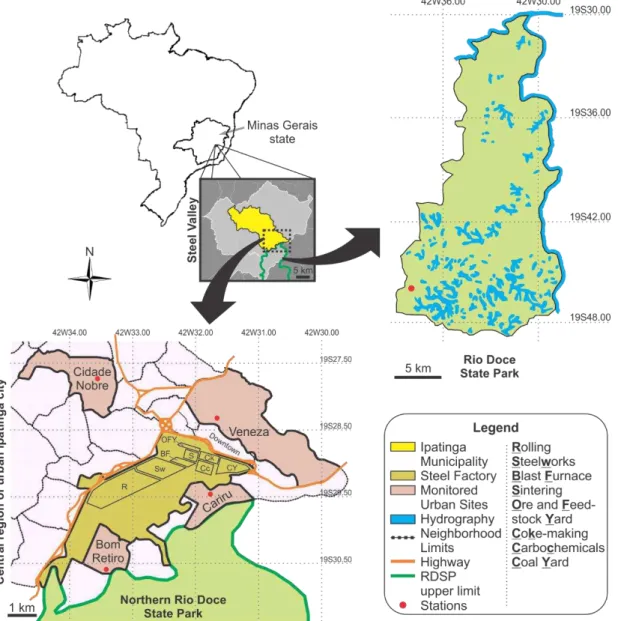
After the acclimation period, saplings were transported to Ipatinga city (217 km away from Viçosa) and to the Rio Doce State Park (RDSP) (ca. 115 km away from Viçosa and ca. 30 km away from Ipatinga), which is located on the border between three municipalities adjacent to Ipatinga: Dionísio, Marliéria and Timóteo. In Ipatinga, plants were exposed in four sites of the urban region: Bom Retiro (19°30'42.2"S, 42°33'25.5"W), Cariru (19°29'28.8"S, 42°31'43.5"W), Veneza (19°28'20.1"S, 42°31'35.9"W) and Cidade Nobre (19°27'41.0"S, 42°33'37.2"W) neighborhoods (Fig. 1). These four sites were selected for being those whose atmosphere is already under constant monitoring, through analytical methods, by means of automatic monitoring stations.
5
continuous fragment of tropical forest in Minas Gerais state. Since 1944 it is an environmental conservation unit under legal protection. The park was chosen as a reference station for being a well-preserved natural fragment of Atlantic Rainforest that was closest to the studied city.
2.3. Field exposure
In each site, plants were placed in racks according to international standards for air quality control using bioindicators (Arndt and Schluter 1985), at 1.5 m above ground. Plants were put under an automatic irrigation system, in which the pots were connected through a polypropylene wick to a water reservoir, according to the model presented by Arndt et al. (1985). Along the experiment, plants were irrigated with deionized water in order to avoid interference of trace metals. Field exposure took place in the wet season, between 10.09.14 and 01.06.15, totalizing 90 days of exposure, the minimum period considered by some authors for carrying out an analytical monitoring in the context of environmental impact studies (Frondizi 2008). A collection was performed in the field at the end of this 90-day exposure period. Additionally, a collection was also performed with a plant lot that remained under greenhouse conditions in Viçosa city (20°45'28.5"S, 42°52'15.3"W), in 11.07.14.
2.4. Atmosphere chemical characterization and meteorological data
6
and meteorological parameters) are assessed on an hour-to-hour basis by the stations. The biomonitoring racks were placed in 2 to 3 m from each of the four monitoring stations.
2.5. Metal quantification in plant matter
Inorganic chemical elements that are usually associated with several emission sources were evaluated. The amounts of Cu, Fe, Zn, Mn, Ni, Pb, Cr, Ba, Al, Co and V were assessed since they are regarded as technogenic tracers for steel industry and several types of vehicular emission, among others (Calvo et al. 2013), and the amounts of Ca and Mg were assessed since they are important components of slag (Shen et al. 2009) and could therefore be also used as tracers. Three out of the five repetitions were sampled, being chosen through simple random sampling.
In order to determine the concentrations of Cu, Fe, Zn, Mn, Ni, Pb, Cr, Ca and Mg in the plant biomass, at the end of the exposure period all leaves except those at the youngest and at the two oldest nodes (in the latter case, aiming at preventing soil contamination) were collected, oven-dried at 75 ºC until constant weight and ground in a stainless steel willye-type knife mill (model Star FT 50, American Lab, Charqueada, Brazil). Then, 0.5 g of each sample was digested in 10 mL nitroperchloric solution (nitric acid + perchloric acid, 4:1) (Sarruge and Haag, 1974), heated until 200 ºC and the volume was then adjusted to 25 mL with deionized water. The elements were quantified by atomic absorption spectrometry (spectrometer model 240FS, Agilent Technologies, Santa Clara, USA).
For Ba, Al, Co and V quantification, the dry matter was filtered and then proceeded analysis by inductively coupled plasma optical emission spectrometry (spectrometer model Optima 8300, PerkinElmer, Waltham, USA).
2.6. Assessment of leaf surface roughness
7
µm2 fields. Leaf micro-relief was evaluated with an atomic force microscope (model NTEGRA Prima, NT-MDT, Moscow, Russia), in 25 µm2 fields, using the semi-contact mode, in which the needle tip stays in intermittent contact with the surface. The measurements taken from the leaf surface allowed for the determination of the mean roughness value (Sa), which represents the average deviation between the height measurements obtained, and the root mean square roughness (Sq), which represents the square root of the average squared deviation between the height measurements obtained. For both analyses, leaf samples were collected from three randomly chosen individuals of the two species in the sapling stage. These individuals had not been exposed to any environmental condition outside the plant nursery. As several leaf surface characteristics such as wettability (which is given by wax chemical (Barnes et al. 1996) and morphological (Neinhuis and Barthlott 1997) features) vary according to leaf age (Fernández et al. 2014), one leaf from each individual was sampled and sampling procedures were standardized accordingly. The third-node leaf was sampled since it was the one collected in the experiment for the scanning electron microscopy, particulate matter accumulation and wax chemical composition analyses.
For the profilometry analysis, fresh leaf samples were collected and placed in plastic pots with wet cotton in other to create a wet chamber and thus preserve cell turgidity. Leaf fragments 16 mm2 were cut with a razor blade from the mid portion of pinnules, which were taken from the mid-portion of the pinnae, which in turn were from the mid portion of the leaf. Samples were then carefully placed on histological glass slides over double-sided tape and immediately analyzed within the period of three hours (for each species).
For the atomic force microscopy (AFM) analysis, fresh leaf samples were collected and sectioned following the same procedure above, but prior to analysis the glass slides containing leaf fragments were placed in a sealed container with silica gel for 48 hours in order to dehydrate samples.
Three pinnules were sampled per leaf for the macro-relief analysis, and two pinnules for the micro-relief one, one leaf fragment being extracted out of each pinnule. The analyses were performed on both leaf surfaces. In each fragment, measurements were taken in three fields, totalizing nine measurements per species, per individual, per leaf surface, in profilometry, and six measurements in each of these same levels, in the atomic force microscopy.
8 2.7.1. Sample preparation
For wax analysis, the Hamilton (1995) method was employed, with modifications. It should be noted that, for this analysis, the whole morphological unit interpreted as leaf, i.e. leaf blade + rachis + pulvinus, was used. The sampling method for this analysis was the compound sample, due to the low amount of waxes present in single leaves of these two species. Thus, one third-node leaf from each individual was collected and gathered in one compound sample per species, per monitored site.
Samples were oven-dried at 75 ºC until constant weight and introduced in Petri dishes with 75 mL dichloromethane for 45 seconds under agitation in ultrasonic bath. This procedure was carried out with extreme care in order to prevent leaf rupture and the consequent release of cellular contents (Ferreira et al. 2005; Guimarães et al. 2009). The obtained extracts were filtered with filter-paper and transferred to 150-mL Erlenmeyers. In order to ensure maximum extraction, the already-processed leaf samples were once again placed in Petri dishes with 75 mL dichloromethane, agitated for 45 s more in ultrasonic bath and filtered again to the same respective Erlenmeyer, resulting a total solution of 150 mL. The solution was transferred to round-bottom flasks and evaporated under water-bath in order to obtain the solid residue (waxes). The evaporation was made in a rotary evaporator (model Rotavapor R-3, Büchi Labortechnik AG, Flawil, Switzerland), at low pressure and at a temperature not higher than 40 ºC. This solid residue was solubilized with small aliquots of dichloromethane (less than 4 mL) and transferred to 4-mL tubes of previously known weight. Dichloromethane was then evaporated in a fume hood with compressed air at room temperature.
2.7.2. Wax mass
The flasks containing solid wax (no solvent) were weighed in an analytical balance, the same used for obtained their sample-free weigh, to obtain wax mass. The amount of waxes was expressed by their mass per unit of leaf dry weight (µg.g-1).
2.7.3. Infrared spectroscopy
9
2.7.4. Transesterification and gaseous phase chromatography
Samples were subjected to the transesterification process in order to obtain their respective methyl esters of fatty acids. For that, 2 to 5 mg of waxes were transferred to test-tubes and dissolved in 1 mL of a solution of 2% H2SO4 in methanol, boiled in water-bath at 55 ºC for two hours, and then cooled at room temperature. Then, 10 mL hexane was added to the tube and the mixture was agitated in ultrasonic bath. The organic phase was then transferred to another test-tube and washed twice with 10 mL saturated NaCl solution, and concentrated in a fume hood with compressed air at room temperature.
The obtained residue from each compound sample, containing methyl esters and alcohols along with the organic fraction, was dissolved in 100 µ L hexane, 1 µL of which was injected in a gas chromatographer coupled to a mass spectrometer. Chromatographic analyses were carried out in a mass spectrometer (model GC-MS QP 2010 Ultra, Shimadzu, Kyoto, Japan) using a Rtx-5MS capillary column (30 m length; 0.25 mm internal diameter; 0.25 µm film thickness) and helium as carrier gas at a 1.60 mL.min-1 flow. Temperature in the injector was 290 ºC, with initial temperature of 80 ºC, for five minutes, increasing from 80 to 285 ºC at a 4 ºC min-1 ratio. Final temperature was kept at 285 ºC for 24 minutes. The ion source and GC-MS interface temperatures were both 290 ºC. The mass detector operated by electron impact ionization (70 eV) in scan mode at the 30 to 600 Da mass range. Identification of wax compounds was made by means of comparison of the mass spectra with those existing in databases NIST 11 and Wiley 7.
2.8.Micromorphological characterization in scanning electron microscopy Third-node leaves were sampled for the SEM analysis. Samples were taken from three repetitions, which were chosen through simple random sampling. Leaf blade fragments ca. 6 mm2 were cut with a razor blade from the mid portion of pinnules, which were taken from the mid-portion of the pinnae, which in turn were from the mid portion of the leaf. Rachis fragments ca. 4 mm long were taken from the rachis mid-region. Fragments were then directly affixed in the field onto stubs previously covered with carbon tape, kept in sealed acetate boxes with silica gel and stored at 9 ºC until observation. Leaves were sectioned so that three leaf blade fragments were sampled for visualization of each leaf surface, from each individual of each species.
10
epicuticular wax micromorphology of each species as well as the morphology of deposited particles. Backscattered electrons were used to highlight particles on the leaf surface (Wang et al. 2015). The deposition patterns of the epicuticular waxes were classified according to Barthlott et al. (1998).
2.9.Micromorphometrical analysis
Quantitative anatomical analyses were performed in order to trace possible effects of the atmosphere composition on the thickness of leaf tissues. Leaf fragments ca. 25 mm2 were fixed in a solution of glutaraldehyde (2.5%) and paraformaldehyde (10%) in a 0.1 M sodium cacodylate buffer (pH 7.2) (Karnovsky 1965) for a minimum period of 24 hours. This procedure was made in the field.
After the fixation period, samples were dehydrated in an ethyl series and stored in 70% alcohol. For the anatomical processing in light microscopy, samples were then dehydrated in a higher-grade ethyl series, embedded in glycol methacrylate historesin (Historesin, Leica Instruments, Heidelberg, Germany) (Gerrits 1991) and cross-sectioned at 5 µm thickness in a fully automated rotary microtome (model RM2265, Leica Microsystems Inc., Deerfield, USA). Sections were then stained in 0.05 % toluidine blue O in a 0.1 M sodium acetate buffer pH 4.7 (O’Brien et al. 1964, modified) and the histological glass slides were mounted in Permount (Fisher Scientific, Waltham, USA). Photographic documentation was performed in a photomicroscope (model AX70 TRF, Olympus Optical, Tokyo, Japan) equipped with a U-photo system, coupled to a digital camera (AxioCam, Carl Zeiss, Jena, Germany).
Samples were collected in second-node leaves of all five repetitions in each exposure site. Sampling followed the procedure adopted by Andrade (2013), with adaptations. From each leaf (one leaf per individual), three leaf blade fragments were anatomically processed, out of which one histological glass slide was confectioned, five sections being selected out of each slide. One micrograph was obtained in each section, and in each micrograph three measurements were taken for each parameter, totalizing 225 measurements per exposure site, per parameter, per species.
11
Measurements were taken with image analysis software Anati Quanti version 2.0 (Aguiar et al. 2007).
2.10. Experimental design and statistical analysis
Experimental design was randomized block, with five repetitions per exposure site (n = five sites) and two species. Data on micromorphometrical analysis and leaf surface roughness was subjected to two-way ANOVAs followed by Tukey’s test at 5% probability. Micromorphometrical data, as well as data on metal accumulation, was also subjected to multivariate analyses of variance (MANOVAs). Pearson’s correlation analysis was used to evaluate the relationship between the adaxial leaf surface roughness and trace-metal accumulation. Coefficients were considered whenever they were significant in both Pearson’s analysis and the two-way ANOVA for metal accumulation. All statistical analyses were performed using softwares R version 3.2.2 and Statgraphics Plus version 5.1.
3. Results
3.1. Meteorological data and atmosphere chemical characterization
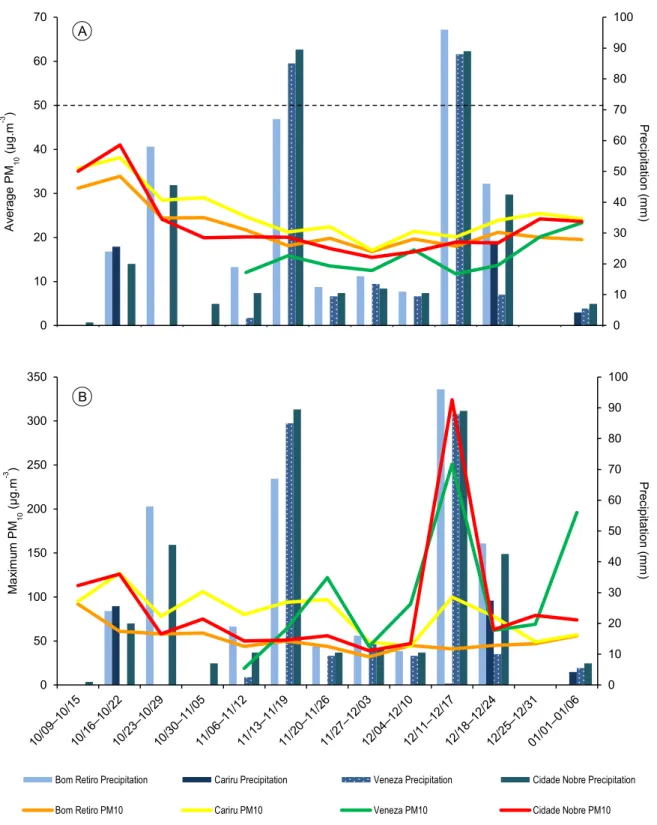
During the experimental period, the heaviest weekly rainfall was registered at Bom Retiro (96.0 mm). High maximum temperatures characterized the entire period, ranging between 30 and 40 ºC. Average values of mean temperature were 24.74 ºC at Bom Retiro, 27.11 ºC at Caritu, 26.67 ºC at Veneza, and 26.44 ºC at Cidade Nobre (Fig. 2, left column).
Considering all monitoring stations in Ipatinga city, the predominant wind was the Northeast one. Much occasionally were there discordant patterns. E.g., there were weak, infrequent Southeast winds at Bom Retiro and analogously low, infrequent Northwest ones at Cidade Nobre (Fig. 2, right column).
12 3.2. Metal quantification in plant dry matter
Among the investigated tracers, vanadium was not detected in any samples and, therefore, is not shown in the data summarized in Table 1.
There were significant interactions in the accumulation of Ca, Cu, Fe, Mn, Ni, Pb and Co. Caesalpinia ferrea showed higher Ca contents in plants at the reference station in comparison with plants exposed at Cariru. This species accumulated higher Cu contents than C. echinata. Increased Cu amounts were detected at Bom Retiro, Cariru and Cidade Nobre. The opposite was observed with Fe, Ni and Pb accumulation. Caesalpinia echinata accumulated higher contents of these three metals than C. ferrea at Bom Retiro, and higher contents at this neighborhood than at the other sites (with the exception of Pb at Veneza). Caesalpinia ferrea showed higher Mn in plants at RDSP than in those exposed at Cariru station, and higher contents than C. echinata at the former site. The Ni contents followed the inverse pattern, being higher in plants at Cariru than in those at RDSP. As for Co, C. ferrea accumulated higher amounts than C. echinata at Cariru and Cidade Nobre. These two sites and Veneza propitiated higher accumulation of the element than Bom Retiro and RDSP in C. ferrea (Table 1).
Overall, besides Fe, increasing concentrations along the wind direction were verified with elements Zn, Mn, Ni, Pb and Cr, and particularly higher amounts of Al. Bom Retiro showed the highest contents of these elements on the plant matter of both species (Table 1).
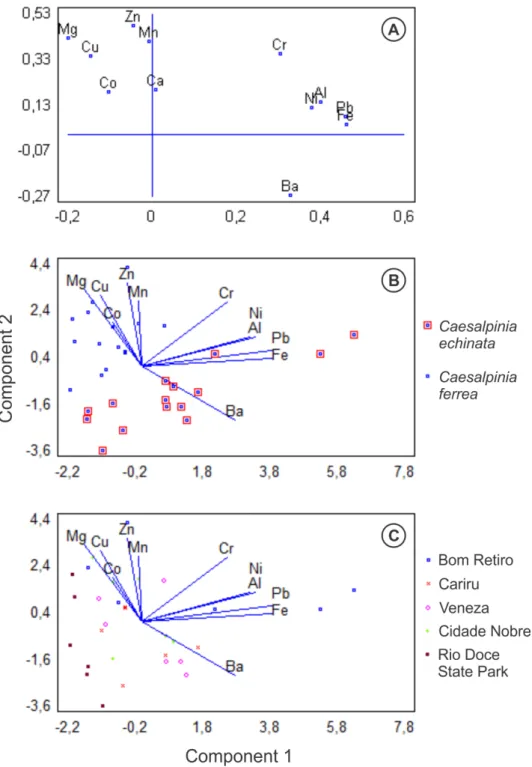
Aiming to explore variation between species and among exposure sites, principal component analysis was also performed with data on elemental quantification, in order to obtain a small number of linear combinations of the 12 metals which account for most of the variability in the data. Three components were extracted, with eigenvalues higher than one. Together they account for 80.24% of the variability in the data.
Considering the two principal components plotted, component 1 was composed by Cr, Ca, Al, Ni, Pb, Fe and Ba, and component 2 by Zn, Mg, Mn, Cu and Co. Calcium, however, was more closely associated with the cluster formed by component 2 than to the one formed by the other metals in component 1 (Fig. 5A).
13
The exposure sites could also be clearly separated. The reference station, for instance, formed a well defined cluster that could be well-segregated by component 1, showing the lowest component weights (Fig. 5C).
Most elements varied toward the urban exposure stations. The element that varied more closely toward the reference station was Mg (Fig. 5C).
Both components demonstrated influence on the final result. Component 1, however, separated species among sites, according to pollution level, while component 2 did such separation to a lesser degree. Component 1 seems, therefore, to be a revealer of pollution, whereas component 2 seems to discriminate species (Fig. 5B, C).
3.3. Leaf surface roughness
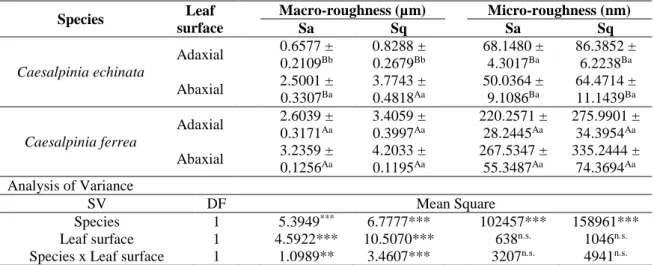
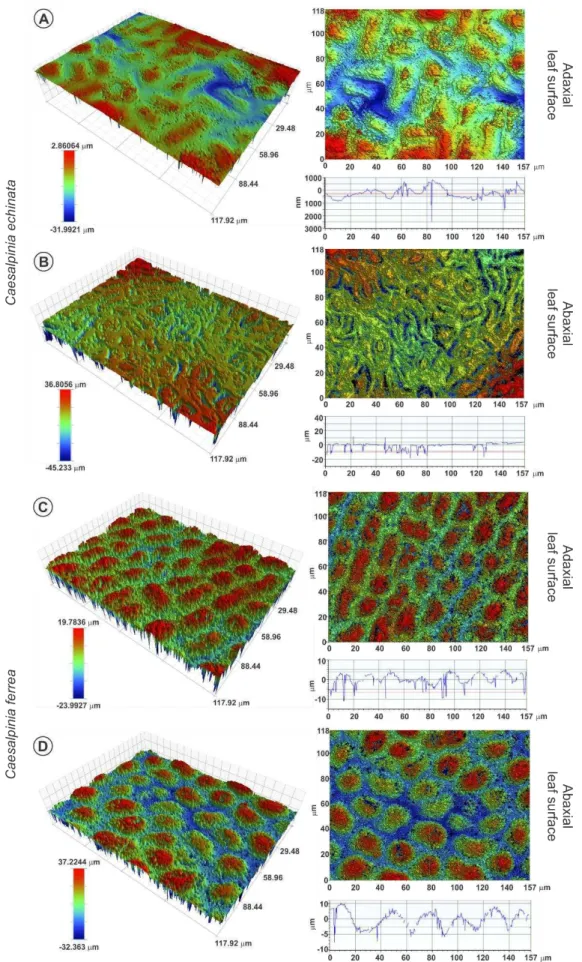
Leaf macro-roughness was significant in the interaction between the species and leaf surfaces (abaxial and adaxial). Caesalpinia ferrea showed higher values than C. echinata, and in each species the abaxial surface was the roughest one. The results given by Sa and Sq differed only in the comparison between species regarding the abaxial leaf surface, showing significant difference in the former and a non-significant one in the latter (Table 2; Fig. 6).
As for leaf micro-roughness, a significant difference was detected only between species, with C. ferrea showing higher values (Table 2; Fig. 7).
In order to track back relationships within metal accumulation and leaf surface roughness, correlation analyses were made between trace-metal and the two estimators (i.e., mean (Sa) and squared (Sq)) of the types of roughness (i.e., macro and micro). Leaf macro-roughness was positively correlated with Ca (at Cariru), Fe (at Bom Retiro) and Ni accumulation (at the reference site) by C. ferrea and negatively so with Cr accumulation (at Bom Retiro) by C. echinata. Leaf micro-roughness was positively correlated with Cu accumulation (at Cariru) in C. ferrea and Ni (at the reference site) and Pb accumulation (at Cidade Nobre) in C. echinata, and negatively so with Mn accumulation (at the reference site) in C. ferrea and Fe and Mn (at the reference site, both) in C. echinata (Tables 1 and 3).
3.4. Waxes
3.4.1. Quantification
14
suggest an increase in the amount of waxes in plants exposed at Bom Retiro, Cariru and Veneza, in comparison with the reference station, the least polluted urban station (Cidade Nobre) and non-exposed plants. This response was more noticeable in C. ferrea. Although C. echinata plants did show higher values at Bom Retiro, Cariru and Veneza than plants at the reference-station, plants at Cariru showed lower values than the ones at Cidade Nobre and than the non-exposed ones (Fig. 8).
3.4.2. Infrared spectroscopy
Infrared spectrum analysis allowed for the determination of the main functional groups of the studied species in the studied sites. The analysis showed that the epicuticular waxes of C. echinata and C. ferrea are characterized by a typically-shaped band of stretching of O–H bonds in the 3.600–3.200 cm-1 region; bands in the ~1375 cm-1 region indicating symmetric deformation of CH3 groups, in the ~1465 cm-1 region indicating scissor-type deformation of CH2 groups, and very intense bands in the 3000– 2840 cm-1 region, due to strong stretch of C–H bands, thus pointing to the presence of alkanes in both species; C=O stretch bands in the 1770–1630 cm-1 region, indicating the presence of ketones; C–O stretch bands in the ~1050 cm-1 region, indicating primary alcohols, and in the ~1150 cm-1 region, indicating the presence of tertiary alcohols; and
weak stretch bands of C≡C at ~2158 cm-1 indicating the presence of alkynes (Figs. 9F
and 10F). This constitution suggests that the wax of both species is primarily a mixture of ketones, long-chain n-alkanes and short-chain alcohols. The infrared spectra ascertained the need to proceed transesterification with the samples prior to the gas-chromatography/mass-spectrometry analysis, due to the presence of functional groups with an active hydrogen (alcohols and carboxylic acids) (Jetter et al. 2006).
15
3.4.3. Gaseous phase chromatography
The GC-MS analysis allowed the identification of 37 different compounds in the waxes of C. echinata (Fig. 11A, Table 4) and 41 compounds in the waxes of C. ferrea (Fig. 11B, Table 5). Contaminants such as phthalate and some benzenic compounds were disregarded. The components in highest proportion in the wax chemical constitution are the ketone nonanone (16.5 %) in the former and the hydrocarbon 2-methyloctacosane (7.6 %) in the latter. Following a corresponding pattern, the waxes of the former are predominantly constituted by ketones, hydrocarbons being the second major component; while the opposite proportion is observed in the latter. The other components in decreasing order of proportion in the wax constitution are: carboxylic acids, alcohols, ethers and esters, in C. echinata, and carboxylic acids, alcohols, esters and aldehydes, in C. ferrea (Fig. 12).
Such chemical constitution renders the waxes of C. echinata more polar than C. ferrea ones. In the former, ca. one-third of the total wax composition is made up by little polar compounds (hydrocarbons + ethers), while over half the wax constitution has such polarity feature in the latter (Fig. 13). In C. ferrea, hydrocarbons alone determine the wax little polar nature, due to the absence of ethers in the wax composition (Fig.12).
3.4.4. Micromorphology (scanning electron microscopy)
Caesalpinia echinata has the layer type of deposition pattern of the epicuticular waxes (Fig. 14A, B). In C. ferrea, the deposition pattern is in vertical non-ordered scales (Fig. 15A, B). The two species are hypostomatic (i.e., have stomata on the leaf abaxial surface only). The wax deposition pattern is the same on both leaf surfaces, in both species (Fig. 14C, D; 15C, D).
Caesalpinia ferrea epidermal cells are characterized by sharply convex outer periclinal cell walls. This feature determines a somewhat grooved epidermal relief (Fig. 15A, C), characterized by recesses among the cells, in which, on the abaxial surface, the stomata are inserted (Fig. 15D). Besides, the anticlinal wall of the epidermal cells of this species are more undulated that those in C. echinata (Fig. 15A, D, and Fig. 14A, respectively).
16
a layer. In C. ferrea, it is glabrous (Fig. 15E) and the wax deposition pattern is also in vertical scales. However, the wax scales in the rachis differ from those on the leaf blade. The former are larger and have round-edges (Fig. 15F), while the latter have serrated edges (Fig. 15B).
3.5. Deposited particles
For means of absolute comparison, the scanning electron microscopy study was performed on leaf samples from non-exposed plants and on samples from individuals exposed at Bom Retiro, the site initially presumed as the most-polluted one, based on wind direction. Particles could be seen adhered to leaf surfaces of both species (Figs. 16, 17, 18). More particles were retained onto the leaf blade of C. echinata (Fig. 16), but less frequently on the abaxial surface (Fig. 16E-G)). Fewer particles were seen on C. ferrea leaves, and, analogously, more frequently on the adaxial surface (Fig. 17). In C. echinata, the presence of fungal hyphae was noticeable, on both leaf blade surfaces (Fig. 16A, C, E, G, H) and also on the rachis (Fig. 18A, C, E). The occurrence of hyphae onto C. echinata leaf surface was frequently associated with the presence of particles (Fig. 16G, H). Hyphae were not seen in C. ferrea leaves, in neither leaf region.
In the rachis, particles were also seen in both species (Fig. 18). In C. echinata, particle occurrence was associated not only with hyphae occurrence, but also with the presence of hairs along the entire leaf region (Fig. 18A, B, C, E). Particle occurrence in the rachis of C. ferrea was much less frequent (Fig. 18G, H).
3.6. Leaf micromorphometry
17 4. Discussion
The predominance of Northeast winds in the region initially suggests that Cidade Nobre would be the least impacted urban site and that Bom Retiro would be the most impacted one, particularly by gaseous pollutants and, among particulate matter, by the ones with the lowest aerodynamic diameter (PM10) (Marris et al. 2012; Almeida et al. 2015). As PM10 are particles with lower deposition rates, they tend to remain in the atmosphere for a longer period of time, and be transported to further distant regions (Riffault et al. 2015). These predictions, however, were only partially met. The site with the highest amounts of TSP was Cariru. This would not be totally unexpected, as its location is at Southeast, also along the windstream. But the second highest amounts were detect at Veneza, only then followed by Bom Retiro and Cidade Nobre. Other possible sources of contamination at Veneza must be investigated. In addition, Cidade Nobre was the most affected site by inhalable particles, after Cariru, followed by Bom Retiro and Veneza. Wind direction renders it little probability of it being affected by steel industry activity. Instead, vehicular emissions may be the predominant factor in this neighborhood.
18
Bom Retiro was the most impacted neighborhood by iron-containing particles. The analysis of heavy metals in particles is a safe method for assessing source-related emissions (Calvo et al. 2013; Almeida et al. 2015; Riffault et al. 2015). Iron particles are usually a product of basic oxygen steel-making and sintering (Almeida et al. 2009; Canha et al. 2012). Although the steelworks and sintering plants are nearer Cariru, the highest iron accumulation in plants exposed on this site was an expected result, as it is in accordance with the predominant wind direction in the region.
The leaf surface of C. ferrea is rougher than the one of C. echinata, both at the epidermal tissue level and at the outer periclinal epidermal cell wall level. The convexity in the outer periclinal cell wall and the platelet-type of wax crystals are the respective determining factors of these two features. To my knowledge, this is the first study quantitatively assessing leaf blade roughness at more than one hierarchical scale in an integrated approach. A possible reason for the lack of studies with this nature is the limitation of atomic force microscopy analysis with leaf samples. Prum et al. (2012a and b) performed an assessment resembling the one proposed herein, but the evaluations addressed qualitative descriptions and were carried out in the context of insect adhesion to leaf surfaces. Koch et al. (2004) assessed leaf micro-roughness of different plant species with AFM, but not along with macro-roughness, as the aims of the authors in both studies were to investigate the dynamics of wax regeneration. I suggest that future studies assessing the potential of plant species for biomonitoring airborne particulate matter investigate not only leaf surface macro-roughness (which itself is still scarce among published research) but also leaf surface micro-roughness, as they may be both related to the degree of particle retention.
Rougher leaf surfaces, if on one hand propitiate the superficial features that allow higher particle accumulation (Belot and Gauthier 1975), on the other usually confers such surface with higher hydrophobicity (Barthlott and Neinhuis 1997). This usually gives the plant a higher self-cleaning effect, i.e., the capacity of removing adhered particles by rain droplets that fall on leaves (Neinhuis and Barthlott 1997). Leaves with such features, like the ones of C. ferrea, are known to be related to lower particle accumulation, since the water droplets remove particles by adhering them to the droplet surface. In contrast, droplets that fall on hydrophilic surfaces, such as that of C. echinata, do not remove particles, yet tend to merely rearrange them (Barthlott and Neinhuis 1997).
19
less amounts of hydrocarbons. As a result, the leaf surface of this species has more water-affinity. That, along with its less rough leaf surface, suggests its higher wettability (Barnes et al. 1996; Neinhuis and Barthlott 1998; Wang et al. 2013; Wang et al. 2014). High hydrophilicity represents, among other outcomes, the higher tendency for the development of a water film over the leaf surface (Cape 1996). This frequently predisposes the leaf to be colonized by microorganisms (Juniper 1991). The occurrence of fungal colonization was observed in C. echinata samples from plants exposed at Bom Retiro, and quite noticeably deposited particles could be seen associated with them. The development of fungal hyphae on the leaf surface has been recently shown to be another enhancing factor to particle accumulation. Sánchez-López et al. (2015) observed, in several plant species, that the fungal mycelium on leaf surfaces formed an extensive web over the phyllosphere, which then retained more particles.
Although the occurrence of hyphae is usually a natural outcome of high leaf wettability, it is possible that fungal colonization has been increased or even triggered by an effect of urban pollution. In view of the known capability of PM to erode epicuticular waxes (Burkhardt and Pariyar 2014), particles could have promoted abrasion on leaf wax cover, thus enhancing its wettability. According to Räsänen et al. (2014), wax erosion by PM in Picea abies led to enhanced hydrophily and, along with decreased stomatal conductance, resulted in increased particle capture efficiency. This could also have ultimately led to higher particle accumulation by C. echinata at Bom Retiro, as a result of both decreased leaf self-cleaning capacity and higher leaf colonization by fungi. Yet, the higher amounts of waxes found in plants exposed at the most polluted sites may somewhat contradict this and, at a first glimpse, be paradoxical. Nonetheless, higher particle retention by hyphae due to abiotic stress suggests the generation of a positive feedback effect. I.e., higher effects by particulate pollutants lead to wax abrasion, which enhances leaf wettability and consequently propitiates the establishment of fungal hyphae. The hyphae, in turn, retain more particles over the leaf surface, thus leading to enhanced effects of the abiotic stress, which is then summed to the biotic one (Juniper 1991; Carver and Gurr 2006; Sánchez-López et al. 2015).
20
Veneza could have been triggered by the exposure to the more polluted atmosphere of these sites.
Accordingly, C. echinata was the species that had more particles adhered to the leaf surface. The results of the analyses performed indicate that differences in the wax chemical nature between the two species may have determined such differential particle adsorption, to the extent that hydrocarbon contents determined hydrophobicity, which is associated with the degree of particle retention (Jetter et al. 2006; Wang et al. 2013). Besides wax composition, its microsculpture is another factor that might have interfered with particle accumulation, as it determined a specifically rough microrrelief. (Neinhuis and Barthlott 1998; Wang et al. 2013; Wang et al. 2015). Macrosculpture of the epidermal tissue should be another influencing factor, as it determined leaf roughness at a larger scale.
A particular behavior inherent to the species biology may also have interfered with the degree of particle deposition. Under high insolation and temperature, both of which characterized several days of the exposure period, C. ferrea plants close their pinnules, regardless of the time of the day. Such phenomenon also occurs in C. echinata individuals, yet much more discretely. Therefore, not only the leaf blade was collected, but also the rachis. Despite having a lower superficial area, this leaf region remained constantly exposed to atmospheric deposition.
21
view of that, several pine species are rather commonly used as biomonitors of airborne particles in the North hemisphere (Lehndorff and Schwark 2008; Mori et al. 2014; Przybysz et al. 2014; Song et al. 2015), even having an already established standardized protocol (VDI 2007).
I recommend the quantitative assessment of leaf surface roughness in future studies that investigate the interaction between plant species and particle deposition. Recent initiatives have been found in the literature (Wang et al. 2015), but reports are still scarce. Such a parameter may allow for researchers to better tap into an important leaf surface features that may determine the degree of at least some plant responses to the surrounding atmosphere impacted by urban-industrial activities. I point out, however, that a more interesting approach is to investigate the roughness given in more than one hierarchical level. Not only macro-relief of the epidermal tissue determine leaf roughness, but also the deposition pattern of epicuticular waxes. The former can be easily assessed through profilometry analysis and should be no trouble for researchers who can dispose of an optical profilometer. The latter, however, has to be performed in an atomic force microscope, which has limitations concerning biological samples. The first one is the detection limit, since the height differences must not exceed 6 µm. Therefore, is may not be applicable for extremely rough surfaces (Koch et al. 2008). The second one is the fragility of the epicuticular wax crystals (Koch et al. 2004). The third concerns sample wetness and/or humidity. Drying leaf samples prior to AFM analysis is recommended to obtain quality results.
The epidermis was the leaf tissue that better responded to the environmental conditions in the experiment. The epidermis of both leaf surfaces was affected, but the environmental effects were particularly noticeable on the epidermis of the leaf adaxial surface of C. ferrea. Thickness of leaf tissues has been tested and successfully used as an anatomical biomarker of abiotic stress (Sant’Anna-Santos and Azevedo 2010; Pedroso and Alves 2015). However, it must be analyzed with care, as climate variations affect leaf development, and may therefore interfere with leaf responses in terms of tissue thickness to air pollutants, like ozone (Moura and Alves 2014). Since the result exhibited a clear statistical distinction between plants from the control site and those exposed at the urban environment, the micromorphometrical analysis represented a consistent approach to the present study. Epidermal tissue thickness could be seen as a biomarker of urban emissions in C. ferrea.
22
substances into plant organs (Beck 2010). It seems reasonable to propose that the higher response of this tissue could be related to its direct contact with pollutants, yet this cannot be taken as a rule. The Restinga species Clusia hilariana, for example, responded to foliar deposition of solid particulate matter of iron with lower thickness of all leaf tissues, except for the epidermis (Rocha et al. 2014).
Besides being harmful to plant formations, air pollution can also cause serious damage to human health. Since Ipatinga city developed in function of the implementation of its steel-industry park (Neves and Camisasca 2013), monitoring its atmospheric conditions is important to evaluate the air quality in the city, and ultimately promote preventive actions concerning public health and environmental impacts. Recent data from 2011 through 2014 showed that daily annual mean of inhalable particles (PM10) in Ipatinga city has surpassed the limit established by the World Health Organization, of 20 µg.m-3 (Programa Cidades Sustentáveis 2015). Thus, developing new strategies and approaches to constantly and more broadly assess air quality in the city should be encouraged. In that sense, the biomonitoring technique has some remarkable advantages, like its technological simplicity with which it allows the determination of places with higher levels of heavy metal pollution (Arndt and Schweizer 1991). Thus, studying the possibility of use of species from the local flora aiming at standardizing trustable methods remain an important issue to be explored. Assessing leaf surface features that determine higher particle accumulation seems to lead the way of this type of research.
Both C. echinata and C. ferrea are widely used as ornamental in Ipatinga city. The former was the one that retained more particles, due to characteristics such as low leaf roughness. Its use as ornamental should be encouraged, as the species may have to potential to form phytobarriers (Sánchez-López et al. 2015), thus helping to clean the urban air from airborne particulate matter (Freer-Smith et al. 2004; Janhäl 2015; Sgrigna et al. 2015). However, landscape design must be thoroughly planned, otherwise the random position of trees could have the opposite effect, actually increasing the accumulation of fine particles in the urban environment (Tong et al. 2015).
23
2008; Moro and Castro 2015), due mainly to its historical significance, as it is the symbol-tree to the country (von Muralt 2006). Standardization remains one of the main issues with comparability of passive biomonitoring studies (Tarricone et al. 2015). Thus, elaborating standardized approaches with this species, in alignment with international studies, and investigating its potential for passive biomonitoring might allow for future establishment of a monitoring network that could sample several cities across the country and give comparable results, not only with local or national, but also with international standards.
5. Conclusions
Caesalpinia ferrea Mart. ex Tul. showed a more well-defined response gradient in relation to the parameters analyzed herein, like the amount and chemical composition of waxes and epidermis thickness. For that reason, this species could be better explored as a biosensor of urban pollution. Its biosensorial potential deserves further investigation, due to the responses observed in its leaf tissues at the anatomical level. The species, however, retained lower amounts of particles and metals associated with vehicular and industrial emission, due to surface features of its leaves that confer them higher self-cleaning effect, like the higher roughness given both by the convex outer periclinal wall of epidermal cells and for its wax-layer microsculpturing. The opposite effects were observed in C. echinata and, for that reason, this species is better recommended for biomonitoring of air pollution as a bioaccumulator. Further studies that might investigate the responses of this species to particulate pollutants under controlled experimental conditions are suggested.
The first hypothesis of the study was not rejected. There was a difference in particle accumulation between the species, and such difference was given by epicuticular wax micromorphology – in the form of platelets in C. ferrea and layer in C. echinata -, to leaf macro-and micro-roughness and to wax chemical composition. The second hypothesis was partially rejected, since based on the afore-mentioned features only C. echinata can be recommended for biomonitoring airborne PM.
24
allowed for a better characterization of leaf surface features that determined particle retention. Such an integrated approach, when taken into consideration, can help to better elucidate the extension of air pollution effects and aid in the secure establishment of parameters for biomonitoring.
6. References
AGUIAR, T.V.; SANT’ANNA-SANTOS, B.F.; AZEVEDO, A.A.; FERREIRA, R.S.
2007. Anati Quanti: quantitative analysis software for plant anatomy studies. Planta Daninha 25, 649–659. (In Portuguese)
ALMEIDA, S.M.; FREITAS, M.C.; REPOLHO, C.; DIONÍSIO, I.; DUNG, H.M.; CASEIRO, A.; ALVES, C.; PIO, C.A.; PACHECO, A.M.G. 2009. Characterizing air particulate matter composition and sources in Lisbon, Portugal. Journal of Radioanalytical and Nuclear Chemistry 281, 215–218. ALMEIDA, S.M.; LAGE, J.; FERNÁNDEZ, B.; GARCIA, S.; REIS, M.A.; CHAVES,
P.C. 2015. Chemical characterization of atmospheric particles and source apportionment in the vicinity of a steelmaking industry. Science of the Total Environment 521–522, 411–420.
ANDRADE, G.C. 2013. Effects of simulated acid rain on the morphoanatomy of the vegetative body of two tree species from the Atlantic Rainforest. 41 pp. Monography (Undergraduation in Biological Sciences). Federal University of Viçosa, Viçosa/MG, Brazil. (In Portuguese)
ARNDT, U.; SCHLUTER, C. 1985. Effect-based determination of the immission load in specific forest decline areas in Baden-Württemberg through the use of bioindicators (active monitoring by indicator plants). Staruskoll. z-Arbeit des PEF, Karlsruhe 5. bis 7.3, 17–41. (In German)
ARNDT, U.; ERHARDT, W.; MICHENFELDER, K.; NOBEL, W.; SCHLÜTER, C. 1985. Standardized exposure of plant reactive indicators. Staub-Reinh. d. Luft 45, 481–483. (In German)
ARNDT, U.; SCHWEIZER, B. 1991. The use of bioindicators for environmental monitoring in tropical and subtropical countries. In: ELLENBERG, H. et al. (eds) Biological monitoring. Signals from the environment. Braunschweig: Vieweg, pp. 199–260.
25
matter distribution based on Saturation Isothermal Remanent Magnetization of herbaceous and tree leaves in a tropical urban environment. Science of the Total Environment 470–471, 975–982.
BARNES, J.D.; PERCY, K.E.; PAUL, N.D.; JONES, P.; MCLAUGHLIN, C.K.; MULLINEAUX, P.M.; CREISSEN, G.; WELLBURN, A.R. 1996. The influence of UV-B radiation on the physicochemical nature of tobacco (Nicotiana tabacum L.) leaf surfaces. Journal of Experimental Botany 47, 99–109.
BARTHLOTT, W.; NEINHUIS, C. 1997. Purity of the sacred lotus, or escape from contamination in biological surfaces. Planta 202, 1–8.
BARTHLOTT, W.; NEINHUIS, C.; CUTLER, D.; DITSCH, F.; MEUSEL, I.;
THEISEN, I.; WILHELMI, H. 1998. Classification and terminology of plant
epicuticular waxes. Botanical Journal of the Linnean Society 126, 237–260.
BECK, C.B. 2010. An introduction to plant structure and development - plant
anatomy for the twenty-first century. 2nd edition. Cambridge: Cambridge
University Press, p. 141.
BECKETT, P.K.; FREER-SMITH, P.H.; TAYLOR, G. 2000. Particulate pollution
capture by urban trees: effects of species and windspeed. Global Change
Biology 6, 995–1003.
BELOT, Y.; GAUTHIER, D. 1975. Transport of micronic particles from atmosphere
to foliar surfaces. In: VRIES, D.A.D.; AFGAN, N.H. (eds) Heat and mass
transfer in the biosphere. New York: Wiley, pp. 583–591.
BRASIL. Ministry of the Environment. 2001. Law N° 10,165, of December 27, 2000. Modifies Law no 6,938, of August 31, 1981, on the Brazilian National
Environmental Policy, its purposes and mechanisms of formulation and application, and other matters. Brasília: Brazilian Federal Senate. Available in: <http://www.planalto.gov.br/ccivil_03/Leis/L10165.htm>. Access in: May 5, 2014. (In Portuguese)
BURKHARDT, J.; PARIYAR, S. 2014. Particulate pollutants are capable to
‘degrade’ epicuticular waxes and to decrease the drought tolerance of Scots
pine (Pinus sylvestris L.). Environmental Pollution 184, 659–667.
26
CALVO, A.I; ALVES, C.; CASTRO, A.; PONT, V.; VICENTE, A.M.; FRAILE, R. 2013. Research on aerosol sources and chemical composition: Past, current and emerging issues. Atmospheric Research 120–121, 1–28.
CANHA, N.; FREITAS, M.C.; ALMEIDA-SILVA, M.; ALMEIDA, S.M.; DUNG, H.M.; DIONÍSIO, I.; CARDOSO, J.; PIO, C.A.; CASEIRO, A.; VERBURG, T.G.; WOLTERBEEK, H.TH. 2012. Burn wood influence on outdoor air quality in a small village: Foros de Arrão, Portugal. Journal of Radioanalytical and Nuclear Chemistry 291, 83–88.
CAPE, J.N. 1996. Surface wetness and pollutant deposition. In: KERSTIENS, G. (ed) Plant cuticles an integrated functional approach. Oxford: BIOS Scientific Publishers, pp. 283–300.
CARTER, M.V. 1965. Ascospore deposition in Euphyta armeniacae. Australian Journal of Agricultural Research 65, 825–836.
CARVER, T.L.W.; GURR, S.J. 2006. Filamentous fungi on plant surfaces. In: RIEDERER, M.; MÜLLER, C. (eds) Biology of the Plant Cuticle. Oxford: Blackwell, pp. 368–397.
CHEN, L.C.; LIPPMANN, M. 2009. Effects of metals within ambient air particulate matter (PM) on human health. Inhalation Toxicology 21, 1–31.
CONAMA. Ministry of the Environment. National Environmental Council (CONAMA). 1990. CONAMA Resolution nº 3, of June 28, 1990. Establishes air quality standards, provided for in PRONAR. Brasília: Diário Oficial da União, August 22, 1990, section 1, pp. 15937–15939. (In Portuguese)
DENATRAN 2015. Ministry of Cities. National Department of Traffic (DENATRAN). National Registry of Motor Vehicles (RENAVAM). Vehicle fleet, by type and having license plate, according to the Federation Municipalities – September 2015. Available in: <http://www.denatran.gov.br/frota2015.htm>. Access in: October 25, 2015. (In Portuguese)
DEVI, G.; BHATTACHARYYA, K.G.; MAHANTA, L.B.; DEVI, A. 2014. Trace metal composition of PM2.5, soil, and Machilus bombycina leaves and the effects on Antheraea assama silk worm rearing in the oil field area of Northeastern India. Water, Air, & Soil Pollution 225, 1884.
27
DOMINGOS, M.; BULBOVAS, P.; CAMARGO, C.Z.S. et al. 2015. Searching for native tree species and respective potential biomarkers for future assessment of pollution effects on the highly diverse Atlantic Forest in SE-Brazil. Environmental Pollution 202, 85–95.
FERREIRA, E.A.; DEMUNER, A.J.; SILVA, A.A.; SANTOS, J.B.; VENTRELLA, M.C.; MARQUES, A.E.; PROCÓPIO, S.O. 2005. Chemical composition of epicuticular wax and characterization of leaf surface in sugarcane genotypes. Planta Daninha 23, 611–619. (In Portuguese)
FERNÁNDEZ, V.; SANCHO-KNAPIK, D.; GUZMÁN, P.; PEGUERO-PINA, J.J.; GIL, L.; KARABOURNIOTIS, G.; KHAYET, M.; FASSEAS, C.; HEREDIA-GUERRERO, J.A.; HEREDIA, A.; GIL-PELEGRÍN, E. 2014. Wettability, polarity, and water absorption of holm oak leaves: effect of leaf side and age. Plant Physiology 166, 168–180.
FREER-SMITH, P.H.; EL-KHATIB, A.A.; TAYLOR, G. 2004. Capture of particulate pollution by trees: a comparison of species typical of semi-arid areas (Ficus nitida and Eucalyptus globulus) with European and North American species. Water, Air, & Soil Pollution 155, 173–187.
FRONDIZI, C.A. 2008. Air quality monitoring: theory and practice. Rio de Janeiro: E-papers, p. 42. (In Portuguese)
GERRITS, P.O. 1991. The application of glycol methacrylate in histotechnology: some fundamental principles. Gröningen: Department of Anatomy and Embriology, State University of Gröningen. 80 p.
GUIMARÃES, A.A.; FERREIRA, E.A.; VARGAS, L.; SILVA, A.A.; VIANA, R.G.; DEMUNER, A.J.; CONCENÇO, G.; ASPIAZU, I.; GALON, L.; REIS, M.R.; SILVA, A.F. 2009. Chemical composition of the epicuticular wax of italian ryegrass biotypes resistant and susceptible to glyphosate. Planta Daninha 27, 149–154. (In Portuguese)
HAMILTON, R.J. 1995. Waxes: chemistry, molecular biology and functions. Edinburgh: Orly Press. 149 p.
HOFMAN, J.; STOKKAER, I.; SNAUWAERT, L.; SAMSON, R. 2013. Spatial distribution assessment of particulate matter in an urban street canyon using biomagnetic leaf monitoring of tree crown deposited particles. Environmental Pollution 183, 123–132.
28
production system in China. Human and Ecological Risk Assessment 20, 1264– 1280.
HUANG, C.W.; LIN, M.Y.; KHLYSTOV, A.; KATUL, G.G. 2015. The effects of leaf size and microroughness on the branch-scale collection efficiency of ultrafine particles. Journal of Geophysical Research: Atmospheres 120, 3370–3385.
JANHÄLL, S. 2015. Review on urban vegetation and particle air pollution - Deposition and dispersion. Atmospheric Environment 105, 130–137.
JETTER, R.; KUNST, L.; SAMUELS, A.L. 2006. Composition of plant cuticular waxes. In: RIEDERER, M.; MÜLLER, C. (eds) Biology of the Plant Cuticle. Oxford: Blackwell, pp. 368–397.
JUNIPER, B.E. 1991. The leaf from the inside and the outside: a microbe’s perspective. In: ANDREWS, J.H.; HIRANO, S.S. (eds) Microbial ecology of leaves. New York: Springer, pp. 21–42.
KAMPA, M.; CASTANAS, E. 2008. Human health effects of air pollution. Environmental Pollution 151, 362–367.
KARNOVSKY, M.J. 1965. A formaldehyde – glutaraldehyde fixative of high osmolarity for use in electron microscopy. Journal of Cellular Biology 27, 27– 137.
KASSOMENOS, P.A.; VARDOULAKIS, S.; CHALOULAKOU, A.;
PASCHALIDOU, A.K.; GRIVAS, G.; BORGE, R.; LUMBRERAS, J. 2014. Study of PM10 and PM2.5 levels in three European cities: analysis of intra and
inter urban variations. Atmospheric Environment 87, 153–163.
KHILLARE, P.S.; HASAN, A.; SARKAR, S. 2014. Accumulation and risks of polycyclic aromatic hydrocarbons and trace metals in tropical urban soils. Environmental Monitoring and Assessment 186, 2907–2923.
KLUMPP, A.; KLUMPP, G.; DOMINGOS, M. 1994. Plants as bioindicators of air pollution at the Serra do Mar near the industrial complex of Cubatão, Brazil. Environmental Pollution 85, 109–116.
KOCH, K.; NEINHUIS, C.; ENSIKAT, H.J.; BARTHLOTT, W. 2004. Self assembly of epicuticular waxes on living plant surfaces imaged by atomic force microscopy (AFM). Journal of Experimental Botany 55, 711–718.