Formulation And Evaluation Of
Compression Coated Tablets Of
Cefpodoxime Proxetil
Ms. Nandini.D.Banerjee*, Mrs. Sushma R. Singh.
(Dr.L.H.Hiranandani college of Pharmacy, CHM Campus, Ulhasnagar- 03, Maharashtra.) Tel.No.: 09969717510
Email:
ABSTRACT:
The purpose of this study was to formulate Cefpodoxime Proxetil compression-coated tablets for gastroretentive drug delivery. In this the core tablet is formulated to be retained in the stomach for a period of approximately 12 hrs using different polymer blend. The core tablet has half the amount of the drug and the rest of the drug in the coating layer. This outer layer is so formulated to release its drug content in a period of 15mins so as to achieve the initial burst release and then after 2 hours as the plasma concentration of the drug decreases then the core layer starts releasing its drug content so that the plasma concentration of the drug is maintained in the therapeutic window for the duration of 12 hrs. Thus the dosing interval is increased from 4 hrs to 12hrs. The batches are optimized using the factorial designing. Also the formulation is evaluated for its release profile and compared with the other standard release profiles.
Key words: Floating tablet, Fast disintegrating tablet, Factorial design, Xanthan gum, Hydroxypropyl methyl cellulose.
INTRODUCTION:
The oral drug delivery is by far the most preferable route of drug delivery system, due to ease of administration, patient compliance, and flexibility in formulation etc. Tablets are indeed the most popular solid dosage form for oral administration. One category of tablet formulations that has gained remarkable importance in drug therapeutics owing to various benefits it offers is controlled or modified release formulations. An ideal drug delivery system should deliver the drug at a rate dictated by the needs of the body during the period of treatment. These prerequisites lead to development of modified release technologies, which can improve the therapeutic efficacy and safety of a drug by targeting the drug to specific site in the body, thereby reducing both the size and number of doses required. The various modified release dosage forms available, include: extended release dosage forms that are designed to achieve a prolonged therapeutic effect by continuously releasing drug over an extended period of time. Delayed release dosage form is designed to release the drug at a time other than promptly after administration. Gastric retentive drug delivery devices (1,2) can be useful for the spatial and temporal delivery of many drugs.
Need of gastro retention arises because of two reasons, viz
• To improve bioavailability of drugs such as cyclosporin, ciprofloxacin, ranitidine, metoprolol tartarate, cefuroxime axetil etc. which are mainlyabsorbed from upper part of GIT or get degraded in basic PH. • For local action in case of pathologies of stomach.
the coating may cover a bitter substance. conceal an unpleasant or mottled appearance, or provide a barrier for a substance irritating to the stomach or one inactivated by gastric juice. Another application of the compression-coated dosage form is in sustained- release preparations. A coating containing the immediate-release portion is compressed around a slowly releasing core. This gives a far more accurate dose than is the case with sugar coating.(3,4,5)
Cefpodoxime proxetil is an orally administered, extended spectrum, semi-synthetic β- lactum antibiotic of cephalosporin class. Cefpodoxime proxetil is prodrug; its active metabolite is cefpodoxime. After oral administration cefpodoxime proxetil is absorbed from the gastrointestinal tract and de-esterifies to active metabolite cefpodoxime.(10,15) Over the recommended dosing range (100 to 400 mg) only the 50% of administered cefpodoxime dose was absorbed systemically. Also the drug has only 2 to 3 hours half life. Its action is by binding to specific penicillin-binding proteins (PBPs) located inside the bacterial cell wall; it inhibits the bacterial cell wall synthesis. It is highly stable in the presence of beta- lactamase enzymes. Floating drug delivery is able to prolong the gastric retention of drug and thereby possibly improve oral bioavailability of cefpodoxime proxetil.(9)
ADVANTAGES OF GASTRORETENTIVE DRUG DELIVERY SYSTEMS:
1) The bioavailability of therapeutic agents can be significantly enhanced especially for those which get metabolized in the upper GIT.
2) For drugs with relatively short half life, sustained release may result in a flip-flop pharmacokinetics and also enable reduced frequency of dosing with improved patient compliance.
3) They also have an advantage over their conventional system as it can be used to overcome the adversities of the gastric retention time (GRT) as well as the gastric emptying time (GET). As these systems are expected to remain buoyant on the gastric fluid without affecting the intrinsic rate of employing because their bulk density is lower than that of the gastric fluids.
4) Gastroretentive drug delivery can produce prolong and sustain release of drugs from dosage forms which avail local therapy in the stomach and small intestine. Hence they are useful in the treatment of disorders related to stomach and small intestine.
5) The controlled, slow delivery of drug form gastroretentive dosage form provides sufficient local action at the diseased site, thus minimizing or eliminating systemic exposure of drugs
6) Gastroretentive dosage forms minimize the fluctuation of drug concentrations and effects. Therefore, concentration dependent adverse effects that are associated with peak concentrations can be avoided. This feature is of special importance for drug with a narrow therapeutic index.
7) Gastroretentive drug delivery can minimize the counter activity of the body leading to higher drug efficiency. 8) Reduction or fluctuation in drug concentration makes it possible to obtain improved selectivity in receptor activation.
9) The sustained mode of drug release from Gastroretentive doses form enables extension of the time over a critical concentration and thus enhances the pharmacological effects.
In the present investigation it is intended to formulate and evaluate tablet in tablet (compression coated tablets) of the drug in which the inner core tablet is formulated to be as gastroretentive floating system while the coating tablet is for immediate release of the initial dose.
MATERIAL AND METHOD: MATERIAL:
CEFPODOXIME PROXETIL was provided as a gift sample from CIPLA Pvt. Ltd, Mumbai, India. The Polymers Hydroxypropyl methyl cellulose K 15 M (HPMC K15 M) and Ethyl Cellulose (EC) was obtained as gift sample from Colorcon Pvt.Ltd, Goa. Microcrystalline cellulose (MCC) and Crosscarmellose Sodium (CCS) was supplied by JRS Pharma, Germany. All other ingredients were of Pharmaceutical grade and was obtained from S.D. Fine Chemicals.
PREPARATION OF CORE TABLET OF CEFPODOXIME PROXETIL:
BATCHES DRUG HPMC EC XANTHAN GUM
CARBOPOL SODIUM
BICARBONATE
Talc
A1 50 25 25 1%
A2 50 25 25 1%
A3 50 12.5 12.5 25 1%
A4 50 25 25 1%
A5 50 12.5 12.5 25 1%
A6 50 8.3 8.3 8.3 25 1%
A7 50 25 25 1%
A8 50 12.5 12.5 25 1%
A9 50 8.3 8.3 8.3 25 1%
Table.1: Different formulations of the core tablets: (All quantities are in mg)
PREPARATION OF FAST DISSOLVING COATING MATERIAL AND COMPRESSION COATED TABLETS:
The core tablets were compression coated with the coat mixture (Table 2). All the constituents of the coating mixture were uniformly mixed and then used for the compression coating. MCC was added in the coating formulation as a cushioning agent so as to protect the core tablet from any damage during the compression coating procedure. 50% of the drug dose was added in the coating fast dissolving layer so as to achieve an initial burst effect so that the drug plasma concentration reaches the therapeutic window. (6,7)
About 50% of the coating mixture was placed in the die cavity (9mm diameter). The core tablet was then placed in the centre of the die cavity, which was filled with the remainder of the coat formulation. Then, it was compressed around the core tablets to give a tablet in tablet formulation of Cefpodoxime Proxetil.
Table.2: Formulation of coating tablet:
Ingredients Quantity Drug 50mg
CCS 4%
MCC q.s
Talc 1%
Factorial Design:
Based on the results of preliminary trial formulations obtained from the above 9 batches of the different polymers and polymer combinations; the combination of Xanthan gum and HPMC was found to give the desired floating time and swelling ratio and thus was used for the optimization of drug release with factorial design. A randomized 2² full factorial design was adopted to optimize the variables. In this design two factors were evaluated, each at two levels, and experimental trials were performed at all 4 possible combinations. The concentration of Xanthan gum and HPMC was selected as the 2 independent variables and the time required to release 80% of the drug as the response variable. (12, 13, 14)
Batches - F1 F2 F3 F4 Factor A - 8.3 25 8.3 25 Factor B - 8.3 8.3 25 25 Factor A- Concentration of Xanthan gum
Factor B- Concentration of HPMC
EVALUATION OF THE COMPRESSION COATED TABLETS: 1. PREFORMULATION PARAMETERS:
a. Drug excipient interaction:
The pure drug and its formulation along with excipient were subjected to IR studies. The excipient compatibility was established by conducting a one month compatibility study at 400
b. Standard calibration curve:
C and 75% Relative humidity. In the present study, potassium bromide pellet was employed using Shimadzu FTIR Spectrometer.
The spectrum of the drug was determined using Shimadzu UV-1800 instrument. Then the concentration curve of the same was obtained within a range of 1ppm to 25ppm.
2. EVALUATION OF CORE TABLETS: a. Thickness:
Ten tablets from each formulation were taken randomly and their thickness was measured with a vernier calliper as per pharmacopeial specification.
b. Hardness and Friability:
Hardness of the tablets was measured using the Monsanto Hardness Tester. The friability of a sample of twenty tablets was measured using a USP type Roche friabilator. Pre-weighed tablets were placed in a plastic chambered friabilator attached to a motor revolving for100 rotation. The tablets were then dusted, reweighed and percentage weight loss (friability) was calculated.
c. Weight variation:
Twenty tablets were selected randomly. Tablets were weighed individually and average weight was calculated. Then deviation of each tablet from average weight was calculated and percent deviation was computed.
d. Drug content:
For the content uniformity test, ten tablets were weighed and powdered and a quantity of powder equivalent to 10 mg of cefpodoxime proxetil was extracted into methanol. The drug content was determined by measuring the absorbance after appropriate dilution with methanol. The drug content was determined using standard calibration curve. The mean percent drug content was calculated as an average of six determinations.
e. Floating property: (9)
The tablets were placed in a 100 ml glass beaker containing 0.1 N HCl.
i. Floating Lag Time: The time required for the tablet to rise to the surface of the medium and float was determined as floating lag time
ii. Floating Duration Time: The time for which the tablet remained floating on the surface of medium was determined as floating duration time.
3. EVALUATION OF COMPRESSION COATED TABLETS: a. Thickness:
Ten tablets from each formulation were taken randomly and their thickness was measured with a vernier calliper.
b. Friability:
The friability of a sample of twenty tablets was measured using a USP type Roche friabilator. c. Weight variation:
Studies were done on 20 tablets and the average was calculated to check the weight variation in individual batches.
d. Drug content:
The above method of drug content determination was again followed for the compression coated tablets. e. Disintegration time of coating tablet:
In-vitro disintegration time was determined for core tablets using disintegration test apparatus. The buffer of pH 1.2 was maintained at a temperature of 37±0.50 C and time taken for complete disintegration of the tablet was measured in seconds. (7)
4. RELEASE KINETICS
The in- vitro dissolution data was fitted in to different kinetic models like zero and first order, Korsemeyer peppas and Higuchi model to find out the drug release profile.
Also the formulation was compared with marketed formulation for its in vitro drug release property.(11) RESULTS:
Figure.1: IR curve of Cefpodoxime Proxetil and compatibility with excipients.
(A) Plain Cefpodoxime Proxetil (B) Drug with HPMC K15M (C) Drug with EC (D) Drug with Xanthan Gum (E) Drug with Carbopol.
Concentration curve data:
The λ max of Cefpodoxime proxetil was found to be 263.2 nm. (Figure 2)
Figure 2: UV data of the drug
Evaluation of core tablet:
Batches Thickness (mm)
Hardness
(kg/cm2
Friability
) (%)
Weight variation (mg)
Drug content (%)
Floating lag time (sec)
Floating duration (hrs)
A1 2.566±0.05 5.0 ± 0.02 0.35 103±1.3 99.12 ± 0.04 60±2.08 10 A2 2.533±0.05 4.9 ± 0.02 0.43 100±1.1 99.44 ± 0.02 120±2.45 5 A3 2.566±0.05 5.0 ± 0.04 0.56 100±1.5 99.44 ± 0.02 78±37 12 A4 2.533±0.05 4.8 ± 0.02 0.63 104±1.4 98.92 ± 0.07 38±21 8 A5 2.6±0.1 5.0 ± 0.02 0.37 99±1.3 99.12 ± 0.04 60±2.08 14 A6 2.6±0.1 4.9 ± 0.02 0.53 100±1.6 98.92 ± 0.07 120±34 12 A7 2.633±0.05 5.0 ± 0.04 0.55 100±1.3 100.224±0.449 126±63 4
A8 2.6±0.0 5.0 ± 0.04 0.37 101±1.4 99.44 ± 0.02 95±24 9
A9 2.6±0.0 4.9 ± 0.02 0.32 103±1.6 100.224±0.449 60±2.08 12 F1 2.6±0.0 5.0 ± 0.02 0.65 100±1.5 98.92 ± 0.07 67±1.45 9 F2 2.533±0.05 5.0 ± 0.04 0.46 103±1.2 99.12 ± 0.04 60±2.08 14 F3 2.566±0.05 4.9 ± 0.02 0.63 101±1.5 99.44 ± 0.02 60±2.08 15 F4 2.6±0.0 4.8 ± 0.02 0.47 100±1.4 99.12 ± 0.04 69±2.53 18
Table.3: Evaluation of core tablets of Cefpodoxime proxetil:
Also the batch A5 gave the least lag time among the above 3 batches, about 60sec . Due to this it was selected for the further optimization studies. Then the batches F1-F4 were formulated by varying the concentration of HPMC and concentration of Xanthan gum.
The batches of the compression coated tablet was evaluated and compared with marketed tablet on the parameters of thickness, friability, weight variation and drug content. It gave the satisfactorily comparable results. Also the disintegration time of the coating layer tablet of all the batches was around 60-70 mins. This signifies that around 50% of the drug will be released in the first 2 hrs after administration . (Table 4)
Batches Thickness
(mm)
Friability (%)
Weight variation (mg)
Drug content (%) Disintegration time of
coating tablet (mins)
A1 4.27±0.01 0.2134 303.4±0.76 98.13 ± 0.12 68
A2 4.173±0.02 0.3513 302.7±0.46 97.36±0.15 64
A3 4.16±0.045 0.2895 304.63±0.3 102.5±0.46 76
A4 4.27±0.01 0.197 304.7±0.75 100.4±0.45 63
A5 4.27±0.01 0.499 302.43±0.5 100.64±0.5 68
A6 4.16±0.045 0.375 304.43±0.54 102.32±0.343 67
A7 4.173±0.02 0.436 302.53±0.47 99.56±0.45 65
A8 4.086±0.04 0.3427 303.72±0.54 98.4±0.27 59
A9 4.086±0.04 0.432 302.46±0.74 99.3±0.5 71
F1 4.27±0.01 0.2895 302.25±0.35 100.3±0.45 59
F2 4.16±0.045 0.2654 304.28±0.5 102.6±0.5 66
F3 4.16±0.045 0.235 303.75±0.53 99.5±0.54 68
F4 4.173±0.02 0.653 303.56±0.6 98.35±0.5 58
Marketed 2.56±0.02 0.265 303.37±0.5 99.56±0.5 ---
Batches First order Zero order Higuchi matrix Korsmeyer-peppas
Equation R2 Equation R2 Equation R2 Equation R2 A5 y = 0.059x +
1.364
0.838 y = 6.685x + 19.83
0.986 y = 25.51x + 2.538
0.963 y = 0.52x + 1.400
0.979
F1 y = 8.822x + 19.48
0.983 y = 0.080x + 1.382
0.994 y = 22.92x + 11.74
0.836 y = 0.563x + 1.407
0.949
F2 y = 0.063x + 1.353
0.958 y = 6.700x + 18.17
0.998 y = 22.26x + 6.205
0.913 y = 0.548x + 1.350
0.977
F3 y = 0.062x + 1.266
0.918 y = 5.930x + 14.01
0.998 y = 22.18x - 0.322
0.936 y = 0.604x + 1.246
0.985
F4 y = 0.061x + 1.193
0.881 y = 4.780x + 12.74
0.992 y = 18.10x + 0.696
0.953 y = 0.592x + 1.180
0.990
Table5: Correlation coefficients (r2
Comparision of the Floating time of the different Batches:
) values of different kinetic models:
The comparative floating time of the different batches are given in Figure. 3.
Figure.3: Comparative study of the duration of tablet floating
Drug release kinetics of compression coated formulations.
The release kinetics was estimated by fitting the in-vitro dissolution data the different kinetic models. Figure 4.
a b c
Figure.4: Floating of tablet at a) 0min; b) 6hrs; c) 12hrs
All the above batches show good regression analysis (R2
The Batch F3 gave the most satisfactory result with respect to dissolution profile. It is seen in the above graph that the drug concentration reaches the therapeutic window within an hour of administration and then the drug release continues for the next 12hrs. This gives a sustained effect. (Figure 5, 6)
) value for zero order kinetics. This suggests that the formulation follows zero order model for the drug release.
0 5 10 15 20 Ti m e ( ho ur s) Formulations
Comparision of the Floating time of the different Batches
:
Figure.5: Dissolution profile of batches A1to A9
Figure. 6: Dissolution profile of optimized batch with marketed preparation
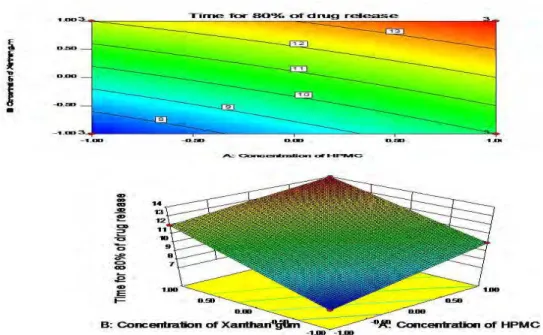
Data Analysis and Development of Polynomial Equation by Factorial design: The optimization study of the formulation was carried out using Design Expert software.
Statistical second order model interaction and polynomial terms were generated for the response variable. The 3D response curve and 2D contour plot were also generated.
The equation derived for the time required for 80% drug release of the factorial formulations is: Response = 10.75 + 1.25A + 2.25B -0.25AB
Where; Response – time for 80% of drug release. A- Concentration of HPMC.
B- Concentration of Xanthan gum.
The + sign of both the factors indicate that they are directly proportional to the response.
That is as the concentration of HPMC and Xanthan Gum increases the time for the drug release also increases correspondingly. (Figure 7)
0 20 40 60 80 100 120
0 2 4 6 8 10 12 14
%
C
u
m
u
la
ti
ve d
ru
g
r
el
ea
se
Time (hours)
Dissolution profile of batches A1-A9
A1 A2 A3 A4 A5 A6 A7 A8 A9
0 50 100 150
0 5 10 15
%
C
um
ul
a
ti
v
e
dr
ug
rel
ea
se
Time (hrs)
Marketed
F1
F2
F3
Figure 7: Contour plot and Response surface plot showing effect of factorial variables:
Conclusion:
The system consist of drug containing core gastro retentive floating tablet which is coated with upper layer of drug containing fast dissolving tablet. The outer coat dissolves in the first 10 mins, thus bringing the plasma drug concentration in the therapeutic window. Then the core tablet eventually floating in the GIT over a period of 12 hours slowly releases the drug to maintain the plasma drug concentration in the therapeutic window over the period.
A 22
ACKNOWLEDGMENT:
full factorial design was studied that revealed that the concentration of HPMC and Xanthan gum significantly affects the dependent variable.
The authors are thankful to the Principal Dr. Parag Gide, Dr. L.H.Hiranandani College of Pharmacy, Ulhasnagar and HSNC board for providing the research facilities. We are also thankful to Head, Department of pharmaceutics, Dr. L. H. Hiranandani college of Pharmacy for giving the facilities to carry out the work.
REFERENCES:
[1] K.Karunakar*, G. Jayapal Reddy, A.Sukumar, J.V.Rao, Y.Surendra; “ Formulation And In Vitro Evaluation Of Gastroretentive Oral Matrix Tablets Of Potential Anti- HIV Agent”; International Journal Of Pharmacy And Biological Sciences. Volume 1| Issue 4 |Oct-Dec |2011|593-600.
[2] Shreeraj H. Shah, Jayvadan K. Patel, Nirav V. Patel; Formulation and development of gastroretentive multi-layer coated tablets containing Gatifloxacin against H.pylori infection; Scholars Research Library Der Pharmacia Lettre, 2010, 2(4): 384-392. [3] Mohrle, R., in: Liberman, Lachman L. Schwartz. Pharmaceutical Dosage Form, Vol 1, Marcel Decker Inc., New York, 2005. [4] Srujan Reddy, Palash Das, Harika Das, Arpita Ghosh; MUPS (Multiple Unit Pellet System) Tablets – A Brief Review; JOURNAL OF
PHARMACEUTICAL AND BIOMEDICAL SCIENCES, Vol. 12, Issue 12,1-5.
[5] Ashwini Rajendra, Bushetti SS and Archana Giri; Design and Evaluation of Compression Coated Formulations for an Antiinflammatory Drug Based on Modified okra Mucilage; Journal of Applied Pharmaceutical Science 02 (07); 2012: 238-245. [6] Leon Lachman, Herbert Liberman, Joseph L. Kanig, in: Theory and Practice of Industrial Pharmacy, 2nd Edn. Varghese Publication,
1985.
[7] Herbert A. Lieberman, Leon lachman and Joseph B. Schwartz; Pharmaceutical Dosage forms; Tablet, Vol. – I 2nd
[8] Raymond C Rowe, Paul J Sheskey and Marian E Quinn; Handbook of Pharmaceutical excipients. 6
edition.
th
[9] T. Akelesh *, S.B.Sapkal, R.Sivakumar, R.Jothi, R.Venkatnarayanan; “Formulation development of gastro retentive floating tablet of acyclovir using natural gums”; Scholars Research Library,Der Pharmacia Lettre, 2011, 3(1): 254-261.
edition.
[10] Margadele J. O Neil, Patricia E, Heckelman, Cherie V. Koch, Kristin J. Roman et.al; “The Merk Index” 14th
[11] Pare A, Yadav SK and Patil UK*; Formulation and Evaluation of Effervescent Floating Tablet of Amlodipine Besylate; Research J. Pharm. and Tech. 1(4): Oct.-Dec. 2008,526-530.
edition, “An Encyclopedia of chemical, drug and biological”. Pg.no: 319
[12] S.B.Shirsand , P.V.Swamy ,V.Kusum Devi , Sarasija Suresh ; Formulation Design and Optimization of Fast Dissolving Effervescent
Tablets of Clonazepam . RGUHS Journal of Pharmaceutical Sciences. P.g 202 - 208.
[13] Modi Foram. P, Patel. Priyal R. ; “ Fromulation, Optimization and evaluation of fixed dose combination of Moisture Barrier Film
Coated Bilayer tablet of Artesunate and Amodiaquine Hydrochloride.” International Journal of PharmTech Research, Vol – 3, No. 4, P.g: 2124-2134, Oct – Dec 2011.