*Correspondence: KondiVanitha. Vishnu Institute of Pharmaceutical Education and Research, Narsapur, MEDAK. E-mail: [email protected]
A
vol. 49, n. 4, oct./dec., 2013
Floating tablets of hydralazine hydrochloride: optimization and
evaluation
Kondi Vanitha
1,*, Mohan Varma
2, Alluri Ramesh
11Vishnu Institute of Pharmaceutical Education and Research,Narsapur, India, 2Shri Vishnu College of Pharmacy, Medak, India
Hydralazine hydrochloride has a half-life of 2 to 4 hours with an oral bioavailability of 26-50%. Since hydralazine has a demethylating effect on various suppressor genes, it can be used in various types of cancer to support chemotherapy. The purpose of this study was to optimize and evaluate loating tablets of hydralazine hydrochloride designed to prolong the gastric residence time and to provide controlled release of the drug for 14 h. The loating tablets of hydralazine hydrochloride were prepared by the wet granulation method. Semi-synthetic polymers of hydroxy propyl methyl cellulose (HPMC K100M) and ethyl cellulose were used as the release retarding agents. A 22 factorial design was applied to systematically
optimize the drug release proile. The concentrations of HPMC K100M and ethyl cellulose were optimized to provide controlled release of hydralazine for 14h. Non-Fickian diffusion release transport was conirmed as the release mechanism for the optimized formulation and the predicted values agreed well with the experimental values. Drug excipient compatibility studies were investigated by FTIR, DSC and XRD. These data indicate that there were no chemical interactions between the drug and the polymer. In vivo X-ray imaging showed loating tablet performance in rabbits.
Uniterms: Hydralazine/floating tablets/evaluation. Hydralazine/floating tablets/optimization. Hydralazine/loating tablets/controlled release. In vivo X-ray/tablets performance. Cancer/treatment.
O cloridrato de hidralazina apresenta meia-vida de 2 a 4 horas, com biodisponibilidade oral de 26-50%. Uma vez que a hidralazina possui efeito desmetilante em vários genes supressores, elapode ser utilizada para diversos tipos de câncer, em apoio à quimioterapia. O objetivo deste estudo foi o de avaliar e otimizar comprimidos lutuantes de cloridrato de hidralazina, planejados para prolongar o tempo de residência gástrica e proporcionar liberação controlada do fármaco por 14 h. Os comprimidos lutuantes de cloridrato de hidralazina foram preparados pelo método de granulação úmida. Polímeros semi-sintéticos de hidroxipropiletil celulose (HPMCK100M) e acetato de celulose foram utilizados como agente de retardamento de liberação. Aplicou-se planejamento fatorial 22 para otimizar sistematicamente o peril de liberação do fármaco. As concentrações de HPMCK100M e de etilcelulose foram otimizadas para se obter liberação controlada de hidralazina durante 14 h. O transporte de liberação de difusão não-Fickiana foi conirmado como o mecanismo de liberação para a formulação otimizada e os valores previstos estiveram de acordo com os valores experimentais. Estudos de compatibilidade entre fármaco e excipiente foram realizados por FTIR, DSC e DRX. Estes dados indicaram que não havia interação química entre o fármaco e o polímero. Imagens de raios-X in vivo mostraram o desempenho dos comprimidos lutuantes em coelhos.
Unitermos: Hidralazina/comprimidos flutuantes/avaliação. Hidralazina/comprimidos flutuantes/ otimização. Hidralazina/comprimidos lutuantes/liberação controlada. Raios X in vivo/desempenho de comprimidos. Cancer/tratamento.
INTRODUCTION
Oral drug delivery systems represent an important area of controlled drug delivery, as such dosage forms
have the major advantage of patient compliance (Dalavi
al., 2007); (ii) have a narrow absorption window in the small intestinal region (Streobel et al., 2006); (iii) are unstable in the intestinal environment and (iv) have poor solubility in a high pH environment. Various dosage forms have been developed for gastric retention; these include loating tablets (Sathis et al., 2011) loating beads,
pellets, floating granules and floating microspheres. Hydralazine is a directly acting smooth muscle relaxant used to treat hypertension by acting as a vasodilator. It is the irst-line therapy for hypertension in pregnancy along with methyldopa.The drug is insoluble in water and has a half-life of 2 to 4hours with an oral bioavailability of 26-50%. In the recent years, more attention has been directed towards hydralazine, since it has a demethylating effect on various suppressor genes. Therefore, it can be used in various types of cancer to support chemotherapy (Melike, Benek, 2012; Song et al., 2009).In the present study, an attempt was made to optimize (Singh et al.,
2009) the concentration of semi-synthetic polymers for the controlled release of hydralazine and to minimize its side effects by administration of a lower dose. As hydralazine can also be used as a support in cancer therapy, the controlled release formulation was prepared using various polymers. Sodium bicarbonate was used as a gas generating agent. Drug-excipient compatibility was studied by Fourier transform infrared spectroscopy (FT-IR), differential scanning calorimetry (DSC) and X-ray diffraction(XRD). An in vivo X-ray imaging study was performed to show loating tablet performance in rabbits.
MATERIAL AND METHODS
Hydralazine was donated by Hetero Drugs Ltd., Hyderabad, India. HPMC K100M and ethyl cellulose were obtained as gift samples from Matrix Labs, Hyderabad. Other ingredients used were of analytical grade.
Optimization of formulation
The optimization technique encompassed designing a set of experiments that could reliably measure the response variables, itting a mathematical model to the data, conducting appropriate statistical tests to assure that the best possible model was chosen, and determining the values of the independent formulation variables to produce the optimum response (Gupta et al., 2008).
Experimental design
In the preliminary studies, eight formulations with different drug/polymer ratios were formulated based on a 22 factorial design (Madan et al., 2009). The design
included two factors each evaluated at two levels. The proportion of the retardant materials HPMC K100M (X1) and ethyl cellulose (X2) were selected as the independent
variables. Drug release at 1.5 (Y1),4 (Y2), 8 (Y3) and 14 hours (Y4) was selected as the dependent variable in this
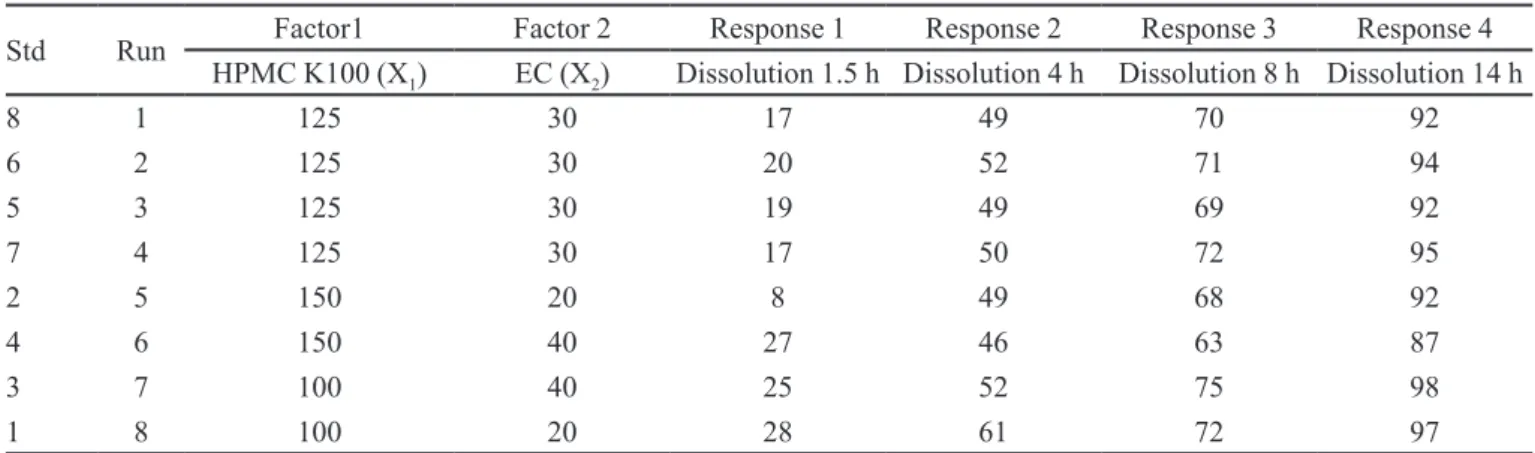
study. The plan of the experiment is given in Table I.
Preparation of tablets
The formulations were prepared by the wet granulation method (Garget al., 2009) at random following a 22 factorial design. The various excipients used are listed
in Table II. All the ingredients, expect magnesium stearate and talc, were thoroughly mixed and passed through a no.60 sieve. Granulation was performed with a solution of 0.5% PVP K 30 in ethyl alcohol. The wet mass was passed through a no.40 sieve and dried at 50 oC for 10 min. The
dried granules were lubricated with magnesium stearate and talc and compressed into tablets using a Cadmach 21 station rotary tablet compression machine.
In vitro buoyancy studies
The tablets were placed in a 100 mL beaker containing 0.1N HCl at a temperature of37± 0.5 oC. The
time taken for the tablet to rise to the surface is called the loating lag time. The total period of time the dosage form remains on the surface of the media is called the total loating time.
Dissolution studies
In vitro dissolution study of hydralazine was performed using a USP Type I basket dissolution apparatus in 900 mL of 0.1NHCl at 37 oC(50 rpm) (Sameer,Singh
et al., 2011). Samples were withdrawn, iltered, suitably
diluted and assayed at 302 nm on a UV spectrophotometer. The samples were then replaced with fresh dissolution medium.
TABLE I - Plan of the experiments with coded levels of the variables
Sl. No. Variables X1 X2
1 X0 - 1 - 1
2 X1 (HPMC K100M) 1 - 1
3 X2 (Ethyl cellulose) -1 1
4 X1X2 (Interaction) 1 1
5 Midpoint
6 Midpoint
7 Midpoint
TABLE III - Experimental plan and observed response values from randomized runs in a 22 factorial design for the development of loating tablets containing hydralazine hydrochloride
Std Run Factor1 Factor 2 Response 1 Response 2 Response 3 Response 4
HPMC K100 (X1) EC (X2) Dissolution 1.5 h Dissolution 4 h Dissolution 8 h Dissolution 14 h
8 1 125 30 17 49 70 92
6 2 125 30 20 52 71 94
5 3 125 30 19 49 69 92
7 4 125 30 17 50 72 95
2 5 150 20 8 49 68 92
4 6 150 40 27 46 63 87
3 7 100 40 25 52 75 98
1 8 100 20 28 61 72 97
TABLE II - Formulation of loating tablets of hydralazine
Ingredients F1 F2 F3 F4 F5 F6 F7 F8
Hydralazine 50 50 50 50 50 50 50 50
HPMCK100M 100 150 100 150 125 125 125 125
Ethyl cellulose 20 20 40 40 30 30 30 30
NaHCO3 45 45 45 45 45 45 45 45
Mgstearate 6 6 6 6 6 6 6 6
Talc 6 6 6 6 6 6 6 6
Lactose 58 8 38 3 38 38 38 38
Total wt. 300 300 300 300 300 300 300 300
All values are in given in mg
Kinetic modeling of drug release
The dissolution proile of all the batches was itted to zero order, irst order, Higuchi, Korsemeyer and Peppas models to ascertain the kinetic modeling of drug release (Dave et al., 2004).
Drug-polymer compatibility
FT-IR analysis
FT-IR was carried out to assess the interaction between the drug and the tablet excipients. For this, sufficient amounts of the pure drug and powdered hydralazine tablets were scanned over a wavenumber range of 4000 to 650 cm-1 at a resolution of 4 cm-1on a BRUKER
Alpha FT-IR spectrometer (serial number:200218). The system was operated in transmission mode.
DSC analysis
Thermal analysis were carried out using a differential scanning calorimeter (Perkin Elmer DSC Pyris-1, Perkin Elmer Inc.).
XRD studies
Diffractograms of the drug, HPMC and floating tablets were obtained using a Philips PW 1830 X-ray diffractometer.
In vivo radio imaging study
The optimized loating tablets excluding the drug and containing barium sulfate (50 mg per tablet) were prepared and studied for in vivo X-ray imaging study to establish the product performance in rabbits
RESULTS AND DISCUSSION
The floating tablets containing hydralazine hydrochloride were prepared by the wet granulation method at random following a 22 factorial design.
provided suitable model equations involving the individual main factors and interaction factors for each investigated response after fitting these data. These models were evaluated statistically by applying one-way ANOVA. All these models were found to be signiicant (p < 0.05).
The model equations in terms actual factors generated by the Design-Expert 7.1.6 software are given below:
Dissolution after 1.5 h= 115.00 – 0.84 X1 – 2.35 X2 +
0.022 X1X2 [R2 = 0. 0.9181; p = 0.0388];
Dissolution after 4 h= 83.50 – 0.18 X1 – 0.30 X2
[R2 = 0.8954; p = 0.0338];
Dissolution after 8 h= 61.00 + 0.08 X1 + 0.95 X2 - 0.008
X1X2 [R2 = 0.9204; p = 0.0372]; and
Dissolution after 14 h= 94.00 + 0.02 X1 + 0.65 X2 -
0.006 X1X2 [R2 = 0.9420; p = 0.0231]
The main effects of factors X1 and X2 were larger
compared to the effects of their interaction, i.e. X1X2. The curvature effect was insigniicant and the steepest ascent method was chosen for optimization. X1 was the major factor; an increased polymer concentration reduced drug release, while ethyl cellulose had a negligible effect on drug release. Ethyl cellulose and HPMC K100M interaction was insigniicant.
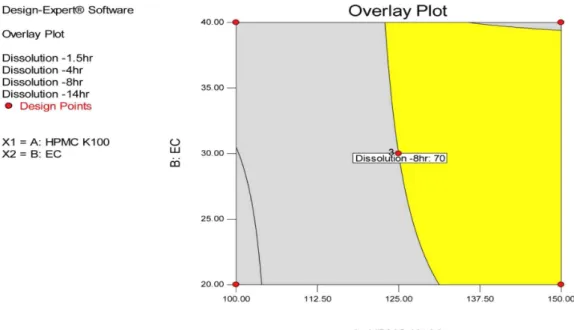
The limit for the estimated response for the preparation of optimized loating tablets of hydralazine hydrochloride was considered to be for1.5 h: NMT 25%; 4 h: 50-60%; 8 h: 60-70; and 14 h: NLT 80%. The overlay plot indicating the region of optimal process variable settings is presented in Figure 1.
ANOVA study
The coeficients of X1 were found to be signiicant
at p<0.05, conirming the signiicant effect on the selected responses. Increasing the concentration of HPMC K100M resulted in adecrease in the release of hydralazine. This was found to be close to unity, indicating good estimation of the coeficient. Similarly, Ri-squared was close to zero, which led to a good model. The values of Prob>F were less than 0.05, which indicated that the model terms were signiicant. In all cases, “Pred R-squared” values were in reasonable agreement with the “Adj R-squared” values. Adeq-Precision is a measure of the signal to noise ratio; a ratio > 4 is desirable. In this case, the Adeq-Precision values were 9.41, 9.29, 10.39 and 11.60 for 1.5 h, 4 h, 8 h and14 h, respectively, which indicated an adequate signal. However, both the variables favored the preparation of controlled release floating tablets of hydralazine. The statistical approach for formulation (optimization) is a useful tool, particularly when simultaneously evaluating several variables. The observed responses were in close agreement with the predicted values of the optimized formulations, demonstrating the feasibility of the optimization procedure for developing loating tablets of hydralazine hydrochloride.
According to the overlay plot (Figure 1), the optimum concentrations are 130 mg for X1 and 30 mg for X2.
In vitro buoyancy
All floating tablets of hydralazine hydrochloride floated well over a long period of time (not less than
FIGURE 1 - Overlay plot indicating the region of optimal process variable settings in the development of loating tablets of
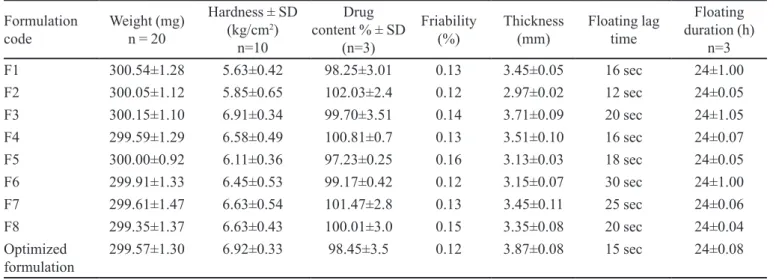
24 hours) with no minimum loating lag time (12 to 30 seconds) (Table IV). These floating tablets contained sodium bicarbonate as an effervescent agent. An effervescent agent generally produces CO2, which reduces the density of the system and makes it loat on an aqueous medium.
In vitro dissolution
In vitro hydralazine hydrochloride release from various hydralazine hydrochloride floating tablets in 0.1 N HCl is presented in Figure 2. The drug release was found to be sustained over a prolonged period of time (14 h). In these loating tablets, HPMC K100M and ethylcellulose were used as release retardant materials. The greater viscosity due to HPMC K100M may promote the formation of a highly viscous gel upon contact with aqueous luids. This would retard the drug release rate from these loating tablets. A comparison of the percentage
TABLE IV - Evaluation of the physicochemical parameters of hydralazine hydrochloride
Formulation code
Weight (mg) n = 20
Hardness ± SD (kg/cm2)
n=10
Drug content % ± SD
(n=3)
Friability (%)
Thickness (mm)
Floating lag time
Floating duration (h)
n=3
F1 300.54±1.28 5.63±0.42 98.25±3.01 0.13 3.45±0.05 16 sec 24±1.00
F2 300.05±1.12 5.85±0.65 102.03±2.4 0.12 2.97±0.02 12 sec 24±0.05
F3 300.15±1.10 6.91±0.34 99.70±3.51 0.14 3.71±0.09 20 sec 24±1.05
F4 299.59±1.29 6.58±0.49 100.81±0.7 0.13 3.51±0.10 16 sec 24±0.07
F5 300.00±0.92 6.11±0.36 97.23±0.25 0.16 3.13±0.03 18 sec 24±0.05
F6 299.91±1.33 6.45±0.53 99.17±0.42 0.12 3.15±0.07 30 sec 24±1.00
F7 299.61±1.47 6.63±0.54 101.47±2.8 0.13 3.45±0.11 25 sec 24±0.06
F8 299.35±1.37 6.63±0.43 100.01±3.0 0.15 3.35±0.08 20 sec 24±0.04
Optimized formulation
299.57±1.30 6.92±0.33 98.45±3.5 0.12 3.87±0.08 15 sec 24±0.08
TABLE V - Comparison of percentage ofdrug release between the experimented (E) and predicted (P) values for the most probable optimal formulation
Time interval Predicted value Experimental value
1.5h NMT 25% 24.05
4h 50-60% 53.49
8h 60-70% 67.17
14h NLT 80% 85.26
of drug release using the Experimented (E) and Predicted (P) values for the most probable optimal formulation are given in Table V.
Analysis of drug release data
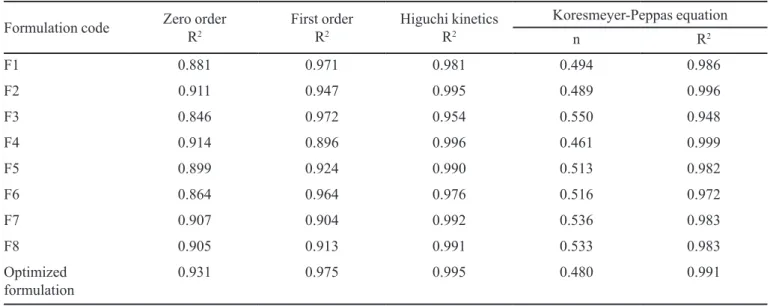
the highest coeficients of determination (R2) was shown
by both the Higuchi and irst order models followed by zero order, which indicates that drug release followed the diffusion mechanism. The results of the in vitro release data were itted to the Korsemeyer-Peppas equation to analyze the release pattern of the drug from the polymeric system. The values of “n” were in the range of 0.48-0.55, indicating that drug release followed Fickian diffusion.
Drug-polymer compatibility
FT-IR analysis
T h e F T- I R s p e c t r a o f p u r e h y d r a l a z i n e hydrochloride, the optimized formulation, HPMC K100M and ethyl cellulose are presented in Figure 3. The characteristic peaks were at3218.41 cm-1 (N-H stretching),
3028.47 cm-1(aromatic C-H stretching), 2974 cm-1
TABLE VI - Drug release kinetics of loating tablets of hydralazine hydrochloride
Formulation code Zero order
R2
First order R2
Higuchi kinetics R2
Koresmeyer-Peppas equation
n R2
F1 0.881 0.971 0.981 0.494 0.986
F2 0.911 0.947 0.995 0.489 0.996
F3 0.846 0.972 0.954 0.550 0.948
F4 0.914 0.896 0.996 0.461 0.999
F5 0.899 0.924 0.990 0.513 0.982
F6 0.864 0.964 0.976 0.516 0.972
F7 0.907 0.904 0.992 0.536 0.983
F8 0.905 0.913 0.991 0.533 0.983
Optimized formulation
0.931 0.975 0.995 0.480 0.991
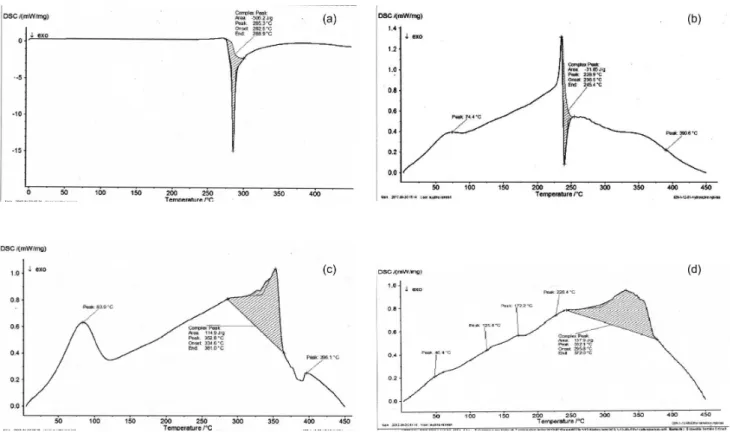
FIGURE 4 - DSC thermograms of the pure drug (a), the optimized formulation (b), HPMC K 100M (c) and ethyl cellulose (d).
(CH stretching due to methyl groups), 2904-1674 cm-1
(aromatic C-H vibrations), 2804 cm-1(C-H stretching),
2029-1870 cm-1(C=C stretching) and 1673-1467 cm-1(C-C
stretching due to the aromatic ring). In the optimized formulation, the main bands of hydralazine were detected at a lower intensity due to the polymers. The characteristic peaks present in the FT-IR spectrum of both HPMC K100M and ethylcellulose also appeared in the spectra of loating tablets of hydralazine hydrochloride. These phenomena indicate that there was an absence of any chemical interaction between the drug and the excipients.
DSC analysis
D S C t h e r m o g r a m s o f p u r e h y d r a l a z i n e hydrochloride, the optimized formulation, HPMC K100M and ethyl cellulose are presented in Figure 4. The DSC of pure hydralazine hydrochloride showed an endothermic peak at 282.5 °C, indicating the melting point of drug. In the DSC of HPMC K100M, broad endotherm at 83.9 °C was observed, which may have been due to evaporation of absorbed water, as well as a broad endotherm at 352.8 °C indicated the absence of a sharp melting point. In ethyl cellulose, a broad endotherm at 332.8 °C indicated the absence of a sharp melting point. The characteristic peaks that appeared in pure hydralazine hydrochloride were present in the optimized formulation and were absent
in the DSC thermograms of both HPMC K100M and ethylcellulose. These results indicate the absence of any chemical interactions between the drug and the excipients used in the formulation.
XRD analysis
The XRD pattern of pure hydralazine hydrochloride, the optimized formulation, HPMC K100M and ethyl cellulose are presented in Figure 5. The XRD pattern of hydralazine hydrochloride indicated crystalline characteristics, which was similar to the pattern of the optimized loating tablets of hydralazine hydrochloride; the polymer diffractograms showed an amorphous pattern.
In vivo radio imaging study
the handling of experimental animals was obtained from the Vishnu institutional animal ethical committee (IAEC No.1358/ac/10/cpcsea) constituted for this purpose.
CONCLUSION
A floating drug delivery system is a promising approach to achieve in vitro buoyancy and extended drug release using the synthetic polymer HPMCK100M, ethyl cellulose and gas generating agent sodium bicarbonate. A systematic study using a 22 factorial design revealed that,
by selecting a suitable composition of HPMCK100M and ethyl cellulose, the desired dissolution proile could
be achieved. The regression coefficient (R2) values of
the release data of all the formulations were obtained by the curve fitting method for the zero order, first order, Higuchi and the Korsemeyer-Peppas models. Most of the formulations followed the Korsemeyer and Higuchi models. The R2 value of the optimized formulation
was 0.991 and the n value was 0.48, indicating Fickian release governed by drug diffusion and the absence of an interaction between the drug and the polymer. An in vivo
X-ray imaging study clearly indicated that the prepared optimized loating tablet was retained in the rabbit stomach over a prolonged period of time and showed good in vivo
performance.
ACKNOWLEDGMENTS
We a c k n o w l e d g e w i t h t h a n k s P r o f . C . V. S . Subramanyam, Professor & Principal, Gokaraju Rangaraju college of pharmacy, Hyderabad for providing support in Optimization techniques and the software.
REFERENCES
DALAVI, V.V.; PATIL, J.S. Statistical optimization and development of gastro retentive system of an antiretroviral drug using a 32 factorial design. Indian J. Pharm. Educ.
Res., v.44, p.236-242, 2012. FIGURE 6 - X ray photograph of the optimized formulation in
a rabbit after 6 h.
DAVE, B.S.; AMIN, A.F.; PATEL, M.M. Gastroretentive drug delivery system of ranitidine hydrochloride:formulation and In Vitro evaluation. AAPS Pharmscitech., v.5, p.77-82, 2004.
GARG, R.; GUPTA, G.D. Preparation and evaluation of gastrorententive floating tablets of Silymarin. Chem. Pharm. Bull, v.57, p.545-549,2009.
GUPTA, R.; PATHAK, K. Optimization studies on floating multiparticulate gastroretentive drug delivery system of famotidine. Drug Dev. Ind. Pharm., v.34, p.1201-1208, 2008.
MADAN MOHAN, K.; NITA, M.; LAKSHMI KANTA, G.; BIJAN KUMAR, G. Multiunit loating drug delivery of rosiglitazone maleate: development, characterization, statistical optimization of drug release and InVivo
evaluation. AAPS Pharmscitech., v.10, p.887-899, 2009.
MELIKE, U.; BENEK, C. Design of hydralazine hydrochloride matrix tablets based on various polymers and lipids. Indian J. Pharm. Educ. Res., v.46, p.75-87, 2012.
SAMEER, S.; KALPANA, P.; PATHAK, A.K.; MISHRA, A. Formulation and evaluation of loating tablet of captopril.
Int. J. Pharm. Technol. Res.,v.13, p.333-341, 2011.
SATHIS KUMAR, D.; SANTHOS, K.; DAVID, B.; HARANI, A.; VENKATESHWAR, R. Formulation and evaluation of bi-layer floating tablets of ziprasidone HCl and trihexyphenidyl HCl. Braz. J. Pharm. Sci., v.47, p.545-553, 2011.
SINGH, B.; PAHUJA, S.; KAPIL, R.; AHUJA, N. Formulation development of oral controlled release tablets of hydralazine: optimization of drug release and bioadhesive characteristics.
Acta Pharm., v.59, p.1-13, 2009.
SONG, Y.; ZHANG, C. Hydralazine inhibits human cervical cancer cell growth in vitro in association with APC demethylation and re-expression. Cancer Chemother. Pharmacol., v.63, p.605-613, 2009.
S T R E O B E L , A . ; S I E P M A N N , J . ; B O D M E I E R . , R . Gastroretentive drug delivery systems. Expert. Opin. Drug Del., v.3, p.217-233, 2006.
YUVERAJ SINGH, T.; PUSHPENDRA SINGH, N.; GARIMA RANI, O. Development and evaluation of floating microspheres of verapamil hydrochloride. Braz. J. Pharm. Sci.,v.43, p.529-534, 2007.
ZHENPING, W.; ZHANFENG,Y.; DIANZHOU,B. Design and evaluation of a two layer loating tablet for gastric retention using cisalpine as a model drug. Drug Dev. Ind. Pharm., v.27, p.469-474, 2001.