FUNDAÇÃO GETULIO VARGAS
ESCOLA BRASILEIRA DE ADMINISTRAÇÃO PÚBLICA E DE EMPRESAS
EDSON OLIVEIRA DE MACEDO
ARE DEFAULTS A FAMILY AFFAIR?
THE RELATIONSHIP BETWEEN KINSHIP AND MICROLOAN PERFORMANCE
EDSON OLIVEIRA DE MACEDO
Are Defaults a Family Affair?
The Relationship between Kinship and Microloan Performance
Dissertação submetida à Escola Brasileira de Administração Pública e de Empresas como requisito parcial para a obtenção do grau de Mestre em Administração
Área de concentração: Gestão de empresas
Orientador: Patrick Gottfried Behr
Ficha catalográfica elaborada pela Biblioteca Mario Henrique Simonsen/FGV
Macedo, Edson Oliveira de
Are defaults a family affair? : the relationship between kinship and microloan performance / Edson Oliveira de Macedo. – 2013.
32 f.
Dissertação (mestrado) - Escola Brasileira de Administração Pública e de Empresas, Centro de Formação Acadêmica e Pesquisa.
Orientador: Patrick Gottfried Behr. Inclui bibliografia.
1. Microfinanças. 2. Parentesco. I. Behr, Patrick Gottfried. II. Escola Brasileira de Administração Pública e de Empresas. Centro de Formação Acadêmica e Pesquisa. III. Título.
F U N D A Ç Ã O
GETU LI O V A R G A S
E D S O N O L I V E I R A D E M A C E D O
A R E D E F A U L T S A F A M I L Y A F F A I R ? T H E R E L A T I O N S H I P B E T W E E N K I N S H I P A N D M I C R O L O A N P E R F O R M A N C E
Dissertação a p r e s e n t a d a a o C u r s o d e M e s t r a d o e m Administração d a E s c o l a B r a s i l e i r a d e Administração Pública e d e E m p r e s a s p a r a obtenção d o g r a u d e M e s t r e e m Administração.
D a t a d a d e f e s a : 2 8 / 0 8 / 2 0 1 3
A p r o v a d a e m :
Q$
l
< 6
j
43
A S S I N A T U R A D O S M E M B R O S D A B A N C A E X A M I N A D O R A
AGRADECIMENTOS
A Deus, pela oportunidade, saúde e paz para que eu pudesse chegar até aqui.
À Juliana, eterna namorada, esposa e companheira de vida, pelo apoio nos momentos mais difíceis dessa jornada, pela paciência nos diversos momentos de ausência e por acreditar.
A minha mãe, Narcisa, meu pai, João, e meu irmão, Jeferson, pela confiança e apoio.
Aos professores da EBAPE, em particular ao Prof. Patrick Behr, pela orientação no desenvolvimento deste trabalho e pelo aprendizado no campo de microfinanças em geral. Agradeço também ao Prof. Rafael Goldszmidt, pelo apoio ao longo do mestrado, pela oportunidade atuar na pesquisa aplicada em microfinanças e pelo apoio neste trabalho.
Aos funcionários da EBAPE, em particular a Celene Silva Melo, pela paciência e conselhos ao longo do curso.
ABSTRACT
I exploit a large data set of microloans from a MFI of Brazilian northeastern to investigate whether the kinship ties influence the likelihood of repayment. I found evidence that the kinship relationship between members of a group loan positively affects repayment. Groups in which all members are connected somehow by kinship have a 24% lower probability of default compared to groups without such connections. Additionally, I show that a group loan with 100% of kinship has a 45% lower probability of default in the first loan than groups lacking of kinship ties among members. I also found a negative relationship between kinship and change in the group formation. These results allow us to infer about the mechanisms of group lending and suggest that the greatest impact of kinship on microloan performance occur through screening activities. The results also suggest that the improvement on monitoring activities outweigh the weakening of enforcement.
RESUMO
A partir de uma grande base de dados fornecida por uma instituição de microcrédito do nordeste brasileiro, a relação entre parentesco e inadimplência é analisada. O presente trabalho mostra evidências de que o parentesco entre membros de um grupo solidário afeta positivamente a adimplência. Grupos em que todos os membros possuíam algum laço de parentesco entre si apresentaram uma probabilidade 24% menor de inadimplência do que grupo sem esses laços. Além disso, quando considerado apenas o primeiro empréstimo, grupos com 100% de parentesco entre os membros apresentaram uma probabilidade 45% menor de inadimplência em comparação com membros sem relações de parentesco. Os resultados deste trabalho também mostram que há uma relação negativa entre parentesco e probabilidade de mudança na formação de um grupo solidário. Essas análises permitem fazer inferências acerca dos mecanismos pelos quais o parentesco afeta o desempenho do microcrédito. Os resultados sugerem que o parentesco possui um benefício maior no processo de autosseleção do grupo. Além disso, os resultados também sugerem que o impacto positivo do parentesco nas atividades de automonitoramento compensa o enfraquecimento das atividades de enforcement.
Contents
1 Introduction ... 9
2 Data and identification strategy ... 14
2.1 Information about the MFI and data collected ... 14
2.2 Kinship measure and surnames ... 15
2.3 Sample composition and summary statistics ... 16
2.4 Empirical approach ... 18
3 Kinship and microloan performance ... 20
3.1 Kinship and overall microloan performance ... 20
3.2 Kinship and loan performance in initial and subsequent loans ... 21
4 Kinship and group formation change ... 23
5 Robustness tests ... 24
5.1 Robustness tests for different measures of arrears ... 24
5.2 Robustness tests for different cut-off values of Kinship ... 26
6 Conclusion ... 27
References ... 29
9
1 Introduction
Access to credit is one of the key elements for the growth of a business (Beck & Demirguc-Kunt, 2006). Thus, small businesses owned by poor people have more difficulties developing. This population has neither collateral nor a high enough credit rating to offer banks a way to overcome the asymmetric information. Microcredit emerged in this context, providing credit to the population normally excluded from the regular credit markets.
The success of Grameen Bank has brought this subject into focus. Despite not having been the first institution to offer microcredit, the Grameen Bank case drew attention because of its operational model, based on group loans. When considering Joseph Stiglitz’s theory of asymmetric information (Stiglitz & Weiss, 1981), we can find several indications of the advantages of this arrangement. The collective action of the group loan has advantages in screening and monitoring borrowers, and reducing the incentives of a voluntary default. Moreover, depending on the type of relationship that members have with each other, the group loan can employ its power of social sanctions to ensure repayment. This model has gained popularity, and it has been replicated by several institutions around the world, including Brazil, where the CrediAmigo1 is considered the "Brazilian Grameen" (Neri, 2008). Part of this popularity is due not only to the success of group loans, but also to the joint liability scheme2. In this scheme, members of a group loan are jointly liable for their peers. If one of the members fails to repay, the other members of the group must repay not only their own obligations, but also that part owed by the defaulter. If the entire group decides to default, all members will lose access to new loans3. In Brazil, in addition to this sanction, the members receive a negative record in the national credit registry, preventing access to credit not only in other financial institutions, but in almost all institutions that provide consumer credit (supermarkets, department stores, etc.)4.
The mainstream literature on joint liability and its advantages has emerged from theoretical models based on the principal-agent problem (Stiglitz, 1990; Banerjee et al., 1994; Besley & Coate, 1995, and Ghatak, 1999). The group loan reduces the MFI’s need of information. Many MFI’s do not directly interfere in the group’s formation, so that the members themselves select their peers (screening). This helps to reduce the problem of adverse selection, as bad borrowers are usually best identified by their peers and tend to be
1 The Microcredit Program of the Development Bank of the Brazilian Northeast (BNB). 2
Group loans and joint liability schemes may be disassociated. The Grameen Bank, for example, works with group loans, but the members of these groups are not responsible for the repayment of their peers in case of peer default.
3 The cited scheme is the most common, but may vary according to each MFI. 4
10
excluded from the group formation. The arrangement of joint liability also contributes to the reduction of the moral hazard problem, since, being responsible for the repayment of his peers, the members have incentive to monitor their peers’ behaviors (monitoring) and impose sanctions on potential defaulters (enforcement).
Even with the success of some theoretical studies which demonstrate the advantages of joint liability, the controversy on the subject remains in empirical analyses. Various studies have found a positive effect (Al-azzam & Mimouni, 2012; Hermes et al., 2005; Wenner, 1995; Wydick, 1999; Zeller, 1998), while others have shown no effect or even a negative one (Bratton, 1986; Diagne & Zeller, 2001; Giné & Karlan, 2011; Godquin, 2004; Karlan & Zinman, 2009; Sharma & Zeller, 1997).
The research of Giné & Karlan (2011) is particularly interesting because of its approach of the issue. The researchers not only tried to test the advantages of group lending, but compared this scheme to the individual lending arrangement. The authors used two randomized trials in order to test the overall effect of group lending and its mechanisms. They found no increase in default between groups randomly removed from the joint-liability scheme. In addition, they found no differences between the two schemes when randomly assigning new customers for either group or individual lending arrangements. Despite these random assignments, weekly meetings with other customers remained even for those in individual liability schemes. This could have been a problem because of the difficulty in isolating the mechanisms of both schemes. In such meetings, personal problems and individual delinquencies become public. Since most of these meetings occur in small villages, a default might be very embarrassing. Thus, even for those customers assigned to the individual liability scheme, peer monitoring and peer pressure might be effective mechanisms in discouraging loan default.
11
peers with a low likelihood of voluntary defaulting. In these cases, joint liability would be effective, not by the means of peer pressure, but by the improvement in the screening process.
Some researchers went beyond this discussion analyzing more specific questions regarding the dynamics of group loans. Among the diverse aspects involved in the functioning of a group loan, many authors have been paying special attention to the role of social ties. The findings on this issue, however, remain controversial. While some empirical studies (Hermes et al., 2005; Karlan, 2007) confirm the positive results predicted by the theoretical models (Besley et al., 1993; Besley & Coate, 1995; Karlan et al., 2009), others have found no effect of social tie (Wydick, 1999), or have found a negative outcome (Ahlin & Townsend, 2007).
Ahlin & Townsend (2007), for example, exploited a database from a survey applied to 262 group loans of a Thai MFI in order to address different theoretical models of joint liability and the mechanisms that could explain the model’s results. The authors found a positive relationship between repayment and the strength of social sanctions, suggesting a positive effect of enforcement mechanisms. However, the findings regarding social ties showed a negative effect on repayment. As suggested by the authors, this may be due to the weakening of the threats of sanctions. Despite the contribution of this research, only a few dimensions of social ties were assessed by the study. Moreover, given the cross-sectional analysis, the authors were unable to show a causal relationship.
Karlan's research (2007), though, tried to overcome the endogeneity problems exploiting data from a Peruvian microfinance institution (MFI). Due to the quasi-random group formation process used by the MFI, the author could use natural experimental design as his main identification strategy. Using geographical proximity and cultural similarity as measures of social connection, the author showed that individuals with stronger social connections to their peers have higher repayment and savings rates. Despite showing that the variables used were appropriated to measure social connection, the author recognized that such measures were wide-ranging and that more research on the relationship between social connections and group loan outcomes was needed.
12
social tie’s dimensions – is directly observable and less likely to produce the condition of multicollinearity.
Sharma & Zeller (1997) remarked that two possible effects are expected from group formation among members with kinship ties. First, the information that members have about their peers helps to reduce the incidences of adverse selection (by screening activities) and asymmetric information (by monitoring activities). On the other hand, the second possible outcome is the difficulty of imposing sanctions, given the closeness between the members, leading to a weakening of enforcement activities. In this study, I assess not only the overall effect that kinship may have on the microloan performance, but also the mechanisms through which such effect may be acting.
I exploit a large data set of microloans from a MFI of Brazilian northeastern to investigate whether the kinship ties between members of a group loan influence the likelihood of repayment. However, just this analysis does not allow us to infer about the mechanisms through which kinship could be influencing the repayment. Strong kinship ties may allow better screening and monitoring activities, but weaken the enforcement by the limited threats of sanctions. In order to try to assess the impact of kinship on screening, I investigate its impact on the first loan repayment and test for differences between these results and overall results. If Kinship presents a different result for the first loan, it may indicate that there is a greater effect of this variable on the screening activities. In order to try to isolate these effects on screening from other mechanisms, I investigate whether the kinship weaken the enforcement by testing its impact on the likelihood of a changing in group formation to a next loan. A positive result in this test may indicate that, indeed, kinship reduces the threats of sanctions, weakening the enforcement activities.
I have found evidence that the kinship relationship between members of a group loan with joint liability positively affects repayment. Groups in which all members are connected somehow by kinship have a 24% lower probability of default5 compared to groups without such connections. These results contribute to a better understanding of the impact of social ties on the performance of the group loans and speak to the literature that addressed the issue, but has not found conclusive results when leading with kinship in its analyses. In their construct of social ties, for example, Ahlin & Townsend (2007) addressed the kinship by testing whether the percentage of group members having a close relative in the group was related to a default at any time in history of the group. Using a sample of 219 group loans and
5 For the purposes of this study, default is defined as the loan that had at least one installment in arrears of more
13
a cross-sectional analysis, they have found a negative result of kinship on the microloan performance. The authors, however, did not control the changes in group formation during the group existence. Moreover, other variables could be causing multicollinearity problems, leading to bias in the result6.
Furthermore, I show that the impact of kinship on probability of default in the first loan of a group is higher than the impact on other loans. A group with 100% of kinship has a 45% lower probability of default than groups lacking of kinship ties among members. This difference suggests that the greatest impact of kinship on group loans occur through screening activities. Over time, the relationship between group members can get even stronger (Feigenberg et al., 2010), making it more difficult to impose sanctions and, thus, worsening the enforcement activities.
I also found a negative relationship between kinship and change in the group formation. Groups with 100% of kinship have a 20% lower probability of promoting a change in the formation of the group to the next loan after a default. This result provides evidence that there is a weakening of enforcement activities. It is possible that, by better understanding their peers, members of the groups are contingent oriented in cases of default from a relative. This effect, however, can be enhanced by fear of sanctions outside the context of the loan through kinship networks (Ferrara, 2003). However, the negative relationship between kinship and probability of default suggests that the improvement in screening and monitoring activities outweigh the weakening of enforcement.
Additionally, this study has the advantage of using a larger sample than other studies that examined the same subject. The analysis relies on 6,669 group loans, with five loans on average per group (a complete sample of 35,407 loans). In the research conducted by Karlan (2007), for example, the main tests were complemented with a survey conducted with 28 group loans. Although addressing kinship in this survey, the author did not find a significant result for this variable. This result may be due to the small sample size.
The above findings contribute to a better understanding of the group lending dynamics, by assessing a specific dimension of social ties: the kinship. The results of this paper allow us to infer about the mechanisms involved and suggest that kinship has a stronger effect on screening activities, while it may weaken the enforcement activities. However, the results also suggest that the improvement on monitoring activities outweigh the weakening of enforcement.
6 As remarked by the authors, the degree of relatedness could be correlated to the variables used to measure
14
These findings may be of interest to practitioners. The information on the degree of kinship can be taken into account in models of credit rating. A group with more relatives may have a bonus to its rating in order to achieve a loan approval. The results also serve as a subsidy for loss provisioning, to the extent that may contribute to a better prediction of defaults.
In the next section I provide information about the MFI institution and its lending process, describe the data, and outline the methodology used to analyze the data. Section three presents the empirical results on the relationship between kinship and microloan performance, while section four discusses results for the relationship between kinship and group formation change. Section five presents robustness tests to check the consistence of these results. Section six concludes.
2 Data and identification strategy
This section provides information about the MFI and describes the data collected, sample composition, summary statistics and my identification strategy.
2.1 Information about the MFI and data collected
The MFI that provided the data is a nonprofit institution and one of the biggest institutions operating in Brazilian northeast. The MFI has 27 branches and more than 20,000 active clients. The loan-transaction data set provided contains information on six branches over the period from January 2000 to January 2012.
This MFI operates with group loans under joint liability schemes. Individuals interested in applying for a microloan are informed about the joint liability rules and instructed to form a group loan of at least three members7. Loan officers do not interfere in the choice of the members. There are no rules against individuals who live in the same household becoming members in the same group loan. The requirement for this is that each member must own a business independently from each other. Thus, for example, a male individual can theoretically have his wife as a peer in the joint liability contract. However, according to the manager of one of the MFI branches, such situations are rare.
The lending contract is based on the joint liability scheme. If a member becomes a defaulter, his peers are responsible for the payment of his loan and are prevented from repaying their own loan installments until the defaulting party’s payment is completed. If the
7
15
other members decide not to assume the defaulter’s payment, all members are considered in default by the MFI. After the loan attains arrears of 90 days, the creditor can include their id numbers on a negative credit record. Thus, besides not being able to apply for a new loan with the MFI, they are prevented from any form of credit with other financial and commercial institutions. This is an important sanction to the members. The negative credit registry is a nationalized on-line database used for most of the companies providing credit in Brazil (financial or not). When applying for a credit in a department store, for example, the
customer’s id number will be checked by the store. If the number is presented in the negative
credit registry, the likelihood of getting the credit approved is almost zero.8
2.2 Kinship measure and surnames
The information about the kinship ties was unavailable. However, the full names of the members of each group were available9. Brazil has a paternalistic system of surnames. Usually, the last name belongs to the father's family and the middle name belongs to the mother's family10.
Given this arrangement, it is possible to infer the kinship between two people from their surnames coincidences. The kinship measure used in this work was obtained by comparing surnames. The surnames of the group members were arranged so that the coincidences could be verified. Since some groups presented different formations along its existence, the coincidences on surnames were verified for each formation of these groups.11
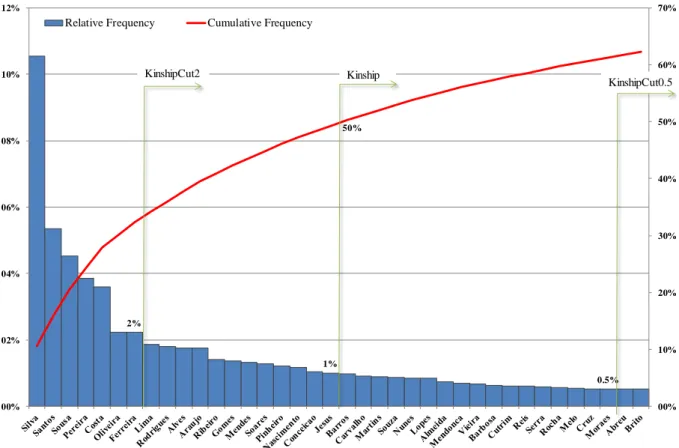
This methodology covered 31,960 customers who were part of some group over the period analyzed. Some customers had only one surname (instead of the typical two surnames). This assessment generated a surname data set with 62,135 observations. After removing the duplicates, the data set was reduced to 1,941 unique surnames12. However, as in other countries, if two individuals share a common surname, it does not mean that they have kinship tie. This issue is particularly problematic for small groups of people sharing well-known surnames13. Figure 1 presents the analyzed data set of surnames. From 1,941 unique
8
Few institutions, however, have rules to accept customers with negative credit record. For more information about credit bureaus in Brazil, see Pinheiro and Cabral (1999).
9 Just recently, the MFI started controlling this type of information, applying a more detailed questionnaire for
the granting of loans.
10 Brazilian law, however, does not restrict a different name arrangement. 11
This approach in building kinship measures is not new. Angelucci et al. (2010), for example, have already used this methodology successfully.
12 This data set was used only to construct the Kinship measure.
13 "Silva", for example, is one of these cases: from 31,960 clients analyzed, 6,561 have "Silva" as one of their
16
observations, 20 surnames were considered very common. Despite representing only 1% of the surnames, 50% of the clients had at least one of them. These surnames were not considered in the construction of the Kinship measure14. Thus, if two individuals shared the
surname “Jesus”, for example, a kinship tie was not considered. However, if these individual
shared the surname “Barros”, then a kinship tie was considered.
Figure 1. The surnames classification and the Kinship measures
2.3 Sample composition and summary statistics
The data set was provided at the individual-installment level. However, as stated, when one of the members default his loan, his peers are also considered to be in default. Thus, the information at individual level is not useful for analyses, since it is not possible to identify which member originated the default of the group. In addition, detailed information on individual characteristics is not present in the data set provided. Thus, for purposes of this study, data were aggregated at the level of group loans.
The information at the installment level was also not useful. Some registries have detailed records about all installments of a specific loan, even when the first loan was in
14 The other measures presented in the figure (KinshipCut2 and KinshipCut0.5) will be used for robustness tests
in later sections.
2% 1% 0.5% 50% 00% 10% 20% 30% 40% 50% 60% 70% 00% 02% 04% 06% 08% 10% 12%
Relative Frequency Cumulative Frequency
Kinship KinshipCut2
17
default. Other registries, however, stopped to record the repayment information when an installment was in default. Since the MFI does not allow groups to repay a new loan installment while a delinquency still exist in last installments, the data set at the loan level has enough information about loan performance. After the aggregation at the “group-loan” level, the sample size was reduced from 140,000 to 41,768 observations.
Furthermore, despite not receiving payments of individual members, exceptions may occur, and renegotiation can take place (considering the particularities of each case). I excluded the loans originated from renegotiations to avoid any potential noise in further analyses. Loans with installments outside of the period covered by the data set were also not considered, as it was not possible to evaluate the performance of these loans without information about all installments. After these adjustments, the base remained with 35,407 observations of 6,669 group loans, covering about 32,000 customers over the period from January 2000 to November 2011.
Table 1 summarizes information about loans operations and characteristics of the groups. Two dependent variables are the focus of the regression analyses: Arrears30 and GroupChangeN. The first one is a binary variable that equals one when the loan had at least one installment in arrears of more than 30 days over loan’s lifetime. Arrears30 was chosen for the main analyses because it is a conventional measure of interest in this field15. In addition, the MFI provider of the data set used in this study issues regular monitoring reports based on this variable. In the sample, only 8.57% of the loans were in that situation. GroupChangeN is a binary variable that equals to 1 if a group has changed after its original formation (equals to 1 in t if the formation is different in t+1). In this case, the sample is smaller because not all groups have more than one loan.
Kinship is an index obtained by the number of group members sharing kinship ties divided by the numbers of group members. Thus, if all group members are related to each other, Kinship is equal to 1. If there is no kinship relationship between them, then Kinship equals to zero. Kinship may be different from one group to another, as well as over time to the same group, since its formation may change. In the sample, for a given credit transaction, the group has on average 11.1% of their members with some kinship tie.
15 The Microfinance Information Exchange (MIX) report for the Latin American market, for example,
18
Loan, Group and Leader characteristics are used as control variables. A typical loan has, on average, 4.7 installments, an approved amount of 76.4% of the applied amount16. The typical group applying for this loan has, on average, 3.12 members. Its members are, on average, 42.2 years old. Within the group, 72.2% of the members are married and 14.8% of them are single. Leaders are, on average, 41.9 years old, while 61% of them are women and 54% are married. Branch binary variables are also used as control variables. In the sample, the branch number one has most of the clients, with 28% of the total, while only 6.4% of clients were served by branch number five.
Table 1 Summary statistics
2.4 Empirical approach
To examine the impact of kinship on the performance of microlending, I analyzed the relationship between the kinship index (as defined above) and loan with arrears of 30 days or more (Arrears30). To try to understand the mechanisms through which Kinship improves microloan performance, as well as their relationship with Arrears30 considering all loans, I
16
The information on rejected applications were not available.
Dependent Variables
Arrears30 35407 0.0857 0.2800 0 0 0 1 1
GroupChangeN 28736 0.4566 0.4981 0 0 0 1 1
Kinship 35407 0.1110 0.2517 0 0 0 0.6666667 1 Loan Characteristics
LoanInstalments (number of instalments) 35407 4.7718 0.6746 2 4 5 6 8 LoanShareApproved (%) 35407 0.7640 0.1652 0.10 0.46 0.79 1.00 1.20 Group Characteristics
GroupSize (number of members) 35407 3.1235 0.6981 2 2 3 4 7 GroupMarried (%) 35407 0.7223 0.2772 0.00 0.25 0.67 1.00 1.00 GroupSingle (%) 35407 0.1475 0.2189 0 0 0 0.67 1 GroupAge 35407 42.22 8.21 19.00 29.50 41.75 56.33 76.67 Leader Characteristics
LeaderAge 35407 41.92 12.04 18.00 24.00 41.00 63.00 85.00
LeaderWoman 35407 0.6095 0.4879 0 0 1 1 1
LeaderMarried 35407 0.5402 0.4984 0 0 1 1 1 Branches
Branch1 35407 0.2804 0.4492 0 0 0 1 1
Branch2 35407 0.2165 0.4119 0 0 0 1 1
Branch3 35407 0.0691 0.2537 0 0 0 1 1
Branch4 35407 0.1649 0.3711 0 0 0 1 1
Branch5 35407 0.0639 0.2445 0 0 0 1 1
Branch6 35407 0.2053 0.4039 0 0 0 1 1
Variable Obs Mean Std. Dev. Min p5 Median p95 Max
19
also analyzed the difference between the impact on the first loan default in comparison to the other loans. This approach is an attempt to isolate the effects of kinship in screening and monitoring activities. It is expected that the screening effect is stronger to the first loan17.
The main model used for this study is defined as the following OLS regression:
(1) , where Arrears30 is a binary variable that equals to 1 if the loan borrowed in year y quarter q by group loan i of branch b had at least one of the installments in arrears of 30 days or more; Control is the set of control variables related to the characteristics of credit transaction (loan officer, group leader and group characteristics)18; Branch is a dummy for MFI branch code; and Time is a dummy for the year y quarter t. I clustered the standard errors at the branch-year level as the borrowers in a year19 and branch are likely to share background characteristics as well as be exposed to the same environment. The results of these OLS estimations are shown in Tables 2 and 3 and discussed in section 3.1.
Yet in an effort to understand the mechanisms underlying the functioning of Kinship within groups, I tested the impact of Kinship in changes in the group formation when applying to a new loan (GroupChangeN). Controlling the default (Arrears30), the OLS estimation tests whether Kinship influences the probability of the group change to take a new loan. The model is tested as specified below:
(2)
,
where GroupChangeN is a dummy for change in group formation in a loan borrowed by group i, of branch b, in year y’ quarter q' (greater than yq) and Control is the set of control variables related to the characteristics of credit transaction (loan officer, group and group leader characteristics). The other variables are the same as described above. This model tests the probability that a group changes its formation in next loan depending of its members kinship ties. Arrears30 was included in the tests because it is an important determinant of the change in profile of the groups, since such a situation deteriorates the relationship between members (Karlan, 2007), which leads to a high expected probability. As in the previous model, the standard errors are clustered at the branch-year level. The results of this model are presented in Table 4 and discussed in section 4.
17
Although changes in the groups are relatively common in the sample, the screening does not involve all members as in the selection of members for the first training group.
18 Given the potential endogeneity problems, the loan characteristics were not used.
19 The results clustered by branch-year-quarterly showed no significant differences compared to the results
20
I also ran some robustness tests to show that these results remain consistent even if I use different measures of Arrears (dummy for 60, 90 and a discrete variable with number of days in arrears) and different cut-off values for Kinship measure (Kinship0.5, Kinship2 and KinshipGen). The results of the robustness tests are presented in section 5.
Given the limitation of the data set provided, it was not possible to have a large range of control variables to the presented models. However, it is not reasonable to expect a source of bias involving the main independent variable, Kinship. In order to have this kind of bias, it is needed some unobserved variable strongly correlated with kinship ties. Thus, I make the assumption that ( | ̅) , where is any variable determining the dependent variable in the analysis (Arrears or GroupFormationN) not specified on the above models, e ̅ is the vector of other independent variables of the models.
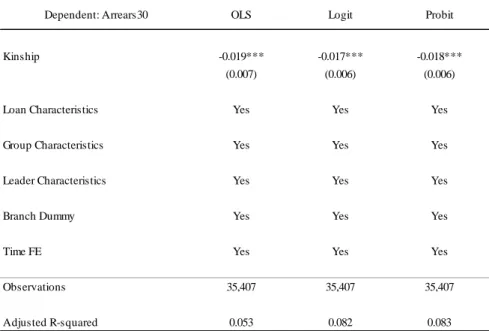
The above models were analyzed using OLS regression. Logit and Probit regressions were tested to show that the results are very similar to those in OLS estimation. These results are described in the Appendix A.
3 Kinship and microloan performance
To verify that kinship has some impact on microloan performance, variations of the model (1) presented in the prior section were tested. Regression analysis with loans in general and splitting the first loan from others are presented in sections 3.1 and 3.2, respectively.
3.1 Kinship and overall microloan performance
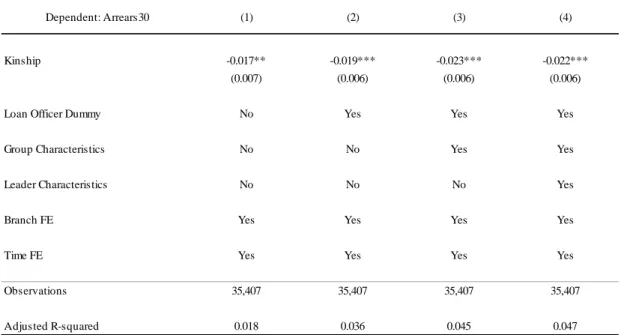
Using Arrears30 as dependent variable and Kinship as independent variable in all specifications, the control variables were included gradually to each column. The results are presented in Table 2. The adjusted R-squared suggests that the increments performed in the specifications are correct and, in fact, contribute to explain the variation of arrears between groups over time.
The fouth specification coincides with the model (1), described in section 2.4. Kinship in this specification is significant at the 1 percent level and its coefficient (-0.022) indicates that groups with 100% of kinship have a 24% lower probability of default in comparison to groups without any kind of kinship between its members.
21
of their estimations and some correlated variables may be causing biased results. Despite these problems, the authors support their results arguing that Kinship could be weakening the threats of sanction. Thus, the improvement in monitoring activities given the higher information that peers had from their kinship ties was not sufficient to compensate the weakening of enforcement activities. The authors, however, have not addressed the role of these mechanisms. In next sections, I try to isolate these mechanisms in order to a better understanding of these results and to infer which effect is greater, an improvement of the monitoring or a weakening of enforcement.
Table 2 Kinship and overall microloan performance
3.2 Kinship and loan performance in initial and subsequent loans
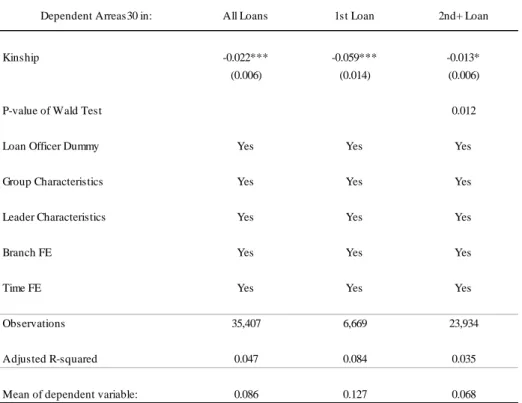
I estimated OLS regressions using the model (1) of section 2.4 to test the microloan performance in different stages of the relationship with the MFI. The regression results confirmed the model (1) as the most suitable in column 4 of Table 2. At each stage, the sample showed reduction because not all groups renewed their loans. The results are presented in Table 3.
In the first column, the model (1) for all loans is replicated for comparison. The estimation results of the kinship’s impact on the default probability in the first loan of the group are shown in the second column. The coefficient of Kinship (-0.059) is significant at the 1 percent level. When considering the initial loan, this result represents a 45% reduction in
Dependent: Arrears30 (1) (2) (3) (4)
Kinship -0.017** -0.019*** -0.023*** -0.022*** (0.007) (0.006) (0.006) (0.006)
Loan Officer Dummy No Yes Yes Yes
Group Characteristics No No Yes Yes
Leader Characteristics No No No Yes
Branch FE Yes Yes Yes Yes
Time FE Yes Yes Yes Yes
Observations 35,407 35,407 35,407 35,407
Adjusted R-squared 0.018 0.036 0.045 0.047
*** p<0.01, ** p<0.05, * p<0.1
22
the probability of default from a group with a 100% kinship compared to a group with no kinship relationships.
Similar analysis is done in the third column for all loans except the first one. The coefficient of Kinship (-0.013) is significant just at the 10 percent level. When not considering the initial loan, this result represents a 18% lower probability of default from a group with a 100% kinship compared to a group with no kinship ties.
I used a Wald test to show that the differences between the coefficient of Kinship on the first loan and the same coefficient in the other loans are significant at the 5 percent level. Despite not being presented in the Table 3, the Wald Test for the difference between the coefficient of Kinship in the first column (all loans) and the coefficient in the third column (all loans excepting the first one) is significant at the 1 percent level (with a p-value of 0.009). Thus, it is possible to say that the impact of Kinship is higher in the first loan compared to other loans of the same group. These results suggest that, among the mechanisms of group loan, kinship has a higher impact on screening activities.
Table 3 Kinship and loan performance by stages
Dependent Arreas30 in: All Loans 1st Loan 2nd+ Loan
Kinship -0.022*** -0.059*** -0.013* (0.006) (0.014) (0.006)
P-value of Wald Test 0.012
Loan Officer Dummy Yes Yes Yes
Group Characteristics Yes Yes Yes
Leader Characteristics Yes Yes Yes
Branch FE Yes Yes Yes
Time FE Yes Yes Yes
Observations 35,407 6,669 23,934
Adjusted R-squared 0.047 0.084 0.035
Mean of dependent variable: 0.086 0.127 0.068
*** p<0.01, ** p<0.05, * p<0.1
23
4 Kinship and group formation change
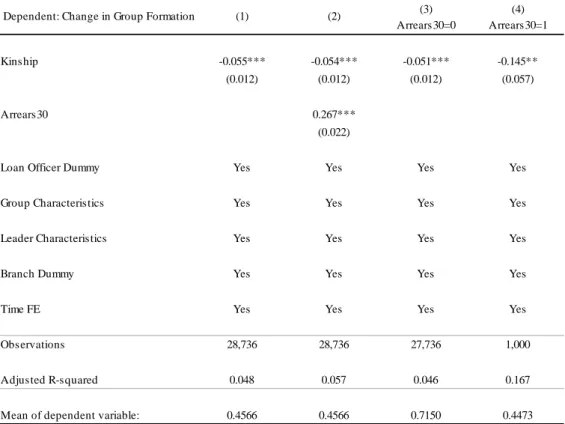
The key variable to analyze the impact of Kinship in group formation change is GroupChangeN. It is a binary variable equals to 1 when there is a change in group formation (size and/or profile) in the next loan (equals to 1 in t if the formation is different in t+1). In regression analysis with GroupChangeN, all independent variables act as lagged variables, since they explain the changes that occur in the next period. The model (2), specified in section 2.4, is presented in the first column. Arrears30 is present in the second specification to test if the Kinship effect remains in the presence of this variable. The third and fourth columns show the results to loans without default and loans with arrears of 30 days, respectively.
In the second specification, Arrears30 is just one control variable. However, their result is also interesting. The coefficient of Arrears is significant at the 1 percent level in all specifications. Its effect is also substantial; the coefficient of 0.267 is almost the same for all specifications and means that the group that default has a 59.7% higher probability to do some change in the formation of the group when applying for a new loan in comparison to a group that did not default.
24
Table 4 Kinship and Group Formation Change
5 Robustness tests
In this section, I present robustness test results to show that the above findings remain consistent, even when using different measures of Arrears and Kinship. The next section discusses the robustness tests on different measures of Arrears; while in section 5.1, I provide the robustness tests results for different cut-off values of Kinship and its relationship with Arrears and GroupChangeN.
5.1 Robustness tests for different measures of arrears
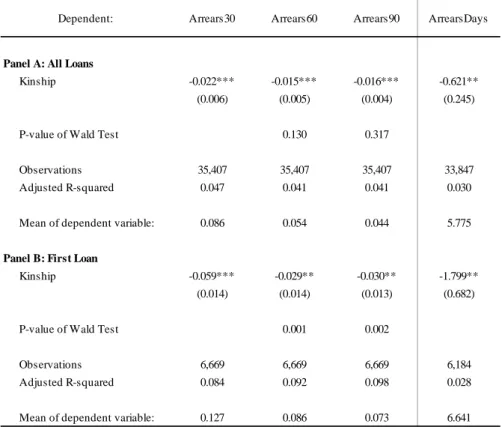
The goal of these analyses is to show that, regardless of the measure chosen for arrears, the results remain consistent with those presented above. The results in Table 5 show that kinship is statistically significant and has a negative correlation with different measures of arrears. The robustness tests for microloan overall performance are presented in Panel A, while the results for the first loan are presented in Panel B. In the first column, previous results are replicated for Arrears30. In columns two and three, I presented the results for Arrears60 (dummy for arrears higher than 60 days) and Arrears90 (dummy for arrears higher than 90
Dependent: Change in Group Formation (1) (2) (3) Arrears30=0
(4) Arrears30=1
Kinship -0.055*** -0.054*** -0.051*** -0.145** (0.012) (0.012) (0.012) (0.057)
Arrears30 0.267***
(0.022)
Loan Officer Dummy Yes Yes Yes Yes
Group Characteristics Yes Yes Yes Yes
Leader Characteristics Yes Yes Yes Yes
Branch Dummy Yes Yes Yes Yes
Time FE Yes Yes Yes Yes
Observations 28,736 28,736 27,736 1,000
Adjusted R-squared 0.048 0.057 0.046 0.167
Mean of dependent variable: 0.4566 0.4566 0.7150 0.4473
*** p<0.01, ** p<0.05, * p<0.1
25
days). In Panel A, despite having smaller coefficients than Arrears30, the difference is not confirmed by the Wald Test. Furthermore, Kinship effect is greater on Arrears60 and Arrears90. In these situations, groups with 100% kinship ties have a 27% and 35% lower probability of default, respectively, in comparison to those without kinship ties. This result is 24% for Arrears30.
For the first loan (Panel B), the P-values of Wald Tests indicate that there are significant differences between the coefficient of Arrears30 and the coefficient of Arrears60 and Arrears90. However, the effect of these variables on Kinship is still significant (32% and 39% lower probability for each state, respectively).
26
Table 5 Robustness tests for different measures of arrears
5.2 Robustness tests for different cut-off values of Kinship
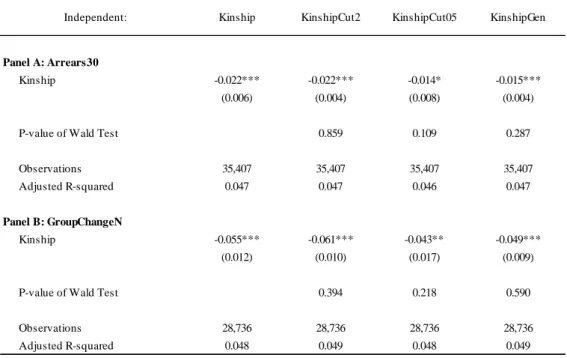
As shown in section 2.3, the measure of Kinship was based on the coincidence of the clients’ surnames. Because some of these surnames presented a high frequency in the sample, they were not considered in developing the measure of Kinship. Table 6 shows the results of different cut offs for Kinship and their relationship with the two main dependent variables analyzed in this work: Arrears30 (Panel A) and GroupChangeN (Panel B).
Column 1 shows the results for the standard measure of Kinship used in this study. In building this measure, surnames with relative frequency greater than 1% were discarded. Columns 2 and 3 show variations of these cut offs. In KinshipCut2, the surnames with relative frequency greater than 2% were discarded. The surnames with relative frequency greater than 0.5% were not considered in building the measure KinshipCut05. In developing the KinshipGen variable, no surnames were discarded. Although the coefficient of KinshipCut05 presents a lower significance than others in both panels, the P-value of the Wald Test indicates that none of the new coefficients are statistically different from the principal one (Kinship). These results remain consistent for both Arrears30 and GroupChangeN.
Dependent: Arrears30 Arrears60 Arrears90 ArrearsDays
Panel A: All Loans
Kinship -0.022*** -0.015*** -0.016*** -0.621** (0.006) (0.005) (0.004) (0.245)
P-value of Wald Test 0.130 0.317
Observations 35,407 35,407 35,407 33,847 Adjusted R-squared 0.047 0.041 0.041 0.030
Mean of dependent variable: 0.086 0.054 0.044 5.775
Panel B: First Loan
Kinship -0.059*** -0.029** -0.030** -1.799** (0.014) (0.014) (0.013) (0.682)
P-value of Wald Test 0.001 0.002
Observations 6,669 6,669 6,669 6,184 Adjusted R-squared 0.084 0.092 0.098 0.028
Mean of dependent variable: 0.127 0.086 0.073 6.641 OLS estimation results in the sample of approved loans dated between January 2000 and November 2011.
ArrearsXX is equal to one if at least one instalment in the loan had been in arrears of XX days or more. ArrearsDays is equal to the number of days in arrears of the loan without Arrrears > 90 days. Control
variables are included as indicated and defined in Table 1. The standard errors are clustered at branch-year level and reported in parentheses.
27
Table 6 Robustness tests for different cut-off values of kinship
6 Conclusion
I exploit a large data set of an MFI located in northeastern Brazil to analyze the impacts of kinship ties between members of a group loan in microloan performance. I found that groups with 100% of members sharing some kinship tie have a 24% lower probability of default compared to groups without kinship ties. Moreover, this effect is even stronger for the first loan with a 45% lower probability of default. These results suggest that Kinship has a greater positive effect on screening activities compared to monitoring activities. Furthermore, the likelihood of a 100% kinship group change its formation after a default is 20% lower in comparison to groups without kinship. This suggests that kinship may be weakening enforcement activities.
Although the literature on group lending and social ties is still controversial, by assessing a specific dimension of social ties, this study contributes to a better understanding of the group lending dynamics and the role of social ties. The results of this paper allow us to infer about the mechanisms involved and suggest that kinship has a stronger effect on screening activities, while it may weaken the enforcement activities. The results, though, suggest that the improvement on monitoring activities outweigh the weakening of enforcement.
Independent: Kinship KinshipCut2 KinshipCut05 KinshipGen
Panel A: Arrears30
Kinship -0.022*** -0.022*** -0.014* -0.015*** (0.006) (0.004) (0.008) (0.004)
P-value of Wald Test 0.859 0.109 0.287
Observations 35,407 35,407 35,407 35,407 Adjusted R-squared 0.047 0.047 0.046 0.047
Panel B: GroupChangeN
Kinship -0.055*** -0.061*** -0.043** -0.049*** (0.012) (0.010) (0.017) (0.009)
P-value of Wald Test 0.394 0.218 0.590
Observations 28,736 28,736 28,736 28,736 Adjusted R-squared 0.048 0.049 0.048 0.049
*** p<0.01, ** p<0.05, * p<0.1
28
However, addressing similar issues, Karlan (2007) have found that social ties have higher impact on monitoring and enforcement activities. Despite of the efforts, this paper was not able to confirm that kinship, in fact, weakens the enforcement activities. It is possible, for example, that members with kinship ties are contingent oriented in cases of default from a relative, reducing the cases of group formation change. It is also possible that these members act more cooperatively with their kinship ties. This controversy requires a better understood, and, as remarked by Ahlin & Townsend (2007), further research should address the different dimensions of social ties and its impact on the various functioning mechanisms of group lending.
Additionally, establishing causality lies beyond the scope of this study. Prior studies had problems with this task in similar analyses of social ties (Ahlin & Townsend, 2007; Wydick, 1999; Zeller, 1998). Karlan (2007) had some success on that, but did not address the kinship issue properly. Once individuals are free to select their peers, it is impossible to assert that kinship by itself is responsible for a good microloan performance. If it is reasonable to assume that individuals will try to choose peers with a low likelihood of voluntary defaulting, why would it be different between relatives? Individuals will choose those within their kinship ties with the lowest likelihood of default. Future work may use randomized experiment to approach the issue of kinship.
29
References
Ahlin, C., & Townsend, R. M. (2007). Using Repayment Data to Test Across Models of Joint Liability Lending. The Economic Journal, 117(517), F11–F51. doi:10.1111/j.1468-0297.2007.02014.x
Al-azzam, M., & Mimouni, K. (2012). What Types of Social Ties Improve Repayment in Group Lending? International Research Journal of Finance and Economics, (87), 25– 34.
Angelucci, M., De Giorgi, G., Rangel, M. A., & Rasul, I. (2010). Family networks and school enrolment: Evidence from a randomized social experiment. Journal of Public
Economics, 94(3-4), 197–221. doi:10.1016/j.jpubeco.2009.12.002
Beck, T., Behr, P., & Madestam, A. (2012). Sex and Credit:Is There a Gender Bias in Lending? SSRN Electronic Journal. doi:10.2139/ssrn.2126489
Beck, T., & Demirguc-Kunt, A. (2006). Small and medium-size enterprises: Access to finance as a growth constraint. Journal of Banking & Finance, 30(11), 2931–2943.
doi:10.1016/j.jbankfin.2006.05.009
Behr, P., Entzian, A., & Güttler, A. (2011). How do lending relationships affect access to credit and loan conditions in microlending? Journal of Banking & Finance, 35(8), 2169– 2178. doi:10.1016/j.jbankfin.2011.01.005
Belenzon, S., & Zarutskie, R. (2012). Married to the Firm? Family Ownership, Performance, and Financing in Private Firms. Working Paper. Duke University.
Besley, T., & Coate, S. (1995). Group lending, repayment incentives and social collateral.
Journal of Development Economics, 46(1), 1–18. doi:10.1016/0304-3878(94)00045-E Besley, T., Coate, S., & Loury, G. (1993). The economics of rotating savings and credit
associations. American Economic Review, 83(4), 792–810. Retrieved from http://www.aeaweb.org/aer/index.php
Bratton, M. (1986). Financing Smallholder Production: A Comparison of Individual and Group Credit Schemes in Zimbabwe. Public Administration and Development, 6(2), 115–132. Retrieved from http://dx.doi.org/10.1002/pad.4230060202
Cameron, A. C., & Trivedi, P. K. (2009). Microeconometrics Using Stata. (StataCorp Lp, Ed.)Stata Press books (Vol. 5, p. 706). Stata Press. Retrieved from
http://stata.biz/news/statanews.23.4.pdf
Diagne, A., & Zeller, M. (2001). Access to Credit and Its Impact on Welfare in Malawi.
Research Report International Food Policy Research Institute, (116), 153. Retrieved
from
30
Feigenberg, B., Field, E. M., & Pande, R. (2010). Building Social Capital Through
MicroFinance. Retrieved from http://www.nber.org/papers/w16018
Ferrara, E. La. (2003). Kin Groups and Reciprocity: A Model of Credit Transactions in Ghana. American Economic Review, 93(5), 1730–1751.
doi:10.1257/000282803322655518
Giné, X., & Karlan, D. (2011). Group versus Individual Liability: Short and Long Term Evidence from Philippine Microcredit Lending Groups. Yale Working Papers.
Godquin, M. (2004). Microfinance Repayment Performance in Bangladesh: How to Improve the Allocation of Loans by MFIs. World Development, 32(11), 1909–1926.
doi:10.1016/j.worlddev.2004.05.011
Hermes, N., Lensink, R., & Mehrteab, H. T. (2005). Peer Monitoring, Social Ties and Moral Hazard in Group Lending Programs: Evidence from Eritrea. World Development, 33(1), 149–169. Retrieved from http://ideas.repec.org/a/eee/wdevel/v33y2005i1p149-169.html Karlan, D., Mobius, M., Rosenblat, T., & Szeidl, A. (2009). Trust and Social Collateral.
Quarterly Journal of Economics, 124(3), 1307–1361. doi:10.1162/qjec.2009.124.3.1307 Karlan, D. S. (2007). Social connections and group banking. The Economic Journal,
117(517), F52–F84. doi:10.1111/j.1468-0297.2007.02015.x
Karlan, D., & Zinman, J. (2009). Observing Unobservables: Identifying Information Asymmetries With a Consumer Credit Field Experiment. Econometrica, 77(6), 1993– 2008.
Lee, S., & Persson, P. (2013). Financing from Family and Friends. NYU Stern Working Paper FIN-12-007; ECGI - Finance Working Paper No. 358. Retrieved from
http://ssrn.com/abstract=2086625
Martinez, R. (2013). Microfinance Market: Trends 2007-2012 in Latin America and the
Caribbean. Lima, Peru. Retrieved from
http://www.themix.org/sites/default/files/Microfinance in LAC - Trends 2007-2012 EN IDB.PDF
Mel, S. de, McKenzie, D., & Woodruff, C. (2009). Returns to Capital in Microenterprises: Evidence from a Field Experiment. The Quarterly Journal of Economics, 124(1), 423. Neri, M. (2008). Microcrédito: o mistério nordestino e o Grameen brasileiro : perfil e
performance dos clientes do CrediAmigo. FGV. Retrieved from
http://books.google.com.br/books?id=whGHoNkqHpgC
Pinheiro, A. C., & Cabral, C. (1999). Credit Markets in Brazil: The Role of Judicial
31
Romano, C. A., Tanewski, G. A., & Smyrnios, K. X. (2001). Capital structure decision making. Journal of Business Venturing, 16(3), 285–310. doi:10.1016/S0883-9026(99)00053-1
Sharma, M., & Zeller, M. (1997). Repayment performance in group-based credit programs in Bangladesh: An empirical analysis. World Development, 25(10), 1731–1742.
doi:10.1016/S0305-750X(97)00063-6
Stiglitz, J. E., & Weiss, A. (1981). Credit rationing in markets with imperfect information.
The American economic review, 71(3), 393–410. doi:10.1126/science.151.3712.867-a Vogelgesang, U. (2003). Microfinance in Times of Crisis: The Effects of Competition, Rising
Indebtedness, and Economic Crisis on Repayment Behavior. World Development,
31(12), 2085–2114. doi:10.1016/j.worlddev.2003.09.004
Wenner, M. D. (1995). Group credit: A means to improve information transfer and loan repayment performance. Journal of Development Studies, 32(2), 263–281.
doi:10.1080/00220389508422414
Wydick, B. (1999). Can Social Cohesion be Harnessed to Repair Market Failures? Evidence from Group Lending in Guatemala. The Economic Journal, 109(457), 463–475.
doi:10.1111/1468-0297.00457
Zeller, M. (1998). Determinants of Repayment Performance in Credit Groups: The Role of Program Design, Intragroup Risk Pooling, and Social Cohesion. Economic Development
32
Appendix
Table A.1 shows the results of the regression analysis using OLS, Logit and Probit, respectively. The results, however, are very close, suggesting no difference between them.
Table A. 1 Models comparison
Dependent: Arrears30 OLS Logit Probit
Kinship -0.019*** -0.017*** -0.018*** (0.007) (0.006) (0.006)
Loan Characteristics Yes Yes Yes
Group Characteristics Yes Yes Yes
Leader Characteristics Yes Yes Yes
Branch Dummy Yes Yes Yes
Time FE Yes Yes Yes
Observations 35,407 35,407 35,407
Adjusted R-squared 0.053 0.082 0.083
*** p<0.01, ** p<0.05, * p<0.1