MESTRADO EXECUTIVO EM GESTÃO EMPRESARIAL
HYBRID PARTNERSHIPS AND SOCIAL
TECHNOLOGY AT THE BOP: A CASE
STUDY
ANDREA RESTELLI
Rio de Janeiro - 2016
DISSERTAÇÃO APRESENTADA À ESCOLA BRASILEIRA DE ADMINISTRAÇÃO
ANDREA RESTELLI
HYBRID PARTNERSHIPS AND SOCIAL
TECHNOLOGY AT THE BOP: A CASE STUDY
Master’s thesis presented to Corporate International Master’s program, Escola Brasileira de Administração Pública, Fundação Getúlio Vargas, as a requirement for obtaining the title of Master in Business Management
PROF. ALEXANDRE FARIA
Restelli, Andrea
Hybrid partnerships and social technology at the BoP: a case study / Andrea Restelli. - 2016.
57 f.
Dissertação (mestrado) - Escola Brasileira de Administração Pública e de Empresas, Centro de Formação Acadêmica e Pesquisa.
Orientador: Alexandre Faria. Inclui bibliografia.
1. Responsabilidade social da empresa – Estudo de casos. 2. Planejamento estratégico – Estudo de casos. 3. Ação social – Estudo de casos. 4. Parceria público-privada – Estudo de casos. I. Faria, Alexandre de Almeida, 1963- . II. Escola Brasileira de Administração Pública e de Empresas. Centro de Formação Acadêmica e Pesquisa. III. Título.
Acknowledgments:
Many see the writing of a dissertation as the final step of a chapter in their life. I instead like
to consider it as a springboard to new challenging and formative experiences.
I would not be at this important stage of my life without the help and support of many people
to whom I will be forever grateful.
First of all I want to thank the Professor at FGV-Direito and the Manager at Instituto
Coca-Cola Brasil, for their contribution and availability.
My gratitude also goes to Professor Alexandre Faria, for all the support and fundamental
advices he gave me to write this dissertation.
Finally, I want to thank my family, whose sacrifices and support have allowed me to become
TABLE OF CONTENTS:
LIST OF FIGURES: ______________________________________________________________________________________ VI
LIST OF SYMBOLS, ABBREVIATIONS AND ACRONYMS: _________________________________________ VII
ABSTRACT: ___________________________________________________________________________________________ VIII
RESUMO: ________________________________________________________________________________________________ IX
1. INTRODUCTION AND RESEARCH QUESTIONS __________________________________________________ 1
2. LITERATURE REVIEW ______________________________________________________________________________ 3
2.1.CORPORATE SOCIAL RESPONSIBILITY _______________________________________________________________ 3
2.1.1. CSR from a historical persepctive ____________________________________________________________ 3
2.1.2. CSR critics _____________________________________________________________________________________ 4
2.2.THE BASE OF THE PYRAMID: _______________________________________________________________________ 5
2.2.1. BoP Introduction: _____________________________________________________________________________ 5
2.2.2. Poverty and Social Capital: ___________________________________________________________________ 6
2.2.3. BoP Market: ___________________________________________________________________________________ 6
2.3.MULTINATIONALS AND THE BOP ____________________________________________________________________ 8
2.3.1. BoP 1.0: ________________________________________________________________________________________ 9
2.3.2. BoP 1.0 Critics: ________________________________________________________________________________ 9
2.3.3. BoP 2.0: ______________________________________________________________________________________ 11
2.3.4. BoP 2.0 Critics: ______________________________________________________________________________ 11
2.3.5. BoP Final Remarks: _________________________________________________________________________ 12
2.4.THREATSTOSOCIALCAPITAL ________________________________________________________________ 13
2.4.1. Financialization: ____________________________________________________________________________ 13
2.4.2. Neoliberalism: ______________________________________________________________________________ 15
2.4.3. Modern Colonialism: ________________________________________________________________________ 16
2.5.MANAGERIALISM: __________________________________________________________________________________ 16
2.6.THE FUNCTION OF PARTNERSHIPS IN MARKETS AT THE BOP: _____________________________________ 18
2.6.1. The Role Of Governments: __________________________________________________________________ 19
2.6.2. Final Remarks: ______________________________________________________________________________ 19
3. RESEARCH METHODOLOGY: ______________________________________________________________________ 21
4. COCA-COLA BRAZIL: _______________________________________________________________________________ 23
4.2.COCA-COLA AND CSR ______________________________________________________________________________ 24
4.3.INSTITUTO COCA-COLA BRASIL ____________________________________________________________________ 25
5. PLATAFORMA COLETIVO: _________________________________________________________________________ 26
5.1.THE COLETIVO PROJECTS __________________________________________________________________________ 26
5.1.1Development and expansion: ________________________________________________________________ 27
5.1.2. Fundings: ____________________________________________________________________________________ 27
5.1.3. Social Impact And Market Results: ________________________________________________________ 28
5.1.4. Future _______________________________________________________________________________________ 29
6. OVERVIEW OF THE MAIN RESULTS: _____________________________________________________________ 30
6.1.ADAPTATION AND IMPLEMENTATION ______________________________________________________________ 30
6.1.1. Educational Methodology: _________________________________________________________________ 30
6.1.2. Partnerships: ________________________________________________________________________________ 31
6.1.2.1. Community and NGOs Selection ___________________________________________________________________________ 31
6.1.2.2. The Partnership with Local NGOs: _________________________________________________________________________ 32
6.2.SOCIAL TECHNOLOGY ______________________________________________________________________________ 33
6.2.1. The Social Franchise System: ______________________________________________________________ 33
6.2.2. The Sharing Of Social Knowledge: _________________________________________________________ 33
7. DISCUSSION OF THE RESULTS: ___________________________________________________________________ 35
7.1.COOPERATION WITH LOCAL PARTNERS ____________________________________________________________ 35
7.1.1. Contextualization And Production Of Social Technology _________________________________ 35
7.1.2. Partners’ (Inter)dependence: ______________________________________________________________ 36
7.2.ADAPTABILITY AND SOCIAL KNOWLEDGE CREATION: ______________________________________________ 36
7.2.1. Community Selection: ______________________________________________________________________ 36
7.2.2. Financial Sustainability: ___________________________________________________________________ 37
7.2.3 Elaboration Of Social Guidelines: ___________________________________________________________ 37
8. CONCLUSIONS: ______________________________________________________________________________________ 39
9. LIMITATIONS: _______________________________________________________________________________________ 40
10. REFERENCES: ______________________________________________________________________________________ 41
LIST OF FIGURES:
FIGURE 1.THE WORLD ECONOMIC PYRAMID ____________________________________________________________________________ 7
FIGURE 2.BRAZILIAN INCOME CLASSES _________________________________________________________________________________ 23
FIGURE 3.BRAZILIAN ECONOMIC PYRAMID _____________________________________________________________________________ 24
LIST OF SYMBOLS, ABBREVIATIONS AND ACRONYMS:
BoP: Base/Bottom of the Pyramid
CSR: Corporate Social Responsibility
IDB: Inter-American Development Bank
MEP: Moderate and Extreme poor
MIF: Multilateral Investment Fund
MNCs: Multinationals
NGOs: Non-Governmental Organizations
ROE: Return on Equity
ABSTRACT:
Stakeholder expectations have recently led many corporations to engage in initiatives aiming
at social development and poverty eradication. However, in spite of the many attempts,
compelling results have yet to be produced, leaving the gap between the individuals living at
the base of the economic pyramid and those belonging to the higher tiers almost untouched.
Some scholars have consequently criticized the lack of contextualization of existing
managerial practices pointing their finger to the strong influence of western ideologies, which
prevent social initiatives from adapting to the needs of different geopolitical contexts.
Through the analysis of a set of Coca-Cola Brazil’s social initiatives (i.e. “Coletivo Projects”)
implemented in various Brazilian communities, the present study shows how Coca-Cola
Brazil has attempted to produce, in collaboration with local NGOs, an universal kind of
“social technology”, which could be easily adapted to different contexts, accelerating the
RESUMO:
A crescente expectativa dos vários stakeholders, bem como as diferentes partes interessadas
nas áreas de atuação de várias empresas, recentemente tem levado diversas corporações a se
envolverem em iniciativas que visam o desenvolvimento social e a erradicação da pobreza.
Porém, apesar das inúmeras tentativas, resultados convincentes ainda não foram produzidos,
mantendo a separação entre os indivíduos que vivem na base da pirâmide económica e
aqueles pertencentes às camadas mais elevadas quase inalterada. Consequentemente alguns
estudiosos criticaram a falta de contextualização das práticas de gestão existentes, atribuindo
o mesmo à forte influência das ideologias ocidentais, que impedem que as iniciativas sociais
se adaptem às necessidades dos diferentes contextos geopolíticos.
Por meio da análise de um conjunto de iniciativas sociais da Coca-Cola Brasil ("Projetos
Coletivo") implementadas em várias comunidades brasileiras, o presente estudo mostra como
Coca-Cola Brasil tentou produzir, em colaboração com os ONG locais, um tipo de
"tecnologia social" universal, que poderia ser facilmente adaptada a diferentes contextos,
1. INTRODUCTION AND RESEARCH QUESTIONS
"There is one and only one social responsibility of business – to use its resources and engage
in activities designed to increase its profits so long as it stays within the rules of the game,
which is to say, engages in open and free competition without deception or fraud."
Milton Friedman, 1962
More than fifty years have gone by since this famous claim was made and the evolution of
businesses practices seems to have proven it wrong. Since then, many corporations have in
fact started to embrace social practices in their daily operations and, nowadays, it is very
uncommon to find companies with a complete disregard of socially responsible practices
(Banerjee, 2008).
Corporate social responsibility itself has experienced an evolution in its role and focus, from
not causing any harm to society to actually fostering the financial and social development of
society as a whole (Prahalad and Hart, 2002), alongside NGOs and Governments (Banerjee,
2008; Hahn, 2009; Levy and Kaplan, 2007).
In particular, the issue of poverty alleviation has increasingly attracted the attention of
scholars (Arora and Romijn, 2011; Munir et al., 2010; Prahalad and Hart, 2002), which called
for the intervention of multinational corporations in helping the communities living at the
base of the economic pyramid (BoP). Even the so criticized financial institutions joined the
battle against poverty, as consequence of the spread of microfinance initiatives (Yunus,
2003). However, in spite of the many attempts to free the world from poverty, significant
results have yet to be produced.
One of the criticism received by the corporations concerns the social strategies and
managerial practices utilized, which are wrongly considered to be suitable to any given
geopolitical context (Clegg, 2014). Those strategies are accused of being biased, due to the
heavy influence of western ideologies on their development process (Cooke and Faria, 2013),
which prevent social initiatives from fully addressing the needs of different communities,
hence causing failures in their pursuit of social development.
In this regard, the present work aims at providing an analysis on the possibility of generating
general social guidelines, which could be applied to different contexts, through the formation
of partnerships with local institutions and through an involvement of the local communities in
(known as “Coletivo Projects”) implemented in various Brazilian communities is conducted,
with special emphasis on the development of managerial practices and relationship with local
partners. The reason behind the choice of taking the Coletivo Projects as object of analysis is
their already large presence in many different communities, which allows a deeper
understanding of the corresponding process and mechanisms.
The key research questions, which will guide the study of the Coletivo Projects, are the
following:
§ To what extent are local institutions and communities involved in the implementation and management of the Coletivo Projects and how do they influence their adaptation
to different contexts?
§ How do partnerships help Coca-Cola in building social knowledge, which could be applied to diverse geopolitical contexts as universal knowledge?
After an overview of the existing literature regarding corporate social responsibility, a
detailed analysis on the evolution of corporate strategies at the base of the pyramid will be
presented, alongside their main critics. The study will then continue with a critical review of
the theories connected to the concepts of managerialism and partnership formation, which
will then be followed by a general description of the evolution and structure of the Coletivo
Projects. The study will end with the presentation and analysis of the managerial aspects of
2. LITERATURE REVIEW
2.1. Corporate Social Responsibility
2.1.1. CSR from a historical persepctive
Although corporate social responsibility (CSR) is a relatively new term, its roots can be traced
even back to the 19th century (Banerjee, 2008). The exact period in which MNCs have begun to care about players other then shareholders has however been subject of different opinions.
While Porter and Kramer (,2011) argue that after World War II socially responsible initiatives
were mainly sought by Governments and NGOs and corporations focused primarily on their
business in developed markets, other scholars believe instead that western MNCs began to
engage in CSR activities during the Cold War, as a mean of confrontation to the opposing
political ideologies (Spector, 2008).
Nevertheless, it was only in the ‘80s that the new perspective of seeing MNCs as possible
actors in the fight against poverty and other social and environmental issues began to spread,
giving birth to the term Corporate Social Responsibility as we know it today (Bonsu and
Polsa, 2011; Levy and Kaplan, 2007).
The reasons why MNCs began to be expected to be socially responsible were their increased
dimensions and power (Munir et al., 2010; Newell and Frynas, 2007), which brought MNCs
to the same level of governments, with regards to responsibilities towards development and
sustainability (Banerjee, 2008; Hahn, 2009; Levy and Kaplan, 2007).
Nowadays, what drives many MNCs to engage in CSR activities is the external pressure,
which interest groups and stakeholders’ expectation place on them (Burchell and Cook, 2012;
Porter and Kramer, 2011; Selsky and Parker, 2005; Scherer and Palazzo, 2011). Of course,
large MNCs alone are not able to solve all the social problems affecting the developed and
developing economies, but their efforts and participation are considered essential to achieve
important results (Prahalad and Hammond, 2002).
The main ideas behind the concept of CSR are the principles of “doing well by doing good”
and the “triple bottom line” way of doing business, which brings financial, social and
environmental objectives on the same level (Davidson, 2009; Singh et al., 2014; Spector,
2008). On the same line of reasoning, external stakeholders are given the same importance as
shareholders, underlining the triple nature of the MNCs objectives (Davidson, 2009). Indeed,
CSR initiatives by MNCs exceed the corporation’s legal requirements (Banerjee, 2008) and
rights, including poverty alleviation (Munir et al., 2010), taking on a very similar role as the
one of governments (Scherer and Palazzo, 2011). Nevertheless, although CSR activities may
be publicized as voluntary, profitability still remains an important factor in the approval or
rejection of projects (Munir et al., 2010).
As a consequence, even though CSR and strategy departments have usually been kept
separated, in recent times their division has blurred, leading to the creation of the term
“strategic CSR” (Munir et al., 2010), which focuses on determining whether it pays off for
MNCs to engage in CSR projects both in financial and competitive advantage terms.
2.1.2. CSR critics
Since its introduction to corporate world, the concept of CSR has not been spared from heavy
criticism.
According to Davidson (2009), “the right thing to do” is what MNCs should do in order to act
in a socially responsible manner. However, a clear definition of “doing good” has not yet be
presented and appears to be highly subjective (Spector, 2008), sometimes resulting in
disagreements between MNCs and the public opinion. An example of this is the marketing by
Unilever of a skin-whitening cream (Fair & Lovely) in 40 Asian and African countries, which
first happened a few years ago. Although the corporation thought that the initiative had a
positive impact on poor women by giving them the possibility of feeling empowered, it went
under heavy criticism by several NGOs and governmental institutions, which accused the
MNC of promoting racism (Karnani, 2009).
This example shows why MNCs should be careful in defining what is good and what is not,
by analyzing all the possible scenarios and finding a good balance between stakeholders’
interests and theirs, in order not to incur the risk of being accused of exploitation or addressed
as a charity organization (Davidson, 2009).
Furthermore, a common thought about the main reason why MNCs engage in CSR activities
brings the majority of those corporations under a bad light of criticism. In fact, they are often
accused of engaging into CSR activities just to improve their brand image and not because
they are actually driven by the idea of doing good to society (Levy and Kaplan, 2007). One
should then be careful not to confuse CSR activities used as “business tools” with the ones
used as “development tools” (Newell and Frynas, 2007); while the latter refers to CSR with
the real objective of doing good to society, the former describes CSR mainly as a mean to
In addition, in contrast to the scholars, who see MNCs as the only players having the
necessary resources and capabilities to conduct effective CSR practices (Levy and Kaplan,
2007), some critics believe that MNCs will never be able to do so, as only small and local
companies have the capacity to fully adapt their strategies to the needs of the local
communities (Simanis and Hart, 2008). Adaptation to different needs is in fact essential for a
successful CSR, which otherwise will do no good to the community.
Indeed, the primary objective of MNCs is to make shareholders satisfied, which often goes
against the interests of society as a whole (Karnani, 2010). Hence, the only way for
corporations to effectively use CSR is to align their profitability to the social interests of the
public; otherwise the results of CSR initiatives will most likely be irrelevant (Karnani, 2010).
This theory has been further analyzed in the Strategic CSR Approach, which suggests that
MNCs will be more effective when fighting social problems directly related to their business,
instead of general ones (Perez-Aleman and Sandilands, 2008).
Finally, more studies are needed to empirically assess the effect of CSR practices, given that,
as for now, there is a lack of evidence regarding financial and social benefits deriving from
CSR activities (Levy and Kaplan, 2007). On the contrary, MNCs are even accused of
engaging in CSR activities to somehow guide social change and influence governments to the
advantage of their own business (Levy and Kaplan, 2007; Scherer and Palazzo, 2011).
2.2. The Base Of The Pyramid:
2.2.1. BoP Introduction:
Consequently to the argument of the existence of a “fortune at the bottom of the pyramid
(BoP)” (later changed to base of the pyramid for parity reasons) for MNCs, elaborated by
Prahalad and Hart (2002), the focus of CSR initiatives has shifted more and more towards the
alleviation of poverty at the lowest level of the economic pyramid. As a result, different and
sometimes contrasting opinions regarding how to eradicate poverty arose. Before going into
details regarding how strategies to fight world’s poverty have evolved, it is worth defining
2.2.2. Poverty and Social Capital:
One could argue that a real definition of poverty, fit to any situation, cannot be found, as
poverty itself has a different meaning depending on the context in which it is discussed. As a
consequence, many different definitions and opinions regarding poverty exist. Nevertheless,
there is one thing on which there seems to be common agreement: poverty is a result of both
economic and social disadvantages (London, 2007; Nahapiet and Ghoshal, 1998; Newell and
Frynas, 2007; Woolcock and Narayan, 2000).
Although many scholars mainly make use of a financial rationale behind the definition of
poverty (Arnold and Valentin, 2013; Karnani, 2009; Munir et al., 2010; Prahalad, 2006),
others focus more on other factors affecting the life of the individuals considered as poor
(Ansari et al., 2012; Karnani, 2007; Sen, 1999).
Since wellbeing is often characterized as the individual and collective capabilities of human
beings to do or be what they value the most (Sen, 1999), poverty could be defined as the lack
of them. From a broader point of view, individual and collective capabilities can be seen as
part of the social capital of a given community (Ansari et al., 2012). Social capital is in fact
often defined as the set of networks, relationships, capabilities and shared features
characterizing a community (Bolino et al., 2002; Ansari et al., 2012).
Social capital however should not be seen as rigid, given that the environment in which
individuals live constantly influences it; governments, non-governmental organizations
(NGOs) and multinational corporations (MNCs) with a constant presence in those
environments have then the power of either enhancing or weakening life quality of
individuals, both socially and financially (Arnold and Valentin, 2013; Perez-Aleman and
Sandilands, 2008).
2.2.3. BoP Market:
According to Prahalad (2004) the BoP market represents a great potential for MNCs given the
number of people belonging to it and their consequent huge purchasing capacity.
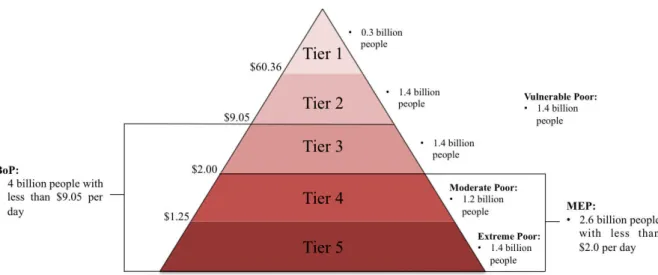
As Figure 1 shows, if the income of individuals at the base of the pyramid is taken into
consideration, the poor representing the BoP could be divided into three tiers, with incomes
ranging between less than $1.25 and $9.05 per day in purchasing power parity (PPP) (Arnold
and Valentin, 2013). At the very base of the pyramid there are the moderate and extreme poor
considered as the most vulnerable individuals; the “higher” BoP tier lives instead with
between $2.00 and $9.00 PPP per day (Arnold and Valentin, 2013). If taken together the
MEP are 2.6 billion, while the whole BoP consists of 4 billion people (Arnold and Valentin,
2013; The World Bank, 2015). The presence of this difference in income at BoP level has
created some disagreement with regards to the evaluation of the market size of the poor.
Prahalad (2006) estimates the BoP market to exceed $13 trillion purchasing capacity in PPP
value, an estimation also shared by other scholars (Vachani & Smith, 2008). However, other
estimates turn the BoP market into a much smaller “fortune”, with a PPP market value of
$1.42 trillion (Karnani, 2009; The World Bank, 2015).
Notwithstanding the inconsistency in the estimations, it is important to understand that the
line between the MEP and the rest of the BoP should not be considered a defined separation,
as the three tiers share common traits and needs (Arnold and Valentin, 2013). Understanding
this is critical for MNCs if they want to have a real impact through their ventures. In fact,
without a clear comprehension of this particular structure, MNCs may end up causing the
opposite effect of what they were hoping for, further penalizing the targeted poor
communities (Ansari et al., 2012; Karnani, 2007).
Figure 1. The World Economic Pyramid
Although potential profits remains the main criteria used by MNCs when evaluating
expansion to new markets (Munir et al., 2010), BoP markets present other peculiarities, which
MNCs willing to invest to gain important competitive advantages (Munir et al., 2010;
Prahalad and Hart, 2002). MNCs truly appear to be in the best position to connect and gather
all the actors needed to ensure a development of the poor communities and the BoP markets
represent a great opportunities for MNCs to experiment and create new technologies, which
could be in turn transferred to the more developed markets (Prahalad and Hart, 2002).
Nevertheless, in order to take advantage of those opportunities, the MNCs will have to adapt
and evolve their business models (Prahalad and Hart, 2002).
BoP markets are in fact characterized by many failures and inefficiencies, which represent at
the same time challenges and opportunities for MNCs (London, 2007). Indeed, BoP members
operate in informal markets, which are very different from the formal market economies we
are used to (Arnold and Valentin, 2013; London, 2007). This difference is caused by a
separation between poor consumers and producers of economic, geographical, temporal and
informational nature (Singh et al., 2014) and a presence of strong social bounds within the
members of the community (Ansari et al., 2012; Arora and Romijn, 2011).
2.3. Multinationals and the BoP
With many of the world’s top 200 MNCs being based in developing countries, it is not hard to
see why the expectation of the MNCs taking an important role in helping the poor has rapidly
spread (Prahalad and Hart, 2002).
The reason why private companies are considered to have higher positive impacts on BoP
communities is that many governmental and NGO-based ventures have been criticized for
having turned themselves into charity programs rather than development initiatives (Munir et
al., 2010) and because, due to globalization, MNCs have sometime gained much more power
and resources than governments in enforcing rights, spreading knowledge and creating social
impact (Munir et al., 2010). In fact, MNCs have become so powerful to be able to influence
governments’ actions and this amount of power gives them an obligation towards the
attainment of a better and fairer world (Hahn, 2009).
As for CSR, the concept of “doing well by doing good” is the main idea behind BoP ventures
carried out by multinational corporations, aiming at alleviating poverty and fostering the
development of poor communities through “win-win” solutions (Arora and Romijn, 2011;
Munir et al., 2010). Benefits to the poor may consist in either an enhancement in utilities or an
increase in the number of human rights enjoyed (Arnold and Valentin, 2013). However,
utility level, as in some cases enhanced general utility does not result to be beneficial to the
poor (Arnold and Valentin, 2013). The double and contrasting objective of poverty alleviation
and business profitability poses in fact new challenges to the strategy departments of
corporations (Varman et al., 2012). While targeting BoP communities, MNCs must be careful
not to be perceived as exploiters by other stakeholders (Davidson, 2009), since the
socio-economic position of BoP communities makes their members more exposed and vulnerable to
marketing exploitation (Karnani, 2007b). This is a serious challenge for managers, since
engaging with the BoP further enlarges the number and complexity of their stakeholders
(Davidson, 2009).
2.3.1. BoP 1.0:
Misconceptions regarding BoP markets range from the poor having no money to spend, to the
products sold to poor communities being very cheap, to poor individuals being unable to take
advantage of new technologies (Prahalad and Hammond, 2002); for all these reasons, MNCs
have traditionally avoided targeting individuals and the base of the pyramid (Hammond and
Prahalad, 2004).
The first wave of BoP initiatives by MNCs (later renamed “BoP 1.0”) went against those
assumptions, in line with the theories elaborated by Prahalad and Hart (2002). Indeed, the
main idea was to help the poor by selling them products and providing services that were not
yet available in BoP communities (Prahalad, 2004). In order for products to be sold to poor
individuals, they had to be modified to make them affordable and appropriate to the local
needs. This was done by slightly modifying the already existing products, exploiting new
technologies and lowering prices through an adjustment of quality and packaging (McKague
et al., 2015). An example of BoP 1.0 venture is the sale by Unilever of single-serve packages
of detergent to poor communities in Mexico, which brought to the poor a product that they
would have otherwise not been able to afford and allowed the company to quickly penetrate
the market (Davidson, 2009). According to Prahalad and Hammond (2002) the untapped BoP
markets presented in fact huge and fast growth opportunities for MNCs. However, in spite of
the initial enthusiasm about the possibilities offered by BoP ventures, BoP 1.0 initiatives have
attracted large criticism from scholars and the public.
2.3.2. BoP 1.0 Critics:
of their standards of living (Arora and Romijn, 2011; Karnani, 2006; McKague et al., 2015).
On the contrary, the model embraced by BoP 1.0 initiatives to increase the offer of available
products is inappropriate for the goal of poverty alleviation and, even if it produced any sort
of benefits to BoP communities, those effects would only be short-term oriented (Simanis and
Hart, 2009).
Not only the results on poor individuals are considered insignificant, but also the MNCs are
believed not to have much to gain by only adapting their products to the needs of the poor. In
order for BoP markets to be profitable to MNCs, a very high number of transactions need to
be reached, as most of them consist of only small amounts of money (Karnani, 2006). The
issue is that the BoP markets themselves are much smaller than expected (Karnani, 2009),
further increasing the already high costs, which MNCs would face, given the complex
structure of those markets (Karnani, 2006). Pricing, advertising, sales promotions and
marketing, which already pose difficult decisions in developed markets, become even trickier
and costlier when ethical concerns are brought to the table (Davidson, 2009).
BoP 1.0 ventures appear then to be an excuse for MNCs to only expand their market base,
instead of giving an actual help to the poor communities’ members (Calton et al., 2013).
Indeed, development of poor communities should be measured according to three main
dimensions: financial condition, capabilities and social relationships (London, 2009) and BoP
1.0 initiatives seem to be unable to improve any of these dimensions, as shareholders still
have a privileged position with respect to the other stakeholders (Davidson, 2009; Munir et
al., 2010) in contrast to the praised win-win solution.
Some critics even argue that BoP 1.0 strategies are actually detrimental to the vulnerable
individuals of poor communities, given their lack of education and experience, which does
not help them take good decision when facing marketing from MNCs (Davidson, 2009). In
fact, the availability of new products, which do not fulfill the essential and basic needs of the
poor, represent an unnecessary distraction, which will eventually make the poor worse off
(Ansari et al., 2012; Davidson, 2009; Munir et al., 2010; Sen, 1999). In addition, products
sold to BoP communities are usually produced in other countries, making the targeted
countries even worse off, as local production faces new competition (Davidson, 2009).
Finally, two fundamental aspects of poverty reduction disregarded by BoP 1.0 strategies are
the increase of disposable income and social empowerment (Karnani, 2006), which have
2.3.3. BoP 2.0:
The second wave of literature regarding BoP strategies (i.e. BoP 2.0) marked an evolution
from the initial top-down idea of BoP 1.0 to a bottom-up model, which aims at helping the
poor through a process of co-creation (Arora and Romijn, 2011; Bonsu, 2011; Karnani, 2006;
Simanis and Hart, 2008). Rather than finding fortune “at” the base of the pyramid, the BoP
2.0 model aims at creating fortune “with” the BoP (Calton et al., 2013; Simanis and Hart,
2008). In the BoP 2.0 model, the poor are not seen merely as consumers but rather as an
essential part of the production process (Arora and Romijn, 2011; Munir et al., 2010). Poor
individuals are included in any of the steps of the value chain, from inputs providers, to
producers, to distributors; it is through this new production process that the local economic
potential is promoted (Hahn, 2009; McKague et al., 2015). BoP individuals are also provided
with credit, with the aim of allowing them to follow their entrepreneurial spirit and create
their own business (Yunus, 2003).
Providing jobs to poor individuals not only will help them improve their financial position but
will also allow them to enhance their individual and community well-being, through the
development of new skills and resulting empowerment (McKague et al., 2015); indeed, while
BoP 1.0 addresses the poor’s lack of choice, BoP 2.0 focuses on their lack of capabilities
(Arnold and Valentin, 2013).
This does not mean that MNCs will desist from offering new products to poor communities.
However, increased utility and consumption is now seen as a result of BoP strategies to
alleviate poverty, not as a mean (McKague et al., 2015). MNCs’ offers will be actually much
more suitable to the needs of poor individuals, as communication and cooperation between
them will be constant (Munir et al., 2010). Poor producers can in fact provide important
inputs to MNCs, which often need high quality and low cost inputs to run profitable projects
in BoP communities. This will in turn help enterprises design a more effective and focused
strategy and business model to foster local development (McKague et al., 2015). In line with
BoP 1.0, in spite of the new enthusiasm surrounding the pursuit of poverty alleviation, BoP
2.0 strategies also attracted criticism.
2.3.4. BoP 2.0 Critics:
In recent times, the so cherished increase in income for members of poor communities has
and foster development among BoP communities (Ansari et al., 2012; Arora and Romijn,
2011).
Although an increase in income could benefit the poor, MNCs should not fall in the trap of
underestimating the delicate position of poor individuals, characterized by different economic
and social needs if compared to members of developed communities (Arora and Romijn,
2011; Karnani, 2009). The common assumption that poor individuals behave as rational
economic actors masks the reality and undermines their already disadvantaged position. This
misconception leads governments to overlook their role of protectors of the poor, leaving
them at the mercy of market exploitation by MNCs (Davidson, 2009; Karnani, 2009).
The reality is that individuals at the BoP make poor economic decision more often than their
wealthier counterparts, not always acting in their best interests: an example is the
consumption of tobacco and alcohol, much higher among BoP members than wealthy
individuals (Davidson, 2009; Karnani, 2009). Furthermore, the consequences of taking bad
decisions are much worse for the poor, who do not have the ability and resources to
compensate for their mistakes (Karnani, 2009).
Even though BoP 2.0 also aims at fostering the empowerment of local individuals, according
to critics, the social side of poverty is not fully addressed albeit its importance (Reficco and
Márquez, 2009). MNCs often lack the capacity, the means and the knowledge to correctly
assess the results of their BoP ventures (London, 2009). One of the reasons is the hard task of
measuring the level of development and empowerment deriving from BoP ventures, which
makes MNCs more focused on financial results and other more direct dimensions, as concrete
results are needed for the approval and a long-term commitment to the projects (Munir et al.,
2010).
BoP strategies are also accused of underestimating the effects the projects have on the
environment and long-term sustainability, given that the encouraged production processes are
highly environmental deteriorating (Munir et al., 2010). In order for BoP strategies to be
feasible, effective and sustainable in the short and long run, they require a holistic model,
including both “intragenerational” and “intergenerational” justice; actual development should
not harm the well being of future generations and at the same time it should promote an equal
development of the current generations (Hahn, 2009; Munir et al., 2010).
2.3.5. BoP Final Remarks:
of whether a BoP 1.0 or BoP 2.0 model was adopted. Given that a win-win solution can only
be attained when MNCs BoP ventures are affordable, profitable and empower the poor
individuals (Arnold and Valentin, 2013), as of today there is no evidence or support for their
success (Arora and Romijn, 2011).
Many projects aiming at the development of BoP communities are accused of underestimating
the importance that social capital has within them and, most importantly, the critical role it
has in helping those poor communities both in the short and long term (Ansari et al., 2012;
Moser, 1996; Narayan, 1995). Indeed, not only does social capital represent an important
resource for the survival of BoP communities, but it could also be employed by MNCs to
amplify the effects of their ventures over time (Ansari et al., 2012).
Multinationals also lack a true understanding of three critical aspects characterizing markets
at BoP:
§ Heterogeneity within the communities
§ The difference in power relations between the members of the communities and the people in charge of the BoP projects
§ And the external political and economic environment characterizing the communities (Arora and Romijn, 2011)
MNCs should focus on learning how those aspects affect the way BoP communities work, in
order to facilitate the success of the projects and the achievement of their final result, through
the transfer of knowledge and capabilities among community members (Ansari et al., 2012).
2.4. THREATS TO SOCIAL CAPITAL
Although BoP ventures were first considering the double goal of being profitable while
helping the poor, in many cases the first has eventually taken over in importance (London,
2007), in the worst cases even leading BoP initiatives to actually modify the structures of poor
communities for the worse, through processes of financialization and promotion of
neoliberalism and modern colonialism.
2.4.1. Financialization:
The advent of BoP strategies by MNCs has been subject of criticism with regards to new
accused of creating a sort of “detrimental financialization” affecting negatively the poor
communities (Karim, 2008), which have eventually found themselves enmeshed in
detrimental relationships with financial institutions (Palomera, 2014).
One example is the so praised concept of microfinance, which, according to its guru and 2006
Nobel Peace Prize winner Muhammad Yunus, was the answer to finally eradicate the world’s
poverty through the lending of small amounts of money to poor entrepreneurs (Yunus, 2003).
However, with the exception of few and isolated successful cases, microfinance has caused
the opposite effect, bringing members of targeted communities into a spiral of indebtedness
(Federici, 2014; Karnani, 2007).
Although some scholars believe that those loans are beneficial to the poor, given that they
present a cheaper alternative to local usurers or no credit at all (Prahalad and Hammond,
2002), the high interest rates charged, due to the laborious processes required to lend out
microloans, have turned out to be unbearable (Federici, 2014). In fact, the return on equity
(ROE) of financial institutions undertaking microfinance activities, is usually higher than the
ROE of the ones who do not (Davidson, 2009). BoP communities are sometimes even
subjected to what is defined as “predatory lending”, through the use of complex credit
regulations, which cannot be fully understood by BoP individuals (Palomera, 2014). As a
matter of fact, most of the time members of BoP communities do not have the necessary
knowledge nor credit experience to fully understand how loans work, focusing more on the
actual monthly amount to be paid instead of the actual price (the interest) they will have to
pay (Karnani, 2006). The same reasoning is also valid when products are sold with payment
through periodic installments, which somewhat hide the real amount to be paid (Hammond
and Prahalad, 2004).
A relevant fallacy of BoP strategies supporting microcredit is the belief that most of the
members of poor communities have an entrepreneurial spirit or the assumption that providing
them with credits will increase the affordability of a certain product (Karnani, 2006). The
concept of “saving” is for the most part unknown, as the poor usually spend most of their low
income on daily needs, making it indeed difficult for them to plan for future repayments
(Karnani, 2006).
Nevertheless, the most detrimental aspect of financialization at the base of the pyramid is the
transformation caused to the social relationship of local communities (Clegg et al., 2013;
Federici, 2014). Indeed, when debt is introduced in poor communities, the social capital
becomes entangled with the financial logic; the sense of solidarity and reliability usually
focus shifts to the repayment of personal debts (Palomera, 2014). This has in turn caused a
division and a destruction of important social networks characterizing the communities, as the
members who could not repay the loans were marginalized and placed under a high
reputational pressure by the community (Davidson, 2009; Federici, 2014; Palomera, 2014).
2.4.2. Neoliberalism:
Alongside financialization, the neoliberal ideology promoted by multinationals initiatives has
also been seen as a threat to the social relationships characterizing the base of the pyramid
(Ansari et al., 2012). Although the deregulation of markets is believed to have a positive
impact on BoP communities, which will eventually lead to economic growth and reduction of
poverty (Arora and Romijn, 2011), the individualistic mentality it carries is actually
disrupting the existing “intra-group bonding” social capital, so important for the long-term
prosperity and development of the communities (Ansari et al., 2012). Furthermore, the
neoliberal ideology undermines the sense of solidarity of poor individuals, hindering the
process of sharing and hence creating a division within BoP communities, which did not exist
before (Ansari et al., 2012).
Another aspect promoted by neoliberalism is the reduced, although not inexistent, role of the
government (Harvey, 2007). Neoliberal ideologies assert that the opposing goals of BoP
strategies can be reached through private initiatives and entrepreneurship (Varman et al.,
2012), with lower participation by the government, which should only focus on providing
support on general services (Bonsu and Polsa, 2011). Indeed, under neoliberalism,
governments of poor countries have reduced their role and importance in regulating markets,
placing further unneeded burdens on the shoulders of the poor communities (Arora and
Romijn, 2011).
Nevertheless, some scholars, in contrast with this idea, argue that the only way for MNCs to
provide real effects through CSR activities at the base of the pyramid is promoting state-led
development initiatives (Arora and Romijn, 2011), as the role of governments is critical for
2.4.3. Modern Colonialism:
A final critic of the presence of MNCs in developing markets concerns their imposition of
inappropriate business practices.
As Prahalad has praised (2002), MNCs are seen as the players with the highest potential in
alleviating the world from poverty and other social issues, making the globalization process
essential for a better world. In accordance with this view, BoP markets are often described as
non-westernized, calling for the intervention and help by western world’s MNCs (London,
2007). However, many scholars have defined this massive intervention of multinational
corporations in developing countries as a sort of “modern colonialism”, where MNCs play the
role of the old colonialists, trying to modify the local communities through the presumption of
knowing what is best for their members (Bonsu and Polsa, 2011; Levy and Kaplan, 2007;
Munir et al., 2010).
Indeed, it could be argued that the pursuit of development of poor communities is based on a
sort of “hierarchy”, with the developed world at the top of the underdeveloped economies
(Cooke and Faria, 2013). A consequence of this hierarchy is the common assumption that the
lack of western capitalist business models is exactly what is preventing BoP communities
from developing, with complete disregards for the local need of specific and innovative
business models (London, 2007), a misconception mostly due to the lack of communication
and interaction between MNCs and the local communities (Bonsu and Polsa, 2011).
However, without a clear understanding of the targeted communities, MNCs run the risk of
imposing a westernization of the local culture not suitable to the conditions of the local
markets (Gordon, 2008). Development of BoP communities should instead be founded on
local needs and adapted to the different contexts, without necessarily imitate the structures
applied in the western world (Cooke and Faria, 2013).
Indeed, although management theories are regarded as generic and universal, the very
different context of BoP markets from the more developed world calls for an adaptation and
contextualization of managerial practices.
2.5. Managerialism:
Managerialism is defined by Locke and Spender (2011) as the process through which the
decision making power of an organization is taken from its owners and employees and given
to an external group of people (i.e. the managers), whose educational background and
that this “knowledge” is somewhat biased, since managerial thoughts and theories have
mainly been developed in the so-called “western world” (Cooke and Faria, 2013; Jack et al.,
2012). Indeed, management has historically been influenced and shaped by western
ideologies, as non-western views are barely present in the evolution of managerial theories
(Cooke and Faria, 2013; Seremani and Clegg, 2015).
This westernization of managerial principles could be seen in part as a consequence of
colonialism, which has in the past imposed theories and processes in the territories colonized,
eclipsing the existing local knowledge and practices and hindering the development of new
ones (Jack et al., 2012; Seremani and Clegg, 2015). As a matter of fact, it can be argued that
colonialism is still present today in a cognitive way, given that the highest rated business
schools and the most esteemed managerial experts all come from the western world
(Seremani and Clegg, 2015).
Another aspect characterizing the development of managerial theories is their supposed
universality: business schools have in fact become a sort of standardized “knowledge
factories”, whose teachings are assumed to be valid in any given context (Clegg et al., 2013).
The removal of concrete realities from managerial training has caused the belief that
conceptual frameworks could be applied unconditionally to any organization, with no regards
to its nature or geographical location (Clegg, 2014). Indeed, current managerial theories lack
contextualization to diverse geopolitical realities, resulting in the production of general
knowledge, not tied to specific conditions (Jack et al., 2012). Management however is not an
exact science and as such, its procedures cannot be applied to different contexts with the
expectation of producing similar results (Clegg, 2014).
Especially nowadays, with the development of emerging countries and the rise of new
economic powers, the adaptation and evolution of management theories is inevitable (Cooke
and Faria, 2013; Jack et al., 2012). Numerous scholars call for a formation of hybrid systems,
which will combine theories from the western and non-western worlds with regards to both
general and specific contexts (Jack et al., 2012; Seremani and Clegg, 2015). These overlaps
and combinations of different theories are referred to as “third spaces”, and should be seen as
constant changing environments, in which “tensions may exist” and contrasting “world
views negotiated and renegotiated over time” (Seremani and Clegg, 2015). The formation
of third spaces should then free outer world’s theories from their constraints and, as a result,
achieve an evolution of western managerial theories and perspectives, characterized by the
This does not mean that universal theories will cease to exist; rather, their development will
be the outcome of a bottom-up approach, as multiples context-specific theories will be the at
their base (Jack et al., 2012).
Nowadays, partnerships with institutions of different nature is what MNCs use to adapt their
managerial practices and create “third spaces”.
2.6. The Function Of Partnerships In Markets At The BoP:
MNCs, NGOs and governments in the past have suffered from a sort of imposed separation of
roles, according to which MNCs should have only served developed markets, while NGOs
and governments should have taken care of the less fortunate (Prahalad and Hart, 2002).
Nowadays however, it is not uncommon for multinational corporations to engage in
partnerships with NGOs and local governments, while addressing relevant social issues (Baur
and Schmitz, 2011; Gordon, 2008; Selsky and Parker, 2005). Indeed, there is a reciprocal
need between MNCs, NGOs and local governmental authorities to better understand and
answer the various needs of the BoP communities (Prahalad and Hart, 2002). The reason
behind it is that MNCs and governmental or non-governmental institutions usually possess
complementary resources and capabilities, which are useful to realize effective projects at the
base of the pyramid (Selsky and Parker, 2005; Singh et al., 2014). While most multinationals
lack relevant experience in the field, given that the capabilities and resources developed in
mature markets do not apply, at least in their entirety, to BoP markets (Seelos and Mair,
2007), civil society organizations, which include both international and local NGOs, often
have a higher and more specific knowledge regarding the poor communities, making them a
critical partner for MNCs (McKague et al., 2015). On the other hand, multinational
corporations possess the size and the means to amplify the effects of BoP initiatives
increasing the effectiveness of its partners (McKague et al., 2015).
However, as the different nature of MNCs and other institutions drives them towards the
attainment of usually opposing goals, hybrid partnerships will pose the problem of finding
mutual interests (Arora and Romijn, 2011). Due to external and internal pressures,
corporations often look for projects, which represent a reliable source of profit in the shortest
time possible, while governments and NGOs tend towards more altruistic goals (Selsky and
Parker, 2005). Therefore, it is essential for them to find common ground that will help them
The different parties involved should then focus on encouraging communication among them,
in order to foster the co-creating learning process in accordance to the so-called “decentered
stakeholder model”, shifting the focus from their original stakeholders to the whole system
(Calton et al., 2013). Co-creation implies the involvement of local individuals in the process
of ventures creation, which, in turn, will help the external MNCs to become more embedded
in the local communities, increasing the level of trust towards them (London, 2007).
Partnership with local institutions and NGOs will in fact help the MNCs to organize ventures
in a more effective and appropriate manner, through familiarization and trust building with
the local communities (Sanchez and Ricart, 2010; Selsky and Parker, 2005; Simanis and Hart,
2008), facilitating and accelerating the MNCs’ entry process at the BoP level (Arora and
Romijn, 2011). As a result of partnering up with different institutions and organizations, the
BoP initiative will also become less risky, since the various parties will share the risk (Munir
et al., 2010; Seelos and Mair, 2007).
2.6.1. The Role Of Governments:
It is not uncommon for governments to be seen as the partner with a lower degree of
involvement. Their role however, should not be underestimated; through investments in
infrastructures, public services and market regulation, they can in fact collaborate with private
initiatives and facilitate their operations (Karnani, 2009; McKague et al., 2015; Munir et al.,
2010; Selsky and Parker, 2005). As a matter of fact, governments of developing countries
have even promoted MNCs’ interventions, providing help and support to new CSR initiatives,
especially when complex social issues are being addressed (Levy and Kaplan, 2007).
“Trisector partnerships” are however tricky, as they require a higher degree of communication
and collaboration between MNCs, NGOs and the governments (Selsky and Parker, 2005),
which could result in a slower response to unexpected local needs and a difference in effort
provided by the various parties (Munir et al., 2010).
2.6.2. Final Remarks:
On the whole, partnership with local institution will result in a combination of expertise from
both realities of the pyramid, which will help to avoid biases from either of the two (London,
governments will also take the role of monitoring each other’s processes, in order to comply
3. RESEARCH METHODOLOGY:
This work aims at providing an answer to the research questions presented in the introduction,
in order to asses the adaptability of the Coletivo Projects implemented by Coca-Cola and to
assess its ability to contribute to the development of guidelines concerning the adaptability of
social initiatives. This was done through the creation of a qualitative single-case study (Dul
and Hak, 2007), which analyzes the development and implementation strategies of Coletivo
Platform by Coca-Cola Brazil.
The reason behind the choice of a qualitative research method is the nature behind the
objectives of the present case study. In fact, the concept of project adaptability cannot be fully
measured a quantitative way and, given some time constraints, it was deemed more effective
grounding the present analysis on qualitative data. The analysis was then based both on
primary and secondary data.
Primary data was obtained mainly through two in-depth interviews for a total length of
approximately three hours, one with a professor from FGV-Direito (Interviewee A) in Rio de
Janeiro, Brazil, and one with a Social Operation Manager (Interviewee B), at Instituto
Coca-Cola Brazil. Those interviews were informal and mainly unstructured, with the goal of
avoiding bias in the answer provided (Saunders et al., 2009).
Although external to Coca-Cola Brazil, interviewee A has worked closely with the
communities in the State of Amazonas and Rio de Janeiro targeted by Coletivo Platform,
while elaborating a research project focused on social initiatives. Her contribution provided
an external point of view on the practices and results of Coletivo projects, which has proven
to be of critical importance in the production of the analysis. Furthermore, its contribution has
also brought to light the opinions of many individuals targeted by Coca-Cola, as the
interviewee has been in contact with many participants in the projects, while conducting
research in different poor communities in Brazil where Coletivo was in operation.
The interview conducted with interviewee B provided instead in internal point of view of the
various methodologies utilized by Coca-Cola Brazil and the ICCB in the development and
implementation of the Coletivo Projects. During the interview, special emphasis was placed
on the managerial processes and the relationship between ICCB, Coca-Cola Brazil and the
local NGOs.
Secondary data was obtained by the consultation of already existing reports on the Coletivo
projects provided by the interviewees and publicized online, which also contained empirical
In addition, the participation as a guest student in the course “Strategy, Government and
Society” taught at FGV-EBAPE by my advisor, gave me the opportunity to review critical
concepts and to constantly exchange ideas and opinions with regards to the present work.
The data and information gathered from the interviews and reports are analyzed taking into
consideration the theories described in the previous section, with particular emphasis on the
theories concerning the avoidance of a western influence on the development and
implementation of projects and the use of hybrid partnerships in doing so.
After a quick contextualization of Coca-Cola in the Brazilian BoP market and a short
introduction about the Coletivo Projects, the research results will be presented and analyzed
4. COCA-COLA BRAZIL:
In this section a concise overview of the Brazilian BoP market is presented, which is then
followed by a contextualization of Coca-Cola Brazil.
4.1.Overview of the Brazilian BoP Market:
Notwithstanding its late struggles, Brazil still remains one of the biggest markets among
developing countries, with more than 200 million people and a GDP of more than 2,350
trillion USD1. Since the beginning of the 2000s, poverty and income inequality in Brazil have
experienced a constant decrease, supported by economic growth and the implementation of
important social policies (Arnold and Jalles, 2014). After 2003, many households improved
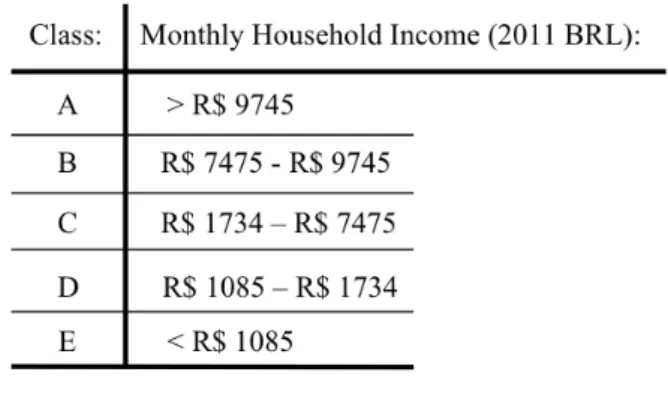
their living conditions entering what is considered as the middle class (i.e. C), which has
increased by almost 50 million people, resulting in the formation of the so-called “new middle
class”, with a monthly household income between 1734 and 7475 Brazilian Reais (Figure 2).
Figure 2. Brazilian Income Classes2
At the same time, the lowest classes (i.e. E and D) have shrunk, with a reduction of almost
18% of individuals living with less than USD 2 per day (Arnold and Jalles, 2014).
Figure 3. Brazilian Economic Pyramid3
However, is spite of these recent improvements, income inequality is still remarkably present
within the Brazilian population, as a 2014 GINI index of 52.94 confirms. It can be seen from
Figure 3that, although the C class includes approximately 60% of Brazilian households, only
15% of the people belong to the higher classes (A and B), while almost 25% are still
struggling at the base of the pyramid accounting for approximately 50 million people (Neri,
2012).
This huge number has led to many social initiatives targeting the Brazilian BoP, some of
which from The Coca-Cola Company.
4.2. Coca-Cola and CSR
Since the early 1990s Coca-Cola Company has been very active in the area if corporate social
responsibility at a BoP level, with many projects aiming at the social development of poor
communities all over the world. Coca-Cola’s initiatives in Africa and Asia to include BoP
individuals in the company’s value chain are a few examples5.
Although not all of its social projects have created the hoped-for impacts (see Karnani, 2006),
the company has shown a strong commitment and has not stopped pursuing the development
of poor communities. In the late ‘90s, with the creation of Instituto Coca-Cola Brasil, social
initiatives began to be applied in Brazil, resulting in the creation of Plataforma Coletivo.
4.3. Instituto Coca-Cola Brasil
The reason behind the creation of Instituto Coca-Cola Brasil6 (ICCB) was the promotion and implementation of transformational programs for the social inclusion and development of
Brazil, with special focus on the creation of a better future for the women and youth of poor
communities.
Since its formation in 1998, the ICCB has grown from 2 to 45 employees and it has
experienced a gradual shift in its role of fostering the development of poor Brazilian
communities; if until 2003 it only supported social projects of other NGOs, from 2004
onwards the Instituto began to take a more active role, personally designing and implementing
new projects with the help of local partners, which eventually led to the creation of Projeto
Coletivo in 2009.
Instituto Coca-Cola Brasil believes that in order to have a relevant impact on society, the
focus has to be on the single individuals. That is why they aim at enhancing the potential of
each individual by placing him/her in charge of his/her life, through training and technical and
moral support.
Nevertheless, ICCB understands that significant social change can only happen when a large
number of people are affected and, to do so, voice is given to poor communities, helping
Coca-Cola to develop different projects suited to their needs.
5. PLATAFORMA COLETIVO:
In 2008, the booming Brazilian economy together with the increase in demand and
consumption at the lower level of the pyramid led Coca-Cola Brazil and the ICCB to develop
a project, which would allow the company to be more present in the poor Brazilian
communities. Following the principles of shared value and co-creation (Calton et al., 2013;
Simanis and Hart, 2008), Coca-Cola did not only concentrate on selling products, but also
focused on having a positive impact on the lives of the less fortunate, fostering empowerment
and development.
Consequently, in collaboration with the Shared Value area of Coca-Cola Brazil, the ICCB
created the Plataforma Coletivo Coca-Cola (Platform Coletivo in English), which operates by
offering different social initiatives (i.e. Coletivo projects), according to the needs of the
various communities.
With Coletivo, Coca-Cola aims at empowering poor Brazilian individuals, improving both
their social and financial conditions, by basing each Coletivo project on three guiding
principles:
§ To increase individuals’ self-esteem through empowerment and income generation § To provide them with life skills by offering technical assistance and access to the labor
market
§ To create shared value through their inclusion in the value chain
Alongside the aforementioned social mission, Coletivo Platform presented the double goal of
being profitable, while doing good to society. Indeed, the organization also followed three
additional business related objectives:
§ To improve brand image and loyalty
§ To increase presence in BoP Brazilian market § To increase sales
Both social and market objectives are measured by Coca-Cola and its partners.