2012 J. Phys.: Conf. Ser. 406 012016
(http://iopscience.iop.org/1742-6596/406/1/012016)
Download details:
IP Address: 200.145.3.40
The article was downloaded on 18/07/2013 at 21:08
Please note that terms and conditions apply.
Study of RF-excited Diethylene Glycol Dimethyl
Ether Plasmas by Mass Spectrometry
M. A. Algatti, R. P. Mota, P. W. P. Moreira J´unior, R. Y. Honda, M. E. Kayama, K. G. Kostov
FEG-DFQ-UNESP, Av. Ariberto Pereira da Cunha 333, 12516-410, Guaratinguet´a, SP, Brazil
E-mail: [email protected]; [email protected]
Abstract. This paper deals with the study of the fragmentation process of diethylene glycol dimethyl ether (CH3O(CH2CH2O)2CH3) (diglyme here in) molecule in low pressure RF excited plasma discharges. The study was carried out using mass spectrometry. The results showed that for a fixed pressure, the increase of the RF power coupled to the plasma chamber from 1 to 35 W produced a plasma environment much more reactive which increases the population of the ionized species likeCH+
3 (15 amu),C2H4+(28 amu),CH3O+(31 amu),C2H4O+(44 amu),
CH3OCH2CH2+ (59 amu) andCH3OCH2CH2O+ (75 amu). This fact may be attributed to the increase of the electronic temperature that makes predominant the occurrence of inelastic processes that promotes molecular fragmentation. For a fixed value of RF power the increase of pressure from 50 mTorr to 100 mTorr produces the decreasing of the above mentioned chemical species due the lower electronic mean free path. These results suggest that if one wants to keep the monomer’s functionality within the plasma deposited films resulting from such kind of discharges one must operate in low power conditions.
1. Introduction
2. Experimental setup and plasma diagnostics
The glow discharges were generated by a RF power supply operating in the range from 5 to 45 W in diglyme atmospheres ranging from 50 mTorr to 100 mTorr within a stainless steel cylindrical, 210 mm of internal diameter and 225 mm long, parallel plate electrodes plasma reactor. The chamber is provided with eight lateral entrances, positioned at the mid plane between the electrodes, that may be used for setting optical, electrical and mass diagnostics and the low (mechanical pump) and high (turbo-molecular pump) vacuum systems. The vacuum inside the plasma chamber is monitored by piraniT M (thermocouple) and penningT M (inverse
magnetrom) gauges. The turbo-molecular pump is coupled to the chamber through a gate valve and is used for cleanness purposes. The pressure is pumped down to 10−6 Torr, being the
chamber purged with argon several times before each running of the experiment. The inner side of the plasma chamber was polished up to the optical quality (roughness of 0.5 µm or less) in order to minimize the retention of impurities and facilitate the cleaning process. The plasma chamber walls were heated with a temperature controlled belt in order to minimize the monomer’s condensation as well as the humidity. Diglyme was placed inside a stainless steel bottle and was fed into the plasma chamber through a needle valve. The plasma was excited by a RF power supply operating in 13.56 MHz whose output intensity could be varied from 0 W to 300 W (Tokyo HY-Power model RF-300T M). The RF power was coupled to the plasma
reactor through an appropriate matching network (Tokyo HY-Power model MB-300T M) that
allows one to minimize the reflected RF power. The mass spectrometry was performed using a mass spectrometer and energy analyser (Hiden Analytical model EQP-300T M), operating in
the mass and energy range from 1 amu to 300 amu and from 0 eV to 100 eV respectively. The block diagram of the experimental setup is presented in Figure 1.
3. Results and discussion
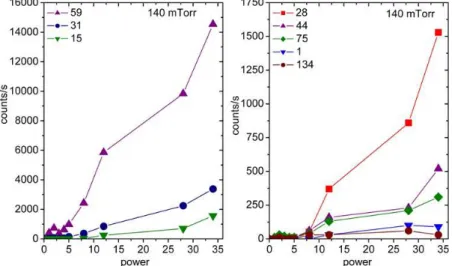
It is presented in table 1 all the possible primary fragments of diglyme molecule (134 amu) resulting from the disruption of the chemical bonds between carbon-carbon and carbon-oxygen atoms. Since the molecule is central symmetric to the oxygen atom located in ethylene-glycol group one may identify only four different points of molecular disruption involving the above mentioned chemical bonds which results the fragments listed in Table 1. It must be pointed out that all the molecular fragments presented in table 1, with the exception of the number 8 (119 amu), may result from secondary or higher fragmentation process of the more heavy fragments of the diglyme molecule. The number of possibilities contributing for the population of a fragment increases inversely proportional to its mass. From the point of view of the non-fouling characteristic of the plasma deposited diglyme films the ethylene-glycol structure, e.g., CH2CH2O (44 amu), is one the most important structure to be retained within the film composition if one wants to keep its functionality [2]. Therefore is important to keep under control the plasma parameters that enhance the presence of heavy fragments within the discharge. Figure 2 shows the RF power dependence of diglyme fragments within the plasma, for a fixed pressure of 140 mTorr. It can be seen that as the RF power coupled to the plasma chamber increases the concentration of the ionized species increases indicating the predominance of electronic inelastic collisions resulting in molecular fragmentation. Figure 3 shows a typical
Figure 1. Block diagram of the experimental set-up
Table 1. Primary Diethylene-glycol-dimethyl-ether fragments and the monomer molecule
fragment chemical structure mass (amu)
1 CH3 15
2 CH3O 31
3 CH3OCH2 45
4 CH3OCH2CH2 59
5 CH3OCH2CH2O 75
6 CH3OCH2CH2OCH2 89
7 CH3OCH2CH2OCH2CH2 103
8 CH3OCH2CH2OCH2CH2O 119 monomer CH3OCH2CH2OCH2CH2OCH3 134
Figure 3. Typical diglyme mass spectra from 1 amu (atomic mass unit) to 134 amu, at 100 mTorr (top) and at 50 mTorr (bottom), for 15 W of RF
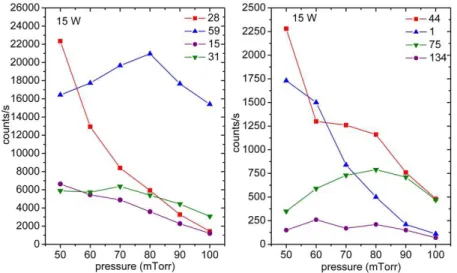
Figure 4. Pressure dependence of diglyme fragments for 15 W of RF power
diglyme mass spectra run at 100 mTorr and 50 mTorr for the RF power kept fixed on 15 W. It may be seen that the number of lighter chemical species increases considerably. This behaviour of discharge can be explained if one considers that for lower pressure the molecular fragmentation is enhanced due the higher values of electronic mean free path and mean temperature. Figure 4 shows the pressure dependence of diglyme ionized fragments for a fixed RF power coupled to the plasma chamber. It can be appreciated that the number of ions decreases with pressure mainly due to molecular recombination process that is enhanced in such conditions. This fact is corroborated by the neutral species mass spectra data, not shown in the present paper.
4. Conclusions
One can conclude from the presented results that the operation of the plasma reactor at low RF power levels is appropriate if one wants to preserve the monomer functionality into the plasma deposited thin films, since it enhances the predominance of heavy chemical species within the discharge reducing the fragmentation processes.
Acknowledgements
Authors would like to thank FAPESP, CAPES and CNPq for financial support.
References
[1] 2008 Advanced plasma technology ed R D’Agostino, P Favia, Y Kawai, H Ikagami, N. Sato and N. Arefi-Khonsari (Weinheim: Wiley-VCH)
[2] 2008 Low temperature plasmas: fundamentals, technologies, and techniques ed R Hippler, H Kersten, M Schmidt and K Shoenbach (Weinheim: Wiley-VCH)
[3] Ostrikov K 2008 Plasma nanoscience: basic concepts and applications of deterministic nanofabrication
(Weinheim: Wiley-VCH)
[4] 2000Handbook of advanced plasma processing techniques ed R J Shul and S J Pearton (Berlin: Springer) [5] Hendricks S. K., Kwok K., Shen M., Horbett T. A., Ratner B. D., and Bryers J. D 2000 J. Biomed. Mater.
Res.50160
[6] Mar M. N., Ratner B. D. and S. S. Yee S. S 1999Sensors and Actuators B 54125 [7] Kwok C. S., Horbett T. A. and B. D. Ratner B. D 1999J. Control. Release62301
[8] Lopez G. P., Ratner B. D., Tidwell C. D., Haycox C. L., Rapoza R. J. and Horbett T. A 1992J. Biomed. Mater. Res.26415
[9] Algatti M. A., Mota R. P., Honda R. Y., Kayama M. E., Kostov K. G., Fernandes F. S., Azevedo T. C. A. M. and Cruz N. C 2009Eur. Phys. J. D54325
[10] Cheng Q., Li S., Komvopoulos K 2009Biomaterials304203 [11] Cheng Q. and Komvopoulos K 2009J. Phys. Chem. C 113213
[12] Cicala G., Creatore M., Favia P., Lamendola R. and D’Agostino R 1999App. Phys. Lett.7537 [13] Oehr C., M¨uller M., Elkin B., Hegemann D. and Vohrer U 1999Surf. Coat. Technol.116-11925 [14] Favia P. and D’Agostino R 1998Surf. Coat. Technol.981102