www.mech-sci.net/6/211/2015/ doi:10.5194/ms-6-211-2015
© Author(s) 2015. CC Attribution 3.0 License.
Shape and force analysis of capillary bridge between two
slender structured surfaces
Z. F. Zhu1, J. Y. Jia1, H. Z. Fu2, Y. L. Chen1, Z. Zeng1, and D. L. Yu1 1School of Mechano-Electronic Engineering, Xidian University, Xi’an, China
2ZTE Corporation, Shenzhen, China
Correspondence to:Z. F. Zhu ([email protected])
Received: 18 April 2015 – Revised: 1 August 2015 – Accepted: 18 September 2015 – Published: 1 October 2015
Abstract. When a capillary bridge of a constant volume is formed between two surfaces, the shape of the liquid bridge will change as the separation between those surfaces is varied. To investigate the variable forces and Laplace pressure of the capillary bridge, as the shape the bridge evolves, a pseudo-three-dimensional force model of the capillary bridge is developed. Based on the characteristics of the slender structured surface, an efficient method is employed to directly solve the differential equations defining the shape of the capillary bridge. The spacing between the plates satisfying the liquid confined within the hydrophobic region of the structured surface is calculated. The method described in this paper can prevent meshing liquid surfaces such that, compared with Surface Evolver simulations, the computing speed is greatly improved. Finally, by comparing the results of the finite element simulations performed with Surface Evolver with those of the method employed in this paper, the practicality of the method is demonstrated.
1 Introduction
The capillary bridge between two structured surfaces is very important in research into, and application of, mechanical structures, surface mount technologies, micro-fluid dynamics, biological bionics, and other technical fields (Stewart et al., 2013; Bowden, 1997; Gau et al., 1999; Mlota et al., 2010; Saad and Neumann, 2014). The forces exerted by the liquid bridge have a great effect on the life and relia-bility of microelectromechanical systems (MEMS), flip-chip alignment, and the mobility of fluids in micro-channels (Guo et al., 2009; Chen and Soh, 2008; Bush et al., 2010; Dalin et al., 2010; Krammer, 2014). Therefore, research into the mechanical properties of a liquid bridge has great practical significance. By using micro-contact printing, vapor deposi-tion, photolithography, and other techniques, a hydrophobic substrate surface can be patterned with hydrophilic strips to produce a structured surface, so as to control the morphology of the capillary bridge and achieve the desired mechanical properties. This has a high application value in fields such as microelectronics, semiconductors, MEMS, and microchan-nels (Bowden, 1997; Gau et al., 1999; Bush et al., 2010;
Lipowsky, 2001; Broesch and Frechette, 2012; Broesch et al., 2013).
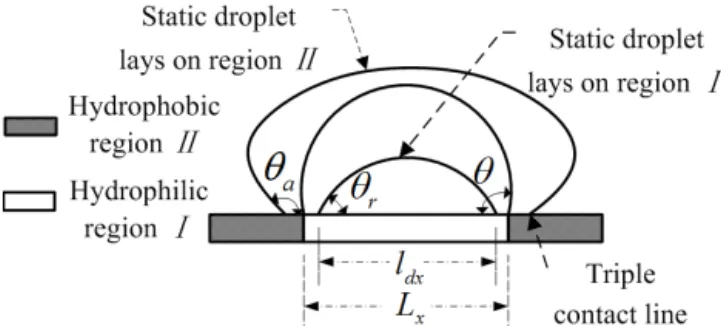
Figure 1.Change in contact angleθcaused by differences in wet-tability.
the actual situation. Another study (Valencia et al., 2001) ad-dressed the morphology of the liquid phases within chemi-cally structured slit pores, using the finite element method to evolve the surface towards minimal energy, but this suffered from the trade-off between computing speed and accuracy. Surface Evolver uses the gradient descent method to mini-mize the free energy of the system, and can be applied to a wide range of problems, rather than being optimized to deal with a specific problem (Brakke, 1994). To obtain a precision solution, therefore, it is necessary to progressively refine the surfaces by applying a tessellated mesh and allowing more time for the computing. Surface Evolver has some shortcom-ings, such as the fact that surfaces are allowed to intersect with each other and convergence to a minimum energy level can be difficult to determine (Brakke, 1994). Therefore, there is a need for a high-efficiency method capable of overcoming these issues.
We adopted the method of equivalent tension to estab-lish a pseudo-three-dimensional force model for the capillary bridge. Considering the marginal effects of the slender cap-illary bridge profile and the Young–Laplace equation, we set out to solve the differential equations defining the shape of a capillary bridge having a constant volume. To maximize the efficiency with which the initial-value problem can be solved, an efficient mathematical analysis method is used to solve the boundary-value differential equations for the cap-illary bridge profiles, therefore optimizing the initial value. Finally, the relationship between the forces and the shape pa-rameters of the capillary bridge is explored. For every cal-culation, we employ the equation defining the equilibrium of the forces to solve the differential equations, then the change processes for the capillary bridge shape parameters are ob-tained by means of a decline process defining the separa-tion between the plates, which satisfies the physical boundary constraints. As there is no need to consider meshing liquid surfaces, the computing speed is greatly improved relative to the simulations performed with Surface Evolver. Moreover, there are no shortcomings, such as surfaces intersecting with each other or convergence to a minimum energy being diffi-cult to judge.
Figure 2. (a) Structured surface of the plate and (b) capillary bridge.
2 Characteristic parameters and force analysis for the capillary bridge
2.1 Characterizations
On a smooth homogeneous surface, the contact angle be-tween a liquid–gas interface and a liquid–solid interface re-mains constant. This is known as the “wetting angle” (Lang-bein, 2002; Bonn et al., 2009). Under a specific gas atmo-sphere, the size of the wetting angle is affected only by the surface tension between the liquid and the solid (Lang-bein, 2002; Bonn et al., 2009; Pozrikidis, 2012; Oliver et al., 1977). As shown in Fig. 1, when the triple contact line slips on the structured surface and reaches the point where the wettability changes, then the triple contact line will be pinned and the contact angle will be changed. This is known as “canthotaxis” (Lipowsky et al., 2000; Herminghaus et al., 2008; Liu et al., 2012; Langbein, 2002). If the liquid is static in region I or II, then the contact angles will be θr or θa, respectively. The variation in the contact angle θ
is: θr ≤θ≤θa when ldx=Lx, θ=θr when ldx< Lx, and θ=θawhenldx> Lx.
and Frechette, 2012; Broesch et al., 2013; Valencia et al., 2001) (see Fig. 2a). The length of region I is set toLy and
its width toLx. Region I has a high aspect ratio (Ly≫Lx).
In this paper we only consider a capillary bridge confined within the region I, that is, the case whereldx=Lx.
Ignor-ing the roughness of the structured surfaces and evaporation from the capillary bridge, a change in the spacing between the plates causes the two ends of the capillary bridge to ad-vance or recede along the length of the region I, while the contact angles at both ends of the capillary bridge remain constant (Broesch and Frechette, 2012; Broesch et al., 2013; Valencia et al., 2001; Swain and Lipowsky, 2000). This is termed the “slipping” of the triple contact lines on region I. The widths (ldx) of the liquid–solid interfaces are confined
by the hydrophobic region II and are constant, but the con-tact angle and the curvature of the lateral liquid–gas interface along the length of the hydrophilic region I will vary with the decline in the capillary bridge height, termed the “hinge movement” of the bilateral liquid–gas interfaces at the lo-cation where the wettability varies (Broesch and Frechette, 2012; Broesch et al., 2013; Valencia et al., 2001; Yaneva et al., 2005). As the spacing between the plates decreases fur-ther, the triple contact line at the two ends of the capillary bridge slips and touches region II, at which point the triple contact line is pinned and the all-around liquid–gas interface of the capillary bridge hinges, which inevitably leads to vari-ations such as the forces of the capillary bridge, internal pres-sure, surface curvature, and contact angles (Lipowsky, 2001; Broesch and Frechette, 2012; Broesch et al., 2013).
2.2 Force analysis for capillary bridge
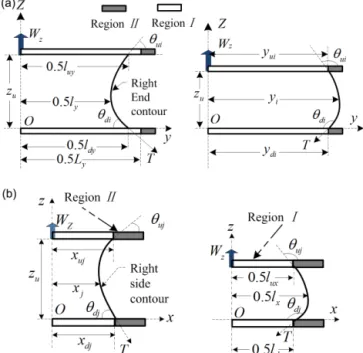
Based on the three-dimensional shape characteristics of the capillary bridge, a pseudo-three-dimensional force model of the capillary bridge was developed by applying the tension equivalent method. In the Cartesian coordinate system, the upward direction of the force is positive. As shown in Fig. 2, taking advantage of the symmetry of the capillary bridge, the force analysis of the right end and the right side of the liquid– gas interfaces is represented by Fig. 3a and b.
The hydrostatic equilibrium equation of the capillary bridge in the vertical direction can be written as
Wz+ldxldypb−ρgV0−2T ldxsinθdi+ldysinθdj
=0. (1)
At the bottom of the capillary bridge, the pressure is
pb=
2T ldxsinθdi+ldysinθdj
+ρgV0−Wz ldxldy
(2)
where ρ is the density of the liquid and T is the surface tension of the liquid–gas interface. The length of the liquid– solid interface on the lower plate is set toldy, while its width
is set toldx.θdi andθdj are the contact angles between the
liquid–gas interface and the liquid–solid interface along the width and length of the liquid bridge, respectively.V0
repre-sents the volume of the liquid;Wz represents the total force
Figure 3.(a)Right end of liquid–gas interface force diagram with different spacings and(b)lateral liquid–gas interface force diagram with different spacings.
applied to the top of the capillary bridge by the upper plate in the vertical direction, which involves the capillary force and the vertical component of the surface tension.
3 Differential equations defining capillary bridge characterizations
3.1 Transformation of Young–Laplace equation
Unknowns Wz and pb cannot be solved using Eqs. (1)
and (2), but the hydrostatic equilibrium equation shows that the unknowns are closely related to the shape characteristic parameters of the capillary bridge. To solve unknownsWz
andpb, solving the differential equations defining the
cap-illary bridge shape becomes key to the problem. Assuming that the liquid volume is constant and transforms the Young– Laplace equation (Padday, 1971), we can develop differential equations to define the shape of the capillary bridge. Because of the high aspect ratio of the capillary bridge (ly≫lx, where lyandlxare the length and width of the capillary bridge,
re-spectively, as shown in Fig. 3), the bilateral curved surfaces of the liquid–gas interface can be regarded as approximating to cylindrical surfaces. Then, one of the major radiuses of curvature of the Young–Laplace equation
1/γ+1/γ′=1p/T (3)
approximates to infinity (γ′⇒ ∞). The curvature of the bi-lateral curved surfaces can thus be written as:
where 1p is the Laplace pressure. We can employ the surrounding atmospheric pressure as a reference (1p=pb−pz), wherepz=ρgzrepresents the variation in
the internal pressure due to gravity, andpbis the pressure at
the bottom of the capillary bridge.
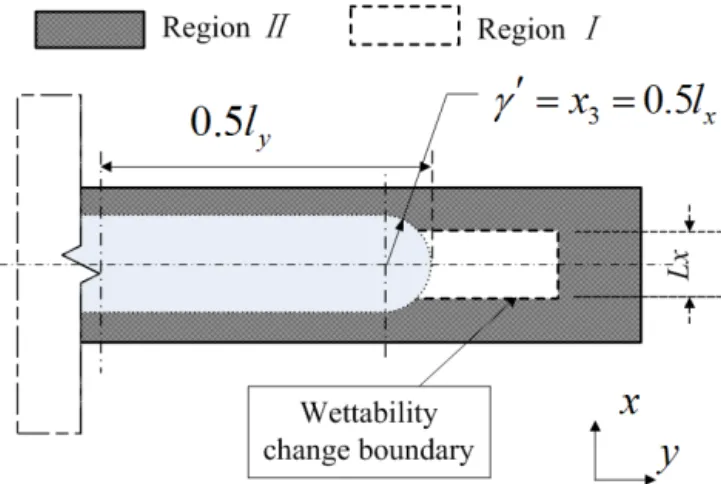
The top view at the right end of the slender capillary bridge is shown in Fig. 4. Given the slender shape of the capillary bridge, the major radius of curvature of the two-end curved surfaces can be approximated as being equal to half the cap-illary bridge widthlx. Based on Eq. (3), the curvature of the
two-end curved surfaces can be expressed as:
1/γ=1p/T −1/γ′ (5)
whereγ′=x
j,xj=0.5lx and the capillary bridge width lx
varies with the height coordinatez.
As shown in Fig. 3, the height coordinatezis chosen as an independent variable in order to satisfy the coordinating relationship between the shape characteristic parameters and pressure, such that the differential expressions of the charac-teristic parameters can be obtained. For different separations between the plates, the volume differential equation forzis obtained by assuming that the capillary bridge volume is con-stant. The differential equations for the shape characteristic parameters can thus be written as follows:
dθi dz =
1 sinθi
1p T −
1 γ′
dyi
dz =1/tanθi dθj
dz = 1p Tsinθj dxj
dz =1/tanθj dV
dz =4xjyi−2
2xj2−π x
2
j 2
(6)
where suffixes i and j are the labels of both ends and the bilateral liquid–gas interface profile curves, respectively; z∈[0,zu], wherezuis the separation between the plates (the
height of the capillary bridge in the stable state),θi andθj
are the slope angles of the outline curves in the yoz and
xoz planes, respectively, andyi andxi are the abscissas of
the outline curves in theyozandxozplanes, respectively (see Fig. 3).
3.2 Boundary conditions of capillary bridge between slender plates
Based on the constraints and the characterization of the cap-illary bridge, the boundary values for the bottom and top of both ends and the bilateral liquid–gas interface profile curves are related as follows:
1. whenz=zu,
xj(zu)=0.5lux=0.5Lx;θj(zu)=θuj;
θi(zu)=θui; yi(zu)=0.5luy; V(zu)=V0, (7)
Figure 4.Top view of right end of capillary bridge.
2. whenz=0,
xj(0)=0.5ldx=0.5Lx; θj(0)=θdj; θi(0)=θdi;
yi(0)=0.5ldy; V(0)=0, (8)
where θdj∈[θr, θa]. The length of the liquid–solid
in-terface on the capillary bridge top is set to luy, and its
width tolux. When the triple contact lines at the two ends
of the capillary bridge have not yet touched region II, θi(zu)=θui=θr, θi(0)=θdi=θr. When the triple contact
lines touch the ends of the region I,yi(zu)=0.5luy=0.5Ly, yi(0)=0.5ldy=0.5Ly.
The solution to differential Eq. (6) is equivalent to solving for the boundary values of first-order nonlinear differential equations, obtaining five unknowns with only one indepen-dent variablez(z∈[0,zu]). Because of the mutual coupling
between the contact angleθdi andθdj at the bottom of the
capillary bridge, differential Eq. (6) can thus be solved.
4 Methods for solving differential equations
4.1 Making the boundary-value problem equal to an initial-value problem
To maximize the efficiency with which an initial-value prob-lem can be solved, the boundary-value conditions for Eq. (8) are assumed to be equivalent to the initial-value conditions, but the solution to the initial-value problem cannot satisfy the boundary-value of Eq. (7), which becomes a problem of ob-jective function minimization. Obtaining the boundary-value conditions for Eq. (7) is equivalent to minimizing relative er-ror objective functions (Eqs. 9 and 10).
Whenldy< Ly,θi(zu)=θi(0)=θr. The objective function
Min:F
θdj∗, ldy∗ , Wz∗
=(θi(zu)−θr) 2
(θr)2
+ xj(zu)−0.5Lx
2
(0.5ldx)2
+(V(zu)−V0) 2
V02 (9)
which includes the implied variables such as bilateral contact anglesθdj∗, the lengthl∗dyat the bottom of the liquid–solid in-terface and the force Wz∗ on the top of the capillary bridge to be optimized. [z∗u2,z∗u1] are the spacing ranges between the plates (capillary bridge height zu) satisfying
boundary-value conditions for Eqs. (7) and (8). If the spacing between the plates is greater thanz∗u1, there is a tendency for the bi-lateral contact anglesθdj∗ > θa. Thus, the triple contact lines
constituted by the bilateral liquid–gas interfaces and plates will be free from restraint and slide into region II. When the triple contact lines at the end of the capillary bridge touch re-gion II, the separation between the plates isz∗
u2,ldy=Lyand θi(zu)=θi(0)=θr. With a further reduction in the heightzu,
the liquid–gas surfaces of both sides and two ends will hinge at the same time.
When ldy=Ly, yi(0)=0.5ldy=0.5Ly. The objective
function is as follows:
Min:F
θdi∗, θdj∗, Wz∗
= yi(zu)−0.5Ly
2
0.5ldy2
+ xj(zu)−0.5Lx
2
(0.5ldx)2
+(V(zu)−V0) 2
V02 (10)
which includes the implied variables, such as the contact an-gles of the two endsθdi∗, the bilateral contact anglesθdj∗ and the forceWz∗on the top of the capillary bridge, which has to be optimized. Here, [z∗u3,z∗u2] are the capillary bridge heights zusatisfying boundary-value conditions for Eqs. (7) and (8).
If the spacing between the plates is less thanz∗u3, the triple contact lines will be free from restraint and slide into re-gion II.
For a height range zu∈[z∗u3, zu1∗ ], as the height zu is
reduced, there are m capillary bridge heights (zu=zu(0), zu(1),· · ·,zu(m)). Under those constraint conditions in which
the capillary bridge could degrade, there aremvalues of bi-lateral contact angles. Whenz=zu, the implicit variables are
obtained by optimizing the implicit variables (ifldy< Ly, the
implicit variables are θdj∗, l∗dy andWz∗; ifldy=Ly, the
im-plicit variables areθdi∗,θdj∗ andW∗
z) in order to attain the
per-missible errors of the objective function (Eqs. 9 or 10), and to make the boundary-values at the top end of the capillary bridge satisfy Eq. (7).
The flowchart for solving differential Eq. (6) is shown in Fig. 5.
4.2 Range of capillary bridge height
If the boundary values at the top and bottom of the out-line curves satisfy Eqs. (7) and (8), the method
intro-Figure 5.Flowchart for solving differential equations.
duced in Sect. 4.1 can be employed to calculate the spac-ing ranges between the plates, provided the liquid does not overflow into hydrophobic region II. The heightz∗u1 which satisfies the constraint conditions can be obtained by opti-mizing objective function (Eq. 11), when θj(0)=θdj=θa
andldy< Ly. The heightz∗u2 can be obtained by
optimiz-ing objective function (Eq. 12), when θi(zu)=θi(0)=θr
and yi(zu)=0.5luy=0.5Ly. The height z∗u3 which
satis-fies the constraint conditions can be obtained by optimiz-ing objective function (Eq. 13), whenθj(0)=θdj=θa and yi(zu)=0.5luy=0.5Ly.
Min:F
z∗u1, l∗dy, Wz∗
= θi z
∗
u1
−θr2
θ2 r
+ xj z
∗
u1
−0.5ldx2
(0.5ldx)2
+ V z
∗
u1
−V02
V02 (11)
Min:F
z∗u2, θdj∗, Wz∗
= θi z
∗
u2
−θr
2
θ2 r
+ xj z
∗
u2
−0.5ldx
2
(0.5ldx)2
+ V z
∗
u2
−V0
2
Table 1.Parameters for capillary bridge and flat plate.
Parameters Lx V0 Ly Wetting Wetting Densityρ Surface (mm) (µL) (mm) anglesθr angleθa (kg mm−3) tensionT
(N mm−1)
Groupa 1 5 10 30, 45, 60◦ 135◦ 1×10⁻⁶ 7.2×10⁻⁵ Groupb 1 7.5 10 30, 45, 60◦ 135◦ 1×10⁻⁶ 7.2×10⁻⁵ Groupc 0.5 5 10 30, 45, 60◦ 135◦ 1×10⁻⁶ 7.2×10⁻⁵
Min:F z∗u3, θdi∗, Wz∗
= yi z
∗
u3
−0.5Ly2
0.5Ly2
+ xj z
∗
u3
−0.5ldx
2
(0.5ldx)2
+ V z
∗
u3
−V0
2
V02 (13)
Objective functions (Eqs. 11 to 13) are implied optimization variables:z∗u1,ldy∗ ,Wz∗;z∗u2,θdj∗,Wz∗andz∗u3,θdi∗,Wz∗.
5 Results and discussion
Three groups of liquid bridge systems are listed in Table 1. The hydrophilic regions I for different wetting angles, the curves of the morphological parameters, the forces, and inter-nal pressures for a range of heights are ainter-nalyzed. Moreover, the results are compared with the Surface Evolver simula-tions.
5.1 Relationships between morphological parameters
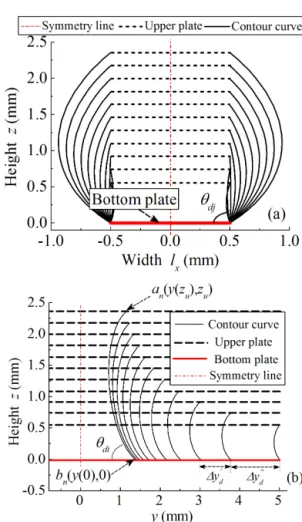
The outline curves satisfying boundary-value conditions for Eqs. (7) and (8) are obtained by programming for solving differential Eq. (6). Figures 6 and 7 show the outline curves forV0=5 µL,Lx=1 mm, andθr=30◦.
When the range of the spacing between the two plates is zu∈[z∗u2,z∗u1], the triple contact lines of the two ends do not
touch hydrophobic region II (ldy< Ly). In Fig. 6a, both sides
of the liquid–gas interface gradually change from convex to concave and the contact anglesθdj decrease with the height zu. However, the width at the bottom of the capillary bridge is
constant (ldx=Lx), because the bilateral triple contact lines
are pinned by hydrophobic region II along the length of re-gion I, and the bilateral liquid–gas interfaces are in a “hinge movement” state. In Fig. 6b, the contact angles θdi of the
capillary bridge’s two ends are constant (θdi=θr), but the
spacing between the two plates can vary. The length of the capillary bridge can change freely, the contour surfaces of its two ends are always concave, and the triple contact lines of the two ends “slip” in region I. As shown in Fig. 6b, it can be found that gravity has a significant effect on the morphology of the capillary bridge (there is a large difference between abscissasy(0) andy(zu) of the upper and lower endpointsan
andbnof the contour curves), when the height of the
capil-lary bridge is greater (zu>1.25 mm). When zu<1.25 mm,
Figure 6.Profiles of the capillary bridge when the two ends’ triple contact lines are unconstrained.(a)Bilateral side contour curves and(b)right end contour curves.
|y(0)−y(zu)| ⇒0, gravity has an increasingly smaller
influ-ence on the morphology of the capillary bridge. The contour curves of the capillary bridge will approximate to a circular arc.
When the heightzu∈[z∗u3,z∗u2], the triple contact lines are
also pinned by hydrophobic region II (ldy=Ly) at the two
ends of region I. In Fig. 7, the liquid–gas interfaces around the capillary bridge are in a “hinge movement” state and gradually bulge outward.
For different volumesV0or widthsLx, the bottom lengths
Figure 7.Profiles of capillary bridge when triple contact lines are pinned. (a) Right-side contour curves and (b) right-end contour curves.
the triple contact lines of the two ends “slip” in region I as the height zu falls. It can be found that the lengths of the
liquid–solid interfaces are in quantitative agreement with the result of the Surface Evolver simulations when the heightzu
is low, but as the height increases, we find that the results from our theory underestimate the simulation results. When the height of the capillary bridge is greater (zu/Lx>1.5),
we assume that the deviation observed at higher values of zu is caused by a decrease in the aspect ratio (ly/lx) of the
bridge, at which point one of the major curvature radiuses of Eq. (3) approximates to infinity (γ′⇒ ∞). By integrating Fig. 8a and c it can be found that, for the same volume V0,
a smaller value ofLxwill greatly reduce the variation in the
heightzu(z∗u1becomes smaller,z∗u3becomes larger).
For variableV0or region I widthLx, Fig. 9 indicates the
variations in the bilateral contact anglesθdj with the
reduc-tion in the height zu. Based on the changes in the
wetta-bility of region I, the ranges of the contact angles are [θr, θa], (θr is 30, 45 or 60◦; θa is 135◦). When the capillary
bridge can freely advance along the length of region I, θdj
decreases with the height, which is in agreement with the re-sults of experiments described in the literature (Broesch and
Frechette, 2012) as well as those of the Surface Evolver sim-ulations. Once the triple contact lines at the left and right ends of the capillary bridge have been pinned by region II (ldy=Ly),θdj will increase as the heightzu decreases. As
the height of the capillary bridge increases (zu/Lx>1.5),
the deviation also increases relative to the results of the Sur-face Evolver simulations. The variation in the bilateral con-tact anglesθdj is in agreement with the results of the Surface
Evolver simulations, except when the wetting angleθr=60◦
andLx=0.5 mm (see the inset in Fig. 9c), because the
re-sults of the Surface Evolver simulations showed that the ends of the capillary bridge did not touch region II in the spacing variable range determined using our theory.
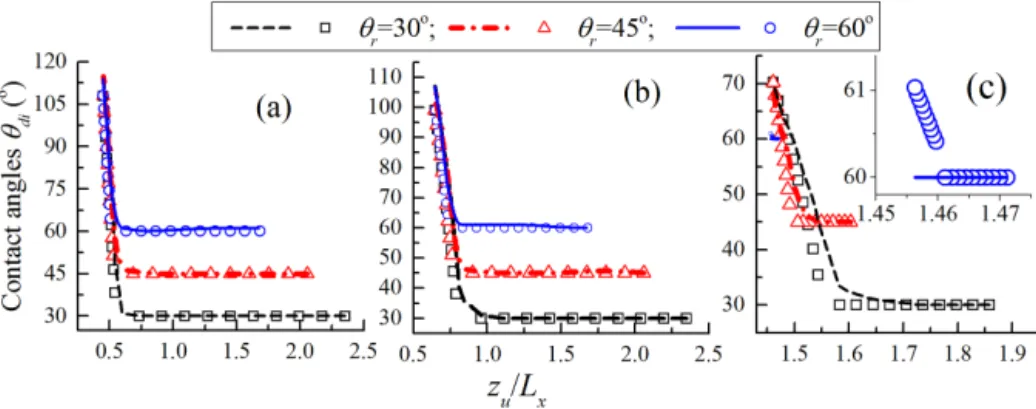
By combining Figs. 9 and 10, it can be seen that θdj
is always greater thanθdi (θdj> θdi), corresponding to the
same heightzu, which implies that a bulge appears on the
side of the liquid–gas interfaces first, and then the bilateral triple contact lines depart from pinning and overflow into hy-drophobic region II when the heightzuis greater thanz∗u1or
less thanz∗u3. The contact angleθdi remains constant when
both ends of the liquid bridge are able to freely “slip”. When the two ends of the capillary bridge are constrained by the re-gion II (ldy=Ly),θdiwill increase. Based on Figs. 9 to 10,
the ranges of variablezuare influenced by the changes in the
wetting angleθr, volumeV0, and the widthLxof the region I.
For the same group of parameters in Table 1,θr only
influ-enceszu1∗ , the upper limit on the range of the heightzu. Ifθr
were smaller,z∗u1could attain a greater value.V0mainly
in-fluencesz∗u3, the lower limit on the range of the heightzu. If V0were smaller,z∗u3could attain a smaller value. The
varia-tions in the bilateral contact anglesθdiare in agreement with
the results of the Surface Evolver simulations, except when the wetting angleθr=60◦andLx=0.5 mm (see the inset in
Fig. 10c), because the Surface Evolver simulations indicate that the ends of the capillary bridge do not touch region II, such thatθdi=60◦remains constant.
5.2 Stiffness characteristics curves of capillary bridge
The force Wz acting on the capillary bridge upper end is
related to zu. The height of the capillary bridge as
deter-mined by the curves known as the “stiffness characteristics curve” ofWzis shown in Fig. 11. Aszudecreases, the force Wzcontinues to increase, to the point where the triple
con-tact lines at the ends of the capillary bridge move into the “slipping” stage. According to Eq. (1), the change inWz
de-pends on variables ldy, pb andθdj. As sinθdj andldy
in-crease,pb decreases (see Fig. 12), thus demonstrating that
the variation inWz is mainly a result of the surface tension.
As the width of region I decreases, the change in the wet-tability of region I exerts a greater influence on the change inWz(see Fig. 11c). Aszufurther decreases, the triple
Figure 8.Variations in bottom length of liquid–solid interfaces.(a),(b), and(c)refer to parameters groupsa,b, andclisted in Table 1 for a range of wetting angles. The data points are as obtained with our theory and the lines are those obtained from the Surface Evolver simulations. The inset shows the change in the bottom length of the liquid–solid interfaces when the wetting angleθr=60◦.
Figure 9.Changes in contact angleθdj at both sides. Here,(a),(b), and(c)correspond to parameter groupsa,b, andclisted in in Table 1 for different wetting angles. The data points are as obtained with our theory and the lines are those obtained from the Surface Evolver simulations.
Figure 10.Changes in contact anglesθdiat both ends. Here,(a),(b), and(c)refer to parameter groupsa,b, andcthat are listed in Table 1 for different wetting angles. The data points are as obtained with our theory and the lines are those obtained from the Surface Evolver simulations.
the force Wz exerted on the capillary bridge by the upper
plate is rapidly declining and it changes from stress to pres-sure as the height decreases, which is mainly affected by the capillary force on the capillary bridge. When we compare the predictions obtained from the Surface Evolver simulations
with the results obtained with our method, we find that the two sets of results are in quantitative agreement, but as the region I widthsLx=0.5 mm and wetting angleθr=60◦(see
Sur-Figure 11. Stiffness characteristic curves of Wz. Here, (a), (b), and (c)correspond to parameter groupsa,b, and c, listed in Table 1 for different wetting angles. The data points are as obtained with our theory and the lines are those obtained from the Surface Evolver simulations.
Figure 12.Variations in bottom pressure of capillary bridge. Here,(a),(b), and(c)refer to groupsa,b, andclisted in Table 1 for different wetting angles. The data points are as obtained with our theory and the lines are those obtained from the Surface Evolver simulations.
face Evolver simulations are about 15 % less than the results obtained with our theory.
Figure 12 shows the changes in the pressurepb. When the
triple contact lines are “slipping”, the decline in the upper plate causes the capillary bridge to elongate. When the value of pb is falling slowly, a transition from negative to
posi-tive values at around zu/Lx=1 can be seen for parameter
groupaand the wetting angleθr=30◦. This corresponds
di-rectly to the transition in the contact anglesθdj from greater
than 90◦ to less than 90◦, as shown in Fig. 9a. When the all-around liquid–gas interfaces are in the “hinge movement” stage, the capillary bridge does not elongate any further. The descent of the upper plate causes the internal pressure to in-crease rapidly. This corresponds to a variation in the con-tact anglesθdj andθdj, shown in Figs. 9 and 10. When the
height of the capillary bridge is greater (zu/Lx>1.5), we
can see that the results of our theory underestimate the re-sults obtained with the Surface Evolver simulations, due to the breakdown of the Eqs. (4) and (5) approximation, as dis-cussed in the previous sections.
6 Conclusions
val-ues ofzu/Lx. The theory highlights the fact that the
comput-ing speed is greatly improved, relative to the Surface Evolver simulations. Moreover, there are no shortcomings, such as surfaces intersecting with each other or convergence to the minimum energy level being difficult to judge. This is partic-ularly useful for the study of these issues. This would reduce the computing time needed to determine the equilibrium po-sitions when a package with a large number of solder joints is assembled onto a PCB.
Acknowledgements. The authors would like to thank the supports by the National Natural Science Foundation of China (No. 61201021, No. 51306134).
Edited by: A. Eriksson
Reviewed by: two anonymous referees
References
Bonn, D., Eggers, J., Indekeu, J., Meunier, J., and Rolley, E.: Wet-ting and spreading, Rev. Mod. Phys., 81, 739–805, 2009. Bowden, N.: Self-Assembly of Mesoscale Objects into Ordered
Two-Dimensional Arrays, Science, 276, 233–235, 1997. Brakke, K. A.: Surface evolver manual. Mathematics Department,
Susquehanna Univerisity, Selinsgrove, PA, 1994.
Broesch, D. J. and Frechette, J.: From Concave to Convex: Capil-lary Bridges in Slit Pore Geometry, Langmuir, 28, 15548–15554, 2012.
Broesch, D. J., Dutka, F., and Frechette, J.: Curvature of Capillary Bridges as a Competition between Wetting and Confinement, Langmuir, 29, 15558–15564, 2013.
Broesch, D. J., Shiang, E., and Frechette, J.: Role of substrate aspect ratio on the robustness of capillary alignment, Appl. Phys. Lett., 104, 1–5, 2014.
Bush, J. W. M., Peaudecerf, F., Prakash, M., and Quéré, D.: On a tweezer for droplets, Adv. Colloid Interf. Sci., 161, 10–14, 2010. Chen, S. H. and Soh, A. K.: The capillary force in micro- and nano-indentation with different indenter shapes, Int. J. Solids Struct., 45, 3122–3137, 2008.
Dalin, J., Wilde, J., Zulfiqar, A., Lazarou, P., Synodinos, A., and Aspragathos, N.: Electrostatic attraction and surface-tension-driven forces for accurate self-assembly of microparts, Micro-elect. Eng., 87, 159–162, 2010.
De Souza, E. J., Brinkmann, M., Mohrdieck, C., and Arzt, E.: Enhancement of Capillary Forces by Multiple Liquid Bridges, Langmuir, 24, 8813–8820, 2008.
Ferraro, D., Semprebon, C., Tóth, T., Locatelli, E., Pierno, M., Mistura, G., and Brinkmann, M.: Morphological Transitions of Droplets Wetting Rectangular Domains, Langmuir, 28, 13919– 13923, 2012.
Gau, H., Herminghaus, S., Lenz, P., and Lipowsky, R.: Liquid mor-phologies on structured surfaces: from microchannels to mi-crochips, Science, 283, 46–49, 1999.
Guo, J.-G., Zhou, L.-J., and Zhao, Y.-P.: Instability analysis of tor-sional MEMS/NEMS actuators under capillary force, J. Colloid Interf. Sci., 331, 458–462, 2009.
Herminghaus, S., Brinkmann, M., and Seemann, R.: Wetting and dewetting of complex surface geometries, Annu. Rev. Mater. Res., 38, 101–121, 2008.
Krammer, O.: Modelling the self-alignment of passive chip com-ponents during reflow soldering, Microelect. Reliabil., 54, 457– 463, 2014.
Langbein, D.: Canthotaxis/Wetting Barriers/Pinning Lines, in: Cap-illary Surfaces, Springer Tracts in Modern Physics, Springer, Berlin, Heidelberg, 149–177, 2002.
Lipowsky, R.: Morphological wetting transitions at chemically structured surfaces, Curr. Opin. Colloid Interf. Sci., 6, 40–48, 2001.
Lipowsky, R., Lenz, P., and Swain, P. S.: Wetting and dewetting of structured and imprinted surfaces, Colloids Surf. A, 161, 3–22, 2000.
Liu, J., Xia, R., and Zhou, X.: A new look on wetting models: con-tinuum analysis, Sci. China Phys. Mech. Astron., 55, 2158–2166, 2012.
Luo, C., Heng, X., and Xiang, M.: Behavior of a Liquid Drop be-tween Two Nonparallel Plates, Langmuir, 30, 8373–8380, 2014. Mermoz, S., Sanchez, L., Di Cioccio, L., Berthier, J., Deloffre, E., and Fretigny, C.: Impact of containment and deposition method on sub-micron chip-to-wafer self-assembly yield, IEEE Interna-tional 3D Systems Integration Conference (3DIC), Osaka, USA, 1–5, 2012.
Mlota, N. J., Toveyb, C. A., and Hua, D. L.: Fire ants self-assemble into waterproof rafts to survive floods, P. Natl. Acad. Sci., 108, 7669–7673, 2010.
Oliver, J. F., Huh, C., and Mason, S. G.: Resistance to spreading of liquids by sharp edges, J. Colloid Interf. Sci., 59, 568–581, 1977. Padday, J. F.: The Profiles of Axially Symmetric Menisci, Philos. T.
Roy. Soc. Lond. A, 269, 265–293, 1971.
Pozrikidis, C.: Stability of sessile and pendant liquid drops, J. Eng. Math., 72, 1–20, doi:10.1007/s10665-011-9459-3, 2012. Saad, S. M. I. and Neumann, A. W.: Total Gaussian
curva-ture, drop shapes and the range of applicability of drop shape techniques, Adv. Colloid Interf. Sci., 204, 1–14, doi:10.1016/j.cis.2013.12.001, 2014.
Stewart, M. P., Hodel, A. W., Spielhofer, A., Cattin, C. J., Müller, D. J., and Helenius, J.: Wedged AFM-cantilevers for parallel plate cell mechanics, Methods, 60, 186–194, 2013.
Swain, P. S. and Lipowsky, R.: Wetting between structured surfaces: Liquid bridges and induced forces, Europhys. Lett., 49, 203–209, 2000.
Valencia, A., Brinkmann, M., and Lipowsky, R.: Liquid Bridges in Chemically Structured Slit Pores, Langmuir, 17, 3390–3399, 2001.