Nonlinear Processes
in Geophysics
c
European Geophysical Society 2002
Long waves over a bi-viscous seabed: transverse patterns
J. M. Becker1and D. Bercovici1, *
1Department of Geology and Geophysics, University of Hawaii at Manoa, Honolulu, HI, USA *Present address Department of Geology and Geophysics, Yale University, New Haven, CT, USA
Received: 10 October 2000 – Revised: 2 July 2001 – Accepted: 3 September 2001
Abstract. The coupled interaction of long standing hydro-dynamic waves with a deformable non-Newtonian seabed is examined using a two-layer model for which the up-per layer fluid is inviscid and the lower layer is bi-viscous. The two-dimensional response of the system to forcing by a predominantly longitudinal (cross-shore) standing wave per-turbed by a small transverse (along-shore) component is de-termined. With a constant yield stress in the bi-viscous lower layer, there is little amplification of these transverse per-turbations and the model response typically remains quasi-one-dimensional. However, for a bi-viscous layer with a pressure-dependent yield stress (which represents the ef-fect that the seabed deforms less readily under compression and hence renders the rheology history dependent), the ini-tially small transverse motions are amplified in some param-eter regimes and two-dimensional, permanent bedforms are formed in the lower layer. This simple dynamical model is, therefore, able to explain the formation of permanent bed-forms with significant cross- and along-shore features by pre-dominantly cross- shore standing wave forcing.
1 Introduction
The interaction of ocean waves and beaches forms a highly complex system and observations reveal that pattern forma-tion occurs in the nearshore. These regular morphological features have spatial scales that range from centimeters for sand ripples, to kilometers for sand bars, and often maintain their structure for time scales significantly longer than the ocean forcing (Plant et al., 1999). While a variety of mod-eling efforts have been carried out to gain insight into the interaction of waves and beaches, no consensus has yet been reached about how best to model the formation of nearshore morphology or the impact that the seabed morphology has on nearshore sediment transport (Thornton et al., 1998). Correspondence to: J. M. Becker
Many models of pattern formation in the nearshore couple the dynamics for the overlying fluid motion to a continuity equation for the sediment by using a prescribed sediment flux law. For example, Blondeaux (1990) (see also Vittori and Blondeaux, 1990, 1992) examined the generation of small-scale sand ripples by sea waves by coupling the flow in the viscous oscillatory boundary layer to the continuity equation for the sediment using an empirically determined sediment flux relationship. Stability boundaries for various sand ripple patterns that are in reasonable agreement with observations were obtained; however, these results rely on the parameter-ization of the sediment flux that is not well understood.
The approach of coupling the dynamics of the fluid mo-tion to the seabed using a sediment transport formula also has been applied in models of the formation of large-scale seabed morphology. This approach is the basis for many cross-shore sediment transport models (Roelvink and Bro-ker, 1993) and also has been used in theoretical models of the formation of longshore sand bars (Carter et al., 1973; Boczar-Karakiewicz, et al., 1995) and more complex morphologies (Holman and Bowen, 1982). In addition, a variety of new modeling efforts have been developed to explain pattern for-mation in the nearshore. These studies also are based upon hydrodynamics coupled to sediment transport formulas, but in contrast to the aforementioned studies, use a linear stabil-ity analysis to determine instabilities in the coupled wave-seabed system. For example, Falques et al. (1996) consid-ered the stability of a longshore current over a plane erodible bed and found instabilities that correspond to the formation of longshore periodic beach topographies. Deigaard et al. (1999) considered the stability of waves and a longshore cur-rent over a barred erodible bed and found instabilities that correspond to rip channels. In an earlier study, a rule-based model that uses a kinematical description of the swash flow and a prescribed sediment flux law was developed to describe the formation of beach cusps (Werner and Fink, 1993).
that capture the essential nonlinear dynamics of the coupled ocean-seabed system. We recently have demonstrated that a simple nonlinear dynamical model of the coupled interaction of waves with a deformable seabed can describe the forma-tion of small wavelength bedforms that maintain their struc-ture over many periods of forcing (Becker and Bercovici, 2000). Our model is based upon the hypothesis that sand may be modeled as a continuum with a non-Newtonian rhe-ology. With a non-Newtonian rheology, it is possible to ap-proximate important features of sand motion such as critical bed shear stress (i.e. the sand bed will deform given a suffi-ciently large stress, but will retain a solid structure otherwise) and history-dependent loading (i.e. sand is more difficult to move under loading than unloading). We remark that non-Newtonian rheologies have been used previously to model mud flows and muddy seabeds (Liu and Mei, 1989, 1993a, b; Ng and Mei, 1994).
The interaction of waves with a non-Newtonian seabed first was examined by Liu and Mei (1993a, b) who consid-ered a two-layer model in the long-wave limit for which the upper layer was inviscid and the lower layer was a Bing-ham plastic. They showed that transient waves generated by an initial free-surface displacement leave behind permanent “foot-prints” in the Bingham plastic layer. In the aforemen-tioned study of Becker and Bercovici (2000), the two-layer model of Liu and Mei (1993a, b) was revisited to determine whether or not persistent forcing by standing waves would generate permanent features in the non-Newtonian seabed modeled as a bi-viscous fluid (the Bingham rheology is a limiting form of the bi-viscous rheology) and how the spa-tial scale of the lower layer pattern was related to that of the standing wave forcing. By forcing the two-layer system with an external surface pressure, Becker and Bercovici (2000) showed that the nonlinear rheology transferred energy from the forced wave motion to odd spatial harmonics in the lower layer, as is consistent with the symmetry of the bi-viscous rheology (i.e. since the stress is an odd function of the strain rate). These lower layer features, however, oscillated with the forcing frequency; hence, permanent bedforms did not form under persistent standing wave forcing for a constant yield stress bi-viscous lower layer. By considering a more re-alistic (although still highly idealized rheology) for the lower layer that accounted for the observation that sand deforms less readily under compression, Becker and Bercovici (2000) showed that energy may be transferred to even and odd har-monics of the forcing and that permanent bedforms with spa-tial scales half that of the forcing were formed in the lower layer. We remark that in Liu and Mei (1993a, b), the per-manent footprint in the Bingham plastic lower layer remains after the passing of the transient water wave. In the present study, the permanent bedforms in the bi-viscous lower layer are interfacial patterns with a non-zero time average over a period of the oscillatory forcing.
The studies of Liu and Mei (1993a, b) and Becker and Bercovici (2000) were developed in an effort to under-stand the cross-shore dependence of the interaction of sea-waves with the non-Newtonian seabed and hence were
one-dimensional. Observations reveal, however, that bedforms with significant cross- and along-shore dependence may form (e.g. Vittori and Blondeaux, 1992; Holman and Bowan, 1982). Here, we examine the two-dimensional model dy-namics to determine under what conditions predominately cross-shore (longitudinal) forcing may generate bedforms with significant along-shore (transverse) structure. As in Becker and Bercovici (2000), we excite standing waves by forcing the system with a harmonic external surface pressure of magnitudeA, but here allow for small transverse pressure perturbations of magnitudeA′, whereA′≪A:
P0=Acos(kx)sin(ωt )+A′cos(ly)sin(σ t ) (1)
and (k, ω) and(l, σ ) are the wave number and frequency pairs of the longitudinal pressure forcing and transverse per-turbation, respectively. In the limit of a constant yield stress bi-viscous lower layer, the transverse pressure perturbations typically remainO(A′) and as a result, the spatial pattern formed in the lower layer is quasi-one-dimensional (with one notable exception, see Sect. 3). In addition, in all cases ex-amined for the constant yield stress bi-viscous lower layer, these interfacial patterns oscillate with the forcing frequency and hence are not permanent. In contrast, for a bi-viscous lower layer with a pressure-dependent yield stress, the trans-verse perturbations are amplified for a range of forcing pa-rameters. Moreover, the two-dimensional spatial patterns in the interface displacement that are excited have a significant non-zero time average and result in the formation of perma-nent bedforms with significant along-shore structure.
2 Dynamics
We consider here two superposed shallow homogeneous lay-ers of fluid (Fig. 1) with equilibrium layer depthsH1andH2,
free-surface displacementζ1(x, t )and interface displacement ζ2(x, t ), where x = (x, y). Both the upper and lower layer
fluids are incompressible with constant densitiesρj (j =
1,2), and the upper layer fluid is inviscid, while the lower layer fluid is bi-viscous.
The long-wave momentum equations for this two-layer system in the absence of inertia are
∂u1
∂t = −g∇ζ1− 1 ρ1∇
P0 (2)
∂u¯2
∂t = −g∇ ζ2+ ρ1 ρ2[
ζ1−ζ2]−
1 ρ2∇
P0−
τb ρ2H2
(3) and the linearized continuity equations are
∂(ζ1−ζ2)
∂t +H1∇ ·u1=0 (4)
∂ζ2
∂t +H2∇ · ¯u2=0, (5)
where u1is the horizontal fluid velocity in the inviscid upper
x y
ζ1
ζ2
z=−(H1+H2) z=−H1 z=0
Fig. 1. The two-layer model. The upper layer fluid is inviscid and incompressible, and is confined toζ2−H1 < z < ζ1. The lower layer fluid is bi-viscous (see Eq. 6) and incompressible, and is con-fined to−(H1+H2) < z < ζ2−H1.
the lower layer,∇ =(∂x, ∂y)is the horizontal gradient
oper-ator,gis gravitational acceleration,τb=(τxz, τyz)|z=−H is the bottom stress andP0(x, t )is the applied surface pressure
given in Eq. (1). A derivation of the one-dimensional ver-sions of Eqs. (2)–(5) may be found in Becker and Bercovici (2001).
The dependence of the stress on the strain rate warrants some motivation which is provided below. We emphasize, however, that this lower layer rheology is highly idealized and is not meant to represent a unique continuum model of sand and sediment motion.
2.1 The lower layer rheology
We first consider a bi-viscous rheology for the lower layer because it is perhaps the simplest model of the two flow states of a sediment laden seabed; the seabed resists mo-tion for small applied stresses, but flows readily for stresses above a critical value. For a bi-viscous lower layer, the stressτ = (τxz, τyz)is related to the long-wave strain rate
˙
ε =(ε˙xz,ε˙yz)= ∂u2
∂z (u2is thez-dependent lower layer
ve-locity) according to 1
µ
τ = ˙ε, τˆ ≤τ0p (6)
1 µ′
τ =τ0p(1 µ′ −
1 µ)
˙
ε
ˆ˙ ε + ˙
ε, τ > τˆ 0p.
In Eq. (6), τ0p, µ and µ′ are the yield stress and
dy-namic viscosities respectively, τˆ = (τxz2 + τyz2)1/2 and
ˆ˙
ε=(ε˙xz2 + ˙ε2yz)1/2. Equation (6) describes a bi-viscous rhe-ology with a yield stress,τ0p, that may depend upon space
and time. The Newtonian rheology may be recovered from Eq. (6) in the limit asµ′ → µ(or equivalentlyτ0p → ∞),
while the Bingham rheology may be recovered from Eq. (6) for a constant yield stress in the limit asµbecomes infinite.
The lower layer rheology, Eq. (6), relates the stress to the strain rate for all values of the vertical coordinate. Since only the bottom stressτboccurs in the depth-averaged lower layer momentum balance, Eq. (3), we approximate the strain rate atz= −H in terms of the average lower layer velocity ac-cording to
˙
εb≡∂u2
∂z |z=−H ≈ ¯
u2 H2
. (7)
We remark that the approximation Eq. (7) differs by anO(1) factor from the bottom strain rate obtained for a Newtonian lower layer in the limit of creeping flow.
The dynamics of Eqs. (1)–(7) govern the evolution of the free-surface and interface displacements, and the upper and lower layer horizontal fluid velocities. To close this set of equations, we specify next the yield stressτ0p.
In what follows, we examine two rheologies for the lower layer. In the first and simplest case, the yield stress is a con-stant τ0 (τ0p = τ0) and Eq. (6) reduces to the bi-viscous
rheology considered by Liu and Mei (1993b). In this case, when µ ≫ µ′, the lower layer dynamic balance for small applied stresses with τb ≤ τ0 is creeping flow, while for
larger applied stresses withτb > τ0, the dynamics are those
of weakly-damped internal waves (Becker and Bercovici, 2001). We emphasize, however, that the bottom stress is a function of space and time; hence, at a particular time, the viscosity of the lower layer fluid may vary in space depend-ing upon the local value of the bottom stress.
The second rheology considered here models the observa-tion that a seabed yields less readily under compression than extension. As a result, we allow the yield stress,τ0p, to be
a simple linear function of the dynamic bottom pressure ac-cording to:
τ0p=τ0(1+Cpb(x, t )), 0≤C < Cmax (8)
pb=ρ2gζ2+ρ1g(ζ1−ζ2)+P0.
WhenC =0, we recover the constant yield stress bi-viscous rheology described above. For 0< C < Cmax, Eq. (8)
rep-resents a Coulomb-type friction, so that the yield stress de-pends upon the normal stress. In regions where the normal stress (bottom pressure) is positive/negative, the yield stress is elevated/depressed. Hence, this pressure-dependent yield stress represents a packing condition: for a positive normal stress, the bed resists motion for a larger range of stresses, since the yield stress is elevated (representing the relative difficulty of setting compacted grains in motion), while for a negative normal stress, the bed is more easily eroded be-cause the yield stress is depressed (representing the relative ease of setting loosely packed grains in motion). In Eq. (8), C is a constant that varies from 0 for a constant yield stress lower layer to an empirically determined maximum value Cmaxchosen so thatτ0pundergoes significant variations, but
remains positive. Similar results to those reported in Sect. 3 also have been obtained with a yield stress that is an expo-nential function of the bottom pressure given by
so thatτ0pis positive for all values ofC; obviously, Eq. (8)
is the first two terms in a Taylor expansion of Eq. (9). Fi-nally, we remark that we have neglected fluid inertia in Eqs. (2)–(3) and linearized the continuity Eqs. (4)–(5) to iso-late the effects of nonlinearity due to the lower layer rheol-ogy Eqs. (6)–(8); hence, the model dynamics are valid in the small-amplitude limit.
2.2 Non-dimensional dynamics
We non-dimensionalize Eqs. (1)–(8) according to (x, t )=L(x∗, c−1t∗)
(uj, ζj)=
AkL ρ1c2
(cuj∗, H ζj∗) (j =1,2)
and
P0=A50, (τ, τ0p)=AkH
ρ2 ρ1
(ϒ, ϒ0p),
where the∗ superscript indicates dimensionless quantities, 50,ϒ, and ϒ0p are the dimensionless applied pressure,
stress, and yield stress respectively,Lis a representative hor-izontal lengthscale andc=(gH )1/2.
As mentioned in the Introduction, we excite waves in the system with the (dimensionless) applied surface pressure 50=cos(κx∗)sin(t∗)+αcos(λy∗)sin(6t∗), (10)
where α = AA′ ≪ 1 is the ratio of the magnitude of the pressure perturbation to the pressure forcing, and (κ, λ) =L(k, l)are the nondimensional wave numbers and (, 6) = Lc(ω, σ ) are the nondimensional frequencies of the pressure forcing and perturbation, respectively. We force standing waves by choosingκ = mπ and consider trans-verse standing wave perturbations withλ=nπfor a variety of(n, m)wherenandmare integers.
In dimensionless form, the governing equations become ∂u∗1
∂t∗ = −∇ ∗ζ∗
1+sin(mπ x∗)sin(t∗)ˆi
+αsin(nπy∗)sin(6t∗)ˆj (11) ∂u¯∗2
∂t∗ = −∇ ∗[ζ∗
2+s(ζ1∗−ζ2∗)] −
ϒb H2∗
+ssin(mπ x∗)sin(t∗)ˆi
+αssin(nπy∗)sin(6t∗)ˆj (12) ∂(ζ1∗−ζ2∗)
∂t∗ +H1∗∇∗·u∗1=0 (13)
∂ζ2∗
∂t∗ +H2∗∇∗· ¯u∗2=0, (14)
where(ˆi,ˆj)are unit vectors in the(x, y)directions,s= ρ1
ρ2 is
the density ratio,(Ŵ, Ŵ′)= L
ρ2cH2(µ, µ
′)are the
nondimen-sional viscosity parameters and(H1∗, H2∗) = H−1(H1, H2)
are the nondimensional layer depths. The nondimensional bottom stressϒb=ϒ|z∗=−H∗is given by
1 Ŵ
ϒb= u¯
∗ 2
H2∗, ϒˆb≤ϒ0p 1
Ŵ′ϒb= ϒ0p
ˆ˙ ε∗b
(1 Ŵ′ −
1 Ŵ)
¯
u∗2 H2∗ +
¯
u∗2
H2∗, ϒˆb> ϒ0p, (15) where (ϒˆb,εˆ˙∗b) are the magnitudes of the nondimensional
bottom stress and strain rate, and
ϒ0p(x∗, t∗)=ϒ0(1+Cpb∗(x∗, t∗)), 0≤C<Cmax
p∗b(x∗, t∗)=s(50+ζ1∗−ζ2∗)+ζ2∗ (16)
is the pressure-dependent yield stress, whereC = 0 for a constant yield stress lower layer (ϒ0p =ϒ0), andC 6=0 for
a lower layer with a Coulomb-type friction.
3 Numerical solutions
We solve Eqs. (11)–(16) numerically using a finite-difference method on a domain given by 0 < x < 2,0 < y < 2 subject to the condition of no normal flow at the bound-aries. We time-step the dependent variables using a centered-difference scheme supplemented with a forward time-step every 10 steps in order to to supress the computational mode. The time-step is chosen so that the CFL condition is satis-fied. The number of grid points in space required to obtain a converged solution is dictated by resolving the highest wave number excited and hence depends upon the forcing wave numbers and frequencies in Eq. (10) (see below). We have benchmarked this code against the pseudo-spectral method of Becker and Bercovici (2000) and the analytic solution for a Newtonian lower layer derived in Becker and Bercovici (2001). We time-step the dynamics starting from rest until an oscillatory steady state is reached. As discussed in Becker and Bercovici (2001), this oscillatory steady-state solution is a forced solution of Eqs. (11)–(16) as the transient free waves of the system are damped. This is why the transverse pertur-bation is imposed as an applied surface pressure rather than as an initial condition.
The dynamics of Eqs. (11)–(16) depend on properties of the fluid model. These parameters include the nondi-mensional layer depth and density ratios: (H1∗, s) and the nondimensional viscosities and yield stress parame-ters: (Ŵ, Ŵ′, ϒ0,C). As in Becker and Bercovici (2000),
we choose the density ratio and upper layer depth as (s, H1∗) = (11.1,13), the viscosities and yield stress as (Ŵ, Ŵ′, ϒ0) = (50,1,1.5)and consider both the
pressure-dependent yield stress (C 6= 0) and constant yield stress (C = 0) bi-viscous rheologies. In the numerical solutions that follow, we choose an empirically determined value forC
so that the yield stressϒ0pundergoes significant variations,
but remains positive.
We solve Eqs. (11)–(16) for the forcing parameters:
κ =mπ, =
q
0 1
2
0 1 2 −2 0 2
x y
ζ1
0 1
2
0 1 2 −1 0 1
x y
ζ2
0 1
2
0 1 2 −2 0 2
x y
ζ1
0 1
2
0 1 2 −1 0 1
x y
ζ2
Fig. 2. Purely longitudinal surface pressure forcing. The free-surface (upper panels) and interface displacement (lower pan-els) at two representative times that satisfy Eqs. (11)–(16) with (s, H1∗, Ŵ, Ŵ′, ϒ0)=(11.1,13,50,1,1.5),(κ, )=(2π,√2π
3),α=0 and a constant yield stress,C=0 in Eq. (16).
form=1,2,3 so that long-standing waves of wave number mare excited in the upper layer. For reference, we present in Figs. 2 and 3 snapshots at two times over a period of the forcing of the free-surface (upper panels) and interface dis-placement (lower panels) for zero applied transverse pressure perturbation (α=0) form=2.
We remark that in the runs presented here form=2, we use a spatial resolution of 129×129 grid points which was sufficient to obtain accurate, converged solutions. Forα = 0, the solutions of Eqs. (11)–(16) remain one-dimensional and the dynamics reduce to those examined in Becker and Bercovici (2000). As mentioned above, the only nonlinearity in the dynamics of Eqs. (11)–(16) is in the rheology, and for a constant yield stress (C=0) the stress is an odd function of the strain rate for one-dimensional motions. The symmetry of the nonlinear rheology restricts the transfer of energy from the forced wave motion to odd harmonics of the forcing. Fig-ure 2 shows the model response for a bi-viscous lower layer with a constant yield stress (C=0) that demonstrates (as in
Becker and Bercovici, 2000) that the nonlinear lower layer rheology results in the transfer of energy from the directly forced wave to odd spatial harmonics of this forcing. This lower layer spatial pattern oscillates in time with the forc-ing frequency and hence, is not permanent. For a pressure-dependent yield stress, however, the odd symmetry of the stress-strain rate relationship is broken and energy may be transferred to even and odd harmonics of the forcing. As a result, for a pressure-dependent yield stress (C6=0), a spatial pattern in the interface displacement with a significant non-zero time average is generated that has half the wavelength of the forcing (Fig. 3).
We next perturb the dynamics of Eqs. (11)–(16) with the small transverse external surface pressure with wave number
0 1
2
0 1 2 −2 0 2
x y
ζ1
0 1
2
0 1 2 −1 0 1
x y
ζ2
0 1
2
0 1 2 −2 0 2
x y
ζ1
0 1
2
0 1 2 −1 0 1
x y
ζ2
Fig. 3. Same as Fig. 2, but with the pressure-dependent yield stress,
C=1.2 in Eq. (16).
and frequency:
λ=nπ, 6=
q
H1∗λ= nπ√ 3
for 1 ≤ n ≤ 6, (m = 2,3)and 1 ≤ n ≤ 4, (m = 1). We fix the nondimensional amplitude of these perturbations α=0.1, although other values ofαwere explored. For two-dimensional motions, the rheology described by Eqs. (15)– (16) for a constant yield stress (C = 0) does provide a
pathway for energy to be transferred between longitudinal and transverse motions through the magnitude of the bottom strain-rateεˆ˙∗b. We find, however, that for a constant yield stress bi-viscous lower layer, the model response remains quasi-one-dimensional and resembles the one-dimensional solutions presented in Fig. 2 forα=0 in all cases examined, except when mn =2. Figures 4 and 5 are analogous to Figs. 2 and 3 and present the free-surface elevation and interface displacement that satisfy Eqs. (9)–(14) form = 2, but for the applied transverse pressure perturbation(α, n)=(0.1,2). Comparing Figs. 2 and 4 shows that the transverse pressure perturbation produces only a small forced transverse modu-lation for the constant yield stress, bi-viscous lower layer and the model results remain quasi-one-dimensional.
For a pressure-dependent yield stress, however, the lower layer response differs dramatically from that obtained for a constant yield stress rheology in some parameter regimes. Specifically, for the numerical experiments conducted when
n m =
1 3,
1 2,
2
3,1,2, the lower layer response is strongly
0 1
2
0 1 2 −2 0 2
x y
ζ1
0 1
2
0 1 2 −1 0 1
x y
ζ2
0 1
2
0 1 2 −2 0 2
x y
ζ1
0 1
2
0 1 2 −1 0 1
x y
ζ2
Fig. 4. Effects of a transverse pressure perturbation withC = ′in Eq. (16). Same as Fig. 2, but with the transverse pressure perturba-tion(α, λ, 6)=(0.1,2π,√2π
3).
rheological model Eqs. (15)–(16) provided by the pressure-dependent yield stress.
As mentioned above, the mn = 2 solution produces an amplified transverse component for the constant yield stress lower layer. We remark, however, that the amplitude of this transverse component is less than that obtained for the pressure-dependent yield stress. Moreover, for the constant yield stress, the lower layer spatial pattern oscillates with the forcing frequency while for the pressure-dependent yield stress, the lower layer spatial pattern has a significant non-zero time average.
4 Discussion
We have considered here the two-dimensional response of a two-layer model of the interaction of long standing waves with a deformable seabed modeled as a bi-viscous fluid. We have shown previously (Becker and Bercovici, 2000) in one dimension that permanent bedforms (i.e. interfacial spatial patterns with a significant non-zero time average over a pe-riod of the forcing) do not form on a bi-viscous lower layer with a constant yield stress, but do form on a bi-viscous lower layer with a pressure-dependent yield stress that models the effect that the lower layer (sand bed) is more difficult to move under increased compression. Here, we have sought to deter-mine under what conditions predominantly longitudinal forc-ing will generate permanent bedforms with significant trans-verse and longitudinal spatial structures.
Insight into the two-dimensional results presented here may be gained by revisiting the one-dimensional model re-sults. For a bi-viscous lower layer with a constant yield stress, the only nonlinearity in the one-dimensional versions of Eqs. (11)–(16) is in the rheology Eqs. (15)–(16) and the odd symmetry of this nonlinearity results in odd spatial har-monics of the forcing being excited in the lower layer.
More-0 1
2
0 1 2 −2 0 2
x y
ζ1
0 1
2
0 1 2 −1 0 1
x y
ζ2
0 1
2
0 1 2 −2 0 2
x y
ζ1
0 1
2
0 1 2 −1 0 1
x y
ζ2
Fig. 5. Effects of a transverse pressure perturbation withC=∞.∈
in Eq. (16). Same as Fig. 3, but with the transverse pressure pertur-bation(α, λ, 6)=(0.1,2π,√2π
3).
over, these odd spatial harmonics all oscillate with the forc-ing frequency. Hence, the lower layer pattern is directly forced in time (i.e. the frequency of the lower layer response is the same as the forcing frequency), but a nonlinear cascade of energy to smaller scales occurs in space (Fig. 2).
For the pressure-dependent yield stress, the odd symmetry of the nonlinear rheology in the one-dimensional dynamics is broken. As a result, energy is transferred to even and odd spa-tial harmonics of the forcing. While the odd spaspa-tial harmon-ics excited in the lower layer still oscillate with the forcing frequency, the even spatial harmonics of the free surface and interface displacements have a significant time-independent component (Fig. 3). Hence, the history-dependent rheol-ogy has resulted in a nonlinear cascade of energy in space andtime; with the constant yield stress bi-viscous rheology, significant nonlinear interactions in the lower layer only oc-curred in space.
In two dimensions, the nonlinear rheology for a constant yield stress remains an odd function of the strain rate in both the longitudinal and transverse directions, and in all cases examined, we find that the interfacial pattern excited oscil-lates with the forcing frequency (e.g. Fig. 4). The spatial structure of this oscillating pattern typically remains one-dimensional (longitudinal), except in the special case when the transverse pressure perturbation has twice the wavelength and frequency of the longitudinal pressure forcing. In this special case, significant coupling between the longitudinal and transverse motions occurs through the magnitude of the bottom strain-rateεˆ˙∗b. So while spatial coupling between lon-gitudinal and transverse motions may occur in two dimen-sions throughεˆ˙∗b, the interfacial pattern still is directly forced in time for a constant yield stress and hence, is not perma-nent.
larger range of perturbation parameters than for a constant yield stress. Moreover, these two-dimensional patterns have a significant non-zero time average (e.g. Fig. 5). Specifi-cally, we find that when the forcing wave number and fre-quency is greater than or equal to the perturbation wave num-ber and frequency, or in the special case when the perturba-tion wave number and frequency is twice the forcing wave number and frequency, transverse bedforms are excited with transverse wavelengths greater than or equal to their longi-tudinal wavelengths. That significant coupling between lon-gitudinal and transverse motions occurs in a larger parame-ter regime for the pressure-dependent yield stress than the constant yield stress bi-viscous rheology is not surprising since the pressure-dependent yield stress breaks the symme-try of this rheology. With a constant yield-stress, the only coupling between longitudinal and transverse motions oc-curs through the strain-rate invariant, while for the pressure-dependent yield stress, additional coupling between longi-tudinal and transverse motions is provided by the history-dependent rheology. Moreover, as in the one-dimensional case, this history-dependent rheology has resulted in nonlin-ear temporal interactions leading to the formation of perma-nent bedforms.
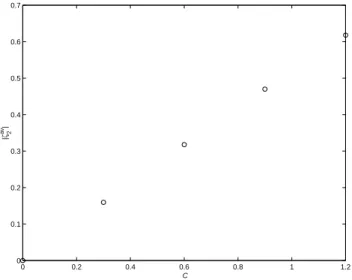
While the present model is highly idealized, it is worth-while to assess the length scales of the bedforms gener-ated by representative wave conditions. For example, a 10-s wave in 10 m of water has a wavelength of approx-imately 100 m. The longitudinal (cross-shore) wavelength of the one-dimensional interfacial pattern shown in Fig. 4 for a bi-viscous, constant yield stress lower layer is approx-imately 50 m, while the interfacial pattern for the bi-viscous lower layer with a pressure-dependent yield stress shown in Fig. 5 has a longitudional (cross-shore) wavelength of ap-proximately 50 m and a transverse (along-shore) wavelength of approximately 100 m. For a unit amplitude wave (crest-to-trough), Fig. 6 shows the crest-to-trough height,|ζ2av|of the time-average of the lower layer interfacial pattern
ζ2av= 2π
Z t+2π
t
ζ2(x, y, t )dt, (17)
where|ζ2av|is the difference between the maximum and min-imum values ofζ2av, as a function of C, the coefficient of the pressure-dependent yield stress in Eq. (16) for the con-trolling parameters(s, H1∗, Ŵ, Ŵ′, ϒ0)=(11.1,13,50,1,1.5),
the forcing parameters(κ, ) = (2π,√2π
3)and perturbation
parameters(α, λ, 6) = (0.1,2π,√2π
3). ForC=0, the
time-average of the interface displacement is zero (see also Fig. 4). AsCis increased, the two-dimensional interfacial pattern of Fig. 5 (lower panels) develops with a time-averaged crest-to-trough amplitude|ζ2av|that increases with increasingC. We emphasize that while both the predicted amplitudes of the bedforms and their transverse wavelength depend upon the controlling and forcing parameters, for all cases examined the longitudinal wavelength of the interfacial pattern is half that of the forcing.
0 0.2 0.4 0.6 0.8 1 1.2
0 0.1 0.2 0.3 0.4 0.5 0.6 0.7
C
|
ζ2 av|
Fig. 6. Dependence of the time-averaged interface displace-ment |ζ2av| as a function of C, the parameter controlling the pressure dependence of the yield stress in Eq. (16) for a free-surface displacement of unit amplitude and(s, H1∗, Ŵ, Ŵ′, ϒ0) = (11.1,13,50,1,1.5), the forcing parameters(κ, )=(2π,√2π
3)and perturbation parameters(α, λ, 6)=(0.1,2π,√2π
3).
We conclude by noting that theoretical models of the cou-pled interaction of waves with a deformable lower layer are useful in isolating the effects of specific dynamical processes on this interaction. For example, we have shown that a simple constant yield stress bi-viscous lower layer rheol-ogy does not allow for the formation of two-dimensional permanent bedforms by standing-wave forcing. By exam-ining a slightly more realistic (although still highly ideal-ized) rheology that incorporates a packing condition through a pressure-dependent yield stress, however, we find that two-dimensional permanent lower layer patterns are excited in some parameter regimes.
Acknowledgements. This paper is funded in part by a
grant/cooperative agreement (NA86RG0041) from the Na-tional Oceanic and Atmospheric Administration, project # R/EP-9, which is sponsored by the University of Hawaii Sea Grant College Program, SOEST, under Institutional Grant No. NA86RG-0041 from NOAA office of Sea Grant, Department of Commerce. The views expressed herein are those of the authors and do not necessarily reflect the views of NOAA or any of its subagen-cies. UNIHI-SEAGRANT-JC-01-01. JB also is supported by NSF-OCE-9633057. This is SOEST contribution no. 5858.
References
Becker, J. M. and Bercovici, D.: Permanent bedforms in a theoreti-cal model of wave-sea-bed interactions, Nonlin. Proc. Geophys., 7, 31–35, 2000.
Blondeaux, P.: Sand ripples under sea waves Part 1. Ripple forma-tion, J. Fluid Mech., 218, 1–17, 1990.
Boczar-Karakiewicz, B., Forbes, D. L., and Drapeau, G.: Nearshore bar development in the southern Gulf of St. Lawrence, J. Water-ways, Port, Coastal and Ocean Eng., ASCE, 121, 49–60, 1995. Carter, T. G., Liu, P. L-F., and Mei, C. C.: Mass transport by waves
and offshore sand bedforms, J. Waterways, Harbors, and Coastal Eng. Div., ASCE, 99 (WW2), 165–184, 1973.
Deigaard, R. N. Dronen, Fredsoe, J., Hjelmager Jensen, J., and Jorgensen, M. P.: A morphological stability analysis for a long straight barred coast, Coastal Eng., 36, 171–195, 1999.
Falques, A., Montoto, A., and Iranzo, V.: Bed-flow instability of the longshore current, Continental Shelf Res,, 16 (15), 1927–1964, 1996.
Holman, R. A.: The interaction of waves, currents and nearshore bathymetry, in:Proceedings Aha Hulikoa Hawaiian Winter Workshop, (Eds) Muller, P. and Henderson, D., 257–262, SOEST Special Publication, 1995.
Holman, R. A. and Bowen, A. J.: Bars, bumps, and holes: mod-els for the generation of complex beach topography, J. Geophys. Res., 87 (C1), 457–468, 1982.
Komar, P. D.: Beach Processes and Sedimentation, 544, Prentice Hall, New Jersey, 1998.
Liu, K.-F. and Mei, C. C.: Long waves in shallow water over a layer of Bingham-plastic fluid-mud-I. Physical Aspects, Int. J. Engng. Sci., 31(1), 125–144, 1993a.
Liu, K.-F. and Mei, C. C.: Long waves in shallow water over a layer of Bingham-plastic fluid-mud-II. Mathematical derivation of long wave equations, Int. J. Engng. Sci., 31(1), 145–155, 1993b.
Liu, K.-F. and Mei, C. C.: Slow spreading of a sheet of Bingham fluid on an inclined plane, J. Fluid Mech., 207, 505–529, 1989. Ng, C.-O. and Mei, C. C.: Roll waves on a shallow layer of mud
modeled as a power-law fluid, J. Fluid Mech., 263, 151–183, 1994.
Plant, N. G., Holman, R. A., Freilich, M. H., and Birkemeier, W. A.: A simple model for interannual sandbar behaviour, J. Geophys. Res., 104 (C7), 15, 755–776, 1999.
Roelvink, J. A. and Broker, I., Cross-shore profile models, Coastal Eng., 21, 163–191, 1993.
Thornton, E., Dalrymple, T., Drake, T., Gallagher, E., Guza, B., Hay, A., Holman, R., Kaihatu, J., Lippmann, T., and Ozkan-Haller, T.: Nearshore research, Report of the Nearshore Re-search Workshop, St. Petersburg, Florida, 14–16 September 1998 http://www.oc.nps.navy.mil/ thornton/
Vittori, G. and Blondeaux, P.: Sand ripples under sea waves Part 2. Finite-amplitude development, J. Fluid Mech., 218, 19–39, 1990. Vittori, G. and Blondeaux, P.: Sand ripples under sea waves Part 3. Brick-pattern ripples formation, J. Fluid Mech., 239, 23–45, 1992.