International Journal of Pediatrics (Supplement 4), Vol.2, N.3-2, Serial No.8, August 2014 19 Original Article http:// ijp.mums.ac.ir
Laparoscopic Colon Surgery for Benign Disease:
A Comparison to Open Surgery
*
Ahamd Bazrafshan1, Abbas abdollahi2, Mohammad Etezadpour3
1
Associate Professor of Pediatric Surgery, Faculty of Medicine, Mashhad University of Medical Sciences, Mashhad, Iran.
2
Associate Professor of General Surgery, Faculty of Medicine, Mashhad University of Medical Sciences, Mashhad, Iran.
3
Resident of General Surgery, Faculty of Medicine, Mashhad University of Medical Sciences, Mashhad, Iran. Abstract
Backgrounds:
Today we are witnessed a growing number of minimally invasive surgical techniques for different diseases. Laparoscopic colon surgery as a minimally invasive surgery is currently growing in treatment of malignancies after proving his place in the treatment of benign diseases. We compare in this study results of laparoscopic colorectal surgery with open surgery.
Materials and Methods:
36 laparoscopic colon resections performed for benign disease were compared to 36 open colon resections with respect to operating times, length of hospital stay, estimated blood loss, days until first postoperative bowel movement, and complications.
Results:
The laparoscopic colon resection group had decreased length of stay, less blood loss, earlier return of bowel function, and an equivalent number of complication. Duration of surgery was higher in the laparoscopic group.
Conclusion:
The use of laparoscopic colon surgery for benign disease not only affords the patient the advantage of the laparoscopic approach, but also allows the surgeon to gain experience for laparoscopic colon surgery in malignant disease.
Key Words: Colon resection, Laparoscopy, Open surgery.
*
Corresponding Author:
Dr. Ahmad Bazrafshan, Dr. Sheikh Hospital, Faculty of Medicine, Mashhad University of Medical Sciences, Mashhad, Iran. Email: [email protected]
Introduction
The introduction of laparoscopic cholecystecomy in the late 1980s ushered in the modern era of minimally invasive surgery. The benefit to patients of reduced pain, shortened hospital stay and faster recovery with superior cosmesis resulted in laparoscopic cholecystectomy becoming the standard of care (1,2). Similar benefits were anticipated as the laparoscopic approach was subsequently applied to nearly all aspects of abdominal surgery. In fact, in centres where the technical expertise is available, laparoscopic splenectomy, adrenalectomy and Nissen fundoplication have now become the preferred method of treatment (3–5).
Laparoscopic-assisted colon resections were first reported in 1991(6-10). Initial enthusiasm for these procedures was high, and it was hoped that the benefits of laparoscopic cholecystectomies would also apply to laparoscopic colon surgery. Our report is the result of a study of a series of 36 patients who underwent laparoscopic-assisted colon surgery; all patients had benign conditions. This group of patients was compared to 36 patients undergoing open colon resections for benign disease.
Materials and Methods
From October 2011 to October 2013, 36 patients had laparoscopic-assisted colon resections for benign disease. During this same period, 36 patients had elective open colon resections. Data collected included patient demographics, indication for surgery, intra and postoperative complications, operating time (skin to skin), length of hospital stay, estimated blood loss, days until first postoperative bowel movement, and postoperative follow-up to the most recent office visit. Patients were unselected, consecutive referrals to 2 academic surgeons practising in university teaching hospitals. All
for deep venous thrombosis, broad-spectrum parenteral antibiotics and an oral bowel preparation when appropriate. All patients provided informed consent for the planned laparoscopic procedure. Statistical analyses consisted of the exact fisher test for nonparametric data and maan-withney for parametric data. P<0.05 was considered statistically significant.
Surgical Technique
For right-side colon resections, patients are positioned supine and the bladder is catheterized. A 12-mm blunt-tipped trocar is inserted through the umbilicus using an open technique. After insufflating a carbon dioxide pneumoperitoneum to 15 mm Hg, a 30° viewing 10-mm laparoscope connected to a 1- or 3- chip charge-coupled device (CCD) camera is inserted. Two or 3 video monitors are positioned with at least 1 on each side of the patient. These are moved regularly throughout the procedure to ensure that the surgeon is always operating facing a monitor and the operating assistant has an ergonomic view of the procedure. Operating trocar placement is variable. Two or 3 additional 5-mm trocars are used, with one placed in the left lower quadrant and another suprapubically or in the epigastrium, or both. With the patient in a steep trendelenburg position, the small bowel is extracted from the pelvis, and the cecum and ascending colon are mobilized with electrocautery.
International Journal of Pediatrics (Supplement 4), Vol.2, N.3-2, Serial No.8, August 2014 21 resections and rectal resections, 3 operating
trocars are used in addition to the umbilical trocar. A 12-mm trocars are placed in the right lower quadrant, and 5-mm trocars are placed in the left lower quadrant and left upper quadrant. In steep trendelenburg position, with the small bowel out of the pelvis, the sigmoid colon and descending colon are mobilized along the white line of toldt. The left ureter is identified. The sigmoid colon is elevated, and a window is created in the sigmoid mesocolon by identification and high ligation of the inferior mesenteric vessels. Proximal and distal mesenteric division is performed intracorporeally with electrocautery.
Results
The two groups of patients had similar demographic characteristics with regard to age and gender (Table. 1).
Table 1: Demographic data
Laparoscopy Open
patient Age mean M/F
36 25.92 19/17
36 26.29 20/16
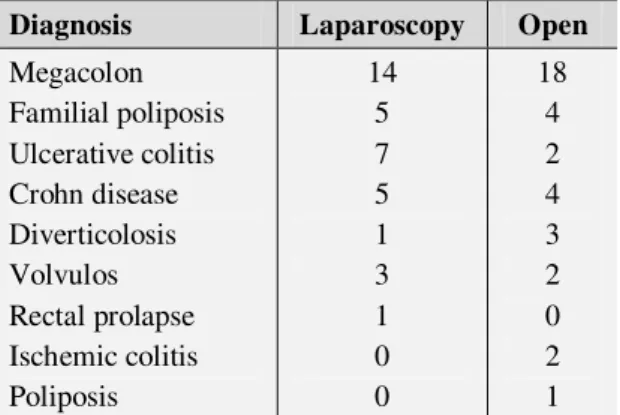
Surgical indications were well matched between two groups (Table. 2). Mean estimated blood loss was 122 milliliters (ml) for laparoscopic group and 192 ml for open resection. Mean operating room time was (137.8±81.79) in open resection and (156.11±72.93) in laparoscopic resection (in minutes).
Table 2: Indication for surgery
Wound infection Anastomosis leakage Pneumonia
Hernia Fistula Obstruction
2 1
1 1 1 1
3 1
1 0 0 0
P-value 0.235
The average length of stay (LOS) was (6±1.09) days for laparoscopic group and (6.89±1.56) days for open group, excluded preoperative days (Table. 3).
Table 3: Outcome comparison for operation time, length of hospital stay and first postoperative bowel movement Variables Group Mean rank Mean Standard deviation P-value
Duration of surgery
Open 30.75 137.8 81.79
0.029
Laparoscopy 40/75 156.1 72.93
Length of hospital stay
Open 42.5 6.89 1.56
0.021
Laparoscopy 30.5 6 1.09
Ileus Open 41.6 2.33 1.98
0.012
Laparoscopy 31.4 1.39 1.46
Laparoscopy group had three intraoperative and seven postoperative complications: one enterotomy secondary to trocar placement which was recognized intraoperatively and repaired without sequelae. One intestinal thermal injury by ligasure which presented as peritonitis and managed by laparotomy and resection anastomosis. One bleeding from sigmoidal artery that controlled with clips application. Three wound infection, one
Table 4: Postoperative complication. Diagnosis Laparoscopy Open
Megacolon Familial poliposis Ulcerative colitis Crohn disease Diverticolosis Volvulos Rectal prolapse Ischemic colitis Poliposis
14 5 7 5 1 3 1 0 0
18 4 2 4 3 2 0 2 1
Discussion
Our series demonstrates that laparoscopic colon resections for benign disease can be done safely and with many benefits to the patient. One of the advantages is a decrease in hospital stay. In our series, the average LOS for laparoscopic resections was four days fewer than the open group. This has been a consistent finding when others have looked at this variable. Estimated blood loss averaged 70 cc less in the laparoscopic cases when compared to the open cases. We and other investigators have shown an earlier return to bowel function. Most studies comparing laparoscopic colon resections to open resections show that the laparoscopic patients tolerate their diet earlier. Some argue that patients undergoing laparoscopic colon resections tolerate their diet earlier because they are fed earlier, 10 but other data support earlier return of bowel function in laparoscopic cases. Bohm et al (11) demonstrated that the normal myoelectric activity of the stomach, small bowel, and colon returned faster in dogs that underwent laparoscopic right colon resections than in those receiving a traditional open procedure. In addition, median time to the first postoperative bowel movement was 38 hours in the laparoscopic group versus 56 hours in the open group. Other factors that may contribute to a faster return of bowel function in laparoscopic patients are
decreased narcotic analgesic usage and less intraoperative manipulation of the bowel.
No discussion on the presumed advantages of laparoscopic surgery would be complete without acknowledging the
work of Holte and Kehlet on “fast track surgery,” who clearly demonstrated that
whereas laparoscopic surgery may be an important way of reducing postoperative pain and ileus, it is not the only means of doing so (12). A multimodal approach of opioid-sparing analgesia, early enteral feeding and laparoscopy may have synergistic benefits that are greater than laparoscopy alone.
One disadvantage has been the increased duration of the operation. Operating time for laparoscopic cases was longer than for open cases (20 minutes). Others have noted a 30 to 40 minute increase in operating time for segmental resections and even longer for total abdominal colectomies.
Complication rates are comparable between laparoscopic and open procedures in this study and others (10,13-17). This study compares favorably with others comparing laparoscopic colon resections to open procedures in terms of complication rates, operating times, and lengths of stay. However, studies that include more extensive resections will have higher complication rates and longer operating times (18). These studies have also documented the safety of laparoscopic colon resection.
International Journal of Pediatrics (Supplement 4), Vol.2, N.3-2, Serial No.8, August 2014 23 Since laparoscopic colon resections for
malignant disease can be more difficult, the procedures necessary to gain these skills should be performed first on patients with benign disease.
Conclusion
We have demonstrated the safety, feasibility and good outcomes that can be achieved with laparoscopic colon and rectal surgery when performed by a small group of surgeons with sufficient technical expertise. We are currently at a cusp in the direction this approach will take. With adequate training and good judgement it is clear that recovery after laparoscopic surgery is improved. There should be no question of the appropriateness and value of this technique for benign disease. The evidence of superior short-term outcomes is available. In addition, we believe that surgeons should gain laparoscopic experience on benign disease while awaiting the results of ongoing trials to determine the safety of resections in malignant colon disease.
Acknowledgment
We would like to thank Clinical Research Development Center of Ghaem Hospital for their assistant in this manuscript.
References
1. Litwin D, Girotti M, Poulin E, Mamazza J, Nagy AG. Laparoscopic cholecystectomy: trans-Canada experience with 2201cases. Can J Surg 1992;35:291-6.
2. Soper NJ, Stockmann PT, Dunnegan DL, Ashley SW. Laparoscopic cholecystectomy.
The new ‘gold standard’? Arch Surg 1992; 127:
917-21.
3. Chekan EG, Pappas TN. The laparoscopic management of gastroesophageal reflux
disease. Adv Surg 1999;32:305-30.
4. Friedman RL, Fallas MJ, Carroll BJ, Hiatt JR, Phillips EH. Laparoscopic splenectomy for ITP. The gold standard. Surg Endosc 1996; 10: 991-5.
5. Smith CD, Weber CJ, Amerson JR. Laparoscopic adrenalectomy: new gold standard. World J Surg 1999;23:389-96.
6. Cooperman AM, Katz V, Zimmon D, Botero G. Laparoscopic colon resection: a case report. J Laparoendosc Surg 1991;l:221-224.
7. Redwine DB, Sharpe DR. Laparoscopic segmentai resection of the sigmoid colon for endometriosis. J Laparoendosc Surg 1991;1:217-220.
8. Jacobs M, Verdeja JC, Goldstein HS. Minimally invasive colon resection (laparoscopic colectomy). Surg Laparosc Endose 1991;1:144-150.
9. Schlinkert RJ. Laparoscopic-assisted right hemicolectomy. Dis Colon Rectum 1991;34:1030-1031.
10. Binderow SR, Cohen SM, Wexner SD, Nogueras JJ. Must early postoperative oral intake be limited to laparoscopy? Dis Colon Rectum 1994;37:584-589.
11. Bohm B, Wilson JW, Fazio VW. Postoperative intestinal motility following conventional and laparoscopic intestinal surgery. Arch Surg 1996;130:415-419.
12. Holte K, Kehlet H. Postoperative ileus: a preventable event. Br J Surg 2000;87: 1480-93. 13. Franklin ME Jr, Rosenthal D, Abrego-Medina D, et al. Prospective comparison of open versus laparoscopic colon surgery for carcinoma: five year results. Dis Colon Rectum1996;39:535-546.
14. Leung KL, Meng WCS, Lam TY, et al. Laparoscopic resection of rectosigmoid carcinoma. Immediate and medium-term results. Arch Surg 1997;132:76l-765.
15. Ramos JM, Beart RW Jr, Goes R, Ortega A, Schinkert RT. Role of laparoscopy in colorectal surgery. A prospective evaluation of 200 cases. Dis Colon Rectum 1995;38:494-501.
16. Agachan F, Joo JS, Weiss EG, Wexner SD. Intraoperative laparoscopic complications. Are we getting better? Dis Colon Rectum1996; 39:314-320.
17. Musser DJ, Boorse RC, Madera F, Reed JF III. Laparoscopic colectomy: at what cost? Surg Laparosc Endose 1994;4:1-5.
19. Schiedeck TH, Schwandner O, Baca I, Baehrlehner E, Konradt J, Kockerling F, et al. Laparoscopic surgery for the cure of colorectal cancer: results of a German five-center study. Dis Colon Rectum 2000; 43:1-8.
20. Fielding GA, Lumley J, Nathanson L, Hewett P, Rhodes M, Stitz R. Laparoscopic colectomy. Surg Endosc 1997;11: 745-9.
21. Prystowski JB, Bordage G, Feinglass JM. Patient outcomes for segmental colon resection
according to surgeon’s training, certification, and
experience. Surgery 2002;132:663-70.