Submitted5 May 2016 Accepted 29 June 2016 Published27 July 2016
Corresponding author Facundo Barbar,
Academic editor Anna Traveset
Additional Information and Declarations can be found on page 10
DOI10.7717/peerj.2273
Copyright 2016 Barbar et al.
Distributed under
Creative Commons CC-BY 4.0
OPEN ACCESS
Medium-sized exotic prey create novel
food webs: the case of predators and
scavengers consuming lagomorphs
Facundo Barbar1, Fernando Hiraldo2and Sergio A. Lambertucci1
1Grupo de Biología de la Conservación, Ecotono Laboratory, INIBIOMA—CONICET (Universidad Nacional del Comahue), San Carlos de Bariloche, Río Negro, Argentina
2Departmento de Biología de la Conservación, Estación Biológica Doñana—CSIC España, Sevilla, España
ABSTRACT
Food web interactions are key to community structure. The introduction of species can be seen as an uncontrolled experiment of the addition of species. Introduced species lead to multiple changes, frequently threatening the native biodiversity. However, little is known about their direct effect on the upper level of the food web. In this study we review empirical data on the predator–prey relationship between the introduced lagomorphs and their consumers, and use meta-analytical tools to quantify the strength of their interactions. We expect that exotic lagomorphs will destabilize food webs, affect ecological processes and compromise the conservation of the invaded regions. We found 156 studies on the diet of 43 species of predators that consume lagomorphs as exotic preys in South America and Oceania. We found an average exotic lagomorphs-predator link of 20% which indicates a strong interaction, given that the average for the strongest links with native prey (when lagomorphs are not included in the predator diet) is about 24%. Additionally, this last link decreases to 17% when lagomorphs are present. When lagomorphs arrive in a new environment they may become the most important resource for predators, producing an unstable equilibrium in the novel food web. Any disruption of this interaction could have catastrophic consequences for the native diversity by directly impacting predators or indirectly impacting native preys by apparent competition. Eradication or any change in their abundances should be carefully considered in conservation actions since those will have great impacts on predator populations and ultimately in the whole communities.
SubjectsConservation Biology, Ecology, Environmental Sciences
Keywords Lagomorpha, Exotic prey, Oceania, Food webs, South America, Top predators
INTRODUCTION
Food web interactions are key in community structure and provide useful information about how an ecosystem works (Krebs et al., 1999;Ings et al., 2009). The strength of the links within a web plays an important role in its stability, where diverse communities with weaker links tend to be more stable than those that are less diverse and with stronger links (Berlow, 1999;Berlow et al., 2004). In this sense, the introduction of species can be seen as a uncontrolled experiment of the addition of species (McCann, 2000). As exotic species grow in abundance they generally become a new resource subsidy (Huxel & McCann, 1998;
link between these novel species and the consumers, that will depend on the availability of the former and on the consumers’ ability to exploit them as a resource (Rodriguez, 2006).
Introduced species generate several changes in an invaded ecosystem, frequently threatening the native biodiversity through the alteration of both ecological functions and food webs, and the dynamics of native populations by predation or competition (Vitousek et al., 1996;Simberloff et al., 2012). However, in some cases introduced species might be beneficial for some native species through facilitation and resource subsidy, among other mechanisms (Rodriguez, 2006; Schlaepfer, Sax & Olden, 2011;Speziale & Lambertucci, 2013). Of these exotic species, introduced terrestrial herbivores are known to compete directly with native herbivores, generating changes in the plant community, facilitating plant invasions and even causing direct or indirect animal extinctions via apparent competition (Courchamp, Langlais & Sugihara, 2000;Holmgren, 2002;Clavero & García-Berthou, 2005;Best & Arcese, 2009). However, studies that directly measure the effect of introduced terrestrial herbivores on the higher trophic level of the food webs are scarce, aside from some studies on invasive freshwater and insect preys (Barber, Marquis & Tori, 2008;Carlsson, Sarnelle & Strayer, 2009;Tablado et al., 2010;Carlsson et al., 2011;
Dijkstra, Lambert & Harris, 2012), even though these predator–prey interactions might be affecting the whole community (Schmitz, Hambäck & Beckerman, 2000;Estes et al., 2011).
The order Lagomorpha was originally distributed worldwide, with the exception of Antarctica, southern South America and Oceania, and includes more than ninety species (Alves, Ferrand & Hackländer, 2008). Of the six Lagomorph species introduced in several continents, the European hare (Lepus europaeus) and European rabbit (Oryctolagus cuniculus) are important invasive species, given their abundance and distribution (Alves, Ferrand & Hackländer, 2008;IUCN, 2015). Those species have invaded southern South America and Oceania, where they do not have an ecological equivalent (Dawson & Ellis, 1994;Robley, Short & Bradley, 2001;Lees & Bell, 2008). They have dispersed rapidly since
their introduction (between 10–20 km/year and up to 100 km/year in some cases (Grigera
& Rapoport, 1983;Stodart & Parer, 1988)). Because of their size and abundance they are consumed by several predator species, being some of them considered as keystone species in their native range (Delibes & Hiraldo, 1981;Delibes-Mateos et al., 2011).
Predators and scavengers (hereafter referred to as predators) such as birds of prey, felids and foxes, among others, consume these preys in both their native and exotic range (i.e.,Tjernberg, 1981;Gil-Sánchez, Ballesteros-Duperón & Bueno-Segura, 2006;Lambertucci et al., 2009;Olsen et al., 2010;Zanón Martínez et al., 2012). These predators can be used as indicator species as they have large home ranges, are charismatic, conspicuous, well studied and susceptible to environmental changes in various ways (Sergio et al., 2008) to assess some ecological traits of invasion and its consequences in terms of stability and conservation of the invaded communities in general (Carroll, Noss & Paquet, 2001;Barber, Marquis & Tori, 2008). Predators plastic feeding behavior and the number of studies on their diet, make them a suitable model to study how lagomorph interact with the upper levels of an invaded food web (Dupuy, Giraudoux & Delattre, 2009;Tablado et al., 2010).
of the link between these two trophic levels. For this purpose, we use meta-analytical tools to quantify the consumption frequency (occurrence of a particular prey item over the total, sensuBerlow et al., 2004) as a measure of the interaction strength between these two trophic levels. Our hypothesis is that due to their high abundance and availability, lagomorphs will enter the trophic network modifying the predator–prey relationships, which may affect ecological processes (e.g., consumption rates, energy flux, competition) and the conservation of the invaded regions. We expect that: (1) predators will form strong interaction links with the exotic preys, which will be equivalent to the interactions with the most consumed native preys, and (2) that the interactions predator—native prey will be weaker when exotic lagomorphs appear in the diet.
METHODS
Bibliographic search
We used Scopus and Google Scholar search engines to find studies detailing predators diet
in South America and Oceania, the two continents where lagomorphs (in particularL.
europaeusandO. cuniculus) were introduced and widely distributed. We conducted the search individually for each predator species based on information about their body size and foraging behavior that could include lagomorphs in their diet consumed either as preys or carrion (i.e., we left out of the search insectivore or light weight predators; <0.2 kg. for birds and mammals). We intentionally left out of the search domestic species as feral cats and dogs. Our search was conducted by predators instead of by prey, because we observed from previous searches on the prey species that several known studies were missing (since lagomorph terms did not appear in bibliographic records contained in the databases). We used the same keywords for each predator (‘‘scientific binomial name of the predator’’ AND diet), including all publications up to August 1st 2015. We then examined each article to determine whether lagomorphs were reported as prey items in the diet of these predators and used those studies to perform our analysis (for more details on the search seeTable S1).
Further, we filtered our results to select dietary studies that comprised several preys, discarding those incomplete cases where consumption of one or few items were reported, as they are not representative of the whole diet. Moreover we selected studies where the total number of prey items was informed, discarding those where information was incomplete or insufficient to accurately extract a proportion of prey items consumed over the total number of prey items. Within each study found we compiled the following information to perform the meta-analysis: (1) Title, authors and year; (2) predator species (identifying the class, family and if they were native or introduced); (3) lagomorph species consumed (either O. cuniculus or L. europaeus); (4) continent where the study was carried out; (5) frequency of occurrence of a prey item (for each lagomorph and for subsets of native preys), and (6) number of total prey items in the study. We used the number of prey items
consumed (‘‘consumption frequency,’’ Berlow et al., 2004) that is confident measure to
item, actual mass of individuals recognized as dietary items, etc.). However, we calculate the ratio between the lagomorphs mass and the predators mass as a descriptive way to know if these preys represent an important input of energy in relation to the predator body size. For this, we used the average adult weight of the lagomorphs and divide it by the adult average weight of each predator, using in each case, the lagomorph consumed, either
O. cuniculus,L. europaeusor both separately (if they predator consumed both).
Data analysis
We used meta-analytical tools to extract the data from published studies on the interaction links between predators and preys. Meta-analysis allows to aggregation and quantification each study result (individual ‘‘effect size’’) to a data set in a way that make them statistically comparable in a common measure (Glass, 1976), where the sample size (n) is responsible for its accuracy (weight). Meta-analysis needs to fulfill several conditions which are critical to a sound analysis (e.g., they depend on the number, heterogeneity and quality of researches included;Viechtbauer, 2010;Higgins & Thompson, 2002). In our study we were able to meet them since we obtained a large amount of data hence making this analysis reliable. We used the raw proportion of a given event (in this study, a particular predator–prey link) over the total amount of events (all links) to obtain a common effect size. In particular we performed four separate meta-analyses, all based on the proportion of a given prey item present on the predators’ diet. We interpreted the presence of a prey item in the diet as the existence of an interaction link (consumption), and its proportion as the strength of this link.
The four meta-analyses were focused on measuring the common effect size (meaning the average consumption link with a particular prey) calculating the proportion over the total prey items of: (1) lagomorphs, (2) most consumed native preys in the presence of lagomorphs (3) the most consumed native preys in absence of lagomorphs and (4) a random subset of native preys, also in presence of lagomorphs. For the first analysis, we used all studies where lagomorphs were present as prey items measuring their proportion in the diet. For the second, we used these same studies (lagomorphs present) choosing the most consumed native prey item for each predator species within the study. For the third, we used the remaining studies (where lagomorphs where not found as prey items) choosing the most consumed native prey item for each predator species within the study. For the last analysis, we randomly selected 50 studies (lagomorphs present) and in each one of them we randomly picked one native prey-predator interaction.
The analyses were performed using the ‘metafor’ package v.1.9-7 on R software ( Viecht-bauer, 2010;R Development Core Team, 2012). We used the ‘escalc’ function to calculate the effect size with the measure ‘PR’: PR=xi/niwhich corresponds to the raw proportion that
a given event is expected to happen (xi), over the total number of events (ni) (Viechtbauer,
2010). We conducted our meta-analysis with a random-effects model approach, since the
error, while higher values (>75%) are the result of heterogeneity due differences between studies (Higgins & Thompson, 2002). We also used the additional information of each study described above (native or exotic predator species, family, etc.) as moderator variables. These categorical variables can be used in a meta-analysis to separate and compare the effect sizes of two or more different groups in a similar way than in an ANOVA (Van Houwelingen, Arends & Stijnen, 2002;Viechtbauer, 2010). This allowed us to assess differences in the effects size (interaction strength) related to the location, and the predators or prey identity.
RESULTS
Bibliographic search
We found a total of 156 studies on the diet of predators that could potentially consume lagomorphs in their exotic range, from which 131 (84% of the total) reported either
O. cuniculus,L. europaeusor both as prey items. Many of those studies evaluated more than one species of predator, and therefore the total number of interactions with lagomorphs reached 210. For the same reason, from the remaining 25 studies where lagomorphs did not appear in the diet we were able to extract 30 different predator-native prey interactions. In total 43 species (17 mammals and 26 birds), from nine different families (Accipitridae, Canidae, Cathartidae, Dasyuridae, Falconidae, Felidae, Mustelidae, Strigidae, Tytonidae),
feed upon the two species of lagomorphs. From these, two large eagles (Aquila audax,
n=23 andGeranoaetus melanoleucus,n=11) and a big owl (Bubo magellanicus,n=11), two foxes (Vulpes vulpes, n=18 andLycalopex culpaeus, n=16), a large felid (Puma concolor,n=13) and a large canid (Canis lupus dingo,n=9), account for 101 of the 210 links measured with Lagomorphs. The geographical regions were fairly well represented in
published articles, being South America (n=86) slightly more represented than Oceania
(n=70) (see detailed results inTable S1). The studies on these two regions were mainly conducted in environments where open areas as steppe or savanna-like physiognomy are predominant, with a few exceptions.
Meta-analysis
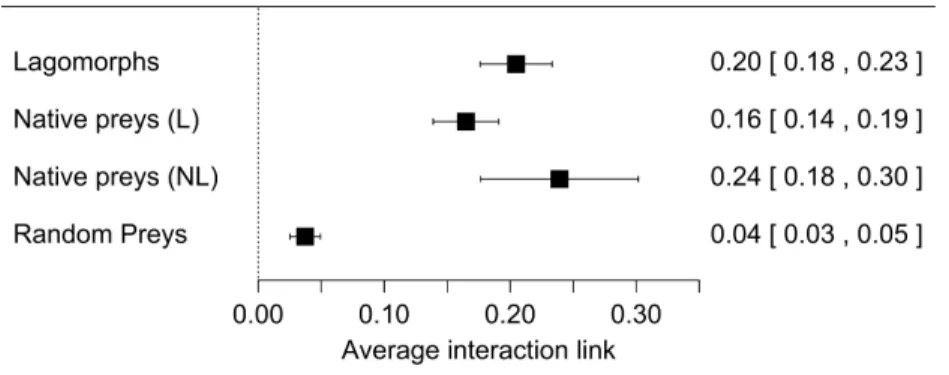
Our first meta-analysis consisting in the proportion of lagomorphs as prey items (with 210 measured interactions) gave us an effect size (±se) of 0.20 (±0.02) (Fig. 1, see details inFig. S1). The total heterogeneity over the total variability (I2=99.98%) shows that the variability in effect estimates is due the heterogeneity between studies rather than error sampling within each study. This is expected in all our analyses since they cover several predator species and there is no reason to expect a common value. The second meta-analysis, where we calculated the proportion of the most consumed native preys when lagomorphs were present (152 interaction links), resulted in a lower effect size of 0.17 (se±0.01) (I2=99.87%) (Fig. 1, see detailsFig. S2). When we analyzed the proportion of the most consumed native prey when lagomorphs were not present (30 interaction links), we obtained a higher effect size of 0.24 (se±0.03) (I2=99.22%) (Fig. 1, see details
Figure 1 Forest plot for the four meta-analyses performed.Each black square represents the effect size (±95% CI), interpreted as the interaction strength. Numbers are the effect size for each analysis (between brackets:±95% CI). (A) Lagomorphs: analysis of the interaction between exotic lagomorphs and preda-tors; (B) Native preys (L): results of the most consumed native prey in presence of lagomorphs in the diet; (C) Native prey (NL): results of the most consumed native prey in absence of lagomorphs; (D) Random preys: results of randomly selected native prey-consumers interactions in presence of lagomorphs in their diet.
Figure 2 Forest plot for the meta-analyses performed for lagomorphs as preys using two moderator variables: if predators are native or exotics (Origin) and the Family of each predator species (predator
family).Each black square represents the effect size (±95% CI) corresponding to the interaction strength.
Numbers correspond to the effect size for each category in the moderator variables (between brackets: ±95% CI).
When we used predator origin as a moderator variable in our analysis we found that both native and exotic predator species preyed on lagomorphs equally (Fig. 2,Table S2). In total we found that 18 of 43 predator species yielded significant results in their effect sizes (Table S2). These species come from five families which presented significant results in their effect sizes as groups (Accipitridae, Falconidae, Canidae, Felidae and Mustelidae,
Fig. 2,Table S2). Finally we did not find significant differences between the consumption of the two lagomorph species nor between the regions studied. However they were slightly
more consumed in Oceania than South-Amercia; andO. cuniculusformed slightly stronger
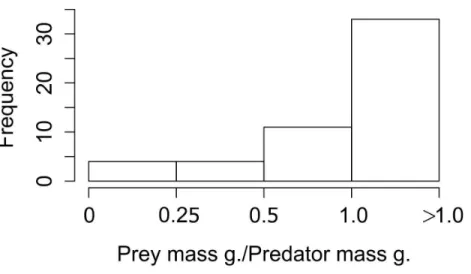
Figure 3 Frequency of ratios between Lagomorph weights and Predator weigths.Number of cases (fre-quency) that the ratio between the lagomorphs weight and the predator weights less than 0.25, between 0.25 and 0.5, 0.5–1 or more than 1.
When we looked at the relationship between the lagomorphs weight and their predators weights (52 interactions in total), we found that the ratio prey mass/predator mass was higher than 1 in 33 of the cases (63%; i.e., the prey as big as the predator or bigger), 11 ranged between 0.5 and 1 (21%); and from the rest, four (8%) are between 0.25 and 0.5 and four (8%) are smaller than 0.25 (Fig. 3).
DISCUSSION
It is worth to mention that our measure for interaction link might be biased by the fact that we only used prey items consumed but not the biomass of the prey. However, while biomass could give a good and complementary measure of the energy contribution from one trophic level to the next, it has some methodological limitations. For instance, the need to know the metabolic rates of the predator, digestibility of the materials ingested and actual mass of the individuals recognized in scats, pellets or guts (Klare, Kamler & Macdonald, 2011). Therefore our measure based on prey items proportion consumed is a confident measure to estimate the interaction strength between these two trophic levels. For large predator species the contribution represented by the biomass would be weaker (e.g., Puma concolor,Elbroch & Wittmer, 2013), but for medium and small size predator the lagomorphs biomass consumed would represent a much higher energetic input (e.g.,Geranoaetus melanoleucusinTravaini et al., 1998,Mustela furoinSmith et al., 1995). Moreover those later families are the ones that have strongest links with lagomorphs (Fig. 2). Moreover, this result is also supported by the prey mass/predator mass ratio since for the majority 84% of the predators lagomorphs represent at least half of their own body mass, and in 63% lagomorphs are of the same mass or higher. This is even a higher ratio than the one found to be optimal for the prey of medium-sized predator mammals (around 45% of the predator mass,Carbone et al., 1999). This highlights that each lagomorph registered as prey item in the studies used for our meta-analysis represented a big energy input for the predators. Our general results are surely conservative since for most of the predator species analyzed here the consumption of each lagomorph as prey item is at least underestimating their contribution in terms of biomass consumed. Moreover, our results show that both large and small predators can have similar values regarding the interaction strength (see
Table S2for detailed information on each species) and differences between species could be related to other factors as prey availability or predator behavior rather than the measure used to perform our analyses.
Many of the predators we studied have plastic feeding behaviors that tend to adapt to the availability of resources (Jaksić, 1989;Marti, Korpimäki & Jaksić, 1993;Dupuy, Giraudoux & Delattre, 2009), and shift their diet weakening other links as a consequence of the establishment of a strong link with the exotic species. This fact along with lagomorph size, may exaggerate their structuring effects produced in the invaded communities. Medium sized herbivores play an important role structuring the communities either via top-down or bottom-up effects, changes in diversity and engineering ecosystems (Olff & Ritchie, 1998;
Hopcraft, Olff & Sinclair, 2010). Lagomorphs may play these roles in their native range, shaping landscapes and maintaining top carnivore populations (Delibes & Hiraldo, 1981;
Lees & Bell, 2008), demonstrating their importance to the whole ecosystem. However, this role is the result of their co-evolution in their native communities, and is expected to be balanced over time. Our results show that changes in the food web structure are currently produced at a global scale in the novel predators-lagomorphs food webs, potentially altering the whole community.
The strong interaction between predators and exotic lagomorphs has huge impact on the invaded communities. First, as indicated in this study, lagomorphs represent a new and generally abundant food subsidy to the consumers (Grigera & Rapoport, 1983;Lees & Bell, 2008). This can have a positive effect on predators, where their survival, reproduction and total abundances are expected to increase with the new availability of resources (Tablado et al., 2010). However, this may have negative effects on the native prey populations, leading to a case of apparent competition (hyperpredation), where a prey species adapted to high predation may have a competitive advantage and can cause the crash of a native prey populations (Courchamp, Langlais & Sugihara, 2000), or where a shift in the diet of an increased population of predators does not necessarily means a decrease in the numbers
of individuals hunted (Holt, 1977). Such food webs relying on one abundant resource are
vulnerable to cascade effects when perturbed and have their stability and maintenance may
be compromised (O’Gorman & Emmerson, 2009).
These novel and imbalanced food webs, where there is a very strong link between two trophic levels that do not occur naturally (Kokkoris, Troumbis & Lawton, 1999;Kokkoris et al., 2002), may have several implications in conservation, as they are vulnerable to sudden changes (McCann, Hastings & Huxel, 1998;Bascompte, Melián & Sala, 2005;Rooney et al., 2006). This is of major concern considering that lagomorphs are game species and therefore susceptible to overharvesting by humans. They also have experienced large population decreases in their native range due to outbreaks of disease that endanger their local populations and also the persistence of the top predator populations that depend on them (Ferrer & Negro, 2004;Delibes-Mateos, Ferreras & Villafuerte, 2007;Lees & Bell, 2008;
Moleón et al., 2009). This scenario of a prey strongly interacting with its predators in a food web may lead invaded systems to an unstable equilibrium, with any disruption having potentially catastrophic results for its diversity (O’Gorman & Emmerson, 2009).
matter should analyze the diversity of native prey, and the original interaction strength with native predators in the absence of lagomorphs in order to understand the strong effect that the latter produce in the invaded areas. Additionally, studies of lagomorph’s effect on the fitness of predators that consume them are important to provide a comprehensive understanding of the ecological processes related to the invasion.
ACKNOWLEDGEMENTS
We thank to HU Wittmer, FM Medina, K Speziale, A Trejo, A Bay Gavuzzo, G Ignazi, J Guido, M Graña Grilli, PEA Alarcón, P Plaza, and an anonymous reviewer for their comments on early versions of this manuscript.
ADDITIONAL INFORMATION AND DECLARATIONS
Funding
The authors received financial support from PIP 00758 and PICT 0725/2014. The funders had no role in study design, data collection and analysis, decision to publish, or preparation of the manuscript.
Grant Disclosures
The following grant information was disclosed by the authors: PIP: 00758.
PICT: 0725/2014.
Competing Interests
The authors declare there are no competing interests.
Author Contributions
• Facundo Barbar conceived and designed the experiments, performed the experiments,
analyzed the data, contributed reagents/materials/analysis tools, wrote the paper, prepared figures and/or tables, reviewed drafts of the paper.
• Fernando Hiraldo performed the experiments, contributed reagents/materials/analysis
tools, wrote the paper, reviewed drafts of the paper.
• Sergio A. Lambertucci conceived and designed the experiments, performed the
experiments, analyzed the data, contributed reagents/materials/analysis tools, wrote the paper, reviewed drafts of the paper.
Data Availability
The following information was supplied regarding data availability:
The raw data has been supplied as aSupplemental Dataset.
Supplemental Information
REFERENCES
Alves PC, Ferrand N, Hackländer K. 2008.Lagomorph biology. Berlin, Heidelberg: Springer.
Barber NA, Marquis RJ, Tori WP. 2008.Invasive prey impacts the abundance and
distribution of native predators.Ecology 89:2678–2683DOI 10.1890/08-0395.1.
Bascompte J, Melián CJ, Sala E. 2005.Interaction strength combinations and the overfishing of a marine food web.Proceedings of the National Academy of Sciences of the United States of America102:5443–5447DOI 10.1073/pnas.0501562102. Berlow EL. 1999.Strong effects of weak interactions in ecological communities.Nature
398:330–334DOI 10.1038/18672.
Berlow EL, Neutel A-M, Cohen JE, De Ruiter PC, Ebenman BO, Emmerson M, Fox JW, Jansen VA, Iwan Jones J, Kokkoris GD. 2004.Interaction strengths in food webs:
issues and opportunities.Journal of Animal Ecology73:585–598
DOI 10.1111/j.0021-8790.2004.00833.x.
Best RJ, Arcese P. 2009.Exotic herbivores directly facilitate the exotic grasses they
graze: mechanisms for an unexpected positive feedback between invaders.Oecologia
159:139–150DOI 10.1007/s00442-008-1172-1.
Bird P, Mutze G, Peacock D, Jennings S. 2012.Damage caused by low-density exotic herbivore populations: the impact of introduced European rabbits on marsupial herbivores andAllocasuarinaandBursariaseedling survival in Australian coastal
shrubland.Biological Invasions14:743–755DOI 10.1007/s10530-011-0114-8.
Carbone C, Mace G, Roberts S, Macdonald D. 1999.Energetic constraints on the diet of
terrestrial carnivores.Nature402:1997–2000DOI 10.1038/46266.
Carlsson NOL, Bustamante H, Strayer DL, Pace ML. 2011.Biotic resistance on the increase: native predators structure invasive zebra mussel populations.Freshwater Biology56:1630–1637DOI 10.1111/j.1365-2427.2011.02602.x.
Carlsson NO, Sarnelle O, Strayer DL. 2009.Native predators and exotic prey—an acquired taste?Frontiers in Ecology and the Environment 7:525–532
DOI 10.1890/080093.
Carroll C, Noss RF, Paquet PC. 2001.Carnivores as focal species for conservation
planning in the rocky mountain region.Ecological Applications11:961–980
DOI 10.1890/1051-0761(2001)011[0961:CAFSFC]2.0.CO;2.
Clavero M, García-Berthou E. 2005.Invasive species are a leading cause of animal extinctions.Trends in Ecology and Evolution20:110–110.
Cooke BD. 2012.Rabbits: manageable environmental pests or participants in new
Australian ecosystems?Wildlife Research39:279–289DOI 10.1071/WR11166.
Cooke B, Jones R, Gong W. 2011.An economic decision model of wild rabbit Orycto-lagus cuniculuscontrol to conserve Australian native vegetation.Wildlife Research
37:558–565DOI 10.1071/WR09154.
Courchamp F, Langlais M, Sugihara G. 2000.Rabbits killing birds: modelling the
hyperpredation process.Journal of Animal Ecology69:154–164
Dawson TJ, Ellis BA. 1994.Diets of mammalian herbivores in Australian arid shrub-lands: seasonal effects on overlap between red kangaroos, sheep and rabbits and on dietary niche breadths and electivities.Journal of Arid Environments26:257–271. Delibes M, Hiraldo F. 1981.The rabbit as prey in the Iberian Mediterranean ecosystem.
In:Proceedings of the world lagomorph conference. Guelph: University of Guelph, 614–622.
Delibes-Mateos M, Ferreras P, Villafuerte R. 2007.Rabbit populations and game management: the situation after 15 years of rabbit haemorrhagic disease in
central-southern Spain.Biodiversity and Conservation17:559–574
DOI 10.1007/s10531-007-9272-5.
Delibes-Mateos M, Smith AT, Slobodchikoff CN, Swenson JE. 2011.The paradox of keystone species persecuted as pests: a call for the conservation of abundant small
mammals in their native range.Biological Conservation144:1335–1346
DOI 10.1016/j.biocon.2011.02.012.
Dijkstra JA, Lambert WJ, Harris LG. 2012.Introduced species provide a novel temporal resource that facilitates native predator population growth.Biological Invasions
15:911–919DOI 10.1007/s10530-012-0339-1.
Dupuy G, Giraudoux P, Delattre P. 2009.Numerical and dietary responses of a
predator community in a temperate zone of Europe.Ecography32:277–290
DOI 10.1111/j.1600-0587.2008.04930.x.
Elbroch LM, Wittmer HU. 2013.The effects of puma prey selection and specialization on
less abundant prey in Patagonia.Journal of Mammalogy94:259–268
DOI 10.1644/12-MAMM-A-041.1.
Estes JA, Terborgh J, Brashares JS, Power ME, Berger J, Bond WJ, Carpenter SR, Essington TE, Holt RD, Jackson JBC, Marquis RJ, Oksanen L, Oksanen T, Paine RT, Pikitch EK, Ripple WJ, Sandin SA, Scheffer M, Schoener TW, Shurin JB, Sinclair ARE, Soulé ME, Virtanen R, Wardle DA. 2011.Trophic downgrading of
planet Earth.Science333:301–306 DOI 10.1126/science.1205106.
Ferrer M, Negro JJ. 2004.The near extinction of two large European predators: super specialists pay a price.Conservation Biology18:344–349
DOI 10.1111/j.1523-1739.2004.00096.x.
Gil-Sánchez JM, Ballesteros-Duperón E, Bueno-Segura JF. 2006.Feeding ecology of
the Iberian lynxLynx pardinusin eastern Sierra Morena (Southern Spain).Acta
Theriologica51:85–90DOI 10.1007/BF03192659.
Glass GV. 1976.Primary, secondary, and meta-analysis of research.Educational Researcher5(10):3–8.
Grigera DE, Rapoport EH. 1983.Status and distribution of the European hare in South
America.Journal of Mammalogy64:163–166.
Higgins J, Thompson SG. 2002.Quantifying heterogeneity in a meta-analysis.Statistics in Medicine21:1539–1558.
Holt RD. 1977.Predation, apparent competition, and the structure of prey communities.
Theoretical Population Biology12:197–229DOI 10.1016/0040-5809(77)90042-9. Hopcraft JGC, Olff H, Sinclair ARE. 2010.Herbivores, resources and risks: alternating
regulation along primary environmental gradients in savannas.Trends in Ecology & Evolution25:119–128DOI 10.1016/j.tree.2009.08.001.
Huxel GR, McCann K. 1998.Food web stability: the influence of trophic flows across
habitats.The American Naturalist152:460–469.
Ings TC, Montoya JM, Bascompte J, Blüthgen N, Brown L, Dormann CF, Edwards F, Figueroa D, Jacob U, Jones JI. 2009.Review: ecological networks–beyond food webs.
Journal of Animal Ecology78:253–269DOI 10.1111/j.1365-2656.2008.01460.x. IUCN. 2015.The IUCN red list of threatened species. Version 2015.4. Gland: IUCN.
Available atwww.iucnredlist.org (accessed on 7 June 2016).
Jaksić FM. 1989.Opportunism vs. selectivity among carnivorous predators that eat mammalian prey: a statistical test of hypotheses.Oikos56(3):427–430
DOI 10.2307/3565630.
Jefferies RL. 2000.Allochthonous inputs: integrating population changes and food-web dynamics.Trends in Ecology & Evolution15:19–22.
Klare U, Kamler JF, Macdonald DW. 2011.A comparison and critique of different
scat-analysis methods for determining carnivore diet.Mammal Review41:294–312
DOI 10.1111/j.1365-2907.2011.00183.x.
Kokkoris GD, Jansen VA, Loreau M, Troumbis AY. 2002.Variability in interaction strength and implications for biodiversity.Journal of Animal Ecology71:362–371
DOI 10.1046/j.1365-2656.2002.00604.x.
Kokkoris GD, Troumbis AY, Lawton JH. 1999.Patterns of species interaction strength
in assembled theoretical competition communities.Ecology Letters2:70–74
DOI 10.1046/j.1461-0248.1999.22058.x.
Krebs CJ, Sinclair ARE, Boonstra R, Boutin S, Martin K, Smith JNM. 1999. Community dynamics of vertebrate herbivores: how can we untangle the web. In: Olff H, Brown
VK, Drent RH, eds.Herbivores: between plants and predators. Oxford: Blackwell
Science, 447–473.
Lambertucci SA, Trejo A, Di Martino S, Sánchez-Zapata JA, Donázar JA, Hiraldo F. 2009.Spatial and temporal patterns in the diet of the Andean condor: ecological
replacement of native fauna by exotic species.Animal Conservation12:338–345
DOI 10.1111/j.1469-1795.2009.00258.x.
Lees AC, Bell DJ. 2008.A conservation paradox for the 21st century: the European wild rabbitOryctolagus cuniculus, an invasive alien and an endangered native species.
Mammal Review38:304–320DOI 10.1111/j.1365-2907.2008.00116.x.
Marti CD, Korpimäki E, Jaksić FM. 1993. Trophic structure of raptor communities: a
three-continent comparison and synthesis. In: Power DM, ed.Current ornithology.
New York: Springer, 47–137.
McCann KS. 2000.The diversity–stability debate.Nature 405:228–233
McCann K, Hastings A, Huxel GR. 1998.Weak trophic interactions and the balance of
nature.Nature395:794–798DOI 10.1038/27427.
Moleón M, Sánchez-Zapata JA, Real J, García-Charton JA, Gil-Sánchez JM, Palma L, Bautista J, Bayle P. 2009.Large-scale spatio-temporal shifts in the diet of a predator mediated by an emerging infectious disease of its main prey.Journal of Biogeography
36:1502–1515DOI 10.1111/j.1365-26992009.02078.x.
Novaro AJ, Funes MC, Susan Walker R. 2000.Ecological extinction of native prey of
a carnivore assemblage in Argentine Patagonia.Biological Conservation92:25–33
DOI 10.1016/S0006-3207(99)00065-8.
O’Gorman EJ, Emmerson MC. 2009.Perturbations to trophic interactions and the stability of complex food webs.Proceedings of the National Academy of Sciences of the United States of America106:13393–13398DOI 10.1073/pnas.0903682106.
Olff H, Ritchie ME. 1998.Effects of herbivores on grassland plant diversity.Trends in Ecology & Evolution13:261–265 DOI 10.1016/S0169-5347(98)01364-0.
Olsen J, Judge D, Fuentes E, Rose AB, Debus SJS. 2010.Diets of wedge-tailed eagles (Aquila audax) and little eagles (Hieraaetus morphnoides) breeding near Canberra,
Australia.Journal of Raptor Research44:50–61DOI 10.3356/JRR-09-28.1.
R Development Core Team. 2012.R: a language and environment for statistical
computing. Vienna: R Foundation for Statistical Computing.Available athttp:
// www.R-project.org.
Robley AJ, Short J, Bradley S. 2001.Dietary overlap between the burrowing bettong (Bettongia lesueur) and the European rabbit (Oryctolagus cuniculus) in semi-arid
coastal Western Australia.Wildlife Research28:341–349DOI 10.1071/WR00060.
Rodriguez LF. 2006.Can invasive species facilitate native species? Evidence of how,
when, and why these impacts occur.Biological Invasions8:927–939
DOI 10.1007/s10530-005-5103-3.
Rooney N, McCann K, Gellner G, Moore JC. 2006.Structural asymmetry and the
stability of diverse food webs.Nature 442:265–269DOI 10.1038/nature04887.
Schlaepfer MA, Sax DF, Olden JD. 2011.The potential conservation value of non-native
species.Conservation Biology25:428–437DOI 10.1111/j.1523-1739.2010.01646.x.
Schmitz OJ, Hambäck PA, Beckerman AP. 2000.Trophic cascades in terrestrial systems: a review of the effects of carnivore removals on plants.The American Naturalist
155:141–153.
Sergio F, Caro T, Brown D, Clucas B, Hunter J, Ketchum J, McHugh K, Hiraldo F. 2008. Top predators as conservation tools: ecological rationale, assumptions, and efficacy.
Annual Review of Ecology, Evolution, and Systematics39:1–19
DOI 10.1146/annurev.ecolsys.39.110707.173545.
Serrouya R, Wittmann MJ, McLellan BN, Wittmer HU, Boutin S. 2015.Using predator– prey theory to predict outcomes of broadscale experiments to reduce apparent
competition.The American Naturalist 185:665–679DOI 10.1086/680510.
Smith GP, Ragg JR, Moller H, Waldrup KA. 1995.Diet of feral ferrets (Mustela furo)
from pastoral habitats in Otago and Southland, New Zealand.New Zealand Journal
of Zoology22:363–369.
Speziale KL, Lambertucci SA. 2013.The effect of introduced species on raptors.Journal of Raptor Research47:133–144 DOI 10.3356/JRR-12-00003.1.
Stodart E, Parer I. 1988.Colonisation of Australia by the rabbitOryctolagus cuniculus
(L.). Technical report, Project Report No. 6. Canberra: SCIRO, Division of Wildlife and Ecology.
Tablado Z, Tella JL, Sánchez-Zapata JA, Hiraldo F. 2010.The Paradox of the long-term positive effects of a North American crayfish on a European community of
predators.Conservation Biology24:1230–1238.
Thompson HV, King CM. 1994.The European rabbit: the history and biology of a successful colonizer. Oxford: Oxford University Press, 264 pages.
Tjernberg M. 1981.Diet of the golden eagleAquila chrysaetosduring the breeding season
in Sweden.Ecography4:12–19DOI 10.1111/j.1600-0587.1981.tb00975.x.
Travaini A, Donázar JA, Rodríguez A, Ceballos O, Funes M, Delibes M, Hiraldo F. 1998.Use of European hare (Lepus europaeus) carcasses by an avian scavenging
assemblage in Patagonia.Journal of Zoology246:175–181.
Van Houwelingen HC, Arends LR, Stijnen T. 2002.Advanced methods in meta-analysis:
multivariate approach and meta-regression.Statistics in Medicine21:589–624
DOI 10.1002/sim.1040.
Veitch CR, Clout MN. 2002.Turning the tide: the eradication of invasive species: Proceed-ings of the international conference on eradication of island invasives. (No. 27). Gland: IUCN.
Viechtbauer W. 2010.Conducting meta-analyses in R with the metafor package.Journal of Statistical Software36:1–48.
Vitousek PM, D’Antonio CM, Loope LL, Westbrooks R. 1996.Biological invasions as
global environmental change.American Scientist84:468–478.
Wittmer HU, Serrouya R, Elbroch L, Marshall AJ. 2013.Conservation strategies for
species affected by apparent competition.Conservation Biology27:254–260.
Zanón Martínez JI, Travaini A, Zapata S, Procopio D, Santillán MÁ. 2012.The ecolog-ical role of native and introduced species in the diet of the pumaPuma concolorin