Volume 2013, Article ID 468624,10pages http://dx.doi.org/10.1155/2013/468624
Research Article
Studying Close Approaches for a Cloud of Particles Considering
Atmospheric Drag
Vivian Martins Gomes,
1Jorge Formiga,
2and Rodolpho Vilhena de Moraes
3 1Grupo de Dinˆamica Orbital e Planetologia, Universidade Estadual Paulista—FEG/UNESP, Brazil2Instituto Nacional de Pesquisas Espaciais—INPE, Brazil 3Universidade Federal de S˜ao Paulo/ICT, Brazil
Correspondence should be addressed to Vivian Martins Gomes; [email protected] Received 29 April 2013; Revised 22 July 2013; Accepted 26 July 2013
Academic Editor: Antonio F. Bertachini A. Prado
Copyright © 2013 Vivian Martins Gomes et al. his is an open access article distributed under the Creative Commons Attribution License, which permits unrestricted use, distribution, and reproduction in any medium, provided the original work is properly cited.
he present paper has the goal of studying close approaches between a planet and a group of particles. he mathematical model includes the presence of the atmosphere of the planet. his cloud is assumed to be created by the passage of the spacecrat in the atmosphere of the planet, which can cause the explosion of the spacecrat. he system is assumed to be formed by the Sun, the planet, and the spacecrat that explodes and becomes a cloud of particles. he Sun and the planet are assumed to be in circular orbits and the motion is planar. he equations of motion are the ones given by the circular planar restricted three-body problem combined with the forces given by the atmospheric drag. In the numerical simulations, the planet Jupiter is the celestial body used for the close approaches. he initial positions and velocities of the spacecrat and the particles are speciied at the periapsis, because it is assumed that this is the point where the explosion occurs.
1. Introduction
he close approach between a spacecrat and a celestial body received a lot of attention in the literature related to the astrodynamics ield. Several missions used this idea to save fuel in their maneuvers. he Voyager mission visited several planets of the Solar System gaining energy from successive close approaches [1–4]. Other applications of this maneuver are available in the literature, like: the use of Swing-Bys in the inner Solar System to send a spacecrat to the giant planets [5] or even to the Sun [6]; the use of Venus in a trip to Mars
[7,8]; studies to make a three-dimensional close approach to
Jupiter to change the orbital plane of the spacecrat [9]; use of one [10] or two [11] passages by the Moon to increase the energy of the spacecrat; the use of multiple passages by the secondary body to ind trajectories linking the primaries [12]
or the Lagrangian points [13,14].
A good description of this maneuver is available in Broucke [15]. here are many other researches available in the literature considering this problem, several of them optimizing parameters to obtain some desired results, like
obtaining multiple close approaches [16–19], combining this maneuver with low thrust [20] or impulsive maneuvers [21]. he eccentricity of the primaries was also included in some researches, like in reference [22].
In the present paper, the efects of the atmosphere of
the planet during the close approach [23, 24] between a
planet and a cloud of particles are studied. he mathematical model is given by the circular restricted planar three-body problem [25], with the inclusion of the atmospheric drag. he cloud is assumed to be created by the explosion of the spacecrat during the closest approach, which is the point where it sufers the strongest efect from the atmosphere.
Similar studies are considered in [26,27]. his same type of
problem is considered from the astronomical perspective in references [28–33].
the points where the particles and the spacecrat are assumed to be far from the planet. hen we can use equations from the two-body celestial mechanics to compute the velocity, energy and angular momentum ater the passage by the planet, for each particle. From those results, the eccentricity and the semi-major axis of each particle can be obtained. Ater that, the orbit of the spacecrat can be integrated backwards in time, now as a single body. he planet is assumed to be in a circular orbit centered in the central body and any keplerian orbit is valid for the spacecrat. he diference from the standard close approach maneuver is the existence of an atmosphere in the planet and it causes a drag force in the spacecrat that makes the explosion and changes the trajectories of the particles ater that explosion. he equations of motion are the ones of the restricted planar circular three-body problem [25] with the addition of the atmospheric drag, in the same way done for a single particle in reference [23]. he drag force is assumed to be proportional to the square of the velocity and the density of the atmosphere varies exponentially with the altitude. he main goal of the present research is to map the change of the orbits of the particles that form the cloud ater the close approach with the planet. In particular, it is mapped the orbital parameters of the particles ater passing by the planet. Ater that the efects are compared with similar maneuvers made without the presence of the atmosphere of the planet. his type of work is important, because it helps to obtain the size and density of the cloud of particles ater the passage, for any given time. hat information has a strong impact on the evaluations of the risks that spacecrats sufer when passing by shorter distances from this cloud. It is also possible to use those informations to plan orbital maneuvers for a spacecrat to escape from the cloud or, at least, to pass by regions of smaller densities. he costs of those maneuvers are strongly dependent on the time in advance that it starts. So, by having a better knowledge of the size and density of the cloud ahead of time, it is possible to reduce the risk and the consumption of the maneuvers that will be realized to escape from the cloud.
2. Definition of the Problem and
Mathematical Model
Since the main goal of the present paper is to study the evolution of a cloud of particles formed by the explosion of the spacecrat, the irst hypothesis is that the spacecrat comes from outside the sphere of inluence of the planet. hen, it enters in the atmosphere of that planet and it travels, as a single body, governed by the gravity and the atmosphere of the planet until it reaches the periapsis of its trajectory around the planet. Although this motion is not keplerian, there is always a point of closest approach to the planet that is called periapsis. At this point the efects of the atmosphere reach its maximum point, transferring energy to the spacecrat and increasing its temperature. It is then assumed that the protecting shield of the spacecrat fails and that it explodes, forming a cloud of particles. hose particles then follow independent trajectories, governed by the same forces (gravity and atmosphere of the planet). he planet is
assumed to be travelling in a circular orbit centered in the Sun and the spacecrat comes to the close approach from an
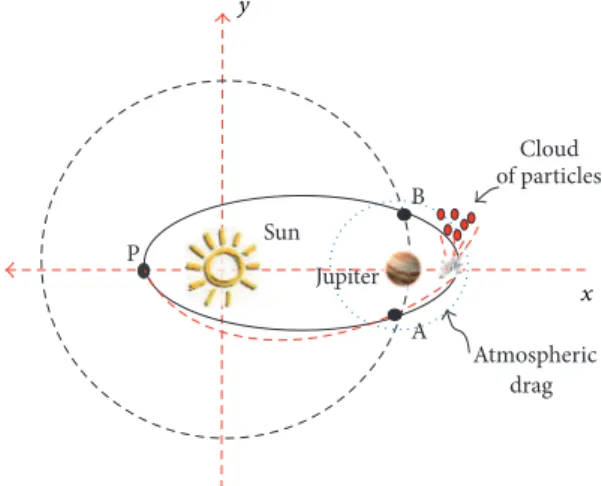
elliptic orbit, also centered in the Sun. Figure1illustrates this
situation. he spacecrat is initially travelling in the elliptic orbit around the Sun that has a perihelion marked by the point P. Jupiter is travelling in a circular orbit around the Sun and it has a sphere of inluence represented by the circle around its center. he point A is the position where the spacecrat starts its approximation to Jupiter, but it is still far from the planet such that the system can be modeled as a two-body problem (spacecrat-Sun). he spacecrat follows its trajectory, now under the gravitational forces of the Sun and Jupiter, until it enters the atmosphere of the planet, when the extra force generated by the drag is included in the dynamics. his force not only modiies the trajectory of the spacecrat, but it also generates the explosion of the spacecrat when it is passing by the point of the closest approach to the planet. Ater that, the cloud of particles follows its way in the atmosphere, as individual bodies. If there is no capture by the planet Jupiter, the particles will leave the planet and go back to an orbit around the Sun. Point B represents the exit point from the sphere of inluence of Jupiter. It is a generic point, marked to explain the main ideas of the trajectory. Each particle has its own exact point of escaping, since the trajectories are independent from each other ater the explosion. he equations of motion for each particle and for the spacecrat are the ones given by the planar restricted circular three-body problem with the inclusion of the atmospheric drag. hose equations are written in the rotating system of reference that is a system that rotates together with the primaries of the system (Sun and Jupiter in the present case). he canonical system of units is used. It implies that the unit of distance is the Sun-Jupiter distance, the unit of mass is the total mass of the bodies involved (Sun and Jupiter, since the spacecrat has a negligible mass) and the unit of time is deined in such a way that the period of the
motion of the primaries is2�. Under those hypothesis, the
equations of motion are [23]:
̈� − 2 ̇� = �Ω�� + ��,
̈� + 2 ̇� = �Ω�� + ��,
(1)
whereΩis the potential, given by:
Ω = 12 (�2+ �2) +(1 − �)
�1 + ��2 (2)
and �� and �� are the components of the drag force ( ⃗�),
expressed by:
⃗� = (��, ��) = −�����0� −(ℎ−ℎ0)/�
2� ⃗�, (3)
where��is the drag coeicient, which is a constant that takes
into account the form of the spacecrat or the particles;�is
the cross section area of the spacecrat or the particles; ⃗�is
Sun
A P
B
x
y
Jupiter
Atmospheric drag
Cloud of particles
Figure 1: Geometry of the maneuver. It is not in scale to visualize better all the steps.
�0is the density of the atmosphere at an altitudeℎ0;ℎis the
altitude of the spacecrat;�is a constant that speciies the
decay velocity of the density with the altitude.
he “Jacobian Integral” is a constant of motion that is very important in the restricted three-body problem. It is valid only when the atmospheric drag is not included. In the present paper it is used as a parameter to identify a single trajectory. It is expressed by:
� = � − �� = ̇�2+ ̇�2 2 − �2+ �2 2 − 1 − ��
1 − ��2, (4)
where�is the energy;�is the angular momentum;�1is the
distance between the spacecrat and the Sun;�2is the distance
between the spacecrat and Jupiter;�is the angular velocity
of the Sun-Jupiter system.
3. Identifying a Trajectory
It is very important to deine a set of variables that can identify uniquely one Swing-By trajectory. here are several choices that can be used for this task. In the present research the following ones are used [15]:
(a)Ψ, the angle of approach. It is the angle formed by
the line of the periapsis (line linking the center of Jupiter to the point of the closest approach of the trajectory) and the line connecting the two primaries (Sun-Jupiter). In the rotating system of reference this line is also the horizontal axis;
(b)�, the Jacobian constant, expressed by (4). Although
this is no longer constant ater the inclusion of the atmospheric drag, this parameter is usually used to identify Swing-By trajectories. It is used only to ind the velocity of the particle at the periapsis;
(c)ℎ�, the altitude of the periapsis for the trajectory
around Jupiter.
he choice of these parameters was made based in the literature [15], that used those variables and they showed to be very adequate to describe the problem.
So, the methodology used to compare trajectories consid-ering or not the drag force is based in the steps shown below.
(i) When studying trajectories without the drag force, a numerical integration is made starting at the periapsis and in backward time, until the point A is reached
by the spacecrat (see Figure 1). At this point the
spacecrat is assumed to be far enough from Jupiter, so the formulas developed for the two-body celestial mechanics are valid to compute the two-body energy and angular momentum before the close approach for the Sun-spacecrat system. Ater that, the initial conditions are returned to the periapsis. he cloud of particles is created by making small modiications in
the variablesΨandℎ�. So, the particles are assumed
to have valuesΨ − � Ψ ≤ Ψ ≤ Ψ + � Ψfor the angle of
approach andℎ�−�ℎ�≤ ℎ�≤ ℎ�+�ℎ�for the altitude
of the periapsis. Limits for those increments(�Ψ, ℎ�)
are ixed in advance, to deine the characteristics of the cloud. Larger values represent a strong explosion that generates a more dispersed cloud. On the other side, smaller values for those two limits represent weaker explosions, with a more concentrated cloud of particles. In this part of the calculations it is assumed that the Jacobian constant is the same for all the particles, at the beginning of the motion. hen numerical integrations are made for each particle, this time in forward time. his integration is performed until the spacecrat collide with the planet or escape
from it and reaches a point B (see Figure1), assumed
to be a point that is far enough from Jupiter such that its efects in the motion of the particle are negligible. At this point two-body celestial mechanics are again assumed to be valid to compute the two-body energy and angular momentum ater the close approach for the Sun-spacecrat system again;
(ii) he maneuver with the presence of the drag force is similar. he numerical integration starts at periapsis,
with the same values for the parameters �, Ψ and
ℎ� of the maneuver without drag. he integration
of the trajectory of the spacecrat is made again backward in time, now including the drag force, until the spacecrat arrives at the point A. he numerical integration for the particles is performed forward in time, including the drag force, for each particle until they reach the point B. he same hypotheses made for the situation without the drag force are made here regarding the initial condition of each particle.
4. Tisserand’s Criterion
It is known for a long time that, when a particle passes close to a massive celestial body, the orbital elements can be drastically modiied. he French astronomer Francois Felix Tisserand established, in 1889, a relationship among the orbital elements that should remain almost unaltered by a close approach. It is an equation, written in the dimensionless canonical system of units, which represents a quantity that should be nearly conserved by the close approach. hus, two observed bodies are probably the same if they nearly satisfy the Tisserand’s Criterion [34]:
1
�� + 2√��(1 − � 2
�)cos��≈ 1�
0 + 2√�0(1 − � 2
0)cos�0, (5)
where ��,�� and �� are the orbital elements of the particle
before the maneuver and�0,�0and�0are the orbital elements
of the particle ater the maneuver. It is important to note that all the orbits involved are planar. It means that there are only two choices for the inclination before and ater the close approach: zero or 180 degrees. So, the trigonometric forms
presented in this equation (cos��and cos�0) are both minus
one or one. In this study, the Tisserand’s Criterion will be used to validate the orbits found.
5. Results
he results are presented in igures that display the semi-major axis and the eccentricity of the particles of the cloud ater the passage for both cases, with and without drag. he legends show the same values for the spacecrat, before the passage. Two values were considered for the Jacobian
constant�:−1.3and−1.0. hose values were chosen based in
simulations with diferent values. Since the Jacobian constant is equivalent to the velocity of the spacecrat at the periapsis, it is important to use values that do not imply in velocities that are not too low, such that too many captures by Jupiter occur; and also those which are not too high, such that the Swing-Bys have very little efects. Eight values were considered for
the angel approachΨ: 0∘, 45∘, 90∘, 135∘, 180∘, 225∘, 270∘, 315∘.
hose values were chosen in order to cover the whole range of
values from 0 to 360∘in equally spaced values, such that there
are captures and escapes for the particles, as well as regions
with no efects from the Swing-Bys. Figures2,3,4,5,6,7,8,
and9show the results, where the semi-major axes are shown
in canonical units. Red represents the cloud of particles for the passage where the drag is included and black represents the situation where drag is not included.
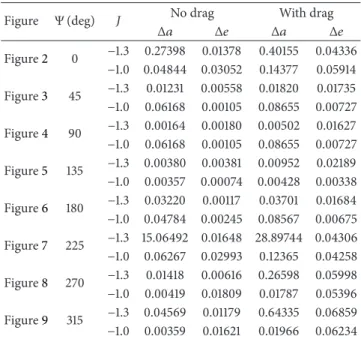
here are many conclusions coming from those results. First, it is clear that the inclusion of the atmospheric drag increases the dispersion of the particles of the cloud. It happened for all the situations simulated. Another efect com-mon to all the simulations is the circularization of the orbits. It means that the atmospheric drag reduces the eccentricities of the particles, when compared to the equivalent simulations without the presence of drag. Considering speciic cases, it
is visible that the maneuvers, in the situation whereΨ = 0∘,
have no change in the energy of the particle due to the Swing-By. he centers of the black curves, for both values of the
Table 1: Amplitude of the dispersions for semi-major axis and eccentricity.
Figure Ψ(deg) � No drag With drag
Δ� Δ� Δ� Δ�
Figure2 0 −1.3 0.27398 0.01378 0.40155 0.04336 −1.0 0.04844 0.03052 0.14377 0.05914 Figure3 45 −1.3 0.01231 0.00558 0.01820 0.01735 −1.0 0.06168 0.00105 0.08655 0.00727 Figure4 90 −1.3 0.00164 0.00180 0.00502 0.01627 −1.0 0.06168 0.00105 0.08655 0.00727 Figure5 135 −1.3 0.00380 0.00381 0.00952 0.02189 −1.0 0.00357 0.00074 0.00428 0.00338 Figure6 180 −1.3 0.03220 0.00117 0.03701 0.01684 −1.0 0.04784 0.00245 0.08567 0.00675 Figure7 225 −1.3 15.06492 0.01648 28.89744 0.04306 −1.0 0.06267 0.02993 0.12365 0.04258 Figure8 270 −1.3 0.01418 0.00616 0.26598 0.05998 −1.0 0.00419 0.01809 0.01787 0.05396 Figure9 315 −1.3 0.04569 0.01179 0.64335 0.06859 −1.0 0.00359 0.01621 0.01966 0.06234
Jacobian constant, have the same keplerian elements of the spacecrat before the passage. he particles are dispersed by the variations of the initial conditions only (angle of approach and periapsis altitude). It is also visible that all the orbits
involved are hyperbolic for the situation where � = −1.0,
since the eccentricities are larger than one and the semi-major
axis are positive. For the situations where� = −1.3all the
orbits involved are elliptic. hese diferences come from the higher magnitude of the velocity at the periapsis caused by the increase of the Jacobian constant. he addition of the atmospheric drag has the efect of making an extra loss in the energy, as expected, showed by the decreases of the semi-major axis. It is also visible that, with the increase of the Jacobian constant (and so the velocity at the periapsis) the modiications in the orbit of the spacecrat decreases. his is explained by the fact that the particles and the spacecrat remains a longer time inside the atmosphere in the situations where the velocity is smaller.
For the situations where= 45∘, the Swing-By maneuver
reduces the energy of the particle. All the orbits before the close approach are hyperbolic and ater the close approach they are elliptic, for both values of the Jacobian constant. It means that captures occur in all situations and the particles become part of the Solar System ater the close approaches. Once again, the efects are smaller when the velocity increases, for the same reasons already explained. Both values of the semi-major axis and eccentricity are larger for higher velocities at the periapsis.
he cases whereΨ = 90∘represent the maneuvers that
No drag With drag 0.80
0.78
0.76
0.74
0.72
0.70
0.68
2.4 2.6 2.8 3.0 3.2 3.4 3.6 3.8
a e
(a) � = −1.3, keplerian elements of the spacecrat before the Swing-By:
� = 3.58547,� = 0.7898784
1.62
1.60
1.58
1.56
1.54
1.52
1.50
1.45 1.40 1.35 1.30 1.25 1.20
a e
No drag With drag
−1.50 − − − − − −
(b) � = −1.0, keplerian elements of the spacecrat before the Swing-By:
� = −1.23775,� = 1.610314
Figure 2: Semi major (a) axis and eccentricity (e) for the particles ater the close approach consideringΨ = 0∘.
Table 2: Orbital parameters and Tisserand’s values for a cloud of particles before and ater the explosion.
Initial orbit (canonical units) Ater maneuver (cloud of particles)
� Ψ(deg) � �
Tisserand’s Criterion
No drag With atmospheric drag
�— �� �min �max
−1.0
0 −1,23775 1,610314 2,000569 2,06071106 2,05025320 2,07252358
45 −0,53638 2,821376 2,000065 2,06142012 2,05096604 2,07322829
90 −0,54698 2,774633 2,000082 2,06192721 2,05148132 2,07372668
135 −1,39075 1,526299 2,000611 2,06193529 2,05149121 2,07373280
180 1,229213 0,844421 2,001342 2,06136489 2,05091418 2,07316926
225 0,534676 0,995945 2,001846 2,06073155 2,05027747 2,07253978
270 0,545158 0,993546 2,001829 2,06022456 2,04977090 2,07203293
315 1,379367 0,839495 2,001300 2,06021643 2,04976138 2,07202647
−1.3
0 3,58547 0,7898784 2,601373 2,66063381 2,65033163 2,67227080
45 −2,03535 1,4746355 2,601006 2,66105799 2,65076288 2,67268695
90 −1,60122 1,6199792 2,600942 2,66130887 2,65102208 2,67292885
135 −26,9689 1,0317580 2,601223 2,66124006 2,65095278 2,67286048
180 0,9678 0,6037537 2,601733 2,66084666 2,65055228 2,67247478
225 0,58864 0,8084081 2,602051 2,66047080 2,65017124 2,67210496
270 0,54589 0,8534019 2,602114 2,66022005 2,64991829 2,67185720
315 0,80375 0,6532013 2,601834 2,66028895 2,64998489 2,67192855
just below 1.0, so they are almost parabolic orbits and the
captures almost did not happen. he cases with� = −1.3
have lower velocities, so the captures are stronger and the eccentricities ater the close approaches are in the range 0.81 to 0.83, so not so close to parabolic orbits. It is also noted that the semi-major axis for the particles are larger when the atmospheric drag is included, what is not expected since the atmosphere takes energy from the particles. his situation
happened because the maneuvers withΨ = 90∘ cause the
largest loss of energy due to the passage by Jupiter, so, if the
atmosphere changes this geometry and the trajectories have angles of approach diferent from that extreme case, there is a reduction in the variation of energy due to the Swing-By. It means that the magnitudes of the energy removed by the atmosphere were smaller than the magnitude of the decreases in the variation of energy due to the fact that the Swing-By occurred out of the extreme geometry.
he situations that haveΨ = 135∘also represent
No drag With drag 0.655
0.650
0.645
0.640
0.635
0.620 0.625 0.630
0.615
0.775 0.780 0.785 0.790 0.795 0.800 0.805 0.810 a
e
(a)� = −1.3, keplerian elements of the spacecrat before the Swing-By:
� = −2.03535,� = 1.4746355
No drag With drag 0.840
0.838
0.836
0.834
0.832
0.828
0.826 0.830
0.824
0.822
0.820
1.25 1.30 1.35 1.40
a e
(b) � = −1.0, keplerian elements of the spacecrat before the Swing-By:
� = −0.53638,� = 2.821376
Figure 3: Semi major (a) axis and eccentricity (e) for the particles ater the close approach consideringΨ = 45∘.
No drag With drag 0.85
0.84
0.83
0.82
0.81
0.546 0.548 0.550 0.552 0.554 0.556 0.558
a e
(a)� = −1.3, keplerian elements of the spacecrat before the Swing-By:
� = −1.60122,� = 1.6199792
0.994
0.993
0.992
0.991
0.990
0.989
0.988 e
0.538 0.540 0.542 0.544 0.546 0.548
No drag With drag
a
(b)� = −1.0, keplerian elements of the spacecrat before the Swing-By:� =
−0.54698,� = 2.774633
Figure 4: Semi major (a) axis and eccentricity (e) for the particles ater the close approach consideringΨ = 90∘.
Once again the characteristic of having smaller loss of energy when the atmosphere is included occurred, this time for both
values of the Jacobian constant. In the case where� = −1.0the
captures resulted in orbits with very high eccentricities, near
the parabolic orbits again. he cases where� = −1.3have now
the characteristic of having almost parabolic orbits before the close approach.
he cases whereΨ = 180∘represent the other geometry
where the Swing-By itself does not modify the orbit of the
particle, similar to the caseΨ = 0∘.All the orbits are elliptic,
before and ater the close approaches, for both values of the Jacobian constant. Another characteristic of these orbits is that there is an inversion in the change of energy due to the inclusion of the drag force. here are decreases for
� = −1.3and increases for� = −1.0. his fact occurs due to the sensibility of the orbits in the border line between gains and losses in energy, in terms of the angle of approach. he atmosphere can make small deviations in the orbits and put them in trajectories with angle of approaches a little
No drag With drag
0.81
0.80
0.79
0.78
0.77
0.76
0.75
0.585 0.590 0.595 0.600 0.605 0.610
a e
(a) � = −1.3, keplerian elements of the spacecrat before the Swing-By:
� = −26.9689,� = 1.0317580
No drag With drag
0.996
0.995
0.994
0.993
0.992
0.991
0.990
0.989
0.533 0.534 0.535 0.536 0.537 0.538
a e
(b) � = −1.0, keplerian elements of the spacecrat before the Swing-By:
� = −1.39075,� = 1.526299
Figure 5: Semi major (a) axis and eccentricity (e) for the particles ater the close approach consideringΨ = 135∘.
No drag With drag
0.59
0.58
0.57
0.56
0.55
0.54
1.18 1.19 1.20 1.21 1.22 1.23 1.24
a e
(a) � = −1.3, keplerian elements of the spacecrat before the Swing-By:
� = 0.9678,� = 0.6037537
No drag With drag 0.845
0.840
0.835
0.830
0.825
0.820
1.20 1.25 1.30 1.35 1.40 1.45 1.50 1.55
a e
(b) � = −1.0, keplerian elements of the spacecrat before the Swing-By:� =
1.229213,� = 0.844421
Figure 6: Semi major (a) axis and eccentricity (e) for the particles ater the close approach consideringΨ = 180∘.
energy. hese diferences in the energy variations can be larger than the removal of energy by the atmosphere, causing the unexpected results.
he situations whereΨ = 225∘have also some interesting
and peculiar facts. First of all, it is a geometry that increases the energy of the particles. For values of the Jacobian constant
equal to−1.0, there are escape trajectories in all the cases, with
the particles leaving closed trajectories around the Sun to go
to open trajectories, leaving the Solar System. he escapes occur in the limit, because the orbit before the close approach is almost parabolic, with eccentricity equal to 0.995945. he
cases with � = −1.3 are more interesting. Passages not
No drag With drag
1.04
1.02
1.00
0.98
0.96
0.94
0 10 20 30 40
a e
−40 −30 −20 −10
(a)� = −1.3, keplerian elements of the spacecrat before the Swing-By:
� = 0.58864,� = 0.8084081
−1.60 −1.55 −1.50 −1.45 −1.40 −1.35
No drag With drag
1.535
1.515
1.505
1.495
1.485
1.475
1.465 1.470 1.480 1.490 1.500 1.510 1.520 1.525 1.530 1.540
a e
(b) � = −1.0, keplerian elements of the spacecrat before the Swing-By:� =
0.534676,� = 0.995945
Figure 7: Semi major (a) axis and eccentricity (e) for the particles ater the close approach consideringΨ = 225∘.
No drag With drag
1.62
1.58 1.60
1.56
1.54
1.52 1.50
1.48 1.46
1.44
a e
−2.3 −2.2 −2.1 −2.0 −1.9 −1.8 −1.7 −1.6
(a)� = −1.3, keplerian elements of the spacecrat before the Swing-By:
� = 0.54589,� = 0.8534019
No drag With drag
2.78
2.76
2.74
2.72
2.70
2.68
2.66
2.64
a e
−0.59 −0.58 −0.57 −0.56 −0.55 −0.54
(b) � = −1.0, keplerian elements of the spacecrat before the Swing-By:
� = 0.545158,� = 0.993546
Figure 8: Semi major (a) axis and eccentricity (e) for the particles ater the close approach consideringΨ = 270∘.
avoid the escapes, so keeping the particles as part of the Solar System. It means that the atmosphere plays an important role in these maneuvers.
he cases withΨ = 270∘consist in maneuvers that gives
the maximum gains in energy for the particles. he result of the larger increases in energy is that now there are only escape trajectories, for both values of the Jacobian constant. It is also noted that the escapes generated trajectories with larger eccentricities, no longer near parabolic orbits. he situation
is similar for the last case studied, withΨ = 315∘. here are
increases in the energy of the particles in all the cases and all the orbits are hyperbolic.
Table1shows the values of the amplitude of the
−3.4 −3.2 −3.0 −2.8 −2.6 −2.4 −2.2 −2.0
No drag With drag
1.48
1.46 1.44 1.42 1.40
1.36 1.38
1.34 1.32 1.30 1.28
a e
(a) � = −1.3, keplerian elements of the spacecrat before the Swing-By:
� = 0.80375,� = 0.6532013
−0.58
−0.59 −0.57 −0.56 −0.55 −0.54 −0.53
2.84
2.82
2.80
2.78
2.76
2.74
2.72
2.70
2.68
2.66
No drag With drag
a e
(b) � = −1.0, keplerian elements of the spacecrat before the Swing-By:
� = 1.379367,� = 0.839495
Figure 9: Semi major (a) axis and eccentricity (e) for the particles ater the close approach consideringΨ = 315∘.
Ater that, the Tisserand’s parameters are evaluated, to
verify the orbits found. Table 2 shows the orbital
param-eters and the Tisserand’s values for the spacecrat before the explosion and for the particles of the cloud ater the
explosion. he values shown are: �(Jacobian constant), Ψ
(angle of approach); � (semi-major axis); � (eccentricity);
�− (Tisserand’s parameter of the spacecrat before the close
approach);��(the average value of the Tisserand’s parameter
for the cloud of particles ater the explosion); �min (the
minimum value of the Tisserand’s parameter for the cloud of
particle ater the explosion) and�max (the maximum value
for the Tisserand’s parameter for the cloud of particles ater the explosion). It is possible to observe that the Tisserand’s
parameters (�−,��,�min,�max) show slight variations ater
the second decimal digit due to the atmospheric drag force, so these results are showing the efects of the drag force. In average, the inclusion of the drag force increased the Tisserand’s parameter by the value 0.06. he amplitude of the dispersion is 0.02.
6. Conclusions
A numerical algorithm to measure the efects of the atmo-sphere in a Swing-By between a planet and a spacecrat that explode during the passage is developed. his algorithm allows the quantiication of the results obtained by the inclusion of the drag force and also gives conditions to make predictions in other situations. his technique is then applied to a spacecrat passing by the planet Jupiter. he results give an idea of the behavior of the particles, showing regions where captures and escapes occur, and also quantifying the efects of the atmospheric drag. In general, the presence of the atmosphere causes a reduction in the eccentricities of the orbits of the particles ater the Swing-By, so generating
orbits that are closer to circular when compared to the situations where drag is not present. his reduction is also quantiied by the present algorithm. he semi-major axis of the trajectories are usually reduced by the presence of the atmosphere, but some exceptions exist near the point
of maximum loss in energy (angle of approach 90∘). his
fact happens because the losses in energy that come from the deviations from this optimal point for the Swing-By is larger than the energy removed by the atmosphere. Next, the Tisserand’s criterion was applied in the maneuvers and the efects of the atmosphere in this parameter were measured, in terms of average and dispersion.
Acknowledgments
he authors wish to express their appreciation for the support provided by grants 2011/13101-4 and 2012/21023-6, from S˜ao Paulo Research Foundation (FAPESP).
References
[1] M. A. Minovich, “A method for determining interplanetary free-fall reconnaissance trajectories,” JPL Technical Memo 312-130, JPL, Pasadena, Calif, USA, 1961.
[2] R. L. Dowling, W. J. Kosmann, M. A. Minovitch, and R. W. Ridenoure, “he origin of gravity-propelled interplanetary space travel,” inProceedings of the 41st International Astronau-tical Federation, GDR. Proceedings, IAA, Dresden, Germany, October 1990.
[4] G. A. Flandro, “Fast reconnaissance missions to the outer solar system utilizing energy derived from the gravitational ield of Jupiter,”Astronautica Acta, vol. 12, no. 4, pp. 329–337, 1966. [5] L. A. D’Amario, D. V. Byrnes, and R. H. Stanford,
“Interplane-tary trajectory optimization with application to Galileo,”Journal of Guidance, Control, and Dynamics, vol. 5, no. 5, pp. 465–471, 1982.
[6] A. A. Sukhanov, “Close approach to sun using gravity assists of the inner planets,”Acta Astronautica, vol. 45, no. 4–9, pp. 177– 185, 1999.
[7] W. M. Hollister and J. E. Prussing, “Optimum transfer to Mars via Venus,”Astronautica Acta, vol. 12, no. 2, pp. 169–179, 1966. [8] S. A. Striepe and R. D. Braun, “Efects of a venus swingby
periapsis burn during an Earth-Mars trajectory,”he Journal of the Astronautical Sciences, vol. 39, no. 3, pp. 299–312, 1991. [9] R. Carvell, “Ulysses-the sun from above and below,”Space, vol.
1, pp. 18–55, 1986.
[10] A. F. B. A. Prado, “Orbital control of a satellite using the gravity of the moon,” Journal of the Brazilian Society of Mechanical Sciences and Engineering, vol. 28, no. 1, pp. 105–110, 2006. [11] S. M. Marsh and K. C. Howell, “Double lunar swingby trajectory
design,” AIAA Paper 88-4289, 1988.
[12] J. K. S. Formiga, “A close approach between a planet and a parti-cle: sun-jupiter system,” inProceedings of the 10th International Conference on System Science and Simulation in Engineering, vol. 1, pp. 32–37, World Scientiic and Engineering Academy and Society Press, Penang, Malaysia, 2012.
[13] A. F. B. A. Prado and R. A. Broucke, “Transfer orbits in restricted problem,”Journal of Guidance Control and Dynamics, vol. 18, no. 3, pp. 593–598, 1995.
[14] A. F. B. A. Prado and R. A. Broucke, “Transfer orbits in the earth-moon system using a regularized model,”Journal of Guidance, Control, and Dynamics, vol. 19, no. 4, pp. 929–933, 1996.
[15] R. A. Broucke, “he celestial mechanics of gravity assist,” in Proceedings of the AIAA/AAS Astrodynamics Conference, AIAA paper 88-4220, Minneapolis, Minn, USA, August 1988. [16] L. A. D’Amario, D. V. Byrnes, L. L. Sacett, and R. H. Stanford,
“Optimization of multiple lyby trajectories,” inProceedings of the AAS/AIAA Astrodynamics Specialists Conference, AAS paper 79-162, Provincetown, Mass, USA, June 1979.
[17] L. A. D’Amario, D. V. Byrnes, and R. H. Stanford, “A new method for optimizing multiple-lyby trajectories,”Journal of Guidance, Control, and Dynamics, vol. 4, no. 6, pp. 591–596, 1981. [18] D. Dunham and S. Davis, “Optimization of a multiple
lunar-swing-by trajectory sequence,”Journal of Astronautical Sciences, vol. 33, no. 3, pp. 275–288, 1985.
[19] N. J. Strange and J. M. Longuski, “Graphical method for gravity-assist trajectory design,”Journal of Spacecrat and Rockets, vol. 39, no. 1, pp. 9–16, 2002.
[20] T. T. McConaghy, T. J. Debban, A. E. Petropoulos, and J. M. Longuski, “Design and optimization of low-thrust trajectories with gravity assists,”Journal of Spacecrat and Rockets, vol. 40, no. 3, pp. 380–387, 2003.
[21] A. F. B. A. Prado, “Powered swing-by,”Journal of Guidance, Control, and Dynamics, vol. 19, no. 5, pp. 1142–1147, 1997. [22] A. F. B. A. Prado, “Close-approach trajectories in the elliptic
restricted problem,”Journal of Guidance, Control, and Dynam-ics, vol. 20, no. 4, pp. 797–802, 1997.
[23] A. F. B. A. Prado and R. A. Broucke, “Efects of atmospheric drag in swing-by trajectory,”Acta Astronautica, vol. 36, no. 6, pp. 285–290, 1995.
[24] W. Schulz, A. F. B. A. Prado, and R. Vilhena de Moraes, “An analytical and numerical study of plane change maneuvers using aerodynamic force,” he Journal of the Astronautical Sciences, vol. 50, no. 3, pp. 289–303, 2002.
[25] V. G. Szebehely,heory of Orbits, Academic Press, New York, NY, USA, 1967.
[26] V. M. Gomes and A. F. B. A. Prado, “Swing-by maneuvers for a cloud of particles with planets of the solar system,”WSEAS Transactions on Applied and heoretical Mechanics, vol. 3, no. 11, pp. 869–878, 2008.
[27] V. M. Gomes and A. F. B. A. Prado, “A study of the impact of the initial energy in a close approach of a cloud of particles,”WSEAS Transactions on Mathematics, vol. 9, no. 10, pp. 811–820, 2010. [28] A. Carusi and F. Pozzi, “A new method for close encounter
computation,”he Moon and the Planets, vol. 19, no. 1, pp. 65–70, 1978.
[29] A. Carusi and G. B. Valsecchi, “Efects of a close encounter with Jupiter on diferent populations of planet-crossing objects,”he Moon and the Planets, vol. 22, no. 2, pp. 133–139, 1980. [30] A. Carusi, G. B. Valsechi, and R. Greenberg, “Planetary close
encounters: geometry of approach and post-encounter orbital parameters,”Celestial Mechanics and Dynamical Astronomy, vol. 49, no. 2, pp. 111–131, 1990.
[31] J. E. Dale and M. B. Davies, “Collisions and close encounters involving massive main-sequence stars,”Monthly Notices of the Royal Astronomical Society, vol. 366, no. 4, pp. 1424–1436, 2006. [32] L. Dong, A. R. Frederic, and S. L. Shapiro, “Collisions and close encounters between massive main-sequence stars,” Astrophysi-cal Journal, vol. 412, no. 2, pp. 593–561, 1993.
[33] E. Everhat, “Close encounters of comets and planets,” Astronom-ical Journal, vol. 74, no. 5, 1969.
Submit your manuscripts at
http://www.hindawi.com
Hindawi Publishing Corporation
http://www.hindawi.com Volume 2014
Mathematics
Journal ofHindawi Publishing Corporation
http://www.hindawi.com Volume 2014
Mathematical Problems in Engineering
Hindawi Publishing Corporation http://www.hindawi.com
Differential Equations
International Journal of
Volume 2014
Hindawi Publishing Corporation
http://www.hindawi.com Volume 2014
Hindawi Publishing Corporation
http://www.hindawi.com Volume 2014
Hindawi Publishing Corporation
http://www.hindawi.com Volume 2014 Mathematical PhysicsAdvances in
Complex Analysis
Journal ofHindawi Publishing Corporation
http://www.hindawi.com Volume 2014
Optimization
Journal of Hindawi Publishing Corporationhttp://www.hindawi.com Volume 2014
Combinatorics
Hindawi Publishing Corporation
http://www.hindawi.com Volume 2014
International Journal of Hindawi Publishing Corporation
http://www.hindawi.com Volume 2014
Journal of
Hindawi Publishing Corporation
http://www.hindawi.com Volume 2014
Function Spaces
Abstract and Applied Analysis Hindawi Publishing Corporation
http://www.hindawi.com Volume 2014
International Journal of Mathematics and Mathematical Sciences
Hindawi Publishing Corporation http://www.hindawi.com Volume 2014
The Scientiic
World Journal
Hindawi Publishing Corporation
http://www.hindawi.com Volume 2014
Hindawi Publishing Corporation
http://www.hindawi.com Volume 2014
Discrete Dynamics in Nature and Society Hindawi Publishing Corporation
http://www.hindawi.com Volume 2014
Hindawi Publishing Corporation
http://www.hindawi.com Volume 2014
Discrete Mathematics
Journal ofHindawi Publishing Corporation
http://www.hindawi.com Volume 2014 Hindawi Publishing Corporation