A Work Project, presented as part of the requirements for the Award of a Master’s Degree in International Finance from the NOVA School of Business and Economics
Relative Strength Momentum: The Brazilian Evidence
FRANCISCO JOSÉ DIAS FERREIRA GRINCHO
N. 3153
A Direct Research Project carried out under the supervision of:
Professor André C. Silva
Abstract
International academic studies show strong support to momentum effects but the literature applied to Brazil presents mixed results. This study examines the profitability of momentum strategies in the Brazilian market from February 1995 until December 2017, replicating the methodology of the pioneering work of Jegadeesh and Titman (1993). “Winners Minus Losers” strategies beat the market according to their risk-return profile. However, results obtained suggest lack of evidence of significant abnormal returns in the full period of estimation and in normal periods. “Winners” manage to exhibit positive abnormal returns for the full period, suggesting that following a long-only strategy is more attractive for investors. The sub-period analysis conducted demonstrates that “winners” drive returns, whereas “losers” negatively impact profitability and are also suggested to be the main cause of the momentum crashes.
JEL Classification: G01, G11, G14.
Introduction
The aim of this article is to investigate the importance of momentum as an anomaly in the Brazilian market and present the analysis of a relative strength momentum strategy applied to a sample of stocks from the Bovespa stock exchange in São Paulo, Brazil. The strategy follows the one implemented by Jegadeesh and Titman (1993) and is applied to Brazilian equities filtered for liquidity from February 1995 until December 2017. This research investigates the performance and application of a pioneering momentum strategy to Brazil, over a longer estimation period than previous studies, with a sample of data carefully chosen in order to take into account the size and liquidity of stocks. Furthermore, special focus is attributed to the defined periods of crisis for Brazil in order to attempt to justify performance.
The use of historical information to make investment decisions has challenged financial theory since the existence of financial markets. Levy (1967) established the first trading rule for successful relative strength strategies. These relative strength strategies aim to generate significant abnormal returns by taking advantage of stock price momentum exhibited by past winners (technical analysis). According to the principle of market efficiency, this approach and such strategies should not yield satisfactory results. Nonetheless, investors have consistently managed to achieve a superior performance, rendering stock price momentum a very interesting topic both for investors and academics.
Jegadeesh and Titman (1993) first identified momentum in the US market. This study demonstrated that momentum portfolios generate significant abnormal profits, yielding a monthly return of 1.3% from 1965-1989. Thereafter, many others confirmed the existence of this anomaly elsewhere. It was shown that this phenomenon is observed for different asset classes (Asness, Moskowitz & Pedersen,
2013), in different markets (Rouwenhorst, 1998; Griffin, Ji & Martin, 2003; Chui, Titman & Wei, 2010) and across time (Jegadeesh and Titman, 2001).
However, the pioneering studies applied to the Brazilian stock market, in the context of long-short strategies of good-bad momentum portfolios, present mixed results that differ mainly because of the time span considered, the data collected and the strategy construction methods. For example, Bonomo and Dall’Agnol (2003) and Fonte and Carmona (2005) rejected the momentum effect identified by Jegadeesh and Titman (1993) in the US market. Other such studies that claim relative strength momentum strategies fail to achieve positive and significant abnormal returns are those of Cruz (2009) and Kimura (2003). On the other hand, Piccoli et al. (2015) suggest the possibility to generate significant abnormal returns from these strategies, confirming the existence of this anomaly in Brazil. Other studies, such as Mussa et al. (2007) and Neto et al. (2011) also support this possibility.
The profitability of such strategies is clear evidence against the Efficient Markets Hypothesis (EMH) since all that is needed to generate these abnormal returns are historical prices. Protectors of this EMH tried to explain the momentum effect by the empirical nature of the studies conducted. For instance, Lo and MacKinley (1990) argued that these abnormal profits might be the result of “data snooping” bias. However, this was rapidly refuted by the research of Grundy and Martin (2001) who demonstrated abnormal profits in the US equity markets since the 1920s. Another argument was that momentum profitability is merely a compensation for risk, thus disregarding it as evidence against the EMH. Fama and French (1996) also overturned this explanation by showing that risk factors assumed in their previous study of 1993 cannot explain the momentum profit even though these factors can describe the returns of other anomalies such as the size effect.
This paper is structured in the following way: Section II provides an overview of the already existing literature concerning this topic. Section III describes the data and other variables used, and its sources. Section IV gives a detailed explanation of the methodology implemented in this research. Section V discusses and describes the conducted analysis and obtained results. Lastly, section VI presents the final remarks and conclusions of this thesis.
Literature review
The main principle defended by the EMH, formalized by Fama (1970) is the absence of arbitrage in the risk/return relation of financial assets. Thus, this theory suggests that the price of an asset reflects all available information regarding the issuing institution, making it impossible for investors to generate abnormal returns. This way, investment strategies that aim to generate higher returns will bear more risk. This assumption is also present in the CAPM model proposed by Sharpe (1964), for which the expected return of an asset is a function of its systematic risk, that is, its sensitivity to variations in the financial market.
Around the 1980s, the CAPM model was deemed insufficient and new models that incorporate new risk factors besides the asset’s systematic risk or ! were created. In this context, Fama and French (1992) demonstrated the importance of other factors such as company size and book-to-market ratio. Finally, Fama and French (1993) proposed a three-factor model that adds to a company’s systematic risk, the risks arising from the size and the book-to-market ratio of the same company.
However, the financial literature reports the existence of various investment strategies that generate abnormal returns that aren’t explained by the contemporary models of risk. Amongst these approaches, one of the most notorious ones is called momentum.
These strategies are based on the tendency of assets to keep the same recent behavior relative to the market in the short-term. Momentum has consistently allowed investors to reach superior performance. There is evidence of this phenomenon internationally and many studies specifically applied to Brazil, which is considered as a unique case. Jegadeesh and Titman (1993) are the pioneers to discover the momentum effect by applying trading strategies that buy past winners and sell past losers in the North American market. The results of this study proved the possibility of significant abnormal returns in 15 of the 16 strategies tested. These momentum strategies consisted on buying high performing stocks between the last 3 to 12 months and selling the worst performing stocks within the same time periods, holding them for periods also ranging from 3 to 12 months. This tendency reverted for holding periods superior to 12 months, suggesting that the momentum effect is only present in the short-term.
Following the work of Jegadeesh and Titman (1993), others started testing the existence of the momentum effect in international markets. Key studies demonstrating this are those of Fama and French (1996) and Jegadeesh and Titman (2001) for the North American market, Rouwenhorst (1998) for the European market and Rouwenhorst (1999) for Emerging markets, including Brazil. This latest study used 87 listed Brazilian companies from 1982-1997, testing a (6, 6) strategy (both formation and holding periods are 6 months). Besides finding positive results for the momentum factor when using the mean of the Emerging countries, the research did not find the existence of momentum for Brazil individually. This market anomaly became so relevant that Carhart (1997) incorporated the momentum factor to the Fama and French three-factor model, proving the importance of this fourth factor to explain asset prices. However, as already mentioned, when applied to the Brazilian
market, it has been showed that momentum strategies don’t generate statistically significant profits, suggesting that Brazil might be an exception.
The basic assumption for there to be the possibility to generate abnormal returns from past information is that markets are inefficient. The research of Minardi (2004) aimed to investigate the weak-form EMH in Brazil and to do so, 649 stocks were selected from September 1994 until August 2000. In this study, the author demonstrated evidence of a significant relation between historical and future information of stock returns, which contradicts the random walk hypothesis in the Brazilian market. On the contrary, Kimura (2003) concluded from his study the impossibility to gain extraordinary profits from contrarian or momentum strategies in the specific case of assets from the Brazilian stock market.
Varga and Brito (2016) closely followed the approach of Fama and French (1993, 1996) to analyze the main factors that can explain the cross section of expected returns in Brazil. Just like the evidence from the US, the authors found that: the “Book-to-Market” variable showed some explanatory power; the momentum premium had similar relevance, being more or less significant depending on liquidity and the period of estimation. Even though positive relations were found between the cross section of returns and a few risk factors, none of these characteristics showed explanatory power for all subsamples studied. Nonetheless, this research provides a good indication of the fundamental risk factors to explain financial returns in Brazil. Bonomo and Dall’Agnol (2003) found evidence of overreaction in the Brazilian market for the same time horizon considered to previous applications in the United States. Unlike DeBondt and Thaler (1985) that demonstrated that there is a long-term expectation directly related to a reversion tendency, the two previous authors found that this overreaction is more intense in the short-term, thus rejecting the hypothesis
of the momentum effect displayed by Jegadeesh and Titman (1993) for the same time horizon. This way, it is shown the occurrence of significant returns for investors adopting contrarian momentum strategies and that there is lack of evidence of the momentum effect in short time periods. Following this conclusion, Cruz (2009) simultaneously explores the abnormal returns from momentum and mean reversion strategies in Brazil. The author introduces the idea of a stronger momentum effect in the long-term but the Brazilian market dynamics reject this.
Further evidence against that demonstrated by Bonomo and Dall’Agnol (2003) is that of Fonte and Carmona (2005) who rejected the momentum and overreaction hypothesis, indicating the weak efficiency of the Brazilian stock market. The previous research selected 98 stocks from the Bovespa index from June 1994 until June 2004 and analyzed contrarian strategies utilizing 6, 12, 18, 24 months for both the formation and holding periods. Although the persistence of returns is verified for the holding period of 6 months, this strategy was not deemed as statistically significant. On the other hand, Piccoli et al. (2015) claim these long-short strategies do generate significant excess returns in normal periods that are used up during periods of crisis. This research paper used the logarithmic returns of the 200 biggest companies of the Bovespa stock exchange between January 1997 and March 2014, calculated from data adjusted for inflation and dividends collected from Economatica. Essentially, in this paper the authors rank stocks each month based of their cumulative returns of the past 2, 3, 4, 5, 6, 7, 8, 9, 10, 11 and 12 months. The strategy consisted of buying the stocks belonging to the superior quintile (“winners”) and selling those of the inferior quintile (“losers”). The results of the present article suggest that the weak evidence of the momentum effect in Brazil aren’t related to the market anomaly, but instead could be explained by the crashes that the momentum portfolios suffer during crises, which, in
a short time span, cancel out a big part of the profits created in other periods. In consequence, average returns generated by these strategies, although positive, aren’t significant in long time periods that include financial crisis in the Brazilian market. However, other authors in their investigations of the existence of the momentum effect in the Brazilian market, such as Mussa et al. (2007) and Neto et al. (2011), obtained results indicating the possibility of abnormal returns from relative strength momentum strategies. Neto et al. (2011) analyzed the persistence of stock returns traded in the Bovespa index on the short-term, testing the hypothesis that “winner” stocks remain “winners” and “loser” stocks remain “losers” in a 6-month period of analysis. Using data from October 1994 until March 2011, the results of this paper showed that “winner” stocks with low liquidity and an intermediary trade level were the best investment options in Brazil. Mussa et al. (2007) replicated the momentum strategy by Jegadeesch and Titman (1993) using monthly returns from all listed stocks from the Bovespa index from 1995 to 2006. This paper found that 3 out of the 16 tested strategies showed positive and statistically significant abnormal returns, thus contributing to the literature by favoring the occurrence of anomalies in Brazil.
Based on the previously mentioned studies, one can already vouch for the importance of the specific methods used for the computation of the strategies analyzed and the periods of estimation, which may yield biased results due to the effect of inflation. As mentioned by Varga and Brito (2016), qualitative and quantitative differences in the pioneering literature applied to Brazil could be due to the inclusion or exclusion of a couple of years, altering the influential weight of each observation, which is a major problem in a period of inflation stabilization that severely impacted normal returns. A possible contribution to mitigate the momentum deadlock in Brazil comes from more recent literature, where authors research the behavior of momentum portfolios
during financial crashes. According to these studies, momentum crashes occur in bear markets (Daniel & Moskowitz, 2016) or periods of high volatility (Barroso & Santa-Clara, 2014). At this point, strategies experience losses of high magnitude, suggesting that momentum has a distribution with high crash risk. Therefore, the lack of evidence of the momentum phenomenon in the Brazilian market could be due to the losses incurred during periods of high turbulence, which would erase strategy profits in less turbulent times.
Data
This paper investigates the presence and performance of momentum-based strategies in the Brazilian market, as implemented by Jegadeesch and Titman (1993) in the North American market from 1965-1989 using data from the CRSP returns file. Data used in this research project was collected from 1986-2017, but only used from February 1995 until December 2017 in order to avoid the country’s hyperinflation plague that lasted from 1980-1994. Only stocks from the Bovespa Stock Exchange (São Paulo) with at least a $R2000M Market Capitalization as of January 2018 were considered in the paper (Mid-Cap stocks or above), yielding a total of 137 stocks within our sample. When collected, all arithmetic monthly returns were adjusted for earnings (dividends). Note that the sample of stocks was drawn purposely to account for the changing composition of the Bovespa index.
Furthermore, data of the monthly number of trades of each stock was also collected in order for the construction of a liquidity filter. The market index, inflation index and the risk-free rate are parameterized by the Bovespa index (IBOV), IGP-DI (“Índice Geral de Preços – Disponibilidade Interna”) and the “CDI” rate (“Certificado de Depósito Interbancário”), respectively. All previous data mentioned was collected from Economática.
Methodology
In this section, the creation of the different strategies is explained. All calculations leading to the portfolio’s returns were done using the Matlab software. Further analysis and tests on the results were conducted using Microsoft Excel and STATA. Before importing the data to Matlab, monthly stock returns were filtered according to the number of trades executed each month. In order to overcome the problem of stock illiquidity within the sample, monthly returns are only taken into account if the number of monthly trades is superior to 20.
The “buy-the-winner and sell-the-loser” strategies consist of buying stocks that have performed well in the past and sell stocks that have performed poorly. As in the research of Jegadeesch and Titman (1993), this paper selects stocks based on their returns over the past 3, 6, 9 and 12 months. Likewise, holding periods vary between 3, 6, 9 and 12 months. Having said this, the formation period is referred to as " $%&'ℎ) while the holding period as * $%&'ℎ). Hence, a (J, K) strategy is one that selects stocks based on their returns over the past " $%&'ℎ) and holds them for * $%&'ℎ). This report assumes the strategy holding period starts immediately after the portfolio formation period. The ranking processes to select which stocks comprise the “winner” and “loser” portfolios use the data filtered for liquidity, whereas the holding period returns are extracted from the non-filtered initial data set from Economática.
In order to obtain robust results, both the arithmetic and geometric methods are used to compute returns in this paper. At the beginning of each month +, securities are ranked on the basis of their average geometric return in the past " $%&'ℎ):
In the previous equation, ,-,/0 is the return of stock F within the ranking period and ,-,/789: is the monthly return of stock F in the month + − ' + 1, where T is the month of forming the portfolio and J is the formation or ranking period. Based on these rankings, 10 decile equal weighted portfolios are formed, by applying the arithmetic mean to their components, and the strategies buy the top performing decile portfolio (“winners”) and sell the worst performing decile portfolio (“losers”) each month, holding it for * $%&'ℎ). Returns for the winner and loser portfolio are then calculated separately as the arithmetic average of the returns of the various different stocks that compose the portfolio at each month of the holding period:
,G,/H = :
IJ∑ ,-,/ @%A * = 3, 6, 9, 12 (2)
In the previous equation, ,G,/H is the return of the “winner” portfolio; L
/ is the number of stocks in the “winner” portfolio and ,-,/ is the return of stock F, all variables at month +. The application of the previous formula is demonstrated for the winner portfolio, but it is also applied for the loser portfolio, (,M,/H ). On a monthly basis, the above procedures are continuously repeated in order for the winner and loser portfolios to be updated.
According to Jegadeesch and Titman (1993), the use of overlapping portfolios provides more robust results due to the minimization of seasonal effects and other such event-driven effects. Thus, all strategies examined include portfolios with overlapping holding periods, meaning that in any given month +, the strategies:
1) Hold a series of equal weight portfolios that are selected in the current month as well as in the previous * − " $%&'ℎ)
For instance, a (3, 3) “winner” portfolio consists of 3 investment units: positions from the top performing decile carried over from month + − 3, + − 2 and + − 1. At the end of month + the first of these investment units (+ − 3) is closed and replaced by a new investment in the decile with the highest 3-month geometric average return as of month '. Therefore, in order to calculate the return of the trading strategies, we first compute the average arithmetic return of the winner and loser portfolios each month as follows: ,GH = N: J∑ ,G,8 H , , M H = N: J∑ ,M,8 H (3)
Note that in the previous equation, O/ refers to the current number of investment units at month +. Consequently, the average return of the trading strategies is a long-short portfolio represented by the average return of the winner portfolio minus that of the loser portfolio:
,(0,H) = ,GH − ,MH (4)
Following the Matlab computations, the resulting arithmetic returns are transformed into logarithmic returns to ensure robustness of results. In order to test for statistical significance of the strategies, a CAPM regression is generated the following way:
(,(0,H),8− AP,8) = Q + ! × (,S,8− AP,8) (5)
In the previous equation, (,(0,H),8− AP,8) represents the strategy’s excess return and (,S,8− AP,8) denotes the market risk premium. Positive and statistically significant alphas would suggest that the reported results indicate the existence of a momentum effect within the period of analysis of the chosen sample for this paper.
As a result, this paper examines a total of 16 strategies to exploit the relative performance of Brazilian stock portfolios following a relative strength momentum strategy over different formation and holding periods.
Empirical Results and Analysis
In this section, the results are presented for the whole period of estimation. An analysis of the descriptive statistics of the winner & loser portfolios individually as well as of the “Winners Minus Losers” (WML) strategies allows the identification of the most attractive relative strength momentum strategy, which is then examined in more detail. Transaction costs are then added to the analysis of the best strategy and a sub-period analysis is conducted to have a deeper understanding of the momentum anomaly in and out of crisis periods. Following the work of Daniel and Moskowitz (2016) and Piccoli et al. (2015), a brief analysis of systematic risk is also conducted for individual portfolios composing the final momentum strategies implemented.
Winners, Losers and “Winners Minus Losers”
Table 1 presents the annual returns and excess returns of winner and loser portfolios individually and of the WML strategies generated. Note that previously to the computation of the individual portfolio average returns, all individual series are adjusted for inflation. In the case of the WML strategies, the series are automatically adjusted for inflation because of the nature of the long-short portfolios. For the Sharpe ratio calculations, an annualized average risk-free rate for the whole period was used. Table 2 shows the average statistics for winners, losers and WML. Here, the most attractive strategy is also presented and compared against the benchmark.
From these tables one can notice a clear difference between individual portfolios since winners generate high yearly returns and losers yield poorer returns, even though a considerable level of risk backs both. Although these portfolios show positive returns more often than not (in 61.17% of months for “winners” and 54.73% for “losers”), the measure of risk-adjusted returns (Sharpe ratio or SR) is quite unappealing to investors, especially for the loser portfolios who show an average SR
of -0.14. The higher moments of the distributions for the individual portfolios suggest that on average, individual portfolios are approximately symmetric and leptokurtic when compared to the normal distribution. This means that, as demonstrated by their average excess kurtosis (2.89 for “winners” and 1.25 for “losers”), these individual return series have larger and sharper central peaks and fatter and longer tails than the normal distribution. Although slightly negatively skewed, distributions exhibit tails of almost the same length.
A big reason for the unappealing Sharpe ratios is directly related to the magnitude of the annualized average risk-free rate assumed (15.50%). The Inter Deposit Rate (“CDI”) was created around the 1980s to insure better distribution of the financial institutions’ resources and is defined as a loan rate for transactions between banks or private institutions backed by private bonds. Brazil’s interest rate burden comes from decisions to stabilize a damaged system, which severely limits growth. These astonishingly high rates reflect the short-term credit risk in Brazil as well as the country’s monetary policy. In an economic environment with uncertainty regarding future prospects, reflected by equities, and extremely high yields that work as default insurance, the likelihood of negative Sharpe ratios increases.
By subtracting the loser portfolios to those of the winners, we obtain the momentum strategies to be analyzed. These strategies show a lower average annual return than those of the individual loser portfolios (10.16% < 10.59%). This substantial decrease in return, coming from the combination of going long on the winners and shorting the losers, together with the high risk-free rate and an average annual volatility of 30.89% creates an average negative SR of -0.17, which is also lower than that of the loser portfolios. Out of all the strategies analyzed, the (6, 6) momentum strategy is deemed as the most attractive to investors because of its risk-return profile. This strategy
shows a much higher than average return (15.55% > 10.16%), bearing slightly more total risk but still managing to exhibit a fair risk adjusted profile (SR of 0.01). It also shows a higher skewness (0.26 > 0.07) and excess kurtosis (2.91 > 2.10) than the average WML strategy, meaning that although it has a higher likelihood of extreme events, it also shows a slightly longer right-hand side tail. Furthermore, the maximum drawdown of this strategy is better than that of the average WML strategy (-78.82% > 83.73%). From these results and by comparing them with the average statistics of winners, one may find more appealing to construct a long only portfolio, forgetting about the short leg of the strategy, which clearly reduces profitability since it ultimately still ends up beating the Bovespa market index on average. Further discussion concerning the strategy is presented in the following sub-heading.
It is also of primordial importance to mention that the strategies implemented are considered as well-diversified investments. This study analyzes strategies where individual portfolios hold a mean of 6 stocks, thus causing each long-short portfolio to hold on average 12 stocks. With the use of overlapping holding periods, each monthly investment unit will be composed of multiple long-short portfolios, causing the (6, 6) strategy to hold up to 72 stocks per month, which respects the standard of 18/19 stocks, set by Brito (1989). Additionally, as observable in figure 1 the application of transaction costs on this strategy severely impacts profitability. Note that due to an extremely high turnover of stock holdings, a fixed monthly fee of 0.5% that is then deducted from monthly performance is assumed.
Momentum and Financial Crises
The long-short portfolios composing the momentum strategies being analyzed suffer occasional crashes, regardless of their magnitude. For this reason, and in order to explore the impact of financial crises in Brazil, the behavior of the momentum
strategies is also controlled for these periods of economic instability. As observable in figure 1, periods of crisis were assumed as classified by the National Bureau of Economic Research (NBER) from the United States. These periods of recession are: March 2002 until November 2002 and December 2007 until June 2009 (all mentioned months are included). Furthermore, as in Piccoli et al. (2015) the monetary crisis in Brazil is also included from January 1999 until March 1999. Additionally, because of the longer time-series assumed in this research, the most recent and also the greatest Brazilian financial crisis in history is taken into account, ranging from January 2014 until December 2016. This yields a total of 67 periods of crisis to be analyzed.
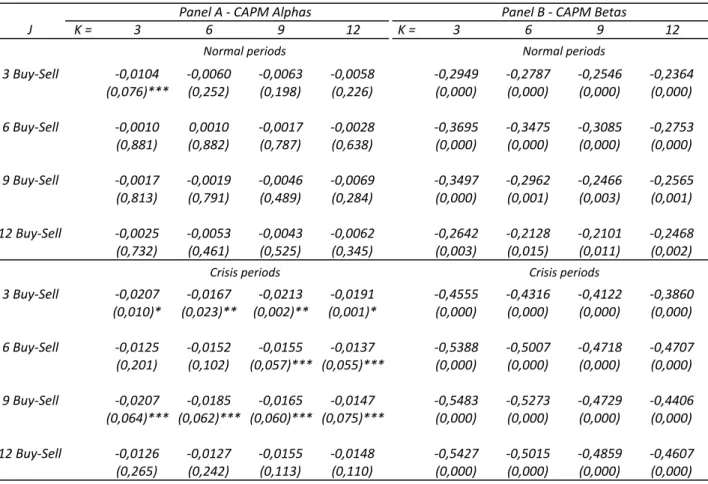
From figure 1, two main points can be highlighted. First of all, one should notice the dichotomous behavior between the market index and the momentum strategy. Peaks of the strategy accompany the most pronounced market index lows and vice versa. This is essentially reflected by a negative beta coefficient as already exemplified in previous studies (Jegadeesh and Titman, 1993 & 2001; Rouwenhorst, 1998). Secondly, the graph also shows that the highest crashes of the momentum strategy occur during crisis periods, which is in line with findings from Piccoli et al. (2015). The main difference is, however, that, even though the Brazilian monetary crisis of 2002 and the Global financial crisis of 2007-2009 show big declines in profits, the most recent crisis in Brazil has the steepest crash of them all. Further details on a possible explanation for these momentum crashes will also be approached later on. Table 3 presents the coefficients generated from CAPM regressions of all strategies for the whole period of estimation, while table 4 shows average annual statistics of all strategies examined and of the (6, 6) strategy individually for the estimation period as a whole, for periods of normal economic conditions and then for periods of crisis. The slightly negative alpha coefficients generated suggest that strategies yield a return that
can be, in great proportion, explained by the market risk factor. Although all alpha coefficients obtained are negative, the (6, 6) strategy shows the value of alpha that is the closest to zero (-0.03%), although not significant. Only the alpha of the (3, 3) strategy is significant at a 95% C.I. (-1.04%). However, the R-square statistic is quite low for all regressions conducted, suggesting poor goodness of fit of this model, which limits the study.
As already explained in figure 1, the average beta coefficient of the strategies is negative (-0.3311) and that of the (6, 6) strategy is even lower than average (-0.3858). From table 4 we confirm that financial crises have a central role in the analysis of momentum strategies since these periods severely impact profits and compensation proportionately to the exposure to risk. It is interesting to note that although volatility diminishes slightly in crises periods, returns decrease enormously. As one would expect, the SR of these trading strategies is much better in normal periods than in periods of crisis. For instance, the (6, 6) strategy shows a SR of 0.10 in normal periods, much greater than that in crises (-0.31). These results suggest that although the volatility of the market remains high in and out of crises, the decline in returns severely downgrades the attractiveness of strategies. Contrary to normal period statistics, crises periods are also characterized by a more negatively skewed distribution and higher excess kurtosis, significantly increasing the number of negative months in the sample period considered. When measured against the Bovespa, average performance of momentum strategies in almost all sub-periods still seems to beat the market index in terms of risk-return profile, except for crises periods where the SR is lower (-0.42 for strategies and -0.33 for Bovespa). The (6, 6) strategy is more appealing than the market in every sub-period analysis conducted.
Furthermore, table 5 presents the CAPM alpha and beta coefficients for the returns series separated for these periods and the respective p-values to test significance of results. All alpha coefficients in crises periods are negative (ranging from 1.25% to -2.13%) and those obtained for strategies in normal periods are all also negative apart from the one for the (6, 6) strategy (0.1%). However, this coefficient is not statistically significant. A general increase in beta coefficients for all strategies from normal periods to crises periods can also be observed.
Daniel and Moskowitz (2016) claim that crashes of momentum portfolios are due to the systematic risk of losers. The suggestion is that the beta coefficients of these loser portfolios suffer an increase during crises periods, which in turn, when the market index recovers towards the end of the crisis, causes loser stocks to also recover in a more amplified way than winners. Consequently, since the momentum strategies being analyzed consist on shorting the loser leg, this yields negative returns of the momentum portfolios, which end up being designated as momentum crashes. Table 6 supports this conclusion by demonstrating the alpha and beta coefficients of individual winner and loser portfolios in and out of periods of crisis as well as for the full period. In all sub-periods the WML strategies exhibit a negative beta, showing that its behavior is contrary to that of the market index, as previously discussed in figure 1. Results of table 6 now demonstrate that independently of the sub-period considered, the beta coefficient of the loser portfolio is always greater than that of the winner. Another critical point to observe is that the winner leg has a similar beta coefficient in both sub-periods considered (average beta in normal periods of 0.5888 and of 0.5812 in crises periods). On the other hand, the loser leg has a beta, on average, of 0.8646 in normal periods that significantly increases to 1.0541 in crises. Also note that all individual winners in exhibit positive and significant alphas in the
full period of estimation, reinforcing the hypothesis that the application of a long-only portfolio can be of interest in the dynamics of the Brazilian stock exchange. Additionally, individual loser legs show positive alphas in the full, normal and crises periods, suggesting that assuming a short position is questionable. For losers, only normal and full period alphas with 3-month formation period show significant results.
Conclusion
This article investigates the profitability and performance of momentum strategies from February 1995 until December 2017. The (6, 6) momentum trading strategy has the highest average annual return (15.5%) and most attractive Sharpe ratio, also managing to be the only strategy with a positive average annual excess return (0.42%). Profits for this strategy remain after the application of fixed monthly transaction costs.
As demonstrated by previous studies, the research fails to prove statistically significant abnormal returns for the WML strategies in the full estimation period, although these strategies beat the Bovespa index. Results also suggest that the main driver of momentum profitability of the WML portfolios is the winner leg. A sub-period analysis confirms this and also allows for the identification of what is behind momentum crashes. Given descriptive statistics and positive significant alpha coefficients for “winners”, momentum effect does exist for the winner leg in the full period, which is then erased by its inclusion in a long-short strategy. The impact of the “losers” is observed by a considerable increase in their beta coefficient in periods of crisis, which indicates that the rebound is characterized by an increased magnitude of the recovery of these loser portfolios in comparison with the overall market index causes the momentum crashes given the short positions assumed.
Bibliography
Sharpe, W. F. (1964). Capital asset prices: A theory of market equilibrium under conditions of risk. The journal of finance, 19(3), 425-442.
SILVA NETO, O. S., DE ARAÚJO MARANHÃO Accioly Fonseca Minardi, A. M. (2004). Retornos passados prevêem retornos futuros?. RAE-eletrônica, 3(2).
Asness, CS, Moskowitz, TJ, & Pedersen, LH (2013). Value and momentum everywhere. The Journal of Finance , 68 (3), 929-985.
Barroso, P., & Santa Clara, P. (2015). Momentum has its moments. Journal of
Financial Economics , 116 (1), 111-120.
Bondt, W. F., & Thaler, R. (1985). Does the stock market overreact?. The Journal of
finance, 40(3), 793-805.
Bonomo, M., & Dall'Agnol, I. (2003). Abnormal Returns and Contrarian Strategies. Brazilian Review of Finance, 1(2), 165-215.
Carhart, M. M. (1997). On persistence in mutual fund performance. The Journal of
finance, 52(1), 57-82.
Chui, A. C., Titman, S., & Wei, K. J. (2010). Individualism and momentum around the world. The Journal of Finance, 65(1), 361-392.
Cruz, J. A. (2009). Aplicando estratégias simultâneas de momento e valor no
mercado brasileiro (Doctoral dissertation).
Daniel, K., & Moskowitz, T. J. (2016). Momentum crashes. Journal of Financial
Economics, 122(2), 221-247.
Fama, E. F. (1970). Efficient capital markets: A review of theory and empirical work. The journal of Finance, 25(2), 383-417.
Fama, EF, & French, KR (1992). The cross-section of expected stock returns. the
Journal of Finance , 47 (2), 427-465.
Fama, EF, & French, KR (1993). Common risk factors in the returns on stocks and bonds. Journal of financial economics , 33(1), 3-56.
Fama, E. F., & French, K. R. (1996). The CAPM is wanted, dead or alive. The
Journal of Finance, 51(5), 1947-1958.
Fonte Neto, JWD, & Carmona, CUDM (2005). Eficiência do mercado acionário brasileiro pós-Plano Real: há evidências de overeaction. XXV Encontro Nacional de
Engenharia de Produção-Porto Alegre, RS , 29 .
Griffin, JM, Ji, X., & Martin, JS (2003). Momentum investing and business cycle risk: Evidence from pole to pole. The Journal of Finance , 58 (6), 2515-2547.
Grundy, B. D., & Martin, J. S. M. (2001). Understanding the nature of the risks and the source of the rewards to momentum investing. The Review of Financial
Studies, 14(1), 29-78.
Jegadeesh, N., & Titman, S. (1993). Returns to buying winners and selling losers: Implications for stock market efficiency. The Journal of finance, 48(1), 65-91.
Jegadeesh, N., & Titman, S. (2001). Profitability of momentum strategies: An evaluation of alternative explanations. The Journal of Finance , 56 (2), 699-720. Kimura, H. (2003). Aspectos comportamentais associados às reações do mercado de capitais. RAE-eletrônica, 2(1), 1-14.
Levy, R. A. (1967). Relative strength as a criterion for investment selection. The
Journal of Finance, 22(4), 595-610.
Lo, A. W., & MacKinlay, A. C. (1990). When are contrarian profits due to stock market overreaction?. The review of financial studies, 3(2), 175-205.
Mussa, A., Trovao, R., Santos, JO, & Famá, R. (2007). A estratégia de momento de Jegadeesh e Titman e suas implicações para a hipótese de eficiência do mercado acionário brasileiro. SEMINÁRIOS EM ADMINISTRAÇÃO-SEMEAD , 10 .
Piccoli, P. G. R., Souza, A., da Silva, W. V., & Cruz, J. A. W. (2015). Revisitando as estratégias de momento: o mercado brasileiro é realmente uma exceção?. Revista de
Administração, 50(2), 183-195.
Rouwenhorst, K. G. (1998). International momentum strategies. The Journal of
Finance, 53(1), 267-284.
Rouwenhorst, K. G. (1999). Local return factors and turnover in emerging stock markets. The journal of finance, 54(4), 1439-1464.
SATURNINO SILVA, V. L., LUCENA RABONI, P. I. E. R. R. E., & GOIS DE OLIVEIRA, M. R. (2014). Efeito momentum no curto prazo: vale a pena comprar ações vencedoras no brasil?. RAM. Revista de Administração Mackenzie, 15(4).
Varga, G., & Brito, RD (2016). The Cross-Section of Expected Stock Returns in Brazil.
Appendix
Table 1: Annualized relative strength portfolio logarithmic returns of winners, losers and WML. Calculations for the figures in this table vary according to the number of observations given the formation period selected (J): A formation period of 3, 6, 9 and 12 months corresponds to 272, 269, 266 and 263 observations. Additionally, Sharpe ratios are presented in parentheses for each time-series of returns.
Table 2: Average annual descriptive statistics of Winner and Loser portfolios individually and of WML portfolios. Key figures for the (6, 6) strategy, which was deemed as most attractive and the Bovespa Index are also presented. As for table 1, the Sharpe ratio was calculated using the average annualized risk-free rate (CDI).
J K = 3 6 9 12 K = 3 6 9 12 3 Sell 11,26% 5,92% 6,50% 5,70% 19,08% 13,75% 14,33% 13,53% (0,10) (-0,05) (-0,04) (-0,06) - - - -3 Buy 14,97% 14,65% 13,39% 13,43% 22,80% 22,48% 21,22% 21,26% (0,26) (0,26) (0,22) (0,22) - - - -3 Buy-Sell -11,78% -6,77% -8,61% -7,76% 3,72% 8,73% 6,89% 7,73% (-0,41) (-0,26) (-0,36) (-0,33) 6 Sell 2,21% 1,35% 2,81% 1,99% 9,82% 8,96% 10,42% 9,60% (-0,15) (-0,19) (-0,15) (-0,18) - - - -6 Buy 17,05% 16,90% 15,53% 14,12% 24,66% 24,51% 23,14% 21,73% (0,32) (0,31) (0,27) (0,23) - - - -6 Buy-Sell -0,28% 0,42% -2,40% -3,00% 14,85% 15,55% 12,73% 12,13% (-0,02) (0,01) (-0,09) (-0,12) 9 Sell 3,90% 0,50% 1,74% 2,95% 11,17% 7,76% 9,01% 10,21% (-0,12) (-0,21) (-0,19) (-0,16) - - - -9 Buy 15,34% 12,09% 10,97% 10,56% 22,61% 19,36% 18,23% 17,82% (0,24) (0,13) (0,09) (0,08) - - - -9 Buy-Sell -3,41% -3,25% -5,63% -7,24% 11,44% 11,60% 9,22% 7,61% (-0,12) (-0,11) (-0,20) (-0,26) 12 Sell -0,22% -1,42% 1,98% 2,97% 6,92% 5,72% 9,11% 10,10% (-0,23) (-0,27) (-0,19) (-0,16) - - - -12 Buy 12,5% 8,3% 11,6% 11,2% 19,63% 15,48% 18,76% 18,35% (0,14) (0,00) (0,11) (0,10) - - - -12 Buy-Sell -1,95% -4,89% -5,01% -6,41% 12,71% 9,76% 9,65% 8,25% (-0,08) (-0,17) (-0,18) (-0,23) Panel A - Average annual excess returns Panel B - Average annual returns
Winners Losers WML (6, 6) Strategy IBovespa
Observations - - - 269 269 μ (%) 20,75% 10,59% 10,16% 15,55% 5,70% σ (%) 28,54% 34,24% 30,89% 32,33% 29,56% Skewness -0,03 -0,02 0,07 0,26 -1,18 Kurtosis 2,89 1,25 2,10 2,91 4,78 Sharpe ratio 0,18 -0,14 -0,17 0,01 -0,33 Maximum Drawdown (%) - - -83,73% -78,82% -78,18% % Positive months 61,17% 54,73% 55,35% 49,81% 55,02% % Negative months 37,18% 43,45% 42,99% 50,19% 44,98%
Figure 1:Compounded cumulative returns of strategy (6, 6) before and after fees compared against the compounded cumulative Bovespa market returns adjusted for inflation. Note that fees displayed in this figure are of 0.5% deducted per monthly performance. Shaded areas represent periods of crisis in Brazil.
Table 3: Alpha and beta coefficients from CAPM model generated by strategies’ excess returns regressed against the Bovespa market premium. P-values of each coefficient are provided in parentheses in order to measure statistical significance.1
1 Statistical significance for the alpha coefficient is shown by the number of * next to the respective
p-value of the coefficient. If coefficient is significant at a 99% C.I. (p-p-value < 0.01) * will show, at a 95% C.I. (p-value < 0.05) ** will show and at a 90% C.I. (p-value < 0.1) *** will show. This method of
J K = 3 6 9 12 K = 3 6 9 12 3 Buy-Sell -0,0104 -0,0062 -0,0077 -0,0070 -0,3433 -0,3246 -0,2998 -0,2788 (0,029)** (0,145) (0,054)*** (0,071)*** (0,000) (0,000) (0,000) (0,000) 6 Buy-Sell -0,0008 -0,0003 -0,0025 -0,0030 -0,4115 -0,3858 -0,3493 -0,3243 (0,876) (0,961) (0,618) (0,532) (0,000) (0,000) (0,000) (0,000) 9 Buy-Sell -0,0034 -0,0032 -0,0051 -0,0064 -0,3949 -0,3573 -0,3067 -0,3053 (0,564) (0,576) (0,347) (0,215) (0,000) (0,000) (0,000) (0,000) 12 Buy-Sell -0,0023 -0,0047 -0,0047 -0,0060 -0,3372 -0,2927 -0,2836 -0,3019 (0,707) (0,434) (0,399) (0,268) (0,000) (0,000) (0,000) (0,000) Panel A - CAPM Alphas Panel B - CAPM Betas
Table 4: Average annual descriptive statistics of all strategies and of (6, 6) strategy solely presented on total (or general) period of estimation, in normal periods and in crisis periods. Note that period selection was done as the NBER classification.
Table 5: Alpha and Beta coefficients from CAPM model generated by strategies’ excess returns in and out of crisis periods regressed against the Bovespa market premium. P-values of each coefficient are provided in parentheses in order to measure statistical significance.
General Normal periods Crisis periods General Normal periods Crisis periods
Observations - - - 269 202 67 μ (%) 10,16% 12,22% 3,71% 15,55% 18,79% 6,37% σ (%) 30,89% 31,77% 28,31% 32,33% 33,22% 29,75% Sharpe ratio -0,17 -0,10 -0,42 0,01 0,10 -0,31 Skewness 0,07 0,21 -0,64 0,26 0,54 -0,48 Kurtosis 2,10 1,91 2,64 2,91 3,14 2,31 % Positive months 55,35% 57,80% 51,61% 49,81% 58,91% 53,73% % Negative months 42,99% 42,20% 48,39% 50,19% 41,09% 44,78% Panel A - Average Strategy Returns Panel B - (6, 6) Strategy Statistics J K = 3 6 9 12 K = 3 6 9 12 3 Buy-Sell -0,0104 -0,0060 -0,0063 -0,0058 -0,2949 -0,2787 -0,2546 -0,2364 (0,076)*** (0,252) (0,198) (0,226) (0,000) (0,000) (0,000) (0,000) 6 Buy-Sell -0,0010 0,0010 -0,0017 -0,0028 -0,3695 -0,3475 -0,3085 -0,2753 (0,881) (0,882) (0,787) (0,638) (0,000) (0,000) (0,000) (0,000) 9 Buy-Sell -0,0017 -0,0019 -0,0046 -0,0069 -0,3497 -0,2962 -0,2466 -0,2565 (0,813) (0,791) (0,489) (0,284) (0,000) (0,001) (0,003) (0,001) 12 Buy-Sell -0,0025 -0,0053 -0,0043 -0,0062 -0,2642 -0,2128 -0,2101 -0,2468 (0,732) (0,461) (0,525) (0,345) (0,003) (0,015) (0,011) (0,002) 3 Buy-Sell -0,0207 -0,0167 -0,0213 -0,0191 -0,4555 -0,4316 -0,4122 -0,3860 (0,010)* (0,023)** (0,002)** (0,001)* (0,000) (0,000) (0,000) (0,000) 6 Buy-Sell -0,0125 -0,0152 -0,0155 -0,0137 -0,5388 -0,5007 -0,4718 -0,4707 (0,201) (0,102) (0,057)*** (0,055)*** (0,000) (0,000) (0,000) (0,000) 9 Buy-Sell -0,0207 -0,0185 -0,0165 -0,0147 -0,5483 -0,5273 -0,4729 -0,4406 (0,064)*** (0,062)*** (0,060)*** (0,075)*** (0,000) (0,000) (0,000) (0,000) 12 Buy-Sell -0,0126 -0,0127 -0,0155 -0,0148 -0,5427 -0,5015 -0,4859 -0,4607 (0,265) (0,242) (0,113) (0,110) (0,000) (0,000) (0,000) (0,000) Crisis periods Crisis periods Normal periods Normal periods Panel A - CAPM Alphas Panel B - CAPM Betas
Table 6: Alpha and Beta coefficients and respective P-values generated from CAPM model of individual Winner and Loser portfolios regressed against the Bovespa market premium in the full period (general), normal periods and periods of crisis. Note that individual excess returns of “Winners” and “Losers” were adjusted for inflation as used separately.
Portfolios (3, 3) (3, 6) (3, 9) (3, 12) (6, 3) (6, 6) (6, 9) (6, 12) (9, 3) (9, 6) (9, 9) (9, 12) (12, 3) (12, 6) (12, 9) (12, 12) α 0,0111 0,0109 0,0099 0,0098 0,1250 0,0123 0,0112 0,0099 0,0109 0,0083 0,0074 0,0070 0,0093 0,0058 0,0084 0,0078 β 0,6045 0,6057 0,6084 0,6033 0,5794 0,5710 0,5785 0,5643 0,5698 0,5862 0,5931 0,5788 0,6175 0,6197 0,6042 0,5702 α 0,0108 0,0062 0,0065 0,0057 0,0033 0,0023 0,0033 0,0024 0,0045 0,0014 0,0021 0,0030 0,0015 0,0001 0,0027 0,0034 β 0,9391 0,9217 0,9002 0,8752 0,9887 0,9521 0,9244 0,8872 0,9659 0,9391 0,8968 0,8815 0,9564 0,9111 0,8879 0,8725 α 0,0161 0,0148 0,0145 0,0140 0,0151 0,0158 0,0144 0,0127 0,0139 0,0114 0,0100 0,0094 0,0108 0,0078 0,0112 0,0105 β 0,5809 0,5907 0,5873 0,5897 0,573 0,5733 0,5829 0,5722 0,5650 0,596 0,6005 0,5774 0,6254 0,6368 0,6107 0,5596 α 0,0130 0,0073 0,0073 0,0063 0,0030 0,0018 0,003 0,0023 0,0027 0,0004 0,0019 0,0035 0,0007 0,0004 0,0030 0,0041 β 0,8755 0,8691 0,8415 0,8258 0,9393 0,9176 0,8883 0,8444 0,9115 0,889 0,8439 0,8307 0,8875 0,8475 0,8187 0,8032 α -0,0037 -0,0012 -0,0041 -0,0027 0,0047 0,0012 0,0012 0,0012 0,002 -0,0014 -0,0008 -0,0004 0,0044 -0,0006 -0,0002 -0,0001 β 0,6412 0,625 0,6402 0,6183 0,5827 0,5471 0,5513 0,5304 0,5670 0,5464 0,5617 0,5701 0,5911 0,5687 0,5751 0,5832 α 0,0059 0,0044 0,006 0,0052 0,0061 0,0053 0,0055 0,0038 0,0116 0,006 0,0046 0,0031 0,0059 0,001 0,0041 0,0035 β 1,0917 1,0515 1,0473 0,9992 1,1165 1,0428 1,018 0,996 1,1102 1,0686 1,0296 1,0056 1,1287 1,0652 1,0559 1,0388 α 0,004* 0,002* 0,004* 0,004* 0,003* 0,003* 0,005* 0,011** 0,013** 0,059*** 0,084*** 0,096*** 0,033** 0,180 0,050** 0,062*** β 0,000 0,000 0,000 0,000 0,000 0,000 0,000 0,000 0,000 0,000 0,000 0,000 0,000 0,000 0,000 0,000 α 0,003* 0,056*** 0,035** 0,053*** 0,408 0,536 0,367 0,488 0,303 0,735 0,583 0,409 0,737 0,980 0,487 0,356 β 0,000 0,000 0,000 0,000 0,000 0,000 0,000 0,000 0,000 0,000 0,000 0,000 0,000 0,000 0,000 0,000 α 0,001* 0,001* 0,001* 0,001* 0,004* 0,002* 0,004* 0,010* 0,012** 0,040** 0,061*** 0,070*** 0,050** 0,151 0,034** 0,004* β 0,000 0,000 0,000 0,000 0,000 0,000 0,000 0,000 0,000 0,000 0,000 0,000 0,000 0,000 0,000 0,000 α 0,001* 0,039** 0,029** 0,051*** 0,508 0,669 0,466 0,54 0,57 0,924 0,665 0,395 0,886 0,926 0,5 0,333 β 0,000 0,000 0,000 0,000 0,000 0,000 0,000 0,000 0,000 0,000 0,000 0,000 0,000 0,000 0,000 0,000 α 0,486 0,82 0,417 0,578 0,377 0,829 0,837 0,83 0,731 0,815 0,905 0,947 0,445 0,929 0,971 0,984 β 0,000 0,000 0,000 0,000 0,000 0,000 0,000 0,000 0,000 0,000 0,000 0,000 0,000 0,000 0,000 0,000 α 0,427 0,562 0,407 0,43 0,5 0,558 0,505 0,607 0,246 0,535 0,592 0,69 0,562 0,92 0,633 0,649 β 0,000 0,000 0,000 0,000 0,000 0,000 0,000 0,000 0,000 0,000 0,000 0,000 0,000 0,000 0,000 0,000 Cr ise s "Winners" "Losers" General N or ma l Cr ise s "Winners" P-values of respective coefficients General "Winners" "Losers" N or ma l "Winners" "Losers" Momentum Strategies "Winners" "Losers" "Winners" "Losers" "Losers"