Visual Methodologies for Communication Studies:
making the familiar Strange and interesting again
Dawn Mannay
Cardiff University
E-mail: [email protected]
Abstract
The Spring School on Advanced Metho-dologies for Communication Studies [1] was organised with the aim of exploring questions concerning both the multiple dimensions of communication methodo-logies at the intersection of culture and communication, and innovative methods for designing communication research and interrogating objects of analysis. This paper reflects my contribution to this discussion, Visual Methodologies; which is embedded within the data production and analysis approaches I have adopted researching within the fields of
psycho-logy and sociopsycho-logy. The paper embeds creative modes of data production within the field of visual studies and draws on research conducted with mothers and their daughters in south Wales, UK, fo-cusing on issues of familiarity, creativity and interpretation. Lastly, the paper re-flects on why it is important for students and practitioners in communication stu-dies to have the analytical tools to de-cipher the meanings that the image maker intended, as well as the meanings later as-signed to visual images.
Key Words: Communication studies, familiarity, interpretation, qualitative research, visual methodologies.
Introduction
A
S Margolis and Pauwels (2011) contend ‘the future of visual research will depend on the continued effort to cross disciplinary boundaries and engage in a constructive dialogue with different schools of thought’; this pa-per adds to the interdisciplinary exchange of ideas; focusing on the value of classic and contemporary studies and the ways in which the familiarity of the visual can be made strange and interesting again in communications studies.Over the last decade publishing houses have demonstrate a prolific increase in visual methods resources; however, our cross disciplinary learning should always be embedded within historically accumulated perspectives. This pa-per will provide an overview of the position of the visual within cultural and social science research; restating classical studies, not least to counter the of-ten uninof-tentional reinvention of the wheel, where visual methodologies and participatory approaches are too often presented as novel creative techniques. The paper introduces a range of data-production techniques including col-laging, mapping and drawing; and communicates the potential of ‘the visual’ as a tool of defamiliarisation (Mannay 2010; 2013a); and the ways in which it can benefit the development of academic, documentary and policy based research. However; the relationship between the participatory and the visual will also be problemetised; and the paper will explore approaches to analy-sis with reference to the advantages of employing auteur theory as a tool that looks behind the image (Rose 2001); and the ways in which the visual and verbal become conjoined. The Spring School on Advanced Methodologies for Communication Studiesaspired to be a space of inception of new ideas about how to imagine creative methodologies, as well as how to develop the inheri-tance of classic ones to the study of emergent and complex phenomena; and the following section works across disciplines drawing on the classic and the contemporary to resituate visual studies.
Visual Legacies
There are long existing classics within the field of visual studies and across disciplines; but there are criticisms that there is little integration or conside-ration of the history of the visual as a source, a tool and a form of scholarly expression. For this reason, there is a danger that visual methods become re-invented over and over again; and Pauwels (2011) laments the ways in which visual methods are reinvented, renamed and relabelled, arguing that such prac-tices are ahistorical and detrimental to advancing more mature methodologies. In an attempt to move toward an integrated conceptual visual agenda, Pauwels (2011) offers a framework for grouping, sorting and reflecting on visual approaches, usefully categorised as ‘found materials as a data source’, ‘researcher-initiated production of visual data and meanings’ and ‘secondary
research uses and respondent generated material’. For Pauwels (2011) ‘found materials’ situate social scientists as image collectors, ‘researcher-initiated productions’ position social scientists as image creators; and ‘participatory-productions’ assign the role of participatory facilitator to the social scientist. This framework will be a valuable tool for both situating the following exem-plars of visual research and reflecting on the ways in which they can inform the field of Communication Studies.
Before discussing these three forms of visual research it is important to provide an overview of the origin and nature of visual artefacts in terms of the concepts of vision and visuality. Vision simply refers to the physiologi-cal capabilities of the human eye, whilst visuality accounts for the complex ways in which vision is constructed. Thus, visuality and the overlapping term scopic regime, refer to the ways in which audiences bring their own ways of seeing and other knowledges to bear on an image (Rose 2001). The audience, then, actively make their own meanings from an image. Yet, if the research is interested in the ways in which people assign meanings to pictures the study of images alone as, as data whose meaning is intrinsic, is a mistaken method (Banks 2001).
If we are to accept the image at face value, then, our engagement and knowledge of the visual artefact cannot move beyond its surface and our sub-jective response. Reiger (2011) warns of the risk of erroneous interpretation, arguing that ‘pictures alone. . . are hazardous to interpret without the reinfor-cement of other information gathered’; here he is referring to the accounts of the image makers and their situated communities; but also the researcher’s ability to reflect upon and interrogate the photographic image. Without the-ory, our seeing is blind or tends to rest on unexplained views and expectati-ons; however, the humanities and social science offer the researcher the tools of iconography, semiotics, cultural studies, sociological paradigms and psy-choanalysis; which offer opportunities to interpret the origins, visuality and comodification of the visual image.
Discovery and Creation
This section returns to Pauwels (2011) conceptual framework of ‘found materials as a data source’, ‘researcher-initiated production of visual data
and meanings’ and ‘respondent generated material’; employing an empiri-cal example to demonstrate the relevance of each category to contemporary communication studies.
Found Materials: Doing Family Photography
Family photographs have become an unpopular site of exploration, cha-racterised as stereotyped, ubiquitous and having an overwhelming sense of similarity and redundancy; however they are a valuable ‘found material’. In her book, ‘Doing family photography: the domestic, the public and the po-litics of sentiment’, Rose (2010) presents family photographs both in their domestic settings and in the public realm; not simply as a collection of ima-ges but rather as social practices. Drawing on the disciplines of anthropology, geography and material culture studies; Rose (2010) explores not what photo-graphs are but what photophoto-graphs do; resonating with the ‘turn to practice’ in social theory discussed at length in this volume (Couldry 201X).
Rose (2010) interviewed women in their own homes to gain a sense of the domestic space and the encounters between object and practice in family photography. Her research examined the ways in which family photographs are embedded in specific practices and how these practices, not simply the pictures’ content, define an image as a family photograph. In this way their meaning is only part of their story and Rose demonstrates how the integra-tion of family photographs is both temporal, spatial and a product of labour. This labour of family photographs is seen as part of women’s traditional res-ponsibility for domestic order and a way for women to negotiate a feminised subjectivity of acceptable motherhood; and enact family togetherness.
In her chapter, ‘Family Photos Going Public’, Rose (2010) examines the transference of family photographs from the private sphere into the public context. Examining the reporting by the British print press of the bombs that exploded on the public transport system in 2005; Rose argues that the images are employed in a politics of sentiment to engender a particular kind of inti-mate public. Family snapshots representing the missing and the dead create a public resonant of a pain alliance; a passive ideal of empathy constructed from caring based on similarity. For Rose, this is a crude empathy, which comes ‘dangerously close to the appropriation of someone else’s experience because we feel for another only insofar as we are positioned as being like that other’
(2010, p.113): and calls for ethics in the field of vision where we learn to look again, differently
This study can be classified under found materials where the social scien-tists is positioned as image collector (Pauwels, 2011); but the image is more than an artefact. Family photographs, both within the private sphere and as media images, are materials that trace the person photographed; they are in an ongoing process of revisiting and sharing: and images have an affective power. Photography then needs to be understood as a social practice in both domestic settings and in the public realm; therefore, in a social world satura-ted by images, communication studies need to recognise that found images are never passive; they are active within social, cultural and affective practices.
Researcher-initiated Production: The Vicos Project
Pauwels (2011) second category, ‘researcher-initiated productions’, posi-tions social scientists as image creators and here we turn to what Pink (2007, p.5) refers to as the ‘hidden history’ of applied visual anthropology to discuss one of the seminal works of John Collier Jn. Collier was a pioneer of visual anthropology who argued that seeing and representing the visual is as im-portant as speaking or writing words. While Goffman (1959) rejected posed photographs; Collier argued that all visual materials reveal something of the culture that produced them. Collier is perhaps best known for his methodolo-gical contribution photo-elicitation (Biella 2002) and the paper shall return to this technique of data production in the following sections; however, in terms of ‘researcher-initiated productions’ we revisit the controversial Vicos Project. The Vicos Project aimed to bring the indigenous population of Vicosi-nos into the 20th century and integrate them into the market economy and Peruvian society. The project was sponsored by Cornell University and the University of San Marcos and for Collier it provided an opportunity to apply his ‘photography for social research’, an approach that we would now term visual anthropology. Between 1954 and 1955 Collier produced close to 9,000 still images as well as hours of film footage charting the visual ethnography of the community (Collier 2007); and this visual information was both for immediate use and part of a baseline record for later evaluation of the project In providing an understanding of the material status of Vicosinos, this data was to be a comparative record, a before and after, of the applied development
of schooling, healthcare and development of the physical and social infras-tructure as well as the relationship of Vicosinos to the surrounding region and Peruvian society. However, Collier’s images did not altogether present the view of a community that was demoralised and in need of a modernisation that desired outside information; and he was heavily criticised for recording happiness in the presence of extreme poverty (Collier 2007).
Collier argued that his images, such as the Fiesta scene in front of Vi-cos church, belied outsiders’ perceptions of a culturally deprived community, lacking in creativity and initiative. Furthermore, Collier felt that it was impor-tant to record the underlying cultural and personal vitality of the community – charting public events, private lives, ceremony, social relationships, portraits that provided an insight into a community; which may not have been wealthy from a westernised perspective but nevertheless had its own intrinsic value.
Researcher-initiated productions situate social scientists as image creators and Collier’s early photographic contributions were documentary in character; however, they became explicit tools for obtaining information and an unders-tanding of the circumstances in which they were made. Collier was concerned with providing an insight into the cultural vitality of communities; which mo-ved away from the desired baseline information of a community in need of regeneration. For Collier the applied focus, in which the aesthetics of the ima-ges were centralised, while appreciated, became increasingly secondary. In communication studies then we again need to look beyond the aesthetics of the image and try to uncover the purpose behind the projects of study and of the photographers themselves whose personal remit can both reinforce and reject the rationale of the set assignment.
Participatory-productions: The Rhythm of our Dreams
Pauwel’s (2011) ‘participatory-productions’ assign the role of participa-tory facilitator to the social scientist; and according to Chalfen (2011) one principal objective of participatory visual methods is to eliminate the concep-tual and practical filters applied both literally and metaphorically by resear-chers; and to engender access to more authentic views. However, we need to understand the distinctions between visual productions; and Chalfen discusses categories of practice, communicating the differences between heavy-hands-on methods and approaches that aspire to minimal instructiheavy-hands-on. For Chalfen,
there is always some form of assignment in participatory work and the fol-lowing case study aimed to produce a documentary film that would generate awareness of social inclusion, its causes and how it should be tackled.
In a proposal for an applied visual anthropology Anne Matinez Perez (2007) worked with practitioners and marginalised communities to explore ‘the rhythm of our dreams’. The study took place with a marginalised area in Cordoba, Spain, often stigmatised by the surrounding communities; a stigma which Perez convincingly argues is undeserved, employing the analogy of the orange tree.
The water reaches all the orange trees equally. If we translate water into social justice it becomes housing, employment, education. When the water is spread out equally no orange tree rots; no person would break down causing social conflict. When the water does not reach the tree the problem is not with the tree itself, which smells, but with the water that never got there’ (Perez 2007, p.229).
The poverty that is closest to us often remains invisible and Perez (2007) aimed to raise visibility. However, unlike media exposés with their tendency to sensationalise or apply the journalistic reductionism of voice over; Perez offers a methodological focus of combined applied anthropology and visual ethnography, in a participatory film making project concerned with ‘giving voice’ and working side-by-side. The project examined dreams through a music therapy approach and in terms of outputs the project created a book, CD-ROM and film. The theme of dreams was used because dreams are often the vehicle for our fantasies and desires they are part of the creative and ima-ginative practice of being an individual and they have the potential to form parts of our agency and also instigate processes of change.
Dreams offer a simple and graphic way of illustrating the distance that both separates and unites us and offering an insight into the contrast between the dreams of those who have access to basic resources and those who do not; as one of the participants in the project shares ‘I dream of not losing my dreams’ (Perez, 2007, p.239). Dreams then illustrate how some of us dare to imagine a better future and struggle to achieve it; whilst others dare not even mention desires that are unattainable. For those working in communications studies documentary and press images often offer homogenous, stereotypical and stigmatising images; in which the poor are the poor of their own accord.
Perez invites us always to look behind these representations, who are the peo-ple pictured, what are their dreams and by what means are they constrained.
Mothers and Daughters on the Margins
The following section concentrates on my use of visual methodologies in a four year ESRC funded project that took place in a marginalised housing area in urbanised South Wales, United Kingdom that I refer to with the pseudonym Hystryd [2].
Research Site
Morrison and Wilkinson (1995) argue that polarisation has a spatial di-mension that is illustrated in the creation of new ghettos of prosperity and poverty that now dominate the Welsh socio-economic terrain. The authors term this division the ‘Los Angelization’ of socio-economic terrain to draw parallels with the inequalities found in American cities; and these ghettos are evident across Wales. Similar to the situation encountered by Perez (2007), this separation means that poverty can easily be overlooked by those with more resources who will rarely encounter those on low incomes.
Hystryd is a predominately white area, in urban south Wales, which has become the epitome of the classically disadvantaged council estate. The po-verty yardsticks applied to the estate include high unemployment; high rates of teenage pregnancy; high numbers of lone-parent families and high take-up of state subsidised school meals. The estate, then, shares the characteristics of the type of place that forms the spatial core of disadvantage in Britain to-day. Such demographic details are a useful starting point but as Fink (2012) argues, statistics diminish people’s lives by treating them as figures; for this reason the research study was interested in the individual within the shadow of similarities.
Participants
As Rawlins (2006) maintains, by considering intergenerational relation-ships it is possible to gain a greater depth of understanding since one can
compare different versions of the same story. Similarly, Pilcher (1995) illus-trates the ways in which age is a social category that acts as an important basis for the distribution of status, and access to power, space and time in contem-porary British society. Thus, the wider study, from which this data is drawn, was interested in considering the views of both mothers and their daughters.
The data presented here was drawn from a research project that explored the everyday experiences of nine mothers and their nine daughters, residing in Hystryd. The research focused on the ways in which the boundaries of the immediate culture and memories of the past mediated their educational and employment histories and futures.
Research Relationships
The relationship between researcher and researched is key to the collection of reliable data (Pole 2007). Therefore, it is important to explicate the position of the researcher. The notion of being an insider or an outsider is inadequate in an absolute sense (Song and Parker, 1995); however, to ignore questions of proximity is to assume that knowledge comes from nowhere, allowing re-searchers to become an abstract concept rather than a site of accountability (Mannay 2011; 2013a; 2013b).
It is misguided, although still apparent in the field of social science, to pri-vilege a particular type of knowledge but it is imperative to acknowledge that ‘perspective is always premised upon access to knowledge’ (Skeggs, 2004, p14). Thus, inside/outsider discourses are important because they place the researcher at the centre of the production of knowledge. Although this paper does not intend to engage with debating insider and outsider dichotomies; I previously lived in Hystryd; consequently there remains the concern that I am ‘experience near’ (Anderson 2002, p.23).
There was, then, a shared sense of precedent geography, which positioned me as ‘researcher near’ and influenced the design of the study. Consequently, it was important to address my position as an indigenous researcher and make a deliberate cognitive effort to question my taken for granted assumptions of that which I had thought familiar (Mannay 2010); and select data production techniques that recognised the ways in which indigenous research has the abi-lity to confer disadvantage as well as advantage; particularly the propensity to enter the research setting with preconceptions which cloud the ability to
notice that which is often taken for granted; the mundane and the everyday (Vrasidas 2001).
In combination with earlier strategies (Delamont and Atkinson 1995), I was influenced by research that employed participants’ visual data to render the familiar setting more perceptible (Kaomea 2003; Gauntlet and Holzwarth 2006). Participant-directed visual data production techniques were selected to promote subject-led dialogue and to attempt to limit the propensity for parti-cipant’s accounts to be overshadowed by the enclosed, self-contained world of common understanding.
Participants employed the data production techniques of photo-elicitation, mapping, collage [3] and narrative [4] to express their perceptions of their so-cial and physical environments, their everyday lives, reflections of their pasts, and aspirations and fears for the future. Visual and narrative data was then dis-cussed in individual elicitation interviews where conversations were guided by these images; a technique established by Collier (Biella 2002); privileging the interpretative model of auteur theory (Rose 2001).
The notion that the most salient aspect in understanding a visual image is what the maker intended to show is often referred to auteur theory (Rose 2001). Auteur theory can be required on a practical level because the in-terpretation of the audience is not necessarily the same as the narrative the image-maker wanted to communicate; indeed it can often be markedly diffe-rent. The practice of asking participants to explain the visual images that they create has become a common feature of social science research, and was em-ployed comprehensively in this study. These techniques proved useful within a participatory methodology to some extent; and illustrated a potential for ma-king the familiar strange both for the researcher and the participants (Mannay 2010).
Fighting Familiarity with Creativity
Importantly art can address automisation by forcing us to slow down our perception, to linger and to notice (Gurevitch 1998); in this way asking partici-pants to create visual productions engendered a reflective process that may not have been possible within the instant nature of the classic interview style ‘con-versation with a purpose’ (Berg, 2007, p. 89). Similarly for Deleuze (2000) abandoning the constraints inherent to language and adopting the stance of a
nomadic thinker offers the freedom to create new connections and open up experience. Artwork, then, opens up the possibility of refreshing habitual responses to the everyday and to render the familiar setting more perceptible (Kaomea 2003).
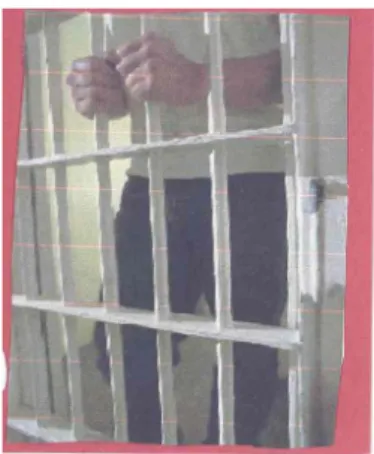
The images produced conferred an ability to make the familiar strange both for researcher and participant and I will discuss two examples that you can read in more detail in an earlier publication (Mannay 2010). Firstly, one of the teenage daughters in the study, Suzie [5], created a collage to commu-nicate her everyday life and she included a picture of a jail (see figure 1). The jail represented her feelings about how her parents constrained her social life; particularly in relation to her male siblings who were allowed more freedom. Importantly, Suzie is not looking for a picture of a jail when making the col-lage; rather she is browsing through collections of images in magazines and searching for other images that she wanted to include.
Figure 1: ‘I feel like I’m in jail because I’m never allowed out’
In our elicitation interview Suzie tells me that she did not realise how much she felt like a prisoner until she made the collage. In this way it is the activity of data production itself that has forced Suzie to slow down, to reflect and to engage with a project of self in which she can articulate her life world. The image of the prisoner has resonated with Suzie at the level of the unconscious and the image itself has acted to make the familiar of her
everyday life strange; and in doing so refocused her ideas about her life and the centrality of control; a source of familial tension explored in earlier studies (see Sarr 2010).
Secondly, we can examine the concept of making the familiar strange with an example from one of the mother’s, Tina’s, map of her everyday world. Tina describes how drawing her two daughters acted to clarify aspects of the maternal relationship. When I looked at the picture I assumed that Chantelle had been presented as bigger than Louise simply because she is older and taller. However, in our elicitation interview around the map, Tina made clear that this was not the case. I could only understand the intended meaning of the image, illustrated in Figure 2, with Tina’s interpretation.
Tina: Louise she’s small and if you look at that she ain’t even in line with Chantelle because she’s in the background and in my drawing I did that be-cause sometimes I feel like Chantelle takes all the attention away from Louise
Figure 2: Tina’s daughters – Chantelle and Louise
In order to gain an understanding of the internal narrative of the image, then, it is was imperative to acknowledge the role of the image-maker. My own interpretation of the visual data would have been inadequate for, both literally and metaphorically it is human beings who speak to one another and the lone image is an inadequate tool for understanding other people’s worlds
(Banks, 2001). ‘The practice of creating visual data, then, presented an op-portunity for Tina to transcend the visible and actual physical difference by distorting generalities of alignment’ (Mannay 2010, p.103).
The example illustrates how my singular interpretation was veiled by a web of taken for granted meanings but the combination of Tina’s creativity and explanation contributed to a more nuanced understanding for both the researcher and the researched. Central to developing this more nuanced un-derstanding was an engagement with auteur theory (Rose 2001); in which the elicitation interviews privileged not only the image as the point of analysis but the creative process of producing the image from the perspective of the image maker.
Communication Studies and the Visual
Wright (2011, p. 317) argues that although print media can be dispara-gingly viewed as tomorrow’s fish-and-chip wrapping; the presence or absence of visual images has ‘the power to make or break the worthiness of any news story’. Wright supports this observation by charting the ways in which arti-cles that do not have readily available images for publication do not make the headlines; because they lack the impact of the visual metaphor. Such visual metaphors are fundamental in the field of communication studies and we need to see such images as embedded in social practices.
Wright (2011), revisits the iconic print media image ‘Boy Petrol Bomber, Londonderry 1969’; which contains the contradictory metaphors as a young boy - the innocent child, stands wearing a gas mask and holding a petrol bomb in his hand. Wright analyses this image, importantly offering the interpreta-tions and insights of the original photographer at the Battle of Bogside; and demonstrates the power of the image by charting the way that it has been cano-nised through its appearance in a series of murals in Northern Ireland; where each artist casts the boy differently according to their political loyalties. In this way images become signs of their times but can be reformatted to act as signs beyond their times; reinvented and mediating new messages.
This is why it is important for students and practitioners in communication studies to have the analytical tools to decipher the meanings that the image maker intended as well as the meanings later assigned. As the paper has
de-monstrated there can be a tendency to privilege a particular type of knowledge when analysing visual images but again, it is imperative to acknowledge that ‘perspective is always premised upon access to knowledge’ (Skeggs, 2004, p14). Therefore, it is important to move beyond our interpretations and ask questions about what the image maker wanted to communicate. Found ima-ges are not passive; therefore, it becomes useful to obtain wider contextual information and an understanding of the circumstances in which visual ima-ges were made. If the image maker can be found, then, it would be salient to ask questions, to find out about their remit and their perspective.
If this is not possible and the image maker remains elusive; it is still use-ful to consider subjectivity; and the ways in which our interpretations can be overshadowed by the enclosed world of our self-contained understandings of the image. For this reason we need to explore the conceptualisation of public images, to examine their socio-political context, to learn about the image ma-ker and the complex power relations in the field of production, to see images as part of wider social practices and in this way, make the familiar strange and interesting again.
Notes
1. The 2012 Visual Methodologies Spring School on Advanced Methodo-logies in Communication Studies was held at the Catholic University of Portugal, 10th to 14th April, and organised by Professor Rita Figueiras and Professor Verónica Policarpo.
2. Hystryd is a pseudonym chosen to maintain the anonymity of the area. 3. The techniques of self-directed photography and photo-elicitation, or
‘photo-voice’ as it is sometimes called, have been used successfully in a range of research studies. In this study participants were each provi-ded with a camera and asked to take a series of photographs depicting meaningful places, spaces and activities. The technique of mapping is an activity when participants are asked to draw a representation of a specific geographical space of journey. In this study participants were each provided with art materials and asked to make a series of maps depicting meaningful places, spaces and activities. The technique of collage is an activity when participants are asked to create a
representa-tion through images taken from existing sources such as magazines. In this study participants were asked to find images and make a series of collages depicting meaningful places, spaces and activities. The photo-graphs, maps and collages then formed the basis of an interview where I engaged in a tape-recorded discussion with each participant. Further discussion of this activity and the other visual techniques applied can be found in (Mannay 2010).
4. In narrative approaches stories provide an analytical frame for the study of mental life as well as the study of social conditions. In this study participants were asked to write narratives from the retrospective pers-pective of their childhood self describing who they wanted to become, positive possible self, and who they feared becoming, negative possible self. This activity was repeated from the perspective of the present and participants again wrote a narrative of possible positive and negative selves.
5. Suzie and Tina are pseudonyms chosen to maintain the participants’ anonymity.
Acknowledgements
I would like to acknowledge the participants, who made this paper possi-ble, and also Professor John Fitz, Professor Emma Renold and Professor Bella Dicks, for supervising this research project; as well as the reviewer and editors for their useful comments and suggestions on earlier drafts of this article. I would also like to thank the organisers, Professor Rita Figueiras and Professor Verónica Policarpo, for inviting me to speak at the 2012 Visual Methodologies Spring School on Advanced Methodologies in Communication Studies, Catho-lic University of Portugal; as here I began to consolidate some of the ideas presented in this chapter. The research project from which this paper is drawn was titled ‘Mothers and daughters on the margins: gender, generation and education’ and was funded by the Economic and Social Research Council.
References
Anderson, G. (2002). Reflecting on research for doctoral students in education Education Researcher, 31 (2): 22-25. http://edr.sagepub.com.
Banks, M. (2001). Visual Methods in Social Research. Sage: London. Berg, B. (2007). Qualitative Research Methods for the Social Sciences (4th
Ed.). Boston, MA: Allyn and Bacon.
Biella, P. (2002). The Legacy of John Collier, Jr. Visual Anthropology Review, 17 (2): 50-60.
Chalfen, R. (2011). Differentiating practices of participatory media produc-tion. In E. Margolis & L. Pauwels (eds) The Sage handbook of visual research methods(pp. 186-200). London: Sage.
Collier, M. (2007). The Applied visual anthropology of John Collier: a photo essay. In S. Pink (ed) Visual interventions: applied visual anthropology (pp. 29-53). Oxford: Berghahn.
Couldry, N. (2012). The varieties of media practice. Presented at R. Figuei-ras and V. Policarpo (eds) Advanced Methodologies for Communication Studies. Catholic University of Portugal, 10th to 14th Apri.
Delamont, S. & Atkinson, P. (1995). Fighting Familiarity: Essays on Educa-tion and Ethnography. Cresskill, NJ: Hampton Press.
Deleuze, G. (2000). Proust and Signs trans R. Howard. London: Athlone. Fink, J. (2012). Walking the neighbourhood, seeing the small details of
com-munity life: reflections from a photography walking tour. Critical Social Policy, 32 (1): 31-50. http://csp.sagepub.com.
Gauntlett, D. & Holzwarth, P. (2006). Creative and visual methods for explo-ring identities. Visual Studies, 21 (1): 82-91. www.tandfonline.com. Goffman, E. (1959). The presentation of self on everyday life.
Harmonds-worth: Pelican.
Gurevitch, Z.D. (1998). The other side of dialogue: On making the other strange and the experience of otherness. American Journal of Sociology, 93(5): 1179-99. www.jstor.org.
Kaomea, J. (2003). Reading Erasures and Making the Familiar Strange: De-familiarising Methods for Research in Formerly Colonized and Histori-cally Oppressed Communities. Educational Researcher, 32(2): 14-25. http://edr.sagepub.com.
Mannay, D. (2010). Making the familiar strange: Can visual research methods render the familiar setting more perceptible?. Qualitative Research, 10 (1): 91-111. http://qrj.sagepub.com.
Mannay, D. (2011). Taking refuge in the branches of a guava tree: the diffi-culty of retaining consenting and non-consenting participants’ confiden-tiality as an indigenous researcher. Qualitative Inquiry, 17(10): 962-964. http://qix.sagepub.com.
Mannay, D. (2013a). ‘Who put that on there... why why why?:’ Explo-ring the power games that remain in play when we apply participatory techniques of visual data production. Visual Studies, 28 (2): 136-146. www.tandfonline.com.
Mannay, D. (2013b). The permeating presence of past domestic and familial violence in the present: So like I’d never let anyone hit me but I’ve hit them, and I shouldn’t have done. In R. McCarthy, J. Hooper & V. Gillies (Eds.), Family Troubles? Exploring Changes and Challenges in the Fa-mily Lives of Children and Young People(pp. 151-162). Bristol: Policy Press.
Margolis, E. & Pauwels, L. (eds) (2011). The Sage handbook of visual rese-arch methods. Sage: London.
Morrison, J. & Wilkinson, B. (1995). Poverty and prosperity in Wales: pola-rization and Los Angelization. Contemporary Wales, 8: 29-45.
Pauwels, L. (2011). An integrated conceptual framework for visual social research. In E. Margolis & L. Pauwels (eds) The Sage Handbook of Visual Research Methods(pp. 3-23). Sage, London.
Perez, A. (2007). The rhythm of our dreams: a proposal for an applied vi-sual anthropology. In S. Pink (ed) Vivi-sual interventions: applied vivi-sual anthropology(pp. 227-246). Oxford: Berghahn.
Pilcher, J. (1995). Age and Generation in Modern Britain. Oxford: Oxford University Press.
Pole, C. (2007). Researching children and fashion: an embodied ethnography. Childhood, 14 (1): 67-84. http://chd.sagepub.com.
Rawlins, E. (2006). Mother knows best? Intergenerational notions of fashion and identity. Children’s Geographies, 4 (3): 359-377.
www.ingentaconnect.com.
Reiger, J. (2011). Differentiating practices of participatory media production. In E. Margolis & L. Pauwels (eds) The Sage handbook of visual research methods(pp. 132-149). London: Sage.
Rose, G. (2001). Visual methodologies. London: Sage.
Rose, G. (2010). Doing family photography: the domestic, the public and the politics of sentiment. Farnham: Ashgate.
Sarr, S. (2010). Parental regulation of teenagers’ time: processes and mea-nings. Childhood, 17(1): 61-75. http://chd.sagepub.com
Skeggs, B. (2004). Class, self and culture. London: Routledge.
Song, M. & Parker, D. (1995). Commonality, Difference and the Dynamics of Discourse in In-depth Interviewing. Sociology 29 (2), 1995: 241-256. http://soc.sagepub.com.
Vrasidas, C. (2002). Interpretivism and symbolic interactionism: Making the familiar strange and interesting again in educational technology research. In W. Heinecke & J. Willis (eds.) Research Methods in Educational Te-chnology(pp. 81-99). Information Age Publishing, Greenwich, CT. Wright, T. (2011). Press photography and visual rhetoric. In E. Margolis &
L. Pauwels (eds) The Sage Handbook of Visual Research Methods (pp. 317-336). Sage, London.