www.revportcardiol.org
Revista
Portuguesa
de
Cardiologia
Portuguese
Journal
of
Cardiology
ORIGINAL
ARTICLE
Predictors
of
response
to
cardiac
resynchronization
therapy:
A
prospective
cohort
study
Ana
Abreu
a,∗,
Mário
Oliveira
a,
Pedro
Silva
Cunha
a,
Helena
Santa
Clara
b,
Vanessa
Santos
b,
Guilherme
Portugal
a,
Pedro
Rio
a,
Rui
Soares
a,
Luísa
Moura
Branco
a,
Marta
Alves
c,
Ana
Luísa
Papoila
c,
Rui
Ferreira
a,
Miguel
Mota
Carmo
d,
on
behalf
of
the
BETTER-HF
investigators
aCardiologyDepartment,HospitalSantaMarta,CentralLisbonHospitalCenter,CHLC,Lisbon,Portugal bExerciseandHealthLaboratory,CIPER,FacultyofHumanKinetics,UniversityofLisbon,Portugal cResearchUnit,CentralLisbonHospitalCenter,CHLC,Lisbon,Portugal
dCEDOC,FacultyofMedicalSciences,UniversityNova,Lisbon,Portugal
Received24March2016;accepted11October2016 Availableonline27May2017
KEYWORDS
Chronicheartfailure;
Cardiac resynchronization therapy; Responder; Predictors Abstract
Introduction:Cardiacresynchronizationtherapy(CRT)hasmodifiedtheprognosisofchronic heartfailure(HF)withleftventricularsystolicdysfunction.However,30%ofpatientsdonot haveafavorableresponse.Thebigquestionishowtodeterminepredictorsofresponse.
Aims:Toidentifybaselinecharacteristicsthatmightinfluenceechocardiographicresponseto CRT.
MethodsandResults:Weperformedaprospective single-centerhospital-basedcohortstudy ofconsecutiveHF patientsselected toCRT (NYHAclassII-IV,left ventricular ejection frac-tion(LVEF)<35%andQRScomplex≥120ms).Respondersweredefinedasthosewitha≥5% absoluteincrease inLVEFatsix months.Clinical,electrocardiographic,laboratory, echocar-diographic,autonomic,endothelial andcardiopulmonary functionparameterswereassessed beforeCRTdeviceimplantation.Logisticregressionmodelswereused.Seventy-ninepatients wereincluded,54 male(68.4%),age68.1years(standarddeviation10.2),19withischemic etiology(24%).
Atsixmonths,51patients(64.6%)wereconsideredresponders.Althoughbyunivariate anal-ysis baseline tricuspid annular plane systolic excursion (TAPSE) and serum creatinine were significantlydifferentinresponders,onmultivariate analysisonlyTAPSEwas independently associatedwithresponse,withhighervaluespredictingapositiveresponsetoCRT(OR=1.13; 95%CI:1.02-1.26;p=0.020).TAPSE≥15mmwasstronglyassociatedwithresponse,andTAPSE <15mmwithnon-response(p=0.005).RespondershadnoTAPSEvaluesbelow10mm.
∗Correspondingauthor.
E-mailaddress:[email protected](A.Abreu).
http://dx.doi.org/10.1016/j.repc.2016.10.010
0870-2551/©2017SociedadePortuguesadeCardiologia.PublishedbyElsevierEspa˜na,S.L.U.Allrightsreserved.
Conclusion:Fromarangeofclinicalandtechnicalbaselinecharacteristics,multivariateanalysis onlyidentifiedTAPSEasanindependentpredictorofCRTresponse,withTAPSE<15mm asso-ciatedwithnon-response.Thisstudyhighlightstheimportanceofrightventriculardysfunction inCRTresponse.
ClinicalTrials.govidentifier:NCT02413151.
©2017SociedadePortuguesade Cardiologia.Publishedby ElsevierEspa˜na,S.L.U.Allrights reserved. PALAVRAS-CHAVE Insuficiênciacardíaca crónica; Terapêuticade ressincronizac¸ão cardíaca; Respondedor; Fatorespreditivos
Preditoresderespostaàterapêuticaderessincronizac¸ãocardíaca: estudocohortprospetivo
Resumo
Introduc¸ão: Aterapêuticaderessincronizac¸ãocardíaca(CRT)modificouoprognósticoda insu-ficiênciacardíaca(HF)comdisfunc¸ãoventricularesquerda.Contudo,30%dosdoentesnãosão respondedores.Agrandequestãoestáemidentificarpreditoresderesposta.
Objetivos: Identificarcaracterísticasbasaisquepodeminfluenciararespostaecocardiográfica àCRT.
Metodologiaeresultados: Estudocohortprospetivo,unicêntrico,hospitalar,dedoentes con-secutivos com HF selecionados para CRT (classes II-IV NYHA, frac¸ão de ejec¸ão ventricular esquerda<35%eQRS≥120mseg).
Osrespondedores foramdefinidos poraumento absoluto de frac¸ãode ejec¸ão ventricular esquerda≥5%aos6meses.
Antes da implantac¸ão do ressincronizador, foram avaliados parâmetros clínicos, eletro-cardiográficos, laboratoriais, ecocardiográficos, autonómicos, endoteliais e funcionais cardiorrespiratórios.Utilizaram-semodelosderegressãologística.
Incluíram-se79doentes,54masculinos(68,4%),idade68,1(SD=10,2)anos,19isquémicos (24%).Aos6meses,consideraram-serespondedores51doentes(64,6%).Apesarde,poranálise univariável,aexcursãosistólicadoplanodoaneltricúspide(TAPSE)eacreatininaséricaserem significativamentediferentesnosrespondedores, emanálisemultivariável,apenas TAPSEfoi independentementeassociadaaresposta,sendovaloressuperiorespreditivosderesposta pos-itivaàCRT(OR=1,13;95%CI:1,02-1,26;p=0,020).ATAPSE≥15mmteveforteassociac¸ãocom resposta,enquantoTAPSE<15mmanãoresposta(p=0,005).Respondedoresnãotiveramvalores deTAPSEinferioresa10mm.
Conclusão:Deumconjuntodecaracterísticasbasaisclínicasetécnicas,aanálisemultivariável apenasidentificouTAPSEcomopreditorindependentederespostaaCRT,associandoTAPSE<15 mm a não resposta. Este estudodestaca aimportância da disfunc¸ão ventricular direita na respostaàCRT.
ClinicalTrials.govidentifier:NCT02413151.
©2017SociedadePortuguesadeCardiologia.PublicadoporElsevierEspa˜na,S.L.U.Todosos direitosreservados.
Introduction
Cardiacresynchronizationtherapy(CRT)wasdevelopedasa
treatmentforheartfailure(HF),andiseffectivein
improv-ing left ventricular (LV) function, with significant impact
ontheprognosisofsymptomaticpatientswithadvancedLV
dysfunctionandwideQRS.1
Since2001,thebenefitsofCRTintermsofreverse
remod-eling and improvements in symptom severity, quality of
life,hospitalizationandsurvivalhavebeenclearly
demon-stratedinrandomizedcontrolledclinicaltrials,asshownin
reviews.2However,despitewell-definedselectioncriteria,
theCRTnon-responserate,whichreaches30-40%inmajor
trials,stillrepresentsamajorconcern.
Differentvariableshavebeenstudiedtodetermine
mark-ersthatmightpredictCRTresponse.3---12 Echocardiographic
measuresofventriculardyssynchrony,forexample,cannot
identifyresponders.12
Identifying genuine predictors of CRT non-response
remainsachallenge.
Aim
The study’smainpurposewastoassessthebaseline
varia-blesthatmightsignificantlyinfluenceanechocardiographic
Methods
Weperformedaprospective,single-center,cohortstudyin
a centralhospitalwitha multidisciplinary programfor HF
andCRT,between2012and2014.
Studypopulation
Patientswereconsecutivelyselectedfor CRTaccordingto
current guidelines13: New York Heart Association (NYHA)
class II-IV, LVejection fraction (LVEF) <35% andQRS >120
ms.
Inability to perform cardiopulmonary exercise testing
(CPET) for anyreason,andtherapeuticinterventionssuch
asexercisetrainingthatmight confoundtheresults,were
consideredexclusioncriteria.
Studyprotocol
Baseline clinical assessment and testing were performed
beforeCRTdeviceimplantation.
Anoutpatientvisitandechocardiogramwerescheduled
atsixmonthstoassessclinicaleffectsandLVreverse
remod-eling.
AclinicalresponsetoCRTwasdefinedasimprovementof
atleastoneNYHAfunctionalclassandanechocardiographic
responseasaminimumabsoluteincreaseof5%inLVEF.
Clinicalandelectrocardiographicparameters
Age,gender,bodymassindexandHFetiologywererecorded
andcardiacrhythm,heartrate(HR),QRSdurationand
mor-phologyweredeterminedontheelectrocardiogram.
Bloodcollectionandanalysis
Bloodsampleswerecollectedinafastingstatefor
assess-ment of complete blood count, creatinine, C-reactive
proteinandbrainnatriureticpeptide,measuredbystandard
techniques. Creatinine clearance was calculated by the
Cockcroft-Gaultformula14:
Creatinineclearance(ml/min)
= (140−ageinyears)×weightinkg(×0
.85iffemale)
serumcreatinineinmg/dl×72
Cardiopulmonaryexercisetesting
Cardiopulmonary exercise testing (CPET) was performed
under medication using the modified Bruce protocol on a
MortaraMultisyn EA 190treadmill, symptom-limited,with
breath-by-breathgasexchangemeasurements(Innocor).
CPET duration, peak oxygen uptake (peak VO2),
per-centage of maximum predicted oxygen uptake, exercise
ventilatory efficiency, minute ventilation/carbon dioxide
production slope (VE/VCO2 slope), anaerobic threshold,
peak HR,baseline HR,percentageof maximum predicted
HR,doubleproductvariation,anddifferencebetweenpeak
HRandheartraterecoveryindex(HRRI),definedasthe
dif-ferencebetweenpeakHRandHRatfirstminuteofrecovery,
weredetermined.
24-hHolterstudy
Twenty-four-hourHolterstudy(BurdickVision5LHolter
sys-tem)includedheart ratevariationanalysisfor assessment
oftheautonomicnervoussystem.Fromthetimeseriesof
NNintervals,atimedomainmeasure,thestandard
devia-tionofallN-Nintervals(SDNN)wascalculatedoverthe24-h
recordings.15
Endothelialfunctionstudy
Endothelial function was assessed by digital tonometry
(Itamar EndoPAT 2000) to study arterial elasticity, with
calculationofthereactivehyperemiaindex(RHI)to
deter-mine peripheral arterial tone, according to the EndoPAT
protocol.16
Echocardiographicstudy
Transthoracic echocardiography, including tissue Doppler
imaging(TDI)andstrainanalysis(GEVivid9),wasperformed
toassess LVend-diastolicandend-systolicvolumes(LVEDV
andLVESV,respectively),LVmass(LVM),LVEF(bySimpson’s
method),globallongitudinalstrain(GLS),LVinflowEwave
and A wave velocities(E and A,respectively), E/A ratio,
E/meane’waveratio(E/e’)onmitralannularTDI,
tricus-pidannularplanesystolicexcursion(TAPSE),leftandright
atrial volumes (LAV andRAV, respectively)and pulmonary
arterysystolicpressure(PASP).
Thestudyprotocolwasapprovedbythehospital’sethics
committee andcomplieswiththe Declaration ofHelsinki.
Writteninformedconsentwasobtainedfromallpatients.
Statisticalanalysis
An exploratory analysis was carried out for all variables.
Categorical data were presented as frequencies and
per-centages, and continuous variables as means or medians
and standard deviation or interquartile range (25th-75th
percentile),asappropriate.Chi-square,Fisher’sexactand
non-parametric Mann-Whitney tests were used,as
appro-priate. Multivariate analysis was performed using logistic
regressionmodels;allvariableswithap-value<0.15in
uni-variateanalysiswereconsidered.
The Hosmer-Lemeshow goodness-of-fit test was used,
witha highp-value indicating that themodel is well
cal-ibrated.The Box-Tidwell transformation wasused totest
theassumptionoflinearityinthelogitofcontinuous
varia-bles and95% confidence intervals (CI) werecalculated as
required. The level of significance was considered to be
␣=0.05.
AlldatawereanalyzedusingSPSS22.0(IBMSPSSStatistics
3.0 2.5 2.0 1.5 1.0 5 No Yes Responder Creatinine (mg/dl)
Figure1 Creatininedistributionaccordingto echocardiogra-phicresponsetocardiacresynchronizationtherapy.
Results
Ofthe116consecutivepatientsreferredforCRT,79(68.4%
male, 24% with ischemic etiology) were included in the
study. Four patients were lost to follow-up and 33 were
excludedbecausetheywerereferredfor exercisetraining
afterCRTorrefusedtoparticipateinthestudy.
Patients’ baseline characteristics are summarized in
Table1.
Atsixmonths,54patients(68.3%)wereclinical
respon-dersand51(64.6%)wereechocardiographicresponders.
Ofthe54clinicalresponders,10(18.5%)didnotrespond
byechocardiographiccriteriaandofthe51
echocardiogra-phicresponders,six(11.7%)didnotimproveclinically.
Seventy-sevenpatients(97.5%)hadcompleteleftbundle
branchblock(LBBB),50ofthemechocardiographic
respon-ders(64%).Twopatientshadcompleterightbundlebranch
block(RBBB),onerespondingtoCRT.
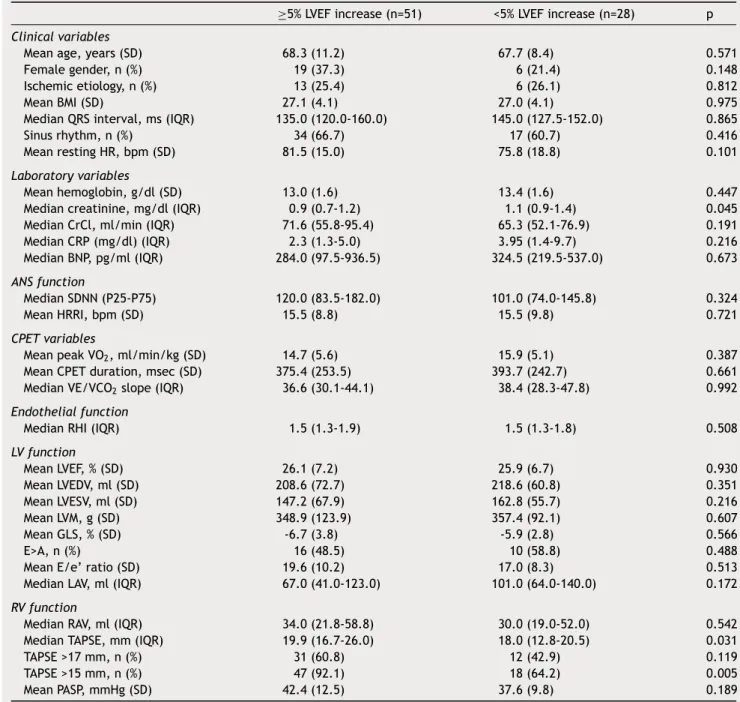
Univariateanalysisresultsforbaselinevariablesare
sum-marizedinTable2.
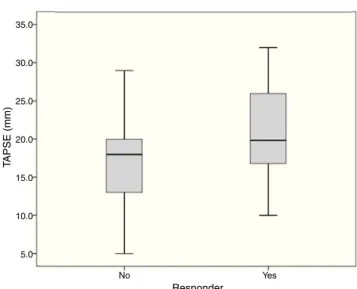
SerumcreatinineandTAPSEvalueswereassociatedwith
echocardiographicresponse(p=0.031andp=0.045,
respec-tively)(Figures1and2).
On multivariate analysisonly TAPSEwasindependently
associated with echocardiographic response (odds ratio
1.13; 95% CI: 1.02-1.26; p=0.020). TAPSE <15 was
associ-atedwithnon-response(p=0.0052).Eightpatients(10%)had
TAPSE<14mm,sevenofwhom(87.5%)werenon-responders.
There wereno responders(and twonon-responders) with
TAPSE<10mm.
Discussion
There is considerable disagreement in the literature
regarding the definition of a CRT responder, as shown by
Fornwalt etal.17 in a26 CRT trialsanalysis, in which the
level of agreement between primary endpoints waspoor,
withtheproportionofpatientsdefinedashavingapositive
CRTresponserangingfrom32%to91%.
35.0 30.0 25.0 20.0 15.0 10.0 5.0 No Yes Responder T APSE (mm)
Figure 2 Distribution of tricuspid annular plane sys-tolic excursion TAPSE values according to echocardiographic responsetocardiacresynchronizationtherapy.
Clinicalresponsebyitselfisnon-specific,largely
subjec-tiveandtoodependentondifferentvariables.Ontheother
hand,LVEF,althoughinfluencedbypreload,afterload,HR,
andmitralregurgitation,isthemostwidelyused
echocardi-ographicparameterandanimportantindexofLVfunction,
duetoitsclinicalprognosticvalue.18
Inourstudy,echocardiographicresponsewasdefinedas
≥5%absoluteimprovementinLVEF,inordertoincludethe
majorityofresponders.UsingalargerLVEFincreasewould
restricttherangeofresponders,improvingresponse
speci-ficity, but decreasing sensitivity. There is still discussion
concerningthebestLVEFchangetoidentifythosewhoare
reallyresponding.17
We observed clinical response in 68.3% of patients
and echocardiographic responsein64.6% (non-responsein
35.4%).
Demographicandclinicalvariablesdidnotdifferbetween
respondersandnon-responders.Otherinvestigatorsalsodid
notfindgender oretiology,adjusted toLVvolumes, tobe
independent predictors.8 On theother hand, sub-analyses
of randomized clinical trialshave suggested that CRT has
greaterbeneficialeffectsonLVfunctionand/orprognosisin
females6,9,10,19andinnonischemicetiology.7,11
Of our patients, 34% were in atrial fibrillation, the
most common arrhythmia in HF and associated with
worse prognosis.20 It is unclear if,correcting for age and
comorbidity, the prognosis for patients in AF is in fact
worse21 or whether it is only a marker of more severe
disease.13
WedidnotfindasignificantrelationbetweenQRS
dura-tionandresponse.Previousrandomizedcontrolledtrialsdid
not clearly show QRS duration asa predictive factor.22---24
However,ina recentmeta-analysisincludingfive
random-ized trials,QRS durationwasa powerfulpredictorof CRT
effectiveness.25 Moreover,asub-analysisoftheMADIT-CRT
trial associatedlongerQRS (>150ms)withbenefitsofCRT
inLVfunction,morbidityandmortality.7TheREVERSEstudy
confirmed theimportance of QRS duration and LBBB
Table1 Baselinecharacteristicsofthestudypopulationbeforecardiacresynchronization.
Variables n=79
Meanage,years(SD) 68.1(10.2)
Femalegender,n(%) 25(31.6)
MeanBMI(SD)(min-max) 27.1(4.1)(18.0-36.8)
Ischemicetiology,n(%) 19(24.0) NYHAclass,n(%) II 23(29.1) III 51(64.5) IV 5(6.3) Medication,% Diuretics 94 Beta-blockers 89 ACEIs/ARBs 90 Anticoagulants 73 Rhythm,n(%) Sinusrhythm 49(62.0) AF 27(34.2) Pacing 3(3.8)
MedianQRSinterval,ms(IQR)(min-max) 140.0(120.0-160.0)
Conductiondisturbancemorphology,n(%)
LBBB 77(97.5%)
RBBB 2(2.5%)
MeanrestingHR,bpm(SD)(min-max) 79.5(16.5)(45.0-126.0)
Meanhemoglobin,g/dl(SD)(min-max) 13.2(1.6)(8.7-16.1)
Mediancreatinine,mg/dl(IQR)(min-max) 1.0(0.8-1.3)(0.6-2.7)
MedianCrCl,ml/min(IQR)(min-max) 68.5(53.9-91.5)(22.7-146.3)
>90,n(%) 27(34.2)
60-89,n(%) 29(36.7)
30-59,n(%) 21(26.6)
<30,n(%) 2(0.25)
MedianCRP(mg/dl)(IQR)(min-max) 2.4(1.3-6.5)(0.2-75.4)
MedianBNP,pg/ml(IQR)(min-max) 286.0(132.0-782.0)(31.0-2787.0)
HRRI,bpm(SD)(min-max) 15.5(9.0)(0.0-37.0)
MeanCPETduration,msec(SD)(min-max) 381.4(248.4)(30.0-947.0)
MeanpeakVO2,ml/min/kg(SD)(min-max) 15.1(5.5)(5.1-31.6)
MedianVE/VCO2slope(IQR)(min-max) 37.2(29.8-46.4)(21.0-71.0)
MeanLVEF,%(SD)(min-max) 26.1(7.0)(11.0-34.0)
MeanLVESV,ml(SD)(min-max) 152.8(63.8)(91.0-322.0)
MeanLVEDV,ml(SD)(min-max) 212.2(68.3)(116.0-420.0)
E>A,n(%) 26/49(53.0)
MeanE/e’ratio(SD)(min-max) 18.8(9.6)(4.0-46.0)
MeanGLS,%(SD)(min-max) -6.4(3.4)(-18.3-[-1.0])
MeanLVM,g(SD)(min-max) 351.5(114.5)(129.0-637.0)
MedianLAV,ml(IQR)(min-max) 90.0(48.3-126.5)(22.0-222.0)
MedianTAPSE,mm(IQR)(min-max) 19.0(16.0-25.0)(5.0-32.0)
MedianRAV,ml(IQR)(min-max) 34.0(20.5-54.5)(9.0-254.0)
MeanPASP,mmHg(SD)(min-max) 40.6(11.7)(20.0-71.0)
ACEIs/ARBs:angiotensin-convertingenzymeinhibitors/angiotensinreceptorblockers;AF:atrialfibrillation;BMI:bodymassindex,in kg/m2;BNP:B-typenatriureticpeptide;CrCl:creatinineclearance(Cockcroft-Gaultformula);CPET:cardiopulmonaryexercisetesting;
CRP:C-reactiveprotein;GLS:globallongitudinalstrain;HR:heartrate;HRRI:heartraterecoveryindex;IQR:interquartilerange (25th-75thpercentile);LAV:leftatrialvolume;LBBB:leftbundlebranchblock;LVEF:leftventricularejectionfraction;LVEDV:leftventricular end-diastolicvolume;LVESV:leftventricularend-systolicvolume;LVM:leftventricularmass;NYHA:NewYorkHeartAssociation;PASP: pulmonaryarterysystolicpressure;peakVO2:peakoxygenconsumption;RAV:rightatrialvolume;RBBB:rightbundlebranchblock;SD:
Table2 Univariateanalysisofvariablesintermsofechocardiographicresponsetocardiacresynchronizationtherapy. ≥5%LVEFincrease(n=51) <5%LVEFincrease(n=28) p
Clinicalvariables
Meanage,years(SD) 68.3(11.2) 67.7(8.4) 0.571
Femalegender,n(%) 19(37.3) 6(21.4) 0.148
Ischemicetiology,n(%) 13(25.4) 6(26.1) 0.812
MeanBMI(SD) 27.1(4.1) 27.0(4.1) 0.975
MedianQRSinterval,ms(IQR) 135.0(120.0-160.0) 145.0(127.5-152.0) 0.865
Sinusrhythm,n(%) 34(66.7) 17(60.7) 0.416
MeanrestingHR,bpm(SD) 81.5(15.0) 75.8(18.8) 0.101
Laboratoryvariables
Meanhemoglobin,g/dl(SD) 13.0(1.6) 13.4(1.6) 0.447
Mediancreatinine,mg/dl(IQR) 0.9(0.7-1.2) 1.1(0.9-1.4) 0.045
MedianCrCl,ml/min(IQR) 71.6(55.8-95.4) 65.3(52.1-76.9) 0.191
MedianCRP(mg/dl)(IQR) 2.3(1.3-5.0) 3.95(1.4-9.7) 0.216 MedianBNP,pg/ml(IQR) 284.0(97.5-936.5) 324.5(219.5-537.0) 0.673 ANSfunction MedianSDNN(P25-P75) 120.0(83.5-182.0) 101.0(74.0-145.8) 0.324 MeanHRRI,bpm(SD) 15.5(8.8) 15.5(9.8) 0.721 CPETvariables
MeanpeakVO2,ml/min/kg(SD) 14.7(5.6) 15.9(5.1) 0.387
MeanCPETduration,msec(SD) 375.4(253.5) 393.7(242.7) 0.661
MedianVE/VCO2slope(IQR) 36.6(30.1-44.1) 38.4(28.3-47.8) 0.992
Endothelialfunction
MedianRHI(IQR) 1.5(1.3-1.9) 1.5(1.3-1.8) 0.508
LVfunction MeanLVEF,%(SD) 26.1(7.2) 25.9(6.7) 0.930 MeanLVEDV,ml(SD) 208.6(72.7) 218.6(60.8) 0.351 MeanLVESV,ml(SD) 147.2(67.9) 162.8(55.7) 0.216 MeanLVM,g(SD) 348.9(123.9) 357.4(92.1) 0.607 MeanGLS,%(SD) -6.7(3.8) -5.9(2.8) 0.566 E>A,n(%) 16(48.5) 10(58.8) 0.488
MeanE/e’ratio(SD) 19.6(10.2) 17.0(8.3) 0.513
MedianLAV,ml(IQR) 67.0(41.0-123.0) 101.0(64.0-140.0) 0.172
RVfunction
MedianRAV,ml(IQR) 34.0(21.8-58.8) 30.0(19.0-52.0) 0.542
MedianTAPSE,mm(IQR) 19.9(16.7-26.0) 18.0(12.8-20.5) 0.031
TAPSE>17mm,n(%) 31(60.8) 12(42.9) 0.119
TAPSE>15mm,n(%) 47(92.1) 18(64.2) 0.005
MeanPASP,mmHg(SD) 42.4(12.5) 37.6(9.8) 0.189
ANS:autonomicnervoussystem;BMI:bodymassindex,inkg/m2;BNP:B-typenatriureticpeptide;CrCl:creatinineclearance
(Cockcroft-Gaultformula);CPET:cardiopulmonaryexercisetesting;CRP:C-reactiveprotein;GLS:globallongitudinalstrain;HR:heartrate;HRRI: heartraterecoveryindex;IQR:interquartilerange(25th-75thpercentile);LAV:leftatrialvolume;LVEF:leftventricularejectionfraction; LVEDV:leftventricularend-diastolicvolume;LVESV:leftventricularend-systolicvolume;LVM:leftventricularmass;PASP:pulmonary arterysystolicpressure;peakVO2:peakoxygenconsumption;RAV:rightatrialvolume;RV:rightventricular;SD:standarddeviation;
TAPSE:tricuspidannularplanesystolicexcursion;VE/VCO2:minuteventilation/carbondioxideproduction.
sample size, the higher percentage of patients with
non-ischemic etiology and mean QRS >150 ms influenced our
results.
Inourpopulation,onlytwopatients(2.5%)hadRBBBand,
althoughthesearegenerallynotexpectedtobenefitfrom
CRT,13onewasaresponder.
The only laboratory parameter with statistical
signifi-canceinunivariateanalysiswasserumcreatinine(Figure1),
althoughcreatinineclearance14showednoassociationwith
CRTresponse.Althoughlowercreatininelevelswereseenin
patientswhorespondedtoCRT(p=0.045),multivariate
anal-ysis did notdemonstrate an independentassociation with
response.
In contrast to our results, Fung et al.,27 in a
popula-tion with renalinsufficiency, showed that respondershad
worse baselinerenalfunction. Inourstudy,most patients
had normalrenal functionor mild dysfunction (34.2%and
severerenaldysfunctionasdefinedbytheguidelines.28
Dif-ferentpopulationsinthetwostudiesmayhavecontributed
tothedifferenceinresults.Therelationofserumcreatinine
andcreatinineclearancetoresponseandoutcomeremains
controversial.29
CPET,Holterandperipheralarterialtonometryvariables
couldnotidentifyechocardiographicresponders.
Non-respondershadgreaterbaselineLVvolume,LVmass
andleftatrialvolumeandlowerLVEFandGLS,althoughthe
differencesdidnotreachstatisticalsignificance.
Intheliterature,therehavesometimesbeenconflicting
data on the impact of baseline LV dimensions on CRT
response,depending onstudypopulations.3,9,10 Parketal.
demonstrated that baselineLV volumewasa predictor of
echocardiographic CRT response.8 Rickard et al.3 showed
that the smaller the LV size, the greater the
improve-mentinLVEFandall-causemortalityafterCRT.Incontrast,
the MADIT-CRTtrial10 showedthat alarger LVwas
associ-atedwithechocardiographicresponse,andasub-analysisof
PROSPECT9foundnodifferenceinresponders.
Regarding the predictive value of baseline LVEF, we
found no relation withless severe patients, unlike in the
MADITsub-analysis,30inwhichpatientswithbetterLVEFhad
a greater response. However, because different inclusion
criteriaanddefinitions ofCRT responsewereused,direct
comparisonsofresultsaredifficultorimpossible.
Therightventriclehasalwaysbeenconsideredthe‘poor
relative’ of the left ventricle,although its importance in
exercisetoleranceandprognosishasbeendemonstrated.31
BecauseCRTwasdevelopedtoimproveLVsynchronicityand
function,itseffectsonrightventricular(RV)functionhave
notbeenfullyexamined,althoughsomestudieshaveshown
benefit.9,32
Animportantissueconcernsthepotentialroleof
base-line RV dysfunction in LV reverse remodeling after CRT.
In our study, TAPSE (Figure 3), a marker of overall RV
function33 and an independent predictor of mortality in
HF patients,34,35 showed an association with
echocardiog-raphicresponsetoCRTbymultivariateanalysis(Figure2),
with responders having higher baseline TAPSE values. RV
dysfunctionwas present in7% of responderscomparedto
36%ofnon-responders,andTAPSE<15mmwasstatistically
associatedwithnon-response,althoughTAPSE<17mm(the
Figure 3 Measurement of tricuspid annular plane systolic excursionbyM-modeechocardiography.
cut-pointforRVdysfunctioninclinicalpractice)showedno
association.TherewerenoresponderswithTAPSE<10mm.
ThismeansthatonlymoderateorsevereRVdysfunctionwas
relatedtoCRTnon-response.
OurresultsareinagreementwithCapellietal.,36 who
demonstrated that CRT induces both RV and LV reverse
remodeling,andis more effective in patientswith higher
TAPSE.Inaddition,Scuterietal.32concludedthatlow
base-lineTAPSEwasassociatedwithpoorresponseandadverse
prognosis, while Sade et al.37 showed that preserved RV
functionisanindependentpredictoroflong-termevent-free
survivalafterCRT.
Ontheotherhand,asub-analysisoftheREVERSEstudy38
demonstratedthatwhileLVreverseremodelingwasgreater
in patients with TAPSE >14 mm, the difference was not
statistically significant. Also, in CARE-HF,39 patients with
severelyreducedTAPSE(<14mm)hadasignificantlylower
responserate,thoughthisassociationwasnotstrongenough
toconsiderTAPSEanindependentpredictor.
Someof theuncertaintyregardingwhetherTAPSEisan
independentpredictorofCRTresponsemayresultfrom
dif-ferencesinstudypopulationsandparticularlyinthecriteria
usedtodefineCRTresponse.
Inconclusion,inthisadvancedHFpopulation,TAPSEwas
theonlyindependentpredictorof CRTresponseregarding
alltheanalyzedvariables.RVfunctionclearlyhasarolein
theselectionofcandidatesforCRT.
Study
limitations
Thestudywasperformedinasinglecenter,andthesample
size was moderate, mostly of patients withnon-ischemic
etiologyreferred for CRT.Follow-up durationwasonlysix
months, even though a small percentage of patients can
be lateresponders. These results need to be reproduced
inalargerstudy,separatingpatientswithischemicand
non-ischemicetiology,withalongerfollow-upperiod.
Ethical
disclosures
Protection of human and animal subjects.The authors
declare thatthe proceduresfollowed were in accordance
withtheregulationsoftherelevantclinicalresearchethics
committeeandwiththoseoftheCodeofEthicsoftheWorld
MedicalAssociation(DeclarationofHelsinki).
Confidentialityofdata.Theauthorsdeclarethattheyhave
followedtheprotocolsoftheirworkcenteronthe
publica-tionofpatientdata.
Righttoprivacyandinformed consent.Theauthorshave
obtained thewritten informedconsentof the patients or
subjectsmentionedinthearticle.Thecorrespondingauthor
isinpossessionofthisdocument.
Funding
This work was supported by research grant
PTDC/DES/120249/2010 from the Foundation for Science
Conflicts
of
interest
Theauthorsdeclarenoconflictsofinterest.
References
1.Tracy CM, Epstein AE,Darbar D,et al. 2012 ACCF/AHA/HRS focusedupdate ofthe2008guidelinesfor device-based ther-apyofcardiacrhythmabnormalities:areportoftheAmerican College of Cardiology Foundation/American Heart Associa-tion Task Force on Practice guidelines. J Am Coll Cardiol. 2012;60:1297---313.
2.McAlister FA, Ezekowitz J, Hooton N, et al. Cardiac resyn-chronizationtherapyforpatientswithleftventricularsystolic dysfunction:asystematicreview.JAMA.2007;297:2502---14.
3.RickardJ,BrennanD,MartinDO,etal.Theimpactofleft ven-tricularsizeonresponsetocardiacresynchronizationtherapy. AmHeartJ.2011;162:646---53.
4.Brunet-Bernard A, Leclercq C,Donal E. Defining patientsat risk of non-response to cardiac resynchronization therapy. Value of rest and exercise echocardiography. Int J Cardiol. 2014;171:279---81.
5.BaxJJ,GorcsanJIII.Echocardiographyandnoninvasiveimaging incardiacresynchronizationtherapy:resultsofthePROSPECT (PredictorsofResponsetoCardiacResynchronizationTherapy) studyinperspective.JAmCollCardiol.2009;53:1933---43.
6.ArshadA,MossAJ,FosterE,etal.,MADIT-CRTExecutive Com-mittee.Cardiacresynchronizationtherapyismoreeffectivein women than in men: the MADIT-CRT (MulticenterAutomatic DefibrillatorImplantationTrialwithCardiacResynchronization Therapy)trial.JAmCollCardiol.2011;57:813---20.
7.BarsheshetA, GoldenbergI,MossAJ,etal. Responseto pre-ventive cardiac resynchronization therapy in patients with ischaemicandnonischaemiccardiomyopathyinMADIT-CRT.Eur HeartJ.2011;32:1622---30.
8.Park MY, Altman RK, Orencole M, et al. Characteristics of responders to cardiac resynchronizationtherapy:the impact of echocardiographic left ventricular volume. Clin Cardiol. 2012;35:777---80.
9.VanBommelRJ,BaxJJ,AbrahamWT,etal.Characteristicsof heartfailurepatientsassociatedwithgoodandpoorresponse tocardiacresynchronizationtherapy:aPROSPECT(Predictors ofResponsetoCRT)sub-analysis.EurHeartJ.2009;30:2470---7.
10.GoldenbergI,MossAJ,HallWJ,etal.Predictorsofresponseto cardiacresynchronizationtherapyintheMulticenterAutomatic DefibrillatorImplantationTrialwithCardiacResynchronization Therapy(MADIT-CRT).Circulation.2011;124:1527---2369.
11.McLeod CJ, Shen WK, Rea RF, et al. Differential outcome of cardiac resynchronization therapy in ischemic cardiomy-opathyandidiopathicdilatedcardiomyopathy.HeartRhythm. 2011;8:377---82.
12.Chung AS, Leon AR, Tavazzi L, et al. Results of the Pre-dictors of Response to CRT (PROSPECT) trial. Circulation. 2008;117:2608---16.
13.Brignole M, Auricchio A, Baron-Esquivias G, et al. 2013 ESC guidelinesoncardiacpacingandcardiacresynchronization ther-apy: theTaskForceoncardiac pacingand resynchronization therapyoftheEuropeanSocietyofCardiology(ESC).Developed incollaborationwiththeEuropeanHeartRhythmAssociation (EHRA).EurHeartJ.2013;34:2281---329.
14.Cockcroft DW, Gault MH. Prediction of creatinine clearance fromserumcreatinine.Nephron.1976;16:31---41.
15.KleigerRE,MillerJP, BiggerJTJr,etal.,fortheMulticenter PostinfarctionResearchGroup.Decreasedheartratevariability anditsassociationwithincreasedmortalityafteracute myocar-dialinfarction.AmJCardiol.1987;59:256---66.
16.Kuvin J,Patel AR, Sliney K, et al. Assessmentof peripheral vascularendothelialfunction withfingerarterial pulsewave amplitude.AmHeartJ.2003;146:168---74.
17.FornwaltBK,SpragueWW,BeDellP,etal.Agreementispoor amongcurrentcriteriausedtodefineresponsetocardiac resyn-chronizationtherapy.Circulation.2010;121:1985---91.
18.KonstamMA,KramerDG,PatelAR,etal.Leftventricular remod-elinginheartfailure.Currentconceptsinclinicalsignificance andassessment.JAmCollCardiolImaging.2011;4:98---108.
19.ChengA,GoldMR,WaggonerAD,etal.Potentialmechanisms underlyingtheeffectofgenderonresponsetocardiac resyn-chronizationtherapy:insightsfromtheSMART-AVmulticenter trial.HeartRhythm.2012;9:736---41.
20.KhanNK,GoodeKM,ClelandJG,etal.PrevalenceofECG abnor-malitiesinaninternationalsurveyofpatientswithsuspectedor confirmedheartfailureatdeathordischarge.EurJHeartFail. 2007;9:491---501.
21.Olsson LG, Swedberg K, Ducharme A, et al. Atrial fibrilla-tion and riskof clinicalevents inchronic heart failurewith andwithoutleftventricularsystolicdysfunction:resultsfrom theCandesartan in Heartfailure-Assessment ofReduction in Mortalityandmorbidity(CHARM)program.JAmCollCardiol. 2006;47:1997---2004.
22.Gervais R, Leclerq C, Shankar A, et al. Surface electro-cardiogram to predict outcome in candidates for cardiac resynchronizationtherapy:asub-analysisoftheCARE-HFtrial. EurJHeartFail.2009;11:699---705.
23.Abraham WT, Fisher WG,Smith AL, et al., for the MIRACLE Study. TheMiracleStudyGroup.MulticenterInSync Random-izedClinicalEvaluation.Cardiac resynchronizationinchronic heartfailure.NEnglJMed.2002;346:1845---53.
24.BristowMR,SaxonLA,BoehmerJ,etal.,fortheComparison ofMedicalTherapy,Pacing,andDefibrillationinHeartFailure (COMPANION)Investigators.Cardiacresynchronizationtherapy withorwithoutanimplantabledefibrillatorinadvancedchronic heartfailure.NEnglMed.2004;350:2140---50.
25.ClelandJG,AbrahamWT,LindeC,etal.Anindividualpatient meta-analysis of five randomizedtrials assessing the effects of cardiac resynchronization therapy on morbidityand mor-talityinpatientswithsymptomaticheartfailure.EurHeartJ. 2013;34:3547---56.
26.GoldMR,ThebaultC,LindeC,etal.EffectofQRSdurationand morphologyoncardiacresynchronizationtherapyoutcomesin mildheartfailure:resultsfromtheResynchronizationReverses RemodelinginSystolicLeftVentricularDysfunction(REVERSE) study.Circulation.2012;126:822---9.
27.FungJWH,SzetoCC,ChanJYS,etal.Prognosticvalueofrenal functioninpatientswithcardiacresynchronizationtherapy.Int JCardiol.2007;122:10---6.
28.LeveyA, CoreshJ,BalkE,etal. Nationalkidneyfoundation practiceguidelinesforchronickidneydisease:evaluation, clas-sificationandstratification.AnnInternMed.2003;139:137---47.
29.ShalabyA, El-SaedA, Voigt C,etal. Elevated serum creati-nineat baselinepredicts pooroutcome inpatientsreceiving cardiacresynchronizationtherapy.PacingClinElectrophysiol. 2008;31:575---9.
30.Kutyifa V,Kloppe A, Zareba W, et al. The influence of left ventricularejection fraction on the effectivenessof cardiac resynchronizationtherapy:MADIT-CRT(MulticenterAutomatic DefibrillatorImplantationTrialwithCardiacResynchronization Therapy).JAmCollCardiol.2013;61:936---44.
31.DiSalvoTG,MathierM,SemigramMJ,etal.Preservedright ven-tricularejectionfractionpredictsexercisecapacityandsurvival inadvancedheartfailure.JAmCollCardiol.1995;25:1143---53.
32.ScuteriL, RordorfR,AjmoneN,etal.Relevanceof echocar-diographicevaluationofrightventricularfunctioninpatients undergoingcardiacresynchronizationtherapy.PacingClin Elec-trophysiol.2009;32:1040---9.
33.KaulS,TeiC,HopkinsJM,etal.Assessmentofrightventricular functionusingtwo-dimensionalechocardiography.AmJCardiol. 1984;107:526---31.
34.GhioS,RecusaniF,KlersyC,etal.Prognosticusefulnessofthe tricuspidannularplanesystolicexcursioninpatientswith con-gestiveheartfailuresecondarytoidiopathicorischemicdilated cardiomyopathy.AmJCardiol.2000;85:837---42.
35.Kjaergaard J, Akkan D, Iversen KK, et al. Right ventricular dysfunctionas an independent predictorof short-and long-termmortalityinpatientswithheartfailure.EurJHeartFail. 2007;9:610---6.
36.Capelli F, Porciani MC, Ricceri I, et al. Tricuspid annu-lar plane systolic excursion evaluation improves selection
of cardiac resynchronization therapy patients. Clin Cardiol. 2010;33:578---82.
37.SadeLE,OzinB,AtarI,etal.Rightventricularfunctionisa determinantoflong-termsurvivalaftercardiac resynchroniza-tiontherapy.JAmSocEchocardiogr.2013;26:706---13.
38.Kjaergaard J, Ghio S, Sutton MSJ, et al. Tricuspid annular planesystolicexcursionandresponsetocardiac resynchroniza-tion therapy:resultsfrom theREVERSEtrial. JCardiac Fail. 2011;17:100---7.
39.GhioS,FreemantleN,ScelsiL,etal.Long-termleft ventricu-larreverseremodelingwithcardiacresynchronizationtherapy: results from the CARE-HF trial. Eur J Heart Fail. 2009;11: 480---8.