Amanda do Amaral Pires Sobreira
1Jamylle Correia dos Santos¹
Débora Ayeska de Oliveira
Willma José de Santana
2Caroline Medeiros Machado
3RESUMO
A Síndrome Metabólica (SM) compreende um conjunto de anormalidades metabólicas que estão relacionadas com a
deposição central de gordura e a resistência à insulina, essa síndrome tem muitas similaridades com a Doença Renal
Crônica (DRC). Os pacientes com SM e DRC podem apresentar desequilíbrios nutricionais tanto positivos como negativos
que exercem forte influência no curso que a doença pode tomar e no tratamento destas. Nesse sentido, a terapia
nutricional pode ser decisiva para evolução dos pacientes, reduzindo sua morbidade e mortalidade. O presente estudo
objetivou avaliar a terapia nutricional no tratamento da SM e DRC. Trata-se de um estudo de caso, exploratório com
abordagem qualitativa, que após uma anamnese com o paciente, foi elaborado um plano alimentar, sendo avaliado antes
e depois da intervenção. Este inicialmente apresentava o peso elevado, o índice de massa corporal indicando obesidade
grau II, perímetro braquial (PB) de eutrofia, perímetro da cintura elevado e RCQ indicando risco para doenças
cardiovasculares. Houve episódios de hipoglicemia, a ureia e a creatinina encontravam-se com valores elevados antes e
após a intervenção, como também não apresentaram mudanças na sua avalição antropométrica tendo em vista que a
dieta visava manutenção de peso, exceto o PB que se elevou indicando sobrepeso (36,5 cm). A glicemia aumentou um
pouco e os marcadores de função renal continuaram altos. Desta forma, um aporte nutricional adequado eficaz é um fator
muito importante para pacientes em hemodiálise e que apresentam síndrome metabólica, porém o paciente deve ter
força de vontade para mudar seus hábitos alimentares.
Palavras chaves: Diabetes. Doença Renal Crônica. Dislipidemia. Avaliação Nutricional. Dietoterapia.
ABSTRACT
The Metabolic Syndrome (MS) comprises a set of metabolic abnormalities related to central fat deposition and insulin
resistance, and has many similarities with Chronic Kidney Disease (CKD). Patients with MS and CKD may present with both
positive and negative nutritional imbalances that strongly influence the disease course and the treatment of these
diseases. In this sense, nutritional therapy can be decisive for patients' evolution, reducing their morbidity and mortality.
The present study aimed to evaluate nutritional therapy in the treatment of MS and CKD. This is a case study, exploratory
with a qualitative approach, which, after an anamnesis with the patient, elaborated a food plan, evaluated before and after
the intervention. This initially showed high weight, body mass index indicating grade II obesity, brachial perimeter (BP) of
eutrophy, high waist perimeter and WHR indicating risk for cardiovascular diseases. There were episodes of hypoglycemia,
urea and creatinine levels were high before and after the intervention, nor did they present changes in his anthropometric
evaluation, considering that the diet aimed at maintaining weight, except the BP that was elevated indicating overweight
(36.5 cm). Blood glucose levels increased slightly and markers of renal function remained high. Thus, adequate nutritional
intake is a very important factor for patients on hemodialysis and who have metabolic syndrome, but patients must have
the willpower to change their eating habits.
Keywords: Diabetes. Chronic Renal Disease. Dyslipidemia. Nutritional Evaluation. Diet therapy.
1 Discente da Faculdade de Juazeiro do Norte, Juazeiro do Norte, Ceará, Brasil. Autora correspondente: [email protected] 2 Docente da Faculdade de Juazeiro do Norte, Juazeiro do Norte, Ceará, Brasil e Dra. em Ciências Biológicas pela UFPE
CASE REPORT
BENEFÍCIOS DA TERAPIA NUTRICIONAL EM
PACIENTE COM SÍNDROME METABÓLICA E
INSUFICIÊNCIA RENAL: RELATO DE CASO
BENEFÍCIOS DA TERAPIA NUTRICIONAL EM
PACIENTE COM SÍNDROME METABÓLICA E
INSUFICIÊNCIA RENAL: RELATO DE CASO
INTRODUCTION
The Metabolic Syndrome (MS) and Chronic Kidney Disease (CKD) constitute a major public health problem worldwide in the context of metabolic diseases and renal complications. Studies conducted in different populations found prevalences of MS from 6% to 70.3%, depending on the conditions evaluated, such as: ethnic group, gender, and associated comorbidities. The prevalence of MS in the general population is approximately 24%, reaching more than 80% among patients with Diabetes Mellitus (DM) type II ¹.
MS is a complex disorder represented by a set of cardiovascular risk factors related to central fat deposition and insulin resistance. These factors include: obesity, high blood pressure, disorders in the metabolism of glucose, hypertriglyceridemia and/or low levels of HDL cholesterol (HDL-c)².
The Metabolic Syndrome (MS) has many similarities with chronic kidney disease (CKD) and the risk factors that resemble are insulin resistance, glucose intolerance, hypertension, dyslipidemia and obesity. In addition, the MS has a strong association with risk factors for CKD and albuminuria.³ Nutritional therapy in metabolic syndrome consists in carrying out a diet plan for weight reduction, which will improve insulin sensitivity, lower glucose levels, reduce abdominal circumference and visceral fat, as well as reduced blood pressure, levels of triglycerides, and consequently increased HDL-cholesterol 4.
The CKD consists of the progressive, slow and irreversible loss of renal function, in which the kidneys are unable to filter waste, salts and liquids from the blood. Consequently, the organism does not maintain the metabolic and hydroelectrolytic balance. As it advances, there is a need of artificial blood filtration, dialysis or renal transplantation5.
Nutrition plays an important role in the treatment of patients with CKD, however, major nutritional problems affect these patients, including restricted diet. The dietary nutritional advice assists in the control and prevention of complications from CKD.6 Thus, each clinical condition deserve a proper planning, because their characteristics will determine how the therapy must be performed.
Therefore, the objective of this study was to conduct a nutritional therapy and assess its benefits, about a case study of a patient with metabolic disease and renal complications, seeking help in his treatment.
METHOD
The research was performed with the approval of the Research Ethics Committee of the College of Juazeiro do Norte, as the record 2.296.667. This is a case study, exploratory with a qualitative approach, developed in the city of Juazeiro do Norte - CE, in the residence of the study subject. After presenting the research, his agreement and authorization, a questionnaire was applied and submitted to an evaluation assessing the perimeter of the arm (BP), waist perimeter (WP), hip perimeter (HP), waist-hip ratio (WHR), height, weight and Body Mass Index (BMI) in accordance with the values established by the World Health Organization (WHO)7.
Biochemical tests (fasting blood glucose, total cholesterol and fractions, triglycerides, glycated hemoglobin, urea, creatinine, hematocrit, hemoglobin, calcium, potassium
and phosphorus) were evaluated, carried out in the Laboratory chosen by the patient according his the doctor’s request.
During the anamnesis, a semi-structured questionnaire was applied, and, after collecting all data, a food plan was prepared in order to maintain his nutritional status and improve the quality of meals, thus providing the control of pathologies, being prepared in accordance with the patient’s needs and following the recommendations proposed by the I Brazilian Guideline for the Diagnosis and Treatment of Metabolic Syndrome, suiting the specific indications for Renal Insufficiency present in Clinical guideline for the care to patients with chronic kidney disease – CKD in the Unified Health System - UHS, as well as his preferences and dislikes. After one month of intervention, there was a new anthropometric assessment, menu change and evaluation of biochemical tests to analyze the changes in his clinical picture. The prescribed diet offered 1,869 kcal/day, 20% Protein, 65% Carbohydrates and 15% Lipids, in order to maintain the weight, being characterized as a low-calorie, normoprotein, hyperglycemic and hypolypidic diet.
Weight was measured on a digital scale of the Tec-Silver Techline brand with a maximum capacity of 150 kg and 100 g division. The waist perimeter (WP) was obtained two fingers above the umbilicus with flexible and stretchable tape measure without compressing tissues. The cut-off points adopted for WP were: high risk for men (WP ≥ 94 cm), and very high risk for men (WP ≥ 102 cm)7. The hip perimeter (HP) was obtained by placing
a flexible and inelastic measuring tape around the hip, in the most protuberant area without compressing the skin, in which the cut-off point was obtained through the WHR with classification of risk of cardiovascular diseases for men (> 0.85) and women (> 1)7. The brachial perimeter (BP) was
obtained by placing a flexible and inelastic measuring tape around the arm, verifying the value. The cut-off point for the classification of nutritional status from the BP were: eutrophy (90-110%), overweight (110-120%) and obesity (>120%)7.
CASE DESCRIPTION AND OBTAINED RESULTS
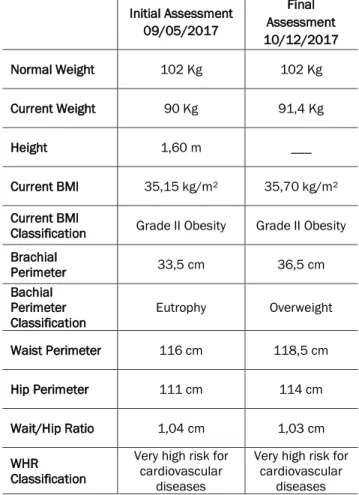
The research subject is a man aged 58 years, married, Catholic, white and with initials C.G.S., residing in the city of Juazeiro do Norte - CE, diagnosed with Metabolic Syndrome progressing to Dialytic Chronic Kidney. He has had diabetes and hypertension for 10 years, living with obesity for a period of 30 years, having performed cardiovascular surgeries in the course of his life (three bridges of saphenous vein and two mammary). Regarding the initial assessment and the one 30 days after, the patient had high weight, which continued progressing in the re-evaluation; his BMI indicated grade II obesity in both evaluations, BP expressed eutrophy, but increased in the second evaluation, indicating overweight, high WP, HP and WHR showed risk for cardiovascular diseases, and all these increased later (Table 01).
Table 01. Data from patient’s weight and anthropometric assessment in both evaluations, before and after the diet therapeutic intervention. Initial Assessment 09/05/2017 Final Assessment 10/12/2017 Normal Weight 102 Kg 102 Kg Current Weight 90 Kg 91,4 Kg Height 1,60 m ___ Current BMI 35,15 kg/m² 35,70 kg/m² Current BMI
Classification Grade II Obesity Grade II Obesity Brachial Perimeter 33,5 cm 36,5 cm Bachial Perimeter Classification Eutrophy Overweight Waist Perimeter 116 cm 118,5 cm Hip Perimeter 111 cm 114 cm Wait/Hip Ratio 1,04 cm 1,03 cm WHR Classification
Very high risk for cardiovascular
diseases
Very high risk for cardiovascular
diseases BMI: Body Mass Index. WHR: Waist-Hip Ratio.
The patient presented hypoglycemia and hypotension in some sessions after the evaluation, having been instructed by the medical staff to increase body weight to cease feeling such symptoms, but, from a nutritional point of view, the improvement could have been promoted by keeping his initial weight and with adequate nutrition for his health conditions, which can justify the increased weight and anthropometric measurements.
The patient uses 13 medicines/day, namely: Monocordil, Furosemide, Apresolina, Selozok, Novanlo, Clopidogrel Bisulfate, Sevelamer Hydrochloride (Ranagel), Somalgin, Atorvastatin, Darforin, Pantoprazole, Calcium and Folic Acid. One month after the evaluation, there have been changes in drug therapy, in which most medicines remained, but Calcium was removed and the use Sevelamer Hydrochloride (Ranagel) decreased from three times a day to just two times. The amount of removed liquids also decreased, from 3.5 - 4.0 kg in each session to 2 - 2.5 kg.
Laboratory tests before and after the diet therapeutic intervention show that the values of glycemia were initially reduced and, after the intervention, increased significantly. As for the values of total cholesterol and fractions were in the patterns of normality. Urea, creatinine and potassium presented high values due to the CKD, calcium and phosphorus were in normal conditions (Table 02).
Table 02: Laboratory tests performed before and after the patient’s nutritional follow-up.
Initial Assessment 08/01/2017 Final Assessment 10/03/2017 Reference value Total Cholesterol 105,39mg/dl 109,21mg/dL Desejável: Menor que 200 mg/Dl LDL Cholesterol 35,44 mg/dl 43,06 mg/dL Ótimo: Menor que 100 HDL Cholesterol 49,51 mg/dl 47,66 mg/dL Acceptable: > 41 - 59 VLDL Cholesterol 20.44 mg/dl 21.49 mg/dl Desirable: Less than 40 mg/dl Triglycerides 102,18 mg/dl 107,43 mg/dL Great: Less than 150 Fasting Blood Glucose 80,75 mg/dl 126,44 mg/Dl Desirable: 65 - 99 mg/dl Glycated Hemoglobin (Hb) 7,0 % 7,30% Normal: 4 a 6 % Urea 128,7 mg/dL 128,2mg/dL Ideal: 15-45 mg/dl Creatinine 7,00 mg/dL 6,80 mg/dL Ideal: 0,7-1,2 mg/dL Hematocrit 39,10 % 43,8% Ideal: 33-36% Hemoglobin 13,0 g/dL 12,98 g/dL Ideal: 11-13 g/dL Calcium 8,6 mg/dL 9,20 mg/dL Ideal: 8,5-9,5 mg/dL Phosphorus 3,80 mg/dL 3,40 mg/dL Ideal: 3,5-5,5 mg/dL Potassium >7,50 mg/Dl 7,50 mg/dL Ideal: 3,5-5,5 mg/dL LDL: Low Density Lipoprotein. HDL: High Density Lipoprotein. VLDL: Very Low Density Lipoprotein.
DISCUSSION
The DM and SAH are the main causes of CKD, which represent 36% and 26% of primary diagnosis, respectively8,
which can justify the development of CKD in the study patient. The anthropometric assessment showed that the patient presents with Grade II Obesity through the BMI classification. A study conducted with adult patients showed
that the highest percentage of MS is present in individuals with high BMI, being 61.8% of its population with Grade II Obesity, corroborating the finding from the present study9.
Moreover, the circumferences measured increased in comparison with the initial data. A study on the association between WHR and dyslipidemias pointed out that the high numbers of this measure have intimate relationship with the occurrence of cardiovascular diseases, which can justify the presence of the high number of infarctions in patients with chronic renal disease10. In this study, the patient presents a
WHR above the recommendation with very high risk for cardiovascular diseases7.
The anthropometric profile of hypertensive users from a men’s health program showed that 84.0% of them had increased WP; 89.3% were at moderate to very high risk for the standard of WHR and 72% were with excess weight11. This
shows that most hypertensive men are with these parameters unsuitable for health, characteristics that are consistent with the anthropometric indices of the patient in the study.
Another analysis of anthropometric measurements performed in elders from the city of Porto Alegre/RS shows that the average BP took the value of 31.51±4,25cm, classifying these individuals into an interval between eutrophy and overweight, considering the Standard Deviation12. This datum
corroborates the finding of initial and final assessment in this case study.
When assessing the nutritional status and dietary intake of renal patients on hemodialysis in Araguari-MG, 100% of their sample had serum creatinine significantly above the reference value and 78.57% of these had potassium levels above the maximum permitted level13, agreeing with the levels
that the patient of this case presents.
In relation to biochemical data on fasting blood glucose and glycated hemoglobin, the patient presented results above recommendations at the end of the studies; these values are also part of the evaluation of the situation of his clinical picture, since microvascular complications and evolution of his renal picture are associated with the presence of DM. A study that evaluated this problem through monitoring of glycated
hemoglobin values of a group of diabetic individuals as a way of preventing the progression of renal lesion states that an intervention to improve the glycemic control is very valuable14.
Given the worsening of the patient’s anthropometry, his food plan might have not been good, a result similar to a study conducted with elderly patients with metabolic syndrome, in which only a third of the studied population presented adherence to the diet15, which reinforces that the adoption of a
healthy eating plan is essential in the treatment of SM, which aims to improve insulin sensitivity and prevent cardiovascular and metabolic changes associated with it.
The study showed some limitations, such as the non-fulfilment of the diet fully, interfering directly and negatively the results, since the patient of this study presents a complex food restriction resulting from his pathologies. Furthermore, the environment in which he lives - emphasis on family habits - may also have triggered such result. Another limitation was the elaboration of the menu contemplating the specificities of all pathologies. He did not present any difficulty regarding the anthropometric or nutritional assessment.
CONCLUSION
An adequate nutritional monitoring is a very important factor for patients on hemodialysis and who have metabolic syndrome, by providing the improvement of the general health status by means of an adequate supply according to their needs. However, the patient’s commitment to make the changes proposed by the professional contribute directly to a satisfactory final result.
Therefore, more studies are necessary to demonstrate the importance of nutritional monitoring, especially for those groups of people with diabetes, hypertension, dyslipidemia, obesity and kidney disease, since they are the main diseases affecting the population.
REFERENCES
1. PINHO, N. A.; SILVA, G. V.; PIERIN, A. M. G.; Prevalência e fatores associados à doença renal crônica em pacientes internados em um hospital universitário na cidade de São Paulo, SP, BRASIL. Jornal Brasileiro de Nefrologia, v.37, n.01, p.91-97, 2015. DOI: 10.5935/0101-2800.20150013.
2. BRUFANI, C. et al. Metabolic syndrome in italian obese children and adolescents: stronger association with central fat depot than with insulin sensitivity and birth weight. International Journal of Hypertension, v. 2011, p.1-6, 2011. DOI:
10.4061/2011/257168.
3. KUBRUSLY, M.; OLIVEIRA, D.C.M.C.; SIMÕES, F.S.P.; LIMA, O.D.R.; GALDINO, R.N.P, SOUSA, F.A.D.P, JERÔNIMO, C.L.A. Prevalência de Síndrome Metabólica diagnosticada pelos critérios NCEP-ATP III e IDF em pacientes em hemodiálise. Jornal Brasileiro Nefrologia, v 37, n. 01, p. 72-78, 2015. DOI: 10.5935/0101-2800.20150011
4. ASSOCIAÇÃO BRASILEIRA PARA O ESTUDO DA OBESIDADE E DA SÍNDROME METABÓLICA DIRETRIZES BRASILEIRAS DE OBESIDADE 2016 / ABESO - Associação Brasileira para o Estudo da Obesidade e da Síndrome Metabólica. – 4.ed. - São Paulo, SP.
5. MENDES, I. G. Função visual na Insuficiência Renal Crônica: Estudo psicofísico da percepção de cor e contraste. 2014. 68 p. Monografia (Enfermagem) -Universidade Federal do Amapá, Macapá.
6. PINTO, D. E et al. Síndrome Metabólica: relato de caso no âmbito laboratorial. Revista Saúde Integrada, Santo Ângelo/RS, 2016, v.9, n. 17, ISSN 2447-7079. http://local.cnecsan.edu.br/revista/index.php/saude/index.
7. WORLD HEALTH ORGANIZATION. Obesity: preventing and managing the global epidemic. Report of a World Health Organization Consultation. Geneva: World Health Organization, 2000. p. 256. WHO Obesity Technical Report Series, n. 284.
8. REMBOLD, S. M.; SANTOS, S.L.D.; VIEIRA, B.G.; BARROS, S.M.; LUGON, R.J. Perfil do doente renal crônico no ambulatório multidisciplinar de um hospital universitário. Acta Paul. Enferm. Vol. 22 n. spe1. São Paulo, 2009. DOI:
http://dx.doi.org/10.1590/S0103-21002009000800009.
9. HESS, S.; TRAMONTINI, J.; CANUTO, R. Fatores associados à síndrome metabólica em adultos atendidos em um ambulatório de nutrição. Revista Scientia Medica, v. 24, n. 01, p. 33-38, 2014.
10. CABRERA, S. A. M. Relação do índice de massa corporal, da relação cintura-quadril e da Caderneta Saúde Pública, Rio de Janeiro, v. 21, n. 03, p 767-775, 2005. DOI: http://dx.doi.org/10.1590/S0102-311X2005000300010.
11. GAMA, G.G.G.; PORTELA, P.P.; GONSALVES, O.L.C.E.; AZEVEDO, R.Q.S.; PIRES, S.G.C.; MUSSI, C.F. Perfil antropométrico de usuários hipertensos de um programa de saúde do homem. Revista Cienc Cuid Saude, v. 15 n01, p. 44-52, 2016. DOI: 10.4025/cienccuidsaude. v15i1.23514.
12. CLOSS, E.V.; ROSEMBERG, S.L.; ETTRICH, G.B.; GOMES, I.; SCHWANKE, A.H.C. Medidas antropométricas em idosos assistidos na atenção básica e sua associação com gênero, idade e síndrome da fragilidade: dados do EMI-SUS. Revista Scientia Medica, v. 25, n.03, p. 2 a 17, 2015.
13. SANTOS, A.L.; OLIVEIRA, B.C.J.; SANTANA, B.R.; PASQUINI, S.A.T.; MORSOLETTO, C.H.R. Avaliação do Estado Nutricional e Ingestão Dietética de pacientes com Insuficiência Renal Crônica (IRC) em tratamento hemodialítico em uma clínica de hemodiálise localizada na cidade de Araguari/MG. Revista E-RAC, v.6, n. 1, p.01-17, 2016.
14. PEREIRA, S.H. Avaliação da hemoglobina glicada em pacientes diabéticos como forma preventiva para progressão da insuficiência renal crônica. Revista Biofarm, v.10, n 04, p. 50-55, 2014.
15. JACONDINO, C. B. et al. Adesão à dieta por idosos com síndrome metabólica. Revista Sci Med. v. 26, n. 3, p. 1-11, 2016. DOI: 10.15448/1980-6108.2016.3.22956