U
NIVERSIDADE
DOA
LGARVE
Faculdade de Ciências e Tecnologia
Larval rearing of Mithraculus sculptus (Lamarck, 1818)
in captivity.
Tiago Miguel Dionísio Mourinho
Dissertação apresentada para obtenção de Grau de Mestre em Aquacultura
e Pescas-Especialidade em Aquacultura
Trabalho efectuado sob orientação de: Prof. Dra. Margarida Cristo
Mestre Joana Salabert
U
NIVERSIDADE DO
A
LGARVE
Faculdade de ciências e tecnologia
Larval rearing of Mithraculus sculptus (Lamarck, 1818) in captivity.
Dissertação orientada por: Prof. Dra. Margarida Cristo
Universidade do Algarve
Faculdade de Ciências e Tecnologia
Dissertação co-orientada por: Mestre Joana Salabert
Lusoreef, Criação de Espécies Marinhas, Lda.
Autor: Lic. Tiago Miguel Dinísio Mourinho
Universidade do Algarve
Faculdade de Ciências e Tecnologia
Mestrado em Aquacultura e Pescas-Especialidade em Aquacultura
Larval rearing of Mithraculus sculptus (Lamarck, 1818) in captivity.
Declaração de autoria de trabalho
Declaro ser o autor deste trabalho, que é original e inédito.
Autores e trabalhos consultados estão devidamente citados no texto e constam da listagem de referências incluída.
O autor: Tiago Mourinho
Copyright® by Tiago Mourinho
A Universidade do Algarve tem o direito, perpétuo e sem limites geográficos, de arquivar e publicitar este trabalho através de exemplares impressos reproduzidos em papel ou de forma digital, ou por qualquer outro meio conhecido ou que venha a ser inventado, de o divulgar através de repositórios científicos e de admitir a sua cópia e distribuição com objetivos educacionais ou de investigação, não comerciais, desde que seja dado crédito ao autor e editor.
Resumo
O aumento exponencial da aquariofilia de recife tem levantado alguns problemas ecológicos. A captura de seres vivos dos recifes para o mercado aquarista tem impactos negativos na ecologia dos mesmos. A melhor solução para combater a apanha de espécimes selvagens e preservar a sensível ecologia dos recifes de coral, permitindo a continuidade da indústria, é a aquacultura. No entanto, a produção em massa de animais dos recifes de coral está a dar os primeiros passos e existem poucos estudos sobre cultivo larvar.
Mitraculus sculptus é um crustáceo decápode cujo habitat vai desde a Flórida até ao
Brasil. A sua utilização na aquariofilia é frequente, pois pertence às chamadas equipas de limpeza dos aquários. Apresenta como função controlar e eliminar uma alga que se torna praga quando introduzida em aquários. É dos poucos seres que se alimentam de
valonia sp., o que torna este decápode muitíssimo útil para a aquariofilia de recife. Por
habitar zonas intertidais, a sua captura é relativamente simples, o que, aliado à abundância, diminui o seu valor comercial.
Não existem muitos estudos sobre a larvicultura desta espécie, no entanto sabe-se que apresenta uma fase larvar curta (cerca de 12 dias) e larvas muito pequenas. As larvas de M. sculptus necessitam de estar em suspensão na coluna de água para se alimentarem, facto que dificulta o seu cultivo. Para que se mantenham em suspensão, a forma dos tanques tem de permitir que a água realize um movimento de upwelling suave, de modo a que as larvas nadem sem grande esforço.
Neste trabalho estudaram-se três tipos de tanques, de forma a determinar qual o mais adequado para o cultivo larvar. Dos três tanques testados, dois apresentavam um formato cilíndrico-cónico, sendo que a diferença consistia na posterior utilização de uma base de assentamento. O tanque denominado nesta experiência por tanque sem base de assentamento foi descrito por Calado et al., (2003b), enquanto que o tanque com base de assentamento foi primeiramente descrito por Tunberg e Creswell (1988), tendo sido, posteriormente, melhorado por Penha-Lopes et al., (2005). O outro tanque testado foi um aquário cúbico, utilizado na empresa, no cultivo de larvas de peixe e no crescimento de cavalos-marinhos. O melhor resultado foi obtido pelo tanque descrito por Calado et al., (2003b). Apesar de não ser estatisticamente diferente dos outros tanques, alcançou uma taxa de sobrevivência de 5.00% e uma taxa de assentamento de 4.00%.
Tendo em conta a importância da alimentação, foram testadas três diferentes concentrações de Artemia sp., 5 nauplii mL-1, 7 nauplii mL-1 e 15 nauplii mL-1. A concentração mais baixa (5 naupii mL-1), foi testada por ser aquela onde o consumo de
Artemia sp. seria menor e, logo, a produção seria mais económica. Já a concentração de
7 nauplii mL-1 é aquela que está descrita na literatura como sendo a que obtém melhores resultados (Rhyne et al., 2005; Penha-Lopes et al., 2005). A concentração de 15 nauplii mL-1 foi testada por ser a utilizada pela empresa na produção de larvas de camarão (Lysmata seticaudata). A concentração intermédia (7 nauplii mL-1) foi a que mostrou melhores resultados para a taxa de sobrevivência, 8.33%. Contudo, no que à taxa de assentamento diz respeito, foi a concentração de 15 nauplii mL-1 aquela que melhores resultados obteve, 4.00%, contra 0.67% da concentração de 7 nauplii mL-1. Esta etapa da experiência mostrou-se importante, devido ao elevado custo dos cistos de Artemia
sp. no mercado, factor que influencia a produção quando feita em larga escala. Por este
facto, quando se trata de planificar uma produção em larga escala, há que ser encontrada uma concentração mínima de alimento, sem que esta se reflicta na sobrevivência das larvas.
Devido ao reduzido tamanho das larvas e à grande quantidade de energia necessária para realizar a metamorfose, foi efetuada uma experiência onde foram testados três tipo diferentes de Artemia sp.. Foi testada Artemia sp. recém-eclodida, por ser a mais pequena e a mais utilizada na bibliografia. Noutro ensaio, as larvas foram alimentadas com Artemia sp. enriquecida com Algamac 3050™ (Biomarine®; Aquafauna). No último ensaio as larvas foram alimentadas primeiramente com Artemia sp. recém-eclodida (até ao 8º dia após eclosão) e posteriormente com Artemia sp. enriquecida (a partir do 8º dia após eclosão). Os melhores resultados foram obtidos no ensaio em que as larvas foram alimentadas apenas com Artemia sp. enriquecida, tendo sido observada uma taxa de sobrevivência de 14.33% e uma taxa de assentamento de 4.67%. Esta taxa de sobrevivência observada, corresponde à taxa de sobrevivência mais elevada ao longo de todo o trabalho.
Os resultados obtidos, quando comparados com os publicados por Calado et al., (2003b) ou por Penha-Lopes et al., (2005), ficam muito aquém dos resultados referenciados nestes dois trabalhos. No entanto, Calado et al., (2003b) alimentaram as larvas de M. sculptus com rotíferos durante o primeiro estágio larvar, o que pode influenciar os dados da taxa de sobrevivência, uma vez que os rotíferos são seres com tamanho muito inferior à Artemia sp.. Penha-Lopes et al., (2005) realizaram o trabalho
com M. forceps, uma espécie mais estudada e que apresenta melhores taxas de sobrevivência durante o estado larvar.
Durante as experiências foi observado que, ao atingirem a fase de megalopa, as larvas necessitam de estruturas para se fixarem e fazer a metamorfose. Dado que na natureza, as larvas agarram-se a rochas e suas cavidades para realizarem a metamorfose, seria possível experimentar o mesmo no cultivo larvar em cativeiro. Contudo, o facto de o objectivo passar por optimizar a produção, para que seja feita em larga escala, torna essa ideia inviável. A introdução de rochas dentro de tanques leva a uma maior acumulação de resíduos e à impossibilidade de contar as pós-larvas, uma vez que estas se escondem nos seus orifícios e cavidades.
Para que a produção de M. sculptus seja consistente são necessários mais estudos, focando-se, principalmente em novos tanques, que não requeiram tanto manuseamento das larvas. A utilização de novas bases de assentamento, com fluxo de upwelling e estruturas que permitam que as larvas se fixem para realizar a metamorfose, também iriam aumentar o sucesso do cultivo larvar desta espécie de decápode.
Palavras-chave: Mithraculus sculptus; caranguejo ornamental marinho;
larvicultura; sobrevivência larvar.
Abstract
The exponential growth of marine aquarium trade leads to some environmental problems in some of the most important reefs in the world. The capture of some reef inhabitants to fulfill the aquarium trade requirements has resulted in some negative impacts in the reefs ecology.
Aquaculture is pointed as the best solution to decrease the reef animal‟s captures and allow the normal continuity of the aquarium trade. However, the large scale production of coral reef specimens is actually beginning. It will take some more years to replace the fisheries for aquaculture.
Mithraculus sculptus is a decapod that can be found in shallow waters from Florida
to Brazil. It is a very useful crab due to its feeding habits; it eats valonia sp. algae, an aquarium pest.
The present work tested three different tanks, in order to determine the most appropriate tank to larval rearing. The one that showed better results was described by Calado et al., (2003), it is a cylindrico-conical tank with 10 liters capacity.
Considering the importance of feeding in larval stages, three different food concentrations were tested. The best result was reached for 7 nauplii mL-1 trial.
Nutrition is also very important so, larvae were cultured with three different types of food: newly hatched Artemia sp., enriched Artemia sp. and a mix of them (newly-hatched in the first 8 days of the experiment and enriched Artemiasp from then until the end).
To produce M. sculptus in large scale, more investigation studies are needed to better understand larvae requirements. New studies should focuses in new tanks and settlement tables, in order to decrease larval handling and increase larval settlement.
Key words: Mithraculus sculptus; marine ornamental crab; larval rearing; larval
Index
1. Introduction... 1
2. Methods ... 3
2.1. Breeders system ... 3
2.1.1. Collecting the larvae ... 3
2.2. Experimental design ... 3
2.2.1. Larvae survival dependence of the tank ... 6
2.2.1.1. Cylindrico-conical tanks without settlement table ... 6
2.2.1.2. Cylindrico-conical tanks with settlement table ... 6
2.2.1.3. Cubic tanks ... 7
2.2.2. Effect of food concentration in larval survival ... 8
2.2.3. Food quality in larval survival ... 8
2.3. Statistical analysis ... 9
3. Results ... 9
3.1. Larvae survival dependence of the tank ... 9
3.2. Effect of food concentration in larval survival ... 10
3.3. Effect of food quality in larval survival ... 10
4. Discussion ... 11
4.1. Larvae survival dependence of the tank ... 12
4.2. Effect of food concentration in larval survival ... 13
4.3. Effect of food quality in larval survival ... 15
1
1. Introduction
In the last decades, the marine ornamental trade has suffered exponential growths, which lead to an increase in the demand for fish, corals and crustacean for aquarium ornamentation. (Pomeroy et al., 2006, Green, 2003). In the middle of the 90‟s there were 45 countries supplying this multi-million dollar industry (Pomeroy et al., 2006). As 90% of the animals traded for marine aquariums are wild-caught, the growth of the marine ornamental trade has raised the impact of this industry in the reef areas (Tlusty 2002). It is estimated that from 2002 to 2006, ornamental marine industry trade has grown from 800 species to 1200 species (Pomeroy et al., 2006; Tlusty, 2002). Beside fish, some of the main species traded belong to other sensitive groups such as giant clams, sea anemones, sea horses, sea stars, and sea urchins (Pomeroy et al., 2006). Only 25 species were tank bred but only 17 were cultured regularly (Pomeroy et al., 2006). The trade expansion increase the amount of animal captured every day. As fisheries occur mainly in less developed countries from the Indo-Pacific, Southeast Asia and Caribbean, sometimes fisherman resort to some fishing technics that damage the environment, in order to increase fish caches. These fishing technics are mostly the use of highly toxic substances such as sodium cyanide, per example (Livengood & Chapman, 2007). Cyanide has a huge impact both on the reef and in the captured fish and that is the main reason to be banned. As an alternative, fisherman are using net traps that allows better fish handling and healthier specimens (Vaz et al., 2012;Livengood& Chapman, 2007; Gasparini et al., 2005).
However, the best way to reduce the impacts in the coral reefs caused by the marine aquarium industry, allowing its growth, is improving aquaculture (Pomeroy et al., 2006; Tlusty, 2002). The main target countries for these trade are the most developed ones like USA, Japan, Taiwan, Australia and of course, European Union. (Pomeroy et al., 2006; Tlusty, 2002). The lack of suitable knowledge on commercial culture techniques makes ornamental aquaculture far from being established (Pomeroy et al., 2006; Calado et al., 2003a). USA are the main producers, culturing from fish to corals, never forgetting crustaceans (Pomeroy et al., 2006; Tlusty, 2002). Nevertheless, ornamental marine trade needs more production closer to other trade countries in order to decrease final costs due to transportation (Livegood & Chapman, 2007).
2 The interest in decapods for aquarium has risen in the past decade, and nowadays the brachyuran group is the second in marine aquarium market, after caridean shrimp. Despite the fact that most of the high valued decapods are caridean and stenopodidean shrimp, some brachyuran crabs has also reached high market value (Calado et al., 2003a). The individual value of a decapod specimen increase with the role played in the reef tank and with the market abundance, meaning that an useful specimen is more valuable than one that doesn‟t play any specific role and a rare specimen has higher value than a common one (Penha-Lopes et al., 2005; Calado et al., 2003a).
Mithraculus sculptus (Lamarck, 1818), is one of the crab species kwon by
controlling an algae that usually becomes a pest, named bubble algae a Valonia spp. and frequently is part of a group of animals in a reef aquarium, “algae cleaning crew” (Penha-Lopes et al., 2005, Calado et al., 2003a). M. sculptus, or emerald crab (common name in the aquarium community) are common in reefs from Florida to Brazil, living in rock cavities, corals or sponges from intertidal to a maximum 55m depth (Coen, 1988). The value of this specie results from its capacity to control bubble algae, but as it is extremely common in the wild and inhabit the intertidal, it is easy for the hobbyist to capture. All these facts contribute to the decrease of its market value (8 US dollars per specimen in 2003) (Calado et al., 2003; Coen, 1988). The main interest in culturing this specie is to avoid captures of wild specimens to preserve reef areas.
Several previous studies showed that larvae culture of genus Mithraculus is possible, however only two studies focused on M. sculptus (Rhyne et al., 2005; Calado
et al., 2003b). Most of the studies are from M. forceps, a similar specie, with a shorter
larval stage (Figueiredo et al., 2008a; Figueiredo et al., 2008b; Penha-Lopes et al., 2007; Penha-Lopes et al., 2006; Penha-Lopes et al 2005; Rhyne et al., 2005).
The objective of this study is to determine the larval culture viability in order to commercialize M. sculptus crabs in the future. This study used the basic knowledge obtained with the experiences by Calado et al., (2003b) with this species and Penha-Lopes et al., (2005) with M. forceps, upgrading them to industrial capacity. The importance of this study resides in the necessity to test different shape tanks, different food types and different food concentrations in larval culture.
3
2. Methods
The present study was conducted at Lusoreef – Criação de EspéciesMarinhas, Lda. A Portuguese enterprise located at Carvoeiro, Lagoa.(www.lusoreef.com)
Larvae of M. sculptus were obtained under laboratorial conditions, with a group of 20 females and 5 males wild caught. All the Saltwater used in this experiment was laboratorial made and was maintained at 35 ±1 ppt, the temperature was kept at 26 ±1 ºC. The tanks had indirect artificial illumination provided by 6 lamps of 20 watt. The ammonia level stayed below 0.05 ppm, nitrites below 0.05 ppm and nitrates below 10 ppm.
2.1. Breeders system
The breeders were grouped in 5 harems of 5 crabs in a proportion of 1 male to 4 females. Each harem is set in a rectangular tank with 0.6 m length, 0.4 m width and 0.08 m height with a volume of 19 liters.
2.1.1. Collecting the larvae
After hatching, the larvae were attracted to the light placed in one of the extremities of the tank. This process is based in the positive phototaxis of the newly hatched larvae. The larvae were collected by syphon, counted and acclimatized before entering the larval system.
2.2. Experimental design
Each experiment was set with three replicates. Each experiment started with larvae born in the same day. It was previously established that a trial couldn‟t take longer than 17 days. So, at day 17, the tanks were drained and samples were collected and the trial finished.
To avoid larval from running out the tank, a 150 µm filter was used when the tanks were closed and a 500 µm when they were draining. The 150 µm filter prevents both,
4
Artemia sp. and larvae from running out of the tank. In the other hand, the 500 µm
prevents larvae from running out of the tank but allows the Artemia sp..
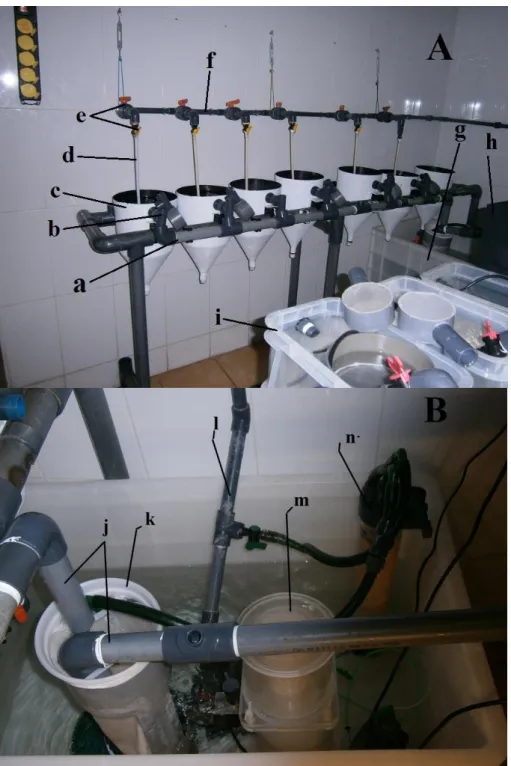
In the experiment, three different tanks were tested. The sump was common for all the tanks and was composed by a 50 µm mechanical filter placed in the discharging tube, biological media filter underneath the filter, a protein skimmer from Schuran, a sand filter from TMC and a ultra-violet filter of 8 watt from TMC in the inflow (Figure 2.1 A, B).
The larvae were fed once a day, in the morning, with newly hatched Artemia sp. (NHA) or enriched Artemia sp. (EA), depending on the trial, right after removing the
Artemia sp., a technique called drain the tanks. In order to evaluate the larval stage, the
tanks were drained and larvae were them accurately observed. All the post larvae were counted and removed from the tank. The figure 2.1 shows the larval system.
5
Figure 2.1:A:Schemefrom larval system of M. sculptus. a- discharging tube (outflow); b- outflow; c- tank; d- inflow
pipe (6 mm); e- water flow control faucets; f- inflow tube (25 mm); g- sump; h-cubic tank i- settlement table;B: Scheme from larval system sump. j-discharging tube (outflow); k- 50 µm filter bag; l- inflow; m- skimmer; n- sand filter.
6
2.2.1. Larvae survival dependence of the tank
In this experiment three distinct larval tanks were tested.
Two of the three larval tanks tested were adapted from Calado et al. (2003b) and Penha-Lopes et al. (2005). The other one was a cubic aquarium used in the company facilities, for the initial growth of other non-crustaceans species.
All the batches tested had the same larval concentration of 10 larvae L-1, and were fed, once a day, with the same food, newly hatched Artemia sp. nauplii in equal concentration (15 nauplii mL-1).
2.2.1.1. Cylindrico-conical tanks without settlement table
These tanks were adapted from Calado et al. (2003b). The differences between this system and the original, were the capacity of 10 liters instead 12 liters and the absence of the header tank. The water circulation was made directly from the sump to the top of each tank with the aid of a powerhead pump. Inside of each tank, was a 150 or 500 µm filters to prevent the larvae and Artemia sp. to escape and to allow only the Artemia sp. to escape, respectively (Figure 2.1A). The turnover of each tank was made every 40 minutes.
In this trial, the larvae were forced to settle-down in the tank, without any area of low turbulence.
2.2.1.2. Cylindrico-conical tanks with settlement table
This experiment was conducted using a system similar to the one by Penha-Lopes and his colleagues (2005). They used the same tank that Calado et al. (2003b) described but from the megalopa stage, transferred larvae to a PVC ring with a mesh in the bottom to facilitate the megalopa settlement before turning into a crab, called settlement table. This ring was first used by Tunberg and Creswell (1988). In this way, from the hatching day until megalopa the larvae were maintained in the tanks described by Calado et al. (2003b) and from megalopa until the metamorphosis in the tanks designed by Tunberg and Creswell (1988).
7 Each tank was fed in three different places to avoid dead areas with a turnover of 1.5 hour-1 (Figure 2.2). The tanks were sort out on the 12th day of the experiment and the larvae, already in megalopa stage, were transferred to the settlement table. The larvae larval stage was determined according to what Rhyne et al., (2006) described about M. sculptus larvae development.
Figure 2.2- Scheme from settlement tables. a- settlement table; b- inflow; c- water control faucet; d- PVC ring; e-
discharging tube (outflow); f- main discharging tube (outflow).
2.2.1.3 Cubic tanks
Glass cubic tanks, 29 cm laterals, with an approximate volume of 24 L, were used in this experiment. The tanks were connected to the sump used to filter the water of all the larval tanks (Figure 2.3). The water feeding facility was a 10 mm L-shaped, multi-hole tube placed in the right corner of the tanks. The outflow was positioned in the middle of the front glass with a 150 µm or 500 µm, as described previously for the other trials.
8
Figure 2.3- Scheme from a cubic tank. a- inflow; b- L-shaped, multi hole tube; c- tank; d- outflow 150 µm filter; e-
500 µm drain filter.
2.2.2 Effect of food concentration in larval survival
In order to evaluate the effect of food concentration in larval survival, three different concentrations of Artemia sp. nauplii: 5 nauplii mL-1, 7 nauplii mL-1 and 15 nauplii mL-1 were tested. The tank used was the one with the best results in the tank shape experience. The Artemia sp. used to feed the larvae was newly-hatched artemia (NHA). As in all the other trials, these tanks were fed once a day, in the morning.
2.2.3 Food quality in larval survival
In this trial, three types of food were tested, newly born Artemia sp., enriched
Artemia sp. metanauplii (EA) and a mix of them (newly-hatched in the first 8 days of
9 enriched with Algamac 3050™ (Biomarine®; Aquafauna). In this experiment it was also used the same type of tanks that gave the best results in the type of tank experimentation. The nauplii concentration used for all the batches, was the one that gave the best result from the previous experience –testing nauplii concentrations.
2.3 Statistical analysis
Survival at the end of the experience (day 17) was compared between the treatments. The percentage of megalopa and crab at the end of each experience, was also compared. In order to statistically compare the treatments, it was used a Kruscal-Wallis test with the formula:
∑ ( ) and H is compared to X2α,a-1 for the test of significance.
3. Results
3.1. Larvae survival dependence of the tank
At the end of the experiment, the overall survival was lower than 10% in all treatments. Although survival was not significantly different between tanks (P>0.20), the cylindrico-conical tank without settlement table had the best results with 5% survival. Survival results from cubic tanks were the lowest, showing only 1% survival (table 3.1).
The settlement results were neither better nor significantly different, as shown in the table 3.1.
As well as survival, the best settlement result was obtained in the tank without settlement table. So, as the best tank, it was chosen for all the other experiments.
10
Table 3.1- Survival and settlement rates of M. sculptus larvae in three different tanks.
The values are percentage ± SD.
3.2. Effect of food concentration in larval survival
This trial was made with the tank that showed best results (without settlement table).
For the three Artemia sp.naulpii concentrations tested, the one that showed best survival results was 7 nauplii mL-1, however it wasn‟t statistically significant (Table 3.2). However if we look to the settlement values, this food concentration is no longer the best one, as the trial 15 nauplii mL-1 had better results with 4% of settlement (Table 3.2). The settlement values aren‟t statistically significant also.
Table 3.2- Survival and settlement rates of M. sculptus larvae feed in three different nauplii
concentration.
The values are percentage ± SD.
3.3 Effect of food quality in larval survival
In this trial there weren‟t significantly different results, neither for the survival nor for the settlement (Table 3.3). However, the best results for the survival were obtained
Tank survival p-value settlement p-value
without table 5.00 ± 3.46 4.00 ± 3.60
with table 4.67 ± 7.23 1.33 ± 1.52
cubic 0.67 ± 1.15 0.00 ± 0.00
0,202 0,096
Tank Survival p-value Settlement p-value
5 na/ml 2.33 ± 1.53 0.00 ± 0.00
7 na/ml 8.33 ± 4.04 0.67 ± 0.57
15 na/ml 5.00 ± 3.46 4.00 ± 3.61
11 when the larvae were fed with enriched Artemia sp. (EA) with 14.33% survival, the best of the results. The same result was acquired for the settlement, but this time with 4.67% settlement.
As this trial was the last one, it was made with the tank that showed the best survival results and the best Artemia sp. concentration. So, it was expected to obtain a better survival rate. In fact, it really occurred, since the trial fed with EA was the best with 14.33% survival and 4.67% settlement.
Table 3.3- Survival and settlement rates of M. sculptus larvae fed with three different type of food.
The values are percentage ± SD.
NHA- Newly Hatched Artemia sp.; EA- Enriched Artemia sp.;
4. Discussion
The only data published for M. sculptus larvae culture is from Calado et al. (2003b) and Rhyne et al, (2005). The majority of the researchers work are on similar species like
M. forceps (Penha-Lopes et al., 2005; Figueiredo et al., 2008a; Figueiredo et al., 2008b;
Penha-Lopes et al., 2007; Penha-Lopes et al., 2006;). The work that compares survival data between the two species, M. forceps shows higher survival rate (Rhyne et al., 2005).
Although none of the results were statistically significant, in large scale production every individual counts and decisions has to be taken. Sometimes there are no significant results between two tanks or two different food concentrations, but we have to choose one, as it happened in this experience.
The term survival rate encompasses both megalopa and first instar crab (larvae) that are alive at the end of the experience. Settlement rate only includes the post-larvae alive at the end of the experience.
Tank Survival p-value Settlement p-value
NHA 8.33 ± 4.04 0.67 ± 0.58
EA 14.33 ± 4.04 0,099 4.67 ± 3.79 0,134
12
4.1. Larvae survival dependence of the tank
The tanks used by Calado et al. (2003b) for culturing M. sculptus larvae, named in the present work as tanks without settlement rings, showed the best results, in the current work. However, the results presented by Calado et al. (2003b) were better than the best survival rate obtained in this trial (5 %), as they obtained 22.1 % survival rate. One possible explanation for this great difference may be the use of Artemia sp., instead of rotifers used by Calado and his coworkers (2003b). The decision to use Artemia sp. instead of rotifers was made on the fact that rotifer culture needs much more care to have healthy cultures than Artemia sp. cultures. Another reason to use Artemia sp. is that rotifers clog up the outflow filters very fast, which leads to frequent filter changes, to prevent water flood and larvae lost. The difference between survival rate and settlement rate isn‟t significant for the tank without settlement table. This means that most of the larvae that survived (5.00%) made metamorphosis (4.00% of the total).
The tanks with settlement rings were previously tested by Penha-Lopes et al., (2005) for M. forceps. Here again, the results we behind our expectations, 4.7 % survival against 50.8 % from Penha-Lopes et al., (2005). In their trial, Penha-Lopes et
al., (2005) used 10 larvae L-1 and fed with NHA at a concentration of 7 nauplii mL-1. The difference between our work and Penha-Lopes et al., (2005) was the crab specie which is of great importance. This tank revealed problems in handling the larvae, since it takes a great deal of manipulation to transfer larvae from the cylindrico-conical tank to the settlement ring; so it can be aggressive for the larvae, leading to an increase in mortality. This is clear by the difference between the survival rate (4.7 %) and the settlement rate (1.3 %) we obtained.
The main difference between the first tank and the ring is the water circulation: in the first, the water flows up carrying the larvae to the surface, and they move down along the central tube; in the second tank, the water flow down pulling larvae against the ring net. This may influence the capacity of larvae to prey on Artemia sp. delaying metamorphosis, since this step requires a lot of energy, because larvae may focuses all energies to searching for a suitable substrate to settle (Rhyne et al., 2005).
In the cubic tank tested, we only reached 0.7% survival and no settlement. This may be due to the water movement in the tank. Although water has an upwelling movement, since tank walls are vertical, it prevents the larvae movement and larvae stay on the bottom. This fact may conduct to starvation since there is no access to food in the
13 water column; the water movement isn‟t uniform and causes some dead spots in the tank. These dead spots cumulate dead larvae, dead Artemia sp. and larvae waste, acting as traps for larvae, causing their death.
Calado et al., (2008) made a study for three species of shrimp (Lismata debelius,
Lysmata seticaudata, Stenopus hispidus) and two species of crab (Stenorynchus seticornis, Clibanarius erythropus), in which they tested a new cylindrico-spherical
tank instead of the traditional cylindrico-conical. The survival rates increased significantly. The water movement in the cylindrico-spherical tank is quite different from the cylindrico-conical, getting a better upwelling current to the larvae (Calado et
al., 2008).
To conclude, in the initial part of our larvae culture, a cylindrico-conicalshape tank decreases the larvae collision in the tank walls and increases the survival rate (Calado et
al., 2003b; Calado et al., 2008). The settlement table tank that gave good results for M. forceps (Penha-Lopes et al., 2005), didn‟t proof well for our experiments with M. sculptus. It showed some disadvantages in the handling of the larvae, which may causes
stress and possible damages. If used in large scale, handling the larvae isn‟t viable, because it takes too much time.
4.2 Effect of food concentration in larval survival
Previous studies showed that the food concentration can influence larvae feeding and consequently survival (Rhyne et al., 2005; Penha-Lopes et al., 2005; Penha-Lopes
et al., 2006).
In our trial three food concentrations of Artemia sp. nauplii were tested, 5 nauplii mL-1, 7 nauplii mL-1 and 15 nauplii mL-1. There was the need to test a low 5 nauplii mL
-1
concentration since for industrial purposes less food spent, means more money saved. This is very important in large scale culture, where the Artemia sp. costs can represent a large percentage of the total production expenses. Also, Calado et al., (2003b) used 5 metanauplii mL-1 in larval growth of M. sculptus starting from the second larval stage.
The 7 nauplii mL-1 concentration was used because it was referenced as one of the best concentration in literature (Rhyne et al., 2005; Penha-Lopes et al., 2005).
The 15 nauplii mL-1 concentration was tested because it is used by the company in other crustacean larvae culture with great results.
14 Rhyne et al., (2005) used a concentration of 7 nauplii mL-1 in their studies with M.
sculptus, reaching a maximum of 25.7% survival rate after metamorphosis to crab. The
best survival result obtained in our experience, used a concentration of 7 nauplii mL-1, although not significantly different from the other two. Comparing results, our trial got lower survival rate (8.33%) than Rhyne et al., (2005). However, it is important to emphasize that they used wild ovigerous females to obtain larvae, while in this trial females were in captivity. Females in captivity didn‟t have their natural food (bubble algae Valonia sp.). This could have great influence in larvae quality and consequently in larvae survival. As captive broodstock were fed with fish food, it certainly has different and non-optimum nutritional values, such as fatty acids. As it happens in fish, this difference may possibly reduce larvae quality (Izquierdo et al., 2001).
Penha-Lopes et al., (2005), made a similar experience with M. forceps, where they tested 4 different food concentrations (1 nauplii mL-1, 4 nauplii mL-1, 7 nauplii mL-1 and 12 nauplii mL-1). Their best result was 62.13 % survival rate with 7 nauplii mL-1. In our trial, for this food density, the survival rate only reached 8.33%. However, only 0.67% of the total larvae made metamorphosis and reached juvenile stage. This means that, besides being the higher survival rate, only 2 larvae reached metamorphosis. This can be explained by the lack of substrate to settle (Penha-Lopes et al., 2005) or by the deficient nutrition (Izquierdo et al., 2001). However, in the tank experience, the best result was reached in the tank without settlement table, going against the literature data (Penha-Lopes et al., 2005).
With the 15 nauplii mL-1 concentration we didn‟t reach a significantly higher survival or settlement rate. Nevertheless, the settlement rate was the higher (4%), and the difference between survival and settlement was only 1%, giving a good settlement rate. Although much higher than the one in this trial, Penha-Lopes et al., (2005) presented higher settlement (62.3 %) with a similar prey concentration (12 nauplii mL
-1
), for M. forceps. This might mean that in some larval stage, a higher food concentration is needed in order to fulfill larvae nutritional requirements. Another possible explanation is that larvae might need higher prey density when metamorphoses begin. However, as our data aren‟t significant, none of this can be stated.
The 5 nauplii mL-1 concentration trial didn‟t get positive results, with only 2.33% survival rate and 0% settlement. Penha-Lopes et al., (2005) tested lower food concentrations like 1 nauplii mL-1 and 4 nauplii mL-1 for M. forceps and the results weren‟t the best (8.9% and 41.2%, respectively). For M. scuptus there are no data for
15 similar food concentration but this experience shows that despite being economically better, 5 nauplii mL-1 aren‟t viable for larvae development.
4.3 Food quality in larvae survival
The importance of a suitable nutrition in larvae growth has been studied for a long time, with emphasis on Artemia sp. (Sorgeloos et al., 1998). Different types of food have been tested in the last years, in order to reduce production costs and increase larvae survival (Rhyne et al., 2005; Penha-Lopes et al., 2006).
In our final trial, the higher survival and settlement rate (14.33% and 4.67%, respectively) were obtained. However, once again, there were no significant differences between the treatments.
The results achieved with the NHA trial remained in the line of the previous experiences, low survival rate (8.33%) and even lower settlement rate (0.67%). Rhyne
et al., (2005) studied the influence of larval nutrition in M. scupltus growth and the best
result was reached with EA. They used Algamac 3050™ (Biomarine®; Aquafauna) to enriches Artemia sp.. Despite this, their results with NHA were similar. Penha-Lopes et
al., (2006) tested different food types (NHA, frozen NHA, commercial pellets, Amphora spp., NHA plus Frozen NHA, NHA plus Amphora spp.) for M. forceps larvae,
and their best results were for the NHA trial. However, they hadn‟t tested any EA. As stated above, our experience best result is with EA, which means that M. sculptus larvae can eat Artemia sp. metanauplii from their initial stage. This is important, in order to prevent the use of rotifers in the first larval stage, like Calado et al., (2003b) did. However, as larvae could require smaller food than EA in the first two zoe stages, NHA was supplied used until larvae reach megalopa stage (8 days after hatching) and EA from megalopa stage until the end of the experience. However, the survival rate was lower than the obtained in the EA trial (6.33% against 14.33%). As Sorgeloos et al., (1998) wrote in their review paper, Artemia sp. starts losing its nutritional value from the moment it hatches. That could be an explanation for the small survival and settlement rates. When larvae eat EA, that lack of nutritional value is reduced and an increase of survival is observed. Despite the lack of previous studies, better results should be observed when larvae are fed first with NHA and then EA. This would be
16 expected because in the first two zoe stages, larvae are small and could have more difficulty to fed, although they do.
As larvae need some substrate to grab and make metamorphosis, a possible idea consists in putting a rock inside the tank, so that larvae can grab, as it happens in the wild. This thought is impossible to execute when the purpose is large scale production. When post-larvae crab holds on the rock, they hide in the cavities, making the handle without killing any larvae an impossible mission. Well, in large scale production, every individual counts and sorting out in order to count crabs it is important. As first instar crabs have around 1mm carapace length, handling them is a difficult job when they are in rock cavities (Rhyne et al., 2006). Another difficult observed in post larvae crabs is due to their aggressiveness, even with shelters, they kill on each other until only one remain alive. This goes against the literature data (Lopes et al., 2007; Penha-Lopes et al., 2006). However, previous studies were made for M. forceps juveniles, leading us to admit that M. sculptus could be more aggressive and cannibalism could occur more frequently. More studies are needed to understand the responses of juveniles crabs to different stocking densities.
Further studies are needed to better understand the larval culture of M. sculptus and thus increase the survival and settlement rate. Regarding nutrition, larvae should be fed more frequently along the day. This should allow them to always feed on „fresh‟
Artemia sp., reducing its metabolic nutrient consumption and so approaching the
optimal larvae nutritional values (Sorgelos et al., 1998). In the case of food concentration, there are several studies published and 7 nauplii mL-1 seems to be the best one. It showed good results and it is economically profitable. In future studies, the cylindrico-spherical thank (Calado et al., 2008) should be tested in order to see if the increase observed for shrimp larvae survival is also observed for M. sculptus larvae.
Aquaculture is the future for tropical marine aquarium trade, and further studies are needed to better understand the traded species reproduction and larvae culture.
17 5. References
Calado, R., Lin, J., Rhyne, A., Araújo, R., Narciso, L. (2003a). Marine ornamental decapods-Popular, pricey, and poorly studied. Journal of crustacean biology 23(4), 963-973.
Calado, R., Narciso, L., Morais, S., Rhyne, A., Lin, J. (2003b). A rearing system for the culture of ornamental decapod crustacean larvae. Aquaculture 218, 329-339.
Calado, R., Pimentel, T., Vitorino, A., Dionísio, G., Dinis, M. (2008). Technical improvements of a rearing system for the culture of decapod crustacean larvae, with emphasis on marine ornamental species. Aquaculture 285, 264-269.
Coen, L. (1988). Herbivory by crabs and the control of algal epibionts on Caribbean host corals. Oecologia 75, 198-203.
Figueiredo, J., Penha-Lopes, G., Narciso, L., Lin, J. (2008a). Effect of starvation during late megalopa stage of Mithraculus forceps (Brachyura: Majidae) on larval duration, synchronism of metamorphosis, survival to juvenile, and newly metamorphosed juvenile size. Aquaculture 274, 175-180).
Figueiredo, J., Penha-Lopes, G., Lin, J., Narciso, L. (2008b). Productivity and profitability of Mithraculus forceps aquaculture. Aquaculture 283, 43-49.
Gasparini, J., Floeter, S., Ferreira, C., Sazima, I. (2005). Marine ornamental trade in Brazil. Biodiversity and conservation 14, 2883-2899.
Green, E., 2003. International trade in marine aquarium species: using the global marine aquarium database. In: Cato, J.C., Brown, C.L. (Eds.), Marine Ornamental Species: Collection, Culture and Conservation. Iowa State Press, Iowa, USA, 31–47.
Izquierdo, M., Fernández-Palacios, H., Tacon, A. (2001). Effect of broodstock nutrition on reproductive performance of fish. Aquaculture 197, 25-42.
Livengood, E. & Chapman, F. (2007). The ornamental fish trade: An introduction with perspectives for responsible aquarium fish ownership. University of florida IFAS Extension, FA124.
Penha-Lopes, G., Rhyne, A., Lin, J., Narciso, L. (2005). The larval rearing of the marine ornamental crab, Mithraculus forceps (A. Milne Edwards, 1875) (Decapoda: Brachyura: Majidae). Aquaculture research 36, 1313-1321.
Penha-Lopes, G., Rhyne, A., Lin, J., Narciso, L. (2006). Effects of temperature, stocking density and diet on the growth and survival of juvenile Mithraculus forceps (A. Milne Edwards, 1875) (Decapoda: Branchyura: Majidae). Aquaculture research 37, 398-408. Penha-Lopes, G., Figueiredo, J., Narciso, L. (2007). Modelling survival and growth of
Mithraculus forceps’ larvae and juveniles (A. Milne Edwards, 1875) (Decapoda: Branchyura: Majidae) in aquaculture. Aquaculture 264, 285-296.
18 Pomeroy, R., Parks, J., Balboa, C. (2006). Farming the reef: is aquaculture a solution for
reducing fishing pressure on coral reefs? Marine Policy 30, 111-130.
Rhyne, A., Penha-Lopes, G., Lin, J. (2005). Growth, development, and survival of larval Mithraculus sculptus (Lamark) and Mithraculus forceps (A. Milne Edwards) (Decapoda: Branchyura: Majidae): economically important marine ornamental crabs. Aquaculture 245, 183-191.
Rhyne. A., Fujita, Y., Calado, R. (2006). Larval development and first crab of Mithraculus sculptus (Decapoda: Branchyura: Majoidea: Mithracidae) described from laboratory-reared material. Journal of the Marine Biological Association of the United Kingdom 86, 1133-1147.
Sorgeloos, P., Coutteau, P., Dhert, P., Merchie, G., Lavens, P. (1998). Use of brine shrimp, Artemia spp., in larval crustacean nutrition: a review. Reviews in fisheries science 6, 55-68. Tlusty, M. (2002). The benefits and risks of aquacultural production for the aquarium trade.
Aquaculture 205, 203-219.
Tunberg B. & Creswell R. (1988). Early growth and mortality of the Caribbean king crab Mithrax spinosissimus reared in laboratory. Marine Biology 98,337-343.
Vaz, M., Rocha-Santos, T., Rocha, R., Lopes, I., Pereira, R., Duarte, A., Rubec, P., Calado, R. (2012). Excreted Thiocyanate detects live reef fishes illegally collected using Cyanide-A non-invasive and non-destructive testing approach. PLoS ONE 7(4): e35355.