SUMMARY
The highest number of broilers is reared in the intensive fattening system on the floor with litter. Besides the intensive systems some sustainable rearing ways are also brought forward (ecological, biologic-dynamic, organic, etc.). The aim of this study was to establish the possible differences in resting behaviour of broilers in three rearing systems: intensive on the floor, free range, and organic system. The results showed great varieties between intensive and less intensive systems. In the intensive system on the floor animals rested statistically highly significantly more than in other two systems. However no differences in the behaviour of broilers in the stall were noticed, ifcompared to broilers in free range and those in the organic system. Comparison of the outdoor area showed that broilers rested statistically significantly more in the organic system. The reasons for different resting behaviour could be in leg weakness, body weight, group size, health problems, age, housing system, etc. Our research did not confirm our hypothesis that the older broilers rest more.
KEY WORDS
broilers, resting behaviour, rearing systems
Resting Behaviour of Broilers in Three
Different Rearing Systems
ACKNOWLEDGEMENT
We wish to acknowledge to Mrs. Karmela Malinger for proof reading the manuscript.
M. ZUPAN1 J. BERK2
F. ELLENDORFF3 M. WOLF-REUTER3 D. ÈOP4
A. HOLCMAN4 I. ŠTUHEC4
1 Centre for proper housing: poultry and rabbits Burgerweg 22, CH - 3052 Zollikofen, Switzerland
2 Institute for Animal Welfare and Animal Husbandry (FAL) Doernbergstr. 25-27, D-29223 Celle, Germany
3 Institute for Animal Science (FAL) Höltystr. 10, D-31535 Neustadt, Germany 4 University of Ljubljana, Biotechnical Faculty, Department of Animal Science
SI - 1230 Domžale, Slovenia
INTRODUCTION
The same as in other farmed species, housing of broilers, especially alternative housing systems with the enriched environment (free access on pasture, covered free range with litter) contribute to better welfare, therefore it is getting more and more important. In intensive rearing systems the species specific or normal behaviour is limited. The behaviour pattern of broilers is further effected also by the intensive selection for growth rate. In intensive systems on the floor the rapid growth rate of muscle in fast growing broilers causes health problems (leg weakness, heard attack, etc.). Such conditions prevent animals to satisfy their natural needs or to develop their behaviour repertoire. In less intensive housing systems the stock density is lower, animals have the possibility of roaming outside and this provides better welfare conditions and normal behaviour.
Animals rest in lying, sitting or standing position. During the light period of the day, time spend for resting is divided into many short periods of sitting and lying. Despite of light duration and stock density the time spent for resting and lying has increased up to 80-90 % of the whole day in an intensive indoor environment on the ground (Scherer and Rist, 1987). Resting time is relative with the age of animals. With increased age animals spend more time lying (Bessei, 1992, Weeks et al., 2000, Lindner and Hoy, 1996). In some studies it was reported that in chickens reared on the litter the important portion of the day time was spent for resting (standing, sitting). For example, Blount (1969) found that at the age of one week the same short intervals were used for resting and feeding. At the age of four weeks the time for resting behaviour doubled. In 24 hours five weeks old chickens Ross 308 spent 76 – 86 % time lying, which means sleeping, or were in the resting stage (Weeks et al., 2000). The percentage increased also if animals had walking difficulties. These animals spent more time lying, usually with one leg extended rectangular from the body. The percent of resting could be influenced also by body weight and fast growth rate of broilers. It is surprising that Weeks et al. (2000) compared the Ross strain on the litter and on free range environment between 10:00 and 11:00 hour from the age of four weeks till ten weeks and found no statistical differences. On the average animals were resting in lying position 76.3 % in both systems.
The goal of our research was to find out if there are any differences in the resting behaviour of broilers in three rearing systems: intensive on the floor, free range and organic system.
MATERIALS AND METHODS
Behaviour of four different commercial broiler proveniences (Ross, Lohmann Meat, Cobb and Isa) were observed in three different rearing systems (intensive system on the floor, free range system and organic system). The basic characteristics of the intensive system on the floor are rearing in the stall with litter and without a run, fast growing strains of broilers, usually artificial light, high stock density (17-18 a./m2 or 35 kg/m2; in our stalls on average 24.15 a./m2) and large group sizes (10,000-25,000 animals; in our experiment on average 27,750 animals). The broilers are usually reared till the age of six or seven weeks (in our stalls on average till the 37 day). In other two systems with a run the slow growing strains of animals are used and stock density in an indoor environment is lower: free range system (13 animals or 27.5 kg/ m2, in our stalls on average 14.6 a./m2), organic system (10-16 animals or 21-30 kg/m2, in our stalls on average 9.2 a./m2). In the outdoor environment the stocking density was: free range system 1 m2 or more/animal (the same as in the directive for free range system), organic system 10 m2/animal (in the directive 2.5 or 4 m2/ animal). In free range system the rearing period ends at the animal age of56 days or later and in organic system at 81 days or later. Animals in the organic system have to befed with organic produced forage.
Broilers were housed in eleven distinctive stalls where both sex were reared together. The stalls were positioned in three locations in Germany: Niedersachsen, Nordhein-Westfalen and Hessen. In the intensive system fast growing commercial breeds Cobb and Ross were housed in two stalls. The broilers of the fast growing commercial breed Lohmann Meat and the slow growing commercial breed Isa were housed in a free range system also in two stalls. In the organic system chickens of slow growing commercial breed Isa were housed in seven stalls. Broiler resting behaviour was recorded on 18 videotapes in winter and summer time. The recorded surface measured 1 m2 in the indoor and 4 m2 in the outdoor environment. The places, where broilers were recorded, were determined in the whole indoor and outdoor area. In the stalls animals were observed with Time-sampling method every 20 minutes between 8 and 17 hour and outdoors between 11 and 15 hour. During the recording broilers were three and four weeks old in the stalls, whereas in the outdoors environment their age was five, six or eight weeks. Till the age of four weeks, the animals of all three systems were permanently kept in the stall.
UNIVARIATE we tested normal distribution for our quantitative feature and we used Shapiro-Wilk test. Using GLM procedure we estimated the differences between rearing systems and between the age of animals.
The frequency of resting behaviour in broilers was expressed as the percentage rate of daily collected data. Data were analysed by means of statistical model, using two formulae, which included fixed influences of age and rearing system. For the indoor environment formula 1 was used (Ai,i= 1,2; 1= 3 weeks, 2= 4 weeks, Bj, j= 1,2,3; 1=intensive system on the floor, 2= free range system, 3= organic system) and for the outdoor environment we used formula 2 (Ai,i= 1,2,3; 1= 5 weeks, 2= 6 weeks, 3= 8 weeks), Bj, j= 2,3; 2= free range system, 3= organic system).
Models:
1. yij = µ + Ai + Bj + eij 2. yij = µ + Ai + Bj + eij
RESULTS AND DISCUSSION
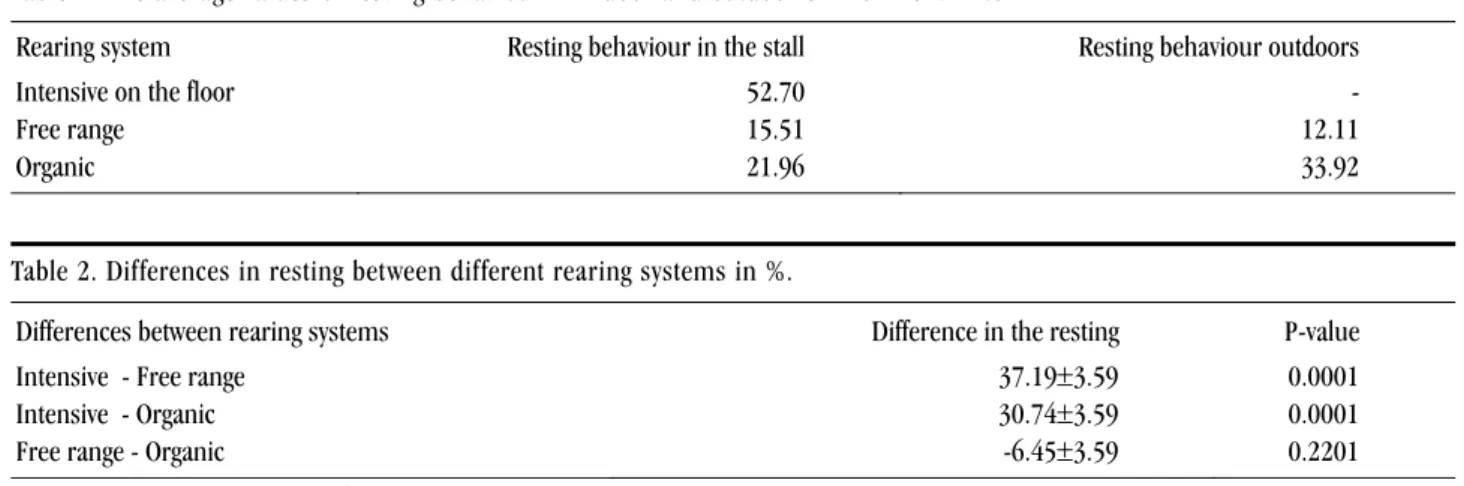
The resting behaviour of broilers in three different rearing systems is presented in indoor, whereas free range and organic systems are regarded also as outdoor environment. For the outdoor area there was only possible to compare two rearing systems: free range and organic. The average values of resting behaviour in indoor and in outdoor environment for different rearing systems are presented in Table 1.
The highest percent of resting was noticed in the intensive system on the floor (52.70 %) and the lowest (15.51 %) in the free range system. Outdoors the animals rested for a longer period of time in the organic system compared to free range, were resting was again higher (33.92 %) outdoors than in the stall (21.96 %).Figure 1 shows the share of resting in the stall.
As can be seen from Figure 1, the highest percent of broilers rest in intensive broiler fattening system on
the floor (42.16 % to 61.78 %). Scherer and Rist (1987), Weeks et. al. (2000) estimated even higher percent of daily resting time. This can be the consequence of the higher age of animals in their studies.
The percent of resting was lowerin both rearing systems with the run. The lowest percent in free range system was between 11 and 12 hours (5.09 %) and in organic system between 12 und 13 hours (6.05 %). The differences in resting behaviour between broilers in three rearing systems are shown in Table 2. Resting behaviour shows great variety.
The differences of resting between intensive system on the floor and free range as well organic system were statistically highly significant. The cause for the highest percent of broilers resting in intensive system on the floor can be the highest stock density (on average 24.15 animals/m2, in free range 14.6/m2 and in organic 9.2/m2) and therefore an inhibition of movement is expressed. Nevertheless, the broilers themselves have an influence on behaviour, because there are differences between slow and fast growing strains.
The differences in resting frequency of broilers in the age of three and four weeks are presented in Table 3. The only statistically significant difference between ages was in free range system, where three weeks old animals rested more than the four weeks ones. Our results did not show the tendency of increased resting behaviour in older animals and are in contradiction with the findings of Bessei (1992), Weeks et. al. (2000), Lindner and Hoy (1996), who reported, that the time spent for resting increases relatively with the age of animals. In their investigations they compared animals whose age difference was bigger than in our investigation and consisted of ten or more days. Perhaps our results would be different, if we compared broilers at the same age as they did.
In the outside area not many animals were recorded and sometimes it happened, that no animals were within the observed surface. The reason can be in a different location of recording. Most animals usually
!" #$ %%#
&"' &" (
%#r%#
!" %)r%#
!" $)r%#
(d" "
Table 1: The average values of resting behaviour in indoor and outdoor environment in %
gathered near the door, not going out to the open grassland.
Between the curves presenting resting behaviour of broilers, which rested in the outside area in two rearing systems, a great variety can be seen. The
curves are shown in Figure 2. In organic system the percentage of resting animals was higher than in free range system and it was increased from 11 to 13 hour, when it reached the peak (39.73 %) and started to decrease up to 31.45 %. In free range system most Figure 1. The average portion of broilers resting in the stall
in three different rearing systems (three and four weeks old broilers).
± ± ± ± ± ± ± ± ±
7LPHK
3RUW
LRQ
RI
DQL
P
DO
V
LQWHQVLYH IUHHUDQJH RUJDQLF
7LPHK
3RU
WL
RQ
RI
DQL
P
DO
V
Figure 2: The portion of broilers resting outdoors in two different rearing systems (five, six and eight weeks old
broilers).
Table 3. Resting behaviour of broilers in different rearing systems at 3 and 4 weeks of age.
+ &"," (
%'* )'* -.
$ )#) $#r))/ ))
/ $r)%/
!" $$# % )r% $
(d" "
Table 4. The share of resting outdoors in two different rearing systems (%) at five, six and eight weeks old broilers.
Table 5. Differences in the share of resting animals outdoors at the free range system between different ages of broilers (above diagonal (%); below diagonal are P-values).
Table 6. Differences in the share of resting animals outdoors at the organic system between different ages of broilers (above diagonal (%); below diagonal are P-values).
2 (
!" %%#
&" /r)/ )
(d" "
+ [ +
-. '* $'* /'* '* # $$r %//r $'* /$ // /r /'* /% % $)
+ [ +
-. '* $'* /'*
'* ) $#$r/$ %%r/$
$'* /$ %$ %$r/$
/'* %$ %)%# %%
animals were resting between 11 and 12 hour (15.30 %) and between 13 and 14 hour (18.25 %). The difference among systems with a run was statistically highly significant. It can be seen in Table 4.
The animals in the organic system rested more. As seen in Table 5, age did not have statistically significant influence on resting behaviour of broilers in the free range system, although the percent of broilers resting in the outside area was increasing with age. On average most animals rested within the age of eight weeks (25.83 %) and the least within the age of five weeks (1.95 %).
Between the age of five, six and eight weeks there were no similar results in organic system compared to free range system (Table 6). Between five and six weeks of age resting behaviour of broilers statistically significantly decreased (P= 0.0361). On average the highest percent of resting broilers was presented at the age of five weeks (45.02 %) and the lowest at the age of six weeks (18.06 %).
CONCLUSIONS
Broilers are mostly reared in the intensive system on the floor, where the animals have less possibilities for normal behaviour. The deviations from normal behaviour are indicators of poor animal welfare. The purpose of the present research was to observe the resting behaviour of broilers in three different rearing systems (intensive fattening on the floor, free range, and organic system) and to compare this behaviour between them. For the observation purposes video recordings were made in the summer and winter period and the time-sampling method was chosen.
On the base of our results it was concluded that broilers in the intensive fattening system on the floor rested statistically highly significantly more than broilers in free range and in organic system. Resting behaviour of broilers between less intensive systems in the stall was not statistically significantly different, although in the outside area, broilers in the organic system rested statistically more than those in free range system. Age had little influence on the resting behaviour in less intensive systems. There are some differences between resting in the stall and outdoors. In the free range system broilers rested in the stall statistically less at the age of four weeks compared with the age of three. In the run of organic system animals showed more resting behaviour at five than at six weeks of age.
REFERENCES
Bessei W. 1992. Das Verhalten von Broiler unter intensiven Haltungsbedingungen. Archiv für Geflügelkunde, 56,1: 1-6
Blount W.P. 1969. Behaviour Studies in Chicks up to Four Weeks Old. British Veterinary Journal, 125, 1: 50-52
Lindner R., Hoy S. 1996. Ergebnisseethologischer Untersu-chungen bei Masthähnchen auf Stroheinstreu bzw. Tief-streu aus Holzhackschnitzeln. Archiv für Geflügelkunde, 61, 2: 49-52
Scherer P., Rist M. 1987. Verhalten von Broilern. Nemèija, KTBL- Schrift 319: 237-248
The SAS System for Windows. Release 6.12.Cary, SAS Insti-tute, 1996
Weeks C.A., Danbury T.D., Davies H.C., Hunt P., Kerstin S.C. 2000. The Behaviour of Chickens and its modification by lameness. Applied Animal Behaviour Science, 67: 111-125