Learning History implies the acquisition of historical and social concepts, analyzing its mu-tual relationships in the explanation of historical change. The comprehension of Industrial Revo-lution in England requires the use of at least four main concepts: Agrarian Revolution, Demogra-phic Increase, Technological Innovations and the need of Accumulated Capital. The understan-ding of these concepts and the establishment of its relationships is a quite demanding cognitive task. Therefore, the crucial role of working me-mory in these cognitive processes is hypothesi-zed.
This paper presents a study on the teaching and learning of this subject matter by first-grade of high school subjects. The main objective of
this study was to analyze the process of un-derstanding and acquisition of this complex subject, testing the influence of three variables: working memory capacity, prior knowledge and attitude for meaningful learning. Pretest exami-ned subject’s knowledge of some basic concepts and their ability to describe and explain the phenomenon, as well as to summarize and comment a text and to represent their knowledge by means of a concept map. Differences in wor-king memory capacity were controlled by means of the reading span test. Finally, subject’s attitu-de for meaningful learning was tested on line using an observation record. Teaching was deve-loped during 6 classes following the usual sche-me and sche-methodology focused on reaching a gra-dual and overall understanding of the phenome-non. Learning results were checked in a post-test where we used the same test than before. There was a highly significant increase in all the post-test measures. Students with higher reading span learnt more and better than students with lower reading span. Therefore, working memory seems to play a crucial role when our subjects are building up historical knowledge as to Industrial Revolution. The significant correlation between Análise Psicológica (1999), 2 (XVII): 241-252
Learning complex historical knowledge
at high school: The role of working
memory (*)
JUAN A. GARCÍA-MADRUGA (**)
TERESA FERNÁNDEZ-CORTE (***)
(*) A reduced version of this paper was presented in the Second International Seminar on History Learning and Instruction, that took place in the Universidad Autónoma of Madrid, in July of 1994, organized by Mario Carretero and James Voss.
(**) UNED, Madrid, Spain.
(***) Instituto de Bachillerato «San Juan de la Cruz», Madrid, Spain.
knowledge in pretest and post-test showed that pretest scores are a quite good predictor of post-test ones, as all the cognitive theories held. As to the attitude, its high correlation with both knowledge measures (pre and post-test) bears out our prediction about the relevant role of this variable. Finally the analysis of subjects concept maps in pretest and post-test confirmed an im-provement on subjects’ organization of know-ledge, increasing its levels of depth and con-nectivity.
1. INTRODUCTION
History has been usually considered as a ra-ther complex subject matter. This complexity can be easily shown when reading book titles such as that of F. Braudel’s The Mediterranean and the Mediterranean World in the times of Philip the Second, E. P Thompson’s The Making of the English Working Class or L. Kelly’s Wo-men in the French Revolution. No one would doubt these books being part in the same discipline, though dealing with distinct aspects, different periods, and being its viewed from dif-fering standpoints. The descriptions, conjectures, interpretations, and explanations that history books contain are grounded upon data sifted from diverse original sources, upon the argu-ments pieced together by other writers, also upon a thorough use of archives. The search for and use of historical evidence is made from a theoretical viewpoint that implies the use of differing concepts and theories within an expla-nation. Historians could thence be divided up into their various schools in the light of those theoretic and procedural options adopted in their working methods.
As might from this be imagined, the study of History has followed a rocky road on its long march to acceptance as a scientific discipline. History has also undergone the rigours of various ‘fashions’ that have at times come to question the very possibility of explaining the real world, it being argued here that the instruments of analysis available to the historian are out of phase, that many of their concepts are devoid of any validity or that it is simply impossible to scientifically understand either human societies or the changes they undergo (Fontana, 1992).
The innate complexity of History as a discipli-ne that we have here attempted to point up also has its bearing upon its being taught as a subject, though we do not in saying this wish to pretend that there are no differences as between the his-torian and those involved in the teaching-learning process. Though they share much, their work is in itself different being as it is subject to different restrictions and requirements.
History’s intellectual complexity makes itself felt in different ways for those who teach and such as learn. If he look into the viewpoint of those who teach the subject, this complexity shows itself in a twofold way, this born of a dis-cipline that offers various paradigms for its ela-borations on the one hand and on the other a need for such theoretical-practical skills as the teaching-learning process requires. In short, the teacher here must know the discipline so as to be able to make his choice when selecting the con-tent and at the same time must have an explicit theory about how in fact people construct their knowledge. The disciplinary options adopted by teachers favour certain ideas of History and set aside others. In much the same way as the histo-rian will own to his school of thought, teacher will to theirs either wittingly or not. Making choices consciously implies the difficulty of doing so amongst the various possible options available and of a need to keep abreast of the theoretical development of the subject to thus cut out, keep in or incorporate new ideas or old ones.
But this is not the only choice to be made. Teaching itself sets its own and other require-ments that spring from the «audience» for this activity and which call for further thought. The teaching process is aimed at certain learning individuals marked by their age, knowledge and willingness to learn who furthermore share me-thods of knowledge building in common with the rest of mankind. That the process should be as successful as could be hoped, there is a call for the establishing of a communication between teacher and learner and this must be done through language, namely that proper to the dis-cipline. However, to set up an inter-play and not a monologue, the teachers and learners must be at one as to the meaning of those concepts that are to be used to analyze and explain historical events to thus be able to follow any theoretical
reasoning as to these or elaborate their own hy-potheses. But student’s knowledge is slight, unformed and disorganized, and sometimes even wrong-headed. Thus one of the prime aims of teaching History is to reach an agreement with students as to meaning of the concepts that are to be used to, and so sharing the meanings, thus be able to set up a mutual dialogue. In short, the building up of knowledge means giving to concepts a sense that can grow more complex, more diverse as the concept itself meets with dif-ferent propositions and contexts. If the teaching process is not thought of as being directed towards giving concepts an ever more organized and complex meaning, we are not then speaking of the building up of human understanding but rather a brute acquiring of information. From this view, a line could then be drawn between mere information and knowledge proper in which the last would be hierarchically structu-red, would have a history of creation and affecti-ve connotations. On the other hand, mere infor-mation would be structureless and be proper to a kind of learning whose principal aims is any-thing but the achievement of meaningfulness (Novak, 1993).
In the light of the above, the difference bet-ween doing and teaching History must, it is to be hoped, be plain. Communication as between ex-perts, including teachers of History, is possible for all such understand the universe of discourse being used even if they at times disagree as to how it is being so used when making out certain historical explanations. The inter-play between a teacher and his pupils requires the step by step building up of conceptual meaning and the inter-relation between concepts present as within cau-sal explanations, as to implications and the con-sequences of historical events.
For the student, History’s intellectual comple-xity derives above all from the degree of abs-traction inherent in much of the concepts used, from the numerous inter-related variables used to explain phenomena, from the reference to periods of time of great length as against brief periods (as the Annales school used to say), from the inescapable need for using written sources be these primary, secondary or just text books, this posing the adolescent a call to handle and comprehend this sort of material. The growing concern with the problems thrown up
by history teaching and the poor results shown from such learning is giving rise to a host of stu-dies which try to explain away these failings from a psychological standpoint as from within the general field of learning theories and, more recently, from the search for the links between disciplinary constructs and the teaching-learning in this subject (see, for instance, Carretero y Voss, 1994; Wineburg, 1991). As yet the fin-dings to be drawn are, in our opinion somewhat scant, this perhaps due to some degree to psy-chologists having been the first to take up the question whilst the discipline’s own experts have stood aside from the task.
2. EXPERIMENTAL STUDY
Our task was centered upon teaching and learning as to «The Industrial Revolution in England». Working upon a theme of this com-plexity, understanding it in depth the analysis of the differing factors to its beginnings and the outcome of it as a whole calls for a full play of the pupil’s cognitive resources. The understan-ding and assimilation of its new contents is thus limited by the capacity and processing efficiency of the student’s working memory. The central role that the working memory must play in any learning based upon the linguistic understanding of a subject matter of this complexity is high-lighted by many findings that tie in the working memory with a whole series of cognitive activities amongst which language comprehen-sion stands out above all (see, for instance, Da-neman & Carpenter, 1980; Gathercole & Badde-ley, 1993).
2.1. Teaching Objectives and Methodology Our first teaching objective was to achieve a comprehensive understanding of that phenome-non that has been called the Industrial Revolu-tion. Our second objective was centered upon an analysis of why it was precisely England and at that time that these events took place. To achieve this second aim studies in a certain depth were made into the concepts of Agricultural Revo-lution, Demographic Increase, Technological Advances and the need for Accumulated Capital. The third objective was carry out an analysis and
critical evaluation of the factory as a center at which all the phenomena studied played a part. This third led on to a fourth objective which was to analyze from a critical standpoint the social consequences that were the upshot of the Indus-trial Revolution.
Our methodology was the same as was used throughout the teaching year. Our classes aim at holding the pupil’s attention and eliciting an acti-ve participation from these both during the tea-cher’s oral explanation and whilst undertaking individual or group project work. The work scheme is always similar. The class opens with a short explanation by the teacher, this either to re-cap on the content or activities of the day before or in order to introduce new material, tasks or subject matter. During these teacher interven-tions, interaction is sought by questions made upon previously handled subject matter in which the pupils are encouraged the explain what it is they understand on hearing a particular notion mentioned, how they would have met specific political or social problems, etc. This phase seeks to keep them active and attentive while for the teacher serving as a probe for any of the ma-ny comprehension problems that may have arisen. From time to time, a random student is asked to summarize the principal ideas that have been laid out to date. Were the result of this to prove erroneous, other pupils would be brought into the task until a satisfactory understanding be achieved. In the same way, a new notion having been presented or a theory felt to be more com-plex, time is allowed for them to put down in writing just what precisely they have understood. Once these notes taken have been read over, de-tailing or corrections are made if thought neces-sary. Frequently, the students themselves discuss the matter between them until an acceptably correct precise of the idea in question has been agreed upon.
After the teacher’s initial exposition and the discussion that this might give rise to, the stu-dents then work with written materials, be these text books or primary or secondary sources. The text book tends to be used as an information outlet, that is to say, that they are asked to carry out a specific task such as the defining of a concept through to a search for the causes that gave rise to a phenomenon using as the source of information their class text book. Primary
sour-ces are used to various ends. At times the pupils are asked to put together a theory based on them, again they might serve to define a concept or allow for the drawing of concept maps and they are even put to use at times in order to draw a contrast between the content of the primary source in its reference to an event or situation and the way this is dealt with in the text book. All activities with written texts are followed by a discussion in which the whole class takes a part. This moment is the one in which doubts or errors are cleared away, information is contrasted or widened in its scope, new problems posed, conclusions drawn and the meaning of concepts which has been pieced together throughout the working period decided upon.
The knowledge evaluation test includes con-cepts, the description of phenomenon, explana-tion for this, summary of and commentary on a text, as well as the construction of a concept map. This model answers to strategies already encountered by the pupil throughout the course. The establishing of a difference between the des-cription of and explanation for a historical phe-nomenon has been adopted to encourage the students in the habit of delimiting on what they are about to study before attempting an explana-tion of the same, an activity not unlike that of other scientists before formulating a hypothetical explanation. Previously Gowin’s VEE was used in the attempt to achieve a strategy that would bring the student closer to what an expert’s wor-king methods are (Novak & Gowin, 1988; Fer-nández Corte, 1993).
A good deal of attention during the course has also been given to work with concept maps. We think them to be very worthwhile tools when it comes to estimating the quantity and quality of students’ knowledge, as well as their capacity to represent the structuring of that knowledge that has been acquired. (Novak, 1991, 1993; Novak & Musonda, 1991).
2.2. Experimental Objectives and Hypotheses The main objective of our study was to ana-lyze the process of understanding and acquisition of this complex subject, testing the influence of three variables: working memory capacity, prior knowledge and attitude for meaningful learning. We were particularly interested in checking the
role of working memory when learning complex historical knowledge. We will also analyze the qualitative changes produced by teaching and learning upon the organization of knowledge when represented by means of concept maps.
Our hypotheses were:
1. There will be an increase from pretest to post-test in subject’s knowledge. This in-crease will be affected by subject’s working memory scores and shown in all the measu-res of knowledge.
2. We will find positive correlations between working memory, attitude and prior know-ledge, and the post-tests scores.
3. Teaching and learning will improve sub-jects’ organization of knowledge increasing its depth and connectivity levels.
3. METHOD
3.1. Tasks and scoring.
Reading Span Task (Daneman & Carpen-ter, 1980; Spanish version by Elosúa et al., 1995)
Subjects had to read a series of sentences aloud at their own pace and recall the last word of each sentence. The task was constructed with 60 unrelated sentences, 12 to 14 words in length. The last word had two or three syllables. Each sentence appeared on a single line across the center of the screen’s computer. Sentences were arranged in 5 levels (3 sets of two, three, four, five and six sentences). Each level had 3 sets of sentences. The screen showed one sentence at a time to the subject. The subject was required to read the sentence aloud. As soon as the sentence was read, a second sentence was placed above the first and the subject read the new sentence. The procedure was repeated until a question mark signaled that a set had ended and that he or she was to recall the last word of each of the sentences in the order in which they had occur-red. We used a descriptive scoring criterion that scores every correct recall, a correct ordering and the level of sentences. This criterion which reflects the details of subjects’ performance allows for a discriminating between subjects
better than the strict one proposed by Dane-manm & Carpenter.1
Attitude for meaningful learning
We designed an observation record that inclu-ded the following aspects:
- Completeness of homework done. - Frequency of discussion participation. - Frequency clarification demands on
mate-rial.
- Responsiveness to questions posed by tea-cher.
- Interest shown for the subject matter. During and after each teaching session this observation record was filled in by the teacher.
Test of knowledge
Subjects received this test before and after teaching. It contains 6 different sections where subjects were asked to undertake the following tasks:
1- Concept definitions. This included the con-cepts of «machine», «factory», «proleta-riat», «bourgeoisie», «demographic increa-se», «agrarian yields», «benefits», and «ca-pital accumulation».
2- Description of the phenomenon known as the Industrial Revolution undergone by England between 1770 and 1840.
3- Causal explanation of the Industrial Revo-lution in England.
4- Summary of a primary text by Thomas Carlyle on this subject that contains an ex-planation of the nature of the phenomenon and outlines its consequences.
5- A comment upon previous text.
6- Building up a concept map as to the Indus-trial Revolution in England.
Five first sections were scored by researchers comparing subjects’ answers with a previous written model of response. In section one each concept was scored with a maximum of 1 point. Sections two-five received a maximum score of 5 points. The concept map of section six was
1This descriptive criterion has shown its effectivity by achieving better correlations with other working memory and text comprehension measures (García Madruga et al., 1994).
scored counting the number of correct concepts, links and propositions included and by calculating the geometric mean2. The overall score was the arithmetical mean of these six scores.
3.2. Design
We used a factorial design with two factors. The first factor was between groups and arose from the subject’s scores in the Reading Span test; we divided subjects in three groups of seven members by their scores. The second factor was within groups and concerned to the instruction (pretest versus post-test).
3.3. Participants
Twenty one students of 1st high school course (9th school level). They were thirteen boys and eight girls (Mean age: 15.0).
3.4. Procedure
Before teaching subjects did working memory and knowledge tests. Teaching was carried out during six class-period sessions of 50 minutes by their teacher of History. The teaching process can be observed in Table 1. After teaching sessi-ons, subjects were asked to prepare for an exam and they received the same knowledge test than before.
1st Session. Students received a small dossier con-taining an outline of contents, and some primary and secondary texts and graphics. Afterwards, students read the contents’ outline and teacher clarified their ques-tions. Finally, the teacher presented and explained the concept of Industrial Revolution connecting it with prior economic concepts.
2nd Session. First, homework done by students was discussed. Concepts of Agrarian Revolution and its re-lationship with Demographic Increase were analyzed in depth. A text by Malthus was set as homework.
3rd Session. As usual, homework done by students was discussed. The changes yield by technological advances in textile, coal and iron&steel industries were analyzed with connections drawn between them and with other aspects such as demographic demands. The core idea of the new organization of work in factories was introduced.
4th Session. After discussing homework, the main subject of this session was the transports’ revolution, particularly the railway. The mutual relationships as between coal, iron&steel industries and the need of capital inversions were underlined.
5th Session. The purpose of this session was to point up that besides the previously analyzed factors, the In-dustrial Revolution was made possible in England as a consequence of some political changes in 17th century as well as some developments in economic theory. So-me texts by Adam Smith and Ricardo were discussed. 6th Session. Students were asked as to the conse-quences of Industrial Revolution. After a lively dis-cussion, the teacher organized the findings focusing on social ones. The rise of the proletariat and the success of bourgeoisie were emphasized. A criticism of the model produced by Industrial Revolution was suggested.
4. RESULTS
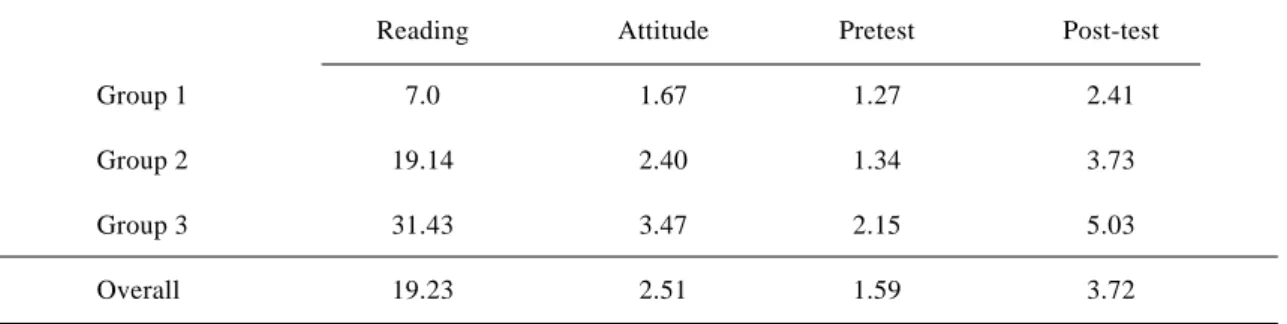
In Table 2 the mean for each group on the three variables is shown. An 3x2 Anova pro-duced significant results in both factors (Group factor: F=11.74, p<0.001; Instruction factor: F=84.65, p<0.00001). Likewise, the interaction reached the significant level (F=4.94, p<0.02). In pretest the differences between groups were not significant, while in post-test all the differences reached the significant level (Tukey tests: groups 1-2, p<0.04; groups 2-3, p<0.05; groups 1-3, p<0.001). As to the group differences between pretest and post-test, only group 2 and 3 reached the significant level (Tukey tests: group 2, p<0.0003; group 3, p<0.0002).
The increase in knowledge from pretest to post-test was reliable in all the measures as Table 3 shows. Nonparametric Wilcoxon tests
2This scoring procedure can be considered as a sim-plification of the procedure proposed by Novak & Gowin (1984). Our qualitative analysis of results in-clude some other considerations including those rela-tive to hierarchical nature of structure.
TABLE 1
reached a very high significant level (p<0.001) in all the measures except summary scores, where the level of signification was slightly inferior (p<0.01).
Table 4 shows the correlations between mea-sures. We can point up that all the correlations, except pretest-increase one, were positive and reliable. Both, working memory and attitude reached a high correlation with post-test and bet-ween them. Working memory correlated signifi-cantly with the increase scoring and with pretest, though the correlation with the pretest was clear-ly lower. On the other hand, attitude correlated significantly with the pretest scoring and the in-crease, though the correlation with the increase seems to be lower. The correlation between prior knowledge (pretest) and post-test was also signi-ficant. The correlations between reading span and attitude, and the increase in the diverse knowledge measures can be observed in Table 5. Reading span correlations with the increase in
concepts, explanation, comment and representa-tion reached the significant level. As to attitude, the correlations with the increase measures, though all of them are lower than previous ones, reached the significant level with concepts, explanation and representation. As can be obser-ved in Table 6, the inter-correlations between different measures were positive and most of them significant.
Finally, we are going to present the concepts maps done by one of our subjects on pretest and post-test. This boy, that we shall call «Alberto», was 14 years and 8 months old, and his scorings in working memory and attitude were close to average; he was included in group 2. Alberto was the pupil who achieved the highest increase from pretest to post-test in the overall knowledge measurement and the highest score in knowledge representation. Alberto’s concept maps on pretest and post-test can be observed in Figures 1 and 2.
TABLE 2
Means on Reading Span, Attitude and Knowledge tests for three groups
Reading Attitude Pretest Post-test
Group 1 7.0 1.67 1.27 2.41
Group 2 19.14 2.40 1.34 3.73
Group 3 31.43 3.47 2.15 5.03
Overall 19.23 2.51 1.59 3.72
TABLE 3
Means on different measures of knowledge in pretest and post-test
Concept Descript. Explan. Summary Comment Repres.
Pretest 2.19 0.71 0.54 1.79 0.74 3.55
TABLE 4
Pearson correlations between reading span, attitude, pretest, post-test and increase
Reading Span Attitude Pretest Post-test Increase
Reading Span 1 Attitude 0.61** 1 Pretest 0.38* 0.76*** 1 Post-test 0.72*** 0.76*** 0.52* 1 Increase 0.61** 0.43* 0.00 0.86*** 1 *: p<0.05; **: p<0.005; ***: p<0.001 TABLE 5
Spearman correlations between reading span and attitude, and the increase in diverse knowledge mesures
Concept Descript. Explan. Summary Comment Repres.
Increase Increase Increase Increase Increase Increase
Readind Span 0.49* 0.22 0.72*** 0.14 0.61** 0.43*
Attitude 0.44* 0.12 0.56** 0.06 0.35 0.38*
*: p<0.05; **: p<0.005; ***: p<0.001
TABLE 6
Spearman correlations between different knowledge measures in post-test
Concept. Descript. Explan. Summary Comment Repres.
Concepts 1 Descript. 0.61** 1 Explan. 0.55** 0.19 1 Summary 0.35 0.47* 0.57** 1 Comment 0.57** 0.64** 0.59** 0.47* 1 Repres. 0.43* 0.37 0.70*** 0.46* 0.56** 1 *: p<0.05; **: p<0.005; ***: p<0.001
FIGURE 1
Alberto's pretest representation of knowledge as to «Industrial Revolution» by means of a concept map
INDUSTRIAL REVOLUTION
REVOLUTION
XIX C. PROLETARIAT MEN
MACHINES ENGLAND in is a using by in by FIGURE 2
Alberto's post-test representation of knowledge as to «Industrial Revolution» by means of a concept map
5. DISCUSSION AND CONCLUSIONS
We were mainly interested in testing the capa-city of young adolescents to construct complex historical knowledge and the influence of some relevant variables as working memory, prior knowledge and attitude for meaningful learning. The results we have found seem to support clearly our hypothesis. We have found a highly significant and expected increase from pretest to post-test, but the point is that the differences between working memory groups in post-test were also significant and, specially, that the in-teraction was also significant; that is to say, students with higher reading span learnt more and better than students with lower reading span. As we can observe in Table 2, the results of lowest reading span group (group 1) in post-test are quite similar to those of highest reading span group (group 3) in pretest. In addition, the lack of significant increase in group 1 bears out that meaningful learning of complex historical contents as Industrial Revolution is restricted by working memory span. Therefore, we can affirm that working memory plays a crucial role when our subjects are building up historical knowledge as to Industrial Revolution. This result seems to confirm our conception on the complex cogniti-ve nature of acquisition of historical knowledge and emphasizes the need for paying more atten-tion to this variable in the study of human lear-ning.
The increase from pretest to post-test was highly significant in all the knowledge measures, though summary’s increase was lower. This re-sult is interesting because the ability to summa-rize is not strictly speaking a knowledge measure and therefore a lower increase after teaching and learning is expected. On the other hand, as the current theories on text comprehension and me-mory maintain (see, for instance, van Dijk and Kintsch, 1983), this increase shows that the abi-lity to construct the macrostructure of a text is an inferential skill that partially depends on the knowledge subjects have about the topic.
As to the correlational measures, we found a significant correlation between knowledge in pretest and post-test. This not unexpected result shows that pretest scores are a quite good pre-dictor of post-test ones, as all the cognitive theories held. The positive and significant
corre-lations as between working memory and pretest, post-test, and increase point up again the deci-sive role of this variable. The lower correlation with pretest than as with the other two measures agrees entirely with the on-line nature of wor-king memory. The results showed in Table 5 allow us to precise the probable influence of working memory on the acquisition of historical knowledge. The high correlation with the expla-nation increase score insists on our conception as to the special cognitive resources which are demanded by the use of several causes mutually interacting to explicate a historical phenomenon as Industrial Revolution. Likewise, the lack of significant correlations with description seems to suggest that this score demands less cognitive resources, perhaps because the underlying for-mat of description is normally narrative and students are more familiar with this kind of his-tory.
As to the attitude, its high correlation with both knowledge measures (pre and post-test) bears out our prediction about the relevant role of this variable. In addition, attitude correlates significantly with working memory and the in-crease measure. However, we would like to em-phasize that attitude seems to correlate better than working memory with pretest whereas working memory appears to correlate better as to with increase. The results shown in Table 5 corroborate the attitude’s tendency to reach lower correlations than working memory as with all the diverse increase measures. This pattern of results appears to suggest a close and comple-mentary relationship between these two varia-bles. Both variables act together on subject’s learning, but whereas attitude explains better the past learning history of subjects, working memory is focused mainly on students’ current cognitive activity and demands and hence pre-dicts better their increasing performance.
On the other hand, attitude results confirm Ausubels’s theory about the need for an attitude or disposition for meaningful learning (see, for instance, Ausubel, 1968). More recently the need for an active disposition for high cognitive performance is being underlined by different authors. For instance, Rothkopf (1988) maintains that academic results are not dependent solely on cognitive competence but also upon the subject’s disposition to employ their resources. Resnick
(1987) goes even further when she states that the use of strategies, like any other high thought process, demands effort from the part of the in-dividual, and so it is necessary to cultivate not only the strategies but the disposition to use them. In addition, as within the very close field of text processing we may find some concurrent evidence. Subjects’ developmental differences in a macrostructure construction task cannot be explained in terms of differences in topic domain knowledge, but on the subjects’ actual and acti-ve use of their knowledge (Luque, García Ma-druga & Kintsch, 1993). In the same line, one of ours carried out an intervention program to im-prove the use of active text processing strategies that increased significantly subjects macros-tructural recall (see, García Madruga et al., 1992). Notwithstanding the undoubtable role of an active attitude for every high cognitive acti-vity, we are not quite sure as to our measure on it. We think that our attitude measure could have some problems. The scoring was done by the teacher and it could be affected by her expecta-tions and her previous knowledge of students. Therefore, we consider that the results as to the attitude demand a more objective scoring proce-dure, maybe by means of the use of video technology.
The existence of positive and most of them significant correlations between the different measures of knowledge in post-test can be consi-dered as a confirmation of the validity of our test. In addition, we would like to emphasize some aspects. First, we can observe that «com-ment» is the only scoring that correlates signi-ficantly with all the other measures. This fact un-derlines the validity of text comment to evaluate the learning of historical subject matter. Second, «description» does not correlate with «explana-tion» and «representa«explana-tion», whereas the highest correlation is as between «explanation» and «re-presentation». This results suggest that the des-cription of a historical phenomenon and its ex-planation might be partially distinct abilities, as we said above. Likewise, it seems to support a tight relationship between the explanation and the representation of historical knowledge. Lastly, the lack of significant correlation bet-ween «summary» and «concepts» insists on the idea that the construction of text macrostructure,
though partially related to domain specific knowledge, is an independent ability.
As to the qualitative changes in the Alberto’s organization of knowledge, the results showed in pretest and post-test concept maps are specially eloquent. Our third hypothesis predicted an improvement on subjects’ organization of know-ledge, increasing its levels of depth and con-nectivity. The overall increase in representation scoring had already confirmed this hypothesis, but Alberto’s post-test concept map can help us to understand more profoundly this improve-ment. Alberto’s pretest map included solely 6 concepts and its connectivity was quite reduced. Pretest representation is hardly hierarchical showing two levels of depth. The post-test cept map greatly increases the number of con-cepts and its connectivity, showing a highly hierarchical structure where six levels of depth can be observed. From this perspective this re-sult bears out how teaching can lead students from a typical novice knowledge organization to a hierarchical cognitive structure close to the ex-pertise.
REFERENCES
Ausubel, D. P. (1968). Educational psychology: A
cognitive view. New York: Holt, Rinehart and
Winston.
Casanova, J. (1991). La historia social y los
historia-dores. Barcelona: Crítica.
Daneman, M., & Carpenter, P. (1980). Individual diffe-rences in working memory and reading. Journal of
Verbal Learning and Verbal Behavior, 19,
450-466.
Carretero, M., & Voss, J. F. (1995). Cognitive and
Ins-tructional Processes in History and Social Scien-ces. Hillsdale, N.J.: LEA.
van Dijk, T. A., & Kintsch, W. (1983). Strategies of
dis-course comprehension. New York: Academic
Press.
Elosúa, R., Gutiérrez, F., García Madruga, J. A., Luque, J. L., & Gárate, M. (1996). Adaptación es-pañola del «Reading Span Test» de Daneman y Carpenter. Psicothema, 8 (2), 383-395.
Fernández Corte, T. (1992). Mapas conceptuales y dia-gramas V: dos estrategias en la enseñanza-apren-dizaje de la historia. Comunicación, Lenguaje y
Educación, 16, 7-24.
Fontana, J. (1992). La Historia después del fin de la
García Madruga, J. A., Martín Cordero, J. I., Luque, J. L., & Santamaría, C. (1992). Teaching active text processing strategies. In B. van Hout-Wolters, & W. Schnotz (Eds.), Text comprehension from
diffe-rent perspectives. Amsterdam: Swets-Zeitlinger
BV.
García Madruga, J. A., Elosúa, R., Gárate, M., Luque, J. L., & Gutiérrez, F. (1994). The inter-relation of
reading comprehension and working memory abi-lities: A developmental study. Paper presented at
8th Meeting of European Society for Cognitive Psychology. Lisbon, September 10-14, 1994. Gathercole, S., & Baddeley, A. (1993). Working
Me-mory and Language. Hove, U.K.: LEA.
Luque, J. L., García Madruga, J. A., & Kintsch, W. (1993). Developmental differences in a summary
task: the role of active knowledge. Technical
Re-port. ICS, Colorado University at Boulder. Novak, J. (1991). Clarify with concept maps. The
Science Teacher, 58, 45-49.
Novak, J. (1993). Human constructivism: a unification of psychological and epistemological phenomena in meaning making. International Journal of
Personal Construct Psychology, 6, 167-193.
Novak. J., & Gowin, D. (1984). Learning how to learn. Cambridge: Cambridge University Press Novak, J., & Musonda, D. (1991). A twelve-year
longi-tudinal study of science concept learning.
Ame-rican Educational Research Journal, 28, 117-153.
Resnick, L. B. (1987). Instruction and the cultivation of thinking. In De Corte, H. Lodewijs, R. Parmentier, & P. Span (Eds.), Learning and instruction (pp. 415-441). Oxford: Pergamon and Leuven Univer-sity Press.
Rothkopf, E. Z. (1988). Perspectives on study skills training in a realistic instructional economy. In C. E. Weinstein, E. T. Goetz, & P. A. Alexander (Eds.), Learning and study strategies (pp. 275-286). Orlando, Florida: Academic Press. Wineburg, S. S. (1991). Historical problem solving: A
study of the cognitive processes used in the evalua-tions of documentary and pictorial evidence.
Jour-nal of EducatioJour-nal Psychology, 83, 73-87.
ABSTRACT
Learning History implies the acquisition of
his-torical and social concepts, analyzing its mutual rela-tionships in the explanation of historical change. The comprehension of Industrial Revolution in England re-quires the use of at least four main concepts: Agrarian Revolution, Demographic Increase, Technological In-novations and the need of Accumulated Capital. The understanding of these concepts and the establishment of its relationships is a quite demanding cognitive task. Therefore, the crucial role of working memory in these cognitive processes is hypothesized.
This paper presents a study on the teaching and learning of this subject matter by first-grade of high school subjects. The main objective of this study was to analyze the process of understanding and acquisi-tion of this complex subject, testing the influence of three variables: working memory capacity, prior knowledge and attitude for meaningful learning. Pre-test examined subject’s knowledge of some basic con-cepts and their ability to describe and explain the phe-nomenon, as well as to summarize and comment a text and to represent their knowledge by means of a con-cept map. Differences in working memory capacity were controlled by means of the reading span test. Finally, subject’s attitude for meaningful learning was tested on line using an observation record. Teaching was developed during 6 classes following the usual scheme and methodology focused on reaching a gra-dual and overall understanding of the phenomenon. Learning results were checked in a post-test where we used the same test than before. There was a highly significant increase in all the post-test measures. Stu-dents with higher reading span learnt more and better than students with lower reading span. Therefore, working memory seems to play a crucial role when our subjects are building up historical knowledge as to Industrial Revolution. The significant correlation between knowledge in pretest and post-test showed that pretest scores are a quite good predictor of post-test ones, as all the cognitive theories held. As to the attitude, its high correlation with both knowledge measures (pre and post-test) bears out our prediction about the relevant role of this variable. Finally the analysis of subjects concept maps in pretest and post-test confirmed an improvement on subjects’ organiza-tion of knowledge, increasing its levels of depth and connectivity.
Key words: Learning and teaching history, working