UNIVERSIDADE DA BEIRA INTERIOR
Ciências Sociais e Humanas
The role of the time-of-use electricity tariffs in
the control of the rebound effect in the
household energy consumption
Flávio Filipe Rodrigues Serras
Dissertação para obtenção do Grau de Mestre em
Economia
(2º ciclo de estudos)
Orientador: Prof. Doutor António Manuel Cardoso Marques
Co-orientador: Prof. Doutor Pedro Morais
iii
Acknowledgements
I would like to thank my supervisor, the Professor António Cardoso Marques for giving me guidance since the first moment. His orientation and incentive was determinant for the final result of this master thesis. A thank you is also in order to Professor Pedro Morais for his valuable assistance and advices on improving this investigation. I would like to express my deepest gratitude to my family, girlfriend and friends for all their understanding, affection and immeasurable support through the years of my studies. Without them I would not have come this far.
v
Resumo
Uma das formas de conservação de energia e de redução dos Gases de Efeito Estufa (GEE) é a utilização mais racional no consumo. No entanto, nem sempre o aumento da eficiência conduz à diminuição do consumo e consequentemente à diminuição dos GEE. O efeito da não obtenção da totalidade dos benefícios decorrentes do aumento da eficiência da energia é conhecido como rebound effect. Assim, este trabalho tem como objetivo focar-se no rebound effect, controlando-o através da definição de preços diferenciados consoante o período de consumo. É desenvolvida uma função de produção familiar que incorpora o consumo de eletricidade, diferenciando-o nos períodos em pico e em fora de pico. Calcula-se a função para o rebound effect direto através da elasticidade do serviço em eletricidade em relação ao aumento da eficiência de energia. Obtém-se as variações de consumo, em cada um dos períodos, que estão associadas a determinado rebound effect direto. Nesta perspetiva, é definida uma nova tarifa time-of-use (TOU) (bi-horária) sendo que os preços variam com o objetivo de anular o rebound effect total. Desta forma, o aumento da eficiência em energia provoca uma maior diminuição do consumo no período mais crítico (período de pico), promovendo a suavização do diagrama de carga. Propõe-se corte parcial da prioridade de despacho da eletricidade de base renovável em regime especial libertando assim recursos para promover maior eficiência de energia. O aumento da eficiência em energia será acompanhado pela nova tarifa TOU, tornando esses ganhos de eficiência efetivamente eficazes, uma vez que a tarifa proposta assegura o controlo dos RE.
Palavras-chave
Eficiência da energia; Tarifas Time of Use; Consumo de electricidade em pico e fora de pico; Rebound effect.
vi
Resumo alargado
O aumento da eficiência em energia é a forma crucial para um mercado elétrico mais eficaz, seja no lado da procura como no lado da produção, levando a menores perdas e a um menor consumo de eletricidade.
Os aumentos de eficiência podem revelar-se de variadas formas, sendo que em todas as formas em que se revelem aumentos de eficiência é possível produzir um mesmo serviço através de uma utilização de energia menor. Apenas com o aumento da eficiência, seja na produção de eletricidade ou na sua utilização por parte de equipamentos mais eficientes, é possível “com menos, fazer mais”. No entanto, nem sempre os aumentos da eficiência garantem uma efetiva redução do consumo de eletricidade. Ou seja, um aumento da eficiência pode de facto reduzir o consumo de eletricidade associado a um determinado serviço, mas a utilização desse serviço poderá aumentar sempre que a diminuição do consumo não corresponda na sua totalidade ao aumento da eficiência ocorrido.
O fenómeno que corresponde às diminuições do consumo de energia inferiores às “esperadas” quando há um aumento da eficiência em energia é conhecido na literatura como o rebound effect (RE). Desta forma os aumentos da eficiência são subaproveitados e os benefícios decorrentes destes serão menores. Com a problemática do RE presente, este trabalho propõe a definição de uma nova tarifa de acordo com o período de consumo (Time-of-use (TOU)) que acompanha os aumentos de eficiência. A nova tarifa TOU será definida com o intuito de manter o nível inicial de consumo em fora de pico devido à problemática dos consumos muito “baixos”. Este problema é agravado em países onde o mix energético tenha como fontes de produção energias renováveis com tarifas feed-in. Essas tarifas ao garantirem à eletricidade, proveniente de produção renovável, uma prioridade de despacho, torna-a dificilmente acomodável em períodos de menor consumo.
A manutenção do consumo em períodos em fora de pico, quando existe um aumento da eficiência, leva a um RE de 100% porque o aumento da eficiência não se traduz em redução do consumo o que levará a um aumento da utilização dos serviços em eletricidade. Nos momentos de pico a tarifa TOU será definida de maneira a que o RE nos momentos de fora de pico seja anulado, mas anulando também o próprio RE no período em pico. Esta definição do preço em pico levará a uma diminuição do consumo através do aumento do preço. Assim para além de o RE ser controlado através da nova tarifa TOU, esta também levará a uma maior suavização do diagrama de carga, uma vez que o “gap” entre o consumo de pico e fora de pico será menor.
Será também proposta uma prioridade de despacho condicionada às eólicas, que num primeiro momento não se traduz numa redução direta no preço da tarifa de eletricidade aos consumidores, mas o montante libertado do condicionamento da prioridade de despacho será utilizado para um incentivo à eficiência em energia. Essa terá agora a sua eficácia potenciada
vii
devido à proposta das variações simultâneas dos preços de uma tarifa TOU. A prioridade de despacho será condicionada de acordo com a eficiência das turbinas que produzirem a eletricidade, promovendo-se também a eficiência em energia no lado da produção de eletricidade.A eficiência das turbinas será definida através do Limite de Betz, que permite averiguar quanto da força mecânica do vento uma determinada turbina eólica consegue extrair da passagem do próprio recurso vento. O trabalho de Betz demonstra que nenhuma turbina consegue extrair mais de 59,26% da força mecânica do vento e dessa forma será feita uma proporção para a prioridade de despacho “oferecida” às eólicas, sendo que apenas os parques eólicos onde todas as turbinas atinjam o valor de aproveitamento da energia mecânica do vento de 59,26% beneficiarão da totalidade da prioridade de despacho para a sua eletricidade produzida.
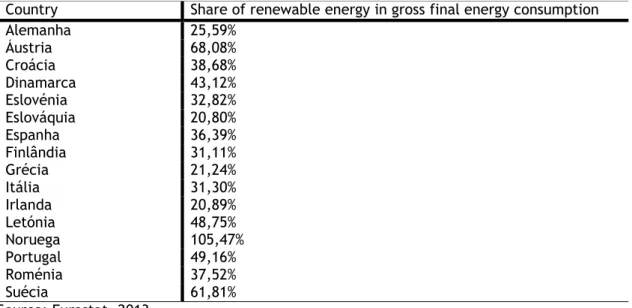
Como forma de demonstrar as políticas propostas é desenvolvido um modelo teórico inspirado em Ghosh e Blackhurst (2014). Serão definidas as funções de consumo de eletricidade no período de pico e fora de pico para que posteriormente seja possível definir as funções para o RE e as elasticidades preço-procura necessárias para averiguar as alterações dos preços da tarifa TOU. Através de um exemplo, onde são utilizados dados dos países europeus onde pelo menos 20% do consumo final de eletricidade seja de origem renovável, demonstra-se as variações dos preços da nova tarifa TOU, para que seja possível o controlo dos RE alcançando uma maior suavização do diagrama de carga, e as implicações da prioridade de despacho condicionada.
ix
Abstract
One way of energy conservation and Greenhouse Gases (GHG) reduction is a more rational energy consumption. However, increased energy efficiency does not always leads to the desired outcomes regarding the reduction of consumption and consequently the reduction of GHG. The effect that makes it impossible to obtain the totality of benefits due to increasing energy efficiency is known as the rebound effect. This study aims to focus on rebound effect, controlling them by setting different prices according to the consumption period. A family production function is developed incorporating the electricity consumption, dividing them between peak and off-peak periods. The function for the direct rebound effect is calculated through the elasticity of electricity service comparing to the increased energy efficiency. The consumption variations are thus obtained in each of the periods that are associated with a particular direct rebound effect. In this perspective, a new Time-of-Use tariff (TOU) dual tariff is defined wherein the prices vary in order to cancel the full rebound effect. This way, the increased energy efficiency causes a further decrease of consumption in the critical period (peak period), promoting the smooth of the load diagram. It is proposed a partial sectioning of the dispatch priority of renewables based electricity in a special regime (SR). This procedure allows freeing resources to promote greater energy efficiency. Increased energy efficiency will be accompanied by the TOU tariff we are proposing, making these actually effective efficiency gains, since the proposed tariff ensures the control of RE.
Keywords
Energy Efficiency; Time-of-Use tariff; Electricity peak and off-peak consumption; Demand side management; Rebound effect.
xi
Index
1.
Introduction ... 1
2.
Literature, motivation and theoretical option ... 4
2.1
Motivation ... 6
3.
Theoretical model of price differentiation in the Rebound Effect ... 7
3.1
Rebound effect and differentiated prices: ... 7
3.2
Conditional dispatch priority: ... 17
4.
Example ... 17
4.1
Rebound effect and differentiated prices: ... 17
4.2
Conditional dispatch priority: ... 27
5.
Discussion ... 29
6.
Conclusions and Implications ... 29
xiii
List of figures
xv
List of tables
Table 1- Countries and respective shares of renewable energy in the final consumption Table 2: Median income by household
Table 3- Average electricity consumption by household Table 4- Electricity prices (flat tariff)
Table 5 - Reference electricity prices (flat and TOU tariff) - Power ≤6,9kVa
Table 6 - Reference electricity prices (flat and TOU tariff) - Power >6,9 kVa ˄ ≤20,7 kVa Table 7 - Electricity consumption per hour during around the clock
xvii
Acronyms list
RE Rebound Effect
Cop Coefficient of performance kWh Kilowatt hour
TOU Time-of-use tariff kVa Quilovoltampere
1
1. Introduction
One of the main goals for the development of an electricity market is the increase of energy efficiency. However, the increase in efficiency does not always have a positive effect on energy consumption, or at least not as good as would be expected. This occurs when the consumption does not reflect the increased efficiency in its entirety, hampering the management of energy demand. The phenomenon that constitutes a less than expected decrease in power consumption, when the energy efficiency increases, is known in literature as the "Rebound Effect". The energy efficiency gains do not always have the desired efficacy due to Rebound Effect (RE). The RE occurs when there is an unexpected result coming from the increased energy efficiency (Jin, 2007).Indeed, the RE is evident when the energy savings is lesser than the expected due to an increase in the demand for energy. The RE can thus be defined as the tendency to higher power consumption due to higher economic benefits (or energy savings) provided by energy efficiency (Berkhout et al., 2000).
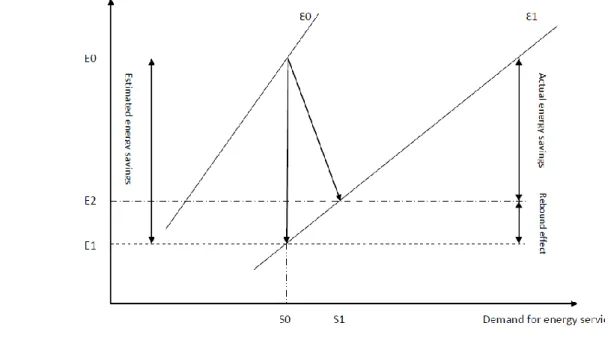
This phenomenon can be observed in the following figure: Figure 1: Example of the RE
Source: Adapted from, Liu e Lin (2013)
This way, it is understood that the RE can assume different dimensions. Through the graphic analysis, it is observed the initial consumption situation “E0” and the predicted consumption after an increase of the energy efficiency (from Ԑ0 to Ԑ1), “E1”. The RE represented in the graphic ranges from 0% to 100%. After the efficiency increase, if the consumption decreases from E0 to E1 and maintains that constant level, the demand (utility) of a certain energy service (S) will stay constant (S0). Therefore the RE will be null because an increase in the efficiency only caused what was “expected”, a consumption decrease (from E0 to E1), which
2
is proportional to the efficiency gains. If the RE is 100% the consumption stays constant at E0, resulting in a electricity service coinciding with the intersection between E0 and Ԑ1. However, what happens in most of the cases in real world is what can be observed in the graphic of the shift from E1 to E2 energy consumptions level. In other words, the difference between E1 and E2 represents the RE in the way that that gap leads to a consumption decrease that is less than proportional to the efficiency gains, causing an increase in the service utility “S” (S0 to S1).The RE can assume extreme values, or within its range. In other words, there is a super-conservation of energy every time the value of the RE is lower than 0 %, therefore the consumption would be less than E1. Furthermore it is observed the phenomenon known in the literature as "backfire effects" every time the value of the RE is greater than 100 %, that way the consumption will be greater than E0. The variations described above will never be observed with the impact of efficiency variation only.
Therefore, the RE could represent a major problem to an efficient management of electricity demand, in a way that they remove the efficacy of the energy efficiency aim. Fortunately, some ways to control the RE could be applied, considering that these vary inversely with the price of energy. One way to reduce them is by increasing the price of energy in order for the efficiency increase to be boosted to the maximum. At the same time that the income effect on other energy services is reduced, thus promoting a more efficient energy market as a whole.
As well known, since a long time the energy markets are helped by financial aids, both on the production and on consumption side, as a way to boost investment in certain sources of power generation in order to ensure the safety of the power grid. One of the financial aids widely used throughout Europe are the feed-in tariffs because they are a way that allows a massive development of renewable energy, particularly in wind and solar energy, such as noted by Gallego-castillo and Victoria, (2015) and Kwon, (2015). An important aspect in contracts concluded with these rates, is the dispatch priority in the grid. The problem with this priority comes when we realize that a forecast of wind generation is very unreliable because although it can be predicted with a day in advance, it is commonly subject to 20-50% forecast errors (Piwko et al., 2005), which is related with the high volatility of wind energy. There are then two possible scenarios that come with several difficulties. In off-peak hours, the consumption is "low" and it occurs usually during the periods coincident with night. In general, during these periods the wind resource is more available and as such, an increased productivity is expected. In this way, if there is suddenly a great wind production, that satisfies the entire consumption, with the wind energy benefiting from dispatch priority, as a result there will be problems at the hydro plants (greater impact on small hydro plants that also benefit from the feed-in tariff), that will not be able to continue to produce and may even have to waste water as not to cause an overload on the grid.
The opposite scenario occurs in peak periods, when the consumption is very high. Due to the volatility of the resource wind, in these situations all the possible means of energy production
3
must be used, in order to avoid the shortages and even the collapse of the grid. This is detrimental because some of the production plants that were needed only work as a way to complement the wind farms, and many of them were designed prior to the wind farms to work as a baseload power plant and with guaranteed pay contracts making their fixed costs highly disproportional on the market. The negative effects from the two scenarios presented can be minimized through a better disciplining of the demand, but also with improvements on the electricity production side. So as to obtain a better demand management whilst keeping the RE controlled, this work focuses on the creation of a TOU rate that will provide in a first instance the necessary reduction of the price in off-peak hours so that the power consumption does not decrease after an increase in efficiency which occurs when the RE is 1. Thus, the off-peak consumption becomes appropriate to the energy mix in each country. Later the price is set considering the peak in order to maintain the control on the RE (reach a global RE 0, taking into account the changes resulting from the decrease in price in off-peak at baseline). In reality, the rebound will never be 0 % since it will be annulled through the manipulation of the consumption with the change in prices, therefore, the price changes will always have to be calculated together with the efficiency variations. Thus a new TOU rate will be defined which allows the smooth of the load diagram, keeping the initial consumption levels in off-peak periods constant and decreasing the peak consumption by obtaining an RE of 0, which by itself potentiates the energy efficiency.Accordingly, this study contributes to the literature by developing an analytical model that allows controlling the RE through a TOU rate that establishes an increase of the peak price that is higher than the price decrease in off-peak periods. With this strategy, there is a decisive contribution to discipline the demand, promoting thus the mooth of the load diagram.
With the control of the RE guaranteed by the TOU rate proposal it will be ascertained which feed-in tariff (for wind) is suitable for the existing energy mix in the target country.It is then expected a decrease of the feed-in tariff, making it possible to quantify which percentage of the price is being directed to the feed-in tariff and then conduct that amount to a policy that encourages the increase of energy efficiency.
This transferred amount, from the financial aids to production, will correspond to the amount saved by a restriction on the order of priority, i.e., imposing a limit to this priority. This way, the demand management is strengthened through a TOU rate to control the negative impacts of energy efficiency, and later this efficiency will be encouraged knowing that their negative impacts are controlled.
With the smooth of the achieved load diagram, an energy mix with a lower installed production capacity can be obtained. It is then expected a decrease of the feed-in tariff, making it possible to quantify which percentage of the price is being directed to the feed-in tariff and then conduct that amount to a policy that encourages the increase of energy efficiency. On the other hand, the increase of wind capacity will require an increase in the production capacity because at a constant level, the increase of wind power requires
4
increased pumping capacity and additional baseload capacity, therefore requiring an investment in two types of electricity production other than the investment in wind energy (if these are added in an environment of decreasing consumption of electricity, particularly in peak periods, the need for this tripling of costs would be lower). Savings will be achieved through lower grid losses and greater predictability of consumption that would translate into greater energy security. However, many thermal power plants with guaranteed cost coverage contracts could close, as well as wind farms where there are contracts that guarantee much higher electricity prices than in other types of electricity production. It would also lower the emissions of carbon dioxide (CO2) by increasing the efficiency of electricity combined with the TOU proposed. This reduction would be higher due to an increase of efficiency that translates into higher electricity output reductions in peak periods, which means less production of electricity from fossil fuels, leading to greater reductions in CO2 emissions. The rest of this dissertation is organized as follows. In Section 2 the review literature is presented. In Section 3 it is developed an analytical model that defines the RE and the necessary changes in the TOU tariff rates to control the RE. It is also stated the idea for the conditional dispatch priority. Section 4 presents an example where it is calculated the RE and the necessary changes in the TOU tariff proposal that control the RE, considering two different times (time 1: off-peak and time 2: peak). It also calculated the percentage by which the order of priority will be conditioned, assuming a specific model of a wind turbine. Section 5 concludes.2. Literature, motivation and theoretical option
One of the best forms of energy conservation, and consequently to cut off GHG emissions, is the energy efficiency, both in consumption and production. However in the presence of a RE it is not possible to obtain full effectiveness of increased energy efficiency. The RE is reported in the literature (e.g. Hong et al. (2013)) as direct or indirect. The direct RE reports to a decrease in a particular product energy use (reduction in the price per unit of use), which leads to an increased use of that product. The indirect RE relates to a decrease in energy prices resulting in a greater disposable income among households, thus leading to more spending on goods and energy services. Consequently, there is higher power consumption, since the household has now a bigger income availability for buying an electric product ("Gadget" that provides a service through the use of electricity, e.g. Air-conditioning) that previously would not be covered by the budget constraint. However, the RE may reveal itself through several ways, for example, with the increase of the number of end-uses, with the average size of the product /service, the average performance (higher ratio of output energy utility relatively to the input power), and also the occupancy rate (for example, greater washing machines) (Yu et al., 2013). A clear example of the RE is related to the car exchange by a family. For example, if a family trades its old car, which ran 100 km per
5
month, for a new car with lower fuel consumption per 100km but now going to go 200 km per month, there has been a RE of 100% because the energy service (go 100 km) rose to double. From what has been said, when financial aids are given for consumption or production, by providing a lower price of electricity, it may cause a greater proliferation of RE. Thus, also the CO2 emissions would increase and damage the environment (Liu and Li, 2011). Thus, a transfer of costs related to renewable support (aiding with lowering the price of electricity) would be interesting from the perspective of the reduction of electricity consumption, leading to a lower the RE. This way, we would be in a situation where the achieved energy efficiency would be enhanced.The literature is no consensual regarding the scope of the RE. Authors like Bentzen (2004), Berkhout et al. (2000), Haas and Biermayr (2000), Hertwich (2005), B. Howarth et al. (2000), Laitner (2000) state that the RE is insignificant and therefore can be ignored. On the other hand, authors such as Brännlund et al. (2007), Grepperud and Rasmussen (2004), Roy (2000) argue that the impact of the RE is too important to be left out. Through these two perspectives Greening et al. (2000) conclude that the RE does not obey any rule so its size will have to be ascertained individually, either between countries or within the same country in different sectors.
There are several ways to reduce the RE identified in the literature. Among them is the increase in energy prices (Ouyang et al. (2010)). Within this thought, Lin and Liu (2013) and Jiang and Tan (2013) state that a reduction in subsidies to support a lower electricity prices, causes an increase in energy prices and thus it will be interesting for the control of the RE. Note that this increased energy prices, as well as contributing to the control of the RE may also cause other effects, as shown by Popp (2002). In fact, this increase may lead to more investment in R&D as well as to the improvement of energy efficiency. The increase in energy prices can still be used as a disciplinary tool of the demand, while controlling the RE. That is the focus of this study. In fact, with relative increases of differentiated prices, depending on the consumption period (Time-of-use) at peak and off-peak, a relative decrease in the RE at the same time it achieves a smooth of the load diagram. This discipline of demand contributes to lower generation costs for producers while allowing to advance towards a reduction of energy dependence, improving economic efficiency of the system and, of course, increasing social welfare. For example, Faruqui and George (2005) showed through the “Statewide Pricing Pilot” (SPP) experiment (experiment conducted in California applying different electricity tariffs with the aim of measuring the behavior of consumers towards the different prices) that consumers reduce their use of energy between 7.6% and 27% at peak consumption.
In short, two distinct policies could be carried out. The first one, differentiation of electricity prices between peak and off-peak hours. The second one, restrictions on the absolute dispatch priority of renewable energy which are associated with feed-in tariffs. Thus, electricity would become more predictable during the peak periods, which would provide a greater security in the grid and also a reduced need of capacity. With the movement of
6
renewable costs for this purpose it would also boost the new energy efficiency enhancement measures, since the price of electricity would rise and the RE could fail to have a very high impact.2.1
Motivation
One way to reduce RE is through the development of renewable energy (Ouyang et al., 2010). This could be seen after the first stated order (increasing price), since Marques et al. (2014) concluded that there is in Greece a one-way relationship between economic growth and renewable electricity, and the economic growth provides the further development of renewable power. So, what is expected through the two political proposals is to encourage a more efficient energy economy so that economic growth is facilitated, and later an improvement of demand management policies keeping the RE controlled. The simultaneous control of the ER with a smooth of the load diagram (due to reduction of the peak consumption) enables, together with the economic growth, an healthier proliferation of renewable energies, since the need for backup and baseload for intermittent renewable energies will be lower.
Knowing that the electricity service (C) represents the electricity consumption according to the energy efficiency (C = E.ԑ), and calculating the rebound effect through variation of the electric service when the energy efficiency varies (direct effect of the Energy efficiency variation, elasticity of electricity service in terms of efficiency), we can deduce what happens to consumption when we get a certain RE. For example, when we obtain the elasticity of 1, we can conclude that the electricity consumption is kept constant. Thereby we can infer that ER is 100%, meaning that the increase of the energy efficiency was absorbed by maintaining the initial level of consumption. A rebound of 100% may be associated with an energy service where the consumer cannot fully appreciate it and thus increased efficiency (a decrease in the cost of service) may allow these consumers to get more a more useful utilization out of it while keeping the cost electricity constant (increasing consumption) with the benefit of enjoying more of that service. On the opposite side, when the RE is 0%, it means that the electricity service does not change when the energy efficiency increases, thus there is a proportional reduction of electricity consumption. This case occurs in services that give no additional utility to the consumer for their increased use, and thus the consumer keeps a constant service that allows him to enjoy a lower cost of recurring use of lower power. Within this logic it is assumed, at first, that the rebound we want to achieve in times when off-peak are 100%, as well the level of consumption is kept constant. This maintenance of the level of consumption during off peak is beneficial because countries have divided an energy production capacity mix appropriate to the consumption levels, and causing these same levels to remain constant will be beneficial for the smooth of the load diagram, since the high and low peaks are not "apart".
After the appropriate setting of the price of off-peak consumption corresponding to the desired, the overall RE is calculated, i.e. the RE in each intake period is weighted by its size
7
(time elapsed during peak is higher than the time elapsed in off-peak), and so it will be defined the desired value of the RE at peak times to ensure the "cancellation" of the rebound in off-peak hours so that the global rebound is 0.3. Theoretical model of price differentiation in the Rebound
Effect
3.1
Rebound effect and differentiated prices:
Consider a household production function, like the used by Ghosh and Blackhurst (2014). Assume now that the electricity service is differentiated between peak and off-peak hours1.
Nomeclature:
Y
- Composite good (represents the household production fuction)C
- electricity service (work in electricity)p
C
- electricity service (work electricity)during peak periods f
C
- electricity service (work electricity) during off-peak periods1
p
E
- peak period consumption (initial)1
f
E
- off-peak period consumption (initial)X
- remaining services with another types of energyc
- electricity service efficiencyp
p
- peak price cp
- flat-rate price fp
- off-peak price cE
- total consumption of electricity
- percentage of time in peak periodt
- number of peak hoursH
- Total hour periodM
- Families’ incomeP
- Mechanical Power in W
1,225 kg/ , air density, in normal temperature conditions (15 ºC) and pressure at sea level.S
- Circle area formed by the movement of the blades.V
- Wind speed in m/sConsidering the energy consumers as a company, the total production (household production function), Y, depends on the combination of work in electricity (measured by the entry of electricity escalated from its efficiency (
E
i,
c) , at peak and off-peak , and of the other factors of production ( types of energy ) X:Household production function:
1 1 1 1
]
.
.
).
1
[(
f pX
fC
f pC
pY
(1)1
Throughout this study, it is assumed that the peak and off-peak periods remain constant every day of the week, like the TOU rate
8
ConsideringC
f
E
f.
candC
p
E
p.
c. (
p,
f) are the parameters of energy inputs. σ is the elasticity of substitution .Proposition 12: If U is an utility function with a strictly positive derivative then
)}
(
{
max
=
)
,
,
,
(
, ,U
Y
p
p
M
V
X f E p E c f p
s.a,M
X
p
f.
E
f
p
p.
E
phas an unique solution defined by:
)
(1
.
=
Zf
Zp
Zf
p
M
E
f f
(12))
(1
.
=
Zf
Zp
Zp
p
M
E
p p
(13)
)
(1
1
.
=
Zf
Zp
M
X
, where (14)
1)
.(
)
(1
=
c pp
f
p
p
Zp
1)
.(
)
(1
=
c fp
f
p
f
Zf
Proof.Considering that U is strictly increasing, then:
}
{
max
}
)
(
{
max
=
)
,
,
,
(
, , , ,U
Y
Y
p
p
M
V
X f E p E X f E p E c f p
,M
X
p
f.
E
f
p
p.
E
pFurthermore, observing that,
0
.
.
.
1 1 1
I
Y
I
Y
I I ,Where I=Inputs (
X
,E
p,E
f), we can affirm that the value of Y increases for any increase in the inputs (X
,E
p,E
f)>0. Therefore, the maximum value of Y will be reached atp p f f
E
p
E
p
X
M
.
.
.Considering that
C
p
E
p.
c(peak electricity work) andC
f
E
f.
c (off-peak electricity work), then, Substituting in (1):1 1 1 1
]
)
.
.(
)
.
.(
).
[(1
f pX
f cE
f p cE
pY
(2)2
9
The Lagrangian comes:)
.
.
.(
)
,
,
,
(
X
E
pE
fY
M
X
p
pE
pp
fE
fL
The correspondent first-order conditions are,
=
)
.(1
]
.
.
)
[(1
1 1 1 1 1 1
f pX
cC
f pC
p f pX
(3) p p c p p p f c p f)
X
.
C
.
C
]
.
.
.
C
=
.
p
[(1
1 1 1 1 1 1
(4) f f c f p p f c p f)
X
.
C
.
C
]
.
.
.
C
=
.
p
[(1
1 1 1 1 1 1
(5)0
=
.
.
p f f pE
p
E
p
X
M
(6)Dividing (5) and (4) by (3) then:
)
.(
)
(1
.
=
c p pp
f
p
p
X
C
(7)
)
.(
)
(1
.
=
c f fp
f
p
f
X
C
(8)Substituting the budget constraint (6) in to (7), then:
.(
)
)
(1
).
.
.
(
=
c p f f p p pp
f
p
p
E
p
E
p
M
C
(9) Let
1)
.(
)
(1
=
c pp
f
p
p
Zp
, then:)
(1
.
)
.
(
=
Zp
Zp
p
E
p
M
E
p f f p
(10) Substituting (6) and then (10), in (8) comes:
.(
)
)
(1
.
.
)
(1
).
.
(
=
c f f f f f fp
f
p
f
E
p
Zp
Zp
E
p
M
M
C
(11) Similarly toC
p, let.(
)
,
)
(1
=
1
c fp
f
p
f
Zf
then:)
(1
.
=
Zf
Zp
Zf
p
M
E
f f
(12) Substituting (12) in to (10):)
(1
.
=
Zf
Zp
Zp
p
M
E
p p
(13) And then substituting (12) and (13) in (6), it is obtained:10
)
(1
1
.
=
Zf
Zp
M
X
(14)Concluding the proof.■
The expressions (12) and (13) represent the point where the family reaches maximum utility for the consumption of electricity during off-peak and peak respectively, and of all the other family’s production factors (14), taking into account the available income
M
.Definition 1. Considering
F
as a function that depends on
, it is called elasticity ofF
in relation to the variable
to:F
F
.
.The elasticity of the electricity service function (
C
) in relation to efficiency (
) is called RE, i.e.:C
C
C
E
r
(
)
=
(
)
.
In other words, it represents the sensitivity between two variables, i.e., by defining the elasticity, the RE may be defined as the change in the electricity service when energy efficiency varies 1 %:
Proposition 2. The peak RE is:
1
)
1).(1
(
=
1
)
(
=
)
(
=
)
(
.
M
p
Ep
C
Ep
r
p E p c p c c
(15) Proof.Calculating the elasticity price for peak consumption, it is obtained:
)
).(1
(1
1
=
.
=
)
(
.M
p
E
p
p
E
E
p E p p p p p p p p
(16)To find the elasticity of consumption with respect to the efficiency, then:
1
)
(
=
1)
.
(
=
.
=
.
=
)
(
p c p p p p cC
C
c
c
C
c
C
c
c
c
C
Ep
c
c
Ep
Ep
Therefore it is know that,
1
)
(
=
1
).
.
(
=
.
.
=
.
=
)
(
Ep
Ep
Ep
c
c
Ep
C
c
c
c
Ep
C
c
c
C
C
c p p p p c
In the literature, assuming that the price of energy is exogenous and efficiency changes are constant, some researchers affirm that the direct RE,
c(
C
p)
, is approximately the inverse of the elasticity price of demand (Greene, 2012; Sorrell et al., 2009; Binswanger, 2001):11
)
(
=
)
(
p pp p cC
E
(17)So,
c(
Ep
)
=
pp(
Ep
)
1,
confirmed by,)
1).(1
(
=
.
.
1)
(
.
)
(1
1
.
=
.
=
)
(
. 2M
p
E
c
Zp
c
Zp
Zf
Zf
p
M
Ep
c
c
Ep
Ep
p E p p p c
(18)RE is calculated through the elasticity of the electricity ork in relation to its efficiency:
1
)
1).(1
(
=
1
)
(
=
)
(
=
)
(
.
M
p
E
C
E
r
c p
c p
c p
pEpConcluding the proof.■
Proposition 3. The off-peak RE is:
1
)
1).(1
(
=
1
)
(
=
)
(
=
)
(
.
M
p
E
C
E
r
c f
c f
c f
fEf (19) Proof.All calculations are performed in the same way that was used to define the peak RE (15), then the elasticity price in off-peak:
)
).(1
(1
1
=
.
=
)
(
.M
p
E
p
p
E
E
f E f f f f f f f p
(20)Concluding the proof. ■
Through the observation of (15) and (19) it can be concluded that having an higher
p
p/p
fwhile keeping constant the consumption will result in a larger RE. This may lead to the idea that the rebound decreases by reducing the price and not through its increase. However, with a higher price, to get a larger rebound is expected considering that under that scenario, households are constrained with greater pressure on the budget. As such, an increase of energy efficiency allows a "relief" of that pressure. With a lower price, the pressure on the budget will be smaller and therefore the consumption of electricity is closest to providing maximum utility of its use3.
Through the RE equations (15) and (19) knowing that
C
E
.
,
it is possible to calculate how much does the consumption of electricity vary when it is observed a particular value for RE. It is then possible to calculate the necessary price variations to accompany the efficiency increases so that the desirable RE is reached.3
This only happens when comparing an efficiency variation with different price levels without considering effects of a price variation. The RE corresponds to a variation in the consumption of energy through the variation of its efficiency, with the possibility of assuming different dimensions depending on the real price variations that occur simultaneously. Therefore, a positive price variation together with the increase in efficiency will lead indeed to a lesser impact of the rebound, since the positive price variation contributes to a decrease in consumption.
12
Proposition 4. By knowing the initial RE in both consumption periods it is possible to design
a new TOU rate so that the total RE is 0 %:
The aim and scope of this proposition is deep enough to slice it on two different propositions, in order to accommodate the dynamics of the actions. The proof will be carried out separately.
Proposition 4.1. Stage 1: The peak price change in order to keep the consumption in
off-peak constant is:
100
.
))
(
(
01
,
1
100
)
(
1
/
01
,
1
100
)
(
1
1
f f p f c f cE
C
C
(21) Proof.Consider the elasticity settings from (19) and (20): Knowing that the off-peak rebound is
(
(
f))
c
C
(an increase of 1 % in efficiency causes a))%
(
(
cC
f increase in the energy service), and as the variation of the energy service only ranges between 0 and 1, when there is a variation in the efficiency and everything else remains constant, we can conclude that the off-peak consumptionE
f decreases when the increase in efficiency (
c) is observed.As a way of knowing how much does the off-peak consumption need to increase after the increase of the eficciency, the decrease of
E
fcan be computed through the following way (knowing thatC
f=
E
f.
c)
:
' c f f f cE
C
C
.
01
,
1
.
=
.
100
))
(
(
1
f f c ' fE
C
E
.
1,01
100
))
(
(
1
=
<=>
(22) Therefore,1
01
,
1
100
))
(
(
1
cC
fis the percentage change in consumption during the
off-peak period when the rebound is
(
(
f)).
cC
The objective in the off-peak period will be the definition of a off-peak price
(
p
f)
that ensures an RE of 1, i.e., that nullifies the effect of the efficiency over consumption, thereby13
maintaining a constant initial level of consumption, so energy losses will be minimized because with this measure it is possible to avoid the problem supply excess.Thus it is estimated that the percentage of off-peak consumption will have to increase:
.100%
1,01
100
))
(
(
1
/
1,01
100
))
(
(
1
1
f c f cC
C
(23)Expression (22) represents the percentage by which the consumption will have to increase when there is an increase in efficiency.
Through the elasticity demand price (20), one could compute the necessary price that ensures the variation of the desired consumption. That is, for the variation of 1 % of the off-peak price, the off-peak consumption varies
(
(
f))%
f
p
E
. Then for an off peak consumptionvariation of
.100%
1,01
100
))
(
(
1
/
1,01
100
))
(
(
1
1
f c f cC
C
the offpeak price will
have to vary:
100
.
))
(
(
.
1,01
100
))
(
(
1
/
1,01
100
))
(
(
1
1
f f p f c f cE
C
C
Concluding the proof. ■
A new RE is obtained for the off-peak period due to the new price and respective consumption. It is worthwhile to note that existing rebound is offset by the simultaneous variation of efficiency and price, but its new calculation will not be zero, because the rebound continues to exist, i.e., there is always the rebound, it may or may not be offset by other factors that influence the consumption other than efficiency. However, a calculation of cross-elasticity to verify the new peak consumption due to off-peak price changes will be needed:
14
p f c f p f f p c f c p f f p p p f f p p f pE
p
p
z
p
z
p
M
E
p
p
E
E
.
)
.(
)
1
(
1
)
.(
1
.
1
.
.
=
.
=
))
(
(
2 1
p f c f p f f p f p f c f c p p p f pE
p
p
z
p
z
p
M
E
.
)
.(
)
1
(
1
).
(1
.
1
.
.
=
))
(
(
=>
2 1 .
(24)By observing the calculation of cross-elasticity price (24) the effects of off-peak price decrease in stage 1 over the electricity consumption during peaks in stage 2, are not considered because we observe a negative effect among them. This is not expected to occur, because when the price decreases in off-peak there is a shift of peak electricity consumption to off-peak period, and thus we would have a positive effect on cross-elasticity. This positive effect is not observed because the household production function is optimized by maximizing the utility, having Y a positive derivative for all inputs (X,
E
fandE
p), and therefore each function of consumption, represents the maximum of utility that the families withdraw from the consumption considering the available income (M). Therefore, the effect obtained from the elasticity is negative because:I. In the event of a decrease in
p
f : The decrease in the off-peak price will cause a greater financial availability for households. Knowing that the families already retreated the maximum utility in electricity consumption, the privileged consumption will be the consumption in peak periods, because the price is higher and therefore an increase in consumption could provide greater utility. This respects the diminishing marginal utility, but also because the peak hours are those in which families will have a greater propensity to benefit from electricity.II. In the case of an increase in
p
f : The off-peak price increase will cause a reduction of the total electricity consumption. As families consumed the maximum at the highest point of utility, they are deprived of part of the consumption in off-peak periods. This way, families favor a shift between consumption in peak towards off-peak periods, because consumption in off-peak periods has a lower price and therefore the abdicated consumption in peak periods is lower than the consumption "gain" on off-peak periods.The decision making dynamics allows the consideration of a balance on stage 2 that was obtained on stage 1. Let’s the see stage 2.