The Evolution of Spinal Fractures since the use of
the HANS
What can we improve?
Irene Beatriz Pinheiro Cardoso Marinho
Dissertação para obtenção do Grau de Mestre em
Medicina
(ciclo de estudos integrado)
Orientador: Dr. Jean Duby
Co-orientador: Dr. Jorge Pon
Dedication
I dedicate this study to my late uncle.
“Nothing is as important as passion. No matter what you want to do with your life, do it
Acknowledgments
I can’t tell how much I appreciate all your help, Dr. Jean Duby! Your passion for Medicine in Motorsports was an inspiration for me.
Regarding this study, I have to be thankful to a considerable number of people who had a huge contribution in my research and in my conclusion, including Mrs. Hayley Gallagher, Dra. Liliana Duarte, Prof. Dr. Miguel Castelo-Branco, Dr. Yves Morizot, Dr. Hervé Farines, Eng. José Azevedo, Dr. Pedro Esteban and Dr. Jorge Pon!
To all drivers and co-drivers, this work is for you and to you. Your ability to beat your own records and to exceed your limits was my motivation.
To Estrela Carvalho, for her amazing support and also a big kiss to Laura for being patient.
To Carla, for all the effort when I couldn´t find the time.
Finally, my gratitude goes to all my family and to André for the hours that Motorsports and Medicine has taken from our relationship in the past six years.
Abstract
Introduction
HANS is the short form for Head and Neck Support and it is a device used by athletes in Motorsports competition. This system reduces the probability of head and neck injuries resulting from a crash in a racing car. The principle of the HANS is to prevent the back and forth movement of the head in a crash. This technology protects from fatal accidents.
Goals
Testing the rate of cervical fractures from the moment the device (HANS) was worn; the rate of dorsal and lumbar fractures since the use of the HANS; The relationship between the use of the HANS /type of HANS and the level of the fractures; the link between the lesion and the seat, the surface and the Championship.
Methodology
This is a retrospective, observational and analytical study of FIA´s athletes. It considers athletes who had an accident which resulted in a broken spinal column since 2010 to 2015 (inclusive). The collected data was carried out by a semi-structured survey. It was used a statistical, observational and descriptive analysis of the surveys.
Results
In this study the sample is N=14. These are the athletes who meet the two criteria: they are FIA´s high-priority athletes and they had a fracture in the spinal column resulting from an accident with a Motorsports racing car. They are mainly male athletes (78,6%), 64,3% are between 20-30 years old (inclusive) and most of them (85,7%) are European. Only N=1 had a spinal lesion before the accident. 41,7% of the athletes had a lumbar fracture and 50% a dorsal one. Only one athlete had a cervical fracture. 92,9% of the athletes were wearing the HANS in the moment of crash. Only N=1 wasn’t using it. The athlete that wasn´t using the HANS had a cervical fracture.
The majority of the fractures were in drivers. Lumbar lesions are more prevalent in co-drivers (60%); however, dorsal lesions are commonly found in drivers (66,7%).
Dorsal fractures are also common on gravel surface (50%); however, the lumbar fractures are more common in tarmac (60%). Both fractures are more common in Rally Championships (75%).
viii
Conclusions
In this study, the rate of cervical fractures with the HANS is null as it was expected from previous studies. It can’t be extended to all athletes because there is only one case that had a cervical fracture without the HANS; however, it is possible because all others cases that were using the HANS didn’t have a cervical fracture.
Learning from prevention in Motorsports is also betting on future areas of road safety. There are many other issues related to injury prevention in Motorsports that need to be studied.
Keywords
Resumo
Introdução
HANS significa do inglês: Sistema da Cabeça e do Pescoço e é um dispositivo usado por atletas de desporto motorizado (pilotos e copilotos). Este sistema reduz a probabilidade de lesões da cabeça e do pescoço resultantes de um acidente com um carro de corridas. O princípio do HANS é manter a cabeça no local, impedindo os movimentos para trás e para a frente num acidente. Assim, com o HANS, a coluna cervical dos atletas mantém-se no local sem nenhuma lesão severa. Este estudo é baseado nos atletas que participam em campeonatos da FIA. A FIA é a Federação Internacional de Automobilismo que regulamenta e administra uma lista de diferentes campeonatos. A maior causa de morte nos acidentes de desporto motorizado resulta de movimentos violentos da cabeça causando uma fratura da base do crânio, da qual resulta a morte. Portanto, esta tecnologia protege de acidentes fatais.
Objetivos
Testar a taxa de fraturas cervicais desde que o uso do HANS é obrigatório; a taxa de fraturas dorsais e lombares com o uso do HANS; a relação entre o uso do HANS / tipo de HANS e o nível das fraturas da coluna; a relação entre a lesão e o assento, piso e o campeonato.
Métodos
Este estudo é retrospetivo, observacional e analítico e tem em conta os atletas da FIA que tiveram um acidente do qual resultou uma fratura na coluna desde 2010 até 2015, inclusive. A recolha dos dados foi feita através de um inquérito semi-estruturado. Foi utilizada a análise estatística, assim como uma análise descritiva e qualitativa dos inquéritos.
Resultados
Nesta dissertação a amostra é de N=14. Estes são os atletas que preenchem os dois critérios: são atletas prioritários da FIA e tiveram uma fratura na coluna espinhal, resultante de um acidente com um carro de desporto motorizado. Na sua maioria são homens (78,6%), 64,3% têm idades compreendidas entre 20-30 anos (inclusive) e a maioria são europeus (85,7%). Apenas um atleta tinha lesões na coluna espinhal antes do acidente.
41,7% dos atletas tiveram uma fratura lombar e 50% tiveram uma fratura dorsal. Apenas N=1 caso teve uma fratura cervical; 92,9% dos atletas estavam a utilizar o HANS no momento do impacto. Apenas 1 caso não estaria a utilizar o HANS. De acordo com um método direto, relacionamos que deste acidente resultou o único caso de fratura cervical. Todos os atletas estariam a usar o HANS do tipo original.
x
70,6% dos atletas sentiram dor no impacto. Após uma hora a maioria também referiu a dor como sintoma. 85,7% dos atletas realizaram Raio-X e TAC e 42,9% realizaram RMN. Todos os atletas tiveram tratamento de suporte e além disso seis deles obtiveram tratamento cirúrgico.
A maioria das fraturas da coluna ocorreu em pilotos. As lesões lombares são mais prevalentes em copilotos (60%); no entanto, as lesões dorsais são mais comumente encontradas em pilotos (66,7%).
As fraturas dorsais são mais comuns em pisos de terra (50%); no entanto, as fraturas lombares são mais comuns no asfalto (69%). Ambas as fraturas são comuns nos Ralis (75%).
Conclusão
Neste estudo, a taxa de fraturas cervicais com o HANS é nula, tal com se esperava perante a bibliografia anterior. Não pode ser extrapolada uma correlação significativa porque apenas existe um caso com fratura cervical sem o HANS; no entanto, poderá ser possível devido ao facto de que os outros casos estavam a utilizar o HANS e não tiveram fratura cervical.
Aprender com a prevenção no desporto motorizado é também apostar em áreas futuras de prevenção rodoviária. Há muitos outros assuntos relacionados com a prevenção de lesões no desporto motorizado que necessitam de ser estudados.
Palavras-Chave
FIA; Medicina no Desporto Motorizado; HANS; Fraturas da Coluna; Trauma no Desporto Motorizado.
Index
Dedication ... iii Acknowledgments ... v Abstract... vii Introduction ... vii Goals... vii Methodology ... vii Results ... vii Conclusions ... viii Keywords ... viii Resumo ... ix Introdução ... ix Objetivos ... ix Método ... ix Resultados ... ix Conclusão ... x Palavras-Chave ... xGraphics List ... xiii
Table’s List ... xv
Acronym’s List ... xvii
Introduction ... 1
Methods ... 3
Type of study ... 3
Main population in the study ... 3
Data Collection ... 3
Variables in the Study ... 4
Statistical analysis of the data ... 5
Results ... 7
Identification and Description of the Sample ... 7
Sociological Data ... 7
Athlete´s Description ... 8
Description of the Events ... 9
Personal clinical data ... 10
The Lesion ... 11
Analysis of the factor HANS ... 11
Description of the Impact/Momentum of crash ... 12
Next Procedures ... 14
Analysis of the factors related to the lesion ... 16
The connection between the lesion and the seat ... 16
Analysis of the connection between the lesion and the surface involved ... 16
Analysis of the connection between the lesion and the Championship ... 17
Analysis of the lesion´s Treatment ... 17
Discussion ... 19
Limitations of the study ... 22
Difficulties of the study ... 22
xii
Conclusion... 23
Bibliography ... 25
Attachment ... 27
Graphics List
Graphic 1: Gender ……… 7 Graphic 2: Age……… 7 Graphic 3: Nationality……… 8 Graphic 4: Seat……… 8 Graphic 5: Place……… 9Graphic 6: Previous Spinal Lesion ……… 10
Graphic 7: Medical Help……… 13
Graphic 8: Continue in the Event ……… 14
Table’s List
Table 1: Variables……… 4
Table 2: Date of Crash……… 9
Table 3: Championship……… 10
Table 4: Surface……… 10
Table 5: The Lesion……… 11
Table 6: Use of the HANS……… 11
Table 7: In the Momentum……… 12
Table 8: After One Hour……… 12
Table 9: Imagology……… 13
Table 10: Treatment……… 14
Table 11: Needs……… 15
Table 12: Crosstabs Lesion Seat……… 16
Table 13: Crosstabs Lesion Surface……… 16
Table 14: Crosstabs Lesion Championship……… 17
Acronym’s List
CAPE Center for Advanced Product Evaluation CT-Scan Computerized Axial Tomography Scan FCS Faculdade Ciências da Saúde
FIA Fédération Internationale de L’ Automobile FIFA Fédération Internationale de Football Association G’s Gravitational force
HANS Head and Neck Support L Lumbar
MRI Magnetic Resonance Imaging N Newton (SI derived unit of force)
QDA Qualitative Data Analysis Software®
RMN Ressonância Magnética Nuclear
SPSS Statistical Package for the Social Sciences®
T Thoracic
TAC Tomografia Axial Computorizada UBI Universidade da Beira Interior WRC World Rally Championship X-Ray X radiation
Introduction
HANS means Head and Neck Support and it is a device used by athletes (drivers and co-drivers) in Motorsports. This system reduces the odds of head and/or neck lesions in a crash with a racing car (1).
The HANS is made of carbon fibers; it is fire-resistant and weighs about 550 grams. It is set behind the neck and the two arms lying flat along the chest. To be effective, it should be attached to the helmet with two anchors. The seatbelts that cross the athlete’s upper body pass over the device on their shoulders and they clip it at the abdomen (1).
The main goal of the HANS is to keep the head from moving forwards and backwards in a Motorsports car crash.
In a car crash without protection, the upper body is decelerated by the seatbelt with the head maintaining the speed until it is decelerated by the neck. Therefore, the mechanism maintains the relative location of the head to the body and transfers the energy to the upper body and to the seat and the seat belt as well. (2)
HANS was invented by Dr. Robert Hubbard and by the car racer Jim Downing in 1991. Nowadays, there are two options: the original HANS and there is also the Hybrid version (lighter and attached with straps to the body) (1).
This study is based in athletes from FIA Championships. FIA represents the interests of Motorsports and regulates a list of several Championships.
Nowadays, for all FIA competitors, the HANS is mandatory since 2009. However, there are still some countries and series where the HANS is not mandatory at all.
The major cause of death in Motorsports accidents is violent head movements, resulting in a basilar skull fracture (Hangman’s fracture) causing serious injuries or immediate death (2).
Hangman’s fracture is caused by a hyperextension with an anterolistese of C1, the fracture of posterior arch of C2 over C3 by the lesion of the IV disc. It can also be extended to the vertebral artery (3). The plurality of the hyperextensions of cervical column is caused by decelerations in road accidents. (4)
It is estimated that 10% of the acute lesions of spinal column came from sports (4). The diagnosis should be with Imagology (X-ray, CT-Scan, and MRI) as well as the objective exam of the athlete/patient (5).
Concerning the dorsal column, although injuries are not very common; they have a high risk of neurological injury. Regarding the bibliography, in the thoracolumbar lesions, the major fractures are due to the compression of the seatbelt during a car crash (4).
As Charlotte Observer study shows, it is estimated that 27% of the deaths on some series could have been prevented by the use of certified Head and Neck Restraints (6).
In 2015, it was said that 1,3 million of people were killed, every year, due to road traffic crashes and that, every 30 seconds, road accidents kill one person around the world
2
(90% of the deaths take place in developing countries) (7). Motorsports and studies on racing cars could lead us to some evolutions in road safety as well.
In all sports’ lesions it is necessary a multifactorial model to comprehend them (8). But, in Motorsports there is a different major risk factor: the high speed crash (9).
The model of Van Mechelen et al to prevent lesions in sports has 4 stages: the dimensions of the problem, the etiology, the preventive measure and in stage 4 it is assessed the efficiency of the method. In this study we are showing phase 4 of the use of the HANS in Motorsports (10).
This technology protects the world’s top athletes from fatal accidents and it can be worn by any driver with a seat, helmet and safety harness.
According to this, it has been suggested that the rate of cervical fractures is null if the athletes were wearing the HANS correctly as the main hypothesis, other goals will be taken in account as the rate of dorsal and lumbar fractures, the connection between the lesion and some characteristics and also the connection to road accidents.
Methods
Type of study
This is a retrospective, observational and analytical study. It is retrospective because all data were collected by inquiries made to the athletes that had a crash before the end of 2015. The time limit was 2009 (FIA regulated the HANS for all Championships). It is an observational study because all data were collected without changing anything what so ever. All data has been provided directly by the drivers/co-drivers. It is considered to be analytical because it is under some scientific hypotheses that are being tested.
Main population in the study
In this study, all FIA´s priority athletes were the main population. This includes drivers and co-drivers in several Championships. The number of FIA´s priority drivers in each event is not a statistical number. For example, during a Championship, in a specific year, the number can roll up and down during different events due to the places (Europe or out of Europe) or due to regulation (e.g.: juniors). Based on an average for each Championship, there are about 200 FIA drivers competing nowadays.
Taking that into consideration and because of the theme of this study, the collected sample includes all the athletes that had an accident and that also had a fracture from the moment the HANS was regulated in FIA Championships. This decision has been taken to improve the quality of the results. Therefore, fortunately, there are only a few cases for the study; however, it is also a sign that there is something that we need to investigate and search for in order to improve safety in Motorsports.
Thus, in this study, the inquired athletes must have both criteria: 1) A registry as a priority athlete with an accident in Motorsports; 2) A fracture resulting from this event.
Data Collection
This project is under an agreement, meaning that every data are confidential.
First of all,it was made an intensive research on the topic. Afterwards, Dr. Jean Duby (FIA Medical Delegate) collected all the surveys with a semi-structured interview (attachment 1). The inquiries were made face to face or via e-mail. The surveys took place under strict confidentiality.
After collecting the data, the variables have been introduced and they have been treated as variable statistics. The criteria of this study have its grounds on qualitative methods and not on quantitative methods.
4
Variables in the Study
The variables in this study are in the next table: Table 1: Variables
Type Variable Categories Classification
Sociology Sex Female Male Nominal Age 20-30 years old 31-40 years old 41-50 years old Scale Nationality European
Non- European Nominal
Seat Driver Co-driver Nominal Event Description Championship Rally Cross-Country Nominal Date 2010 2011 2012 2013 2014 2015 Scale Place Europe
Out of Europe Nominal
Surface Gravel Tarmac Dunes Nominal Clinical Data Level of Fracture Lumbar Dorsal Cervical Nominal Use of HANS Yes
No Nominal
Type of HANS Hybrid
Original Nominal Previous spinal problems/other lesions Yes No Nominal Previous spinal fracture Yes No Nominal
What was felt in the moment of crash Pain Dyspnoea Nothing Nominal What was felt
after one hour of the crash Pain Dyspnoea Nothing Nominal Wellness/Health to
continue the event
Yes No Nominal Medical Assistant in the moment Yes No Nominal Imagology X-ray CT-scan MRI Nominal Treatment Supportive Surgery Nominal Limitations nowadays Yes No Nominal
Subjective Needs to be improved
Seat HANS Seat Belt Nothing
Statistical analysis of the data
The statistical analysis of the data has been performed in the software Statistical
Package for the Social Sciences® (SPSS) 23.
All data have a variable name that appears in the data editor. From now on, we classify it with a type and a label. The evaluation has been divided as a scale (when there is a quantitative variable) or in nominal (when there is a qualitative variable, as it happens most of the times). There are some variables in the survey with a multiple choice structure. All this was taken into consideration concerning the statistics.
In this study, it was taken into account the statistics of the crossing variables in 2x2 (Crosstabs). We can’t use the Chi-square test because is a statistic of the association of the variables, commonly known as the nominal variables. It is calculated with the null hypothesis (H0) in which all lines and columns are independent from each other. However, this test presumes that there isn´t any cell with zero frequency and no more than 20% of the cells have a frequency below 5 units. It should also be presumed that N is more than 20.
For the moment all this assumptions aren’t taken into consideration in this study. Therefore, we could use Fisher’s test to check if there is an association. There is one condition that hasn´t been taken into consideration in this study, which is the fact that the variables have two categories. The variable that it is used as an independent one (the lesion) has three categories: lumbar, dorsal and cervical lesions and we can’t classify it due to their characteristics.
Thus, it is not statistically reliable to use these tests. This study, along with the inquiries, forces to a qualitative and descriptive analysis, more than statistics inferences.
In behalf of the correlations (Spearman and Pearson’s), it just can’t be used as nominal variables as it can be seen above, in table 1. In this study, the variables are nominals. It is also not allowed to compare averages since the variables are not numeric.
Therefore, due to the results listed above, it was used a descriptive analysis to discuss the results. Once our intention is to collect clinical data with specific characteristics, we understood that the extensive method will be more adequate. Therefore, this method is part of a more quantitative approach to reality, allowing a statistical analysis of the data collected, allowing us a quantification of regularities and a later generalization. According to Greenwood, this method allows the "observation, through direct or indirect questions, populations of relatively large units placed in real situations, in order to obtain answers that could be handled by a quantitative analysis." 1
An intensive analysis is used in sociological investigations, which translates an examination, both in breadth and depth of a particular sample selected according to the objectives and the theoretical assumptions of research. The case study aims to obtain a comprehensive analysis of the phenomenon in question and requires a comprehensive collection, where is no concern in finding quantitative irregularities. 2
Also we opted for semi-structured interviews, because in this case the interviewer knows all the issues on which you need to get feedback from the athlete, but the order and
6
how it will be introduced are left to their discretion, guidance is only fixed for the beginning of the interview. This implies the existence of a previously prepared interview script, so as to define what is sought for the study that is been conducted (attachment 1).
_____________________
1 Greenwood, quoted by Almeida, JFP, Madureira J. A Investigação em Ciências Sociais. 2nd edition.
Lisboa: Presença.
2 Almeida JFP, Madureira J. Metodologia das Ciências Sociais. 10th edition. Porto: Edições
Results
Identification and Description of the Sample
Sociological Data
Fourteen athletes were selected for this study under specific criteria. We can find the distribution of the sociological data below (sex, age and nationality).
Graphic 1: Gender
8
Graphic 3: Nationality
Concerning the sex, the majority of the athletes are male athletes (78,6%) and 21,4% are female athletes. Only three women are part of the sample. The age of those who responded to the surveys is between 20-50 years old. In this study, the majority of the athletes are European.
Athlete´s Description
Graphic 4: Seat
Description of the Events
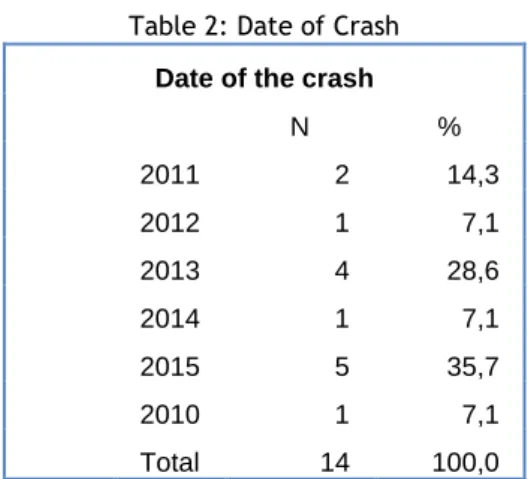
Table 2: Date of Crash
Date of the crash
N % 2011 2 14,3 2012 1 7,1 2013 4 28,6 2014 1 7,1 2015 5 35,7 2010 1 7,1 Total 14 100,0
From the moment the HANS was required by FIA in 2009, we vary between the years 2010-2015. Regarding the date of the crash in those 5 years, 35,7% happened last year.
Graphic 5: Place
10 Table 3: Championship Championship N % RALLY 11 78,6 CROSS COUNTRY 3 21,4 Total 14 100,0
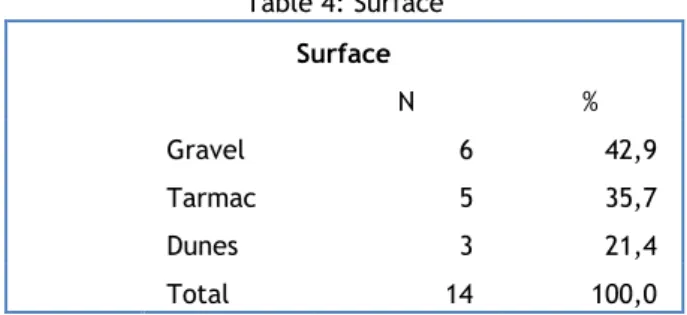
These results prove that 0 inquired athletes were in open-cockpit race-cars or tourism cars. Table 4: Surface Surface N % Gravel 6 42,9 Tarmac 5 35,7 Dunes 3 21,4 Total 14 100,0
Regarding the surface, there is a small difference between gravel (N=6) and tarmac (N=5).
Personal clinical data
In this study and in what previous clinical data is concerned, the main goal was to see if there was a match between the clinical features.
of lesion. However, in the surveys, none of the athletes had problems/limitations of spinal column.
The Lesion
Table 5: The Lesion
Lesion N % Lumbar 5 41,7 Dorsal 6 50,0 Cervical 1 8,3 Total 12 100,0 Doesn´t know 2 Total 14
About the lesion, 12 answers were considered valid because there were 2 inquired athletes that didn’t known/didn’t want to answer about the level of the fracture. Consequently, 50% of the fractures are at a dorsal level and 41,7% at a lumbar level. Which means that the majority of the lesions were at a dorsal-lumber level (N= 5+6= 11). Only 1 fracture was at a cervical level (8,3%).
From observational data in the inquiry, we’ve became aware of five fractures from a T6 level to L4 level. They are the result of a crash in landing after a high-speed jump.
Analysis of the factor HANS
In the survey, it was asked if the drivers were wearing the HANS or not and what kind of HANS were they using.
Table 6: Use of the HANS
Use Hans
N %
Yes 13 92,9
No 1 7,1
Total 14 100,0
According to this, from our sample of 14 athletes, 13 were wearing the HANS in the moment of crash; however, 1 athlete wasn’t using the HANS. From a descriptive analysis of the inquiries, it is known that the athlete that wasn’t wearing the HANS was the only case with a cervical fracture. About the 13 athletes that were wearing the HANS, 13 were using the original model; none of them were using the hybrid model.
12
Description of the Impact/Momentum of crash
Concerning the crash, drivers and co-drivers inquired characterized the impact and the following procedures as it is exposed in the tables below.
Table 7: In the Momentum
In the Momentum of crash
Answers %cases N % S Pain 12 70,6% 85,7% Dyspnoea 3 17,6% 21,4% Nothing 2 11,8% 14,3% Total 17 100,0% 121,4%
Concerning the symptoms: 85,7% of the athletes felt pain in the local of the lesion, 21,4% referred dyspnoea and only N=2 didn’t felt anything at the time of the accident.
Table 8: After One Hour
One hour later
Answers %cases N % S Pain 9 64,3% 69,2% Dyspnoea 1 7,1% 7,7% Nothing 4 28,6% 30,8% Total 14 100,0% 107,7%
One hour later, their answers were different. The majority (69,2%) admitted feeling pain in the local of the lesion. This percentage is much less than those who felt pain in the momentum of crash. According to the symptom of dyspnoea, only 7,7% referred it one hour later, differently from the 21,4% at the moment of crash. This means that the symptoms decreased one hour after the crash (dyspnoea, pain) and the increasing lack of symptoms took place one hour after the crash.
Graphic 7: Medical Help
Regarding medical help required by the athlete, there were 2 athletes that didn’t have any significant symptoms that made them ask for medical support. The majority of the athletes (85,7%) required local medical help after the crash. The medical assistance could have been the official doctors of the event, the doctors of the teams or even when the athletes were transferred to an external assistance.
Table 9: Imagology Imagology Answers %cases N % Exams X-Ray 12 40,0% 85,7% MRI 6 20,0% 42,9% CT-Scan 12 40,0% 85,7% Total 30 100,0% 214,3%
About the Imagological tests taken, the same percentage of the cases went to an X-Ray and a CT-Scan. There were N=6 athletes that did a MRI (42,9%).
14
Graphic 8: Continue in the Event
Respecting this, the majority stopped immediately their participation in the event. This could have been due to the damages of the car or due to medical condition of the athlete. Only 2 athletes continued in the event despite the crash.
Next Procedures
After the crash, and since the survey is retrospective, the athletes were studied concerning the type of treatment they took, the limitations and the consequences caused by the crash. The results are in the tables below.
Table 10: Treatment Treatment Answers % cases N % Treatment Supportive 14 70,0% 100,0% Surgery 6 30,0% 42,9% Total 20 100,0% 142,9%
About the treatment that the athletes took, all athletes had supportive treatment. Besides this, there were 6 athletes that complemented the treatment with surgery. The surgeries were to stabilize fractures with osteosynthetic material.
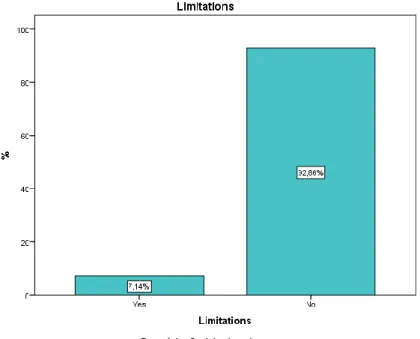
Graphic 9: Limitations
The majority of the cases had no limitations since the crash until the moment of the inquiry. Only one athlete had limitations due to the accident. From a descriptive data, we know that this case was after a L1 fracture with limitations of movements. These limitations were defined as not being able to do daily life activities without help.
Table 11: Needs
Needs
Answers %cases
N %
Future changes Seat 6 37,5% 42,9%
Hans 2 12,5% 14,3%
Seat Belt 1 6,3% 7,1%
Nothing 7 43,8% 50,0%
Total 16 100,0% 114,3%
This is the less accurate answer of the survey. It was studied the opinion of the athletes about their own crash and what should be improved in the future. 50% of the athletes didn’t know/didn’t give an answer. About those who gave an answer 42,9% said that the structure/position/material of the seat is a factor to be studied in the future.
16
Analysis of the factors related to the lesion
Based on the level of the lesion, some factors were tested, such as the seat of the athlete (driver or co-driver); the type of surface (gravel, tarmac or dunes) and the Championship (rally or off-road). All the tables below are related only to 12 athletes because there were 2 athletes that didn’t know/didn’t answer the level of the fracture. Therefore, they cannot be part of the analysis.
The connection between the lesion and the seat
Table 12: Crosstabs Lesion Seat
Crosstabs Lesion * Seat
Seat Total Driver Co-driver Lesion Lumbar N 2 3 5 % Lesion 40,0% 60,0% 100,0% Dorsal N 4 2 6 % Lesion 66,7% 33,3% 100,0% Cervical N 1 0 1 % Lesion 100,0% 0,0% 100,0% Total N 7 5 12 % Total 58,3% 41,7% 100,0%
According to this, the majority of the fractures were in drivers N=7. The lumbar lesions are more prevalent in co-drivers (60%) than in drivers (40%). On the other hand, at a dorsal column level, lesions are more prevalent in drivers (66,7%) than in co-drivers (33,3%).
Analysis of the connection between the lesion and the surface involved
Table 13: Crosstabs Lesion Surface
Crosstabs Lesion * Surface
Surface Total
Gravel Tarmac Dunes
Lesion Lumbar N 1 3 1 5 % Lesion 20,0% 60,0% 20,0% 100,0% Dorsal N 3 1 2 6 % Lesion 50,0% 16,7% 33,3% 100,0% Cervical N 0 1 0 1 % Lesion 0,0% 100,0% 0,0% 100,0% Total N 4 5 3 12 % Lesion 33,3% 41,7% 25,0% 100,0%
majority of dorsal fractures were in gravel.
Analysis of the connection between the lesion and the Championship
Table 14: Crosstabs Lesion Championship
Crosstabs Lesion * Championship
Championship Total RALLY CROSS COUNTRY Lesion Lumbar N 4 1 5 % Lesion 80,0% 20,0% 100,0% Dorsal N 4 2 6 % Lesion 66,7% 33,3% 100,0% Cervical N 1 0 1 % Lesion 100,0% 0,0% 100,0% Total N 9 3 12 % Total 75,0% 25,0% 100,0%
The connection between the lesion and the Championships proves that the majority of the lesions (75%) were in Rallies.
Analysis of the lesion´s Treatment
Table 15: Crosstabs Vertebra Treatment
Crosstabs Vertebra*Treatment Treatment Total Supportive Surgery Lesion Lumbar N 5 4 5 % vertebra 100,0% 80,0% Dorsal N 6 1 6 % vertebra 100,0% 16,7% Cervical N 1 1 1 % vertebra 100,0% 100,0% Total N 12 6 12
Regarding the treatment, all drivers/co-drivers went through supportive treatment; however, from the n=6 who did surgery: 1 is from a cervical fracture, 4 are from a lumbar fracture (80%) and 1 is from a dorsal level fracture.
Discussion
Considering this study and since the main population is my sample, I can’t conclude that there is a statistical meaningful correlation between the results. Meanwhile, through the exposure of the surveys, it is known that the only case with a cervical fracture was the one without the HANS. It can’t be extrapolated to all other athletes because there is only one case identified in this study, but, still, it is possible. All other cases that were wearing the HANS didn’t have any cervical fracture.
Therefore, this study intends to come upon the scientific literature that says that no basilar skull fractures occurred since the HANS was worn (2).
In addition to that, there are several cases of cervical fractures without the HANS before this system was worn (11). Some of them were fatal.
Therefore, we can conclude that the mechanism maintains the relative location of the head to the body and transfers the energy to the spine.
In a crash test simulating a 40mph dead, the impact is blocked by using the HANS, neck loading was kept under 130lbs, while the unrestrained head endured over 1,000lbs, this is less than the average strength for the head and neck (1). Following Downing, the weight of the head and helmet, pulling the neck, can be enough to cause a skull/cervical fracture (6).
The tension of the neck to cause fatal lesion is approximately 4 000 Newton. The test conducted by CAPE at 42 mph and 40 G’s acceleration upon impact, resulted in 5800 Newton of neck tension. (6).
Basilar skull fracture is the most dangerous lesion due to the bad prognosis associated to death. It occurs in all kind of Championships. There is no data about other cervical fractures associated to Motorsports. (2)
According to the results of the previous clinical data, there aren’t any described limitations in the spinal column; therefore, this could discharge any secondary cause of the fractures as osteoporosis or secondary factors (drugs, eating disorders, gastrointestinal disorders, endocrinal disorders or others).
Concerning the signs and symptoms, the major symptom was pain in the momentum (85,7%) and even one hour after the crash (69,2%). In addition to that, the majority of the athletes stopped their participation in the event. The pain is described in literature as the most frequent and steady symptom in spinal fractures (12).
Due to the high sensibility of CT-Scan in the evaluation of the range of spinal lesions, its use has been increasing as a preliminary exam. In this study, it is shown that 85,7% had taken a CT-Scan. In a thoracolumbar level, CT-Scan identifies the fragments and the lines of these fractures and helps in the treatment as well as in the prognosis. MRI should be used in traumatic neurological lesions, not clarified enough with X-ray or CT-Scan. It is even essential to determine when the fracture was made. It was used in 42,9% of the cases in this study (13).
20
We cannot reach to a meaningful correlation in this study about the dorsal lumbar fractures; however, following Viano studies, in an event of a crash, besides the compressive loading due to the inability of the seat to prevent movements, the shoulders are stopped from going upward; therefore, additional compressive loading takes place. This is enough compressive loading to a dorsal lumbar fracture (14). In the event of a crash, cephalic extremity is thrown forward, but it acquires a kinetic energy. Fortunately, it is protected by the HANS, but the energy is probably carried back to thoracic and lumbar vertebrae.
About the connection between the lesion and the surface, other characteristics like, tyres, stages and the weather should be taken into account.
Both dorsal and lumbar fractures were commonly found in Rally Championships, where normally the surfaces are more irregular and there are more adverse conditions that could result in a crash.
In this study, lumbar fractures are more common in co-drivers (60%) and dorsal fractures in drivers (66,7%). From data tests with dummies we know that from T6 to T12 the compression load tolerance is about 4475N and from L1 to L5 is greater than at a dorsal level (6651N) (15, 16). Therefore, if at a lumbar level can hang on more compression load; we could say that the co-drivers need much more load in order to have fractures in those cases. This could be due to some characteristics that are different in both driver and co-driver seats.
Concerning the treatment, it shows that 100% of the inquired athletes had supportive treatment and N=6 had surgery. The supportive treatment in thoracolumbar fractures consists in pain-killer drugs, rest, anti-inflammatory, physical therapy and a full-body tabard to stabilize the fracture.
Five of the cases in this study with fractures between T6 to L4 result from landing after a jump. All of these fractures are burst fractures which are caused by an axial vector, followed by a fall. The IV disc is driven into the body of the next vertebrae. If the fracture is unstable, surgery is needed. The majority of the surgeries, in this study, were at a lumbar level. There are different types of impacts resulting in fractures in Motorsports: rear warding impacts are the most frequent; frontal are the most severe and vertical ones like the burst fractures (2).
About the limitations after the crash, there is only one case, after a L1 fracture, with movement limitations. About this, we have to take into account that the prognosis in thoracolumbar fractures has to consider, among others, age, physical condition, speed and circumstances of the car. It is crucial to remember that, due to the lesion, the athlete faces a rehab process which has a specific and individual approach. The doctors should respect the athlete’s decisions, the regulations and the teams, as well as the emotional support in order to be succeeded from a clinical perspective (17, 18).
All the inquired athletes that were wearing the HANS were using the original system. Choosing randomly one FIA Championship (WRC), it was shown that 30% of the athletes used the hybrid HANS and 70% used the original model.
and remain in contact with the chest and abdominal, all the way to the buckle. With the standard HANS the belts do not touch the body from the device until the buckle. Further researches need to study both type of HANS.
If to Motorsports the HANS is the best security system since seatbelt, this could also lead us to the prevention of road accidents.
As an example, in Portugal, the document from the road safety observatory from National Authority, between the 1st and the 31th of January of 2016, shows us that there are a
total of 10.741 accidents (more than in 2015) from which resulted 34 deaths, only in this month. The same document shows that from the 1st of February of 2015 to the 31th of January
of 2016, 457 deaths happened (19). This is a worrisome number. Medicine should also care and search for preventive models and studies.
In 2014, there was one death and at least six serious injuries per day on road accidents in Portugal. In 1950 were around 500 victims per year, but the number of vehicles on the road was much less than now (20).
In a study by the Technical University of Lisbon, concerning the victims in 2003, it can be shown that 55, 9% are drivers (21).
In the study provided in Adelaide, it shows that in a 60 km/h speed limit area, the risk of involvement in a casual crash doubles within each 5 km/h (22). No doubt that speed is the single most significant contributor to road collisions.
In Muller et al study, they analyzed 33.015 road accidents. The rate of cervical fractures was 0, 38%, thoracic fractures (0,24%) and lumbar fractures (0,30%) (23). Therefore, cervical fractures are commonly found after road crashes and they are also a cause of mortality, morbidity and high costs.
From a forensic study used to describe the cervical lesions of a driver and front-seat passenger from 2005-2012 in Moscow in fatal road crashes, both suffered bending-extensions lesions; however, in drivers, was commonly found the lesion of II-IV vertebrae and in front-seat passengers IV-VI vertebrae (24).
For that reason, this study could be a step up to an investigation in the spinal column fractures in road accidents, as well as a head and neck restraint device to prevent it.
Nowadays, there is an increasing research in sports prevention and also in the evaluation of risk factors and type of lesions. There have been a lot of strategies to prevent injuries in athletes (4).
This is highly substantial not only to federate athletes, but also to the common practice of sports. As an example, FIFA created the “11+” a warm-up program to reduce injuries in football players since the age of 14. The scientific study shows an effectiveness of 50% with less injuries (25).
22
It’s sad to take a look over so many Motorsports fatal accidents but it is also in behalf of this that this sport keeps evolving for so many years. We have to look back, to search in order to prepare the future, always keeping our head in the present.
Limitations of the study
Besides all the accuracy in the procedures around this study, it has some limitations. In terms of the application of the statistical studies and taking into consideration the low number of the samples in the study, it is difficult to have some significant statistical data. Fortunately, we only have few crashes for the study; this probably means that there has been a decrease in the number of crashes with fractures, nowadays. It is not possible to do comparisons in averages since none of the variables are numeric. Therefore, it was used a descriptive analysis rather than a quantitative one.
Another significant limitation is that some athletes are out of this study because they could have some fracture after one event but never returned the data to FIA or to national federations. There is also a geographic limitation because athletes are all spread around the world.
It was quite usual to have inquiries without all data or with some question without an answer (didn’t know/didn’t want to answer).
Also, it should have been studied the kind/type of limitations of these athletes and also the type of previous problems before the event.
In February of 2016, it was launched an improved version of MAX QDA 12® , a software designed for qualitative and quantitative research. Due, to the delivery date of the dissertation we cannot try the cited program to analyze the interviews.
Difficulties of the study
Concerning this study, the main difficulty was researches on the theme. There aren’t a lot of scientific articles about Medicine in Motorsports and there are only a few about this theme.
Another issue was due to the fact that the majority of the variables are nominals and not numeric. If the answers were dichotomous, it could have been possible a statistical analysis with correlations between them.
Major points of the study
This study follows FIA´s regulations and other studies concerning the efficient of the HANS. It intends to enhance the connection between Medicine and Motorsports for further studies. It was useful to get in touch with the advantages of the HANS in the athlete’s outcome and also getting to know some risk factors in Motorsports
.
Conclusion
The rate of cervical fractures with the HANS is null, as it was expected. This led us to the fact that the HANS is effective in its main function, as it was postulated in the main hypothesis. It is important to refer that the HANS is effective only if it is well-positioned by the athletes.
There was one case of a cervical fracture but this happened without the HANS. It happened because there are still some series and countries where the use of the HANS is not mandatory.
In relation to the inquired opinions, how 42,9% of the athletes choose the seat is something to be investigated in the prevention of fractures.
The FIA regulations (Appendix J – Article 253, Published on 07.03.2016) say: “If there
is a cushion between the homologated seat and the occupant, the maximum thickness of this cushion is 50 mm.” If it is thicker, the impact of the spinal column in a tough seat it will be less hard, and the energy could flow in all directions in the low part of the car. Studies show that it is necessary to use at least 76,2mm of thickness to reduce the load from T8 to T12 (26). This is only a hypothesis, further engineer and orthopedic studies are needed in order to prove it.
The seat in some series has an inclination of more than 90○. From a Trammell and
Flint study, the angle of 45○ of the seat plus the elevation of the car resulted in the athletes’
thoracolumbar spine being roughly horizontal during a high speed crash (2). The seat´s position in this formula seems to predispose to spinal fracture as researches indicate (27). A more upright posture is less likely to result in fracture, because there are less compressive loads.
Undergoing studies from Farines show that trauma and the magnitude orders are supposable in Rally accidents and aircraft ejection due to the fact that both pilots have the same postures.
Trammell et al concludes about a pelvic ‘bucket’ to promote the physiological lordosis of the body and to reduce the load in a thoracolumbar level in an event of a high speed crash (26).
It is important to have reliable motor racing cars in all circumstances; thus, the occurrence and consequences after the crashes should be minimized.
Our study is supposed to work as an inspiration for further researches on preventing road accidents. A device like the HANS modified to normal drivers and passengers could prevent some fatalities in road crashes?
Caring is essential but prevention is the solution.
For this reason, FIA created the Road Safety 2030: a higher level action for road safety, launched in 2015. The Panel brings together global leaders to promote innovative solutions for road safety health with a 2020 target of less than 600 000 road fatalities in the
24
world. The 10 point manifesto sustains one point for safer vehicles and also for more effective laws on the roads due to speed (7).
From now on, further studies should be prospective studies to all the crashes. Therefore, it will be possible to do the analysis of the effects accurately.
At this moment, I am appreciating your interest for this work. Tomorrow, are going to be the athletes.
Bibliography
1. Stonefeld, R. Helping HANS [Internet]. 1995-2005 [cited 2016 Feb 12]. Available from: http://www.atlasf1.com/2001/feb21/stonefeld.html
2. Trammell T, Flint K. Spine Fractures in drivers of Open-Wheel Open cockpit Race Cars. Aspetar Sports Medicine Journal. 196-202.
3. Serra LMA, Oliveira AF, Castro JC. Critérios Fundamentais em Fraturas e Ortopedia. 3rd Edition. Lisboa: Lidel; 2012.
4. Pessoa P, Jones H. Traumatologia Desportiva 2. Lisboa: Lidel; 2014.
5. Castro W, Jerosh J, Grossman T. Examination and Diagnosis of Musculoskeletal Disorders. New York: Thieme; 2001.
6. Downing, J. Death at the Track : Fatalities on U . S . Short Tracks / Drag Strips from Head / Neck Injuries. Paper presented at: IMIS Safety and Technical Conference at the Center for Advanced Product Evaluation; 2012 December 5; USA.
7. Federation Internationale de l’ Automobile. Road Safey 2030 [pamphlet]. Paris: FIA; 2015.
8. Bahr R, Krosshaug T. Understanding injury mechanisms: a key component of preventing injuries in sport. Br. J Sports Med. 2005. 39: 324-29.
9. Bahr R, Holme I. Dynamic Multifactorial model of sports injury etiology. Br J Sports Med. 2003. 37: 384-92.
10. Van Mechelen W, Hlobil H, Kemper H. Incidence, severity, etiology and prevention of sports injuries. Sports Medicine. 1992. 14 (2): 82-99.
11. Hallbery A. 1985: Ari Vatanen’s near-death experience. Motorsport Retro [Internet]. 2011 Apr 11 [cited 2016 March 5]; Available from: http://www.motorsportretro.com/2011/04/ari-vatanen/
12. Haverbeck JF, Arenas JP, Palma CL. Manual de Ortopedía y Traumatología [monograph online]. Santiago de Chile: Universidad Católica de Chile. [cited 2016
March 8]. Available from:
http://escuela.med.puc.cl/paginas/publicaciones/TextoTraumatologia/Trau_Portada .html
13. Berlin L. CT versus radiography for initial evaluation of cervical spine trauma: what is the standard of care?. AJR Am J Roentgenol. 2003. 180 (4): 911-5.
14. Viano DC. Role of the seat in rear crash safety. Warrendale: SAE International; 2002. 15. Yoganandan N, Pintar F, Sances A, Maiman D, Myklebust J, Harris G, Myklebust J, Ray
G. Biomechanical investigations of the human thoracolumbar spine. SAE TP. 1988. doi:10.4271/881331.
16. Yoganandan N, Arun MW, Stemper BD, Pintar FA, Maiman DJ. Biomechanics of Human Thoracolumbar Spinal Column Trauma from Vertical Impact Loading. Ann Adv Automot Med. 2013 Sep; 57: 155–166. Sud Med Ekspert. 2015 Nov-Dec;58(6):24-7.
26
17. Trainor TJ, Trainor MA. Etiology of low back pain in athletes. Curr Sports Med Rep. 2004. 3(1): 41-6.
18. Aaltonen S, Karjalainen H, Heinonen A, Parkkari J, Kujala UM. Prevention of sports injuries: systematic review of randomized controlled trials. Arch Intern Med. 2007. 167(15): 13-27.
19. Autoridade Nacional de Segurança Rodoviária. Sinistralidade Rodoviária [Internet]. 2016 [cited 2016 Feb 20]. Available from: http://www.ansr.pt/Estatisticas/RelatoriosDeSinistralidade/Documents/2016/INFOR MA%C3%87%C3%83O%20PERI%C3%93DICA/Per%C3%ADodo%20(08%20a%2015)abr.pdf 20. Autoridade Nacional de Segurança Rodoviária. Sinistralidade Rodoviária em Portugal
Continental em 2014 [Internet]. 2015 [updated 2015 Jan 02; cited 2016 Feb 20]. Available from: http://www.ansr.pt/Noticias/Pages/Sinistralidade-Rodovi%C3%A1ria-em-Portugal-Continental-em-2014.aspx
21. Instituto Superior Técnico, Instituto de Engenharia Mecânica. peões, atropelamentos e reconstituição de acidentes (Dados Estatísticos) [Internet]. 2007 [updated 2007 Jan 25; cited 2016 Feb 23]. Available from: http://www.dem.ist.utl.pt/acidentes/para/estatistica.html
22. Kloeden CN, McLean AJ, Moore VM, Ponte G. Travelling Speed and the Risk of Crash Involvement. NHMRC 1997 Nov; 1: 20-23 The University of Adelaide.
23. Müller CW, Otte D, Decker S, Stübig T, Panzica M, Krettek C, Brand S. Vertebral fractures in motor vehicle accidents – a medical and technical analysis of 33,015 injured front-seat occupants. Accid Anal Prev [Internet]. Elsevier Ltd; 2014;66:15–9. Available from: http://dx.doi.org/10.1016/j.aap.2014.01.003
24. Pigolkin I, Dubrovin A, Sedykh EP, Mosoyan AS. The forensic medical evaluation of the injuries to the cervical spine in the driver and the front-seat passenger of a modern motor vehicle after the frontal crash. Accid Anal Prev. 2014. 66:15-9. doi: 10.1016/j.aap.2014.01.003.
25. Soligard T, Myklebust G, Steffen K, Holme I, Silvers H, Bizzini M, Junge A, Dvorak J, Bahr R, Andersen TE. Comprehensive warm-up programme to prevent injuries in young female footballers: cluster randomised controlled trial. BMJ. 2008 Dec; 337. doi:10.1136/bmj.a2469
26. Horton J, Trammell T, Chinni J, Vertical Impact to an Open Wheel Race Car and Development of a Crash Test to Simulate Driver Response. SAE Int. J. Passeng. Cars - Mech. Syst. 2009. 1(1):1382-1391. doi:10.4271/2008-01-2981.
27. Troxel TB. Biomechanical analysis of thoracolumbar spine fractures in Indianapolis-type racing car drivers during frontal impacts [PhD thesis]. Detroit, MI: Wayne State University; 2008.
Attachment
Attachment 1 – Athletes Inquiry
This inquiry is for a study named: ‘The evolution of Spinal Fractures since the use of the HANS’.
All the confidentiality of the data will remain safe.
Name (only initials):___________ Championship:________________ Car (in the crash):_____________________ Date of the crash: ____/______/_______ Place/Country/Event:______________________________Gravel/Tarmac/Both:_____
Spinal Lesion:_________________________ Vertebrae:________
With/Without HANS:_______________________ Hybrid/Original:_______________ Previous Spinal Lesions (in Motorsports or
Not):____________________________________________________________________________ _________________________________________________________________________________ _________________________________________________________________________________ Previous Problems with Spinal
Column:_________________________________________________________________________ _________________________________________________________________________________ _________________________________________________________________________________ What did you feel in the moment of the crash?
_________________________________________________________________________________ _______________________________________________________________________________ One hour later? What about after the rally?
_________________________________________________________________________________ _________________________________________________________________________________ _______________________________________________________________________________ Did you remain in the event?_____________________ Did you have medical help?____________________________________________________________________________ _______________________________________________________________________________ Diagnosis – also the date and place of the final diagnosis:
_________________________________________________________________________________ ________________________________________________________________________________ Which tests did you take?
28
X-ray/MRI/CT-Scan
_________________________________________________________________________________ _________________________________________________________________________________ _______________________________________________________________________________ Medical report and treatment:
_________________________________________________________________________________ _________________________________________________________________________________ _______________________________________________________________________________ FIA medical report and decisions for the next event:
_________________________________________________________________________________ _________________________________________________________________________________ _______________________________________________________________________________ How did you feel after 3 Months? Did you feel pain? Did you feel any limitations? Where and which kind?
_________________________________________________________________________________ _______________________________________________________________________________ ________________________________________________________________________________ Did you feel it was because of the seat? Why?
_________________________________________________________________________________ ________________________________________________________________________________ Did you feel it was because of the HANS? Why?
_________________________________________________________________________________ _______________________________________________________________________________ Did you feel it was because of the belt? Why?
_________________________________________________________________________________ _______________________________________________________________________________ What do you think that has to be improved?
_________________________________________________________________________________ _________________________________________________________________________________ _______________________________________________________________________________