THEMES AND METHODS IN
SUSTAINABILITY RESEARCH
José Storopoli
1; Heidy Ramos
2; Giseli Quirino
3; Carlos Rufín
4 José Storopoli, Doctor of Business Administration, Universidade Nove de Julho, Professor of Strategy at Universidade Nove de Julho, SP, Brazil. E-mail: josees@uni.pro.br
Heidy Ramos, Doctor of Business Administration, Universidade de São Paulo, Professor of Sustainability Management at Universidade Nove de Julho, SP, Brazil. E-mail: heidyrr@uni.pro.br
Giseli Quirino, MBA candidate at Universidade Nove de Julho, SP, Brazil.E-mail: [email protected]
Carlos Rufín, PhD, Harvard University, Professor of Strategy and International Business at Suff olk University, MA, United States. E-mail: crufi n@suff olk.edu
ABSTRACT:The aim of the study was to identify emergent themes and utilized methods in sustainability research. The study was a bibliometric study with co-citation and bibliographic coupling analysis. The sample is comprised of 1,292 articles published in all the peer-reviewed Scopus business journals, between 1999 and 2018. The study differentiates from traditional bibliometric analyses, by scrutinizing not only theorist themes but also the employed methods. The co-citation analysis highlights three major themes that guide sustainability research: (1) Sustainable Supply Chain Management; (2) Corporate Social Responsibility; and (3) Sustainable Tourism. The bibliographic coupling analysis shows fi ve major current research themes: (1) Sustainable Classic Supply Chain Structures; (2) Global and Emerging Economies Sustainable Supply Chain; (3) Selection of suppliers and fuzzy techniques; (4) New Sustainable Supply Chain Structures; and (5) Environmental Responsibility. Sustainability research appears in several areas of knowledge and presents a variety of methods without showing an inclination towards qualitative or quan-titative approach. This results in more unifi ed and sedimented themes that are primarily constituted by quantitative studies, and more diverse themes, emerging or dealing with diffi cult to measure phenomena that are addressed qualitatively. The theme of sustainability management is on the rise, which generates a positive expectation on the expansion of research over the coming years. However, we identifi ed the absence of important themes related to green technologies, sustainable innovations and public policy.
KEYWORDS: bibliometrics, sustainability, co-citation, bibliographic coupling.
RESUMO: O objetivo do estudo foi identifi car temas emergentes e métodos empregados na pesquisa em sustentabilidade. Para tanto, foi realizado um estudo bibliométrico com análises de co-citação e de pareamento bibliográfi co. Amostra é composta de 1,292 artigos publi-cados entre 1999 e 2018 em todos os periódicos peer-review de business da Scopus. O estudo se diferencia de análises bibliométricas tradicio-nais ao se debruçar não só sobre os temas teóricos, mas também sobre os métodos empregados. Como principais resultados se destaca que a análise de co-citação evidencia três grandes temas que norteiam a pesquisa em sustentabilidade: (1) Gestão da Cadeia de Suprimentos Sustentável; (2) Responsabilidade Social Corporativa; e (3) Turismo Sustentável. A análise de pareamento bibliográfi co mostra cinco grandes temas de pesquisa vigentes: (a) Estruturas Clássicas Sustentáveis da Cadeia de Suprimentos; (b) Economias Globais e Emergentes nas Cadeias de Suprimentos Sustentáveis; (c) Seleção de fornecedores e técnicas fuzzy; (d) Novas Estruturas de Cadeia de Suprimentos Sustentáveis; e (e) Responsabilidade Ambiental. A pesquisa em sustentabilidade possui estudos em diversas áreas do conhecimento e apresenta variedade de métodos nas publicações sem evidenciar uma tendência na abord-agem qualitativa ou quantitativa, sendo que temas mais uníssonos e
sedimentados são majoritariamente constituídos por estudos quantita-tivos; e temas mais diversos, emergentes ou que tratam de fenômenos de difícil mensuração são abordados qualitativamente. Conclui-se que a temática sobre gestão de sustentabilidade está em ascensão, o que gera uma expectativa positiva sobre o aprofundamento das pesquisas ao longo dos próximos anos. Entretanto, identifi camos a ausência de temas importantes relacionados às tecnologias verdes, inovações sustentáveis e políticas públicas.
PALAVRAS-CHAVE: bibliometria, sustentabilidade, co-citação, parea-mento bibliográfi co.
RESUMEN:El objetivo del estudio es identifi car temas emergentes y los métodos empleados en la investigación en sostenibilidad. Fue realizado un estudio bibliométrico con análisis de co-citación y de acoplamiento bibliográfi co. La muestra está compuesta por 1,292 artículos publicados entre 1999 y 2018 en todas las revistas de negocios de Scopus revisadas por pares. El estudio se distingue de los análisis bibliométricos tradicio-nales, por analizar no sólo los temas teóricos, sino también los métodos que se emplearon. Como principales resultados se destaca que el análisis de co-citación destaca tres temas principales que guían la investigación de sostenibilidad: (1) Gestión de la Cadena de Suministro Sostenible; (2) Responsabilidad Social Corporativa; y (3) Turismo Sostenible. El análisis del acoplamiento bibliográfi co muestra cinco temas principales de inves-tigación actualmente: (a) Estructuras Clásicas Sostenibles de la Cadena de Suministro; (b) Cadena de suministro sostenible de las economías globales y emergentes; (c) Selección de proveedores y técnicas fuzzy; d) Nuevas estructuras de la Cadena de Suministro Sostenibles; y (e) Responsabilidad Ambiental. La investigación en sostenibilidad tiene estudios en varias áreas del conocimiento y presenta una variedad de métodos en sus publicaciones sin mostrar una tendencia hacia un enfoque cualitativo o cuantitativo, una vez que los temas más unifi cados y sedimentados están constituidos principalmente por estudios cuanti-tativos; y temas más diversos, emergentes o que tratan con fenómenos que son difíciles de medir, se abordan de forma cualitativa. Se concluye que el tema de la gestión de la sostenibilidad está en crecimiento, lo que genera una expectativa positiva sobre la profundidad de la investigación en los próximos años. Sin embargo, identifi camos la ausencia de temas importantes relacionados con las tecnologías verdes, las innovaciones sostenibles y las políticas públicas.
PALABRAS-CLAVE: bibliometría, sostenibilidad, co-citación, acoplamiento bibliográfi co.
v. 8, n. 3 (2019): set./dez
.
Th e word “sustainability” has been used in many areas of knowledge and is often related to envi-ronmental issues and the use of natural resources. Th is term gained relevance beginning in the s through environmental literature, and then was incorporated into global discussions (Vojnovic, ). Th e United Nations Conference on the Human Environment, held in , is considered to be the fi rst world-wide event to address the issue of sustainability, emphasizing the need to preserve natural resources and mitigate man-made environ-mental damages to natural resources (Declaration of the United Nations Conference on the Human Environment, ).
Th e sustainability approach expanded, with a strong focus in , through the World Commission on Environment and Development (WCED), which coined the report ‘Our Common Futures.’ Th is report described the “sustainable development” concept as a process of integra-tive and global economic growth that considers both social and environmental issues as funda-mental elements for the development of nations. It also established in this document the need to consciously use available natural resources and to preserve these resources for future generations (Report of the World Commission on Environment and Development: Our Common Future, ).
In the decades that followed, concerns regarding sustainability became more pronounced due to environmental degradation and social and economic inequalities between countries. Given this scenario, further discussions were held to refl ect on the challenges of sustainability in the global context. After ECO (United Nations Conference on Environment and Development) the issue of sustainability was elevated to the level of environmental policy which has a universal responsibility. Based on this decision, the United Nations (UN) formulated an action plan called Agenda . Th is plan aims to bring signifi -cant policy changes at the local, regional, and global levels to promote sustainable development (United Nations Conference on Environment and Development - Agenda , ).
In Business Administration, high impact studies corroborated to insert and expand company strategies of environmental management and
social responsibility. Elkington () discusses consumers’ growing concerns about the environ-mental impact generated by companies, high-lighting the need to create strategies that meet business’ fi nancial interests, but also the environ-mental and social expectations of stakeholders. Th us, the author considers and proposes three fundamental axes for sustainability: economic, social and environmental. Th is concept, ‘Triple Bottom Line’, has wide relevance in the scientifi c world, being adopted and implemented in various areas of knowledge, expanding and intensifying actions, research and debates about sustainability.
Considering the relevance of the sustainability concept, researchers and academics, of all nation-alities, concentrated on this theme as a focus of study. According to Souza and Ribeiro (, p. ), in Brazil, “there are few studies on scientifi c production in the area of environmental sustain-ability that deal with themes, authors, references and methodological approaches.” Th erefore, the research question of this study is: what are the main themes and methods of research on sustain-ability? Th erefore, the objective of the study is to identify emerging themes and methods employed in sustainability research.
Th e research sample is based on the , academic articles from high impact factor journals indexed in the Scopus database for years (-). Bibliometric analysis of co-cita-tion and bibliographic matching were performed. Co-citation analysis emerged from three major themes that guide sustainability research: () Sustainable Supply Chain Management; () Corporate Social Responsibility; and () Sustainable Tourism. Th e bibliographic matching analysis shows fi ve major current research themes: () Sustainable Classic Supply Chain Structures; () Global and Emerging Economies in Sustainable Supply Chains; () Selection of suppliers and fuzzy techniques; () New Sustainable Supply Chain Structures; and () Environmental Responsibility. Unlike most bibliometric studies that only address theoretical issues of bibliometric analysis, we also focus on methodological issues. Our main contri-bution is to demonstrate that in sustainability research, more unifi ed and sedimentary themes are principally made up of quantitative studies and more diverse themes, emerging or dealing
with phenomena that are diffi cult to measure, are addressed qualitatively.
. BIBLIOMETRICS
Bibliometrics is defi ned as the measurement of science, scientists, or scientifi c activity (Broadus, ) and as the application of mathematics and statistical methods to books and other media of communication” (Pritchard, , p. ). Th erefore, the purpose of bibliometrics is to cata-logue, classify and quantify knowledge in a given discipline. By considering the extent of the liter-ature, bibliometrics can be used to delve into the research trends (Acedo, Barroso, & Galan, ; Furrer, Tomas, & Goussevskaia, ; Shafi que, ; Whit & McCain, ), networks of scholars (Shane, ) and their productivity, or of a specifi c author (Ferreira, ), the themes inves-tigated (Furrer et al., ; Schildt, Zahra, & Silanpää, ), or the track record of publications in a journal (Phelan, Ferreira, & Salvador, ; Ramos-Rodríguez & Ruíz-Navarro, ).
Bibliometric studies can use several techniques. Th e more common techniques are based on cita-tions and co-citacita-tions analyses to assess scientifi c relevance and infl uence. Citation analyses are based on counting frequencies - the frequency with which a given work is cited by other scholars. Th e assumption is that scholars cite other works that are relevant to their own research and, hence, that highly cited works have a greater infl uence on the direction of the research (Culnan, O’Reilly, & Chatman, ) and shaping future literature (McCain, , ). Co-citation analysis is often used to understand the intellectual structure of a discipline or topic (Leydesdorff , ; Ramos-Rodríguez & Ruíz-Navarro, ; Subramanyam, ). Co-citation is a form of document coupling that measures how frequently a pair of documents is cited together and the clusters of co-cited papers permits identifying the structure of science (Small, ) in a discipline or topic. Th at occurs, because as the same pairs of works (scientifi c articles or other source documents) are co-cited by many scholars, clusters start to emerge (Small & Garfi eld, ). Th e supposition is that the papers in these clusters share content commonalities.
Management scholars are no strangers to bibliometrics research (McCain, ). For
instance, Acedo, Barroso, and Galan’s () bibliometric study examined the dissemination and main trends of the Resource-Based View (RBV). Ramos-Rodríguez and Ruíz-Navarro () conducted a bibliometric study in a single journal, the Strategic Management Journal, to identify the works with the greatest impact on strategic management research and analyze the changes in the intellectual structure of the discipline over time. Nerur, Rasheed and Natarajan () traced the evolution of the intellectual structure of the fi eld of strategic management. Shafi que () studied innovation as a fi eld of research among four major social science disciplines (economics, sociology, psychology and management) through citation and co-citation matrices. In international Business, Ferreira () examined the impact of a scholar, Sumantra Ghoshal, on the research conducted in the discipline. In entrepreneurship, Schildt, Zahra and Silanpää () identifi ed the communities of scholars through co-citations. In information science, White and McCain () conducted an author co-citation analysis to visu-alize the discipline.
. METHOD
Th is section is composed by the description of the data collection procedures, following the sample is presented and described. Finally, data analysis procedures are described as well as good practices and assumptions of statistical techniques.
.
In order to capture the plethora of methodolo-gies, methods, and instruments for sustainability research, we performed a full-scope search at the
Scopus database. We chose to limit the timeframe
to the last years from backward; this was done to account for further future research with the purpose of replicating and expanding our procedures. Th e performed query can be done by later studies to arrive at the same sample. Th e search expression that was conducted in the Scopus database is the following: TITLE-ABS-KEY
(“sustainab*” AND “manag*”) AND TITLE-ABS-KEY (“quantitat*” OR “qualitat*”) AND SUBJAREA (busi) AND PUBYEAR > AND PUBYEAR < AND DOCTYPE (ar). Th e fi rst
v. 8, n. 3 (2019): set./dez tag (TITLE-ABS-KEY) searches for the indicated
expressions in every title, abstract and keywords from the indexed database documents. Th e choice of including both the “sustainab*” and “manag*” expressions was made to select only documents that exclusively deal with sustainability and management. Th e asterisk is a wildcard operator that enables the search to extend to all possible closures of the expressions and, thus, allowing for all the sustainable published research in manage-ment to be captured. Also, the expressions
“quan-titat*” and “qualitat*” are employed to further
refi ne the results to empirical documents that use either quantitative or qualitative methods of analysis. Th e tag SUBJAREA (busi) only encom-passes documents indexed in Scopus journals that have business as the subject fi eld. Finally, the last tag (DOCTYPE) restricts results to only peer-reviewed articles (ar). Our search expression, comprising of only articles between and in all the peer-reviewed Scopus business journals, tallied a total of , documents.
. SAMPLE
Our sample is comprised of , articles published in Scopus-indexed journals during a -year period (-). According to Table , the journal with the most articles in our sample is the Journal of Cleaner Production, being one of the main outlets for sustainability research in management, business
and organizations. It has, in , an H-index of , a Scimago Journal Rankings (SJR) score of . and Journal Citation Report (JCR) -year impact of .. Although it is the most prolifi c journal in our sample it is not the most impactful. Th at title belongs to Business Strategy and the Environment with stats of H-index, . SJR and . and JCR -year impact.
. DATAANALYSIS
Th e fi rst analysis performed was the citation anal-ysis. In most bibliometric studies, we need to correct citation errors made by the authors of the sample’s articles. For example, the document may be cited with an incorrect year or using a diff erent abbreviation of the cited document’s author name or the journal of the cited document is cited in a diff erent manner. Th ese misspellings can impede analysis by mistakenly duplicating a cited document and making it count and compute as two separate and diff erent documents; thus, limiting the actual intellectual scope of infl uence of the cited
docu-ment in the citation analysis. Th e corrections were manually completed by one of the authors of the study and were double-checked by another author in order to assess the eff ectiveness of the correction and reliability of the sample’s citations.
Th e , documents in the sample cited , documents. To select the top cited documents, we employed Lotka’s Law of bibliometrics. It states that
Figure 1: Current scientifi c production
very few articles (around ) would be representa-tive of the fi eld (Nath, & Jackson, ). Usually, in established fi elds no more than cited references would represent between and of the total citations. Restricting the top cited documents to at least four times cited by the sample enabled us to retain top-cited documents that accounted for , citations (. of the entire sample citations). Despite these documents not reaching the crit-ical representativeness of at least of the sample citations, it represents a large critical mass of the most important citations in the sample.
To generate the co-citation analysis, we derived a squared co-occurrence matrix of the top-cited documents. Th is matrix is symmetric with the top-cited references as both columns and rows; and each cell is the number of times a certain document (column/row) was co-cited with another document (row/column). Th e co-citation matrix was then used to perform a factor analysis using principal compo-nents analysis (PCA) using Varimax as a rotation technique. Th e Varimax rotation technique, in
relation to the other orthogonal rotations, tries to maximize loads of the items, making the factors contain only a few variables with high loads.
Th e bibliographic coupling analysis exists to
identify the sample’s documents that have shared citations. Th is is done by generating a co-occur-rence matrix of all the , documents in the sample regarding the number of citations they have in common. To perform a suffi cient PCA factor analysis, we selected only the sample documents that have at least shared citations, bringing the analysis to articles.
Th e factorial analysis is based on some precau-tions and assumpprecau-tions to be observed (Quevedo et al., ). Th e fi rst one is the KMO
(Kaiser-Meyer-Olkin) measure, which measures the proportion
of inconsistencies among the variables that can be derived from the common variance, also called systematic variance. KMO is computed between and . Low values (close to ) indicate there are large partial correlations in comparison to the sum of the correlations, that is, there is a predominance SCOPUS SCOPUS - () SCIMAGO - () () JCR - () Journal of Cleaner Production - . .
Business Strategy and the
Environment -, - . . z Journal of Sustainable Tourism - . . Espacios - . Journal of Business Ethics -, - . . African Journal of Hospitality Tourism and
Leisure -X n/a
Social Responsibility
Journal -X, - . n/a
International Journal of Applied Business and
Economic Research - - (canceled) . n/a Journal of Cultural Heritage Management and Sustainable Development -, - . n/a
Evaluation and Program
Planning - . .
v. 8, n. 3 (2019): set./dez of correlations of the variables that are problematic
for the factorial analysis. Hair et at. () suggest that individual KMOs smaller than . be removed from the factorial analysis. Consequently, this removal causes the overall KMO of the remaining variables of the factor analysis to be greater than ..
Th e second assumption to be validated in a factorial analysis is Bartlett’s sphericity test. Th e test is applied in a correlation matrix and is based on the null hypothesis (H) that a correlation matrix is an identity matrix. An identity matrix is an array in which all the diagonal elements are and all the elements outside the diagonal are . Th e assumption is that the correlation matrix is diff erent from the identity matrix for the factor analysis to be performed, so Bartlett’s sphericity must have a p-value less than . to reject H.
Th e third assumption of a valid factor anal-ysis is the commonality of the rotated variables. Th e commonalities indicate the common variance shared by factors with certain variables. Greater commonality indicated that a greater amount of inconsistency in the variable was extracted by the factorial solution. For a better measurement of factorial analysis, communalities should be . or greater (Hair et al., ).
Finally, the last caution to be taken when using a factorial analysis is to pay attention to the cross-loads of the rotated variables. Cross-cross-loads occur when a variable has a load on two diff erent factors, and the minimum threshold for cross-load is load values above .. Hair et al. () recommend that high cross-loads be ignored if the variable has a load greater than . on the factor that it origi-nally belongs to according to the theory.
For each of the assumptions of the factor analysis, one must take corrective actions and perform the whole analysis again by navigating hierarchically through the assumptions again to ascertain new violations. Th at is, if, for example, a variable was removed by low commonality, we must again investigate the KMO values of each variable, the systemic KMO value and the p-value of the Bartlett sphericity test. In this process, the highest violation in the hierarchical chain of assumptions must be corrected. If there are two variables with the same type of assumption viola-tion, one must fi rst correct the variable with the worst measurement index of that violation. For example, if two variables exhibit commonality
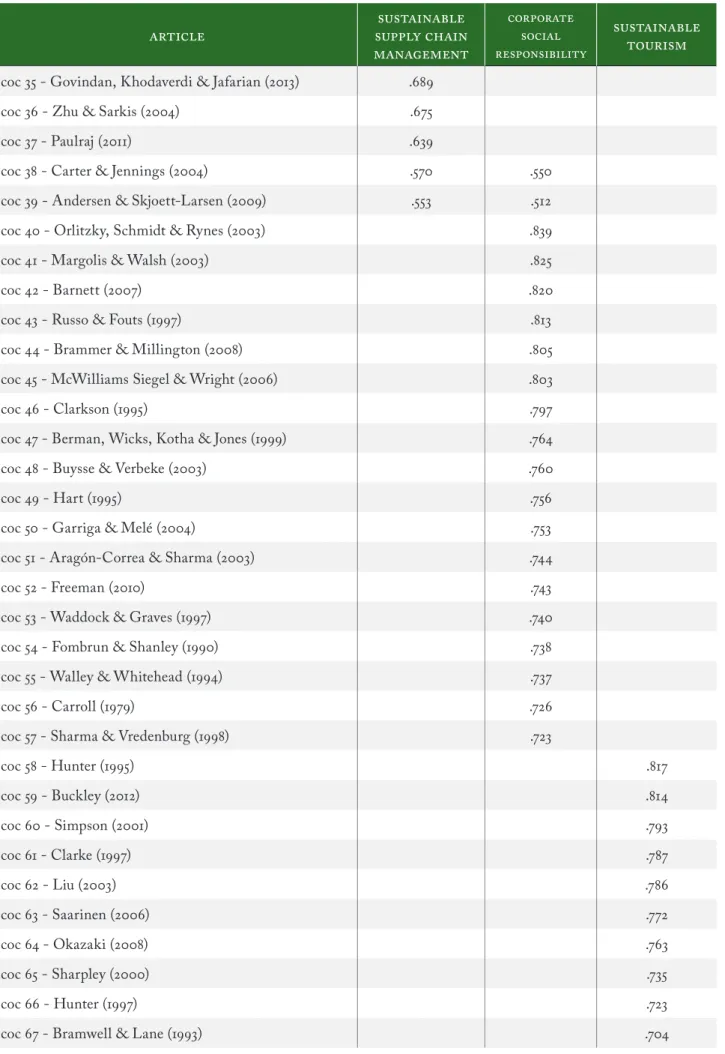
below ., one should fi rst remove the one with the least commonality and redo the analysis and verify if the other variable that had low common-ality still presents violations of commoncommon-ality in the new scenario in which the variable with highest breach measurement was removed. Th is proce-dure is repeated until a fi nal solution is reached without a breach of assumptions (Table ).Th e fi rst component is named “Sustainable Supply Chain Management” and refl ected in articles. Th is group includes the inclusion of the concept of sustainability in the context of supply chains, as a way of generating value and competitive advantage for companies, from the environmental and social dimensions at various levels of the chain.
Some sample studies that analyze this concept from a performance perspective are: Bai, Sarkis, Wei and Koh (2012), Carter and Rogers (2008), Golicic and Smith (), Erol, Sencer & Sari (), Hervani, Helms and Sarkis (), Wang and Sarkis (), Rao and Holt ().
The research by Van Hoof and Th iell () highlights the results of cleaner production proj-ects within supply chains in the context of Small and Medium Enterprises, which means that this concern does not only consider large companies. As well as the research by Walker, Di Sisto and McBain () on barriers and facilitators of envi-ronmental management practices comparing the public and private context.
In this study group, country-specific contexts were analyzed, such as India (Mitra & Datta, 2014), Malaysia (Zailani, Jeyaraman, Vengadasan & Premkumar, ) and China (Zhu & Sarkis, ).
Companies that adopt this perspective influence the whole chain, for instance, having an impact on supplier choice, as analyzed by Bai and Sarkis (2010), Ageron, Gunasekaran and Spalanzani () and Weber, Current and Benton ().
As it is still a theme that is under construc-tion, we highlight the theoretical studies focused on the defi nition of conceptual frameworks (Hassini, Surti, & Searcy, ), literature review according to Ahi and Searcy (), Srivastava (), Miemczyk , Johnsen and Macquet (), Seuring and Müller () and Sarkis, Zhu and Lai (); as well as research agendas and studies on the future challenges of sustainable supply
Table 2: Co-citation analysis
coc - Hassini, Surti & Searcy () .
coc - Ahi & Searcy () .
coc - Bai & Sarkis () .
coc - Brandenburg, Govindan, Sarkis & Seuring () .
coc - Bai, Sarkis, Wei & Koh () .
coc - Gold, Seuring & Beske () .
coc - Seuring () .
coc - Ageron, Gunasekaran & Spalanzani () .
coc - Carter & Rogers () .
coc - Golicic & Smith () .
coc - Srivastava () .
coc - Erol, Sencer & Sari () .
coc - van Hoof & Th iell () .
coc - Miemczyk, Johnsen & Macquet() .
coc - Hervani, Helms, & Sarkis () .
coc - Pagell & Wu, Z. () .
coc - Mitra & Datta () .
coc - Seuring & Müller () .
coc - Handfi eld, Sroufe & Walton() .
coc - Ahi & Searcy () .
coc - Pagell & Shevchenko () .
coc - Wang & Sarkis () .
coc - Zailani, Jeyaraman, Vengadasan & Premkumar () .
coc - Carter & Liane Easton () .
coc - Dou, & Sarkis (). .
coc - Weber, Current & Benton () .
coc - Sarkis, Zhu & Lai () .
coc - Linton, Klassen & Jayaraman() .
coc - Rao & Holt () . .
coc - Walker, Di Sisto & McBain () .
coc - Hofmann, Busse, Bode & Henke () .
coc - Kleindorfer, Singhal & Van Wassenhove () .
coc - Hoejmose & Adrien-Kirby () .
v. 8, n. 3 (2019): set./dez
coc - Govindan, Khodaverdi & Jafarian () .
coc - Zhu & Sarkis () .
coc - Paulraj () .
coc - Carter & Jennings () . .
coc - Andersen & Skjoett-Larsen () . .
coc - Orlitzky, Schmidt & Rynes () .
coc - Margolis & Walsh () .
coc - Barnett () .
coc - Russo & Fouts () .
coc - Brammer & Millington () .
coc - McWilliams Siegel & Wright () .
coc - Clarkson () .
coc - Berman, Wicks, Kotha & Jones () .
coc - Buysse & Verbeke () .
coc - Hart () .
coc - Garriga & Melé () .
coc - Aragón-Correa & Sharma () .
coc - Freeman () .
coc - Waddock & Graves () .
coc - Fombrun & Shanley () .
coc - Walley & Whitehead () .
coc - Carroll () .
coc - Sharma & Vredenburg () .
coc - Hunter () . coc - Buckley () . coc - Simpson () . coc - Clarke () . coc - Liu () . coc - Saarinen () . coc - Okazaki () . coc - Sharpley () . coc - Hunter () .
coc - Bramwell & Lane () .
chain management (Pagell & Shevchenko, ; Carter and Liane Easton, ; Hoejmose & Adrien-Kirby, ).
Th e second component is named “Corporate Social Responsibility” and was included in arti-cles, of which Rao and Holt (), Carter and Jennings () and Andersen and Skjoett-Larsen () are common with component as they are also linked with the Supply Chain theme, but in our analysis belong conceptually to component .
In Carroll’s study (), the concept of Corporate Social Responsibility (CSR) can be clas-sifi ed by considering four categories that make up a pyramid: () Economic Responsibility: the basis and is associated with the concern of organizations to make a profi t; () Legal Responsibility: linked to the need to know and obey the law; () Ethical Responsibility: obligation to do what is right and fair; and () Philanthropic Responsibility: contributing resources to the community (corpo-rate citizen). In addition to this study, other authors of the sample discussed the theoretical perspectives of the CSR concept (McWilliams, Siegel & Wright, ; Garriga & Melé, ; and Fombrun & Shanley, ).
Th e articles by Orlitzky, Schmidt and Rynes (), Margolis and Walsh (), Brammer and Millington (), Waddock and Graves (); Russo and Fouts () relate the concept of corporate social performance to corporate fi nan-cial performance that is geared to maximizing the wealth of the organizations’ owners. Some studies also relate the organization’s CSR prac-tices to stakeholder theory and the impact of these practices on the company’s reputation, image and fi nancial performance [Barnett (), Clarkson (), Berman, Wicks, Kotha & Jones (), Buysse & Verbeke () and Freeman ()]. Finally, the studies by Russo and Fouts (), Hart () and Aragón-Correa and Sharma () analyze Corporate Social Responsibility in the light of Resource-based View (RBV).
Th e third component is named “Sustainable Tourism” as the challenges associated with the environment and the concern for sustainable devel-opment and the effi cient use of resources impact this sector. Th is component considered studies. Th e research presents several theoretical perspec-tives on the subject: Hunter (), Clarke (), Liu (), Saarinen (), Okazaki (),
Sharpley (), Hunter () and Bramwell and Lane (). Presented are priorities for academic research aimed at improving the sustainability of the tourism industry (Buckley, ), as well as the use of management tools such as Strategic Planning and stakeholder participation to foster sustainable tourism (Simpson, ).
BIBLIOGRAPHICCOUPLINGANALYSIS
Bibliographic Coupling began with sample documents that have a minimum of shared cita-tions. Th e analysis was performed to achieve a solution that satisfi ed all the assumptions under-lying a valid PCA: general and individual KMO above ., Bartlett’s sphericity test p-value less than ., and communalities over .. After interac-tions, we reached a fi nal solution comprised of sample documents loaded in fi ve components that explained of variance. Th ey are represented in the following Table and have been ordered from the most explained variance (or greater eigenvalue) to the lowest.
Th e fi rst component we call “Classical Sustainable Supply Chain Frameworks” and consists of fi ve sample articles dealing with research on sustainable supply chain management. Conceptually, all fi ve articles analyze frameworks and metrics related to sustainable supply chain management performance. Th e fi rst article, Stindt (), is a theoretical essay proposing a sustain-able supply chain management planning frame-work. Oelze & Habisch () applied a typology of Responsible Supply Chain Management in cases ( multinationals and small companies) using Eisenhardt’s () approach with inter-views (Miles & Huberman, ) along with trian-gulation of data (Patton). Osiro, Lima-Junior and Carpinetti () propose supply chain sustain-ability assessment metrics based on previous literature studies and test them using Quality Function Deployment (QFD) matrix and expert assessment. Zhou, Wang, Lim, He and Li () is a background analysis of the supply chain back-ground in selecting sustainable partners employing Multi Criteria Decision Making (MCDM) using quantitative equations with a fuzzy approach, plus experts to evaluate the dashboard metrics. Finally, Touboulic and Walker () assesses the Collaborative paradigm on Sustainable Supply
v. 8, n. 3 (2019): set./dez
Table 3: Bibliographic Pairing Analysis
Coup – Stindt () .
Coup – Oelze & Habisch(
) .
Coup – Osiro, Lima-Junior &
Carpinetti () .
Coup - Zhou, Wang, Lim, He
& Li () .
Coup - Touboulic & Walker
() .
Coup - Ehrgott, Reimann,
Kaufmann & Carter () .
Coup - Chacón Vargas,
Mantilla & Eduardo () .
Coup - Ortas, E., M. Moneva,
J. & Álvarez, I. () .
Coup - Wu, Liao, Tseng &
Chiu () .
Coup - Sen, Datta, Patel &
Mahapatra () .
Coup - Taticchi, Garengo, Nudurupati, Tonelli &
Pasqualino () .
Coup - Kähkönen, Lintukangas, Hallikas &
Evangelista () .
Coup - Raj & Srivastava () .
Coup - Pandey, Shah & Gajjar
() .
Coup - Comas Martí &
Seifert () .
Coup - Kähkönen,
Lintukangas & Hallikas () .
Coup - Fabbe-Costes,
Roussat, Taylor & Taylor () .
Coup - Eriksson, & Svensson
Chain Management through action research on a network of small agricultural suppliers from a large food multinational, with interviews, data triangulation (Patton) and single case study approach (Yin).
Th e second component was named “Global and Emergent Economies Sustainable Supply Chain” and has four sample articles. From a theoretical point of view, it is very similar to the fi rst component of classic Sustainable Supply Chain frameworks, but its entire context is global or immersed in emerging economies. Ehrgott, Reimann, Kaufmann and Carter () analyze how pressures act as antecedents in developing suppliers’ environmental capacities in emerging economies from stakeholder theory and the bene-fi ts that companies derive from this eff ort. It is a comparative study between the United States and Germany, with purchasing managers employing Structural Equation Modeling. Chacón Vargas, Mantilla and Eduardo () study orga-nizational background and implementation of Sustainable Supply Chain Management practices employing a qualitative approach (Creswell / Yin), with a case study of companies from diff erent sectors in Colombia. Th e analysis and data collec-tion are based on semi-structured interviews of executives, in which content analysis was applied. Ortas, Moneva and Álvarez () investigate the relationship between a sustainable supply chain and companies’ fi nancial performance through the Granger Causality Test (an econometric technique). Th e sample is substantial with , companies and the eight-year data collection period (-). Wu, Liao, Tseng and Chiu () propose a sustainable supply chain management evalua-tion model using Multi Criteria Decision Making (MCDM). It is a case study with four experts at a Taiwanese semiconductor company.
The third component, “Supplier Selection and Fuzzy Techniques”, has five sample articles and theoretically addresses supplier selection issues using the fuzzy approach. Sen, Datta, Patel & Mahapatra () analyze how to select sustainable suppliers in Supply Management using quantitative methods under fuzzy approach and recruited four experts to evaluate the panel approach. Taticchi, Garengo, Nudurupati, Tonelli and Pasqualino () is a narrative literature review on state-of-the-art tools
and performance measurement in sustainable supply management that employs bibliometric techniques similar to this article. Kähkönen, Lintukangas, Hallikas and Evangelista () is a definition of supplier risk management prin-ciples and practices from a sustainable perspec-tive by surveying Finnish companies. Raj and Srivastava () employ a fuzzy approach to assessing sustainable performance in a supply chain and is a unique case study with an Indian airline. Pandey, Shah and Gajjar () develop a sustainable supplier selection framework using a fuzzy approach and also a unique case study with an Indian automotive industry.
Th e fourth component was named “New Sustainable Supply Chain Frameworks” and consists of articles that diff er conceptually from the fi rst component, even though they both have Sustainable Supply Chain frameworks as their theme. Comas Martí and Seifert () analyze the consistency of companies’ sustain-able supply chain strategies through Content Analysis and Grounded Th eory (Glaser-Strauss). Kähkönen, Lintukangas and Hallikas () analyze the role of sustainable management of Supply Management in Sustainable Performance of companies from the perspective of Dynamic Capabilities. Th e study employed Focus Group with supply chain management professionals and a survey of companies.
Finally, the fi fth component, Environmental Responsibility, consisting of articles, deals with moral and ethical issues of Sustainable Supply Chain management. Fabbe-Costes, Roussat, Taylor and Taylor () is an analysis of envi-ronmental scanning (ES) practices for sustain-able supply chain management (SSCM) and was prepared with semi-structured interviews with professionals along with validation of results with a focus group of supply chain specialists. Eriksson and Svensson () analyze moral disengagement in sustainable business supply chains (Business Sustainability - Bsus) based on qualitative multi-case research (Eisenhardt, ).
Th e fi ve components, derived from principal component factor analysis, to explain quantity of variance (or higher eigenvalue) show not only a trend of relevant emerging themes in sustain-ability research, but also demonstrate that there is no favoring of quantitative or qualitative
v. 8, n. 3 (2019): set./dez methodological approaches. Th e fi rst component
“Classical Sustainable Supply Chain Frameworks” has fi ve articles, being a theoretical essay, therefore, without defi ned methodological approach. Of the remaining four articles, two are quantitative and two qualitative. In the four articles in the second compo-nent, “Global and Emergent Economies Sustainable Supply Chain”, consists of two articles that are quantitative studies and one is qualitative, and one is a mixed study that employs both approaches. Th is demonstrates that this component slightly favors quantitative approaches. Th is can be explained by the global character of the component in which they generally adopt international business traditions and biases whose approaches are typically quanti-tative. Th e third component (Supplier Selection and Fuzzy Techniques) is entirely quantitative with its
fi ve articles using strictly fuzzy quantitative tech-niques. Th e fourth component, “New Sustainable Supply Chain Frameworks”, involves the proposi-tion of new sustainable supply chain management frameworks and tend to be more exploratory than descriptive. Th erefore, its methodological approach is qualitative, and one article is strictly qualitative. Th ere is an article from a study of mixed methods, which confi rms quantitatively the results obtained
in the qualitative research. Finally, the fi fth compo-nent, “Environmental Responsibility”), is predom-inantly qualitative because it addresses moral and ethical issues that are diffi cult to measure quantita-tively (Randall & Gibson ).
DISCUSSION
The results of this research corroborate the growth of the theme of sustainability in the scientific scope at the world level according to Figure 1 (Annual Scientific Production). The sample with 1,292 documents revealed that the scientific production in sustainability: (1) has studies in several areas of knowledge; and (2) presents a variety of methods in the publications without endorsing a preference towards qualitative or quantitative approach.
Despite this diversity, the articles in the sample converge and point to the researchers’ concern to promote discussions and reflections, together with the development of strategies, actions and solutions that promote sustainability on a local, regional and global scale.
With this article we contribute to the iden-tifi cation of patterns and trends of sustainability research. We associate the word “management”
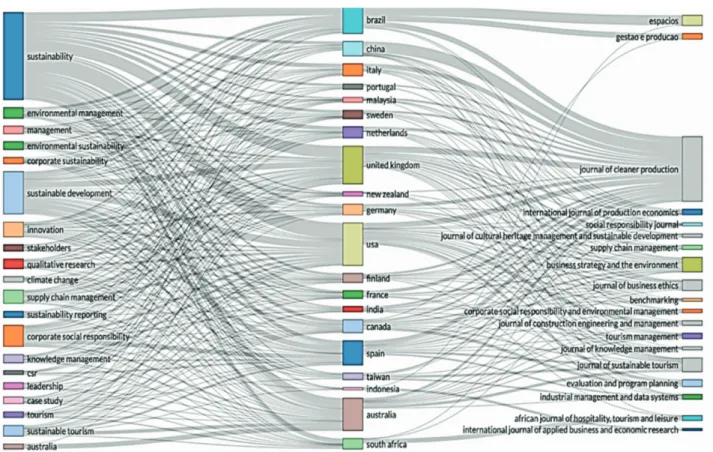
with the theme of “sustainability” and with the use of statistical techniques and bibliometric method we determine the main authors, journals, method-ological approaches and research topics. According to Figure (Scientifi c Production by Country), we can identify: () the most researched themes; () the countries; and () the main journals. It is also possible to distinguish by the thickness of the lines which countries and themes are most published. In this context, the most important are the devel-oped countries: United States, United Kingdom, Australia and Spain for the variety of content and publications. However, in emerging countries such as Brazil and China, it is observed that they have a variety of themes, however, published in a smaller number of journals.
In the continuity of the study, when conducting the analysis of co-citation and bibliographic pairing, there is a predominance of contents related to the Sustainable Supply Chain. In the most representative articles in this sample, the authors discuss their considerations and conclusions on the implementation, effi ciency and management of the Sustainable Supply Chain. Some examples are: coc - Hassini, Surti and Searcy (), coc - Ahi and Searcy () with conceptual proposals on the subject. Other articles limit the research question to a traditional setting, such as: coup - Stindt () and coup - Oelze and Habisch (). Other articles in the sample broaden the discus-sions to a global context, including economic, social and environmental issues in developed and emerging markets, as follows: coup - Ehrgott, Reimann, Kaufmann and Carter (), coup - Chacón Vargas, Mantilla and Eduardo ().
Th e issue of sustainability management is on the rise, which generates a positive expec-tation about further research over the next few years. However, we have identifi ed the absence of important themes that should be developed and explored with the aim of boosting and expanding the world scientifi c literature, such as: () develop-ment of green technologies; () sustainable innova-tions in a broader context that are not just limited to innovations in supply chain processes; and () public policies and environmental certifi cations.
FINALCONSIDERATIONS
. CONCLUSIONS
Co-citation analysis identifi ed three components. Th e fi rst component was called “Sustainable Supply Chain Management” and encompassed theoretical studies on the topic, as well as research relating this concept to organizational perfor-mance, supplier selection and future research agendas. Th e second was called “Corporate Social Responsibility” with studies that addressed various theoretical perspectives in the light of stakeholder theory, Resource-based View and analysis of the relationship between corporate social perfor-mance and fi nancial perforperfor-mance. Finally, the last component was named “Sustainable Tourism” with a mainstream of theoretical studies.
Bibliographic matching analysis emerged with fi ve components. Regarding its theoretical frame-work, the fi rst component, Sustainable Classic Supply Chain Structures, has studies that deal with frameworks and metrics related to sustain-able supply chain performance. In the second component, Global and Emerging Economies in Sustainable Supply Chains, the theme is very similar to the fi rst component, but its whole context is global or immersed in emerging economies. Th e third component, named Vendor Selection and Fuzzy Techniques, discuss vendor selection issues using the fuzzy approach. Th e fourth compo-nent, New Sustainable Supply Chain Structures, proposes new sustainable supply chain manage-ment frameworks. Finally, the fi fth component, Environmental Responsibility, addresses the moral and ethical issues of sustainable supply chain management.
Th e components of bibliographic matching, analyzing under the methodological framework, demonstrate that there is no favoring of quanti-tative or qualiquanti-tative methodological approaches. In general, more unison themes demand quanti-tative studies and more diverse themes, emerging or dealing with diffi cult to measure phenomena, are addressed qualitatively. Such a relationship between methodological approaches and maturity of research topics is already evident in the litera-ture. Souza and Ribeiro () show this trend in the Brazilian sustainability literature.
v. 8, n. 3 (2019): set./dez . LIMITATIONS AND SUGGESTIONS FOR FUTURE
STUDIES
Bibliometrics has some limitations in its appli-cations. Th e fi rst concerns the assumption that document citations are made to indicate there is a synergistic theoretical connection. In this sense, one document cites another as there is an intention to add the contributions of the cited document. Th erefore, citations in a bibliometric study cannot be interpreted as a manifestation of confl ict or disagreement. However, authors often cite documents to oppose the premises or contri-butions of such documents, generating a citation that, through bibliometric eyes, will be misinter-preted as alignment and consent. Th is limitation of bibliometrics means that bibliometric studies have to pay greater attention to their citation and co-citation analyzes. Th is does not occur in bibliometric pairing analysis, as a minimum cut is usually made on the number of common nodes (cited documents) that paired documents must have to join the pairing analysis sample.
Th e second limitation is that bibliometrics is no substitute for extensive and deep readings and syntheses. Bibliometric studies can accu-rately: ) quantitatively connect themes, jour-nals and authors; ) identify research themes and subthemes; and ) produce representations of published research (Zupic & Čater, ). Every bibliometrics has a human intervention in the sense of the researcher deciding, based on his knowledge of the theoretical fi eld in question, what will be the interpretation of these bibliometrics results.
As future studies, we believe that meth-odological innovations in bibliometrics can be applied. Th ese innovations can have a hybrid char-acter, joining with semantic approaches that can detect new emerging topics in scientifi c research through bibliographic pairing with latent semantic indexing (Glänzel & Th ijs, ). Th ere is also the possibility of linking bibliometrics with machine learning approaches, the most prominent being topic modeling (Blei, ). Th ese two methods have great potential for expanding the domain mapping scope of a desired theoretical fi eld.
REFERENCES
Acedo, F. J., Barroso, C., & Galan, J. L. (2006). Th e resource-based theory: dissemination and main trends. Strategic Management Journal, 27(7), 621-636. doi: 10.1002/smj.532 Blei, D. M. (2012). Probabilistic topic models. Communications of the ACM, 55(4), 77-84.
Broadus, R. N. (1987). Towards a defi nition of “bibliometrics”. Scientometrics, 12(5-6), 373-379. Doi: 10.1007/BF02016680 Culnan, M. J., O’Reilly, C. A., III, & Chatman, J. A. (1990). Intellectual structure of research in organizational behavior, 1972-1984: a co-citation analysis. Journal of the American Society for Information Science, 41(6), 453-458. doi: 10.1002/ (SICI)1097-4571(199009)41:6<453::AIDASI13>3.0.CO;2-E Furrer, O., Tomas, H., & Goussevskaia, A. (2008). Th e structure and evolution of the strategic management fi eld: a content analysis of 26 years of strategic management research. International Journal of Management Reviews, 10(1), 1-23. doi: 10.1111/j.1468-2370.2007.00217.x
Ferreira, M. (2011). A bibliometric study on Ghoshal’s managing across borders. Multinational Business Review, 19(4), 357-375.
Glänzel, W., & Th ijs, B. (2012). Using ‘‘core documents’’ for detecting and labelling new emerging topics. Scientometrics, 91(2), 399-416. doi:10.1007/s11192-011-0591-7
Hair, J. F., Black, W. C., Babin, B. J., Anderson, R. E., & Tatham, R. L. (2009). Análise multivariada de dados. São Paulo: Bookman Editora.
Leydesdorff , L. (1987). Various methods for the mapping of science. Scientometrics, 11(5), 295-324. doi: 10.1007/ BF02279351
McCain, K. W. (1986). Cocited author mapping as a valid representation of intellectual structure. Journal of the American Society for Information Science, 37(3), 111-122. doi: 10.1002/ (SICI)1097-4571(198605)37:3<111::AID-ASI2>3.0.CO;2-D __________. (1990). Mapping authors in intellectual space: a technical overview. Journal of the American Society for Information Science, 41(6), 433-443. doi: 10.1002/(SICI)1097-4571(199009)41:6<433::AID-ASI11>3.0.CO;2-Q
__________ (1991). Mapping economics through the journal literature: an experiment in journal cocitation. Journal of the American Society for Information Science, 42(4), 290-296. doi: 10.1002/(SICI)1097-4571(199105)42:4<290::AID-ASI5>3.0.CO;2-9
Nerur, S. P., Rasheed, A. A., & Natarajan, V. (2008). Th e intellectual structure of the strategic management fi eld: An author co-citation analysis. Strategic Management Journal, 29(3), 319-336.
Phelan, S. E., Ferreira, M. P., & Salvador, R. (2002). Th e fi rst twenty years of the Strategic Management Journal. Strategic Management Journal, 23(12), 1161-1168. doi: 10.1002/smj.268 Pritchard, A. (1969). Statistical bibliography or bibliometrics? Journal of Documentation, 25(4), 348-349.
Quevedo-Silva, F., Santos, E. B. A., Brandão, M. M., & Vils, L. (2016). Estudo bibliométrico: orientações sobre sua aplicação. REMark, 15(2), 246-255.
1980–2000. Strategic Management Journal, 25(10), 981-1004. doi: 10.1002/smj.397
Randall, D. M., & Gibson, A. M. (1990). Methodology in business ethics research: A review and critical assessment. Journal of business ethics, 9(6), 457-471.
Schildt, H. A., Zahra, S. A., & Silanpää, A. (2006). Scholarly communities in entrepreneurship research: a co-citation analysis. Entrepreneurship Th eory & Practice, 30(3), 399-415. doi: 10.1111/j.1540-6520.2006.00126.x
Serra, F. A. R., Ferreira, M. P., de Camargo Guerrazzi, L. A., & Scaciotta, V. V. (2018). Doing Bibliometric Reviews for the Iberoamerican Journal of Strategic Management. Iberoamerican Journal of Strategic Management (IJSM), 17(3), 01-16
Shafi que, M. (2013). Th inking inside the box? Intellectual structure of the knowledge base of innovation research (1988– 2008). Strategic Management Journal, 34(1), 62-93. doi: 10.1002/smj.2002
Shane, S. (1997). Who is publishing the entrepreneurship research?, Journal of Management, 23(1), 83-95. doi: 10.1177/014920639702300105
Small, H. (1973). Co-citation in the scientifi c literature: a new measure of the relationship between two documents. Journal of the American Society for information Science, 24(4), 265-269. doi: 10.1002/asi.4630240406
Small, H., & Garfi eld, E. (1993). Co-citation analysis of science: henry small on mapping the collective mind of science. Current Comments, (19), 3-13.
Souza, Maria Tereza Saraiva de, & Ribeiro, Henrique César Melo. (2013). Sustentabilidade ambiental: uma meta-análise da produção brasileira em periódicos de administração. Revista de Administração Contemporânea, 17(3), 368-396. https:// dx.doi.org/10.1590/S1415-65552013000300007
Subramanyam, K. (1983). Bibliometric studies of research collaboration: a review. Journal of Information Science, 6(1), 33-38. doi: 10.1177/016555158300600105
White, H. D., & McCain, K. W. (1998). Visualizing a discipline: an author co-citation analysis of information science, 1972-1995. Journal of the American Society for Information Science, 49(4), 327-355. doi: 10.1002/(SICI)1097-4571(19980401)49:4<327::AID-ASI4>3.0.CO;2-4
Zupic, I.; Čater, T. Bibliometric Methods in Management and Organization. Organizational Research Methods, [s. l.], v. 18, n. 3, p. 429–472, 2015.
v. 8, n. 3 (2019): set./dez
CO-CITATIONREFERENCES
Hassini, E., Surti, C., & Searcy, C. (). A literature review and a case study of sustainable supply chains
with a focus on metrics. International Journal of Production Economics, (), -. coc Ahi, P., & Searcy, C. (). A comparative literature analysis of defi nitions for green and sustainable supply
chain management. Journal of Cleaner Production, , -. coc Bai, C., & Sarkis, J. (). Integrating sustainability into supplier selection with grey system and rough set
methodologies. International Journal of Production Economics, (), -. coc Brandenburg, M., Govindan, K., Sarkis, J., & Seuring, S. (). Quantitative models for sustainable supply
chain management: Developments and directions. European Journal of Operational Research, (), -. coc Bai, C., Sarkis, J., Wei, X., & Koh, L. (). Evaluating ecological sustainable performance measures for
supply chain management. Supply Chain Management: An International Journal, (), -. coc Gold, +A:BS., Seuring, S., & Beske, P. (). Th e constructs of sustainable supply chain management–a
content analysis based on published case studies. Progress in Industrial Ecology, an International Journal, (),
-. coc
Seuring, S. (). A review of modeling approaches for sustainable supply chain management. Decision Support
Systems, (), -. coc
Ageron, B., Gunasekaran, A., & Spalanzani, A. (). Sustainable supply management: An empirical study.
International Journal of Production Economics, (), -. coc
Carter, C. R., & Rogers, D. S. (). A framework of sustainable supply chain management: moving toward
new theory. International Journal of Physical Distribution & Logistics Management, (), -. coc Golicic, S. L., & Smith, C. D. (). A meta-analysis of environmentally sustainable supply chain
management practices and fi rm performance. Journal of Supply Chain Management, (), -. coc Srivastava, S. K. (). Green supply-chain management: a state-of-the-art literature review. International
Journal of Management Reviews, (), -. coc
Erol, I., Sencer, S., & Sari, R. (). A new fuzzy multi-criteria framework for measuring sustainability
performance of a supply chain. Ecological Economics, (), -. coc van Hoof, B., & Th iell, M. (). Collaboration capacity for sustainable supply chain management: small and
medium-sized enterprises in Mexico. Journal of Cleaner Production, , -. coc Miemczyk, J., Johnsen, T. E., & Macquet, M. (). Sustainable purchasing and supply management: a
structured literature review of defi nitions and measures at the dyad, chain and network levels. Supply Chain
Management: An International Journal, (), -. coc
Hervani, A. A., Helms, M. M., & Sarkis, J. (). Performance measurement for green supply chain
management. Benchmarking: An International Journal, (), -. coc Pagell, M., & Wu, Z. (). Building a more complete theory of sustainable supply chain management using
Mitra, S., & Datta, P. P. (). Adoption of green supply chain management practices and their impact on
performance: an exploratory study of Indian manufacturing fi rms. International Journal of Production Research,
(), -. coc
Seuring, S., & Müller, M. (). From a literature review to a conceptual framework for sustainable supply
chain management. Journal of Cleaner Production, (), -. coc Handfi eld, R., Sroufe, R., & Walton, S. (). Integrating environmental management and supply chain
strategies. Business Strategy and the Environment, (), -. coc Ahi, P., & Searcy, C. (). An analysis of metrics used to measure performance in green and sustainable
supply chains. Journal of Cleaner Production, , -. coc Pagell, M., & Shevchenko, A. (). Why research in sustainable supply chain management should have no
future. Journal of Supply Chain Management, (), -. coc Wang, Z., & Sarkis, J. (). Investigating the relationship of sustainable supply chain management with
corporate fi nancial performance. International Journal of Productivity and Performance Management, (),
-. coc
Zailani, S., Jeyaraman, K., Vengadasan, G., & Premkumar, R. (). Sustainable supply chain management
(SSCM) in Malaysia: A survey. International Journal of Production Economics, (), -. coc Carter, C. R., & Liane Easton, P. (). Sustainable supply chain management: evolution and future
directions. International Journal of Physical Distribution & Logistics Management, (), -. coc Dou, Y., & Sarkis, J. (). A joint location and outsourcing sustainability analysis for a strategic off shoring
decision. International Journal of Production Research, (), -. coc Weber, C. A., Current, J. R., & Benton, W. C. (). Vendor selection criteria and methods. European Journal
of Operational Research, (), -. coc
Sarkis, J., Zhu, Q., & Lai, K. H. (). An organizational theoretic review of green supply chain management
literature. International Journal of Production Economics, (), -. coc Linton, J. D., Klassen, R., & Jayaraman, V. (). Sustainable supply chains: An introduction. Journal of
Operations Management, (), -. coc
Rao, P., & Holt, D. (). Do green supply chains lead to competitiveness and economic performance?.
International Journal of Operations & Production Management, (), -. coc
Walker, H., Di Sisto, L., & McBain, D. (). Drivers and barriers to environmental supply chain management practices: Lessons from the public and private sectors. Journal of Purchasing and Supply
Management, (), -. coc
Hofmann, H., Busse, C., Bode, C., & Henke, M. (). Sustainability-related supply chain risks:
Conceptualization and management. Business Strategy and the Environment, (), -. coc Kleindorfer, P. R., Singhal, K., & Van Wassenhove, L. N. (). Sustainable operations management.
Production and Operations Management, (), -. coc
Hoejmose, S. U., & Adrien-Kirby, A. J. (). Socially and environmentally responsible procurement: A
v. 8, n. 3 (2019): set./dez
Tang, C. S., & Zhou, S. (). Research advances in environmentally and socially sustainable operations.
European Journal of Operational Research, (), -. coc
Govindan, K., Khodaverdi, R., & Jafarian, A. (). A fuzzy multi criteria approach for measuring
sustainability performance of a supplier based on triple bottom line approach. Journal of Cleaner Production, ,
-. coc
Zhu, Q., & Sarkis, J. (). Relationships between operational practices and performance among early adopters of green supply chain management practices in Chinese manufacturing enterprises. Journal of
Operations Management, (), -. coc
Paulraj, A. (). Understanding the relationships between internal resources and capabilities, sustainable
supply management and organizational sustainability. Journal of Supply Chain Management, (), -. coc Carter, C. R., & Jennings, M. M. (). Th e role of purchasing in corporate social responsibility: a structural
equation analysis. Journal of Business Logistics, (), -. coc Andersen, M., & Skjoett-Larsen, T. (). Corporate social responsibility in global supply chains. Supply
Chain Management: an International Journal, (), -. coc
Orlitzky, M., Schmidt, F. L., & Rynes, S. L. (). Corporate social and fi nancial performance: A
meta-analysis. Organization Studies, (), -. coc
Margolis, J. D., & Walsh, J. P. (). Misery loves companies: Rethinking social initiatives by business.
Administrative Science Quarterly, (), -. coc
Barnett, M. L. (). Stakeholder infl uence capacity and the variability of fi nancial returns to corporate social
responsibility. Academy of Management Review, (), -. coc Russo, M. V., & Fouts, P. A. (). A resource-based perspective on corporate environmental performance and
profi tability. Academy of Management Journal, (), -. coc Brammer, S., & Millington, A. (). Does it pay to be diff erent? An analysis of the relationship between
corporate social and fi nancial performance. Strategic Management Journal, (), -. coc McWilliams, A., Siegel, D. S., & Wright, P. M. (). Corporate social responsibility: Strategic implications.
Journal of Management Studies, (), -. coc
Clarkson, M. E. (). A stakeholder framework for analyzing and evaluating corporate social performance.
Academy of Management Review, (), -. coc
Berman, S. L., Wicks, A. C., Kotha, S., & Jones, T. M. (). Does stakeholder orientation matter? Th e relationship between stakeholder management models and fi rm fi nancial performance. Academy of Management
Journal, (), -. coc
Buysse, K., & Verbeke, A. (). Proactive environmental strategies: A stakeholder management perspective.
Strategic Management Journal, (), -. coc
Aragón-Correa, J. A., & Sharma, S. (). A contingent resource-based view of proactive corporate
environmental strategy. Academy of Management Review, (), -. coc Freeman, R. E. (). Strategic management: A stakeholder approach. Cambridge University Press. coc Waddock, S. A., & Graves, S. B. (). Th e corporate social performance–fi nancial performance link. Strategic
Management Journal, (), -. coc
Fombrun, C., & Shanley, M. (). What’s in a name? Reputation building and corporate strategy. Academy of
Management Journal, (), -. coc
Walley, N., & Whitehead, B. (). It’s not easy being green. Reader in Business and the Environment, , . coc Carroll, A. B. (). A three-dimensional conceptual model of corporate performance. Academy of Management
Review, (), -. coc
Sharma, S., & Vredenburg, H. (). Proactive corporate environmental strategy and the development of
competitively valuable organizational capabilities. Strategic Management Journal, (), -. coc Hunter, C. J. (). On the need to re-conceptualise sustainable tourism development. Journal of Sustainable
Tourism, (), -. coc
Buckley, R. (). Sustainable tourism: Research and reality. Annals of Tourism Research, (), -. coc Simpson, K. (). Strategic planning and community involvement as contributors to sustainable tourism
development. Current Issues in Tourism, (), -. coc
Clarke, J. (). A framework of approaches to sustainable tourism. Journal of Sustainable Tourism, (), -. coc
Liu, Z. (). Sustainable tourism development: A critique. Journal of Sustainable Tourism, (), -. coc
Saarinen, J. (). Traditions of sustainability in tourism studies. Annals of Tourism Research, (), -. coc Okazaki, E. (). A community-based tourism model: Its conception and use. Journal of Sustainable Tourism,
(), -. coc
Sharpley, R. (). Tourism and sustainable development: Exploring the theoretical divide. Journal of
Sustainable Tourism, (), -. coc
Hunter, C. (). Sustainable tourism as an adaptive paradigm. Annals of Tourism Research, (), -. coc Bramwell, B., & Lane, B. (). Sustainable tourism: An evolving global approach. Journal of Sustainable coc