LESS AVIAN INFLUENZA RISK BIRDS IN POULTRY
FREE RANGE AREAS COVERED WITH TREES
Bestman M1*, Wagenaar J1, de Jong W1, Weerts T1, Luske B1
(1) Louis Bolk Institute, Bunnik, the Netherlands *Corresponding author: [email protected]
Abstract
This study investigated the relation between the presence of wild bird species that may infect domestic poultry with Avian Influenza, and woody vegetation within the range areas as well as in the landscape surrounding the range areas. During two seasons all wild birds were counted in the free-range areas of 11 poultry farms and their immediate surroundings. More high-risk birds were observed in free-range areas with less than 5 % woody cover, compared to free-range areas with more woody cover. Furthermore, more high-risk birds were observed in the surroundings of free-range areas in open landscapes, compared to half-open landscapes. For low-risk birds, no relation was found between woody cover or openness of the landscape and their presence in free-range areas or surroundings. These results merit further experimental research on the relation between the presence of AI risk birds and woody vegetation in and around poultry free-range areas.
Keywords: free-range poultry; organic poultry; animal welfare
Introduction
For several reasons poultry free-range areas are planted with trees. A reason from an animal welfare point of view is that a higher proportion of chickens from a flock will use the free-range area if there is cover by trees. If a higher proportion of the chickens is using the free-range area, significantly less feather pecking damage (a welfare problem) is seen (Bestman and Wagenaar 2003; Green et al. 2000). Another reason for planting the free-range area with trees is to combine two types of l
(Paolotti et al. 2016). However, free-range chickens can have contact with wild birds and become infected with avian influenza (van der Goot et al. 2015). Water birds and waders are regarded as high risk birds (Veen et al. 2007). Since these birds are associated with open landscapes, we expected a negative relation between tree cover in the free-range area and presence of these risk birds. Our aim was to be able to advise free-range poultry farmers about the role of tree cover in relation to the presence of wild birds known for their risk to carry avian influenza. Wild birds have been counted in 11 poultry free-range areas with different proportions of tree cover.
Materials and methods
Eleven organic and conventional free-range egg production farms were selected based on their proportion of free-range area covered with trees (fruit trees, biomass willows or miscanthus). This varied from 0 to 90% cover. See Table 1 for farm characteristics.
Table 1: Characteristics of farms involved in this study. Farm No of hens, rounded to 1,000 Size of free-range area in hectares Woody cover in % of free-range area Type of vegetation in free-range area Vegetation of surrounding landscape Openness of surrounding landscape
1 24,000 12 0 Grass Grassland Open
2 18,000 8 35 Grass, fruit,
Miscanthus Agriculture*, woodland strips, forest Half-open 3 30,000 17 8 Grass, trees, bushes Agriculture, woodland strips Half-open 4 15,000 6 75 Miscanthus,
grass Agriculture, woodland strips, forest
Half-open
5 12,000 5 90 Fruit, grass Agriculture Half-open
6 17,000 8 0 Grass Grassland Open
7 16,000 6 35 Grass, fruit Agriculture,
woodland strips Half-open 8 15,000 8 50 Fruit, biomass willows, grass Agriculture, woodland strips Half-open
9 15,000 7 10 Grass, fruit Agriculture,
woodland strips, forest
Half-open
10 24,000 10 10 Grass, fruit Agriculture,
woodland strips, forest Half-open 11 6,000 2 90 Fruit, diverse bushes Grassland Open *
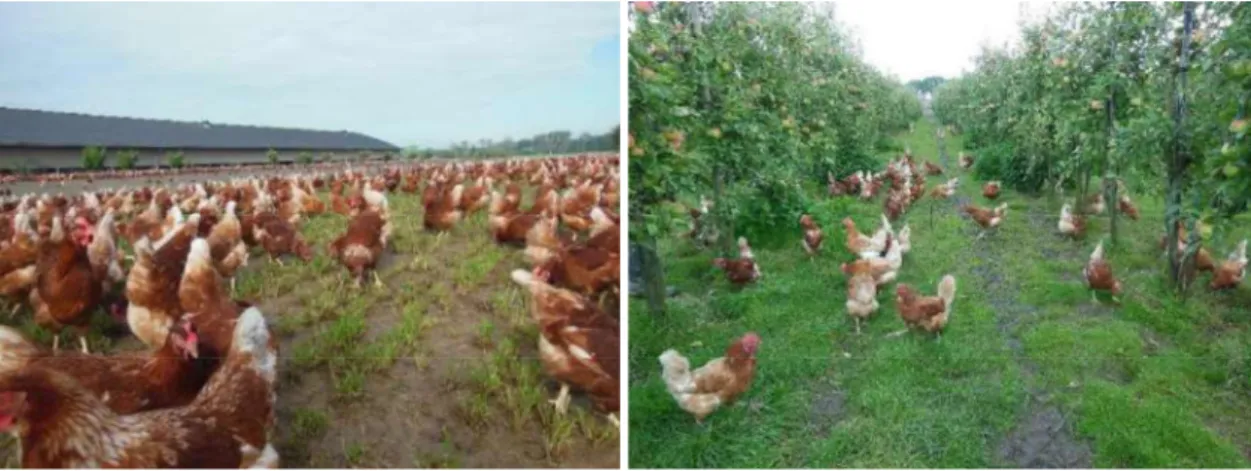
The farm surface was divided in free-range area (accessible to the chickens) and farmyard (area with buildings and farm house; not accessible to chickens). For bird counts in the surroundings, we selected two plots bordering (or close to) the range area, which could be observed from a car from the public road. The farms were visited 4 times per season. The observations were done in 2 seasons: early spring and autumn/winter. All observations started at 10 am. All birds in and flying above the free-range area and in and flying above two selected neighboring plots were counted. Observations started from the car and were continued on foot walking all around the free-range area and the farm buildings. Based on large scale wild bird monitoring (Breed et al. 2011) and expert judgments (Veen et al. 2007; Slaterus personal information), wild birds were divided in 3 categories: high risk birds, low risk birds and no/unknown risk birds. High risk birds were all water birds and waders: geese, ducks, swans, storks, oystercatchers, et cetera. Low risk birds were birds that were not as vulnerable to influenza infection as the high risk birds, but who could carry the virus after they were in contact with infected birds. These were birds of prey and corvids, which are scavengers. The no/unknown risk birds were all other birds, mainly singing birds from sparrow tot woodpecker, that were rarely or not found with an avian influenza infection. Farms were divided into 4 categories depending on the proportion of tree cover in the free-range area (0 5%; 5 25%; 25 50%; >50%) and into 2 categories depending on the openness of the surrounding landscape (half closed or open) (Figure 1). Observations were divided in birds seen inside the free-range area (touching the ground or trees) and birds seen in the surroundings (flying above the
free-Results
Totally 24,053 birds were counted during 21 observations: 268 high risk birds in the free-range area (see Table 2), 427 low risk birds in the free-range area, 3372 high risk birds in the surroundings, 1639 low risk birds in the surroundings and all other birds being no/unknown risk birds in either the free-range area or the surroundings.
Table 2: Avian Influenza high risk birds seen in 11 free-range areas in 2 seasons.
Farm 1 2 3 4 5 6 7 8 9 10 11 Total % woody cover 0 35 8 75 90 0 35 50 10 10 90 Openness landscape* O HC HC HC HG O HC HC HC HC O Phalacrocorax carbo 1 - - - - 8 - - - 9 Ardea cinera 3 1 - - 1 8 1 - - - - 14 Geese spec 26 - - - 26 Anser anser 25 - - - - 49 - - - 74 Ardea alba 4 - - - - 6 - - - 10 Vanellus vanellus - - 1 - - - 4 - - - - 5 Cygnus olor 2 - - - 2 Anser albifrons - - - 1 - - - 1 Anas strepera - - - 5 - - - 5 Aythya fuligula - - - 2 - - - 2 Fulica atra - 1 - - - 4 - - - 1 - 6 Gull spec 9 - 60 - - - 69 Alopochen aegyptiaca - - - 3 - - - 4 - 7 Haematopus ostalegus 2 - - 2 - - 4 - - - - 8 Gallinula chloropus - - - 1 - - - 1 Gallinago gallinago - - - 2 1 - - - 3 Anas platyrhynchos 12 2 - - - 6 3 2 - 1 - 26 Total 84 4 61 5 2 92 12 2 0 6 0 268
*O=open landscape; HC=half closed landscape
Significantly more high risk birds were seen in free-range areas with less than 5 % tree cover (model: p=0.026; R²=35; se=15.8). However, all farms with low proportion of tree cover were located in an open landscape (see Table 1). Therefore it was not possible to conclude whether it was the low proportion of tree cover in the free-range area or the open landscape that was associated with higher numbers of high risk birds in the free-range area.
No relation was found between the number of low risk birds in free-range areas and the proportion of tree cover in the free-range area, nor in open, nor in half closed landscapes (model: p=0.613; se=2.5).
Significantly more high risk birds were seen in the surroundings of the free-range area if the landscape was more open (p=0.005; R²=39; se=1.3). However, 2 out of 3 farms in open landscape had 0 % cover with trees in their free-range area and 1 out of 3 had 90% cover. Therefore it was not possible to conclude whether it was the open landscape or the absence of tree cover in the free-range area that was associated with higher number of high risk birds in the surroundings.
No relation was found between the number of low risk birds in the surroundings of the free range area and the openness of the landscape, nor in case of range areas with higher or lower proportion of tree cover, nor in half closed or open landscapes (model: (p=0.58; se=1.3)).
Figure 1: Examples of free-range areas with <5% tree cover (left) and with 90% tree cover (right).
Discussion
The farm sample available makes it difficult to separate the effects of tree cover in the free-range area and the openness of the landscape around the farm.
Explanations for higher numbers of geese and ducks in free-range areas with a smaller proportion of tree cover could be that they prefer open areas in which they can see predators, they forage on the ground and eat mostly grass. Moreover, they prefer foraging in large groups, for which they need large open spaces. These traits may also explain why higher numbers of high risk birds are seen in the surroundings of free-range areas, if located in an open landscape.
The absence of a relation between low risk birds in the free-range area and proportion of tree cover might have to do with the low number of birds of prey seen anyway. Corvids were seen on all farms. The corvids were attracted by other aspects than those related to the proportion of tree cover in the free-range area. Moreover, corvids often live and roam in large groups, a reason why you see more of them, which is not the case in birds of prey. These traits may also explain why no relation was found between low risk birds and openness of surrounding landscape.
Conclusions
The results support to further investigate the role of trees as a measure to keep down avian influenza risk birds in and around poultry free-range areas. Especially experimental research, in which the presence of these species before and after the planting of trees is being investigated, may show whether planting of trees can be advised as a measure.
Acknowledements
European Agricultural Fund for Rural Development, the Dutch Ministry of Economic Affairs, and
-the Dutch Ministry of Economic Affairs) and -the AGFORWARD EU 7th Framework Programme of RTD (Grant Agreement N° 613520).
References
Bestman M, Wagenaar JP (2003) Farm level factors associated with feather pecking damage in organic laying hens. Livest Prod Sci 80: 133 140. doi
Breed C, Duncan D, Stroud D, Nicholson R, Edwards J (2011) Annual report on surveillance for avian influenza in wild birds in member states of the European Union in 2011. European Reference Laboratory for avian influenza, Weybridge, Addlestone, Surrey, UK.
Goot J van der, Elbers A, Bouwstra R, Fabri T, Wijhe-Kiezebrink M van, Niekerk T van (2015) Risicofactoren voor introductie van laag-pathogeen aviaire influenza virus op legpluimveebedrijven met vrije uitloop Nederland. CVI Rapport 15/CVI0078.
Green LE, Lewis K, Kimpton A, Nicol CJ (2000) A cross sectional study of the prevalence of feather pecking damage in laying hens in alternative systems and its association with management and disease. Vet Rec 147: 233 238. Paolotti L, Boggia A, Castellini C, Rocchi L, Rosati A (2016). Combining livestock and tree crops to improve ustainability
in agriculture: a case study using the Life Cycle Assessment (LCA) approach. J Clean Prod 131: 351-363. Veen J, Brouwer J, Atkinson P, Bilgin C, Blew J, Eksioglu S, Hoffman M, Nardelli R, Spina F, Tendi C, Delany S (2007)
Ornithological data relevant to the spread of Avian Influenza in Europe (phase 2): further identification and first field assessment of higher risk species. Wetlands International, Wageningen, The Netherlands.