A Dynamic Optimization Algorithm for
Supply Chain Planning
Pedro Miguel Vieira Esmeriz Pereira
Master’s Dissertation
Supervisor FEUP: Prof. Maria Teresa Bianchi Aguiar
Integrated Masters of Industrial Engineering and Management
“Insanity is doing the same thing over and over and expecting different results.” - Albert Einstein
Um algoritmo de otimização dinâmica para o planeamento da cadeia
de abastecimento
Resumo
A análise de uma cadeia de abastecimento evoluiu do estudo de processos individuais para a consideração de todo o sistema como um elemento único. Neste contexto, a seguinte dissertação aborda o planeamento da cadeia de abastecimento da HUUB, uma empresa que oferece serviços logísticos, e o processo de tomada de decisão sobre a agregação de armazéns adicionais através de uma parceria com outra empresa.
Neste projeto, é proposto a implementação de um algoritmo de otimização dinâmica de programação inteira que irá realizar o planeamento da operação, onde a função objetivo é a minimização do custo total. O resultado do planeamento permitirá também inferir se a associação com outra empresa e a realização de tarefas operacionais nos respetivos armazéns é uma opção viável.
Para apoiar a recolha de dados sobre os procedimentos a serem planeados, foi elaborada uma estrutura de custos com base no método Activity-Based Costing com imputação de custos baseada no tempo de execução de cada atividade. Em relação à construção da estrutura de custeio, a operação foi dividida em 5 processos principais: (i) receção, (ii) pick para stock, (iii) pick de stock, (iv) embalamento e (v) envio. Além disso, o processo e a estrutura de custos de outros armazéns também foram incluídos.
Para implementar este modelo, foi desenvolvido um algoritmo de programação em Python onde (i) os dados de entrada são obtidos através de consultas em SQL, (ii) o processamento de dados e construção do modelo é executado através de várias bibliotecas Python, (iii) a computação iterativa da solução é obtida através de solvers externos e (iv) o resultado é enviado como um arquivo JSON para uma base de dados e posteriormente consumido por uma plataforma web. Concluiu-se que o modelo é capaz gerar a solução ótima, dentro da janela de tempo imposta. Além disso, concluiu-se que a opção de parceria é uma escolha viável que permite uma diminuição de custos, considerando a estrutura de preços apresentada nesta dissertação. Esta opção pouco impacto tem na concretização de vendas de comércio eletrónico, em comparação com as vendas para retalhistas onde a influência é significativa.
Abstract
The analysis of a supply chain has evolved from the study of individual processes to the consideration of the whole system as a single element. In this context, the following dissertation addresses the supply chain planning of HUUB, a company that offers logistics services, and the decision-making process of aggregating additional warehouses through a partnership with another company.
Within this project, it is proposed the implementation of a dynamic mixed integer programming optimization algorithm that will perform the planning of the operation, where the objective function is the minimization of the total cost. The result of the planning will allow to infer if the option to partner with another company and deploy operational task on its warehouse is a viable option
To support the input of information regarding the procedures to plan, a cost framework was devised based on Time-Driven Activity-Based Costing and on the Cost-to-Serve approach. Regarding the construction of the cost framework, the operation was divided into five main processes: (i) reception, (ii) pick to stock, (iii) pick from stock, (iv) packing and (v) shipping. Additionally, the process and cost structure of other warehouses were also included.
To implement this model, a Python programming algorithm was developed where (i) the input data is obtained through SQL queries, (ii) the processing of data and construction of the model is executed through several Python libraries, (iii) the iterative computation of the solution is obtained through external solvers and (iv) the result is sent as a JSON file to the database and posteriorly consumed by a web platform.
It was concluded that the model was able to generate an optimal solution in all cases, within the time window imposed. Furthermore, it was concluded that the outsourcing option is a viable choice that enables cost savings, for the price structure presented. While the inclusion of another company may not influence the fulfilment of e-commerce sales orders, its influence on wholesale ones is significantly high.
Acknowledgements
First, this project would not have been possible without the people at HUUB. Every person provided an immense will to motivate, support and guide me in this endeavour, thus I express my gratitude to all of them as a family and to each of them individually for their heartfelt presence during this chapter of my life.
I would like to thank my supervisor, Professor Maria Teresa Bianchi Aguiar for all the counselling, patience and dedication on the elaboration of this dissertation and for her constant motivation on doing more and better.
All of what I am today I owe to my family. To my mother, the most passionate and persistence person I know, who never knows how to quit. To my father, for teaching me the value of respect, honesty and humbleness. To my sister, the truest companion in my life and the person that has shared the most with me. My deepest gratitude to all of you for everything you have given me. I would also like to thank all my friends for all the experiences and moments that I have lived and for their friendship in the good times and in the bad times.
Finally, I would like to thank Bárbara, whose presence was vital for making this one of the best periods of my life.
Table of Contents
1 Introduction ... 1
1.1 Company Overview ... 1
1.2 Problem Definition ... 3
1.3 Objectives ... 4
1.4 Structure of the Dissertation ... 4
2 Literature Review ... 5
2.1 Supply Chain Management ... 5
2.1.1 Production Planning and Inventory Control... 5
2.1.2 Distribution and Logistics ... 6
2.2 Costing Models ... 7
2.2.1 Direct Product Profitability ... 7
2.2.2 Total Cost Ownership ... 7
2.2.3 Activity-Based Costing ... 8
2.3 Optimization Models ... 9
2.3.1 Modelling Approaches ... 9
2.3.2 Linear Programming Solvers ... 9
2.3.3 Optimization models for supply chain management ... 10
2.4 Industry solutions ... 10 2.5 Critic analysis ... 11 3 Problem Context ... 13 3.1 Organizational Structure... 13 3.2 Operation AS-IS ... 15 3.2.1 Process Structure ... 15 3.2.2 Sales Channels ... 16 3.2.3 Data Insertion ... 17
3.3 Operation To-Be: Analysis of multi-staging ... 18
3.3.1 Last-mile Price Comparison ... 18
3.3.2 Operational Considerations ... 19
4 Methodology ... 20
4.1 Data Preparation ... 20
4.1.1 Cost Quantification ... 20
4.1.2 Process measurement ... 22
4.2 Decision Variables & Objective Function... 23
4.3 Problem Constraints ... 24
5 Implementation and Results ... 28
5.1 Programming Approach ... 28
5.2 Model Validation ... 29
5.3 Computational Experiments ... 30
5.4 Analysis of Results ... 32
5.4.1 Cost Framework ... 33
5.4.2 Partnership with DAMCO ... 34
6 Conclusion and Future Projects ... 35
6.1 Main results ... 36
6.2 Future projects ... 36
Referências ... 38
ANNEX A: Supply Chain Planning Matrix ... 41
Nomenclature
ABC – Activity-Based Costing
API – Application Programming Interface B2B – Business to Business
B2C – Business to Consumer
DMS – Distribution Management System DPP – Direct Product Profitability
JSON – JavaScript Object Notation OMS – Order Management System SKU – Stock Keeping Unit
SQL – Structured Query Language TCO – Total Cost Ownership
Table of Figures
Figure 1 - HUUB's central positioning regarding the stakeholders ... 1
Figure 2 - BI&AI Functions ... 14
Figure 3 - Stock and Split operations ... 15
Figure 4 - Sales Chanel share on Product/ Shipping perspective ... 16
Figure 5 - Data insertion mechanisms ... 17
Figure 6 - Transhipment process to the Netherlands ... 19
Figure 7 - Structure of the operation ... 21
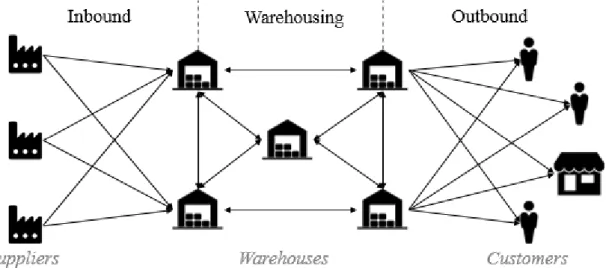
Figure 8 - Material flows of the operations ... 24
Figure 9 - Request planning structure ... 29
Table of Tables
Table 1 - Comparison of main shipping destinations ... 18
Table 2 - Average measurement of the Shipping stage of a brand concerning wholesale ... 22
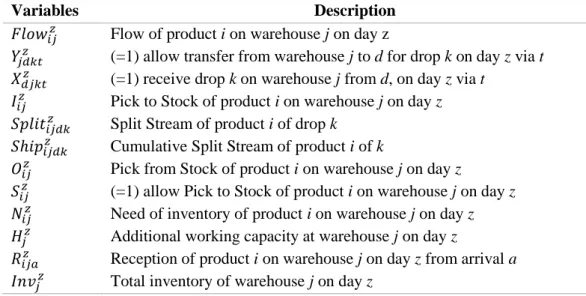
Table 3 - Decision Variables ... 23
Table 4 - Decision to perform Inbound or Outbound operations ... 24
Table 5 - Scenarios in analysis and respective expectation ... 30
Table 6 - Testing of samples using different solvers ... 31
Table 7 - Results of outsourcing to DAMCO ... 34
Table 8 - Indices of the model ... 43
1 Introduction
The following dissertation addresses the operational and tactical supply chain planning of HUUB and the decision-making process of which warehouses to open and where. For any given moment in time, an optimization model will consider the limitations of each distribution centre and allocate the resources that allow the fulfillment of deliveries at the lowest cost. To achieve the lowest cost, actions such as cross-docking and bulk shipments are considered to minimize the impact of costs related to last-mile delivery, storage and warehousing processes. In this methodology, there are three major components of interest regarding the performance of the algorithm: (a) an appropriate cost quantification method, (b) the optimization model employed and (c) the practical implementation of the model.
The analysis of a supply chain has evolved from the study of individual processes to the consideration of the whole system as a single element. This methodology became a necessary measure due to the insurgence of rising costs concerning manufacturing as well as reduced product life cycles and the globalization of commerce (Beamon 1998). In order to further extend the efficiency and flexibility of the supply chain, new models are being created with a greater level of complexity to try to tackle issues regarding (i) product postponement, (ii) scope of analysis and (iii) the bullwhip effect (Cohen and Lee 1988).
1.1 Company Overview
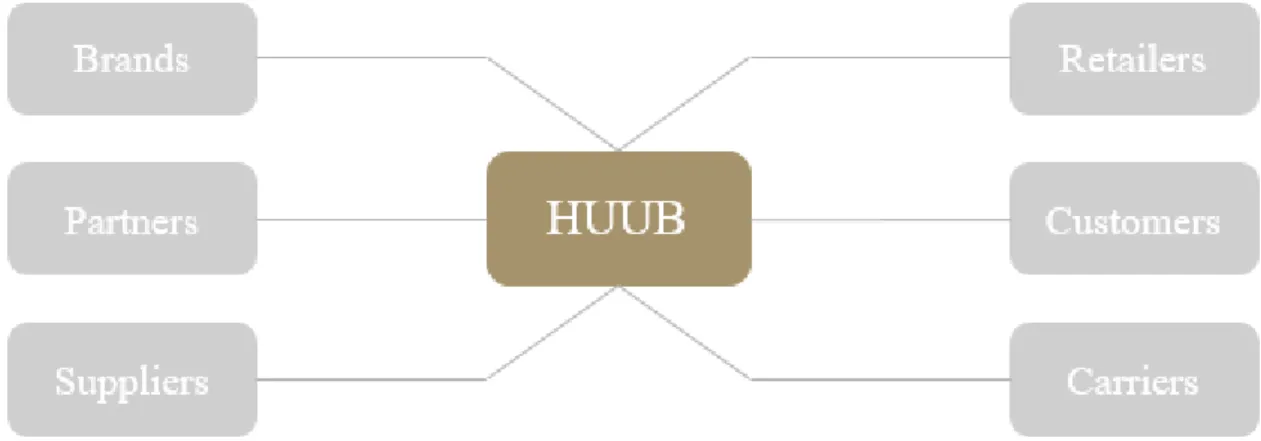
HUUB is a start-up company created in 2015 that provides logistic services and management of the supply chain of brands in the fashion industry. These services concern the warehouse handling of products and the offering of technological features that let brands control their supply chain without the burden of managing it. The objective of this company is to become the central element of supply chain management, providing a value proposition of an end-to-end service that connects of every stakeholder, as seen in Figure 1.
The vision of this company is to offer a “plug and play” service where, after the inclusion of a brand, every component of the supply chain is instantly connected and available at any moment. Behind this concept is the goal to simplify the operation of the customers in conjunction with a reduction of its operating costs. To achieve this, the company is currently dedicated to developing a data structure to improve the physical flow coordination. Future additions count with financial support where the relationship with the brands evolves from a customer-provider to a partnership.
To support this information sharing and connection between stakeholders, HUUB developed a web platform known as Spoke, being this the cornerstone of the value proposition. This platform can deploy repeatable and automatic processes, supported by a transactional database that enables the management of data. Moreover, Spoke already supports warehouse management features as well as order fulfilment and the management of its respective delivery, aiding the operational management. This platform stands to technological processes as HUUB stands to its customers: the central component of an ecosystem. However, to assure a good performance and agility, the services provided on this platform are supported by Application Programming Interfaces (APIs). Instead of performing all the activities in the system, Spoke will only consume the information already processed by other modules. This allows greater flexibility due the autonomy granted to each process but also safety regarding service failure since the breakdown of one component does not affect the remaining ones, among other benefits.
Through its web platform, HUUB acts as a broad network that starts working with brands at the moment of creation of a collection until the delivery to the final customer. The whole operation is divided into four major areas: Product, Production, Logistics, and Sales. After being enrolled within the network, brands start attending fairs where most of their sales emerge, especially the ones regarding the wholesale sector. From this point forward HUUB does the follow-up of the production designated for the fulfillment of the sales orders and manages the Inbound. Additional activities include inventory management, fulfilment of sales orders and analysis of the best transportation method, among others.
Regarding its price structure, HUUB aims to maintain simplicity in this aspect as well. The current approach is the offering of a single price per product where all warehouse procedures are assured, being considered as a fee. The prices regarding transportation are the only component that is not included in this fee, being negotiated only after the onboarding of the customer. Acting as a merger of supply chains, HUUB is capable of achieving the best transportation costs, which in turn represent lower transportation costs for the brands. Nonetheless, HUUB has the objective of including the transportation prices within the fee, providing a single pricing element to the brands where all processes, within or outside the warehouse, are included.
At the current moment, HUUB possesses one warehouse in Portugal and has access to another one in the Netherlands through a partnership with DAMCO where future operations will be executed. The overall storage and shipment include over 180.000 products concerning 20.000 stock keeping units and 6600 deliveries related to two seasons per year (fall/winter and spring/summer), though some brands require the existence of a third partition. Nonetheless, due to the accelerated onboarding of brands, these numbers have and will continue to rise, which leads to a more intense operation and, consequently, a more difficult planning process.
1.2 Problem Definition
At the start of this project, the planning of the operation was a manual task performed on a weekly basis. In this process, a person would analyse the sales orders to fulfil and the receptions to process and then a schedule would be devised for the whole week. The information received concerns mainly wholesale sales orders regarding the preparation of a season. Depending on the expected number of sales, the brands communicate the expedition dates and quantities that require fulfilment and the suppliers inform when and how many items they will supply to meet that demand. However, some variations may occur such as delays in the operation as well as supplementary sales orders that were inserted into the system on that day, which influence the planning to great extent. E-commerce sales orders are not planned with the same precedence as wholesale sales and, due to their shorter deadlines, they cannot be planned with the same antecedence. Furthermore, HUUB is responsible for the planning of the operation but the deadlines are imposed by the brands and the suppliers, restricting the capability to produce a smooth operational flow.
To assure that the execution followed the planning, three daily meetings were made, where the progress of the operation was registered and variations were accommodated. This approach disregarded the costs of each warehousing procedure and the accommodation of variations was a repetitive and time-consuming process. Due to these limitations, this approach was unable to assess if the inclusion of additional warehouses would bring benefits to the operational flow of the company.
Up until recently, HUUB operated on a single warehouse in Portugal where all processes occurred, including the storage of products. From this location, every shipment was prepared and the transportation was made in a one to one basis. However, with the growing number of deliveries and the expansion to different countries, the complexity of the system increased. Furthermore, due to capacity restrictions, a single warehouse would not be sufficient to support the whole operation. As such, a partnership was made to assure the presence of a warehouse in the Netherlands. This enables the utilization of another distribution centre and consequently achieve economies of scale through the implementation of aggregated activities. These activities include bulk shipments between warehouses and the respective cross-docking of products to the end customer. Despite enabling a larger flexibility and overall capacity in the system, this comes at the cost of a greater complexity regarding the scheduling of processes. Another factor that increases the complexity of coordinating the flow of items is the seasonal aspect of this sector. Due to its proximity with brands, HUUB is also affected by this characteristic, resulting in the presence of bullwhip effect.
This project was developed to address this problem where a decision-support algorithm was developed to determine the economic and operational viability of the second warehouse and to allocate tasks, considering the conditions of the system. This algorithm will consider optimization techniques where the objective is to minimize the overall costs within the constraints applicable to the system. Among these constraints are the capacity of the warehouses, the service level agreements with brands and the resources available, to name a few. To achieve these points, an analysis of the information available was made as a preliminary step to assess the most problematic aspects of the operation. The development of this project was made in partnership with the department of Business Intelligence, where several functions of process analysis and research and development of technological solutions take place.
1.3 Objectives
This project was created to implement a solution that creates the best available planning for the operation of the supply chain while accommodating all the operational possibilities and its respective cost. This main goal was further divided into three specific objectives, each with its own context and relevance.
The first objective was to create a cost framework that promotes visibility over the individual impact of each task involved in warehousing activities. At the beginning of this project, the transportation cost of each sales order was the only cost considered in the analysis of the profit margin. The remaining costs would only be assessed at the end of each season by comparison of cash flows. Therefore, the assessment of the economic condition of the company could not be performed during the season but rather at the end of the period in analysis.
The second objective, and the main one was the development of an algorithm capable of responding to the requests of the system and delivering the best planning for the operation. In this context, the best practice involves a cost minimization that withstands the constraints applicable in each day. These constraints are related with (i) overall inventory capacity of each distribution centre, (ii) meeting the quantities required in each sales order, (iii) and shipping the items to the designated locations.
The third objective was to implement a dynamic structure that allows the simulation of different scenarios and, consequently, the possibility of executing sensitivity analysis regarding stress situations. Besides stress testing, the impact analysis of future warehouse locations can be simulated. To do so, the algorithm must be able to dynamically extract the parameters required instead of considering static values for every situation. With this principle, the program can be integrated as a tool on the web platform of the company and respond to distinct requests.
1.4 Structure of the Dissertation
This dissertation is structured in five chapters. The second chapter, “Literature Review”, approaches the state of the art of several areas of study included in the development of this project. Apart from the academic research, there is also the description of solutions being employed in industry at the present moment.
The third chapter, “Problem Context”, regards the organizational structure of the company, the processual analysis of HUUB and the description of the different flows available at each process. Complementarily, the methodology behind the cost quantification and assessment of each process is also explained.
The forth chapter, “Methodology”, exposes the construction of the cost framework and of the mathematical model created during this project. Regarding the first element, it includes the specification of the main stages of analysis and its respective subtasks, followed by the measurement method employed. Concerning the mathematical model, it includes the explanation of the decision variables, the objective function, and the constraints applicable to this system.
The fifth chapter, “Implementation and Results”, concerns the implementation of each stage of the algorithm and the results obtained in each step. An analysis concerning each modification and subsequent consequences is also present.
The sixth and final chapter, “Conclusion and Future Projects”, concerns the conclusions of this dissertation, an analysis on the accomplishment of the goals proposed and the exposure of future projects that can be performed and/or add value to this project.
2 Literature Review
This chapter regards the main fields of study of this project regarding supply chain planning. These areas have a sequential order where the previous topic provides information that influences the approach of the following subject. The first topic concerns the comprehension of supply chain management, where concepts and the main problems of this field are exposed. After the prioritization of the main processes to address, there is an introduction to cost quantification of the system and the respective best practices on how to achieve the required data. The final section concerns optimization models and techniques that could be engaged.
2.1 Supply Chain Management
A supply chain can be defined as the integrated process between several business entities that collaborate in three main fields: (i) acquisition of raw materials, (ii) the utilization of these resources to produce final products and (iii) the respective delivery to retailers or end-customers (Beamon 1998). The capability of a supply chain to work as a unit dictates the achievement of required performance objectives. From a high-level observation, a supply chain can be divided into four major processes: (a) Procurement, (b) Production, (c) Distribution and (d) Sales (Meyr, Wagner, and Rohde 2002). For more information please consult Annex A. Given the nature of the supply chain structure approached on this project, the procurement of materials and the sales are not accounted since they are planned by external agents. Thus, the analysis of supply chain planning will focus on main stages of (i) Production Planning and Inventory Control and (ii) Distribution and Logistics.
2.1.1 Production Planning and Inventory Control
The scheduling of production and the inventory control are areas frequently associated with the capability of fulfilling demand volumes through a well-planned production flow model. For a continuous demand rate emerged the Economic Order Quantity model (Harris 1990), where the production rate is assumed constant. Regarding random output processes, several stochastic production rate (SRP) models have emerged to address the production and demand variations in a given time horizon (Kaminsky and Wang 2015).
While more recent models possess an integrated approach between production and inventory, other alternatives pass by the creation of a safety stock. This alternative serves as a prevention measure to avoid shortages due to uncertain factors in the supply chain (Korponai, Tóth, and Illés 2017). Nonetheless, in case of bad dimensioning, the overestimation of safety stock limits leads to increasing storage costs, a factor with increasing impact if several warehouses are considered. Besides storage costs, the accumulation of products leads to its respective obsolete state. To mitigate this risk, forecasting methods have been developed as a mean to reduce uncertainty and have more accurate provisions of needs (Prak, Teunter, and Syntetos 2017).
2.1.2 Distribution and Logistics
This segment of supply chain dictates how products and transported between the different actors of the supply chain. According to Cohen and Moon (1990), the supply chain is typically characterized by a forward flow of materials in conjunction with a backward flow of information, where the main cost driver is transportation.
Within transportation, one topic of current research is the last part of the delivery process, known as the “last-mile problem”. Punakivi, Yrjölä, and Holmström (2001) refer home delivery logistics, the last part of a distribution route, as the most complex aspect of the distribution process since the demand of B2C shipments comprehends a wide spectrum of requirements. These include the lower dimension of an order from a B2C customer than a B2B, the higher number of individual shipments for B2C sales, the tight delivery time windows and the correct conditioning of each individual parcel. In addition, Esper et al. (2003) discuss this component as the most relevant one of the order fulfilment process, where on-time delivery and privacy play an important role in the decision of the consumer. As such, this component is considered to be the most expensive, pollutant and the least efficient factor of the supply chain (Gevaers, Van de Voorde, and Vanelslander 2014).
To minimize the impact of this factor, some companies have designed policies of direct customer pick-up or even tried to expand their distribution centres to a location closer to the end customer (Tavana et al. 2017). Through distribution centres located near the end customer, the division into smaller shipments occurs in a posterior instance of the delivery process, minimizing the impact of the last-mile delivery.
The most common approach to tackle this problem is the implementation of a cross-docking strategy. Cross-docking is a distribution strategy where goods are unloaded from Inbound vehicles to Outbound ones without storing them in between (Van Belle, Valckenaers, and Cattrysse 2012). From the main four functions of warehousing (receiving, storage, order picking, and shipping), storage and picking tend to be the most expensive. The first due to holding costs and the second because it is labour intensive. Cross-docking represents a huge benefit in supply chain inventory management mainly because it eliminates these two stages (Bartholdi and Gue 2004).
The concept of cross-docking considers the immediate unloading of products upon their arrival at the distribution centre, resulting in shorter delivery lead times and a reduction on the fleet size. Such practice is not possible for must companies since it involves a perfect time alignment with both carriers and suppliers. As such, this method, denominated by one-touch or pure cross-docking, is frequently adapted to two-touch or single stage cross-docking or even multiple stage cross-docking (Apte and Viswanathan 2000). Of these two, the first concerns the reception of items at the dock and posterior loading for the Outbound transportation, with no work involved in between. The second stems from the first, with the inclusion of the reconfiguration of parcels before the unloading process on Outbound trucks.
To maximize the benefits of cross-docking, the transportation of products is often executed with the aggregation of products in one bulk shipment. With this premise, there is a decrease of flexibility to accommodate product demand rate variations, as either situations of stock-out or accumulation of stock might occur. In fact, if the unit stock-out cost is high and the product demand rate is unstable, the traditional distribution method is preferable. However, if the unit stock-out cost is low and the demand rate is stable, adopting cross-docking is the better alternative. For the remaining situations, the inclusion of cross-docking can be a good solution if complemented with adequate systems and planning tools (Apte and Viswanathan 2000).
2.2 Costing Models
Despite the large base of studies regarding supply chain cost quantification, it is still a difficult task to isolate every cost factor. While the target focus is on cost reduction, companies have faced difficulties implementing a costing model that fits their supply chain structure, leading to inaccurate cost analysis, especially regarding overhead and indirect costs (LaLonde and Pohlen 1996). Several costing models have been created to try to accommodate more aspects of the operation. For the purpose of this dissertation, a selection of the most widely used/known models are exposed
2.2.1 Direct Product Profitability
Direct Product Profitability (DPP) is one technique where the profit contribution considers handling, freight, direct labour and space costs incurred by an item (LaLonde and Pohlen 1996). This method was vastly used by retailers to determine the shelf space allocation that yields the higher profit margin based on the profitability of each product. The cost imputation of this method starts with the calculation of the gross margin as the result of the difference between the sales price and the purchase cost. Upon this value, warehouse, transport and store costs are deducted to obtain the direct product profit (Associates 1993).
Despite aiding the retailers in the decision process of which and how many products to acquire, this method is not an adequate approach on supply chain cost quantification (Ernst and Young LPP 1994, LaLonde and Pohlen 1996). As the name suggests, the costs in its formulation only concern the direct costs of a product. In supply chain planning, due to the high range of stakeholders involved, this model loses relevance as indirect costs play a major role on the assessment of the overall cost (Doherty, Maier, and Simkin 1993).
2.2.2 Total Cost Ownership
Total Cost Ownership (TCO) is a model that enables the cost analysis since the moment of purchase until the end of the life (Carr and Ittner Fall 1992). This technique has a dual meaning where it can be considered as a purchasing tool or as a philosophy of understanding of the total cost of a purchase. Either way, it is a particularly useful technique to employ to evaluate a supplier. Furthermore, TCO analysis allows a better understanding of which areas each supplier provides the most value as well as their issues and cost structure (Jackson and Ostrom 1980, Burt and Anklesaria 1990). Due to its long-term analysis emphasis, this technique is useful to determine the viability of investments in the long run, thus providing good information for negotiations (Monckza and Trecha 1988, Ellram and Siferd 1993).
Despite the easiness to understand the overall concept, several authors and studies have reported the difficulty to put this method in practice (Ellram 1995, 1993). To fully support its greater need of information, in comparison to other methods, an information system to support wide-scale data supply is required, representing a major investment. Lacking this resource, companies face a labour intensive process of performing this task manually (Ellram 1995). In addition, LaLonde and Pohlen (1996) refer that, due to the focus on the stage of acquisition, this method highlights the relationship between a company and its suppliers. Simultaneously, it also narrows the scope of analysis to existing partnerships and, thus, opportunities for making inter-firm cost trade-offs might be missed. To adopt this method some cultural modifications might have to be put in place in a company, being this the main reason behind the consideration of this technique as a philosophy. However, the management may offer resistance to these changes, compromising the success of cost assessment (Ellram 1993).
2.2.3 Activity-Based Costing
Activity-Based Costing (ABC) is a technique to assign direct and indirect costs based on the distinct activities an item is subject to and is frequently used as a part of total cost management (Cooper Winter 1989). The imputation of cost focuses on the definition of activities instead of production costs and this stands as the differentiation factor in comparison with other models. According to Turney (2008), cost estimation methods can be categorized as: intuitive, analogical, parametric and analytical, each with its unique benefits. From these, ABC fits in the last category since the determination of cost is based on the decomposition of a process into activities with known cost drivers.
Turney (2008) discusses the insurgence of ABC as a tool particularly useful to examine overhead costs, being this the motive for the hype generated in the industry at its beginning. Before ABC, the overhead costs were considered as a whole, being directly and equally distributed along the various stages of the operation. Such measure proved to be a dangerous assumption where the decision making process was influenced by a potentially incorrect quantification since most overhead costs do not impact every activity in the same proportion. Miller and Vollmann (1985) highlight the relevance of this in electronic manufacturing companies that experienced an increased proportion of overhead costs, sometimes exceeding 50%, between 1980 and 1985. To complement the internal company analysis with customer satisfaction several additions to this method have been developed. Of these, the Cost-to-Serve, stands out as a secondary step of ABC, introducing the customer as a differentiation factor where the analysis of a process goes deeper and variates depending on the customer (Kone and Karwan 2011).
Duh et al. (2009) provide a thorough comparison between traditional costing models and ABC and the determination of success factors in ABC implementation, complemented with a survey about ABC practice. This study as well as others (Ellram Winter 1995) converge on the benefits and barriers that this technique provides. The advantages of ABC include improved costing accuracy, offering of useful cost information for decision-making and detailed tracking of indirect cost-to-cost objectives. However, due to its analytical focus on the activities, this technique is unable to report bad working habits. Thus, little to no change of old management behaviour can be employed directly from this technique, not driving companies to change their fundamental views about how to organize work. A fundamental aspect that also serves as a main barrier regarding ABC implementation is the amount of resources that need to be allocated to fully analyse each activity. Initial efforts to quantify tasks involved the deployment of a team that would interview, observe and measure each process (Lewis 1995). Not only is this process time consuming as the results obtained are static since every modification, concerning the flow or the performance of a process, requires a new analysis. Nonetheless, the main issue of this analysis is the unit of measurement of each task since different kinds of units make the total cost analysis more complex.
The most recent approach to address these issues is the implementation of a time-driven activity-based costing supported by an extensive and processual based information system (Kaplan and Anderson 2003). A continuously updated information system disables the need to allocate staff to perform measurements. Furthermore, this updating process requires only two parameters: (i) unit cost of supplying capacity and (ii) the time required to perform a transaction/activity. This accelerates the performance of the model, enables a data collection directly from transactional enterprise resource planning systems and enables the handling of greater volume of transactions, among other benefits (Pernot, Roodhooft, and Van den Abbeele 2007, Kaplan and Anderson 2013, Demeere, Stouthuysen, and Roodhooft 2009, Kaplan and Anderson 2003).
2.3 Optimization Models
The basis of a decision-making process is the identification and modelling of the problem to address and the search for the optimal solution (Zhang, Lu, and Gao 2015). Optimization models can be implemented and solved with (i) exact algorithms, (ii) heuristics or (iii) metaheuristics (Schneider and Kirkpatrick 2006). The first solves the problem by returning the best solution available supported with mathematical evidence. The second is problem-dependent and returns a reasonable solution, though proof of optimality is not assured, lacking a mechanism to avoid local optimal solutions. The third one derives from the previous one but through mechanisms to avoid being stuck in local optimal solutions and has the benefit of being problem-independent. The main disadvantage of exact algorithms is the computational time needed to achieve the optimal solution, thus the increasing popularity of heuristics as a good trade-off between performance and time (Schneider and Kirkpatrick 2006). Nonetheless, most exact solvers currently available employ several methods to decrease their running time.
2.3.1 Modelling Approaches
The basic concept behind an optimization model is the creation of a mathematical formulation where the variables represent the subject of analysis, the restrictions bound the domain of possible solutions and the objective function represents the goal to achieve. Depending on the type of variables and restrictions considered in the modelling of an optimization problem, the nature of the model differs. The most widely used approach is linear programming where the constraints and the objective functions possess linear combinations of the decision variables (Dantzig 2016). Within this subject, mixed-integer linear programming has been the preferable method among authors. This method is popular mainly due to the capability of assigning integer values to variables that represent real quantities and the utilization of binary variables to represent dual decisions. Nonetheless, non-linear, stochastic and fuzzy logic programming models have been implemented with success, despite its diminished utilization (Mula et al. 2010).
As previously mentioned, a mathematical formulation of a problem can result in a model that is unsuitable in a practical situation due its long processing time. Additionally, to implement a decision-making tool in a company, one must consider that the model should be able to adapt to the period upon which a decision should be made. Sarimveis et al. (2008) propose the application of dynamic programming to address both these blockers. The dynamic programming proceeds towards optimality by dividing the time horizon into multiple sub-problems. Therefore, each instance has a lower impact on the computation of the optimal solution.
2.3.2 Linear Programming Solvers
The main benefit of executing a linear programming model is the convergence towards an optimal solution, assuming a feasible domain of solutions. To solve these models, software tools known as solvers have been created that include several methods to compute a solution with the lowest number of iterations.
Meindl and Templ (2012) give an overview over the main existing free and open source solvers as well as the ones commercially distributed, all of them related with linear programming. Out of the free ones, GLPK and LP_SOLVE are written in ANSI C and solve mixed integer problems. CLP was created within the OR project and is written in C++. Within Coin-OR, this solver is used in SIMPHONY, BCP and CBC libraries. SCIP is presented as a framework for solving integer and constraint programming and is available as a C callable library. Regarding commercial solvers, IBM ILOG CPLEX Optimization Studio, also known
large mixed integer linear programming, and support several interfaces that connect with other programming languages. The Xpress Optimization Suite is also a proprietary software that supports several common computer platforms and provides several interfaces.
The overall conclusion of this study was that commercial software tools are both faster and more capable of solving linear programming problems, especially the ones that concern a large size problems. Nevertheless, these tools are expensive for most companies and for small/mid-sized problems, the usage of open source solvers can still be possible if multithread processing is applicable on the model (Mittelman 2011).
2.3.3 Optimization models for supply chain management
In supply chain management, the objective function is related with performance measures and tend to focus on cost/profit analysis, inventory minimization and return on investment maximization. Other objectives focus on the customer experience where the maximization of service level and other customer related metrics are used (Beamon 1998).
Supply chain optimization has been the focus of study for a long time. Mula et al. (2010) published a study that reviews the decision level and criteria used on previous models. According to this study, most works focus on tactical decision level operations related with production and distribution planning. Koç, Toptal, and Sabuncuoglu (2017) propose a model for the coordination of Inbound and Outbound shipment schedules of a single stage supply chain. The objective is to determine both the production and shipment schedules that minimizes the sum of transportation costs and inventory holding costs. Cohen and Lee (1989) developed a mixed-integer linear programming optimization model to determine which distribution and manufacturing facilities should be open, considering the cost impact of each parameter on the objective function. On the operational decision level, other authors have focused on extending the granularity of analysis with models that support operational choices. Rizk, Martel, and D'Amours (2008) restricted their model to address only operational optimization based on the flow synchronization between a single manufacturing location and multiple destinations. To analyse both decision levels, Goetschalckx, Vidal, and Dogan (2002) propose a framework that includes both the tactical as well as the operational aspects of a supply chain. Their research focused on how to combine the design of strategic global supply chain networks with the production and distribution allocations of a global logistics system. Their goal is to create savings opportunities through two different models that employ an iterative heuristic solution algorithm based on mixed integer linear programming. Sabri and Beamon (2000) possess a similar approach with a multi-objective supply chain model dedicated for strategic and operational supply chain planning. In this study, the considered structure includes suppliers, plants, distribution centres and customer zones and the objective functions consider cost minimization and maximization of plant volume flexibility.
2.4 Industry solutions
At the present, there are already a couple of companies that manage supply chains through planning algorithms. Amazon possesses an integrated supply chain where the scheduling of activities minimizes human intervention. Apple, Intel, Dell, and Walmart are some of the best companies at managing their supply chain, though a complete and automated system is not present in their operations.
On the other hand, there are companies whose value proposition is specifically this subject: the offering of solutions that enable supply chain planning and management. These solutions typically involve software modules or improvement programs.
Regarding the first topic, LLamasoft and VCK logistics stand as providers of software modules designed for supply chain design, management, and planning. Similarly, QuintiQ provides several packages that allow supply chain planning and management, with the flexibility to implement automated, semi-automated or manual procedures. Logility allows its customers to perform real-time analysis of their supply chain and plan through the usage of software components that employ what-if scenarios.
Concerning improvement programs, the objective is to enhance the overall supply chain flow without implementing additional tasks but rather enhance the current ones in order to avoid bottleneck situations. On this sphere of solutions, companies as Bain, UPS, and MEP have developed frameworks of improvement where specific goals are set to try to improve the supply chain performance.
2.5 Critic analysis
The expected evolution of HUUB’s operation was to generate increasing number of bulk shipments along with cross-docking processes to DAMCO. Despite lowering last-mile costs, such action must be carefully analysed to avoid the accumulation of stock since the storage cost in the Netherlands is greater than in Portugal. Thus, the main objective of this project was to create the best plan where a trade-off between inventory control and the distribution process is always present.
Following the example of several authors, this project was based on the creation of an optimization algorithm as the backbone of the decision process. To determine the impact of each variable, we employed an ABC based on Time-driven processes merged with the philosophy of Cost to Serve. As the beginning of the supply chain concerns the arrival of products from suppliers, one might think that TCO would be a better alternative. However, such is the case when the option to choose between suppliers is considered in this evaluation. In this system, the supplier is chosen by the brand and HUUB proceeds to act from this point forward, thus, the opportunity to select suppliers is non-existing. Due to the disadvantages mentioned in chapter 2.2.2, the fact that this method is not an integrated overall approach, and that the main advantage has no impact in this scenario, the TCO is excluded. Regarding the DPP, several authors mention this tool as inadequate to supply chain costing since only the direct costs are considered, therefore this option is also excluded. The ABC model does not provide feedback on how to change the processes but rather transmits cost data regarding each activity. Additionally, high human effort is required to implement this technique and maintain it updated. On the context of this project, the first disadvantage does not influence the decision process since the objective is to plan the operation based on the impact of each current process. To eliminate the human effort, the acquisition of data will be made directly from the information system. This action is even easier when imposing a Time-driven quantification because only one parameter is obtained and kept on the database. With the inclusion of the Cost-to-Serve, the analysis of the process is more thorough since the same process can have a distinct impact between brands and/or sales channel.
The optimization model was designed based on mixed integer linear programming that will be run every week to provide the planning of the following fifteen days. Since the scheduling of activities is divided into periods, and the information regarding sales orders, receptions and cost drivers may vary between weeks, this model has a dynamic approach, following the behaviour suggested by Sarimveis et al. (2008). Moreover, this model integrates both the tactical decision of which warehouses and respective processes to employ and the operational decision of which and how many products to allocate to each process. This optimization process is similar to the one developed by Goetschalckx, Vidal, and Dogan (2002) but with the upside of including all stages into a single model. Furthermore, this model is classified as a deterministic analytical
model, according to LaLonde and Pohlen (1996) and its processing involves the usage of one of the solvers mentioned in chapter 2.3.3.
Concerning currently available industry solutions, it was concluded that solutions that optimize all sectors of a supply chain supported by optimization algorithms are still missing. Improvement programs are mainly focused on improving efficiency levels instead of creating a sustainable and autonomous tool and current software units do not provide a complete solution. Instead, these solutions are divided into packages where each has a specific target of improvement/planning. Moreover, within these software programs, the results are mainly obtained through alert signals, what-if analysis, and illustrative frameworks.
3 Problem Context
The overall operation of HUUB incorporates several stakeholders that affect the development of the company. This section aims to understand the relationship between the teams of the organization and its suppliers and customers through an analysis on the organizational structure. Additionally, an explanation of the operation as-is was made to decompose each process and to identify problems and bottleneck situations. After this, an analysis of the cost structure of DAMCO was made to assess the characteristics to include in the optimization model.
3.1 Organizational Structure
Despite being a start-up, the internal organization of HUUB is built upon 6 different departments: Information & Technology, Business Intelligence & Artificial Intelligence, Marketing & Sales, Financial & HR, Account Management, and Operations.
Information & Technology (IT)
The IT department main responsibilities are the development and maintenance of the information system Spoke. The Spoke is a web-based platform which, amongst other features, aims to connect every stakeholder of the supply chain of a brand. This is the backbone of all logistic operations since it has a Warehouse Management System (WMS), an Order Management System (OMS) and a Distribution Management System (DMS). In what concerns IOT, the main objective is to build a mashup of sensors through the supply chain that will allow a quicker and more accurate collection of data and thus a better supply chain optimization.
Operations
The Operations team is responsible for the coordination of activities to fulfil sales orders and store incoming goods, all this at the warehouse in Portugal. The warehouse in the Netherlands will not be coordinated by this team, even if validated as a viable distribution centre. Instead, a designated volume is planned beforehand and communicated. With this information, DAMCO will devise its own schedule and guarantee the delivery process within the boundaries set by HUUB.
Marketing & Sales
The Marketing & Sales department has an important role in personal relationships and customer acquisition. Regarding sales, the direct contact with prospect brands at fashion fairs has been the principal way to acquire new customers. This strategy, like any other strategy, has its advantages and disadvantages. On one hand, every lead that enters the acquisition funnel is well qualified, meaning that the conversion ratio is high. On the hother hand, the cost of reaching new brands is considered to be high due to high expenses.
Business Intelligent & Artifitial Intelligence (BI&AI)
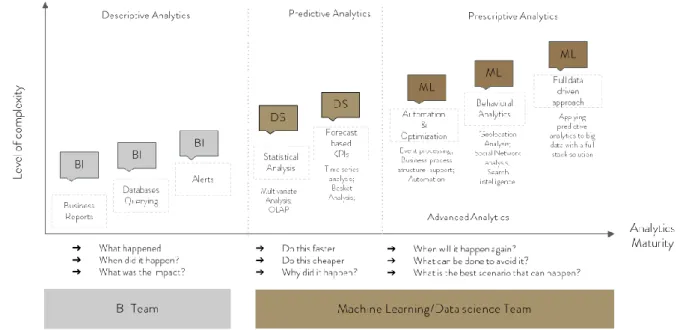
The Business Intelligence and Artificial Intelligence department has two major responsibilities. The first is the analysis of collected data and the identification of business insights from it. The second is the development of algorithms, including machine learning functions, that optimize the operational aspect of the company. Both these responsibilities can be grouped into descriptive, predictive and prescriptive analysis as seen in Figure 2.
By guaranteeing an alignment between the team developments and the company strategy this team has the resources and know-how to develop ground-breaking solutions, consequently leveraging the value proposition of the company. After developing and testing a module, the BI&AI team partners with IT to evaluate the best way to incorporate that module in Spoke. One example of this approach is this project, whose implementation counted with a collaborative work between BI&AI and the IT departments.
Figure 2 - BI&AI Functions
Account Management
The Account Management Team is the main point of contact between HUUB and its brands. Because of this positioning, the Account Management team has two major tasks. The first is to ensure that the brands joining HUUB know how to use the platform, meaning that they provide them all the information and instructions required to join HUUB’s ecosystem. The second is to use HUUB’s capabilities to help brands on their own businesses. This approach, where service suppliers provide business insights to their customers, is employed because there is a high correlation between the success of HUUB and the success of its customer. If the brands have better business approaches, they will sell more, which translates into bigger projects with HUUB and, therefore, higher revenue values.
Financial
The Financial team has the objective of controlling the company financial status and to ensure that every transaction is made according to all norms. In parallel, this team is also responsible for the development of a cost framework so that several key performance indicators can be built. This project does not provide a full cost framework but supplies information that will be integrated in the future.
3.2 Operation AS-IS
Despite being a continuous action, this chapter will expose the operational characteristics of HUUB considering a season, which is approximately six months, as a sample. The beginning of this process starts at fashion fairs where the marketing & sales team approach brands and introduce the company and the service that it offers. If a brand desires to acquire the service, the team will start the onboarding. In this stage, a profile is created in Spoke, the web platform of the company, and all the information about already performed sales orders is introduced in the system. From this moment on, an account manager is designated to perform the follow-up of the brand along the season and the brand gains access to a web platform where all the details concerning their merchandise is available. After the full onboarding stage, all the sales orders and respective supply of products is directly inserted on Spoke thanks to an integration procedure between Spoke and the information system of the brand, made by the IT team. From this point forward, the processes involve warehousing activities, starting with the arrival of products.
3.2.1 Process Structure
Concerning the reception of items, the number of actions to perform depends on the number of sales orders to fulfil that are already in the system. If there are no sales orders that require products from the reception, then the items are received and picked to stock. On a posterior stage, when a sales order is activated, the items are picked from stock, the pack is prepared and the final procedures regarding the shipping details are executed. The stream ends with the transportation of the items from the warehouse. This case is represented in Figure 3 as the Stock Flow, where all five major activities are performed.
Figure 3 - Stock and Split operations
If there are already sales orders that require its fulfilment upon the arrival of goods, then the items undergo a flow known as Split Flow. In this case, packs are already prepared and the items are directly sent to the shipping packs and the remaining ones are picked to stock. If the pack possesses all the required items then they are sealed and the final shipping details are made, ending with the transportation of the pack. Avoiding the storage and the picking (the 2nd and 3rd processes on Figure 3), which are the most time-consuming activities, minimizes the
work-in-progress and the cycle time of the operation. Consequently, the division of the operation into these two streams enables an increased response capacity with the same
Within the processes of Figure 3, the reception of items involves the manual verification of the real quantity versus the estimated quantity expected to arrive. After all, components are checked, the operators close the reception and the system automatically reports if the quantities match or not. If the result is a mismatch, the system informs the brand and an alert to contact the supplier is generated to address this kind of issues in the shortest possible time.
Both picking (to and from stock) involve the deposition/removal of items on racks. If the item is catalogued as a high rotation item, then the designated rack is closer to the shipping/reception dock as a measure to shorten the picking time. The packing occurs after all the necessary items have been picked to the designated pack. At this moment, the confirmation of the items and the closing and taping of the packs is made. The last step involves the weigh-in of the pack, the insertion of the shipping information and the printing of labels and documents need for the transportation. At the end of the process, the packs are stored in a shipping dock stage and wait the arrival of the carrier.
3.2.2 Sales Channels
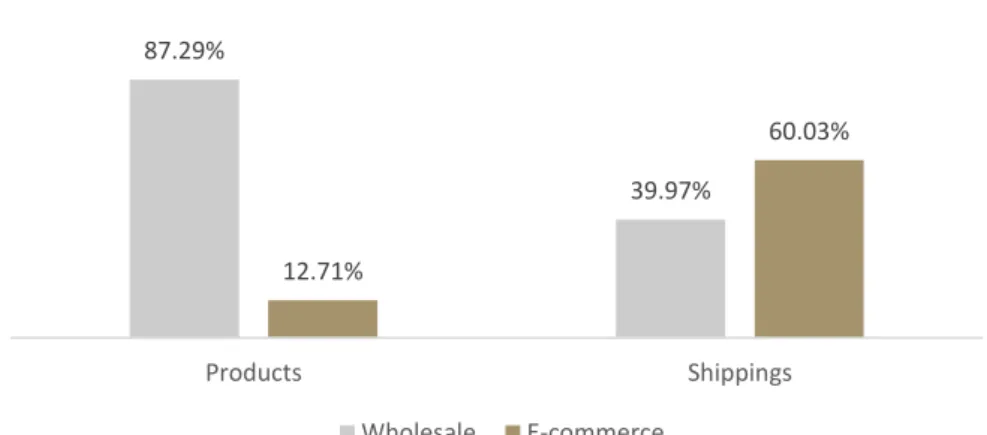
Regarding the type of sales channel, the service provided responds to both e-commerce and wholesale sales. Between these two channels, the e-commerce stands out as the most frequent kind due to its granularity of direct shipping to the final customer. The wholesale orders are characterized by high volume of products per order, as seen in Figure 4, and a larger period to deliver the products. Moreover, the sales orders, mainly of the wholesale segment, are further divided into smaller batches known as drops. While a sales order concerns a sale of a brand to a single customer for a specific season, brands usually ship the items in two to three periods known as pre-season, mid-season, and end-season, where each one of them corresponds to a drop.
Figure 4 - Sales Chanel share on Product/ Shipping perspective
When comparing these two channels, the e-commerce sales emerge as the ones with higher operating costs for HUUB. Wholesale orders concern the negotiations between brands and retailers where brands first acquire the amount to produce based on the sales they obtain. Therefore, the sales orders are planned with weeks in advance and when the items are finally produced and shipped to HUUB, the company already devised a schedule of fulfilment that maximizes the Split Stream. For e-commerce sales, the brand estimates a designated amount to produce, the items are produced, sent and stored at the warehouse and the preparation and shipping of the items is only made when a sales order emerges. Thus, e-commerce related receptions are processed mainly through the Stock Stream, representing higher costs for the company. 87.29% 39.97% 12.71% 60.03% Products Shippings
Sales Channel Share
3.2.3 Data Insertion
Aside from the operational aspects, there are parallel activities that provide useful information for the planning process. While the Operations team is responsible for the regulation and control of the operation, the account managers insert information in the system. Most of the data inserted concerns sales orders of brands that are still to complete the onboarding process. Since this information is the trigger to start the fulfilment of sales orders/drops, a delay on the insertion results on a tighter schedule for the operation. Being time a crucial aspect, there are several functions built in Spoke to generate information on an autonomous way. Such measure not only eases the work of the Account Management team but also smoothens the overall flow of information and, consequently, of the operation planning.
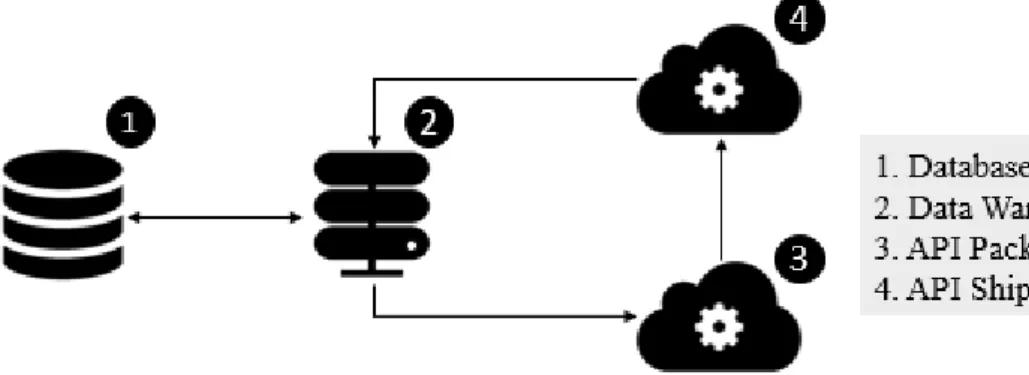
To support this independent work, there is a data warehouse responsible for the incremental collection of data from the database based on specific rules and time schedules. While this structure provides the same data as the database, the access and methods to work it are more adequate to perform analytical procedures. Each time a sales order is introduced, a trigger is activated to deploy other mechanisms. In the context of this project, since the planning is affected by expected receptions and incoming sales orders, these must be fully described to widen the scope of the planning. The receptions represent a component that is fully defined by the brands and the suppliers, so all the respective information must come from them. The sales orders, on the other hand, only depict the quantity to ship, the destination and the deadline. Every other component can be defined by HUUB as long as these requirements are met. Every new sales order is analysed and each missing field is updated with the latest intel provided by an application programming interface (API). The first API module, the API Pack, checks each item and the respective characteristics as kind, size, and fabric, to name a few, and predicts the best pack set for the sales order, its volume and weight. To avoid dependency of human measurement, this software module was built upon machine learning techniques that analyse data of previous sales orders and train the estimation model. With increasing volume of data, the model improves its accuracy over time, minimising the error involved in the prediction. After returning this information, a second API, the API Ship is activated to find the two best options of delivery from HUUB to the final customer. These options concern an economic shipping with a larger lead time and an express shipping, which is more expensive but faster. These options are generated by simulating a shipping on the website of each carrier and returning all the different rates. From these, the best economic and express options are selected and returned to the data warehouse. Every week, all drops yet to be shipped are revaluated on this API to update the shipping price. This is done as a precautionary measure in case a carrier changes the cost structure of its service. At the end, the data warehouse receives this information and returns it to the database. This set of activities can be observed on Figure 5.
3.3 Operation To-Be: Analysis of multi-staging
One of the main considerations of HUUB is to outsource warehousing procedures and last-mile transportation to other companies. In this segment, the company currently in analysis to perform this partnership is DAMCO. This company, part of A.P.Moller – Maersk, is one of the world’s leading providers of freight transport and supply chain management services with warehouses in every continent. The decision to partner with DAMCO came as an opportunity to fulfil deliveries from a warehouse in the Netherlands to diminish the transportation cost to the end customer. At the core of this idea, was the allocation of high-rotation items on that warehouse to fulfil e-commerce sales and the planning of bulk shipments to perform cross-docking of higher volume sales to retailers. Therefore, the shipping rates provided by DAMCO should at least be lower than the rates obtained by HUUB. In fact, depending on the work involved, the marginal difference on the last-mile delivery should accommodate the costs incurred with the new route.
3.3.1 Last-mile Price Comparison
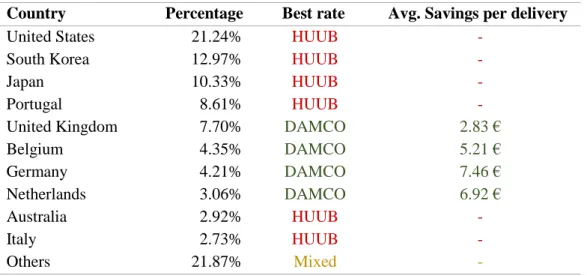
To evaluate this possibility, a study about the benefits of partnering with DAMCO was made prior to the start of this project. The methodology employed concerned only the direct comparison between the last-mile prices over the countries that represent the most customers. From the major destinations, only the ones concerning central European countries were able to generate cost savings, as seen in Table 1.
Table 1 - Comparison of main shipping destinations
Country Percentage Best rate Avg. Savings per delivery
United States 21.24% HUUB -
South Korea 12.97% HUUB -
Japan 10.33% HUUB -
Portugal 8.61% HUUB -
United Kingdom 7.70% DAMCO 2.83 €
Belgium 4.35% DAMCO 5.21 € Germany 4.21% DAMCO 7.46 € Netherlands 3.06% DAMCO 6.92 € Australia 2.92% HUUB - Italy 2.73% HUUB - Others 21.87% Mixed -
While this first analysis concerns a basic price comparison, the possibility to deploy distribution centres in other areas can still be advantageous. The clearest example is the impact on service level agreements between HUUB and its customers. On the peak of a season, the company faces a surge of products to process that might be so intense that the work-in-progress tends to delay the operation and, consequently, delay the delivery of items. To avoid an operational meltdown, HUUB may resort to DAMCO as an increased work capacity. In the short-term, though, all receptions must cross the Portuguese distribution centre before reaching other facilities. Direct shipping will be possible when suppliers become more rigorous on their production deadlines. The main conclusion from this initial evaluation is that DAMCO seems to provide a cheaper transportation service regarding certain countries. Complementary to this conclusion is the assumption that this alternative may be used to prevent delays. However, both these statements could be proven wrong since they are based on static situations that, in reality, might not be possible. Hence, to perform a more rigorous validation, this scenario should also be considered when optimizing the overall planning. Since the goal is to analyse the impact of every
3.3.2 Operational Considerations
The main restriction regarding the supply chain planning of HUUB is the fulfilment of sales orders within the proposed deadlines. Since most activities depend on the progress of other activities, the occurrence of work pipelines may happen, resulting in bottleneck situations. The partnership with DAMCO emerged as an aid in this context, where more resources can be allocated to resolve stress situations. This solution represents an additional cost to the company and may provide an innocuous improvement if the lead time of the operation is also greater than the one required by the brand.
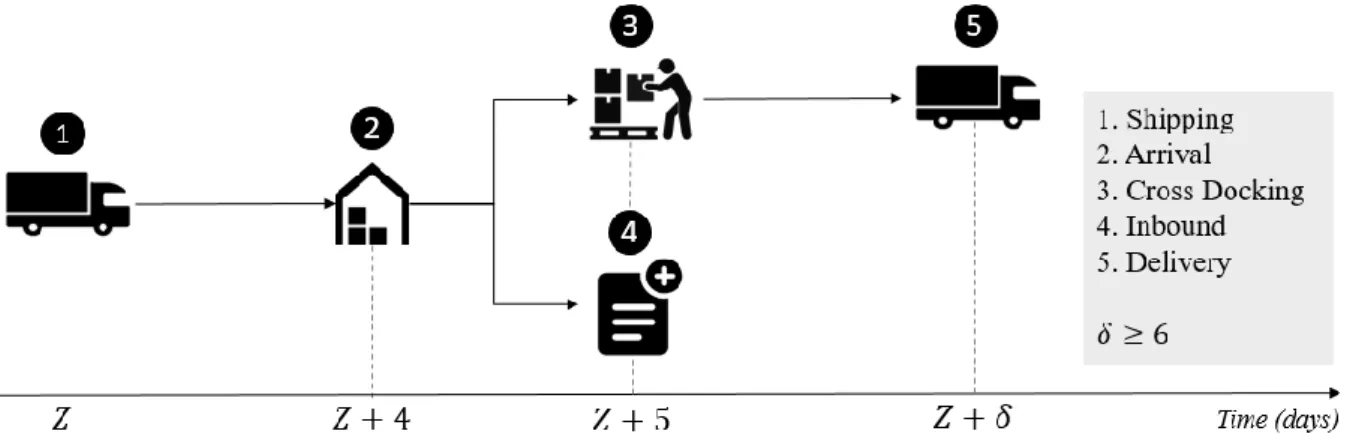
At the present moment, the operation in the Netherlands concerns only (i) cross-docking mechanisms and (ii) high rotation items where every week a large shipment is sent from HUUB. The cost imputation on this transport is proportional to the number of pallets transhipped and the respective lead time is four days. This step is where economies of scale can be reached since a set of products are grouped into pallets and shipped. In this case, higher number of products per transhipment causes a decrease on the cost per unit being transhipped. Upon the arrival, the items that are not intended to fulfil a sale are registered and stored within the warehouse in what is called the Inbound of goods, as seen in Figure 6. A cross docking operation is executed to deal with the items designated for the sales orders and then they are shipped. The whole process always takes, at the minimum, six days to process.
Due to these conditions, every sales order that is placed with an antecedence lower that six days will never contemplate the hypothesis of being included on the transhipment to the Netherlands. Moreover, even six days is a positive scenario since most countries involve a delivery process with a lead time of several days and the operations at HUUB may also take time to finish. Annex B represents overall shipments so far.
Figure 6 - Transhipment process to the Netherlands
Apart from the service conditions, the option to ship to DAMCO must also account with the operational costs involved. For cross docking items, the cost is reflected on a fee per box that arrives. However, if an item is to be shipped on the next day or any other day, then the protocol is to pick it to stock and then proceed to execute the Outbound. In this case, there is a fee for the number of boxes, another one for each item and a storage fee for each item. Therefore, if a transhipment is made between HUUB and DAMCO that requires a temporary storage then it is possible that the overall cost is higher than expected. Concerning the Outbound movement, the cost structure depends if the delivery is for B2B or for a B2C destination. On the first one, the cost is only reflected on the number of boxes to be shipped. For the second case, there is an additional fee based on the number of products.
Based on this analysis it was concluded that, due to all this complexity, a mathematical optimization model will be a significant contribution to future management. Thus, the main focus of this project was the development and implementation of an optimization model that