Report prepared by
Eckhard Voss and Raquel Rego
September 2019
DIGITALIZATION
A LABOUR PERSPECTIVE
AND PUBLIC SERVICES:
PUBLIC SERVICES
INTERNATIONAL
The global union federation of workers in public services
Digitalization and Public Services:
A Labour Perspective
This report was commissioned by PSI to Eckhard Voss1, Wilke Maack GmbH in
Hamburg and Raquel Rego2, University of Lisbon in September 2019
[
Manuscript completed in May/June 2019]© Public Services International September 2019
Foreword
T
he report “Digitalisation and Public Services: a labour perspective” provides a global overview and policy guidance for public services unions to ensure digitalisation lives up to its promise to enhance public service quality, effec-tiveness and accessibility for users, while improving working conditions and creating decent employment opportunities.
It looks at the shapes digitalization is taking in different public service sectors world-wide; how it affects delivery, quality and access; employment, working conditions and labour rights; what public service trade unions are doing about it; and what reg-ulatory and governance considerations can be drawn from this review.
The research is based on the review of all main PSI sectors and on an interview sample of 20 public service trade unions representatives from all continents. The findings show that much of the impact of digital technologies on public services depends on how these are regulated and used, and on whether workers and their unions have a say or not on their development and introduction at the workplace. It was commissioned by PSI with the support of the Friedrich Ebert Stiftung (FES), and elaborated by Eckhard Voss, Wilke Maack GmbH in Hamburg and Raquel Rego, University of Lisbon.
Rosa Pavanelli
General Secretary
Public Services International
It finds that digital technologies can improve public service quality and access and contribute to democratic accountability and citizens’ trust in public institutions, while advancing workers’ occupational health and safety (OSH). At the same time, it shows those same technologies can open the door to public service privatization, create a dangerous dependency of public institutions on private digital technology providers, and deepen inequalities among public service users.
The review concludes that:
z The introduction of digital technologies in public services is frequently driven by
private corporate interests
z Corporate-led digitalisation is regularly associated with major public service user
and data privacy abuse, resulting in a worsening of public service quality and efficiency
z Cost-cutting driven digitalisation tends to replace and slash public service
jobs. It often uses new technologies for worker surveillance and performance monitoring, increases working time and extends job tasks
z It is urgent to establish an adequate regulatory framework for the introduction
and use of digital technologies in public services and their workplaces. Such regulation must be developed in close dialogue with public services workers and their trade unions through meaningful participation, information and consultation, and by negotiating relevant wording in collective agreements.
Digitalisation and artificial intelligence are changing the way public services func-tion for both users and public service workers. The way governments deal with the digitalisation process will influence those changes. Their actions will have negative outcomes if governments see digitalisation as a way to outsource functions, further abdicating their responsibilities and power. On the other hand, positive results could flow from governments leading the digitalisation process, defining rules, setting lim-its and implementing control procedures that can improve working conditions for public employees and make services more responsive and accessible for users.
Foreword 3
Executive Summary 6
Digitalization Glossary 11
List of Acronyms 16
INTRODUCTION 17 1 DIGITALIZATION AND PUBLIC SERVICES: A SECTOR-SPECIFIC OVERVIEW 24
1.1 Context and drivers 24
1.2 Central government 25
1.3 Local and regional government 30
1.4 Public utilities 34
1.5 Health and Social Services 37
1.6 Education and culture services 41
1.7 Security, border and emergency services 42 2 IMPACT OF DIGITALIZATION ON PUBLIC SERVICES QUALITY,
EFFICIENCY AND ACCESS 46
2.1 Disentangling myth, ideology and reality 46 2.2 Impact on public service access and on the relationship
between public services, citizens and users 48 2.3 Impact on privacy and security issues 49
2.4 Impact on efficiency and quality 50
2.5 Impact on public finances 52
3 IMPACT OF DIGITALIZATION ON PUBLIC SERVICE EMPLOYMENT
AND WORKING CONDITIONS 54
3.1 Impacts on employment 54
3.2 Impact on working conditions: The overall picture 56 3.3 Skills and competence requirements 58
3.4 Occupational health and safety 60
3.5 Working time and work-life balance 61
3.6 Work monitoring and surveillance 63
3.7 Impact on existing and new inequalities in the labour market and workforce 64 3.8 ‘Digital Taylorism’: Emergence of precarious forms of employment 66 4 TRADE UNIONS AND PUBLIC SERVICE DIGITALIZATION 68 4.1 Involvement in digitalization-related public policies 70 4.2 Anticipation and managing of digital change and restructuring 73 4.3 Collective agreements setting frameworks for socially just digitalisation 73 4.4 Trade union guides and model collective bargaining agreements 75 4.5 Regulating the impact of digitalization on occupational health and safety 76 4.6 Local level bargaining and direct workers involvement 78 4.7 Shaping and regulating working time, telework and work-life balance 79 4.8 The right to training and qualification 80 4.9 Impact of digitalization on workers and trade union rights 82
5 CONCLUSIONS AND RECOMMENDATIONS 84
References 88 Annex: Trade unions participating in the study 92
1. This reportwas commissioned by PSI. In ad-dition to an extensive literature review, the study finds its main sources in interviews and information gathered from trade union repre-sentatives from PSI-affiliated organizations in different public service sectors around the world, including in Africa (Burkina Faso, Morocco), Asia (South Korea, Singapore, India), North America (Canada, United States), South America (Argentina, Brazil) and Europe (Denmark, France, Germany, Norway, Spain, and the United Kingdom). The interviewees represent a wide range of public services from central administration and local and regional government to health and care services, hos-pitals, utilities, police, emergency services and education and cultural services.
2. It focusses on research questions that so far remain largely unanswered by current litera-ture. These questions pertain to the introduc-tion of digital technologies across different public sector service branches and the moti-vations that underpin it (1), but also to the im-pact of public service digitalisation on service quality, effectiveness as well as access to pub-lic services (2). The report then addresses the impact of digital technologies and digitalised workplaces and work environments on public service employment and working conditions (3) and how trade unions have addressed these issues by own activities, within social dialogue and by collective bargaining (4). The analysis concludes with highlighting key re-sults as regards the governance systems and regulatory tools that exist (or need to be de-veloped) in order to secure the protection and interests of public service users and workers in the context of service digitalisation (5).
3. A large body of literature has already been published on digitalisation, the impact of new technologies on the world of work and the in-troduction of new technologies and related
forms of work organization—including in gov-ernment and public services. Public service digitalisation is being actively promoted and fostered by international organisations such as the United Nations (UN), the Organization for Economic Cooperation and Development (OECD) or the EU Commission to increase ef-ficiency and improve the quality and accessi-bility of public services. According to the pro-ponents of public service digitalisation, digital technologies and automation would also im-prove workers’ working conditions, reduce health and safety risks and improve their work-life balance.
4. However, there are good reasons to doubt digitalisation being a win-win recipe for all public services. Evidence suggests that often the introduction of digital technologies and au-tomation is mainly being driven by a will to in-crease productivity and work intensity as well as cutting jobs. Evidence shows that the pro-vision of digital know-how, in both hardware and software, increases the pressure placed on public authorities to outsource essential activities, including those related to critical infrastructure. Furthermore, it is proven that while digitalisation and the increased use of digital devices can have positive effects on working conditions, they may also be used to monitor worker performance and behaviour, to intensify and compress work processes and surveillance, and to extend working time or at least availability.
5. Digitalisation goes beyond past waves of technology-driven change: The digitalisation of public services does not only concern the introduction and application of new technol-ogies and tools such as sensors, smart de-vices, chatbots, cloud computing, data ana-lytics, smartphone apps, machine learning, artificial intelligence or blockchain technolo-gy. More importantly, it concerns the far more
wide-ranging impact these technologies have on the way public services are provided, the relations between public services and citizens, and the type of labour needed. Since they are often developed, provided and owned by global tech companies such as Google, Apple or Microsoft, they also change the power rela-tionship between public and private actors in the delivery and control of public services.
6. In central government and administration, the study shows that e-government and ‘digital first’ approaches in public services and admin-istration are strongly promoted by internation-al organisations such as the UN or the World Bank as the one and only path for government modernisation. Digitalisation of central gov-ernment function can have positive effects, as was highlighted by trade union representatives in Brazil where newly digitalised public servic-es such as online scheduling, online tax col-lection and e-processes in court have brought benefits to users in terms of public service ef-ficiency and quality.
7. Large ‘smart government’ programmes—such as those implemented in Singapore, the intro-duction of digital identities and land registra-tion in India, or tax payment practices based on blockchain technologies in Denmark—show that digitalisation in central government and public administration is a global trend and is being actively promoted by large multinational tech companies, whose key role as ‘enablers’ goes far beyond the basic function of deliver-ing hardware and software. Public sector trade unions in the United States or Canada critically noted that the digitalisation of government and administration provides a huge opportunity for data gathering and use for large private tech companies. Technological dependency on big data corporations is problematic because pub-lic administrations often lack the resources to hire suitably qualified IT specialists and skilled
professionals to develop and manage digi-tal-service technology, which further increas-es their overreliance on large private compa-nies. The result is that governments have, for example, deployed Artificial Intelligence (AI) technologies and services by contracting pri-vate companies and remained dependent on them, creating additional risks regarding the sharing of citizens’ data with business actors.
8. This state of dependency is also an issue in local and regional governments where the ‘Smart City’ concept has emerged, ushering in the use of a variety of new, digital technol-ogies such as data gathering and exchange and ‘digital first’ approaches in local public services, and thereby shaping new forms of interaction between public services and us-ers/citizens. Evidence drawn from Smart City programmes in developing countries shows that underneath the glossy promise of making cities clean and “intelligent”, Smart City pro-grammes are principally a tool to attract foreign direct investment for technology-driven PPPs and privatisation in local public services. Few Smart City programmes are oriented towards improving public service access, addressing inequality and citizens’ needs, or redefining data as common goods rather than a private commodity.
9. Data gathering and analytics have also become key drivers of digitalisation in the utilities sec-tor, namely in water provision. Here digitalisa-tion is increasingly affecting the way in which public utilities are modernised and managed. Technologies such as the Internet of Things, smart grids, predictive maintenance or smart metering are not only having an impact on how utilities are managed but are also transforming providers by changing their relations with us-ers, the role of suppliers and the involvement of digital companies as essential parts of ser-vice provision. The utilities sector presents
significant technological gaps and increasing access inequality for new digital services and tools. The case of Argentina illustrates these gaps within a country: while smart electricity meters are in use and bitcoins have become a valid payment method for public transporta-tion natransporta-tionwide, in some regions, horses are still used by many citizens as a means of local transport.
10. The ambiguity of the impacts of digitalisation is very clear in health and social services and in education services. New digital technol-ogies such as e-health or e-medicine, digital patient management, remote learning and dig-ital medical devices can help and support doc-tors, nurses, teachers and administrative staff in the delivery of health and social services and have the potential to provide added value for patients, students and workers who need to update their skills and knowledge. Digital tools and technologies can also improve ser-vice access and enhance serser-vice provision in remote or rural areas. However, according to evidence from the United Kingdom, South Korea or the United States, digitalisation and automation are often used to reduce the hu-man factor and headcount in these same la-bour-intensive public service sectors.
11. The increasing role and influence of powerful tech companies over public service digital-isation emerges as a constant across all sur-veyed regions. This is also the case of digital technologies and artificial intelligence pro-grammes used in security services, police or emergency services. This raises questions not only about the dependence created be-tween these vital services and private corpo-rate actors, but also about their cost-benefit ratio, personal data protection, civil rights and behaviour surveillance and monitoring.
12. As regards the impact of digitalisation on pub-lic services quality, efficiency and access, the study has found that digitalisation is sig-nificantly changing the content of public ser-vices and the way they are delivered, but not necessarily for the better. Interviewed union representatives expressed concern that, while new technologies can bring improvements to the quality, efficiency and accessibility of public services, this ideal scenario is far from automatic and requires specific regulation and social framework conditions geared towards making digitalisation work for the common good rather than private gains.
13. In the case of service accessibility, the ‘digital first’ principle is self-contradictory when large parts of a country’s population have no access to the Internet and digital devices or are not IT literate. The elderly, people with disabilities, low-skilled workers and low-income groups are most likely not to see their access to pub-lic services enhanced as a result of their dig-italisation. UK public service unions reported that in Britain 9 million citizens are practically excluded from digitalised services. In develop-ing countries, access to digitalised public ser-vices is even more challenging as large shares of the population are unable to participate in the ongoing processes of digital change.
14. The ‘digital first’ approach, coupled with the outsourcing of digital systems development and the privatization of certain government functions also poses a threat to the data se-curity, privacy and protection of users and citizens as well as public service workers. Interviewed unions emphasised the urgent need to rethink the design and objectives of public service digitalisation and adapt regula-tory frameworks in order to effectively tackle the new risks it poses.
15. Digitalisation also has a significant impact on public finances and public service budg-ets. While some of the implications are direct, others are less immediately visible. The intro-duction of new technologies and processes to public services can represent a significant investment in infrastructure, tools and exper-tise (often brought in from external suppliers or via PPPs). Public sector unions in Canada and Germany highlighted that the outsourcing of certain activities, the leasing and maintenance of digital devices and the cost of licences or data security services are resulting in signifi-cant direct and indirect costs. These costs are often underestimated, as is the investment needed to train and develop the skills and competences of public sector workers when such new technologies are introduced.
16. However, this is not the only way in which digitalisation is impacting public budgets and income. The emergence of new forms of dig-ital-based employment, such as digitally-me-diated service work and online platform work also play a significant role. Indeed, working conditions in such digitally mediated and man-aged employment are often precarious and low-paid. Workers tend to be “self-employed”, which means that, even in cases where they are completely dependent on or fully availa-ble to the digital platform provider employing them, said platform does not pay any form of social security contribution into the social insurance system for their work. In addition, global tech corporations have developed so-phisticated systems of corporate tax avoid-ance that starve public finavoid-ances.
17. Digitalisation is also affecting employment and working conditions. The situation of private sector service workers, such as highly quali-fied IT specialists and managerial staff in high
tech companies, engineering and consultancy services, who are benefitting from job crea-tion and rising income levels, contrasts sharp-ly with that of public service workers. As far as public service employment is concerned, interviewed public sector unions highlight-ed significant negative effects. One of these effects is the substitution of tasks and jobs that can easily be automated such as admin-istrative work, invoicing and the handling of standard cases. Digitalisation and automation too often result in work intensification or high-er stress levels. Furthhigh-ermore, the spread of digitally mediated and platform work in public services, especially the health and care sec-tor, are transforming employment relationship patterns at the expense of employees, who are often pushed to go into so-called ‘bogus’ self-employment or contracted under precari-ous conditions.
18. The study shows that public service unions are not against digitalisation, quite the oppo-site, as long as it serves public interest. The unions clearly acknowledge that these tech-nologies can be beneficial to public service users and workers, for example by enabling social care workers to optimise their routes and spend more quality time caring for pa-tients. Mobile devices and tracking software can also improve the safety of police officers and social workers when they find themselves in dangerous situations at work. However, the same technologies can also be used to con-stantly monitor employee performance and behaviour, to increase their pace of work and to limit pay only to the time spent with service users.
19. The study also shows that public service trade unions from all continents are actively engag-ing and takengag-ing initiatives in order to address
the challenges arising from the introduction of digitalisation and shape a just digital tran-sition in public services.
20. Trade unions are voicing their positions and demands with regard to top-down, govern-ment-led digitalisation programmes in all major public service sectors and especially in health and social care, education, public utilities and local and regional government services.
21. Some unions have included digitalisation-re-lated issues in their collective bargaining agendas at all possible levels, negotiating bipartite, tripartite and cross-sectoral agree-ments, as well as regional, municipal and workplace-based collective agreements to in-fluence and shape the management of digital change processes in public services.
22. In some cases trade unions have succeed-ed in securing and placing value on workers’ representation and participation as ‘digital change agents’ (e.g. Denmark or Norway). In other cases (e.g. United States, Germany or Italy) they have negotiated on the subject of digitalised work and employment conditions, such as ‘telework’, ‘flexible’ and ‘smart’ digi-tal work, and thereby have asserted the ‘right to disconnect’ for public and private service workers as guaranteed by national legislation in France and Italy.
23. Trade unions are also making a critical contri-bution to a better understanding of the health and safety risks associated with digitalized public service workplaces. They are support-ing workers through guidelines, model work-place and framework agreements at company and sector level (e.g. UK, US or Germany) and the negotiation of new and extended rights to training (e.g. Singapore).
24. More recently, trade unions such as the SPFQ trade union from Quebec, Canada or HK Kommunal in Denmark have initiated their own research projects or developed their own ex-pertise as regards the application of machine learning, process automation and artificial intelligence in public service processes and decision-making.
25. Beyond public services, the report has shown that public service trade unions are also key actors in shaping the debate about the over-all future of work, including the need to adapt the concept of employment and employment contractual relationships to the new forms of interaction that have arisen between work-ers, online platforms and other types of digi-tal-based intermediaries.
26. Finally, public service unions are actively in-volved and often the ones to initiate public civic debate in their workplaces, communities and countries on core questions surrounding the future of public services, as well as their role and contribution to democracy, equality, the common interest and investment in criti-cal services and infrastructures for all, not for the few.
27. The report clearly shows that, in the countries and sectors where strong, organised work-ers’ representation exists and enjoys a power-ful voice, it plays an important, positive role in prompting and shaping the policies and regulation needed to accompany the public service digitalisation process. Furthermore, countries and sectors in which trade unions were allowed to freely exercise their role and were involved and valued in the process from the beginning achieved better results in ensur-ing a more socially just digital transition for public service workers and users alike.
q
Digitalisation Glossary
Term
Explanation
“Privacy by design” and “privacy by default”
Privacy by design or privacy by default means that appropriate software and hardware is designed and developed in such a way that relevant data protection measures are taken into account from the outset. The technology design is geared towards respecting data protection requirements in all areas. The European General Data Protection Regulation (GDPR), which entered into force in May 2018, mandates that “privacy by design” is compulsory for all companies with users in the EU.
Agile Work Initially developed by IT experts with the aim of defining new ways of developing software with greater responsiveness to changing user needs. From this collaboration the ‘Agile Manifesto’ emerged, which put a focus on collaboration between self-organised cross-functional teams and their customers. Since then the ‘agile’ method of project and team work has spread to organisations of all types and sizes. Today, ‘agile’ is a business buzzword in management theory. It is linked to project management software such as Scrum or Kanban and the promise of doing things better, faster and more effectively than traditional teamwork-based processes.
Algorithm In mathematics and computer science, an algorithm is a step-by-step instruction to solve a problem or carry out a task. Algorithms can process data and perform calculations, automated reasoning and other tasks. For example, they make it possible for navigation software to find the shortest way from A to B. Algorithms are also important in selecting individualised adverts, promotions or other suggested content that we receive when using programmes such as Google, Facebook or Instagram. Algorithms are also increasingly being used in the world of work, namely in HR and recruitment for screening purpose and for providing suggestions as to which candidates might best match a position in an organisation.
Artificial
Intelligence (AI) An area of computer science that emphasizes the creation of intelligent machines that work and react like humans. The use of artificial intelligence is present in all areas of everyday life, from national language processing (Siri, Alexa) to online chatbots or HR software that supports decision making when hiring and firing employees. According to the U.S. IT Magazine VERGE, in Summer 2019, 300 Amazon employees in Baltimore were dismissed because they did not match productivity targets. Both the productivity targets and the identification of the employees were done by AI.
Big Data (Analytics) Data volumes that are too large, too complex, too fast moving or too weakly structured to be evaluated with manual and conventional methods of data processing.
Biometric data Biometrics is the science of body measurement of living beings. Biometric data is known to be fingerprint, facial or iris characteristics, but can also relate to behavioural characteristics such as writing behaviour, lip movement or voice.
Bitcoin (or “Crypto
currency”) Bitcoin is a digital currency or virtual money. There are no physical coins or banknotes in this payment system. The fundamental difference between crypto currencies like Bitcoin and conventional money is that the digital means of payment function completely independently from banks or states. Bitcoin transactions are completely anonymous and decentralised and do not require the intervention of an additional authority, such as a bank, between the partners involved. Thus they are beyond the control of the state. In addition, the true identity of both actors remains hidden, since only the account balances and Bitcoin addresses used for transactions are visible to the public. Whether “digital” coins have the potential to become an alternative currency, however, will only become clear in the future, as the focus has been drawn to the speculation function rather than the online payment function, as the significant current Bitcoin hype proves.
Term
Explanation
Blockchain A blockchain is a database or ledger that consists of a chain of data blocks. This chain is constantly extended by new blocks in which transactions are stored. The principle can be compared to an accountant who, on a daily basis, writes all transfers in a network down on a sheet of paper and staples it into a large folder in the evening. The sheet of paper would be the data block, the folder the block chain. In a blockchain, all participants receive a copy of the updated block chain. Thus, since there are as many copies as there are users, the information in the blockchain is stored on thousands of computers around the globe. This makes it virtually forgery-proof compared to conventional, central databases. What information is stored in the data blocks and how it is used does not matter, be it Bitcoins, supply chain data, freight books, e-government data, medical records, power-grid management data, border control, or public utility data such garbage disposal, urban public transport passenger data. Blockchain technology currently is actively promoted by innumerable software companies throughout the world, but in particular in China and other Asian countries. Chatbot / bot A chatbot (or simply ‘bot’) is a text-based dialogue system that allows one to chat
with a machine. It has a dedicated area for text input and output, through which it is possible to communicate in natural language with the machine system behind it. Due to increasing computer power, chatbot systems can access more extensive data faster and therefore offer the user intelligent dialogue. Such systems are also referred to as virtual personal assistants. Prominent examples are the Google Assistant or Amazon’s Alexa.
Cloud computing IT infrastructure that is made available via the Internet. It is a business service that usually includes storage space, computing power or application software. In technical terms, cloud computing describes the approach of making IT infrastructures available via a computer network without having them installed on the local computer. The largest cloud computing suppliers are Microsoft, Amazon, Salesforce, SAP and IBM that have developed cloud computing as a new and increasingly important field of business (e.g. Infrastructure as a Service, Platform as a Service, Software as a Service). Collaborative
robotics (Cobot) A collaborative robot (Cobot) is an industrial robot that works together with human workers. Crowdsourcing Crowdsourcing is the outsourcing of tasks or projects from a company to a group of internet users. The term crowdsourcing is made up of the words outsourcing and crowd. However, crowdsourcing does not mean the outsourcing of corporate tasks to third parties, but rather the outsourcing of tasks to a crowd of people, usually freelancers or smaller companies. Companies mainly outsource tasks to a large global crowd of workers in order to avoid direct labour contracts, which would include social security contribution obligations, and stimulate cost-competition between crowdworkers. See also Crowdworkers
Crowdworkers Crowdworkers are people who accept work orders that are made available to a large number of internet users (crowd). The orders are usually offered via internet platforms (so-called crowdsourcing platforms) and, depending on the order/project, processed by one or more crowdworkers. Very different types of crowdwork exist, such as local services such as private cleaning, gardening or homecare services as well as IT- or Platform-based crowdwork for freelancers in the field of journalism, media or design where crowdworkers compete globally. See also Gig Economy
Crypto currency See Bitcoin
Cyberattack An attempt by hackers to damage or destroy a computer network or system. Larger cyberattacks that gained large media coverage were for example the attack of several public organisations, banks, the parliament and ministries in Estonia in 2007 or the attack on the Ukrainian electricity system in 2015.
Digital Identity As opposed to an identity in the real world, where persons are characterised by attributes such as physical characteristics or personal data, digital identities rely on electronically processable characteristics. Such characteristics can be a username and password, smart cards and tokens or biometric data. Often, in both the digital and the real world, multiple attributes are combined to better secure unique identification.
Term
Explanation
Digital-first Principle of public service provision where the access of users to services and/or the communication between users and public service employees is done digitally, i.e. via the Internet, through computers and other digital devices.
Digital natives The term digital native refers to a person of the social generation who grew up in the digital world. By contrast, the term digital immigrant exists as an antonym for someone who has only come to know this world in adulthood.
Disruptive technologies / innovations
In contrast to incremental or evolutionary innovations, disruptive innovations refer to those that change the rules of the game on the market and/or in user behaviour for digital devices and/or data. Disruption is often not triggered by the technology itself but by a change in its usage. One example is the MP3 audio format. This technology did not trigger any disruption, its use in the context of the functionality and user-friendliness of portable MP3 readers such as Apple’s iPod or built-in smartphone applications did so.
E-government E-government stands for electronic government. This refers to the increased use of modern IT technologies and electronic media for government, its administrative processes and service delivery. Forms of e-government include offices or authorities communicating with each other or with citizens electronically, such as online tax declaration portals, birth certificate requests or motor vehicle registration done online via a government’s webpage.
eHealth, eMedicine eHealth, also known as Electronic Health, refers to the use of digital technologies in the healthcare and medical sector. It refers to all tools and services that use information and communication technologies (ICT) for prevention, diagnosis, treatment, monitoring and management of pathologies, as well as clinical and patient data collection and processing. Considering the large amount of private health data gathered, data protection is an important issue.
Gig economy, Gig(s) Refers to a part of the economy and labour market in which small orders are placed on short notice with independent, self-employed persons or freelancers through the use of digital platforms (e.g. Uber for auto-transport, Eat for food deliveries, etc.). GPS tracking A GPS tracker is a device that can be located via the satellite system and emits radio
signals indicating its location that are received by an external reception device. They can be used to track objects and people. GPS tracking functions are integrated into smart phones and many other devices for daily use.
Gunshot detection
platforms A gunfire locator or gunshot detection system is a system that detects and conveys the location of gunfire or other weapon fire using acoustic, optical, or potentially other types of sensors, as well as a combination of such sensors. These systems are used by law enforcement, security companies, the military and businesses to identify the source and, in some cases, the direction of gunfire and/or the type of weapon fired.
Industry 4.0 After mechanization (Industry 1.0) based on steam technology, mass production (Industry 2.0) based on Taylorism and automation (Industry 3.0) based on electricity and analogue computing, the advent of digital technologies and of the Internet of Things and Services in manufacturing is leading to the fourth industrial revolution or Industry 4.0.
Internet of Things
(IoT) General term for information infrastructure technologies that make it possible to network physical and virtual objects (e.g. computers, cars, trash bins, traffic lights, etc.) and allows them to communicate through information and communication technologies. An example of this are self-scan products in supermarkets whereby an RFID (radio-frequency identification) chip emits the price and digital check out occurs automatically. Traffic management and smart traffic lights or sensor-based trash services in smart cities are also examples of IoT-based processes.
Data mining Data mining is the systematic application of statistical methods to large amounts of data (in particular “big data” or mass data) with the aim of identifying correlations, cross-connections or trends that so far have not been detectable due to a lack of computer capacity. Data mining is not only carried out for scientific reasons but also by private actors in order to develop new solutions or business ideas, for example in the field of predictive maintenance or eHealth.
Term
Explanation
Machine learning Generic term for the ‘artificial’ generation of knowledge from experience that mimicks human learning. An artificial intelligence system (a robot or a computer) can be set to learn from examples, interactions and experience and can embed them into its system as general rules after the learning phase has ended. It will then be able to use that information in the future in similar situations. Machine learning is a part of ‘artificial intelligence’.
mHealth The term mHealth (also mobile health) stands for the support of medical procedures and health care measures by devices such as smartphones, tablets or personal digital assistants ( PDA) as well as by lifestyle and health applications that can be operated via sensors. Mobile health includes a number of technical applications, for example the determination of vital signs such as blood sugar or body temperature, but also communication or motivation applications, which are intended to remind the user to take medication. The use of apps plays a major role here, because the sensors installed in the smartphones can capture and process a large amount of health-related data. The main field of application for mHealth is remote monitoring patients with chronic illnesses. Automatic SMS dispatch from health providers to patients is the method most frequently used for this technology, which is expected to expand in the future in the prevention and treatment of dementia, Alzheimer’s disease and other neurodegenerative illnesses.
MOOC Massive Open Online Course refers to online courses mainly used in higher education and adult education, which usually have large numbers of participants as they do not impose any access or admission restrictions.
Once-Only
principle The aim of the Once-Only principle is that citizens and companies only have to communicate certain standard information, such as name and surname, birthdate, sex and address, to public authorities and administrations once, thereby avoiding having to do it every time. In compliance with data protection regulations and with the explicit consent of the users, public administrations are then allowed to reuse the data and exchange them with each other. The Once-Only Principle aims to reduce the administrative burdens facing citizens and businesses. PDA Personal Digital Assistant, i.e. a small mobile handheld computer device used to write text or
manage schedules, emails and telephone numbers. Many of these features are now typically embedded into smartphones.
Platform
economy The platform economy is economic and social action made possible by digital platforms that typically function as online matchmakers or technology frameworks and operate as intermediaries, putting offer and demand for a certain product or service in touch. The most common type by far are “transaction platforms” such as Amazon, Airbnb, Uber or Baidu. Predictive
analytics Predictive analytics include a variety of statistical techniques such as data mining, predictive modelling, and machine learning that analyse current and historical collected data, extrapolate them and make predictions about future trends and events. Predictive analytics are used in marketing, financial services, insurance, telecommunications, retail, travel, mobility, healthcare, child protection, capacity planning, social networking and other fields. They represent an extremely valuable market and carry the potential for great influence in economies and societies.
Predictive
maintenance A maintenance process based on the evaluation of machine-processed data analysis collected from advanced manufacturing or industry 4.0. The real-time processing of the underlying data makes it possible to forecast maintenance needs and consequently reduce downtimes. In addition to the interpretation of sensor data, this requires a combination of real-time analysis technology and an in-memory database that can assign a technician to solve a problem before it occurs.
Robot Process
Automation (RPA) Robot Process Automation is a term that describes the application of algorithms and artificial intelligence to “copying” and conducting administrative and other work processes that had previously been carried out by humans in the field of pay rolling, accounting tasks or tax collection or basic functions of human resources management, for example.
Servicification Term indicating that manufacturing activities and competitiveness in the world economy increasingly depend on services rather than products (vs. “commodification”).
Term
Explanation
Sharing economy This is a collective term for companies, business models, platforms, online and offline communities that enable the shared use of completely or partially unused resources such as real estate (AirBnB) or transport (BlaBlaCar) by connecting offer and demand for such goods and services.
Smart meters /
grids An “intelligent” or smart meter is an electricity, gas, water or heating meter that reads and transmits digital data regarding consumption and maintenance needs and is therefore integrated into a communication network connected to the provider. Such intelligent meters have been in use since the 1990s, primarily for large customers. They have also been available to private households since around 2010. Depending on the model, intelligent meters can also transmit data to the energy supply company at fast intervals, which should enable it to better manage its network and resources and anticipate peaks and downtimes (Smart Grid system).
Social rating/
credit systems Social rating or credit systems are not new. In the past, financial lenders and mortgage providers were already tracing the timely manner in which clients paid their debts, giving them a score for solvency. Such systems have expanded in other areas, for example online shopping or in the rating of Uber drivers and passengers or restaurants and hotels (Tripadvisor, Booking, AirBnB). Building on these practices, current social rating/credit systems are being expanded to all aspects of life, and in the case of authoritarian states, used to judge citizens’ social behaviour and potential opposition to rulers.
Taylorism Taylorism describes the principle of controlled work processes established by the American Frederick Winslow Taylor (1856-1915). It is a management system that predicates breaking down production into specialised, repetitive tasks in order to increase productivity and efficiency.
Tele-health Tele-health covers the dissemination of health-related services and information (including patient’s information) via electronic information and telecommunication technologies. See also eHealth and mHealth
Telework Forms of work in which employees carry out all or part of the work outside the employer’s premises. In the case of home work, this work takes place at the employee’s home. In most cases, the results of said work are then transmitted to the employer via digital channels (e-mail, shared server, website etc.).
Uberisation Uberisation is a term that has generally come to indicate a highly unprotected employment relationship based on a digital platform in which services (such as Uber taxi services) are offered on short-term or instant demand through direct contact between a user and a supplier via a mobile application or website. The intermediary company (in this case Uber) neither owns cars nor employs drivers directly but earns a percentage on the service.
Virtual reality
(VR) Virtual reality or VR is the computer-based display and perception of reality in a real-time mode that often allows for interaction with the user, for example in the context of computer games. VR today is used in many areas, e.g. in surgery, remote maintenance and repairs or training (e.g. flight or train simulation).
Work on demand Work on demand is a request put to an individual to deliver work for a specific, limited time. While work on demand has existed as a business practice for a long time (consultancies, short-term contracts, time-bound outsourcing etc.) the digitalisation of work and the rise of online platforms ( Platform economy Uberisation) that operate as intermediaries for work on demand shone a new light on these practices. Work on demand is often presented as a ‘win–win situation’ by platforms: workers get to tailor their work time to their personal responsibilities outside the workplace, while businesses can adjust their workforce according to their short-term needs. This type of work principally generates non-standard form of employment.
Zero-hour
contracts Zero-hour contracts are an extreme form of flexible working used by some employers that do not specify a minimum number of working hours per week. By signing a zero-hour contract a worker agrees to be available for work at any time as required, while the employer is not obliged to provide any work and the worker is not obliged to accept the work offered. The worker is expected to be on call and receives compensation only for hours worked. This approach generates precarious employment as it typically shifts most risks and costs of the employment relationship onto the worker and away from the employer.
AFT American Federation of Teachers (United States)
AUPE Amalgamated Union of Public Employees (Singapore)
CFDT Confédération française démocratique du travail (France)
CGT Confédération générale du travail (France)
CNTSS/CUT National Confederation of Social Security Workers (Brazil)
CSQ Centrale des Syndicats du Québec (Canada)
CTM Confederación de Trabajadores Municipales Confederation of Municipal Workers (Argentina)
DAMD Danish General Practice Database
EGDI E-Government Development Index
EPSU European Federation of Public Service Unions
ETUC European Trades Union Confederation
ETUI European Trade Union Research Institute
FNV Federatie Nederlandse Vakbeweging (Netherlands Trade Union Confederation)
FP-CGIL Funzione Pubblica Confederazione Generale Italiana del Lavoro (Public Services Sectoral branch of the Italian Trade Union Confederation)
FSC/CC.OO Federation of Services to Citizens (Span)
GPS Global Positioning System
HK Handels- og Kontorfunktionærernes Forbund (Denmark)
ILO International Labour Organisation
IoT Internet of Things
IT / ICT Information Technology / Information and Communication Technology
KMHU Health and Medical Workers Union (Korea)
LED Light Emitting Device
NHS National Health Service
OECD Organisation for Economic Cooperation and Development
OHS Occupational Health and Safety
PPP Public Private Partnership
PSI Public Services International
PSIRU Public Services International Research Unit
RPA Robotized Process Automation
SFPQ Syndicat de la Fonction Publique et Parapublique du Québec (Canada)
SYMEB Syndicat des Médecins du Burkina (Burkina Faso)
TUAC Trade Union Advisory Committee at OECD
UN United Nations
UNISON UNISON Trade Union (United Kingdom)
UNITE Unite Trade Union (United Kingdom)
UNSA Union nationale des syndicats autonomes (France)
ver.di Vereinte Dienstleistungsgewerkschaft (Germany)
List of Acronyms
INTRODUCTION
INTRODUCTION
Background and context:
Digitalization and the future
of work
N
ew digital technologies and the digitalisation of communication, production and administra-tion processes have become one of the key drivers of economic and social change on a global scale. In academic debates, the digital transforma-tion of the economy has been compared to previous industrial revolutions and cycles1 and described asthe start of a new era of capitalism2.
Digitalisation is a multi-dimensional term defined in different ways depending on the specific angle of ob-servation and analysis. Narrower definitions focus on the adoption of digital technologies and processes in economic and social activities while broader defini-tions also refer to its transformational effects on hu-man civilizations, societies, and the economy. This is illustrated by the following definition from the OECD: "Digitisation is the conversion of analogue data and processes into machine-readable format. Digitalisation is the use of digital technologies and data as well as interconnection that result in new or changes to existing activities. Digital transformation refers to the economic and societal effects of digiti-sation and digitalidigiti-sation.3"
Beyond definitions, what ultimately matters is that digitalisation is having a powerful transformational impact. New and 'disruptive' technologies such as cloud computing, big data gathering and analytics, Internet of Things (IoT), machine learning or artificial intelligence (AI)4 not only affect all sectors of the
economy, including public services, but also impact employment and how we work. As noted in 2018 by the ILO Global Commission on the future of work, "in-creased digitalization and automation is expected to
significantly affect both the quality and quantity of jobs. New types of jobs and employment are chang-ing the nature and conditions of work by alterchang-ing skills requirements and replacing traditional patterns of work and sources of income.5"
This report defines digitalisation as the interaction between new digital technologies and the economic, social, employment and work-related transformation processes that result from the use and introduction of such technologies.
There is a growing awareness that digitalisation and digital transformation process are having and will continue to have a profound impact on the way pub-lic services are organised and delivered, as well as on the relationship between public services and citi-zens/users6. By contrast, the impact of digitalisation
on public services from a labour perspective, includ-ing on employment and workinclud-ing conditions, but also on workers' rights and collective bargaining has not yet entered public debates.
For policy makers, business consultants, IT multi-nationals and the tech industry, digitalisation is syn-onymous with opportunities such as increased ef-ficiency and cost-reductions in manufacturing and service work, access to new profit opportunities and economic growth, and IT-related job creation, with unexplored potential for innovation and a greener economy.
But digitalisation is not only about opportunities. It is also associated with the replacement of human work by digital processes and devices, robots, new forms of performance and behaviour control in the workplace and the unregulated collection of person-al data. Digitperson-alisation is person-also giving rise to new forms of employment relationships, e.g. the placement of jobs and 'gigs' under precarious conditions. All of this significantly impacts labour rights and collective bar-gaining conditions.
INTRODUCTION
Opportunities
Threats
New jobs (computer engineers and scientists,
network experts, maintenance etc.) * Destruction of medium and low-skilled jobs (automa-tion and computerisation)
* More ‘agile’ work organisation; new forms of more flexible and more autonomous work
* Intensification of ‘anytime, anywhere’ work; ‘al-ways-on culture’; ‘hyper-connectivity’ resulting in blurring of the boundary between private life and working life leading to stress and burnout
* Abolition of repetitive, low-skill and routine tasks, reduction or elimination of arduous or dangerous work. Improvement of occupational safety and health
* Loss of control by workers over their own expertise, know-how and free will (becoming the “tool” of a machine)
* Better ergonomics, help in performance of heavy or complex tasks
* Digital management, policing of workers, risk of mutu-al loss of trust between employees and management
* New forms of collaboration and cooperation among workers
* De-personalization of work, loss of face-to-face in-teractions, erosion of social skills at work
* Reshoring (return of industries and new ‘smart’ factories – and jobs – to their regions or country of origin)
* Precarisation of jobs and of employment relation-ships, dependence on ‘data masters’; ‘servification’
* Possibility of new ways of distributing productivi-ty gains (working time reduction)
* Weakening of collective action and industrial rela-tions; shrinking of traditional collective bargaining coverage
* Possibilities of social emancipation due to a new concept of ‘work’ and change of economic mod-el based on peer-to-peer rmod-elations (where all par-ticipants/actors are equal) and common goods
* Skills and training/labour demand mismatch
* Exacerbation of inequalities (as regards skills and competences, “core” vs. “peripheral” jobs and po-sitions, etc.)
* Wage level stagnation or decline due to an increase in highly flexible employment relationships and inter-rupted employment histories
* "Digital Taylorism" and emergence of a class of digital workplace-based workers (crowd sourcing); world competition among workers for all jobs not requiring face-to-face contact
* Erosion of country-based tax base and social insur-ance financing
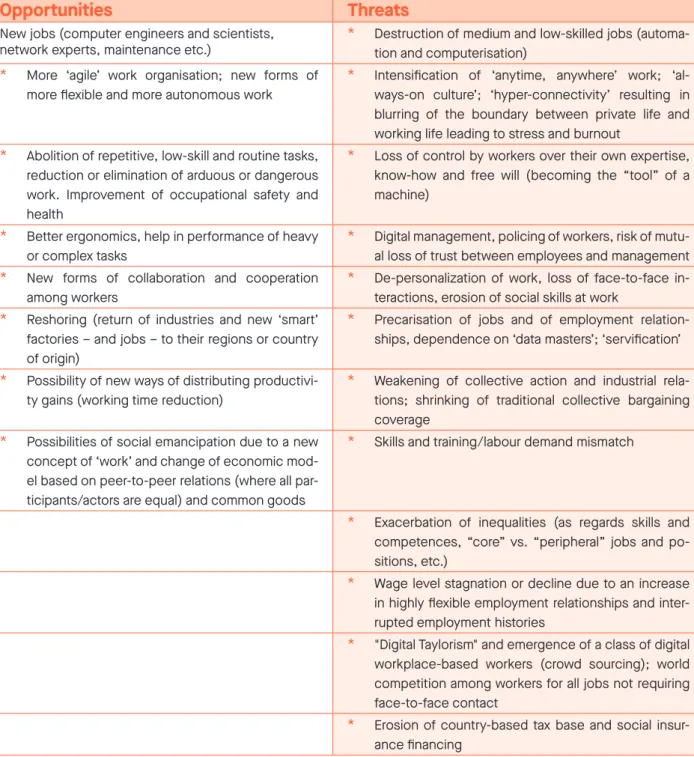
Table 1: Overview of the main opportunities and threats related to digitalisation
Source: Adaptation from Degryse, 2016: Digitalisation of the economy and its impact on labour markets.
From the perspective of labour and work, digitalisa-tion presents opportunities, but also risks and threats. This is highlighted in the following table that summa-rizes its main potential impacts.
INTRODUCTION
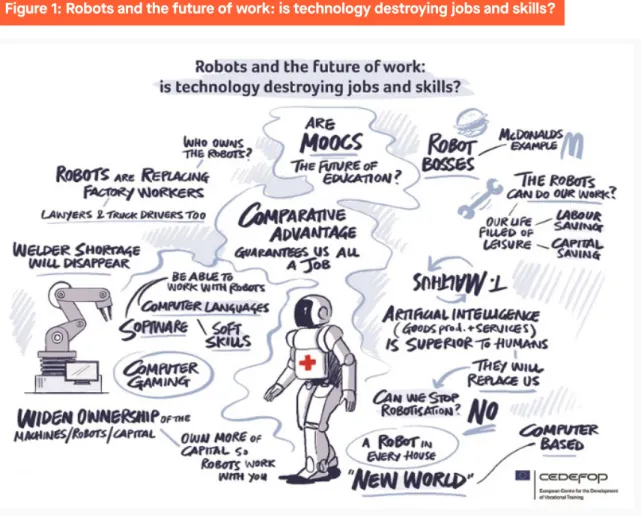
Source: CEDEFOP: Digitalisation and the future of work, available at: http://www.cedefop.europa.eu/ de/events-and-projects/projects/digitalisation-and-future-work
Figure 1: Robots and the future of work: is technology destroying jobs and skills? The potential threats posed by the many facets of
digitalisation are exemplified in the following vignette about the potential implications of automation, robo-tisation and AI for the workplace. These risks raise a number of important questions, such as how to deal with job destruction and the replacement of workers
by robots, how to ensure that skills and competence development keeps pace with digitalisation, and how to manage adult learning so that all can benefit from new learning opportunities in order to ensure employ-ability in a digitalised world.
Digitalisation and the ongoing developments of new technologies will continue to have a major impact on workers’ everyday life. Digitalisation has enabled the rise of a range of new forms of work, such as platform work, digitally mediated service work or the 'gig-economy7 that often mixes or contains
el-ements of traditional forms of precarious work such as dependent self-employment, work on demand or crowd working8 . Those involved in these
increasing-ly widespread forms of work operate under a higher
risk of job insecurity as they are less protected in terms of labour rights and social security coverage than workers in more traditional forms of employ-ment9. Digitalisation is likely to add new types of
precarious work, especially in the grey area between salaried employment and self-employment and will increase the number of people in flexible, mobile and temporary employment10.
INTRODUCTION
scheduling and place of work offer alternatives for our changing culture and the demands of our chang-ing workforce.14"
Cases of new technology improving working prac-tices in public services include the use of phone applications to track and direct social or homecare workers to their appointments. The use of this tech-nology can be a benefit to workers, for example by allowing them to optimise their routes and spend more time caring for patients. Mobile devices and tracking software can also improve the security of police officers and social workers when working in dangerous conditions by reducing the time needed for rescue and recovery operations in emergency or assault situations.
However, the same technologies can also be used to monitor the performance of employees, increase their pace of work and limit pay only to time spent with service users, excluding travel time. Therefore, it is important that the power to control and decide how to use a new technology is not left uniquely in the hands of employers, but that their application is regulated and monitored in the public interest. There is a need to define clear rules that respect workers' rights and involve workers and their representatives in defining the terms of use of new technologies, in-cluding through collective bargaining.
Given this complexity, the net, exact impact of dig-italisation and digitalised public services on em-ployment, working conditions and workers' rights is far from clear. It very much depends on existing or emerging regulatory framework conditions at an in-ternational, national and workplace level, including whether employees and their trade unions have a say or are denied participation in modelling digitalisation projects and introducing new technologies into pub-lic services.
It is therefore hardly surprising that digitalisation is a polarising issue for trade unions and workers’ repre-sentatives. The previously mentioned 2018 survey of European trade unions found that about half of all respondents from all economic sectors and from more than 30 European countries thought that the opportunities resulting from digitalisation would out-weigh the risks for their respective country, sector or Workers in the gig economy are also vulnerable in
terms of unpredictable working hours, variable in-come levels, lack of training opportunities, poor or no access to employment rights and social protec-tion, and inadequate pension coverage11.
Therefore, it is important to view digitalisation not only as a purely technological issue, but also as a social and political process with wide-ranging, long-term implications, as it relates to the role of work and human labour in our future economies and societies. It is necessary to analyse the social impact of digi-talisation on production and service sectors as well as on employment and labour, social conditions and cohesion, workers' rights and the power relationship between capital and labour.
A 2018 survey and cross-sectoral consultation with European national trade union and company level employee representatives12 highlighted that, from the
perspective of trade unions and workers, digitalisation is linked to two fundamental challenges: first, antici-pating, managing and shaping the effects of new dis-ruptive technologies and digitalisation on established industries, services and 'traditional forms' of work. Second, actively shaping the digital transformation of workplaces and of the labour market in a manner that limits risks and threats, fosters fair solutions for all workers and builds on the potential positive impacts and opportunities digitalisation can bring.
Digitalization and public
services
Digitalisation and new technologies are having a huge impact on employment and working conditions in public services. On the positive side, digital tech-nologies could improve health and safety by reduc-ing the strain and repetitiveness of work while also improving democratic accountability and strengthen-ing quality public services13. In a 2002 report the
U.S. public services trade union, AFT, stated that "technology opens new avenues for job innovation, workplace design and professional development. Planned or negotiated telework plans can offer em-ployees alternatives to work from home or a tele-work centre closer to home. New concepts for the
INTRODUCTION
While similar global surveys have not yet been carried out to our knowledge, based on the interviews car-ried out with representatives of PSI-affiliated trade unions in non-European world regions within the framework of this study, overall scepticism can be confirmed. Indeed, very few respondents referred to the opportunities linked to digitalisation and digital public services, whereas a majority stressed existing risks and potential further negative effects on work-ing conditions and employment.
Figure 2: Do you think that digitalisation will provide more opportunities than risks for your country, company or job? (% of responses, n=771 (all sector), n=70 (public services)
Source: Voss, E. 2018: “Digitalisation and Workers Participation – What Trade Unions, Company level Workers
company. However, a strong minority of over a third of respondents believed that digitalisation would bring more risks than opportunities, while the rest simply did not know.
When comparing responses from public service trade unions with the overall results, it seems that workers representatives and trade unions in public
services appeared more sceptical regarding the pos-itive impact of digitalisation on their respective coun-try, workplace or job. Around 50% of all respondents from public service unions (compared to 37% on average across all sectors) disagreed or strongly dis-agreed that digitalisation would provide more oppor-tunities than risks in their respective country, work-place or job.
Purpose of this report
Given the general research gap surrounding the im-pact of new technologies and digitalisation on public services, the main purpose of this report is to pro-vide a broad global overview of the introduction of digital technologies in the sector and to look at the ways in which they are impacting employment, work-ing conditions and labour rights as well as service delivery, quality and accessibility.
INTRODUCTION
In line with its 2017 Congress Programme of Action, the Public Services International (PSI) global union15
decided to prioritise work on digitalisation and com-missioned the present report, with the support of the Friedrich Ebert Stiftung (FES)16. By addressing the
topic of digitalisation through a global lens, the re-port aims to reduce this research gap and serve as a basis for global debate and consultation amongst public service trade unions worldwide.
Methodology and scope of
the study
PSI required researchers to address five main top-ics related to digitalisation, employment and working conditions in public services:
z The forms digital technologies are taking in dif-ferent public service branches and services and how they are being introduced;
z Their impact on the quality, effectiveness and accessibility of public services for users and communities;
z How digital technologies are changing employ-ment and working conditions (including occupa-tional health and safety, employment levels, job tenure, equality, etc.) in public services;
z The impact of digital technologies on public service workers’ rights and trade unions, name-ly through collective bargaining and alternative forms of participation;
z The regulatory tools and governance systems that exist (or should be established) to oversee the introduction and impact of digital technolo-gies on public services and protect workers and users.
In addition to the analysis of these questions and their contextualization, the focus of this report is largely empirical: the authors tried to draw on con-crete practice experiences and the lessons learned from both the desk research and the interviews and materials gathered from respondent PSI affiliate
representatives. Specific attention was paid to trade union demands, recommendations and practices that aim to ensure that new technologies in public services live up to their promise to enhance service quality, effectiveness and accessibility for users, while also improving working conditions and creating decent employment opportunities.
The study is based on two complementary meth-odological approaches. First, an extensive literature review and associated desk research looking at dig-italisation and public services from several angles: the introduction of digital technologies into pub-lic services; the impact of digitalisation on service quality, effectiveness and accessibility; the impact of digital technologies on working conditions and la-bour rights; and digitalisation as addressed by trade unions and collective bargaining.
Secondly, the study included interviews with a sam-ple of 20 PSI-affiliated trade union organisations from 5 continents: Europe, Asia-Pacific, Latin America, North America and Africa. Contacts were facilitated by PSI, and interviews were carried out between autumn 2018 and the beginning of 2019 based on a semi-structured questionnaire (see annex 2). Interviews were conducted in English, French, Spanish, German, Portuguese and Swedish. The complete list of organisations that participated in the study is available in the annex.
While PSI affiliates from the European region were the most responsive with 11 participating public service unions, the scope of the report remains global as 10 interviews were conducted with trade union representatives from other regions: 2 from North America, 2 from Latin America, 3 from Asia-Pacific and 1 from Africa.
As regards the study’s sectoral scope, the research covers all the main branches represented by PSI: central government administration; local and region-al (municipregion-al) government; utilities (electricity, water and waste services); health and social services; ed-ucation and culture; firefighting, police and emergen-cy services.
INTRODUCTION
Structure of this report
This report is composed of 5 chapters. Chapter 1 provides an overview of the context, drivers and frameworks of digitalisation in public services. New technologies and digitalisation in public services are discussed from a sectoral perspective (central government, local and regional government, public utilities, health and social services, education and cultural services, security, border and emergency services). The impact of digitalisation on the quality, effectiveness and accessibility of public services, in-cluding privacy and security issues, service efficien-cy and quality as well as public finances is the focus of chapter 2. Chapter 3 gathers evidence from desk research and from interviews on digitalisation’s impact on employment, working conditions and workers' rights in public services. Chapter 4 describes trade union practices and approaches to digitalisation, in-cluding efforts and strategies to influence and shape the digital transformation process in public services. It presents the way in which trade unions around the
globe are involved
in pub- lic policy and
r e f o r m , social dialogue and collective bargaining practices pertaining to digitalisation, as well as the direct in-volvement and participation of unions and workers representatives in the introduction of new technolo-gies and in the development of major criteria for good digital public services. The report closes with chap-ter 5 drawing some conclusions and issuing recom-mendations on how digitalisation can be turned into a driver for better public services and jobs for all, while identifying strategic areas for future research that fit such a vision.
q
DIGITALIZATION
AND PUBLIC SERVICES:
A SECTOR-SPECIFIC OVERVIEW
1.
DIGITALIZATION AND PUBLIC SERVICES:
A SECTOR-SPECIFIC OVEROVERVIEW
1.1 Context and drivers
D
igitalisation is part of a broader modernisation trend in public services. Technological inno-vation has led to the introduction of digital technologies, tools and processes such as machine learning, artificial intelligence or blockchain technol-ogy across all public services with the aim of increas-ing resources and cost efficiency and makincreas-ing servic-es and interactions between service providers and users more efficient.Such changes have been strongly supported by national governments on all continents through e-government, e-citizenship or e-health initiatives. Additionally, Internet giants located mainly in the Silicon Valley17 and China have triggered a new cycle
of innovation primarily based on artificial intelligence. This cycle is currently ongoing and might shape the future of public services even more substantially. These changes are linked to relatively new ways of organising and providing public services, often asso-ciated with the buzzword ‘smart’: ‘smart administra-tion’, ‘smart cities’, ‘smart metering’, and even ‘smart legislation’. Large tech companies such as Google,
Apple, Microsoft and many others know that digitali-sation is a lucrative business across all public service sectors, and thus have channelled large private in-vestments into new technology development. They have entered public services as new players and important drivers of disruptive technologies such as machine learning, artificial intelligence or blockchain technology.
In contrast to previous waves of technological change in public services, digitalisation also includes new forms of services that did not exist in the past. These new services are often related to the gather-ing and analysis of private data from citizen/users, new channels of communication and interaction with citizen/users (digital platforms) or brokerage of ser-vices (e.g. in health and care, transport). They are very much driven by large multinational companies active in IT and telecommunication, medical servic-es, transport, facilitiservic-es, software and digital applica-tion development. For these companies, digital tech-nologies such as cloud computing, big data analytics or machine learning and AI form the basis of new business models applicable to industry and public services alike. The involvement of private compa-nies in public service provision and development goes beyond data control and commercialization. It