Vol.58, n.3: pp. 462-467, May-June 2015 http://dx.doi.org/10.1590/S1516-8913201500391
ISSN 1516-8913 Printed in Brazil
BRAZILIAN ARCHIVES OF BIOLOGY AND TECHNOLOGY
A N I N T E R N A T I O N A L J O U R N A L
Effect of Nitrogen Limitation on Cell Growth, Lipid
Accumulation and Gene Expression in
Chlorella sorokiniana
Ying Xia Li
1*, Feng Juan Zhao
2and Dong Dong Yu
3 1Marine Science and Engineering College; Qingdao Agricultural University; Qingdao - P.R.China. 2Department of Biological Sciences; BinZhou University; Bingzhou - P.R. China. 3Huangdao Entry-Exit Inspection and Quarantian Bureau; Qingdao - P.R. China
ABSTRACT
The influence of nitrogen (N) limitation on the cell growth, chlorophyll content, intracellular lipid production and expression levels of two pathway genes in Chlorella sorokiniana was investigated in mixotrophic culture in this study. The maximum biomass concentration of C. sorokiniana cultured in modified BG11 medium containing 3, 6, 9, 12 and 15 mM N were 1.60, 2.21, 2.74, 3.18 and 3.21 g/L of dry cell weight, respectively with maximum specific growth rate of 0.180, 0.198, 0.201, 0.203, 0.206 day−1 during culture with an initial N feed of 3, 6, 9, 12 and 15 mM in the first eight days, respectively. The maximum lipid content was 51 % with 3 mM N. However, the maximum lipid productivity of 0.00884 g L−1 day−1 was achieved with 6 mM N. Expression levels of accD (heteromeric acetyl-CoA carboxylase beta subunit) and accI (homomeric acetyl-CoA carboxylase) genes in C. sorokiniana were studied by real-time PCR. Increased expression levels of accD reflected the increased lipid content in stationary phase. In contrast, expression of the acc1 gene always remained low, showing that the gene might not be critical for lipid accumulation.
Key words: nitrogen limitation, Chlorella sorokiniana, lipid, Real- time PCR
*Author for correspondence: liyx108@ 163.com
INTRODUCTION
With the shortage of fossil fuels and their production of green house gas carbon dioxide upon combustion, it is a pressing mission for humans to find an alternative fuel. Microalgal biodiesel is now receiving considerable attention (Chisti 2007). Microalgal biodiesel is a second-generation biofuel, and microalgal lipids may be a more sustainable biodiesel feedstock than crop oils because of their widespread availability and higher lipid yields (Cheng et al. 2009). To achieve high biomass and lipid production, microalgae are cultured in heterotrophic conditions where some organic carbons such as sugars and organic acids
are added to serve as carbon sources (Xu et al.
2006; Liang et al. 2009). However, the alga culturing in strict heterotrophy is more expensive than in photoautotrophy. Mixotrophic cultivation is not only complement photoautotrophy with organ carbon, but also can reduce the cost of heterotrophic microalgal culture and improve the lipid content (Wan et al. 2011). Hence, the microalga cultured under mixotrophic condition can exhibit higher biomass and lipid content. Microalgae have been frequently cultured in nitrogen deficient media that allows obtaining
higher lipid productivity (Liu et al. 2012).
Limiting nitrogen in the culture medium can
induce Chlorella vulgaris to accumulate more
Acetyl coenzyme A (Acetyl-CoA) is a key
substance of lipid synthesis. Acetyl-CoA
carboxylase (ACCase) show crucial role in fatty acid biosynthesis, which can catalyze acetyl-CoA to be converted to malonyl-CoA and to enter the pathway of lipid biosynthesis (Cronan and Waldrop 2002). Many plants contain two forms of ACCase: heteromeric/ bacterial and homomeric/ eukaryotic ACCase. Heteromeric ACCase is the key enzyme for fatty acid synthesis in the chloroplast including four subunits, but only the beta subunit (accD) is synthesized in the chloroplast. The expression of accD gene in the chloroplast genome is very important to the levels of heteromeric ACCase (Nakkaew et al. 2008). Homomeric/ eukaryotic ACCase, encoded by acc1 gene is composed of a single polypeptide and important for the synthesis of long-chain fatty acids, flavonoids, and anthocyanins in the cytosol (Sasaki and Nagano 2004).
The genus Chlorella is the oldest commercial
application of microalgae and can be grown in
photo/mixo/heterotrophic mode of culture. C.
sorokiniana is a promising freshwater non-motile unicellular alga, accumulating high amounts of
lipids and proteins (Wan et al. 2011). C.
sorokiniana is one of potential microalgal species used for the lipid production. In this study, the effect of nitrogen limitation on the growth, lipid content and expression levels of three pathway
genes in C. sorokiniana was investigated. Firstly,
the effect of nitrogen concentration on the cell growth, chlorophyll content and lipid productivity was examined. Secondly, accD and accI gene expression level in this alga under nitrogen-limited culture conditions was assessed using real- time PCR in mixotrophic culture.
MATERIAL AND METHODS
Strain and Culturing Conditions
The strain C. sorokiniana was purchased from the
Freshwater Algae Culture Collection of the Institute of Hydrobiology in Wuhan, China. The culture medium was modified BG-11 in which the
concentration of NaNO3 was adjusted to 3, 6, 9,
12, 15 Mmol L−1, and 25 g.L-1 glucose was added.
The components of basal culture medium were as
follows (mg/L): 40 K2HPO4, 700 MgSO4.7H2O,
36 CaCl2.H2O, 6 citric acid, 6 Ferric ammonium
citrate, 0.1 EDTANa2, 20 Na2CO3, 1 trace
containing (g/L): 2.86 H3BO3, 1.86 MnCl2·H2O,
0.22 ZnSO4.7H2O, 0.08 CuSO4.5H2O, 0.39
Na2MoO4·2H2O and 0.05 Co(NO3)2·6H2O. The
initial pH of the medium was adjusted to 7.0. The
cultures were incubated at 28oC with shaking at
120 rpm under 20 μmol photons.m-2.s-1
illuminations through cool-white fluorescent lamps with a photoperiod of 12 h light/dark. This experiment was conducted in three replicate. For nitrogen limitation, the cells were washed three times with sterilized distilled water and suspended in a nitrogen-limitation medium.
Determination of growth rate and Lipid Content
The specific growth rates (μ) was calculated using
the following equation: μ=(InNt-InN0)/t where N0
was the initial dry weight and Nt was the dry
weight at time t.
For lipid analysis, cells were harvested using centrifugation at 10 000 g for 10 min and the
pellets were dried at 60 oC for overnight. The dried
microalgae samples (0.2 g) were extracted with 50
mL of chloroform–methanol (2:1, v/v) over 24 h
and sonicated at room temperature with a sonicator for 30 min (60 W, 6 s interval). Then, the suspension was filtered and the filtrate was washed two times with a KCl solution. The lower liquid was transferred into a pre-weighed glass
vial. The chloroform–methanol solution was
evaporated to dryness at 40 oC under vacuum. The
lipid content was measured and calculated using
the following equation: Y(%)= WL/WDA, where
WL and WDA were the weights of the extracted
lipid and the dry algae biomass, respectively.
Determination of N Concentration and
Chlorophyll Content
The N concentrations were detected by a UV spectrophotometer at 220 and 275 nm. Two
milliliters microalgal cell suspension was
centrifuged at 10,000 g for 5 min and the cell sediments were resuspended in 5.0 mL 95% (v/v) ethanol in dark for 12 h. Afterwards the cell suspension was centrifuged at 10,000 g for 10 min. The absorbance (A) of the supernatant was measured at 665 and 649 nm using a
spectrophotometer. The concentrations of
chlorophyll were calculated by the following equations:
Statistical Analysis
All the experiments were conducted in triplicate treatments unless otherwise stated. Data analyses were done by using the SPSS 10. One-way Analysis of Variance (ANOVA) was used and Least Significant Differences were calculated at P= 0.05 (LSD0.05).
Total RNA extraction and cDNA synthesis
According to the growth curves of C. sorokiniana
under various N concentrations, samples were collected in logarithmic phase (fifth day) and stationary phase (tenth day). Total RNA was
isolated and purified from C. sorokiniana cultured
in medium supplemented with 25 g.L−1 of
sterilized glucose with RNAprep Pure Plant Kit
(Tiangen, China) according to the manufacturer's
instructions. Total RNAwas quantified at OD260
and OD280, and the integrity of total RNA was
checked by 1.5% agarose gel electrophoresis and ethidium bromide staining. To confirm the removal of genomic DNA from total RNA, amplification of the control gene (18S rRNA) was performed using RNA as PCR templates. Total RNA served as the template to synthesize cDNA
with RevertAid™ H Minus First Strand cDNA
Synthesis Kit (Fermentas, China) with random primers.
Real-time PCR assay
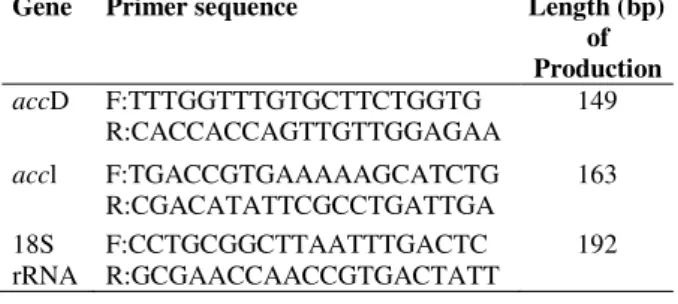
All primer pairs of selected genes are listed in
Table 1. The 18S rRNA gene of C. sorokiniana
was used as the internal standard. Real-time PCR was performed in an iCycler iQ real-time PCR detection system (Bio-Rad Laboratories, Inc., Hercules, USA) using SYBR® Green real-time PCR Master Mix (Toyobo Co., Ltd., Osaka,
Japan) according to the manufacturer’s
instructions: one cycle of 95 oC for 30 s and then
40 cycles of 95 oC for 15 s each, followed by 55 oC
for 15 s, and 72 oC for 30 s. The 25 μL reaction solution of real-time PCR was composed of 2.5
μL of cDNA, 0.4 μm final concentration of each
primer and 12.5 μL 2× real-time PCR Master Mix.
Three biological and three technical replicate were analyzed: Three parallel samples were used for RNA isolation and three parallel real-time PCR analyses were performed for each RNA sample. In order to normalize the amount of transcripts in each sample, the relative abundance of 18S rRNA was also determined as the internal standard. At the completion of each run, melting curves for the
amplicons were measured by raising the
temperature stepwise by 0.5oC from 55oC to 95oC
while monitoring fluorescence. The specificity of the PCR amplification was checked by examining
the melting curve for melting temperature TM, its
symmetry and the lack of non-specific peaks. The
gene expression data was analyzed using the 2-ΔΔCt
method. Different concentrations of purified 18S rRNA gene fragments were used to generate the standard curve of real-time PCR.
Table 1 - Primer for real-time PCR detection of expression of genes related to lipid accumulation in
Chlorella sorokiniana.
Gene Primer sequence Length (bp)
of Production
accD F:TTTGGTTTGTGCTTCTGGTG
R:CACCACCAGTTGTTGGAGAA
149
accl F:TGACCGTGAAAAAGCATCTG
R:CGACATATTCGCCTGATTGA
163
18S rRNA
F:CCTGCGGCTTAATTTGACTC R:GCGAACCAACCGTGACTATT
192
RESULTS
The Effect of N limiatation on the Growth of C.
sorokiniana
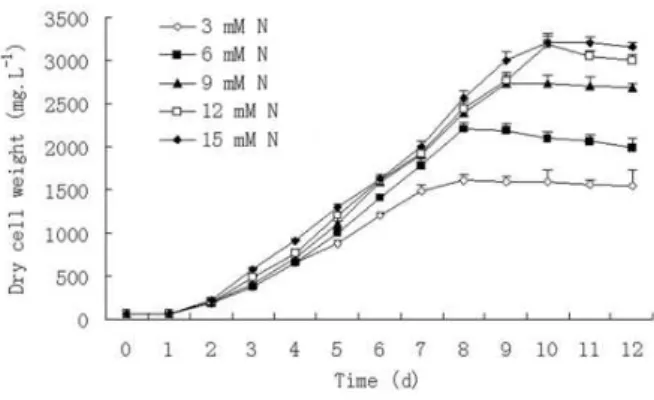
The growth profiles of C. sorokiniana with
different N concentrations in the modified BG-11
medium are shown in Figure 1. The growth of C.
sorokiniana was significantly and positively correlated with nitrogen concentration in the medium. Evidently, all growth curves showed a similar progression: one day of lag phase and seven to eight days of logarithmic phase, followed
by a stationary phase. It took eight days for C.
sorokiniana to reach stationary phase under initial N feed 3 and 6 mM and nine days with an initial N feed of 9 mM. It took ten days to reach stationary phase under an initial N feed of 12 and 15 mM. After ten days of culture, a higher initial N concentration in the medium produced an increased biomass concentration and the highest
biomass concentration was 3.210 g L−1 with initial
N feed of 15 mM, which also produced a specific
growth rate of 0.321 day-1. The lowest growth rate
Figure 1 - Typical time-course profiles of cultivated in the modified BG-11medium containing different N concentrations in Chlorella sorokiniana.
The Effect of N limiatation on the Lipid Content
The lipid content reached to 51% of the biomass after ten days of cultivation with initial N feed of 3 mM in the modified BG-11 medium (Fig. 2). Also, the lipid content with 3 mM N was more than two times higher than that with 15 mM N, suggesting that excess nitrogen in the medium led to the decrease of the lipid content in the cell.
Notwithstanding, lipid productivity was highest with 6 mM N. The highest total lipid content (0.51 g/g) and lipid yield (0.884 g/L) were achieved when cultured with initial N feed of 3 and 6 mM, respectively. Therefore, even though the cells had high lipid content, the biomass concentration was low when nitrogen was limited (initial N concentration below 3 mM). The initial N feed of 6 mM was identified as the critical concentration to achieve high growth rate and high lipid productivity (Table 2).
Figure 2 - Lipid productivity in the media of different N concentrations.
Table 2 - Summary of cell growth, specific growth rate, lipid production and nitrogen consumption results obtained with media with different N concentrations in Chlorella sorokiniana.
N concentration (mM)
3 6 9 12 15
Initial NaNO3 (mM) 2.88 5.91 9.21 12.43 15.74
Residual NaNO3 (mM) 0 0 0.5 1.7 3.8
Maximum biomass concentration (g/L) 1.602 2.210 2.740 3.180 3.210 Biomass productivity (g DCW l-1.d-1) 0.200 0.27 0.298 0.318 0.321 Biomass yield (g DCW/g N) 39.732 26.710 22.470 21.169 20.958 Lipid productivity (g L-1.d-1) 0.0817 0.0884 0.074 0.058 0.056
The Effect of N limiatation on the N Consumption and Chlorophyll Content
Figure 3A shows the time-course profiles of N consumption in the cultures with different initial concentrations. The media with 3 and 6 mM initial N were depleted after four and six days,
respectively. Not surprisingly, however,
substantial residual N was detected at the end of culture in media containing 9, 15 and 20 mM N initially. The volumetric contents of chlorophyll in both reached highest on the tenth day (Fig. 3B), while they reached the highest level on the tenth day with initial N feed of 15 mM, which suggested that abundant N promoted the chlorophyll accumulation in the cells. The
maximum chlorophyll content was 3.97 mg L-1.
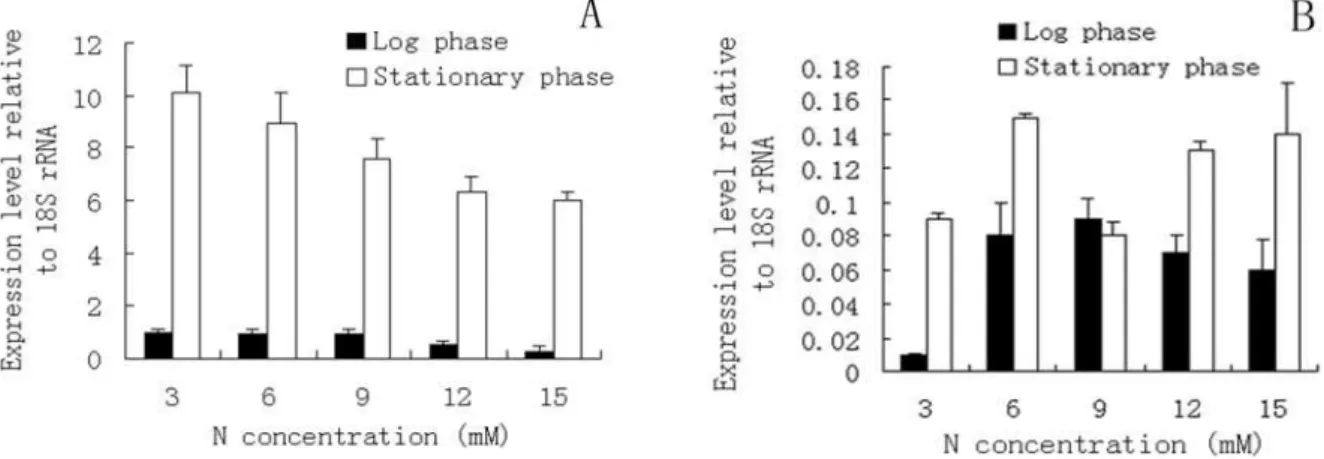
The Effect of N limiatation on the expression of accD and accI
The expression levels of two different genes
(accD and accI) in C. sorokiniana were studied
Figure 3 - Nitrogen consumption (A) and Chlorophyll content (B) in the media of different N concentrations.
Figure 4 - Quantification of the expression of pathway genes, accD(A) and acc1(B) related with lipid synthesis in Chlorella sorokiniana with different N concentrations, where the results were normalized against the control gene (18SrRNA gene), to correct sample-to-sample variation.
DISCUSSION
The biochemical composition of microalgae can be affected by changing the physical and chemical parameters of the culture medium including nitrogen limitation (Huang et al. 2013). Nitrogen limitation is a severe stress condition for all the organisms, as nitrogen is a major constituent of proteins and nucleic acids. In this study, limiting N led to accumulation of lipid. Nitrogen limitation in Isochrysis galbana culture can increase the intracellular content of fatty acid and active diacylglycerol acyltransferase, which converts
fatty acid to triglyceride (Sukenik and Wahnon
1991). This might be the main reason for shifting
from growth to high lipid content in Chlorella
cultures on the stationary phase. Therefore, a low N concentration increased the total lipid content.
The results also showed that different N concentrations influenced cell growth and lipid productivity. An initial N feed of 6 mM was identified as the critical concentration to achieve a high growth rate and high lipid productivity. Therefore, higher lipid productivity could also be achieved by two-step-culture method. The microalage were cultured in a mediun with sufficient N to achieve a higher biomass, then was transferred to a N-limited medium to attain higher lipid.
Therefore, the chlorophyll content of algal content cultured in media with lower N concentration was low.
The expression of accD in the chloroplast was very important to the levels of heteromeric
ACCase (Nakkaew et al. 2008) and was
upregulated from the logarithmic to stationary
phase along with the increase of lipid content in C.
sorokiniana with N limitation. The result also showed that heteromeric ACCase was one of the key enzymes required for lipid biosynthesis. The expression levels of accD was low in logarithmic phase in all the culture. Two reasons might be responsible for it. Firstly, in the lipid biosynthetic pathway, acetyl-CoA was first converted to malonyl-CoA in a step catalyzed by acetyl-CoA carboxylase (ACCase). In the logarithmic phase acetyl-CoA might be used to synthesize other biomolecule (Huang et al. 2013). Secondly, lipid content was low in the logarithmic phase and the expression of accD was related with the content of lipid. Thus, the expression level of accD also appeared to be a good indicator of lipid content in the stationary phase of mixotrophic growth. However, the expression of accI was very low at all the levels, which suggested that accI might not be a key gene for lipid biosynthesis.
ACKNOWLEDGEMENTS
This work was financially supported bythe
research start-up costs of high- level personnel of the Qingdao Agricultural University (No.1114349)
andthe Natural Science Foundation of Shandong
Province (No. ZR2011DL012).
REFERENCES
Chen F, Johns MR. Effect of C/N ratio and aeration on the fatty acid composition of heterotrophic Chlorella sorokiniana. J Appl Phycol. 1991; 3: 203-209. Cheng Y, Zhou WG, Gao CF, Lan K, Gao Y, Wu QY.
Biodiesel production from Jerusalem artichoke
(Helianthus tuberosus L.) tuber by heterotrophic microalgae Chlorella protothecoides. J Chem Technol Biotechnol. 2009; 84: 777-781.
Chisti Y. Biodiesel from microalgae. Biotechnol Adv. 2007; 25: 294-306.
Cronan JE, Waldrop GL. Multi-subunit acetyl-CoA carboxylases. Prog Lipid Res. 2002; 41: 407-435. Huang XX, Huang ZZ, Wen W, Yan JQ. Effects of
nitrogen supplementation of the culture medium on the growth, total lipid content and fatty acid profiles of three microalgae (Tetraselmis subcordiformis,
Nannochloropsis oculata and Pavlova viridis). J Appl Phyco. 2013; 25: 129-137.
Li YQ, Horsman M, Wang B, Wu N, Lan CQ. Effects of nitrogen sources on cell growth and lipid accumulation of green alga Neochloris oleoabundans.
Appl Microbiol Biotechnol. 2008; 81: 629-636. Liang Y, Sarkany N, Cui Y. Biomass and lipid
productivities of Chlorella vulgaris under autotrophic, heterotrophic and mixotrophic growth conditions. Biotechnol Lett.2009; 31: 1043-1049. Liu J, Yuan C, Hu GR, Li F. Effects of light intensity
on the growth and lipid accumulation of microalga
Scenedesmus sp. 11-1 under nitrogen limitation. Appl Biochem Biotechnol. 2012; 166: 2127-2137.
Nakkaew A, Chotigeat W, Eksomtramage T, Phongdara A. Cloning and expression of a plastid-encoded subunit, beta- carboxyltransferase gene (accD) and a nuclear-encoded subunit, biotin carboxylase of acetyl-CoA carboxylase from oil palm, (Elaeis guineensis Jacq). Plant Sci. 2008; 175: 497-504. Sasaki Y, Nagano Y. Plant acetyl-CoA carboxylase:
structure, biosynthesis, regulation, and gene manipulation for plant breeding. Biosci Biotechnol Biochem. 2004; 68: 1175-1184.
Sukenik A, Wahnon R. Biochemical quality of marine unicellular algae with special emphasis on lipid composition.I. Isochrysis galbana. Aquaculture. 1991; 97: 61-72.
Wan M, Liu P, Xia J, Rosenberg JN, Oyler GA, Betenbaugh MJ, et al. The effect of mixotrophy on microalgal growth, lipid content and expression levels of three pathway genes in Chlorella sorokiniana. Appl Microbiol Biotechnol. 2011; 91: 835-844.
Xu H, Miao XL, Wu QY. High quality biodiesel production from a microalga Chlorella protothecoides by heterotrophic growth in fermenters.
J Biotechnol. 2006; 126: 499-507.