Engineering ISSN: 1809-4430 (on-line)
_________________________
1 Engo A grônomo, Doutorando, Departamento de Engenharia Rural, Faculdade de Ciências Agronômicas/Universidade Estadual
Paulista (FCA/UNESP), Botucatu – SP, Fone: (14) 38807624, [email protected]
2
Engo A grônomo, Professor Titular, Departamento de Engenharia Rural, FCA/UNESP, Botucatu – SP, [email protected] –
TECHNICAL PAPER
KNOWLEDGE ON ADJUVANT PROPERTIES, DISPOSAL OF PESTICIDERESIDUES AND SPRAY DRIFT OCCURRENCE IN THE STATE OF MATO GROSSO
Doi:http://dx.doi.org/10.1590/ 1809-4430-Eng.Agric.v36n2p 352-360/ 2016
FERNANDO K. CARVALHO1, ULISSES R. ANTUNIASSI2, ALISSON A. B. MOTA3,
RODOLFO G. CHECHETTO4, LÍDIA R. DE CARVALHO5.
ABSTRACT: This paper aimed at investigating the knowledge level of people working on pesticide spraying activities concerning spray adjuvant properties, as well as collecting information on disposal locations for residues from internal spray tank cleaning, and finally the understanding of pesticide spray drift occurrence in the state of Mato Grosso, Brazil. The information was gathered through a questionnaire answered by participants of a rural extension program in application technology located in nineteen grain and fiber producing regions of Mato Grosso state. Among the mentioned adjuvants, 49.0% belonged to the mineral oil class and 17.9% of participants did not know the functions performed by such products. In addition, 58.5% of the participants discarded residues into the field. Among the participants who answered the question about spray drift occurrence causes, 54.1% indicated problems relating to inadequate weather conditions. In conclusion, there is a lack of knowledge on adjuvant functions, besides of inappropriate residue disposal in the state of Mato Grosso. Spray drift was referred as a problem; however, most of participants were not able to discuss the causes of these losses.
KEYWORDS: pesticides, spraying, environmental safety, application technology.
CONHECIMENTO SOBRE ADJUVANTES, DESCARTE DE RESÍDUOS E OCORRÊNCIA DE DERIVA NO ESTADO DO MATO GROSSO
RESUMO: O objetivo deste trabalho foi investigar o nível de conhecimento de trabalhadores ligados à atividade de aplicação de defensivos agrícolas sobre as funções de adjuvantes de calda e coletar informações sobre os locais de descarte dos resíduos provenientes da lavagem interna do reservatório de calda de pulverizadores, ocorrência e motivos da deriva, nas aplicações de defensivos agrícolas, no Estado do Mato Grosso. As informações foram coletadas por meio das respostas de um questionário entregue aos participantes de um programa de extensão rural, em tecnologia de aplicação, em dezenove municípios produtores de grãos e fibras do Estado. Ao todo, 49,0% dos adjuvantes citados pertenciam à classe dos óleos minerais e 17,9% dos participantes declararam não saber as funções desempenhadas pelos adjuvantes. Os resíduos eram descartados nas lavouras por 58,5% dos participantes. Dentre os participantes que responderam sobre as causas da ocorrência de deriva nas aplicações, 54,1% indicaram problemas relativos às condições climáticas inadequadas. Conclui- se que há carência de conhecimento sobre as funções desempenhas pelos adjuvantes, bem como a ocorrência de descarte de resíduos em locais inadequados no Estado do Mato Grosso. A deriva foi reconhecida como um problema, mas a maioria dos participantes não se propôs a discutir as causas deste tipo de perda.
INTRODUCTION
If improperly used, pesticides can cause environmental impacts. Despite the new technologies in pesticide application, there are still cases of environmental contamination, such as inappropriate residues disposal or spray drift occurrence during applications (RAMWELL et al., 2004; HILTZ & VERMEER, 2013).
In this way, pesticide residues are any substance or material that cannot or will not be used in applications and need to be discarded, as spray solution surplus and wastewater from spray tank cleaning (RAMWELL et al., 2004; DAMALAS et al., 2008; HILTZ & VERMEER, 2013).
Pesticides residues should not be disposed into specific ground points as cesspools and water bodies. Such residues must be sprayed on the crops or in directed to a wastewater treatment system (BRASIL, 2011). If the pesticides residue disposal, such as those resulting from the internal cleaning of spray tanks is done in inappropriate places, as mentioned above, it is considered a contamination source, which can be characterized as environmental crime (BRASIL, 2011).
The drift can be characterized as part of the application that does not reach the target, and can be mitigated in several ways. There are many alternatives to reduce drift like the correct choice of spray nozzles, applications under suitable climatic conditions and the use of spray adjuvants (ANTUNIASSI et al., 2011; HILZ & VERMEER, 2013; MOTA et al., 2013; GANDOLFO et al., 2014).
Currently, information about the quality and safety of pesticide applications are important in order to help future rural extension programs, but they are scarce in the literature.
Therefore, this study aimed to investigate the knowledge of people working on pesticide spraying activities on the properties of adjuvants, gather information on disposal locations of pesticide residues from spray tank cleaning, as well as understanding the occurrence of drift during pesticides applications in the state of Mato Grosso, Brazil.
THE SUBJECT’S DESCRIPTION
The data collection was performed by filling in the questionnaires given to participants of a rural extension program in application technology located in different cities in the state of Mato Grosso, Brazil. The cities are located in major grain and fiber producing regions, such as soybeans, corn and cotton. These crops play a vital role in the economy of the state.
The audience was composed of people working on pesticide spraying activities, especially agronomists, farmers, applicators and technicians.
The questionnaire was applied in nineteen cities participating in this project, which are located at the four cardinal points of the state of Mato Grosso. These locations lie within the Midwestern Brazil, where large flat farming areas that use self-propelled sprayers are common. Survey information were collected from August 23 to September 21, 2010.
The questionnaire was composed of the questions presented in the Table 1. The first two issues were about the uses, results and functions performed by the adjuvants. The third group of issues deals with aspects related to the internal cleaning of sprays tanks and the waste disposal area that came from of these cleanings. Finally, the fourth group of questions was about the occurrence and reasons for spray drift of pesticides.
TABLE 1. Questions approached in the questionnaire.
Questions Description
1 Do you use adjuvants? Which one? Did you get good results?
2 Do you know the functions that the adjuvants play ? Which one?
3 How do you do the internal cleaning of the spray tank? Where do you do this cleaning and where is done the disposal of the used water?
4 Did you ever have proble ms with spray drift? If so, describe.
The original data was calculated as percentages for all evaluated variables also it was performed the association between the variables using the chi-square test. When the chi-square test indicated differences in the responses proportions of responses depending on the cardinal points in the state of Mato Grosso, the Goodman's test was used to analyze the differences, allowing comparing the proportions. The statistical software called Bioestatística was used to perform the statistical analysis (CURI & MORAES, 1981).
RESULTS AND DISCUSSION
Two hundred and two people answered the questionnaire in the cities where it was applied. There was variation in the percentage of people who responded each question, because not all the participants answered all questions.
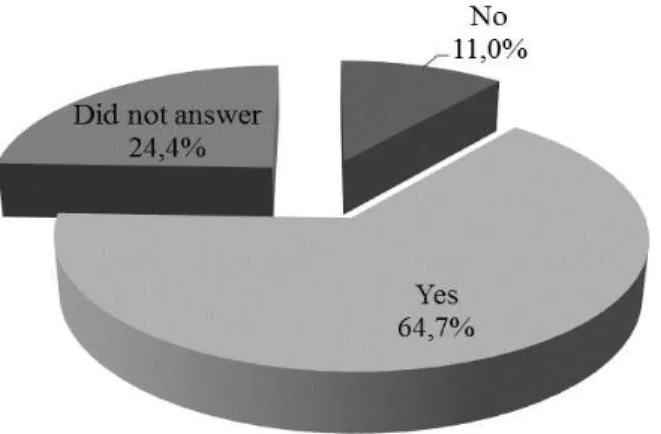
In the first question, which deals with the use or not of adjuvants, 64.7% of the participants used adjuvants during the pesticides applications and 11.0% did not use adjuvants during the applications (Figure 1). This result may indicate improvement in the applications quality if the adjuvants selection were based on technical criteria. The correct use of adjuvants can enhance the applications quality, reduce spray drift and improve the pesticides effectiveness (ANTUNIASSI et al., 2011; CHECHETTO & ANTUNIASSI, 2012).
FIGURE 1. Frequency distribution of responses according to the use or not of adjuvants in the pesticides applications.
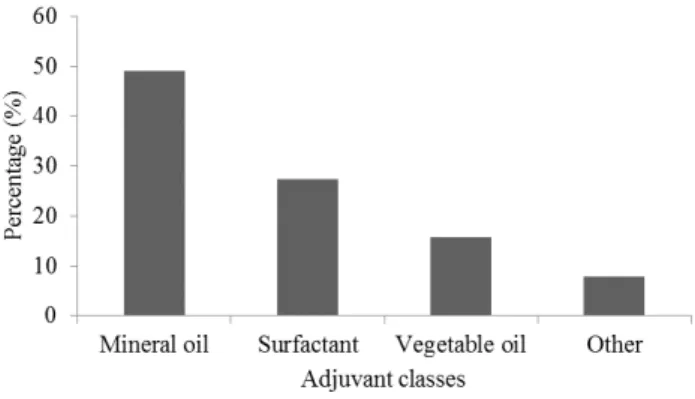
In addition, 37.3% of participants answered about the adjuvants used in pesticides applications. The adjuvants cited were divided into four classes: mineral oil; vegetable oil; surfactant; or others (OLIVEIRA et al., 2013). The adjuvants that did not fall in the first three classes, or that did not have information on the label about its composition, were classified as "other."
FIGURE 2. Frequency distribution of responses according to the adjuvants classification.
The surfactants are substances that reduce the surface tension, decreasing the attraction force of the liquid molecules, increasing the scattering, and consequently increasing the contact of the droplets with the plant surface. The most important functions of the oil adjuvants are increase the retention and penetration of the active ingredients in targets; increase the spreading of the droplets, as well as reduce drift.(CHECHETTO & ANTUNIASSI, 2012; MOTA et al., 2013; OLIVEIRA et al., 2013).
In this way, 57.7% of the participants answered the question about the functions performed by the adjuvants. With, 39.8% of the 57.7% of the participants reported knowing the functions performed by the used adjuvants and 17.9% answered not knowing it (Figure 3). Selecting an adjuvant is not simple, since it can exhibit distinct functions. Furthermore, the application effectiveness is dependent on the interactions between the pesticides, adjuvants and the crop to be treated (ANTUNIASSI et al., 2011; MOTA et al., 2013; OLIVEIRA et al., 2013). In conclusion, not knowing the function played by an adjuvant can increase the cost of the phytosanitary trea tments or the risk of environmental contamination by spray drift (CHECHETTO & ANTUNIASSI, 2012).
FIGURE 3. Frequency distribution of responses according to the knowledge about the function played by adjuvants in the spray applications.
There were no significant differences between regions regarding to the percentage of participants who knew or not the functions performed by the used adjuvants (chi-square, p> 0.05).
FIGURE 4. Frequency distribution of responses according to the positive (yes) or negative (no) answers obtained by the adjuvants using in the spray applications.
In the same way, were also not found statistical differences relative to good results or not stemmed from the adjuvants using in the pesticides applications, regarding the number of participants by region of the state of Mato Grosso (chi-square, p> 0.05).
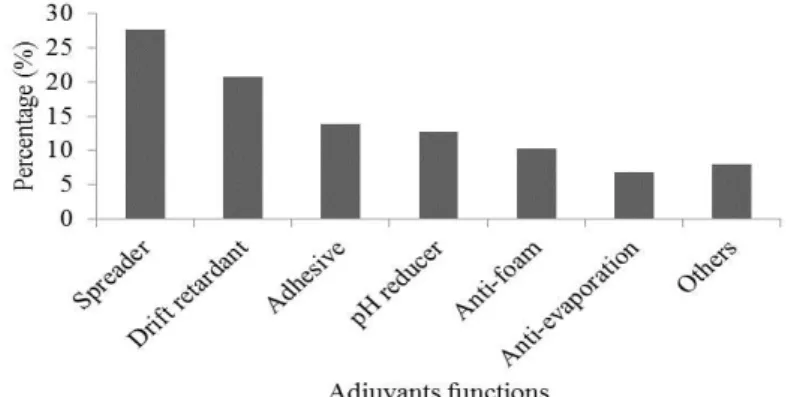
Regarding the question about the function played by the used adjuvants, 28.4% of the total participants responded to this question. Of the total participants, 27.6% expected spreader effect, 20.7% drift reduction, 13.8% “adhesive effect”, 12.6% pH reduction, among others (Figure 5). Therefore, the expected functions for the adjuvants were to improve the spreading of the droplets, reduce spray drift and increase the pesticide retention on the leaves during the spray applications. These functions are compatible with the adjuvants classes used by those participants (OLIVEIRA et al., 2013; MOTA et al., 2013; ANTUNIASSI et al., 2011).
FIGURE 5. Frequency distribution of responses according to the adjuvants classification.
In addition, 20.4% of the participants answered the question about the method used for the internal cleaning of spray tanks. Among 20.4% of the participants, 14.4% used only water during the washing, while 6.0% used water and a commercial product to help eliminate the pesticide residues (Figure 6).
FIGURE 6. Frequency distribution of responses according to the method used for the spray tank cleaning.
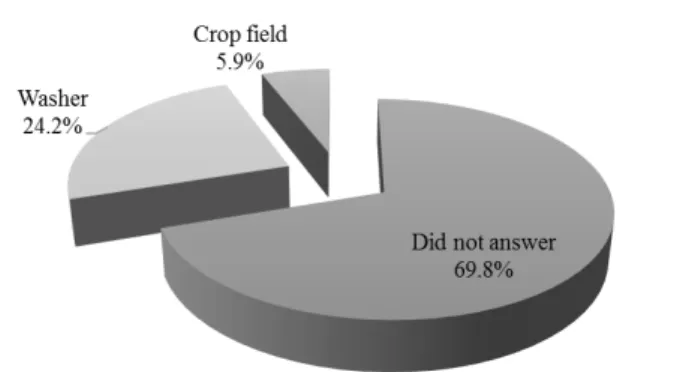
In addition, 30.1% of the participants answered the question about the place where was done the internal cleaning of spray tanks. In this way, 24.2% of the 30.1% of the participants used the washer of the farm, which is a concrete ramp used for washing machines, and 5.9% of the participants performed the washing in the crop field, as shown the Figure 7.
FIGURE 7. Frequency distribution of responses according to the location of the internal cleaning of spray tanks.
According to RAMWELL et al. (2004), the amount of pesticide residues of some internal cleaning of spray tanks are too high to be disposed in small areas, until 15 m2, because these products may cause a local contamination. This study also emphasized that clean the sprayers always in the same location can also cause residue s accumulation. The authors observed that cypermethrin residues found on sprayer parts were sufficient to pulverize an area of 5,880 m2.
After the internal cleaning of spray tank, the cleaning residues must be discarded. The results indicated that 58.5% of the pesticide residues were sprayed in the crop field and 19.1% disposedin cesspool, as show the Figure 8. Successive disposing of pesticide residues in specific locations, such as cesspool, can cause soil and water contamination, resulting in a specific point of contamination and is considered an environmental crime (BRASIL, 2011). Therefore, for this variable, it is important to have correct guidance procedures in order to do the proper disposal of such residues.
FIGURE 8. Frequency distribution of responses according to the residue disposal area of the internal cleaning of spray tanks.
On the other hand, 52.7% of participants had some sort of problems during the applications with spray drift and 24.4% had no problem with it, as show the Figure 9. Of all the questions, this was the question with the most number of answers, with 77.1% of the participants involved.
FIGURE 9. Frequency distribution of responses about spray drift occurrence.
It was found significant differences (chi-square, P <0.05) between the drift occurrence among the regions in the state of Mato Grosso. The lowest percentage was obser ved in the eastern region of the state, where 26.9% of participants witnessed spray drift occurrence in applications, differing significantly from the other regions (Goodman, P <0.05%), as noted in Table 2.
Such differences may occur due to regional variations in climate conditions, such as wind incidence, technological development, and cultural or educational characteristics of the people involved with pesticides activities.
TABELA 2. Frequency distribution of responses according to the drift occurrence during the pesticides applications by region.
Spray drift occurrence
Region Yes (%) No (%) Did not answer (%) Total (%)
East 26.9 b 38.4 a 34.6 a 100.0
North 58.3 a 15.0 a 26.6 a 100.0
West 52.4 a 27.4 a 19.7 a 100.0
South 66.6 a 20.8 a 12.5 b 100.0
Average with different letters in the columns differ by Goodman test, at 5% of probability.
sprayers and 1.3% of the people believed that the spray drift causes were the rush during the applications, which increases the probability of errors (Figure 10). These data corroborate with CUNHA et al. (2011) and GANDOLFO et al. (2014) who said that the main ways to reduce spray drift are performing applications with suitable climatic conditions and using spray nozzles correctly.
FIGURE 10. Frequency distribution of responses according to the reasons of the spray drift occurrence during pesticides applications.
CONCLUSIONS
There is a lack of knowledge about the functions performed by the adjuvants during pesticides applications in the state of Mato Grosso. There is an improper disposal of pesticide residues from the internal cleaning of spray tanks. The spray drift was recognized as a problem, but most of the participants did not propose to discuss the reasons that caused this type of losses during the spray applications.
REFERENCES
ANTUNIASSI, U.R.; VELINI, E.D.; OLIVEIRA, R.B.; OLIVEIRA, M.A.P.; FIGUEIREDO, Z.N. Systems of aerial spraying for soybean rust control. Engenharia Agrícola, Jaboticabal, v.31, n.4, p.695-703, jul/ago. 2011.
BRASIL. Conselho Nacional do Meio Ambiente - CONAMA. Resolução n.430, de 13 de maio de
2011. Diário Oficial da União, Brasília, DF, 16 maio 2011. n.92, p.89.
CHECHETTO, R.G.; ANTUNIASSI, U.R. Espectro de gotas gerado por diferentes adjuvantes e pontas de pulverização. Revista Energia na Agricultura, Botucatu, v.27, n.3, p.130-142, jul./set. 2012.
CUNHA, J.P.A.R.; FARNESE, A.C.; OLIVET, J.J.; VILLALBA, J. Deposição de calda
pulverizada na cultura da soja promovida pela aplicação aérea e terrestre. Engenharia Agrícola, Jaboticabal, v.31, n.2, p.343-351, mar./abr. 2011.
CURI, P.R.; MORAES, R.V. Associação, homogeneidade e contrastes entre proporções em tabelas contendo distribuições multinomiais. Ciência e Cultura, Campinas, v.33, n.5, p.712-722, maio. 1981.
DAMALAS, C.A.; TALIDIS, G.K.; THANOS, S.D. Assessing farmers' practices on disposal of pesticide waste after use. Science of the Total Environment, New York, v.390, n.2-3, p.341-345, Feb. 2008.
GANDOLFO, M.A.; CARVALHO, F.K.; CHECHETTO, R.G.; GANDOLFO, U.D.; MORAES, E.D. Effect of working pressure at different spray nozzles on drift quantification in wind tunnel.
HILZ, E.; VERMEER, A.W.P. Spray drift review: The extent to which a formulation can contribute to spray drift reduction. Crop Protection, Amsterdam, v.44, p.75-83, feb. 2013.
MOTA, A.A.B.; ANTUNIASSI, U.R.; CHECHETTO, R.G.; OLIVEIRA. R.B.; SILVA, A C. Effect of adjuvants on the amount of air included in droplets generated by spray nozzles.
Engenharia Agrícola, Jaboticabal, v.33, n.6, p.1281-8, nov./dez. 2013.
OLIVEIRA, R.B.; ANTUNIASSI, U.R.; MOTA, A.A.B.; CHECHETTO, R.G. Potential of adjuvants to reduce drift in agricultural spraying. Engenharia Agrícola, Jaboticabal, v.34, n.5, p.986-992, set./out. 2013.