
Temporal dynamics of spectral reflectance and vegetation
indices during canola crop cycle in southern Brazil
Dinâmica temporal dos índices da reflectância espectral e índices de vegetação durante o ciclo da cultura de canola no Sul do Brasil
Daniele Gutterres Pinto1* Denise Cybis Fontana1 Genei Antonio Dalmago2 Gilberto Rocca da Cunha2
Elizandro Fochesato3 Matheus Boni Vicari4 Jorge Alberto de Gouvêa2 Anderson Santi2
ISSNe 1678-4596
INTRODUCTION
Canola (Brassica napus L. var. oleifera) has become an important crop of economic interest in southern Brazil, as an alternative to winter cereals under crop rotation systems and due to the high oil content of its seeds (TOMM, 2007). The relatively recent introduction of this crop to the agricultural systems of southern Brazil has
given rise to a need for specific knowledge on
growing conditions in the subtropical climate that predominates in the region. Within this context,
monitoring tools are available for use during the growth cycle that allow characterization of growing practices, assessment of variability in growth and
development during a specific harvest and between
harvests, and prediction of crop yield. Most of the aforementioned variability is associated with local environmental conditions, especially weather conditions, and with crop husbandry practices adopted by growers.
Regarding weather conditions, variability in crop weight and grain yield is largely associated with temperature and water regimes during the
1Departamento de Plantas Forrageiras e Agrometeorologia, Universidade Federal do Rio Grande do Sul (UFRGS), 91540-000, Porto Alegre, RS, Brasil. E-mail: [email protected]. *Corresponding author.
2Centro Nacional de Pesquisa de Trigo, Embrapa, Passo Fundo, RS, Brasil.
3Departamento de Agronomia, Universidade Alto Vale do Rio do Peixe (UNIARP), Caçador, SC, Brasil. 4Departament of Geography, University College London, Londres, Reino Unido.
ABSTRACT: The objective of this study was to characterize the variability of spectral reflectance and temporal profiles of vegetation indices
associated with nitrogen fertilization, crop cycle periods, and weather conditions of the growing season in canola canopies in southern Brazil. An experiment was carried out during the 2013 and 2014 canola growing seasons at EMBRAPA Trigo, Passo Fundo, state of Rio Grande do Sul, Brazil. The experiment was conducted in a randomized block design with four replications. Five doses of nitrogen top dressing were used as treatments: 10, 20, 40, 80, and 160kg ha-1. Measurements were obtained with the spectroradiometer positioned above the canopy, to construct spectral reflectance curves for canola and establish temporal profiles for several vegetation indices (SR, NDVI, EVI, SAVI, and GNDVI). In addition, data on shoot dry matter were obtained and phenological stages were determined. The spectral reflectance curves of canola were reported to change with canopy growth and development. Temporal profiles of vegetation indices showed two maximum peaks, one before flowering and other after flowering. The indices SR, NDVI, EVI, SAVI, and GNDVI were able to characterize changes in the canola canopy over time, as a function of phenological phases, weather conditions, and nitrogen fertilization, throughout the development cycle. Plant growth and development, variations in crop management, and environmental conditions affect the spectral response of canola.
Key words: spectroradiometry, nitrogen fertilization, Brassica napus.
RESUMO: O objetivo deste trabalho foi caracterizar a variabilidade da reflectância espectral e dos perfis temporais dos índices de vegetação
de dosséis de canola, associada à adubação nitrogenada, aos períodos do ciclo da cultura e às condições meteorológicas no sul do Brasil. Foi instalado um experimento nas safras de 2013 e 2014, na EMBRAPA Trigo, em Passo Fundo, RS. O delineamento experimental foi de blocos casualizados com quatro repetições. Foram utilizados os tratamentos de cinco doses de nitrogênio em cobertura: 10, 20, 40, 80, 160kg ha-1. Foram realizadas medições com espectrorradiômetro, sobre o dossel, para compor curvas de reflectância espectral da canola e perfis temporais dos índices de vegetação SR, NDVI, EVI, SAVI e GNDVI. Também foram obtidos dados de matéria seca da parte aérea e feitas determinações de fenologia. Verificou-se que as curvas de reflectância espectral da canola mudaram com o crescimento e desenvolvimento do dossel. Os perfis temporais dos índices de vegetação apresentaram dois picos máximos, um antes e outro após o florescimento. Os índices SR, NDVI, EVI, SAVI e GNDVI foram capazes de caracterizar temporalmente as modificações do dossel da canola ao longo do ciclo, em função de fases fenológicas, condições meteorológicas e adubação nitrogenada. O crescimento e desenvolvimento das plantas, as variações de manejo da cultura e as condições ambientais afetam a resposta espectral da canola.
Palavras-chave: espectrorradiometria, adubação nitrogenada, Brassica napus.
growing cycle. Agriculture is the most climate-dependent economic activity (SENTELHAS, 2009). Among crop husbandry practices, nitrogen fertilization is a major causative factor of variability in leaf area index (LAI) and seed weight and yield, as nitrogen is a nutrient essential to plant growth and development (GRANT & BAILEY, 1993). When nitrogen is insufficient, canola plants may display slow growth, small leaves, few branches, a thin, open canopy, short flowering time, and low pod numbers (GRANT & BAILEY, 1993).
Remote sensing techniques, such as vegetation indices, are one of several options available for data generation on canola growing in the Southern Brazilian, state of Rio Grande do Sul. MÜLLER et al. (2009) tested several vegetation indices, derived from spectral data obtained from a canola canopy fertilized with different nitrogen doses, and showed that these indices can be used to predict the green area and dry matter indices.
Vegetation indices have been widely used as indicators of the presence and condition of vegetation, given their association with biophysical parameters such as biomass and leaf area index (PONZONI et al., 2012). The proposal of the vegetation indices more cited in literature, such as normalized difference vegetation index (NDVI) and enhanced vegetation
index (EVI), is founded on the antagonistic reflectance
response exhibited by vegetation in visible and near-infrared spectral regions; i.e., accumulation of
biomass leads to decreased reflectance in the visible region and increased reflectance in the near-infrared
region (JENSEN, 2009).
Within this context, the objective of this study was to characterize the variability of spectral
reflectance and temporal profiles of vegetation
indices associated with nitrogen fertilization, crop cycle periods, and predominating weather conditions during the winter canola growing season in southern Brazil.
MATERIALS AND METHODS
Experiments were conducted during the 2013 and 2014 harvests at the experimental station of EMBRAPA Trigo, located in Coxilha, state of Rio Grande do Sul, Brazil. The predominant soil of this
region is classified as a dark red dystrophic latosol,
characterized by being deep to very deep, well-drained, and suitable for annual crops (STRECK et al., 2008). For the purposes of this study, the Hyola
61 canola genotype was seeded in a randomized block
design with four replications. Treatments consisted of
five doses of nitrogen (urea) top dress: 10, 20, 40, 80,
and 160kg ha-1. The preceding crops were soybean
for the 2013 harvest and common bean for the 2014 harvest. Seeding dates were 22 April 2013 and 29 April 2014. Both experiments used a row spacing of 0.34m and a seeding rate to achieve a density of 40 plants m-2. The area of each plot was 127m² in 2013
and 60m² in 2014.
After seedling emergence, every 2
weeks, two paired plants representative of each
plot were collected for determination of dry matter content. For this purpose, the harvested plants were separated into leaves, stems, flowers, and pods placed in an oven at 60ºC, and dried to a constant weight.
Phenological characterization was performed every 7 days and was based on observation of the main plant development stages, in accordance with the criteria described by IRIARTE & VALETTI (2008). Phenological stage was deemed to have changed when 50% of plants in the plot displayed the corresponding phenological characteristic on the main stem. Meteorological data from an automatic weather station installed in the experimental area were used to calculate the climatic water balance for the period April-October, by the method described by THORNTHWAITE & MATHER (1955). This calculation was based on an available water content (AWC) of 75mm, which remained constant throughout the cycle. Thermal time were also calculated, using the degree-day method (OMETTO, 1981), considering 5ºC and 27ºC as the lower and upper limit base temperatures for canola respectively.
To evaluate the spectral response of
canola, canopy reflectance measurements were
obtained with a LICOR LI-1800 spectroradiometer (spectral resolution 2nm) in the 350-1100nm
range. Measurements were taken at a distance of
approximately 1m above the canopy, resulting in a sample area of 530cm-2. A barium sulfate (BaSO
4)
plate was used to simulate a Lambertian surface of
known reflectance as a reference. Canopy reflectance
was calculated as the ratio between canopy and
reference surface reflectance. All measurements were obtained with clear, cloudless skies, at approximately
12:00 noon solar time, in an attempt to ensure similar lightning and observation conditions.
One reflectance measurement was
was conducted. These measurements were used to
plot mean canopy reflectance curves and calculate
the following vegetation indices: simple ratio (SR) (JORDAN, 1969) (Equation 1), NDVI (ROUSE et al., 1973) (Equation 2), EVI (JUSTICE et al., 1998) (Equation 3), soil-adjusted vegetation index (SAVI) (HUETE et al., 1988) (Equation 4), and green normalized difference vegetation index (GNDVI) (GITELSON, 1996) (Equation 5).
SR = ρnir/ρr (1)
NDVI = (ρnir - ρr)/(ρnir + ρr) (2)
EVI = G (ρnir - ρr)/(L+ρnir+C1ρr+C2ρb) (3)
SAVI = [ρnir - ρr)/(ρnir+ ρr+L)] (1+L) (4)
GNDVI = (ρnir – ρg)/(ρnir+ ρg) (5)
Where: ρnir,ρr , ρg and ρb are reflectance
in the near-infrared, red, green, and blue spectra respectively; L is a constant that minimizes the ground effect (L=1); G is the gain factor (G=2.5); and C1 and C2 are adjustment factors to minimize the effect of aerosols in the atmosphere (C1=6.5 and C2=7.5).
Spectral bands used for calculation of vegetation indices were made compatible with the band widths and sensitivities of the MODIS
(Moderate Resolution Imaging Spectroradiometer)
sensor by application of a filter function generated
in ENVI 5.0© software. This procedure aimed to
allow future comparisons with orbital data, which is the subject of ongoing investigations. The lower and upper limits of the red, near-infrared, green, and blue bands in the MODIS sensor are 620-670, 841-875, 545-565, and 459-479nm respectively (ANDERSON et al., 2003).
An analysis of variance was performed for the vegetation indices across different treatments (nitrogen top dress doses) in each year. Means were
compared by the Tukey test, at a 5% significance level (P≤0.05).
RESULTS AND DISCUSSION
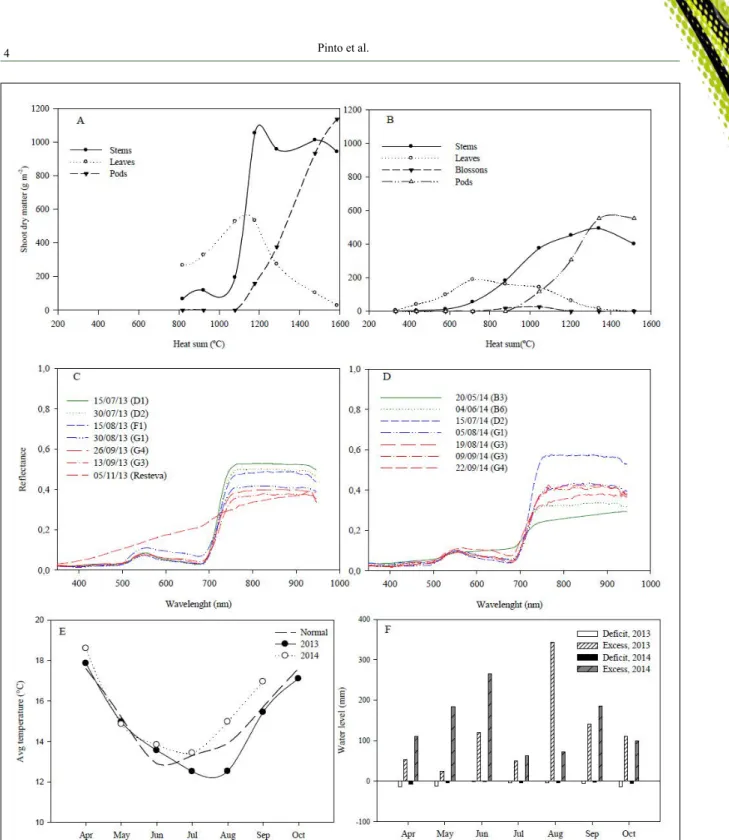
In both harvests, leaf dry matter content
increased until the start of the flowering period.
From this point onwards, the dry mass of canola becomes mainly composed of stems and pods, whereas leaf dry matter content decreased (Figure 1A e 1B). The mean dry matter partitioning across
treatments exhibited a similar pattern in both harvests, and provided evidence of structural changes in the canopy as a function of phenological stages (Figure 1A and 1B). However, differences in cumulative shoot dry matter weight occurred as a result of differences in weather conditions between harvests (Figure 1E and 1F).
During the 2013 harvest, the average air temperature ranged from 12.5 to 17.9ºC, whereas in the 2014 harvest, temperatures were higher, ranging from 13.4 to 18.6ºC. In addition, hidrical excess was observed during the growing cycle; however, this is a common phenomenon during the autumn and winter months in the state of Rio Grande do Sul. The lower temperatures observed in 2013 led to cold acclimation of the plants and, thus, enabled greater vegetative growth than in 2014. Cold acclimation of canola plants consists of a series of physiological, molecular, and biochemical
changes that take place in plants exposed to low
temperatures (RAPACZ, 1999).
During the vegetative period, plant biomass is composed of stems and leaves. Leaves
achieved a peak biomass of 53g m-2 and 189g m-2
in the 2013 and 2014 harvests respectively, at
the start of the flowering period, the time during
which the LAI is at its highest (JUSTES et al., 2000). At this stage, stem biomass increased as a result of main stem elongation and emergence of secondary stems from axillary buds (THOMAS, 2003). During ripening stage, while leaf dry matter content decreased, pod dry matter accumulation was observed.
The mean reflectance curves for all
treatments during the 2013 and 2014 harvests exhibited a typical pattern described by JENSEN (2009) as the “spectral signature of vegetation” and
reflected structural changes that took place in the
canopy during the growth and development cycle (Figure 1C and 1D).
radiation is absorbed by leaves; 40-60% is
reflected, and the rest is conveyed to the lower layers
of the canopy (PONSONI, 2012).
Near-infrared reflectance is determined
by the inner structural features of leaves, the
structural organization of the spongy mesophyll, and the ratio of cells to air spaces within this tissue. Young leaves contain more air spaces, and thus have
a structure conducive to near-infrared reflectance.
As leaves senesce, number of air spaces decreased
due to the presence of larger cells; thus, reducing
reflectance in the near-infrared region (GATES et
al., 1965).
Electromagnetic radiation (EMR)
reflectance in the visible range increased approximately 44% from first measurement to its peak
on 30 August 2013. At this time, plants were in full bloom, bearing yellow blossoms, thus showing that
peak reflectance in the visible spectrum was achieved
at the yellow wavelength. During the ripening stage, on measurements performed on 13 September and 26
September, canopy reflectance in the visible region
was reduced (approximately 37%). This occurred as photosynthetically active radiation (PAR) is intercepted and absorbed by pods and stems after blossoms have fallen off. According to NIED (2013), in canola, reproductive tissues and stems may account for up to 80% of all PAR intercepted by the canopy.
During the 2014 harvest, considering the
same growth cycle stages, a EMR reflectance in the
visible and near-infrared regions followed a similar pattern to 2013 harvest. In both years, maximum
near-infrared reflectance occurred during the stem
elongation stage (D1 and D2), whereas maximum
visible reflectance coincided with the flowering
stage (G1).
The vegetation indices employed in this study exhibited similar variation in temporal dynamics, demonstrating structural changes in the canopy (Figure 2). Values increased during vegetative
plant development and peaked before the onset of flowering. Indices then declined during the flowering period. As discussed above, blossoms reflect part
of the visible-range EMR incident onto the canopy. As most vegetation indices are based on the contrast between near-infrared and visible bands (Figure
1C-1D), increased reflectance in the visible region due to flowering led to a reduction in vegetation indices. After the flowering period, vegetation index values
rose again as blossoms dropped and pods began to form. Pods and stems absorb visible EMR to carry
out photosynthesis from the seed-filling through the
ripening stages (NIED, 2013).
This temporal pattern of variation in
canola vegetation indices, with two peaks, is distinct
from that observed in other crops. Annual crops
usually display only one peak for vegetation indices
(KLERING et al., 2013; JUNGES et al., 2013). This is useful information, as it may be used to distinguish canola crops in satellite imagery-based crop monitoring and mapping studies.
Comparison of results between the two years in which the experiment was conducted
revealed the influence of weather conditions on
plant growth. In 2014, vegetation indices also
declined during the flowering period, although less
sharply than in 2013. This may have been associated with the presence of fewer blossoms in the canopy
during the 2014 harvest, leading to lower reflectance
in the visible spectrum. Furthermore, at the end of
the flowering period, the increase in vegetation
index values was smaller, as, given the smaller number of blossoms in the canopy, there were fewer buds. Corroborating this hypothesis, the maximum pod dry-matter weight was 1,268g m-2 in the 2013
harvest, versus 633g m-2 in the 2014 harvest (Figure
1A and 1B).
Regarding the variability attributable to nitrogen fertilization (Table 1), during the 2013 harvest, despite significant differences in the SR index across nitrogen treatments, the expected response pattern -;i.e., higher nitrogen doses being associated with higher vegetation indices - was not seen. In this harvest, the SR was the only index that revealed significant differences across nitrogen doses; the highest SR indices
were reported for the 10kg ha-1 treatment during
the flowering stage and for the 40kg ha-1 treatment
during the ripening stage. During the 2014 harvest, significant differences in the calculated indices were observed only during the vegetative period and for NDVI and GNDVI. In terms of
NDVI, plots that received the 160kg ha-1 treatment
performed better than those treated with 80kg ha-1.
In terms of GNDVI, plots that received the 160kg
ha-1 treatment performed better than those treated
with 10kg ha-1.
These findings suggested that, in years
most appropriate weather conditions to canola growth and development, as was the case in 2013, the sensor-based indices were less able to detect structural differences in the canola canopy between treatments. In years when weather conditions are less suitable for canola growth and development, as in 2014, the sensor was able to detect differences in the canopy across different nitrogen fertilization treatments. Of the vegetation indices employed in this study, those most sensitive in terms of ability to detect differences in the canola canopy across nitrogen fertilization treatments were the SR, NDVI, and GNDVI.
CONCLUSION
Changes in the spectral reflectance curves
changes in the canopy that took place during the
various stages of the growth cycle and to associated
weather conditions. Temporal profile of vegetation indices in canola displays two maximum peaks, one before flowering and the other after flowering, which makes canola easy to distinguish from other crops
grown in Southern Brazil. The SR, NDVI, and GNDVI vegetation indices are sensitive metrics for detection of
changes in the spectral reflectance of canola associated
with variation in top dress nitrogen application.
ACKNOWLEDGEMENTS
The authors thank Universidade Federal do Rio Grande do Sul (UFRGS), EMBRAPA Trigo, and Conselho Nacional de Desenvolvimento Científico e Tecnológico (CNPq) for supporting the conduction of this study.
Table 1 - Vegetation indices in canola (simple ratio [SR] normalized difference vegetation index [NDVI], enhanced vegetation index [EVI], soil-adjusted vegetation index [SAVI], and green normalized difference vegetation index [GNDVI]), across five doses of nitrogen top dress (10, 20, 40, 80 and 160kg ha-1), at three growth cycle stages: vegetative (Veg), flowering (Flo), and ripening (Rip),
during the 2013 and 2014 harvests. Coxilha, Rio Grande do Sul.
Vegetation Growth ---Nitrogen dose (kg ha-1 )---
Year Index Stage 10 20 40 80 160
2013
Veg 16.63 A 15.99 A 23.46 A 16.78 A 16.19 A
SR Flo 6.80 A 6.04 AB 6.78 AB 7.35 AB 4.89 B
Rip 9.32 AB 11.91 AB 12.20 A 9.00 B 9.75 AB
Veg 0.89 A 0.89 A 0.89 A 0.89 A 0.88 A
NDVI Flo 0.74 A 0.71 A 0.74 A 0.73 A 0.66 A
Rip 0.80 A 0.84 A 0.85 A 0.79 A 0.81 A
Veg 0.61 A 0.61 A 0.52 A 0.58 A 0.60 A
EVI Flo 0.42 A 0.43 A 0.47 A 0.42 A 0.35 A
Rip 0.47 A 0.50 A 0.48 A 0.42 A 0.42 A
Veg 0.60 A 0.60 A 0.48 A 0.56 A 0.59 A
SAVI Flo 0.43 A 0.46 A 0.48 A 0.43 A 0.37 A
Rip 0.50 A 0.50 A 0.46 A 0.43 A 0.42 A
Veg. 0.74 A 0.75 A 0.79 A 0.76 A 0.75 A
GNDVI Flo 0.60 A 0.59 A 0.65 A 0.62 A 0.54 A
Rip 0.65 A 0.69 A 0.71 A 0.63 A 0.67 A
2014
Veg. 12.06 A 15.44 A 14.83 A 12.67 A 23.63 A
SR Flo 7.00 A 9.75 A 12.72 A 8.54 A 8.39 A
Rip 7.90 A 8.59 A 8.35 A 8.24 A 9.54 A
Veg. 0.87 AB 0.87 AB 0.87 AB 0.85 B 0.91 A
NDVI Flo 0.73 A 0.79 A 0.81 A 0.79 A 0.75 A
Rip 0.76 A 0.79 A 0.79 A 0.78 A 0.81 A
Veg. 0.51 A 0.59 A 0.62 A 0.60 A 0.63 A
EVI Flo 0.43 A 0.45 A 0.50 A 0.44 A 0.46 A
Rip 0.38 A 0.46 A 0.42 A 0.43 A 0.48 A
Veg 0.53 A 0.59 A 0.64 A 0.65 A 0.60 A
SAVI Flo 0.46 A 0.46 A 0.48 A 0.46 A 0.46 A
Rip 0.39 A 0.49 A 0.44 A 0.44 A 0.50 A
Veg 0.67 B 0.75 AB 0.73 AB 0.70 AB 0.80 A
GNDVI Flo 0.62 A 0.67 A 0.70 A 0.67 A 0.61 A
Rip 0.65 A 0.66 A 0.64 A 0.65 A 0.67 A
REFERENCES
ANDERSON, L.O. et al. Sensor MODIS: uma abordagem geral. São José dos Campos: INPE, 2003. Available from: <https://www. researchgate.net/profile/Liana_Anderson/publication/268337770_ S E N S O R _ M O D I S _ U M A _ A B O R D A G E M _ G E R A L / links/557878d508aeb6d8c01f1679.pdf>. Accessed: Mar. 30, 2016.
GATES, D.M. et al. Spectral properties of plants. Applied Optics, v.4, n.1, p.11-20, (1965).
GITELSON, A.A. et al. Use of a green channel in remote sensing of global vegetation from EOS-MODIS. Remote Sensing of
Environment, v.58, n.3, p.289-298, 1996. Available from: <http://
dx.doi.org/10.1016/S0034-4257(96)00072-7>. Accessed: Sep. 15, 2015. doi: 10.1016/S0034-4257(96)00072-7.
GRANT, C.A.; BAILEY, L.D. Fertility management in canola production. Canadian Journal of Plant Science, v.73, p.651-670, 1993. Available from: <http://dx.doi.org/10.4141/cjps93-087>.
Accessed: Jul. 07, 2015. doi: 10.4141/cjps93-087.
HUETE, A.R. A soil-adjusted vegetation index (SAVI). Remote
Sensing of Environment, v.25, p.295-309, 1988. Available from:
<http://dx.doi.org/10.1016/0034-4257(88)90106-X>. Accessed: Aug. 23, 2015. doi: 10.1016/0034-4257(88)90106-X.
IRIARTE, L.B.; VALETTI, O.E. Cultivo de colza. Buenos Aires: Instituto Nacional de Tecnologia Agropecuária - INTA, 2008. 156p.
JENSEN, J.R. Sensoriamento remoto do ambiente: uma perspectiva em recursos terrestres. 2.ed. São José dos Campos: Parêntese, 2009. 598p.
JORDAN, C.F. Derivation of leaf area index from quality of light on the forest floor. Ecology, v.50, p.663-666, 1969. doi: 10.2307/1936256.
JUNGES, A.H. et al. Identification of croplands of winter cereals in Rio Grande do Sul state, Brazil, through unsupervised classification of normalized difference vegetation index images. Engenharia
Agrícola, v.33, n.4, p.883-895, 2013. Available from: <http://
dx.doi.org/10.1590/S0100-69162013000400027>. Accessed: Sep. 02, 2015. doi: 10.1590/S0100-69162013000400027.
JUSTES, E. et al. Effect of crop nitrogen status and temperature on the radiation use efficiency of winter oilseed rape. European
Journal of Agronomy, v.13, p.165-177, 2000. Available from:
<http://dx.doi.org/10.1016/S1161-0301(00)00072-1>. Accessed: Aug. 14, 2015. doi: 10.1016/S1161-0301(00)00072-1.
JUSTICE, C.O. et al. The moderate resolution imaging spectroradiometer (Modis): land remote sensing for global change
research. IEEE Transactions on Geoscience and Remote
Sensing, v.36, n.4, p.1228-1249, 1998. Available from: <http://
dx.doi.org/10.1109/36.701075>. Accessed: Jun. 23, 2015. doi: 10.1109/36.701075.
KLERING, E.V. Influência do fenômeno ENOS nos perfis temporais de NDVI das áreas orizícolas do Rio Grande do Sul. 2013. Ciência e Natura, v. Dez, p.94-96, 2013. Available from: <http://dx.doi.org/10.5902/2179-460X11561>. Accessed: Jul. 31, 2015. doi: 10.5902/2179-460X11561.
MÜLLER, K. et al. Analyses of vegetation indices derived from hyperspectral reflection measurements for estimating crop canopy parameters of oilseed rape (Brassica napus L.). Biosystems
Engineering, v.101, p.172-182, 2008. Available from: <http://
dx.doi.org/10.1016/j.biosystemseng.2008.07.004>. Accessed: Apr. 26, 2015. doi: 10.1016/j.biosystemseng.2008.07.004.
NIED, A.H. Parâmetros bioclimáticos e resposta da canola ao ambiente físico. 2013. 135f. Tese (Doutorado em que Fitotecnia) – Programa de Pós-graduação em Fitotecnia, Faculdade de Agronomia, Universidade Federal do Rio Grande do Sul, Porto Alegre, RS.
OMETTO, A.C. Bioclimatologia vegetal. São Paulo: Agronômica Ceres, 1981. 440p.
PONZONI, F.J. et al. Sensoriamento remoto da vegetação. 2.ed. Cubatão: Oficina de Textos, 2012. 160p.
RAPACZ, M. Frost resistance and cold acclimatation abilities of spring-type oilseed rape. Plant Science, v.147, p.55-64, 1999.
ROUSE, J.W. et al. Monitoring vegetation systems in the great plains with ERTS. In: EATHRESOURSES TECHNOLOGY SATELLITE - 1 SYMPOSIUM, 3., 1973, Washington.
Proceedings... Washington: ERTS, 1973. V.1, sec A, p.309-317.
SENTELHAS, P.C.O. Introdução. In: MONTEIRO, J.E.B.A. (Coord.). Agrometeorologia dos cultivos: o fator meteorológico na produção agrícola. Brasília: INMET, 2009. p.3-12.
STRECK, E.V. et al. Solos do Rio Grande do Sul. Porto Alegre: EMATER/RS; UFRGS, 2002. 126p.
THORNTHWAITE, C.W.; MATHER, J.R. The water balance.
Publication of climatology, v.8, 104p, 1955.
TOMM, G.O. Indicativos tecnológicos para a produção de
canola no Rio Grande do Sul. Passo Fundo: Embrapa Trigo,
![Figure 2 - Temporal dynamics of vegetation indices in canola (simple ratio [SR] normalized difference vegetation index [NDVI], enhanced vegetation index [EVI], soil-adjusted vegetation index [SAVI], and green normalized difference vegetation index [GNDVI](https://thumb-eu.123doks.com/thumbv2/123dok_br/15949511.680668/6.892.138.680.118.1028/vegetation-normalized-difference-vegetation-vegetation-vegetation-normalized-difference.webp)
![Table 1 - Vegetation indices in canola (simple ratio [SR] normalized difference vegetation index [NDVI], enhanced vegetation index [EVI], soil-adjusted vegetation index [SAVI], and green normalized difference vegetation index [GNDVI]), across five doses o](https://thumb-eu.123doks.com/thumbv2/123dok_br/15949511.680668/7.892.131.807.242.928/vegetation-normalized-difference-vegetation-vegetation-vegetation-normalized-difference.webp)
