Rev Saúde Pública 2004;38(2) www.fsp.usp.br/rsp
Contraceptive measures and H IV transmission
protection among women with H IV/ AID S
M arli T Gimeniz Galvãoa, Ana Teresa de Abreu Ramos Cerqueirab and Jussara M arcondes-M achadoc
aDepartamento de Enfermagem da Universidade Federal do Ceará. Fortaleza, CE, Brasil. bDepartamento
de Neurologia e Psiquiatria da Faculdade de Medicina de Botucatu (FMB) da Universidade Estadual Paulista (Unesp). Botucatu, SP, Brasil. cDepartamento de Doenças Tropicais e Diagnóstico por Imagem da FMB-Unesp. Botucatu, SP, Brasil
A study by the Department of Tropical Diseases and Imaging of Faculdade de Medicina de Botucatu – Universidade Estadual Paulista (Unesp).
Based on the doctoral thesis presented to the Faculdade de Medicina de Botucatu (Unesp), 2002. Received on 3/12/2002. Reviewed on 9/6/2003. Approved on 23/9/2003.
Correspondence to:
Marli T Gimeniz Galvão Departamento de Enfermagem Universidade Federal do Ceará
R. Alexandre de Baraúna, 1145 Rodolfo Teófilo 60430-160 Fortaleza, CE, Brasil
E-mail: [email protected]
Keywords
Sex behavior. Contraception. Women. Acquired immunodeficiency
syndrome, transmission. HIV infections, transmission. Socioeconomic factors. Women’s health. Health education.
Abstract
Objective
Sexual intercourse is currently the route of transmission among women that has most contributed to the feminization of the HIV/AIDS epidemic. As an ongoing effort to establish more appropriate standards for health counseling, the study’s purpose was to investigate the use of contraceptive methods that would also prevent HIV/AIDS women against disease transmission.
Methods
An exploratory study was developed in an outpatient clinic of a public university hospital, a reference center of HIV/AIDS patients in the mid-south region of the state of São Paulo, Brazil, during a 5-month-period (2000 and 2001). The study was carried out in 73 HIV/AIDS women. Data were collected using a semi-structured questionnaire exploring subjects’ sociodemographics, contraception method used and HIV status of their sex partners. A descriptive data analysis was performed and the contents of open answers were grouped into themes. Fischer’s exact test was applied for analyzing some variables at a 5% significance level. Content analysis was carried out according to Bardin’s proposal.2
Results
Most women at reproductive age were married and had been infected almost exclusively through heterosexual contact. Of them, 35.4% reported having an HIV discordant partner and 13.7% used inadequate contraceptive methods that failed to protect them against HIV transmission.
Conclusions
The study results call for the need of continuous education on safer sex among HIV/ AIDS women to empower them to discuss with their partners alternative options of exercising their sexuality and to raise awareness on their contraceptive choices in a way to protect their own health, their partner’s and even their unborn offspring’s health.
INTRODUCTION
From 1980 to 2001, of 222,356 HIV cases reported in Brazil, 59,624 were women9 and the faster grow-ing number of heterosexual contact as a transmis-sion route has mostly contributed to the feminization of the HIV/AIDS epidemic.9 Perinatal transmission
is a dramatic outcome of women being affected by HIV/AIDS.
Rev Saúde Pública 2004;38(2) www.fsp.usp.br/rsp Medidas de proteção entre mulheres com HIV/Aids
Galvão MTG et al
role on choosing how, when and in what conditions they will have sex.7
Knowledge of contraceptive methods and their use by Brazilian women has been widely discussed in recent years, from social aspects, such as inequality of rights, opportunities, and financial resources, to political issues since women’s health programs have not been effectively implemented.14 Moreover, to the authors’ best knowledge, up to now the government’s Women’s Health Care Program has not offered any resourceful action for HIV women. Counseling dur-ing condom distribution campaigns focus mostly on condom use as preventive against STD/AIDS trans-mission rather than a targeted contraceptive method.
Ávila et al1 noted that the World Health Organiza-tion, concerned over the increase in HIV-infected women at reproductive age worldwide, has advised researchers on the need for studies on contraception and HIV.
The call from health authorities, the steady increase in HIV cases among Brazilian women, mostly at re-productive age, allied to the effort of providing infor-mation to better advise HIV/AIDS women on health prompted the investigation on the use of contracep-tive and HIV transmission prevention methods.
M ETH O D S
An exploratory study was carried out in an outpa-tient clinic of a public university hospital, a refer-ence HIV/AIDS center located in the mid-southern area of the state of São Paulo. The service also pro-vides care and counseling on prevention to non-in-fected partners of HIV-innon-in-fected patients.
As a patient attending this service usually comes for follow-up visits on average every 3 months, a 5-month- study period was established, from December 2000 to April 2001, which allowed enough time for patients to reschedule missed appointments.
Of a total of 83 patients who attended the outpa-tient clinic during the study period, 73 HIV-infected women participated in the study. Exclusion criteria were as follows: negative women, partners of HIV-infected male patients followed up in the clinic, and those who missed their appointments during the study period. Selection criteria were: female, confirmed HIV infection, 18 years old or older, outpatient follow-up for at least 4 months, and consent to participate in the study. All patients agreed to take part in the study.
Individual interviews were used for data collection
and were carried out in a separate room by a trained researcher who filled out a questionnaire with open and close questions. The data collection tool was di-vided into two sections: section one was designed for collecting sociodemographic data on the patients, and section two had two questions, one exploring the contraceptive method currently used (“What do you do to avoid getting pregnant?”), and the other on their partner’s HIV status (“What did your partner test in the HIV testing?”).
The contraceptive method used question was also designed to indirectly assess the odds of HIV trans-mission given that some contraceptive methods work for both prevention and contraception.
Sociodemographic data underwent a quantitative analysis. Fischer’s exact test with a 5% significance level was used in the analysis of variables contracep-tive methods and marital status. The latter was di-vided into married and non-married.
Open questions underwent content analysis de-scribed by Bardin.2 Answers were recorded literally in the questionnaire by the research interviewer and the following steps were taken during content analy-sis: 1) All information was obtained from the answers as a way to get indicators on contraceptive methods used and partner’s HIV status; 2) All answers were compiled and classified according to common fea-tures or relationship clusters, generating categories related to the reported contraceptive methods ad-equacy or inadad-equacy; 3) Answers were classified into two categories: adequate and inadequate contracep-tive methods. Answers reporting methods effeccontracep-tive to prevent both pregnancy and HIV transmission or reinfection were classified as adequate and those in-dicating contraceptive actions that were ineffective to prevent either HIV infection or pregnancy were classified as inadequate. The answer categorizations were evaluated by two separate evaluators who reached a consensus. Quantitative data analysis was carried out based on established categories.
The study protocol was approved by the Ethics Research Committee of the Botucatu Medical School. All patients were informed on study purposes and consented to participate in the study.
RESU LTS
Table 1 shows sociodemographic data of 73 HIV-infected women participating in the study.
!
Rev Saúde Pública 2004;38(2) www.fsp.usp.br/rsp
Medidas de proteção entre mulheres com HIV/Aids Galvão MTG et al
married or living with a partner, followed by sepa-rated, widows, and single women.
Schooling was analyzed as years spent at school, determined by the highest grade subjects achieved and successfully completed. Most women in the study (68.5%) had one to eight years of schooling.
Regarding HIV infection route, the vast majority (93.2%) were infected via heterosexual contact.
HIV status of the women’s regular sexual partner were not drawn from medical reports but instead from information given by the women themselves. Of 62 reported having sexual partners, 34 (54.9%) were HIV-infected, 22 (35.4%) tested negative and six (9.7%) did not undergo HIV testing (Table 1).
Answers to the question “What do you do to avoid
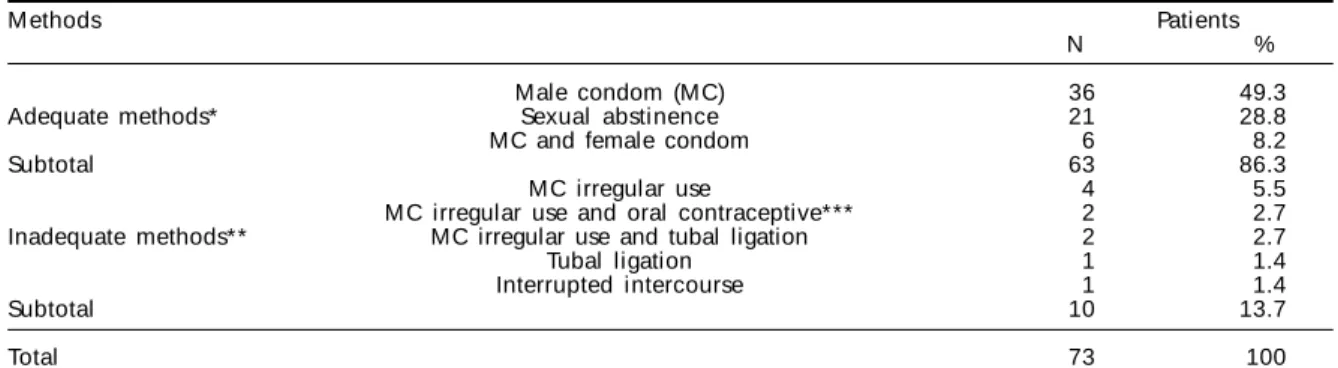
getting pregnant?” were nominated according to the contraceptive methods used and classified as adequate and inadequate methods (Table 2).
The following are examples of answers including methods classified as adequate:
“... I don’t want any more children. I have com-pletely eliminated sex from my life.” [sexual absti-nence];
“... he always wraps up his doll ...” [use of male condom];
“... we alternate the condom use.” [use of either male or female condoms].
Answers that illustrate inadequate methods were as follows:
“... I feel secure by taking the pill as he does not always use a condom.” [irregular use of male condom and contraceptive pills];
“... he takes it out before ...” [interrupted inter-course];
“... sometimes he uses a condom.” [irregular use of male condom].
Among women studied, 63 (86.3%) reported using adequate methods to avoid pregnancy that were also protective against HIV transmission or reinfection; most (36; 49.3%) reported using male condoms and six (8.2%) using either male or female condoms. Sexual abstinence, considered to be totally safe for preventing pregnancy, and HIV transmission and re-infection was reported by 21 (28.8%) women.
Of those using inadequate methods, four (5.5%) reported irregular use of male condoms because of Table 1 - HIV-infected women according to sociodemographic
data, Botucatu, 2001. (N=73)
Sociodemographics Patients
N %
Age groups(years)*
<19 1 1.4
20-29 25 34.3
30-39 26 35.6
40-49 18 24.6
≥50 3 4.1
Schooling years
1-4 13 17.8
5-8 37 50.7
9-11 14 19.2
≥12 9 12.3
M arital status
M arried/living w ith a partner 44 60.3
Separated 11 15.0
W i dow 10 13.7
Si ngl e 8 11.0
Exposure category
H eterosexual 68 93.2
Heterosexual + IV drug user 5 6.8 HIV-status of sexual partner **
H IV-positive 34 54.9
H IV-negati ve 22 35.4
Not tested 6 9.7
*Minimum age =19 years old; Maximum age =56 years old; **N=62, 11 patients reported not having sexual partners.
Table 2 - HIV-infected women according to contraceptive method used, Botucatu, 2001.
M ethods Patients
N %
Male condom (MC) 36 49.3
Adequate methods* Sexual abstinence 21 28.8
MC and female condom 6 8.2
Subtotal 63 86.3
M C irregular use 4 5.5
M C irregular use and oral contraceptive*** 2 2.7 Inadequate methods** MC irregular use and tubal ligation 2 2.7
Tubal ligation 1 1.4
Interrupted intercourse 1 1.4
Subtotal 10 13.7
Total 73 100
*Adequate methods: both contraceptive and HIV preventive methods.
**Inadequate methods: HIV preventive methods but with no contraceptive effect.
" Rev Saúde Pública 2004;38(2) www.fsp.usp.br/rsp Medidas de proteção entre mulheres com HIV/Aids
Galvão MTG et al
their partners’ refusal; two (2.7%) reported sporadic use of male condoms along with contraceptive pills and two (2.7%) reported sporadic use of male con-doms and having tubal ligation. One (1.4%) reported interrupted intercourse and another one (1.4%) re-ported having tubal ligation. The use of contracep-tive pills was considered an inadequate method given that concomitant use of antiretrovirals reduces the efficacy of oral contraceptives (Table 2).6
Table 3 presents contraceptive methods used that also prevent HIV transmission as well as women’s marital status during the study period. Most (86.3%) reported using adequate methods including 35 married women.
The answers distribution related to adequate and in-adequate contraceptive methods between married and not married women (single, widow, and separated) showed a statistically significant difference (p=0.0376). Not married women used more adequate preventive and protective methods than the married ones (Table 3).
D ISCU SSIO N
Increasing HIV infection cases is seen worldwide among 15 to 49 year old people.15 At the same time, statistics show a growing number of cases in women. High HIV prevalence among women implies an in-crease in mother-to-child transmission and growing morbidity and mortality rates in children.15
Similar findings were seen in the present study where 71.3% of women aged 19 to 39 years. As it is also a stage of life where pregnancy is most likely, these women should get thorough counseling con-cerning adequate methods for contraception and pre-vention of HIV transmission.
The desire for maternity is also there among HIV-infected women;11 however, assisted-reproductive technology is not yet available to most HIV-infected people in Brazil. Since HIV infection does not pre-vent women and men from desiring having children, this could be overcome by choosing to have a baby at the most appropriate time in the disease course when risk of HIV transmission is lower.
According to the Brazilian Ministry of Health, women infected earlier in life when they are most fertile bring about an increase of pregnant women who could infect their children9. A rise in the number of cases seen among pregnant women can be attributed to the rec-ommended routine HIV testing in prenatal visits.
Most women in the present study were married and reported using adequate contraceptive methods that also protected them against HIV infection. The same was seen among not married women who often re-ported using adequate methods. However, more mar-ried women also reported using inadequate preven-tive methods to avoid pregnancy and HIV infection. This could be explained by the fact that as these women are in a more stable relationship and have a steady partner; they might have found it more diffi-cult to negotiate with their partner the use of protec-tive methods against reinfection that would work as contraception as well. Or else, as Paiva et al11 pointed out, these women could have a concealed desire, not revealed by them in the study, of having children.
The study findings now raise the issue on how women can protect themselves against HIV transmis-sion in their relationships. Living in distinctive “ma-cho” cultures these women are not even able to nego-tiate condom use when they suspect their partner has extramarital affairs. In fact, four women in the study reported irregular use of male condom because their sex partners’ refusal.
Beckerman3 calls attention to the fact that before the advent of new therapeutic options HIV-infected patients had a shorter survival and there were few discordant couples. In the present study, i was found that 35.4% women had non-infected sexual partners.
A common dilemma experienced by HIV-positive women who have HIV-negative sex partners is whether to have or not children. They usually report feeling highly anxious because of the risk of infecting both their offspring and partner.
Studies on the sexuality of HIV-infected women show that, after being tested positive, they go through
Table 3 - Distribution of HIV-infected women according to contraceptive methods and marital status, Botucatu, 2001.
Contraceptive methods M arri ed N ot married* p **
N % N %
Adequate methods*** 35 79.5 28 96.6 0.0376
Inadequate methods**** 9 20.5 1 3.4
Total 44 100 29 100
* Not married = single, widow, separated. ** Fischer’s exact test p= 0.0376.
*** Adequate methods (male condom, sexual abstinence, male plus female condom).
#
Rev Saúde Pública 2004;38(2) www.fsp.usp.br/rsp
Medidas de proteção entre mulheres com HIV/Aids Galvão MTG et al
a period of less sexual activity.5,12 In the first year they report experiencing a “relationship crisis” and, thus remain sexually abstinent fearing to infect their partner and ashamed to tell them they are infected.5
Pereira12 noted that while investigating the sexual-ity of HIV-infected women. After getting to know their positive status, women reported feeling embarrassed and tense to talk about it. These women came across a wide variety of feelings and, not being able to expe-rience their sexuality as before, they feared and avoided having relationships, and some even aban-doned sexual contact. As the disease forces them to undergo several changes to experience their sexual-ity, they rather ignore their sexual drive.
Sexual abstinence was a way of avoidance reported by 28.8% women in the study. It was most often seen in separated women, followed by single and widows. Married woman reported sexual abstinence less frequently.
Sexual abstinence is a totally safe practice that elimi-nates the risk of HIV transmission. However, as Grimberg5 and Pereira12 showed, it works as a diver-sion but does not express a true desire. A similar phe-nomenon could be seen in the present study. When prompted with the question “What do you do to avoid getting pregnant?”, the women studied not only re-ported the method(s) used (adequate and inadequate methods) but also gave reasons for their choices. It showed that the option for sexual abstinence express-ing women’s fears of infectexpress-ing their partner and off-spring could not be understood as lack of sexual drive. For some of them, abstinence was an outcome of trauma they experienced having lost previous preg-nancies due to intrauterine infection. Some were so traumatized that, anticipating their partner’s irregu-lar use of condom, they ensured contraception by taking contraceptive pills at the same time.
Brazilian studies from 1995 to 1999 show use rates of male condom among HIV-infected women ranging from 10% to 58.5%.10,15
Several studies indicate that male condoms are not used as a result of the partner’s refusal for feeling un-comfortable or believing it would hamper their sexual pleasure and masculinity. Furthermore, they evidence women’s failure to negotiate with their partner.4,8 Santos13 adds that condom is not easily introduced in a couple’s relationship. Today the use of a female condom, reported by 8.2%, enables women to overcome their partner’s re-fusal of protecting themselves. And it is emerging as a choice method that could benefit HIV-infected women preventing both pregnancy and HIV transmission.
Subjects in Nobre’s10 study claimed that, although health professionals have emphasized the need for condom use as a preventive measure, they were never showed how to use it correctly. Another study warns that physicians were not used to talk much with of HIV-infected women about condom use, safe sex, con-traceptive use or any other issues related to their re-productive health.13
Oral contraceptive use among HIV-infected women, a method that prevents pregnancy but sexual partner infection, was uncommonly seen in the study sam-ple. This could be partly because these women are well informed on the inefficacy of this contraceptive method as it interferes with antiretroviral drug activ-ity. There is evidence of reduction of the efficacy of oral contraceptives from 18.0% up to 47.0%,6 and women could get pregnant even on contraceptive use.
Santos et al13 recommend sound counseling on con-traceptive method choice and concon-traceptive use and reinforce the major role of health care team on the attention of HIV-infected patients.
In the present study, 13.7% reported using inad-equate methods to avoid pregnancy that could work also to prevent HIV transmission. Most were married and only one was a widow. However, as for their male partners, six were HIV-negatives. Another study car-ried out in the city of São Paulo observed out that 41.5% of women reported irregular use of male con-dom regardless their partner’s HIV status.13
There are no studies in the literature that convinc-ingly approach the reasons why HIV-infected women would engage in risky behavior for either HIV rein-fection or unintended pregnancy. A study investigat-ing non-use of condoms by infected and non HIV-infected couples show that HIV-negative men reported not taking efficacious preventive measures against HIV infection because they did not believe their part-ners were infected and because they are “macho” men.4
Paiva et al11 note, however, that wanting to have children a human legitimate desire either motivated by religious issues and to give life a meaning or as a gender issue, to build up a feminine or virile identity.
$ Rev Saúde Pública 2004;38(2) www.fsp.usp.br/rsp Medidas de proteção entre mulheres com HIV/Aids
Galvão MTG et al
REFEREN CES
1. Ávila MH, Toney SV, Liguori AL. Enfoques de investigación sobre VIH/SIDA em salud reproductiva. México(DF): Instituto Nacional de Salud Pública; 1995.
2. Bardin L. Análise de conteúdo. Lisboa: Persona; 1979.
3. Beckerman NL. Couples coping with discordant HIV status. AIDS Patients CARE STDs 2002;16:55-9.
4. Galvão M TG, Ramos-Cerqueira ATA, Ferreira M LSM , Souza LR. Razões do não uso do preservativo masculino entre pacientes com infecção ou não pelo HIV. J Bras Doenças Sex Transm 2002;14:25-30.
5. Grimberg M. Género y VIH/SIDA. Un análisis de los diferenciales de gênero en la esperiencia de vivir com VIH. Cuad Med Soc 2000;78:41-54.
6. Hader SL, Smith DK, Moore JS, Holmberg SD. HIV infection in women in the United States: status at the millennium. JAMA 2001;285:1186-92.
7. Jimenez AL, Gotlieb SLD, Hardy E, Zaneveld LJD. Prevenção de doenças sexualmente transmissíveis em mulheres: associação com variáveis sócio-econômicas e demográficas. Cad Saúde Pública 2001;17:55-62.
8. Marin BV, Gomez CA, Tschann JM, Gregorich SE. Condom use in unmarried Latin men: a test of cultural constructs. Heath Psychol 1997;16:458-67.
9. Ministério da Saúde. Bol Epidemiol Aids 2001;15:1-59.
10. Nobre MRC, Vilanova CRC. Aids, mulher e preven-ção. J Bras Doenças Sex Trans 2000;12:91.
11. Paiva V, Lima TN, Santos N, Ventura-Filipe E, Segura-do A. Sem direito de amar? A vontade de ter filhos entre homens (e mulheres) vivendo com HIV. Psicol USP 2002;13:105-33.
12. Pereira M LD . A re(invenção) da sexualidade feminina após a infecção pelo HIV [tese de doutora-do]. São Paulo: Escola de Enfermagem da USP; 2001.
13. Santos NJS, Buchalla CM, Fillipe EV, Bugamelli L, Garcia S, Paiva V. Mulheres HIV positivas, reprodu-ção e sexualidade. Rev Saúde Pública 2002;36(4 Supl):12-23.
14. Schor N, Ferreira AF, M achado VL, França AP, Pirotta KCM, Alvarenga AT, et al. Mulher e anticoncepção: conhecimento e uso de métodos anticoncepcionais. Cad Saúde Pública 2000;16:377-84.