ABSTRACT The aim was to analyze the relation between integrality interventions and condi-tions of service delivery, in addition to the work process of Family Health Teams, in health centers in a district of the city of Belo Horizonte (MG). It is a cross-sectional study with self-administered questionnaire. Descriptive and comparative analyses were carried out through Pearson’s chi-square, using p=0.05 value to verify the statistical significance. Both service delivery conditions and the work process showed association with the accomplishment of integrality interventions, and planning proved to be the most important tool for the accom-plishment of such activities.
KEYWORDS Integrality in health. Family Health Strategy. Health promotion. Primary Health Care. Working conditions.
RESUMO Busca-se analisar a relação entre ações de integralidade e as condições de oferta dos serviços, além do processo de trabalho das Equipes de Saúde da Família, em centros de saúde de um distrito de Belo Horizonte (MG). É um estudo transversal com questionário autoaplicável. Ao todo, 538 profissionais participaram do estudo. Foram realizadas análises descritivas e com-parativas, por meio do qui-quadrado de Pearson, e de um valor -p=0,05 para verificação da sig-nificância estatística. Tanto as condições de oferta dos serviços quanto o processo de trabalho se mostraram associados à realização de ações de integralidade, sendo que o planejamento se mostrou a ferramenta mais importante para a realização de tais atividades.
PALAVRAS-CHAVE Integralidade em saúde. Estratégia Saúde da Família. Promoção da saúde. Atenção Primária à Saúde. Condições de trabalho.
Integrality, conditions of service delivery
and work process of Family Health Teams in
Belo Horizonte
Integralidade, condições de oferta de serviços e processo de trabalho
de Equipes de Saúde da Família em Belo Horizonte
João Leite Ferreira neto1, Graziella Lage oliveira2, natália de oliveira viana3, Luiz Guilherme
Male Ferreira duarte4
1 Pontifícia Universidade Católica de Minas Gerais (PUC-Minas), Programa de Pós-Graduação em Psicologia – Belo Horizonte (MG), Brasil.
2 Universidade Federal de Minas Gerais (UFMG), Faculdade de Medicina – Belo Horizonte (MG), Brasil.
grazilage.oliveira@gmail. com
3 Pontifícia Universidade Católica de Minas Gerais (PUC-Minas) – Belo Horizonte (MG), Brasil. natalia.oliveiraviana@yahoo. com.br
Introduction
Family health is the Primary Health Care (PHC) strategy chosen in Brazil for the reorientation of the national model named Unified Health System (Sistema Único de Saúde – SUS) (BRASIL, 2012). International literature considers that a
strong PHC increases the country’s capability to achieve high quality health care, in associa-tion with good cost-benefit relaassocia-tion (KRINGOS ET AL., 2013). The Family Health Strategy (FHS),
cur-rently present in over 90% of the country’s mu-nicipalities (HARZHEIM, 2011), was implemented in
1994 initially aiming at the small municipalities. Since the end of the 1990s, the strategy aban-doned its initial statute to become a structur-ing strategy for the municipal health systems, aiming at the reorientation of PHC (GIOVANELLA; MENDONÇA, 2008). Its intervention is on the realm
of health practices carried out in the territory, in so far as it establishes bonds of commitment and co-responsibility between the FHS team and a specific set of circa 3,000 to 4,500 people in a given area. Each team, composed of one physician, one professional nurse, two nurse auxiliaries, and six community health workers, take the responsibility for the integral health care of the population linked to it, by means of health promotion, prevention, recovery and re-habilitation of diseases and disorders, as well as for interventions on risk factors experienced in that community.
According to the National Policy for Primary Care (Política Nacional de Atenção Básica – PNAB) (BRASIL, 2012, P. 19), in its 2012 review, the
aim of Primary Care (Atenção Básica) is to
develop integral care that impacts on health conditions and autonomy of people, and on determinants and conditionings of communi-ties’ health,
by means of a set of “practices of care and management”. Such practices, hereby named integrality interventions, were the investigation target of the research.
Integrality is understood as health care
that congregates treatment and rehabilita-tion as well as prevenrehabilita-tion and promorehabilita-tion interventions, in the various levels of com-plexity; it is one of the fundamental princi-ples of SUS (DOMINGOS ET AL., 2016). Mattos (2009)
considers that this principle is the least de-veloped of the sanitary reform. If the aim of PHC is to provide qualified primary care that would respond to 85% to 90% of the popula-tions’ health problems, the outcome is not always positive. On the one hand, it is not rare to find FHS teams operating as emer-gency units, overloaded by the spontaneous demand from the region, and on the other hand, teams that advocate that the work should only be for prevention/promotion, not taking the responsibility for the patient’s care and practicing a referral clinic (HARZHEIM, 2011). The balance proposed by integral care
between promotional and curative interven-tions is a crucial requisite for the success of PHC. Despite a certain discursive consensus on the importance of promotion, it does not automatically occur in the daily practice of the Primary Health Units (PHUs).
Literature confirms that the association between integrality and PHC is a central issue in collective health research (BAPTISTA; FAUSTO; CUNHA, 2009). However, Norman and
Tesser (2015) point out that despite much
discussion about prevention/promotion and care in the organization of services, there is scarce production regarding the operation-alization of these interventions in routine care at FHS.
Methods
A transversal study was carried out with data collection between April and December 2014. Questionnaires were individually an-swered by each professional working in the 88 EqSFs of the 20 PHUs of the chosen district. In this district there is a universe of 752 posts authorized for the composition of teams. From this amount, 703 posts are actu-ally occupied, according to data provided by the municipal administration.
There was an attempt to submit the ques-tionnaires to all professionals of the EqSFs, using the exclusion criteria for those who had been working at the unit for less than three months, considering that they would have scarce knowledge on the unit’s routine. The tool was designed to meet the objectives of the research and was divided in four sec-tions: 1) worker’s characterization; 2) daily work at the Primary Health Unit; 3) work management; and 4) work in the territory.
For this study, a number of variables were selected and divided into the following cat-egories of analysis: Integrality in Health Interventions Developed by FHS (20 vari-ables); Conditions of Service Delivery (3 variables); and Work Processes (3 variables). It is worthy to highlight that among the variables in category Conditions of Service Delivery there are: risk classification of the territory where the PHUs are, provided by the municipality of Belo Horizonte (MG); Primary Health Unit that possesses differen-tiated delivery (Program of Education from Health Work – Programa de Educação pelo Trabalho para a Saúde – PET-Saúde, medical residency); and the relation between the number of EqSFs and population. Category Work Processes includes: assessment of teamwork in meetings; assessment of inter-ventions accomplished on the population; and planning. The variable ‘planning’ was designed from four questions: ‘How often do you participate in meetings?’; ‘How often are issues on planning interventions in the
unit discussed in meetings?’; ‘How often are issues on planning interventions outside the unit discussed in meetings?’; and ‘How far does the autonomy of your team go to plan interventions on the territory?’. Regarding the first three questions, scores were attrib-uted: 2 points for answers ‘always’; 1 point for answers “often’ or ‘at times’; and 0 (zero) for negative answers (‘never’ or seldom’). The last question was scored with 1 (yes) or 0 (no). The sum of points could vary between 0 and 7. In this score model, variable ‘plan-ning’ was divided in: ‘Satisfactory Plan‘plan-ning’ for score (decreasing) between 7 and 5 points; ‘Some Planning’ for score between 4 and 2 points; and ‘Little Planning’ for score between 1 and 0.
Descriptive analyses were carried out (frequency distribution and measures of central tendency and dispersion) as well as comparative analyses (univariate analyses using Pearson’s chi-square and Fischer’s exact test when appropriate). Value p≤0.05 was considered to verify statistical signifi-cance. For each variable, using confidence interval of 95%, odds ratios (OR) were found. Data was stored and analyzed using the program Statistical Package for Social Sciences (SPSS), 19.0 version.
The project was submitted to and ap-proved by the Ethics Committee of the Pontifical Catholic University of Minas Gerais (Pontifícia Universidade Católica de Minas Gerais de Minas Gerais), with the approval of the Municipal Secretariat of Health (Secretaria Municipal de Saúde) of the Municipality of Belo Horizonte, state of Minas Gerais (MG), in compliance with the ethical regulations for research involving human subjects (Certificate of Application for Ethics Review 14928213.9.0000.5137).
Results
from 16% to 30%, being lower among profes-sionals holding a university degree. Although 30% of the technical nurses did not take part in the research, it is considered that it was a representative sample, because 76.5% of workers of all professional categories participated.
The analysis of the total number of profes-sionals shows that: the majority is composed of women (89.7%), average age 42 years old (pattern deviation=9.7), varying between 22 and 67 years of age; work at the PHUs for over 6 years (46.6%). When analyzing the amount of years of work specifically of phy-sicians it drops to less than one year (48.4%). Professionals holding a university degree (physicians and nurses) have also been working there for less than one year (33.1%), whereas 58% have been there from one to three years, and 21.3% for over six years. The PHUs where those professionals work are situated in areas classified as medium/low risk (69.1%), according to the municipality of
Belo Horizonte (PBH-MG), and they attend an average of 33 users per day; 41.3% of those PHUs have a registry of between 2,800 and 3,400 people attended per EqSF. Regarding differentiated delivery at the units (medical residency and PET-Saúde), 60.8% provide these activities.
Regarding work performed by the profes-sionals (table 1) it is observed that listening to the user is what happens most frequently during the reception (97.6%), followed by re-ferral (86.2%). Most users (87.3%) have their demands attended during reception.
Concerning consultation with physicians and nurses, it is observed that the activities occurring with higher frequency are provid-ing guidance in general (99.3%) and guid-ance on how to use medicaments (84.7%), followed by medical history of user’s health treatment (87%). External referral occurs with lower frequency (24.4%). On table 1 there is more information on referral to pre-vention/promotion activities.
Table 1. Work characteristics of the 538 health professionals, in Belo Horizonte (MG). Brazil, 2015
Variables n %
When does reception happen at the unit?
during entire opening time 279 53,3
at hours deined by the team 184 35,2
varies according to the team 60 11,5
Which professionals participate in the reception?
nurses 495 92,2
nurse auxiliaries 517 96,3
physicians 193 36
Community Health agents 76 14,2
What is the average amount of time spent in each reception?
Maximum 5 minutes 64 17
More than 5 minutes 313 83
What happens during reception?
Listening to user’s need 525 97,6
User referral 463 86,2
providing information/guidance 448 83,3
Source: authors’ elaboration.
Table 1. (cont.)
delivery of examination results 188 34,9
How many patients have their demands met at reception?
Few or none 24 6
Half 28 6,7
Most 365 87,3
What happens during examination (only physicians and nurses: n=138)?
Guidance 137 99,3
Medical history of user’s health treatment 120 87
Medical history of user’s other health practices 93 67,4
prescription of medicaments 94 69,6
Guidance on how to use the medicaments 116 84,7
prescription of diet/food guidance 82 60,3
prescription of physical activity 81 59,6
other guidance on life habits 102 74,5
Listening to the user on resistance to prescriptions 87 64,4
internal referral – medical support , mental health, nasf 56 41,5
external referral – specializations, hospitalization, emergency Unit (Upa), Social assistance reference Center (Cras)
37 27,4
Group activities with users at the unit 31 23
referral to prevention/promotion activities 94 68,6
Prevention/promotion activities to which users are referred:
Leisure activities 75 54
Community activities 70 50,4
Walking 95 68,3
Lian Gong 120 87
Town academy 114 82
Health groups 77 55,4
nasf 113 81,3
How long after referral does the user get access to urgency/emergency services?
Same day 124 97,6
More than 1 day 5 2,4
Has the heath professional received permanent education in the last 12 months?
Yes 333 62,8
no 197 37,2
Tools used by ESF for territory analysis:
Family register 406 83,2
Health at the Territory project 66 13,5
Health at School program 234 48
vulnerability index 200 41
epidemiological data 252 51,6
professional reports 371 76
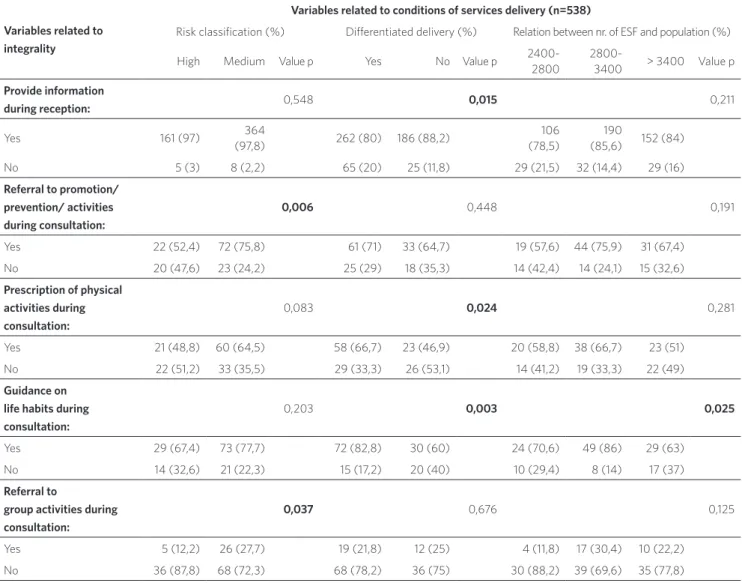
Table 2 shows the results of univari-ate analysis between variables relunivari-ated to Conditions of Services Delivery and Integrality Interventions. It is observed that the variable ‘risk classification’ appears as important to four integrality interventions; and variable ‘relation between nr. of EqSF and population’ appears as significant to three integrality intervention.
No integrality intervention showed rela-tion with the three variables selected to rep-resent the conditions of service delivery at the PHUs. At most, there was relation with two of those variables, as ‘differentiated delivery’ seems to have more importance in accomplishing integrality interventions, while ‘risk classification’ seems to be least important.
Table 2. Association between integrality interventions and conditions of health services delivery –univariate analysis, Belo Horizonte (MG). Brazil, 2015
Variables related to integrality
Variables related to conditions of services delivery (n=538)
risk classiication (%) diferentiated delivery (%) relation between nr. of eSF and population (%)
High Medium value p Yes no value p
2400-2800
2800-3400 > 3400 value p Provide information
during reception: 0,548 0,015 0,211
Yes 161 (97) 364
(97,8) 262 (80) 186 (88,2)
106 (78,5)
190
(85,6) 152 (84)
no 5 (3) 8 (2,2) 65 (20) 25 (11,8) 29 (21,5) 32 (14,4) 29 (16)
Referral to promotion/ prevention/ activities during consultation:
0,006 0,448 0,191
Yes 22 (52,4) 72 (75,8) 61 (71) 33 (64,7) 19 (57,6) 44 (75,9) 31 (67,4)
no 20 (47,6) 23 (24,2) 25 (29) 18 (35,3) 14 (42,4) 14 (24,1) 15 (32,6)
Prescription of physical activities during consultation:
0,083 0,024 0,281
Yes 21 (48,8) 60 (64,5) 58 (66,7) 23 (46,9) 20 (58,8) 38 (66,7) 23 (51)
no 22 (51,2) 33 (35,5) 29 (33,3) 26 (53,1) 14 (41,2) 19 (33,3) 22 (49)
Guidance on life habits during consultation:
0,203 0,003 0,025
Yes 29 (67,4) 73 (77,7) 72 (82,8) 30 (60) 24 (70,6) 49 (86) 29 (63)
no 14 (32,6) 21 (22,3) 15 (17,2) 20 (40) 10 (29,4) 8 (14) 17 (37)
Referral to
group activities during consultation:
0,037 0,676 0,125
Yes 5 (12,2) 26 (27,7) 19 (21,8) 12 (25) 4 (11,8) 17 (30,4) 10 (22,2)
Table 3 shows the results of univariate analysis between variables selected to repre-sent the work process in PHUs and integral-ity interventions. Differently from variables related to the conditions of service deliv-ery, the three variables related to the work process were more significant to integrality interventions. The variables ‘assessment of teamwork in meetings’ and ‘assessment of interventions on the population’ appear as
important to five integrality interventions, and only three were integrality interventions in common. The variable ‘planning’ was the most significant to the selected integrality interventions, having been related to eight of them. In this sense, it is observed that planning seems to be the most important tool for the accomplishment of integrality interventions.
Invitation for activities at Basic Health Unit during home visit:
0,608 0,039 0,015
Yes 100
(64,5)
236
(66,9) 197 (62,7) 139 (71,6) 70 (55,6)
149
(69,6) 117 (69,6)
no 55 (35,5) 117 (33,1) 117 (37,3) 55 (28,4) 56 (44,4) 65 (30,4) 51 (30,4)
Fonte: elaboração própria.
Table 2. (cont.)
Table 3. Association between integrality interventions and work process in health services –univariate analysis, Belo Horizonte (MG). Brazil, 2015
Variables related to integrality
Variables related to Work Process in services (n=538)
assessment of teamwork in meetings%
assessment of interventions on
the population% planning%*
always Little
/never
value
p Yes no value p 1 2 3 value p
Provide information at
reception: 0,008 0,917 0,258
Yes 81,7 92,4 84,1 84,6 81,2 82 879,3
no 18,3 7,6 15,9 15,4 18,8 18 12,7
Prescription of diet/
consultation: 0,003 0,213 0,210
Yes 61,1 33,3 61,8 50 54,1 55,1 70
no 33,9 66,7 38,2 50 45,9 44,9 30
Internal
referral to consultation: 0,984 0,718 0,004
Yes 41,4 41,7 41,3 45,5 31,4 30 60
no 58,6 58,3 58,7 54,5 68,6 70 40
External
referral to consultation: 0,771 0,546 0,028
no 72,1 75 72,7 71,4 82,9 78,4 59,2 Invitation for activities at
UBS, during home visit:
0,294 0,001 0
Yes 65,4 71 69 45,8 51,4 74,7 73,5
no 34,6 29 31 54,2 46,6 25,3 26,5
Assessment of health condition, during home visit:
0,455 0,744 0
Yes 72,3 76 73 70,8 56,4 79,3 80,5
no 27,7 24 27 29,2 43,6 20,7 19,5
Does ESF use family
register? 0,014 0 0
Yes 85,3 74,7 85,9 61,5 74 86,3 90
no 14,7 25,3 14,1 38,5 26 13,7 10
Does ESF use
vulnerability index? 0,001 0,031 0
Yes 45,4 27,4 43,4 25,6 33,1 35,1 56,3
no 54,6 72,6 56,6 74,7 66,9 64,9 43,7
Does ESF use
professional reports? 0,855 0,113 0,001
Yes 77 79,9 77,8 66,7 65,7 81,5 85,5
no 23 22,1 22,2 33,3 34,3 18,5 18,5
Are there group activities outside Basic Health Unit?
0,776 0 0,024
Yes 77,4 76 79 21 68,2 79,6 78,8
no 22,6 24 42 58 31,8 20,4 21,2
Table 3. (cont.)
Source: authors’ elaboration.
*planning: 1=little; 2=some, 3=satisfactory.
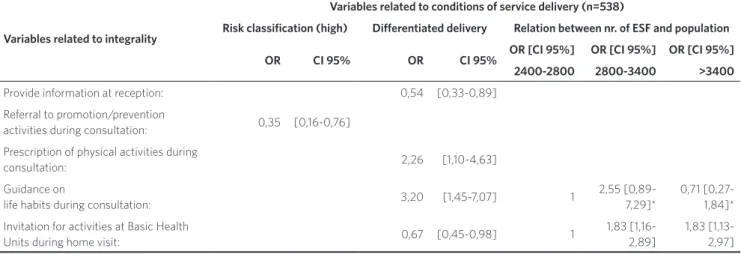
Tables 4 and 5 describe the estimation of the measure of association – Odds Ratio (OR) – for each variable that appeared as-sociated to integrality interventions. For the conditions of service delivery (table 4), it is observed that the PHUs that have differen-tiated delivery have less chances to provide information during reception (OR=0.54) and to invite to activities at PHU during home visit (OR=0.67), when compared to the units that do not have differentiated delivery. However, they have twice as many chances
to prescribe physical activities during the consultation (OR=2.26) and three times more chances to provide guidance on life habits during the consultation (OR=3.2). The analysis of risk classification shows that PHUs with high risk classification have less chance to refer the users to prevention/ promotion activities during the consultation (OR=0.35) when compared to PHUs with medium/low classification risk.
dose-response gradient is observed: the higher the number of users per team, the lower the chance to accomplish integral-ity interventions. But one cannot state that there has been a significant difference, since
the confidence interval of the OR estima-tion contains the number 1, indicating that at some point the groups are equal. Probably the difference observed for value -p(<0.05) is due to the sample size.
Table 4. Estimation of measure of association between integrality interventions and conditions of health services delivery – univariate analysis, Belo Horizonte (MG). Brazil, 2015
Variables related to integrality
Variables related to conditions of service delivery (n=538)
Risk classiication (high) Diferentiated delivery Relation between nr. of ESF and population
OR CI 95% OR CI 95% OR [CI 95%] OR [CI 95%] OR [CI 95%]
2400-2800 2800-3400 >3400
provide information at reception: 0,54 [0,33-0,89]
referral to promotion/prevention
activities during consultation: 0,35 [0,16-0,76]
prescription of physical activities during
consultation: 2,26 [1,10-4,63]
Guidance on
life habits during consultation: 3,20 [1,45-7,07] 1
2,55 [0,89-7,29]*
0,71 [0,27-1,84]*
invitation for activities at Basic Health
Units during home visit: 0,67 [0,45-0,98] 1
1,83 [1,16-2,89]
1,83 [1,13-2,97]
Source: authors’ elaboration.
*despite value p <0.05, conidence intervals (Ci 95%) do not show to be signiicant.
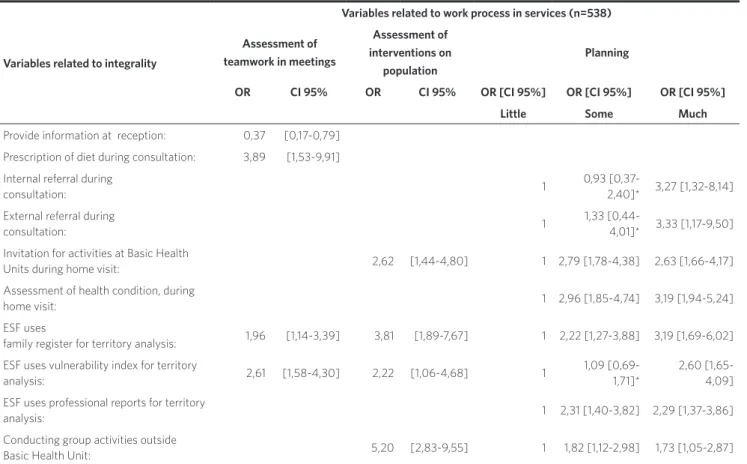
Table 5 describes the estimation of the measure of association (OR) for each vari-able related to work process that appears associated to integrality interventions. ‘Planning’ was the variable mostly associ-ated to integrality interventions, being im-portant to eight of them. For most integrality interventions, the more planning there is, higher are the chances that the PHU will accomplish them. PHU that has satisfactory planning has three times more chances to accomplish internal (OR=3.27) and external (OR=3.33) referrals, and to make the assess-ment of health condition during home visit (OR=3.19), when compared to the PHU with little planning. The variable ‘assessment of interventions on population’ has appeared
the family register (OR=1.96) and the vulner-ability index (OR=2.61), when compared to
the PHU whose professionals do not make teamwork assessment in meetings.
Table 5. Estimation of OR between integrality interventions and work process in health services –univariate analysis, Belo Horizonte (MG). Brazil, 2015
Variables related to integrality
Variables related to work process in services (n=538)
Assessment of teamwork in meetings
Assessment of interventions on
population
Planning
OR CI 95% OR CI 95% OR [CI 95%] OR [CI 95%] OR [CI 95%]
Little Some Much
provide information at reception: 0,37 [0,17-0,79]
prescription of diet during consultation: 3,89 [1,53-9,91]
internal referral during
consultation: 1
0,93
[0,37-2,40]* 3,27 [1,32-8,14]
external referral during
consultation: 1
1,33
[0,44-4,01]* 3,33 [1,17-9,50]
invitation for activities at Basic Health
Units during home visit: 2,62 [1,44-4,80] 1 2,79 [1,78-4,38] 2,63 [1,66-4,17]
assessment of health condition, during
home visit: 1 2,96 [1,85-4,74] 3,19 [1,94-5,24]
eSF uses
family register for territory analysis: 1,96 [1,14-3,39] 3,81 [1,89-7,67] 1 2,22 [1,27-3,88] 3,19 [1,69-6,02]
eSF uses vulnerability index for territory
analysis: 2,61 [1,58-4,30] 2,22 [1,06-4,68] 1
1,09 [0,69-1,71]*
2,60 [1,65-4,09]
eSF uses professional reports for territory
analysis: 1 2,31 [1,40-3,82] 2,29 [1,37-3,86]
Conducting group activities outside
Basic Health Unit: 5,20 [2,83-9,55] 1 1,82 [1,12-2,98] 1,73 [1,05-2,87]
Source: authors’ elaboration.
* despite value p <0.05, conidence intervals (Ci 95%) do not show to be signiicant.
Discussion
This research has found statistically signifi-cant associations between integrality inter-ventions and conditions of service delivery, and between work processes involving the variables assessment and planning, with highlight on the latter.
The research data confirm the strong tendency to the feminization of the work
force at PHC, with 89.7% of respondents to the questionnaire being women, which is confirmed in various researches (ELLERY; PONTES; LOIOLA, 2013; SEIDL et al., 2014).
Qualidade da Atenção Básica – PMAQ-AB), whose information has guided this research. The articles published in the journal ana-lyzed data from 2012, covering the national territory and producing descriptive analyses that are related in several aspects to the data presented here.
Regarding the time span working at the EqSFs, the data extracted from the PMAQ-AB 2012 indicate that in munici-palities with more than 500,000 inhabit-ants, among professionals with university degree, 21.1% have less than one year and 27.3% have more than six years in the job
(SEIDL ET AL., 2014); the national average is
con-siderably above that found in the district researched, which is peripheral in relation to the Central-Southern region of the mu-nicipality. Difficulty retaining physicians, which is confirmed by the strong presence of professionals of the Program More Doctors (Programa Mais Médicos) temporarily com-posing the teams, stresses the dimension of the problem. As integrality presupposes the continuity of care, having difficulty retaining professionals in this region may hinder the effectiveness of the assistance (SEIDL ET AL., 2014).
The difficulty with the retention of phy-sicians in the district is to be highlighted; according to information of the district management, it was the one with the highest need of physicians from the Program More Doctors. Considering that ten physicians were excluded from the sample due to having been for less than three months at the unit, the percentage of physicians with less than one year raises to 61.8%. Several studies point out that among the crucial factors con-tributing to this situation are the inadequate working conditions (MAGNANO; PIERANTONI, 2015).
Ney and Rodrigues (2012, P. 1305) highlight that
among health professionals, physicians have more job offers in the private sector and this contributes to the turnover at SUS. They also point out that the system lacks on offering a medical career and providing a ‘perspective for the future’, thus hindering the retention
of physicians. From the point of view of in-tegral care, this turnover hampers the bond and continuity of work with the population involved.
Regarding the conditions of service deliv-ery and integrality, it is necessary to highlight the excessive number of population involved, in Brazil, when compared to other countries
(TESSER; NORMAN, 2014). While the country
pres-ents a limit of 4,500 users per EqSF, other countries with less vulnerable population have quite lower limits: Spain with 2,500; United Kingdom with 2,000; and Portugal with 1,500 (GIOVANELLA ET AL., 2008). It is evident
that a reduction on the size of the population involved could result in improvements on in-tegral care, as indicated on table 3.
The article by Cruz et al. (2014) sought to
characterize the use of management tools for planning and self-assessment by the EqSFs, drawing on data from PMAQ-AB. The authors understand that planning and self-assessment are strategic management tools for the quality improvement of health care. They observe that the institutionaliza-tion of assessment has been contributing to the incorporation of a ‘reflective and peda-gogical practice’ in support to management and to changes in the institutional culture.
The results shown in the above men-tioned article indicate that the frequency of answers concerning activities planning is lower in municipalities with up to 50,000 inhabitants, and higher in those with more than 100,000 inhabitants. Yet in the con-struct self-assessment its occurrence was mentioned by over 80% of the EqSFs, except for the Central-Western region.
2011), emphasizing the role of
communica-tion, which is a competence still neglected in health education (ELLERY; PONTES; LOYOLA, 2013).
Thus, team meetings are crucial to guar-antee the persistence of participative and engaged management from the members of the EqSFs. This study has found this relation between assessment and planning tools and integral care, with a stress on planning. It has also found the institutionalization of meet-ings between the EqSFs, as well as between the EqSFs and the Nucleus of Support to Family Health (Núcleo de Apoio à Saúde da Família – Nasf ) and the mental health teams, with a monthly frequency for the meetings between teams.
Medina et al. (2014) sought to describe
the promotion and prevention inter-ventions of the EqSFs captured in the PMAQ-AB. According to those authors, Noncommunicable Diseases (NCDs) repre-sent 70% of the morbidity in Brazil. However, a small number of studies assess the effec-tiveness of promotion interventions in PHC. Those interventions require a commitment that continues over time. The authors con-sider it important to focus on interventions aiming at changes in the collective lifestyle, directed to environments like schools and the communities. Activities at schools are mentioned in that research by 75% of the EqSFs (MEDINA ET AL., 2014). Even so, the results
show a low institutionalization of promotion interventions in FHS. It is known that health promotion is a highly controversial theme in public health in Brazil (FERREIRA NETO ET AL., 2013) and that the understanding of
manag-ers is still very much centered on preventive interventions directed to changes in lifestyle
(FRACOLLI; GOMES; GRYSCHEK, 2014); thus, this area
requires greater advancements. This re-search has focused on health promotion in the scope of the interventions of the EqSFs, associating them with integrality, which is a central principle of SUS. Working condi-tions as well as work processes, consolidated in the assessment and planning tools, appear
as variables with significant correlation with integral care interventions in PHC.
Conclusion
The external assessment of PMAQ-AB, unlike the present study, searched docu-ments that would prove such activities and verified a disparity between answers and documentary evidence (CRUZ ET AL., 2014). This
research used only the answers to the ques-tionnaires, with no search of documents to prove the activities, which is a limitation of this study.
In short, integral care interventions have a double association, with the conditions of service delivery and with the management of work processes of the EqSFs, in the PHC. Therefore, advancements in this direction should involve both the improvement of the conditions of service delivery, with the required investment, and permanent educa-tion of teams, aiming at the use of manage-ment tools. In Brazil there is still a long way to go when comparing with countries where there is funding for health services with an effectively universal scope, like England
(DUNCAM ET AL., 2015).
In the district under study, there is a highlight concerning the difficulty to retain physicians in the EqSFs, associated to the precariousness of working conditions. This is an aspect of no secondary character, and it must be handled aiming to strengthen inte-gral care in FHS. In parallel to this, it is im-portant to progressively reduce the number of families per EqSF; in Brazil, the amount of EqSFs is twice as big as in European coun-tries, and it must be reminded that besides having less poor populations, those coun-tries have basic sanitation issues far better resolved. Thus, the problem of retention of physicians will not be solved separately, without general improvement of working conditions in PHC.
of the relation between work processes and integral care interventions (CRUZ ET AL., 2014). In
this aspect, planning has been revealed as an essential tool for the qualification of work in primary care and it should be stimulated through strategies of continuing education, institutional support, and the increase of the attention to risks focusing on spontane-ous demand, which restricts the necessary amount of time for team meetings to over-come the model ‘transfer of cases’. In con-clusion, both working conditions and work processes are factors that may either favor or hinder integrality interventions in PHC.
Colaborators
The authors João Leite Ferreira Neto and Graziella Lage Oliveira have substantially contributed to the design, planning, analysis and interpretation of data; drafting and criti-cal review of contents; and approval of final version of manuscript. Natália de Oliveira Viana and Luiz Guilherme Mafle Ferreira Duarte have substantially contributed to the analysis and interpretation of data; criti-cal review of contents; and approval of final version of manuscript.
References
BAPTISTA, T. W. F.; FAUSTO, M. C. R.; CUNHA, M. S. Análise da produção bibliográfica sobre atenção primária à saúde no Brasil em quatro periódicos selecionados. Physis, Rio de Janeiro, v. 19, n. 4, p 1007-1028, 2009.
BRASIL. Ministério da Saúde. Política Nacional de Atenção Básica. Brasília, DF: Ministério da Saúde, 2012.
CRUZ, M. M. et al. Usos do planejamento e
autoavaliação nos processos de trabalho das equipes de Saúde da Família na Atenção Básica. Saúde em Debate, Rio de Janeiro, v. 38, n. esp., p. 124-139, 2014.
DOMINGOS, C. M. et al. Legislação da atenção básica do Sistema Único de Saúde: uma análise documental.
Cad. Saúde Pública, Rio de Janeiro, v. 32, n. 3, mar. 2016.
DUNCAM, P. et al. “Health for All” in England and
Brazil? International Journal of Health Services, Rockville Pike, v. 45, n. 3, p. 545-563, 2015.
ELLERY, A. E.; PONTES, R. J.; LOIOLA, F. A. Campo comum de atuação dos profissionais da Estratégia Saúde da Família: um cenário em construção. Physis, Rio de Janeiro, v. 23, n. 2, p. 415-437, 2013.
FERREIRA NETO, J. L. et al. Processos da construção da Política Nacional de Promoção da Saúde. Cad. Saúde Pública, Rio de Janeiro, v. 29, n. 10, p. 1997-2007, 2013.
FRACOLLI, L. A.; GOMES, M. F.; GRYSCHEK, A. L. Percepções de gestores municipais sobre ações de promoção da saúde: em foco os agentes comunitários.
Saúde Soc., São Paulo, v. 23, n. 3, p. 919-927, jul./set. 2014.
Primária à Saúde. In: GIOVANELLA, L. et al. (Org.).
Políticas e sistema de saúde no Brasil. Rio de Janeiro: Fiocruz; Cebes, 2008. p. 575-625.
GIOVANELLA, L. et al. (Org.). Políticas e sistema de saúde no Brasil. Rio de Janeiro: Fiocruz; Cebes, 2008.
HARZHEIM, E. Atenção primária à saúde e as redes integradas de atenção à saúde. In: ORGANIZAÇÃO PAN-AMERICANA DA SAÚDE (OPAS). Inovando o papel da Atenção Primária nas redes de Atenção à Saúde: resultados do laboratório de inovação em quatro capitais brasileiras. Brasília, DF: Organização Pan-Americana da Saúde, 2011. p. 45-54.
KRINGOS, D. et al. The strength of primary care in Europe: an international comparative study. British Journal of General Practice, Londres, v. 63, n. 616, p. 742-750, nov. 2013.
MAGNANO, C.; PIERANTONI, C. R. Dificuldades e estratégias de enfrentamento referentes à gestão do trabalho na Estratégia Saúde da família, na perspectiva dos gestores locais: a experiência dos municípios do Rio de Janeiro (RJ) e Duque de Caxias (RJ). Saúde em Debate, Rio de Janeiro, v. 39, n. 104, p. 9-17, jan./mar. 2015.
MATTOS, R. A. Princípios do Sistema Único de Saúde (SUS) e a humanização das práticas de saúde. Interface (Botucatu), Botucatu, v. 13, supl. 1, p. 771-780, 2009.
MEDINA, M. G. et al. Promoção da saúde e prevenção de doenças crônicas: o que fazem as equipes de Saúde da Família? Saúde em Debate, Rio de Janeiro, v. 38, n. esp., p. 69-82, out. 2014.
NEY, M. S.; RODRIGUES, P. H. A. Fatores críticos para a fixação do médico na Estratégia Saúde da Família.
Physis, Rio de Janeiro, v. 22, n. 4, p. 1293-1311, 2012.
NORMAN, A.; TESSER, C. Acesso ao cuidado na Estratégia Saúde da Família: o equilíbrio entre demanda espontânea e prevenção/promoção da saúde.
Saúde Soc., São Paulo, v. 24, n.1, p. 165-179, 2015.
PEDUZZI, M. Equipe multiprofissional de saúde: conceito e tipologia. Rev. Saúde Pública, São Paulo, v. 35, n. 1, p. 103-109, 2001.
PEDUZZI, M. et al. Trabalho em equipe na perspectiva da gerência de serviços de saúde: instrumentos para a construção da prática interprofissional. Physis, Rio de Janeiro, v. 21, n. 2, p. 629-646, 2011.
SEIDL, H. et al. Gestão do trabalho na Atenção Básica em Saúde: uma análise a partir das equipes participantes do PMAQ-AB. Saúde debate, Rio de Janeiro, v. 38, n. esp., p. 94-108, out. 2014.
TESSER, C.; NORMAN, A. Repensando o acesso ao cuidado na Estratégia Saúde da Família. Saúde Soc., São Paulo, v. 23, n. 3, p. 869-883, 2014.
received for publication: June, 2016 Final version: october, 2016 Conlict of interests: non-existent