Living near the port area is associated with physical
inactivity and sedentary behavior
Morar perto da área portuária está associado à inatividade física e
comportamento sedentário
Evandro Fornias Sperandio
I, Rodolfo Leite Arantes
II, Tsai Ping Chao
III, Marcello Romiti
II, Antônio Ricardo de Toledo Gagliardi
II,
Victor Zuniga Dourado
IVLaboratory of Epidemiology and Human Movement (Epidemiologia e Movimento Humano, EPIMOV), Universidade Federal de São
Paulo, Santos (SP), Brazil
ABSTRACT
CONTEXT AND OBJECTIVE: The impact of the port of Santos, Brazil, on the population’s health is unk-nown. We aimed to evaluate the association between living near the port area and physical inactivity and sedentary behavior.
DESIGN AND SETTING: Cross-sectional study developed at a university laboratory and a diagnostic clinic.
METHODS: 553 healthy adults were selected and their level of physical activity in daily life was assessed using accelerometers. Multiple linear and logistic regressions were performed using physical inactivity and sedentary behavior as the outcomes and living near the port area as the main risk factor, with adjustments for the main confounders.
RESULTS: Among all the participants, 15% were resident near the port area. They took 699 steps/day and presented, weekly, 2.4% more sedentary physical activity, 2.0% less time in standing position and 0.9% more time lying down than residents of other regions. Additionally, living near the port area increased the risk of physical inactivity by 2.50 times and the risk of higher amounts of sedentary behavior (≥ 10 hours/day) by 1.32 times.
CONCLUSION: Living near the port of Santos is associated with physical inactivity and higher sedentary behavior among adults, regardless of confounders. The reasons for this association should be investigated in longitudinal studies.
RESUMO
CONTEXTO E OBJETIVOS: O impacto do porto de Santos, no Brasil, sobre a saúde da população é desco-nhecido. Nosso objetivo foi avaliar a associação entre viver nas proximidades da área portuária e a inativi-dade física e comportamento sedentário.
TIPO DE ESTUDO E LOCAL: Estudo transversal desenvolvido em laboratório universitário e em uma clí-nica de diagnósticos.
MÉTODOS: Foram selecionados 553 adultos saudáveis e seu nível de atividade física na vida diária foi ava-liado usando acelerômetros. Foi realizada regressão linear múltipla e logística usando a inatividade física e o comportamento sedentário como desfechos e morar perto da área portuária como o fator de risco principal, ajustando para os principais confundidores.
RESULTADOS: Entre todos os participantes, 15% residiam na área portuária. Estes deram 699 passos/dia a menos e apresentaram, por semana, 2,4% da atividade física mais sedentária, 2,0% menos tempo em pé e passaram 0,9% mais tempo deitados do que os residentes das demais regiões. Além disso, morar nas proximidades da área portuária aumentou o risco de inatividade física em 2,5 vezes, assim como o risco de maior comportamento sedentário (≥ 10 horas/dia) em 1,32 vezes.
CONCLUSÃO: Morar perto do porto de Santos tem associação com a inatividade física, assim como o au-mento do comportaau-mento sedentário em adultos, independentemente de fatores de confusão. As razões para tal associação devem ser investigadas em estudos longitudinais.
IPT, PhD. Associate Researcher, Department
of Human Movement Sciences, Universidade Federal de São Paulo (Unifesp), Santos (SP), Brazil.
IIMD, PhD. Researcher, Department of
Cardiovascular Medicine, Angiocorpore Institute of Cardiovascular Medicine, Santos (SP), Brazil.
IIIPT. Specialization Student, Instituto do Coração
(InCor), São Paulo (SP), Brazil.
IVPT, PhD. Associate Professor, Department of
Human Movement Sciences, Universidade Federal de São Paulo (Unifesp), Santos (SP), Brazil. Visiting Scholar, Bernard Lown Scholars in Cardiovascular Health Program, Harvard T.H. Chan School of Public Health, Boston, United States.
KEY WORDS: Environmental health. Motor activity. Sedentary lifestyle. Social class. Risk factors.
PALAVRAS-CHAVE: Saúde ambiental. Atividade motora. Estilo de vida sedentário. Classe social.
INTRODUCTION
Historically, ports are considered to be engines of economic development for the cities and regions where they are located. he port of Santos in Brazil is one of the most important ports
in Latin America due to its size and export capacity.1 his is the
main gateway for incoming and outgoing products in this coun-try. Despite boosting the economy, it is known that ports cause a negative impact on the health of residents of the surrounding
areas.2 Living near the port area is associated with low
socioeco-nomic status,3 and the pollution of the port increases the risk of
developing respiratory4 and cardiovascular disease.5
According to the global recommendations on physical activ-ity for health, “adults aged 18-64 should do at least 150 minutes of moderate-intensity aerobic physical activity throughout the week or do at least 75 minutes of vigorous-intensity aerobic physi-cal activity throughout the week or an equivalent combination of
moderate and vigorous-intensity activity.”6 hus, physical
inactiv-ity is characterized as failure to reach the recommendations
men-tioned above.7 Sedentary behavior, in turn, can be deined as “any
wakeful behavior characterized by energy expenditure of 1.5 or fewer metabolic equivalent tasks (METs) while in a sitting or
reclin-ing posture”.8 It is well known that physical inactivity is related to
health impairments, but sedentary behavior has recently emerged as a new independent risk factor for chronic diseases as well as for
mortality, regardless of moderate-to-vigorous physical activity.9-14
Examples of sedentary behavior include watching television,
sit-ting, playing video games and using computers.15 Current studies
have been investigating associations of physical activity and sed-entary behaviors separately or combined.
Our previous results showed that the proportion of physically inactive subjects in a sample in the city of Santos was between 14% and 20% and that there was an association between physi-cal inactivity and restrictive lung patterns detected by
spirom-etry.16,17 he level of physical activity in daily life is inluenced
by the physical environment in which subjects live, with their
social and individual correlates,18 but may also be related to
chronic exposure to air pollutants. he vicinity of the port area in Santos seems to be a violent area with few or no safe public spaces where people can perform physical activities. Moreover, it is a highly polluted area, where the annual average levels of particulate matter grossly exceed what is recommended by the
World Health Organization.19
Information about the impact of the port of Santos on the popu-lation’s health is scarce, especially in relation to the level of physical activity within daily life and sedentary behavior directly evaluated by means of triaxial accelerometers. Our hypothesis was that liv-ing in neighborhoods close to the port of Santos would be associ-ated with higher prevalence of physical inactivity and increased levels of sedentary behavior, regardless of the main confounders.
OBJECTIVE
We aimed to evaluate the association between living near the port of Santos and physical inactivity and sedentary behaviors among adults.
METHODS
Participants and design
Five hundred and ity-three adults (≥ 20 years of age) were
selected from the Epidemiology and Human Movement Study, i.e. the EPIMOV (Estudo Epidemiológico sobre o Movimento Humano) study. Briely, the EPIMOV study is an ongoing cohort study with the primary objective of investigating the longitudinal association of sedentary behaviors and physical inactivity with occurrences of hypokinetic diseases, especially cardiorespiratory and musculoskeletal diseases. he present study is a cross-sec-tional study from the irst year of the EPIMOV study. he vol-unteers who participated in it were recruited through publicity in social networks, folders displayed in the universities of the region, local magazines and newspapers.
We divided the participants into two groups: people residing near the port area and people residing in other surrounding neigh-borhoods within the metropolitan area of Santos. We used the map of the city to select residents of neighborhoods that are adjacent to the port area. We deined the participants’ socioeconomic level according to the mean income of each neighborhood based on oi-cial documents held by the city of Santos, which include a map of the city according to the average income of heads of households. he participants were divided into three monthly income levels (i.e. low: R$ 622-1866; moderate: R$ 1866-3732; and high: R$ 3732-6220). In the early clinical evaluation, personal and demographic data were collected. In addition, the participants answered the physical
activity readiness questionnaire20 in order to evaluate some possible
risks relating to performing physical exercises such as cardiopulmo-nary exercise testing. hey also answered questions about any history of respiratory illness, based on the American horacic Society
ques-tionnaire,21 to investigate exposure to pollutants, history of asthma
and smoking status; and cardiovascular disease risk stratiication was
performed as speciied by the American College of Sports Medicine.22
We excluded participants with a self-reported diagnosis of heart disease, lung disease or musculoskeletal disorders. We made objective measurements to evaluate physical activity in daily life through triaxial accelerometry and lung function through spi-rometry; and conducted cardiopulmonary exercise testing using a ramp protocol on a treadmill. We also investigated the presence of self-reported major risk factors for cardiovascular disease,
includ-ing age (≥ 45 years for males and ≥ 55 years for females), systemic
coronary heart disease was deined as myocardial infarction or sudden death of father or other male irst-degree relative before 55 years of age, or of mother or other female irst-degree relative before 65 years of age. Education level was reported as illiterate or completed primary, secondary or tertiary education.
Smoking was also investigated through self-reporting. he sub-jects were considered to be smokers if they reported current tobacco
use and had smoked 100 or more cigarettes during their lifetime.23
he participants were informed about the possible risks and discomforts of this study and signed a consent form. he local Ethics Committee for Human Research approved this study (pro-tocol: 186.796).
Anthropometric measurements
Body weight and height were measured, and the body mass index
was calculated in accordance with standardized methods.24
Spirometry
Spirometry was performed using a handheld spirometer (Quark PFT/CPET, Cosmed, Pavona di Albano, Italy) in accordance
with the criteria established by the American horacic Society.25
he forced expiratory volume in the irst second (FEV1), forced
vital capacity (FVC) and FEV1/FVC ratio were quantiied. he
pre-dicted values were calculated using national reference equations.26
Cardiorespiratory itness
he maximum/symptom-limited exercise capacity was assessed dur-ing cardiopulmonary exercise testdur-ing on a treadmill (ATL, Inbrasport, Curitiba, Brazil), following a ramp protocol. Ater 3 minutes at rest, the speed and inclination were automatically incremented according
to the estimated maximal oxygen consumption (V’O2max), with the
aim of completing the test in about 10 minutes.27,28 Cardiovascular,
ventilatory and metabolic variables were analyzed breath by breath, using a gas analyzer (Quark PFT, Cosmed, Pavona di Albano, Italy).
Oxygen uptake (V’O2), carbon dioxide production (V’CO2), minute
ventilation (V’E), and heart rate were monitored throughout the test.
he data were iltered every 15 seconds for further analysis. Peak V’O2
was deined as the arithmetic average of the last 15 seconds at the end of the incremental phase of the cardiopulmonary exercise testing.
Accelerometer-based sedentary behavior and physical activity in daily life
Sedentary behavior and physical activity in daily life were evalu-ated using a previously validevalu-ated triaxial accelerometer (ActiGraph
GT3X+, MTI, Pensacola, FL, USA).29-31 he equipment consisted of
a small, lightweight box (4.6 cm x 3.3 cm x 1.5 cm) that was attached to the waist above the dominant hip, by means of a band (total weight = 19 g). It had the capacity to measure human movement along the vertical, sagittal and mediolateral axes. he participants
were subjected to seven consecutive days of evaluation during their wakeful hours. To be considered valid, data collection days needed to have at least 10 hours of continuous monitoring, starting when the subject woke up, together with absence of excessive counts (> 20,000). We instructed the participants to remove the acceler-ometer at bedtime and during showers and aquatic activities.
Periods with fewer than 60 counts per minutes (cpm) on the accelerometer were interpreted as periods when the accelerometer was not worn, with a tolerance of 2 minutes for periods with some movement, i.e. less than 50 cpm. he thresholds for the intensity of
the physical activity were as follows:32 1. very light (100-759 cpm);
2. light (760-1951 cpm); and 3. moderate-to-vigorous (> 1951 cpm). he minimum quantity and intensity levels for physical activity to be considered as such was 150 minutes of moderate-to-vigorous
physical activity per week.33,34 Individuals who did not reach this
level of physical activity were considered to be physically inactive. he total amount of sedentary behavior was determined based on the number of minutes with counts less than 100. On the other hand, active time was considered to be time spent on activities with
≥ 100 cpm. By means of the inclinometer located inside the
accel-erometer, the time spent in each body position was measured (i.e. reclining during wakeful hours, sitting or standing). he measure-ments were calculated as minutes/week and as percentages of the total time. Sedentary behavior was also assessed as a categorical
variable in accordance with the threshold recently described.13,14
Participants who performed ≥ 10 hours/day of sedentary activities
were classiied in a group with a high amount of sedentary behavior, whereas the group with a low amount was deined as < 10 hours/ day of such activities. Only data from the participants who used the accelerometer for at least four valid days were analyzed.
Statistical analysis
he sample size was calculated in accordance with the prevalence of physical inactivity of around 20% that was observed in previ-ous indings from the EPIMOV study in the metropolitan area
of the city of Santos.16 hrough taking a 99% conidence interval,
it was found that at least 423 participants needed to be enrolled in the present study. We performed the sample size calculation using the free tools available on the website www.openepi.com.
race (i.e. categorized as black, white, mixed, Amerindian or East Asian); education level (i.e. classiied as tertiary educational attain-ment or not); self-reported cardiovascular disease risk factors (i.e. hypertension, diabetes, dyslipidemia, smoking, obesity or
physi-cal inactivity); cardiorespiratory itness (peak V’O2 [ml/min/kg])];
and lung function (FEV1 [liters]). Obesity was categorized as yes or
no (body mass index ≥ 30 or < 30 kg/m2, respectively). he
prob-ability of alpha error was set at 5%.
RESULTS
Fiteen percent (n = 83) of our participants were residents in the port area. hese were signiicantly younger and had higher
socio-economic status (Table 1). However, the univariate analysis showed
that sex, race, anthropometry, lung function, exercise capac-ity, smoking status, physical inactivity and risk of cardiovascular
disease variables were not statistically diferent between residents and non-residents in the vicinity of the port. he prevalences of diabetes mellitus, hypertension and dyslipidemia in this study were similar to those found in population-based studies in Brazil.
he results from the linear multiple regression analysis showed that there was an association between living near the port area and increased sedentary behavior, as evaluated using triaxial accelerom-eters. Other variables such as socioeconomic status, education level and smoking were also signiicant determinants of higher amounts
of sedentary behavior (Table 2). Living in the port area increased
the risk of physical inactivity more than twofold, independently of any other confounder. Age and smoking also increased the risk of physical inactivity, ater adjusting the logistic regression model according to age, gender, education level, socioeconomic status, risk factors for cardiovascular disease, cardiorespiratory itness, lung function and smoking. On the other hand, cardiorespiratory
itness reduced the risk of physical inactivity (Table 3).
Regarding sedentary behavior, 51.7% of our participants
per-formed ≥ 10 h/day of sedentary activities. Living near the port
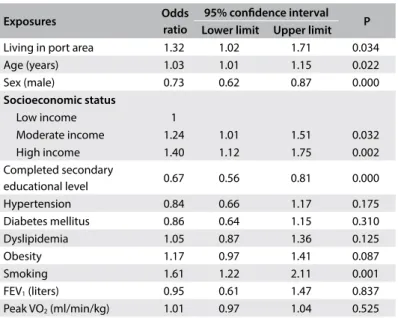
increased the risk of high amounts of sedentary behavior by 32%. In this multiple logistic regression model, age, gender, socioeco-nomic status, education level and smoking were also selected as determinants of high amounts of sedentary behavior. here was a positive association between higher socioeconomic status and
higher amounts of sedentary behavior (Table 4).
hrough multiple regression analysis, the residents of the port area showed higher amounts of sedentary behavior, i.e. less time standing and more time reclining, and also a lower number of steps/day, in comparison with people who did not live in the
port area (Table 5).
DISCUSSION
his study investigated the association between living near the largest port in Latin America and physical inactivity and seden-tary behavior among adults. he associations found indicated that living near the port of Santos increased the risk of physi-cal inactivity and sedentary behavior among adults, regardless of socioeconomic status, education level, cardiovascular risk, lung function or cardiorespiratory itness.
Unlike what we expected, the residents of the port area were younger and had higher socioeconomic status than people who did not live in the port area. hese results contrast with
previ-ously published data. Grobar3 observed that the unemployment
and poverty rates are signiicantly higher in port districts. his disparity is possibly due to a peculiarity of the city of Santos. he neighborhood of Ponta da Praia, one of the neighborhoods with the highest average income of the city, is located very close to one of the main terminals of the port. Nevertheless, living near the port region increased the risk of physical inactivity and seden-tary behavior, regardless of the higher socioeconomic status of
Table 1. General characteristics of the sample Residents in
port area (n = 83)
People who did not live in port area (n = 470)
Age (years)* 41 ± 12 45 ± 14
Sex (%, male/female) 44/56 36/64
Race (%)
White 66.2 73.7
Black 6.0 4.6
Mixed 22.2 19.4
East Asian 5.6 1.0
Amerindian 0 1.3
Weight (kg) 75 ± 19 76 ± 16
Height (m) 1.64 ± 0.11 1.63 ± 0.09
Body mass index (kg/m2) 27 ± 6 28 ± 5
FVC (liters) 3.89 ± 1.16 3.56 ± 1.03
FVC (% pred.) 97 ± 11 94 ± 13
FEV1 (liters) 3.19 ± 0.97 2.89 ± 0.84
FEV1 (% pred.) 96 ± 12 93 ± 13
FEV1/FVC (%) 82 ± 5 81 ± 5
Peak V’O2 (ml/min/kg) 34 ± 11 29 ± 10
Completed secondary
educational level (%) 42.3 50.8
Socioeconomic level (%)
Low income* 13.2 35.6
Moderate income 43.3 34.2
High income* 43.3 18.4
Cardiovascular risk (%) Systemic arterial
hypertension 12.5 18.2
Diabetes mellitus 8.3 11.2
Dyslipidemia 23.6 28.8
Obesity 29.2 36.3
Smoking 6.9 11.3
Physical inactivity† 20.8 21.9
Data presented as mean ± standard deviation or as count and percentage. *P < 0.05: residents of the port area versus residents of other neighborhoods; †Assessed using triaxial accelerometers.
the residents of Ponta da Praia. his inding is interesting because studies have shown that low socioeconomic status groups perform an insuicient amount of physical activity to achieve health
ben-eits.35 Our results suggest that living next to a major port could
afect lifestyle, even among people with privileged socioeconomic
status in relation to Brazilian patterns. herefore, whether living in the port area in Santos is diferent from living in another port area elsewhere in the world remains to be clariied.
Although there was no association between socioeconomic status and physical inactivity, we observed a positive association
Table 2. Results from linear multiple regression analysis on the association between sedentary behavior evaluated using accelerometers and living in the port area
Outcome Living in port area, beta (95% CI) P Other signiicant exposures R2
Sedentary physical activity (hours/week) 13.2 (2.4 – 24.0) 0.045 – 0.024
Sedentary physical activity (%/week) 2.4 (1.1 – 3.7) 0.003
Education level Socioeconomic status
Smoking Peak V’O2
0.067
Time standing (hours/week) -4.4 (-7.0 – -1.8) 0.006
Education level Socioeconomic status
Hypertension Obesity
0.157
Time standing (%/week) -2.0 (-3.3 – -0.7) 0.014
Education level Socioeconomic status
Hypertension Obesity
0.180
Time reclining (hours/week) 1.5 (0.2 – 2.8) 0.074 Smoking
Peak V’O2
0.068
Time reclining (%) 0.9 (0.3 – 1.2) 0.051 Smoking 0.055
Average number of steps/day -699.1 (165.5 – 1232.7) 0.031
Smoking Obesity Peak V’O2
0.079
CI = conidence interval. Models adjusted for age, gender, education level, socioeconomic status, hypertension, diabetes mellitus, dyslipidemia, obesity, cardiorespiratory itness, lung function and smoking.
Table 3. Results from the logistic regression analysis between physical inactivity assessed using accelerometers and factors associated to it (exposures)
Exposures Odds
ratio
95% conidence interval P Lower limit Upper limit
Living in port area 2.50 1.40 4.47 0.002
Age (years) 1.03 1.01 1.04 0.000
Sex (male) 0.69 0.48 1.007 0.055
Socioeconomic status
Low income 1
Moderate income 1.05 0.67 1.66 0.815
High income 1.12 0.68 1.84 0.648
Completed secondary
educational level 1.04 0.70 1.54 0.837
Hypertension 0.78 0.49 1.25 0.313
Diabetes mellitus 1.04 0.60 1.81 0.868
Dyslipidemia 0.85 0.57 1.26 0.423
Obesity 0.97 0.67 1.41 0.979
Smoking 1.87 1.16 3.04 0.010
FEV1 (liters) 1.07 0.59 1.92 0.814
Peak VO2 (ml/min/kg) 0.90 0.86 0.95 0.000
Models adjusted for age, gender, education level, socioeconomic status, hypertension, diabetes mellitus, dyslipidemia, obesity, smoking, lung function and cardiorespiratory itness. FEV1 = forced expiratory volume in the irst second; V’O2 = oxygen uptake.
Table 4. Results from the logistic regression analysis between sedentary behavior assessed by accelerometers and factors associated to it (exposures)
Exposures Odds
ratio
95% conidence interval P
Lower limit Upper limit
Living in port area 1.32 1.02 1.71 0.034
Age (years) 1.03 1.01 1.15 0.022
Sex (male) 0.73 0.62 0.87 0.000
Socioeconomic status
Low income 1
Moderate income 1.24 1.01 1.51 0.032
High income 1.40 1.12 1.75 0.002
Completed secondary
educational level 0.67 0.56 0.81 0.000
Hypertension 0.84 0.66 1.17 0.175
Diabetes mellitus 0.86 0.64 1.15 0.310
Dyslipidemia 1.05 0.87 1.36 0.125
Obesity 1.17 0.97 1.41 0.087
Smoking 1.61 1.22 2.11 0.001
FEV1 (liters) 0.95 0.61 1.47 0.837
Peak VO2 (ml/min/kg) 1.01 0.97 1.04 0.525
between higher socioeconomic status and higher amounts of sed-entary behavior. It has been suggested that the associations between socioeconomic status and sedentary behavior present diferent directions in high-income countries, compared with low and middle-income countries, and that this varies according to the domain of sedentary behavior. Overall, the association between
socioeconomic level and sedentary behavior is inverse.36 However,
Mielke et al.36 observed that this relationship varies according to
the income level of the country. In high-income countries, socio-economic status presented an inverse association with sedentary behavior (efect size: 0.67; 95% CI: 0.62-0.73), whereas a positive relationship was observed in low to middle-income countries (efect size: 1.18; 95% CI: 1.04-1.34). Unlike in high-income countries, in which all indicators of socioeconomic level were negatively associated with sedentary behavior, only resources showed a sig-niicant positive association in low to middle-income countries. Despite the signiicant relationship mentioned above, living in the port area remained a signiicant determinant of higher amounts of sedentary behavior.
Residents near port areas are exposed to increased levels of air pollution due to emissions of particulate matter derived from the exhaust fumes of trucks and ships, and as a result of mechanical processes of milling operations and the ensuing street dust suspensions. Very recent studies have reported on the
inluence of air pollution on decreased physical activity.37-39 In
one of these studies, particulate matter and O3 levels were
cor-related with reduction in physical activity in daily life and the number of steps/day, among patients with chronic obstructive
pulmonary disease (COPD).38 Although air pollution was not
assessed in our study, we believe that this in the port of Santos may partly explain the higher proportion of physically inactive people and larger amount of sedentary behavior among resi-dents of the port area. In fact, a recent large study conducted in Brazil showed that the particulate matter monitoring in the city of Santos is poor and started only in 2011. Moreover, Santos only has two air-monitoring stations and is classiied as hav-ing the sixth highest concentration of particulate matter in the
state of São Paulo, Brazil. he average level of particulate matter
in the metropolitan area of the city of Santos was 37.23 µg/m3
(annual mean) in 2011, which was signiicantly above the lev-els recommended by the World Health Organization. Despite the lack of assessment of particulate air pollution in the present study, it would be rational to suppose that environmental expo-sure to particulate matter may play a major role in the results
presented here.19
Our results also showed that smoking was associated with physical inactivity and with greater amounts of sedentary behavior,
independently. Previous results from the EPIMOV study40
rein-force the indings of the present study. We compared two groups of physically active individuals, one formed by smokers and the other by nonsmokers. Although they performed the same amount of moderate-to-vigorous physical activity, as assessed directly using triaxial accelerometers, and were matched regarding major con-founders, the smokers performed higher amounts of sedentary physical activity and spent more time sitting and lying down per week. Like in the present study, other recent studies have reported
an association between smoking and physical inactivity.41,42
As we expected, cardiorespiratory itness was inversely asso-ciated with physical inactivity and living near the port did not alter the risk of physical inactivity. Ecological models for physical activity and sedentary behavior identiied inluences from several attributes, including individual components, the social environ-ment, the physical environment and public policy. Some of the main barriers preventing physical activity are lack of motivation,
awareness and time, and lack of structure for physical activity.43
People may have the necessary knowledge, skills, attitudes and motivation to be physically active, but if they do not have access to the necessary opportunities, they may be restricted or prohib-ited from being active. Building or enhancing facilities for physical activity can require a large amount of time and resources. Public health policies and intervention programs designed with a focus on increasing the level of physical activity and decreasing sed-entary behavior are probably necessary for this region of Santos. Regarding the determinants of physical inactivity and sedentary
Table 5. Comparison between residents of the port area and people living in other areas regarding sedentary behaviors and the number of steps/day
Variables People living in other areas Residents of port area
Median Percentile 5 Percentile 95 Median Percentile 5 Percentile 95
Sedentary physical activity (h/week)* 70.73 40.22 152.22 79.50 42.31 160.07
Sedentary physical activity (%/week)* 75.30 61.30 88.70 77.40 64.90 90.87
Time standing (h/week)* 37.87 17.20 65.44 33.68 12.41 57.52
Time standing (%/week)* 21 9 34 20 7 34
Time spent lying down (h/week)* 6.31 1.48 22.93 7.86 2.07 24.35
Time spent lying down (%)* 4 1 13 4 1 17
Number of steps/day* 7,646 3,584 13,249 7,215 3,410 12,569
behavior, cohort studies are needed to investigate the causes of the associations of physical inactivity and greater amounts of seden-tary behavior with living near the port area of Santos.
his study has limitations that need to be described. he cross-sectional design did not allow us to establish any relationship between cause and efect. However, our objective was to evaluate the association between living near the port area of Santos and physical inactivity and sedentary behavior. We found that these associations were consistent. Our indings may guide new research questions towards identifying other determinants of physical inac-tivity and sedentary behavior relating to major ports.
CONCLUSIONS
Living near the largest port in Latin America, located in the city of Santos, Brazil, is associated with physical inactivity and seden-tary behavior among adults, regardless of socioeconomic status, education level, cardiovascular risk, lung function or cardiorespi-ratory itness. Whether this association is related to environmen-tal exposure and/or to lack of equipment for physical activity in this region should be investigated in cohort studies.
REFERENCES
1. Torres RJ, Abessa DMS, Santos FC, et al. Efects of dredging operations on sediment quality: contaminant mobilization in dredged sediments from the Port of Santos, SP, Brazil. Journal of Soils and Sediments. 2009;9(5):420-32. Available from: http://link.springer.com/article/10.1007/s11368-009-0121-x. Accessed in 2016 (Nov 22).
2. Bezerra MGV, Rigotto RM, Pessoa VM, Silva FVE. Implicações do desenvolvimento econômico no trabalho, ambiente e saúde em comunidades portuárias no Ceará, Brasil [ The implications of economic development on work, the environment and health in port communities in the State of Ceará, Brazil]. Ciên Saúde Coletiva. 2014;19(10):4023-30.
3. Grobar LM. The economic status of areas surrounding major U.S. container ports: evidence and policy issues. Growth and Change. 2008;39(3):497-516. Available from: http://onlinelibrary.wiley.com/ doi/10.1111/j.1468-2257.2008.00435.x/abstract. Accessed in 2016 (Nov 22).
4. Ripabelli G, Tamburro M, Sammarco ML, de Laurentiis G, Bianco A. Asthma prevalence and risk factors among children and adolescents living around an industrial area: a cross-sectional study. BMC Public Health. 2013;13:1038.
5. Yau PS, Lee SC, Cheng Y, et al. Contribution of ship emissions to the ine particulate in the community near an international port in Hong Kong. Atmospheric Research. 2013;124:61-72. Available from: http://www. sciencedirect.com/science/article/pii/S0169809513000033. Accessed in 2016 (Nov 22).
6. World Health Organization. Global Recommendation on Physical Activity for Health. Geneva: World Health Organization; 2010. Available from:
http://apps.who.int/iris/bitstream/10665/44399/1/9789241599979_ eng.pdf. Accessed in 2016 (Nov 22).
7. Garber CE, Blissmer B, Deschenes MR, et al. American College of Sports Medicine position stand. Quantity and quality of exercise for developing and maintaining cardiorespiratory, musculoskeletal, and neuromotor itness in apparently healthy adults: guidance for prescribing exercise. Med Sci Sports Exerc. 2011;43(7):1334-59.
8. Owen N, Leslie E, Salmon J, Fotheringham MJ. Environmental determinants of physical activity and sedentary behavior. Exerc Sport Sci Rev. 2000;28(4):153-8.
9. Rosenberg DE, Lee IM, Young DR, et al. Novel strategies for sedentary behavior research. Med Sci Sports Exerc. 2015;47(6):1311-5. 10. Gibbs BB, Hergenroeder AL, Katzmarzyk PT, Lee IM, Jakicic JM. Deinition,
measurement, and health risks associated with sedentary behavior. Med Sci Sports Exerc. 2015;47(6):1295-300.
11. Young DR, Reynolds K, Sidell M, et al. Efects of physical activity and sedentary time on the risk of heart failure. Circ Heart Fail. 2014;7(1):21-7. 12. Després JP. Physical Activity, Sedentary Behaviours, and Cardiovascular Health: When Will Cardiorespiratory Fitness Become a Vital Sign? Can J Cardiol. 2016;32(4):505-13.
13. Pandey A, Salahuddin U, Garg S, et al. Continuous Dose-Response Association Between Sedentary Time and Risk for Cardiovascular Disease: A Meta-analysis. JAMA Cardiol. 2016;1(5):575-83.
14. Lee PH. Examining Non-Linear Associations between Accelerometer-Measured Physical Activity, Sedentary Behavior, and All-Cause Mortality Using Segmented Cox Regression. Front Physiol. 2016;7:272. 15. Owen N, Healy GN, Matthews CE, Dunstan DW. Too much sitting: the
population health science of sedentary behavior. Exerc Sport Sci Rev. 2010;38(3):105-13.
16. Sperandio EF, Arantes RL, Matheus AC, et al. Distúrbio ventilatório restritivo sugerido por espirometria: associação com risco cardiovascular e nível de atividade física em adultos assintomáticos [Restrictive pattern on spirometry: association with cardiovascular risk and level of physical activity in asymptomatic adults]. J Bras Pneumol. 2016;42(1):22-8. 17. Sperandio EF, Arantes RL, da Silva RP, et al. Screening for physical inactivity
among adults: the value of distance walked in the six-minute walk test. A cross-sectional diagnostic study. Sao Paulo Med J. 2016;134(1):56-62. 18. Giles-Corti B, Donovan RJ. The relative inluence of individual, social
and physical environment determinants of physical activity. Soc Sci Med. 2002;54(12):1793-812.
19. Vormittag EMPAA, Rodrigus CG, Miranda MJ, et al. Avaliação do impacto da poluição atmosférica no estado de São Paulo sob a visão da saúde. São Paulo: Instituto Saúde e Sustentabilidade; 2013. Available from: http://www.vereadornatalini.com.br/PDF/Documentoinaldapesqui sapadrao_2409FINALsitev1.pdf. Accessed in 2016 (Nov 22). 20. Thomas S, Reading J, Shephard RJ. Revision of the Physical Activity
Readiness Questionnaire (PAR-Q). Can J Sport Sci. 1992;17(4):338-45. 21. Ferris BG. Epidemiology Standardization Project (American Thoracic
22. Thompson PD, Arena R, Riebe D, Pescatello LS; American College of Sports Medicine. ACSM’s new preparticipation health screening recommendations from ACSM’s guidelines for exercise testing and prescription, ninth edition. Curr Sports Med Rep. 2013;12(4):215-7. 23. Santos JDP, Silveira DV, Oliveira DF, Caiafa WT. Instrumentos para
avaliação do tabagismo: uma revisão sistemática [Instruments used to evaluate smoking habits: a systematic review]. Ciên Saúde Coletiva. 2011;16(12):4707-20.
24. Lohman TG, Roache AF, Martorell R. Anthropometric standardization reference manual. Champaign: Human Kinetics Books; 1991. 25. Miller MR, Hankinson J, Brusasco V, et al. Standardisation of spirometry.
Eur Respir J. 2005;26(2):319-38.
26. Pereira CAC, Neder JA. Diretrizes para testes de função pulmonar. Jornal Brasileiro de Pneumologia. 2002;28(Supl 3):s1-s238. Available from: http://www.jornaldepneumologia.com.br/detalhe_suplemento. asp?id=45. Accessed in 2016 (Nov 22).
27. Hansen JE, Sue DY, Wasserman K. Predicted values for clinical exercise testing. Am Rev Respir Dis. 1984;129(2 Pt 2):S49-55.
28. Porszasz J, Casaburi R, Somfay A, Woodhouse LJ, Whipp BJ. A treadmill ramp protocol using simultaneous changes in speed and grade. Med Sci Sports Exerc. 2003;35(9):1596-603.
29. Troiano RP, Berrigan D, Dodd KW, et al. Physical activity in the United States measured by accelerometer. Med Sci Sports Exerc. 2008;40(1):181-8. 30. Brooks AG, Gunn SM, Withers RT, Gore CJ, Plummer JL. Predicting
walking METs and energy expenditure from speed or accelerometry. Med Sci Sports Exerc. 2005;37(7):1216-23.
31. Trost SG, Way R, Okely AD. Predictive validity of three ActiGraph energy expenditure equations for children. Med Sci Sports Exerc. 2006;38(2):380-7.
32. Matthew CE. Calibration of accelerometer output for adults. Med Sci Sports Exerc. 2005;37(11 Suppl):S512-22.
33. American College of Sports Medicine. ACSM’s guidelines for exercise testing and prescription. 8th ed. Philadelphia: Lippincott Williams &
Wilkins; 2009.
34. American College of Sports Medicine Position Stand. The recommended quantity and quality of exercise for developing and maintaining cardiorespiratory and muscular itness, and lexibility in healthy adults. Med Sci Sports Exerc. 1998;30(6):975-91.
35. Lindström M, Hanson BS, Ostergren PO. Socioeconomic diferences in leisure-time physical activity: the role of social participation and social capital in shaping health related behaviour. Soc Sci Med. 2001;52(3):441-51. 36. Mielke GI, Brown WJ, Nunes BP, Silva IC, Hallal PC. Socioeconomic
Correlates of Sedentary Behavior in Adolescents: Systematic Review and Meta-Analysis. Sports Med. 2016. [Epub ahead of print]. 37. Roberts JD, Voss JD, Knight B. The association of ambient air pollution
and physical inactivity in the United States. PLoS One. 2014;9(3):e90143. 38. Alahmari AD, Mackay AJ, Patel AR, et al. Inluence of weather and
atmospheric pollution on physical activity in patients with COPD. Respir Res. 2015;16:71.
39. Li F, Liu Y, Lü J, Liang L, Harmer P. Ambient air pollution in China poses a multifaceted health threat to outdoor physical activity. J Epidemiol Community Health. 2015;69(3):201-4.
40. Sperandio E, Lauria V, Matheus A, et al. Cardiorespiratory itness and peripheral muscle function in physically active adult smokers. European Respiratory Journal. 2014;44(Suppl 58):P4891. Available from: http://erj.ersjournals.com/content/44/Suppl_58/P4891. Accessed in 2016 (Nov 22)
41. Holahan CK, Holahan CJ, Li X. Living With a Smoker and Physical Inactivity: An Unexplored Health Behavior Pathway. Am J Health Promot. 2015;30(1):19-21.
42. Papathanasiou G, Papandreou M, Galanos A, et al. Smoking and physical activity interrelations in health science students. Is smoking associated with physical inactivity in young adults? Hellenic J Cardiol. 2012;53(1):17-25.
43. Mabry RM, Al-Busaidi ZQ, Reeves MM, Owen N, Eakin EG. Addressing physical inactivity in Omani adults: perceptions of public health managers. Public Health Nutr. 2014;17(3):674-81.
Sources of funding: This study received inancial support in the form of a research grant from the São Paulo Research Foundation(FAPESP), in the state of São Paulo, Brazil, grant no. 2011/07282-6
Conlict of interest: The authors declare that they did not have any conlicts of interest regarding this paper
Date of irst submission: June 16, 2016
Last received: September 28, 2016
Accepted: October 12, 2016
Address for correspondence:
Evandro Fornias Sperandio
Departamento de Ciências do Movimento Humano Universidade Federal de São Paulo (Unifesp) Av. Ana Costa, 95
Vila Matias — Santos (SP) — Brasil CEP 11060-001