Employment of meld score for the prediction of survival after liver
Employment of meld score for the prediction of survival after liver
Employment of meld score for the prediction of survival after liver
Employment of meld score for the prediction of survival after liver
Employment of meld score for the prediction of survival after liver
transplantation
transplantation
transplantation
transplantation
transplantation
Emprego do escore
Emprego do escore
Emprego do escore
Emprego do escore
Emprego do escore MELD
MELD
MELD
MELD
MELD para a predição da sobrevivência pós-transplante
para a predição da sobrevivência pós-transplante
para a predição da sobrevivência pós-transplante
para a predição da sobrevivência pós-transplante
para a predição da sobrevivência pós-transplante
hepático
hepático
hepático
hepático
hepático
T
HALESP
AULOB
ATISTA, TCBC-PE
1; B
ERNARDOD
AVIDS
ABAT2; P
AULOS
ÉRGIOV
IEIRADEM
ELO, TCBC-PE
3; L
UIZE
DUARDOC
ORREIAM
IRANDA,
TCBC-SP
4; O
LIVALC
IRILOL
UCENADAF
ONSECA-N
ETO, TCBC-PE
5; A
MÉRICOG
USMÃOA
MORIM,ACBC-PE
6; C
LÁUDIOM
OURAL
ACERDA,
TCBC-PE
7A B S T R A C T
A B S T R A C T
A B S T R A C T
A B S T R A C T
A B S T R A C T
Objective Objective Objective Objective
Objective: To assess the overall accuracy of the preoperative MELD score for predicting survival after liver transplantation (LT) and appraise medium-term (24 months) predictors of survival. MethodsMethodsMethodsMethodsMethods: We conducted a cross-sectional study including patients transplanted by the Department of General Surgery and Liver Transplantation of the Oswaldo Cruz University Hospital, University of Pernambuco, between July 15th, 2003 and July 14th, 2009. We used analysis of area under ROC (receiver operating characteristic)
as a summary measure of the performance of the MELD score and assessed predictors of medium-term survival using univariate and multivariate analysis. ResultsResultsResultsResultsResults: The cumulative survival of three, six, 12 and 24 months of the 208 patients studied was 85.1%, 79.3%, 74.5% and 71.1%, respectively. The preoperative MELD score showed a low discriminatory power for predicting survival after TH. By univariate analysis, we identified intraoperative transfusion of red blood cells (p <0.001) and platelets (p = 0.004) and type of venous hepatocaval anastomosis (p = 0.008) as significantly related to medium-term survival of the patients studied. However, by multivariate analysis only red blood cell transfusion was a significant independent predictor of outcome. Conclusion
Conclusion Conclusion Conclusion
Conclusion: The MELD score showed low overall accuracy for predicting post-transplant survival of patients studied, among which only intraoperative transfusion of red blood cells was identified as an independent predictor of survival in the medium term after TH.
Key words Key words Key words Key words
Key words: Survival analysis. Patients. Organ transplantation. Liver transplantation. Mortality.
Work performed at the Department of General Surgery and Liver Transplantation of the Oswaldo Cruz University Hospital, University of Pernambuco, Recife, Pernambuco, Brazil.
1. Master’s Degree, Health Sciences, Faculty of Medical Sciences and Institute of Biological Sciences, University of Pernambuco - FCM/ICB/UPE; 2. Assistant Professor, Department of Surgical Medicine, FCM/UPE; 3. PhD in Surgery, Federal University of Pernambuco -UFPE; 4. Associate Professor, Department of Surgical Medicine, FCM/UPE; 5. PhD Graduate, Surgery UFPE; 6. Assistant Professor, Department of Surgical Medicine, FCM/UPE; 7. Professor, Department of Surgical Medicine, FCM / UPE.
INTRODUCTION
INTRODUCTION
INTRODUCTION
INTRODUCTION
INTRODUCTION
L
iver transplantation (LT) is currently the most effective
treatment for patients with terminal chronic liver disease.
However, the shortage of liver grafts persists as the main
limiting factor for its development
1. In order to reduce
the number of deaths on the waiting list
2,3and eliminate
possible confounding factors related to the chronological
system, a new policy for allocation of liver grafts, based
o n t h e M E L D ( M o d e l f o r E n d - S t a g e L i v e r
Disease) system has been adopted in Brazil since July
4, 2006
4.
Based on easily measurable laboratory data
2,5,6,
the MELD score has been considered more transparent and
objective
2,5,7for the ordination of liver disease on the waiting
list for TH. Nevertheless, although it has been validated as
a predictor of mortality in the list, the role of this scoring
system for predicting survival after HT remains controversial
3,6,8, which could suggest the need to readjust the graft
allocation criteria for a model that also took into
consideration the results of TH
8.
The objective of this study was to evaluate the
accuracy of preoperative MELD score to predict survival
after TH and also analyze factors predictive of
medium-term survival (24 months).
METHODS
METHODS
METHODS
METHODS
METHODS
Pernambuco (HUOC / UPE) between July 15
th2003 and
July 14
th, 2009.
All transplant recipients were listed in the
Transplant Center of Pernambuco and had their data
collected from the database of the Service itself, considering
the end date of preservation until June 15,
2011. Retransplanted patients were considered only in
relation to the first procedure and we excluded patients
transplanted for acute liver failure / fulminant liver failure
and those undergoing transplantation of multiple organs,
such as “split-liver” or “domino”. Similarly, we also excluded
patients with incomplete data in their hospital records.
The variables studied included data related to the donor,
recipient and transplant center. For the “MELD” score we
considered “pure” value recorded in the medical records
at admission for transplantation or calculated with
examinations collected on this occasion, without regard to
the proposed correction to prioritize candidates in “special
situations” (corrected MELD)
4.
For the preoperative diagnosis of hepatocellular
carcinoma (HCC) we considered the criteria of the Barcelona
Consensus
9, confirmed by pathology of the explant. For
the selection of patients with HCC candidates for TH, we
used the “Milan criteria”. The diagnosis of viral hepatitis
was based on the positivity of serological markers of each
viral type. After TH, tacrolimus, mycophenolate (mofetil or
sodium) and prednisone were used as immunosuppressive
treatment, without changes in the protocols applied from
2003 to 2009.
Continuous variables were expressed as medians
and interquartile range, while categorical variables were
presented in absolute frequencies and percentages. The
odds of post-HT survival were estimated by the
Kaplan-Meier product-limit method.
The overall accuracy of the MELD score to predict
survival after TH was evaluated using ROC (receiver
operating characteristic) curve analysis. The area under the
ROC curve (AUC) was used as a summary measure of the
performance of the MELD score to predict this
outcome. Additionally, stratified analyzes were conducted
among patients with or without HCC.
Still, using univariate and multivariate analysis,
we assessed the variables as factors predictive of
medium-term survival (24 months) after TH. Initially, the association
of each variable with the outcome mentioned in univariate
models was evaluated using the logrank and Cox
proportional hazards test. Then, the variables whose
association with post-HT survival showed a statistically
significance lower than 20% were analyzed in multivariate
Cox proportional hazards to identify independent
predictors. This analysis was also adjusted according to the
criteria for allocation (chronological vs. MELD) and the time
of transplantation (quartiles).
The collected data were tabulated in duplicate
and the level of statistical significance in all analyzes was
1% (p <0.01).
The study was registered at SISNEP - National
Information System on Ethics in Research involving Human
Subjects (CAAE - 0003.0.106.000/10) and approved by the
Ethics in Human Research cCommittee of the Oswaldo Cruz
University Hospital - Cardiac Emegncy Room of
Pernambuco, under protocol number 12/2010.
RESULTS
RESULTS
RESULTS
RESULTS
RESULTS
From July 15
th,2003 to July 14
th, 2009 298 HTs
were performed in 288 patients by the Department of
General Surgery and Liver Transplantation HUOC /
UPE. Eighty patients were ineligible and were excluded from
the study: 63 were younger than 16 years, ten were
transplanted for acute liver failure / fulminant hepatitis, one
underwent a domino transplant, one underwent a transplant
of the “split-liver” and five cases had incomplete data in
their hospital records. Descriptive statistics corresponding
to the remaining cases included in the study (n = 208) is
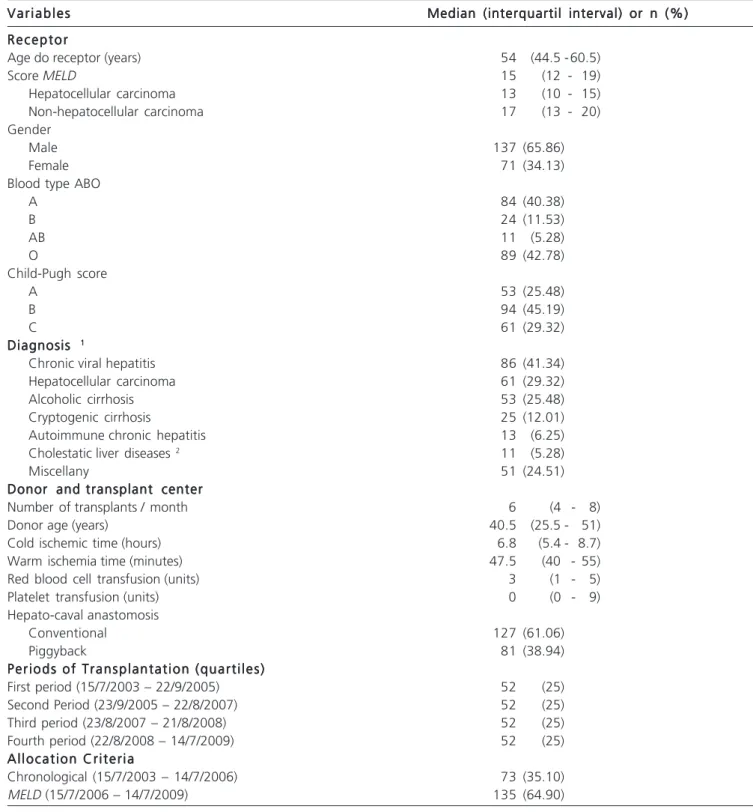
summarized in Table
1.
The proportional cumulative survival of patients
at three, six, 12 and 24 months after HT was 85.1%,
79.3%, 74.5% and 71.1%, respectively (Figure
1). Throughout the 95.1 months of follow-up, 76 patients
died (36.5%) and seven (3,4%) were subjected to a
retransplant. The main causes of death were infection,
tumor recurrence and liver failure / transplant rejection. The
median of follow-up of the surviving patients was 42.7
months, ranging from 24.8 to 95.1 months.
Figure 2 shows the ROC curve of MELD score to
predict the medium-term survival after HT. Its corresponding
AUC is 0.504. AUCs of 0.476, 0.477 and 0.504 were
observed for the prediction of survival of three, six and 12
months after HT, respectively. For the strata HCC and
non-HCC, the corresponding values of AUC for the prediction
of survival of 24 months were 0.594 and 0.514.
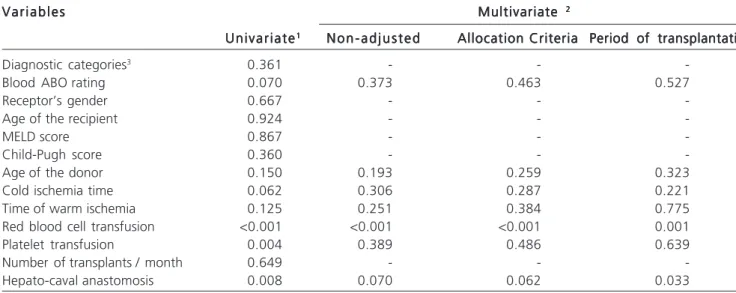
By univariate analysis, we identified transfusion
of red blood cells (p <0.001) and platelets (p = 0.004) and
type of hepatic venous reconstruction (p = 0.008) as
significantly related to survival after HT. However,
multivariate analysis showed that only red blood cell
transfusion was an independent predictor of medium-term
survival of transplant patients. In this study, each unit of
RBCs transfused during surgery increased the relative risk
of death within 24 months at 13.5%, which ranged from
12.1% to 13.5% after multivariate analysis (Table 2).
DISCUSSION
DISCUSSION
DISCUSSION
DISCUSSION
DISCUSSION
was rigorously validated as a predictor of mortality for
cirrhotic patients on waiting lists for transplants
6,11-13and
was eventually incorporated into a new criterion for the
allocation of grafts for HT
4,14,15.
Nevertheless, the role of the MELD score to
predict survival after HT, which has been considered a
matter of vital importance to the issue of liver
transplantation
6,remains controversial
3,6,8. In a systematic
review on the performance of the MELD score in this
scenario, Cholongitas et al.
6concluded that this score was
not a good predictor of short-term mortality after TH and
that further studies were needed to evaluate its performance
in the medium and long term.
In this study, analysis of the area under the ROC
curve (AUC) was used as a summary measure of the MELD’s
performance for the prediction of survival after HT. Normally,
Table 1 Table 1 Table 1 Table 1
Table 1 - Variables studied.
V a r i a b l e s V a r i a b l e s V a r i a b l e s V a r i a b l e s
V a r i a b l e s Median (interquartil interval) or n (%)Median (interquartil interval) or n (%)Median (interquartil interval) or n (%)Median (interquartil interval) or n (%)Median (interquartil interval) or n (%) R e c e p t o r
R e c e p t o r R e c e p t o r R e c e p t o r R e c e p t o r
Age do receptor (years) 54 (44.5 -60.5)
Score MELD 15 (12 - 19)
Hepatocellular carcinoma 13 (10 - 15)
Non-hepatocellular carcinoma 17 (13 - 20)
Gender
Male 137 (65.86)
Female 71 (34.13)
Blood type ABO
A 84 (40.38)
B 24 (11.53)
AB 11 (5.28)
O 89 (42.78)
Child-Pugh score
A 53 (25.48)
B 94 (45.19)
C 61 (29.32)
Diagnosis Diagnosis Diagnosis Diagnosis Diagnosis 11111
Chronic viral hepatitis 86 (41.34)
Hepatocellular carcinoma 61 (29.32)
Alcoholic cirrhosis 53 (25.48)
Cryptogenic cirrhosis 25 (12.01)
Autoimmune chronic hepatitis 13 (6.25)
Cholestatic liver diseases 2 11 (5.28)
Miscellany 51 (24.51)
Donor and transplant center Donor and transplant center Donor and transplant center Donor and transplant center Donor and transplant center
Number of transplants / month 6 (4 - 8)
Donor age (years) 40.5 (25.5 - 51)
Cold ischemic time (hours) 6.8 (5.4 - 8.7)
Warm ischemia time (minutes) 47.5 (40 - 55)
Red blood cell transfusion (units) 3 (1 - 5)
Platelet transfusion (units) 0 (0 - 9)
Hepato-caval anastomosis
Conventional 127 (61.06)
Piggyback 81 (38.94)
Periods of Transplantation (quartiles) Periods of Transplantation (quartiles) Periods of Transplantation (quartiles) Periods of Transplantation (quartiles) Periods of Transplantation (quartiles)
First period (15/7/2003 – 22/9/2005) 52 (25)
Second Period (23/9/2005 – 22/8/2007) 52 (25)
Third period (23/8/2007 – 21/8/2008) 52 (25)
Fourth period (22/8/2008 – 14/7/2009) 52 (25)
Allocation Criteria Allocation Criteria Allocation Criteria Allocation Criteria Allocation Criteria
Chronological (15/7/2003 – 14/7/2006) 73 (35.10)
AUC values e” 0.7 are considered clinically useful, whereas
values d” 0.5 are related to scores with no discriminatory
power
3,16,17. Based on the results found, the preoperative
MELD score showed low overall accuracy for predicting
survival after HT, similar to that described in other Brazilian
studies
3,18.
Also, since the survival of transplanted patients with
HCC is influenced by parameters related to the tumor
19, we
performed analyzes stratified between subgroups HCC and
non-HCC. However, no statistically significant difference was
found between the medium-term survival of these subgroups,
and the MELD score had also low overall accuracy for
predicting survival after HT in both strata. Although the
MELD criteria have been adopted to prioritize the most severe
patients on the waiting list, the majority of transplanted patients
is still low MELD scores
6,20-22. Furthermore, it has been shown
that the score does not display the same prognostic precision
in milder forms of hepatic cirrhosis
6,23. Thus, the effect of
hepatic dysfunction may not be evident in patients with MELD
scores below 30, suggesting that only higher values would
affect post-HT survival
24. In accordance with these reports,
only 3.4% of transplant patients by the Service under review
had MELD scores e” 30 (data not shown). This low proportion
of patients with high scores likely contributed to minimize its
overall accuracy for predicting survival after TH in this series.
Intraoperative transfusion of red blood cells has often been
related to lower survival after liver transplants
18,25-28, which
can also be seen in this series, which identified a strong influence
of the transfusion of blood components in the medium-term
survival of transplant patients. This negative effect of blood
transfusions probably stems from immunomodulation related
to transfusions and changes of its components from storage
process
29, which may increase the risk of nosocomial
infections, acute lung injury and development of autoimmune
diseases in the long term
30. Moreover, as emphasized by
Mitchell et al., the need for blood transfusion may act only as
a marker of severity of the patients undergoing HT
31, for
whom lower survival rates are expected.
Given the current recommendations for the
presentation of observational studies
32, we used a
significance level of only 1% for the statistical analyzes in
our work. In addition, we avoided the categorization of
continuous variables in order to minimize losses in statistical
power and the occurrence of residual confounding related
to the dichotomization method
33,34. Similarly, stratified
analyzes were performed according to the diagnosis of liver
disease and multivariate analysis adjusted for temporal
variables that could serve as confounding factors in
interpreting the results, as the criterion for the allocation of
grafts and the time of transplantation
35.
In addition to the socio-economic peculiarities
concerning the study population
36, this series has special
importance for the study of the predictive value of MELD
score for post-HT survival in view of the divergent results
found in Pernambuco after the adoption of the MELD
criteria. Unlike the observed in other Brazilian states, in
Pernambuco we observed a significant reduction in mortality
on the waiting list
37and better post-HT survival after the
adoption of this model, probably as a result of increasing
governmental encouragements to transplantation of organs
and tissues
35. On the other hand, the inclusion of more
donor-related variables could add relevant information to
Figura 2 -Figura 2 -Figura 2 Figura 2
-Figura 2 - Curva ROC do escore MELD para a predição da so-brevivência de médio prazo (24 meses) após o trans-plante hepático (AUC=0,504).
Figura 1 -Figura 1 -Figura 1 Figura 1
this analysis, especially due to the considerable number of
marginal donors employed by the Service in the study
1,38,39.
It therefore follows that the MELD score was not
accurate for predicting survival after HT in the Department
of General Surgery and Liver Transplantation HUOC / UPE
where only intraoperative transfusion of red blood cells was
identified as an independent predictive factor of
medium-term survival after HT.
Acknowledgements
Acknowledgements
Acknowledgements
Acknowledgements
Acknowledgements
The authors thank Ms. Tania M. Xavier,
Miss. Juliana S. Gomes and Dr. Isaac Esmeraldino for their
invaluable help with data collection. We also thank Dr.
Gedson A. Maia and Dr. Joseph A. de Morais for reviewing
the English texts and Dr. Joseph N. Figueroa and Dr. Ulysses
Montarroyos for their excellent technical assistance during
the statistical analysis.
R E S U M O
R E S U M O
R E S U M O
R E S U M O
R E S U M O
Objetivo Objetivo Objetivo Objetivo
Objetivo: Analisar a acurácia geral do escore MELD pré-operatório para a predição da sobrevivência pós-transplante hepático (TH) e explorar fatores preditivos da sobrevivência de médio prazo (24 meses). Métodos: Métodos: Métodos: Métodos: Métodos: Estudo de corte transversal incluindo pacientes transplantados pelo Serviço de Cirurgia Geral e Transplante Hepático do Hospital Universitário Oswaldo Cruz, Universidade de Pernambuco, entre 15 de julho de 2003 e 14 de julho de 2009. Utilizou-se análise da área sob curva ROC (receiver operating characteristic) como medida-resumo do desempenho do escore MELD e se exploraram fatores preditivos da sobrevivência de médio prazo utilizando análise uni e multivariada. ResultadosResultadosResultadosResultadosResultados: A sobrevivência cumulativa de três, seis, 12 e 24 meses dos 208 pacientes estudados foi 85,1%, 79,3%, 74,5% e 71,1%, respectivamente. O escore MELD pré-operatório apresentou baixo poder discriminatório para a predição da sobrevivência pós-TH. Por análise univariada, identificaram-se a transfusão intraoperatória de hemácias (p<0,001) e plaquetas (p=0,004) e o tipo de anastomose venosa hepatocaval (p=0,008) como significativamente relacionados à sobrevivência de médio prazo dos pacientes estudados. No entanto, por análise multivariada, observou-se que apenas a transfusão de hemácias foi um fator preditivo independente deste desfecho. ConclusãoConclusãoConclusãoConclusãoConclusão: O escore MELD apresentou baixa acurácia geral para a predição da sobrevivência pós-transplante dos pacientes estudados, entre os quais, apenas a transfusão intraoperatória de hemácias foi identificada como fator preditivo independente da sobrevivência de médio prazo após o TH.
Descritores Descritores Descritores Descritores
Descritores: Análise de sobrevida. Pacientes. Transplante de órgãos. Transplante de fígado. Mortalidade.
REFERENCES
REFERENCES
REFERENCES
REFERENCES
REFERENCES
1. Macedo FI, Miranda LE, Pádua TC, Fernandes JL, Neto OL, Lacerda CM. Effects of donor age on patient survival in liver transplantation: short-and long-term analysis. Hepatogastroenterology. 2009;56(93):1133-6.
2. Freeman RB, Wiesner RH, Edwards E, Harper A, Merion R, Wolfe R, et al. Results of the first year of the new liver allocation plan. Liver Transpl. 2004;10(1):7-15.
3. Brandão A, Fuchs SC, Gleisner AL, Marroni C, Zanotelli ML, Cantisani G, et al. MELD and other predictors of survival after liver transplantation. Clin Transplant. 2009;23(2):220-7.
4. Brasil. Ministério da Saúde, Departamento de Cuidados da Saúde. Portaria GM no 1160, de 29 de maio de 2006. Modifica os critérios
de distribuição de fígado de doadores cadáveres para transplante, implantando o critério de gravidade de estado clínico do paciente. Diário Oficial [da República Federativa do Brasil] [Internet]. Brasília, 31 de mai. 2006; v. 103. Acessado em 12 abr. 2009. Disponível
Table 2 Table 2 Table 2 Table 2
Table 2 - Univariate and multivariate predictors of medium-term survival (24 months) after liver transplantation.
V a r i a b l e s V a r i a b l e s V a r i a b l e s V a r i a b l e s
V a r i a b l e s MultivariateMultivariateMultivariateMultivariateMultivariate 2 2 2 2 2 U n i v a r i a t e
U n i v a r i a t e U n i v a r i a t e U n i v a r i a t e
U n i v a r i a t e11111 N o n - a d j u s t e dN o n - a d j u s t e dN o n - a d j u s t e dN o n - a d j u s t e dN o n - a d j u s t e d Allocation CriteriaAllocation CriteriaAllocation Criteria Period of transplantationAllocation CriteriaAllocation Criteria Period of transplantationPeriod of transplantationPeriod of transplantationPeriod of transplantation
Diagnostic categories3 0.361 - -
-Blood ABO rating 0.070 0.373 0.463 0.527
Receptor’s gender 0.667 - -
-Age of the recipient 0.924 - -
-MELD score 0.867 - -
-Child-Pugh score 0.360 - -
-Age of the donor 0.150 0.193 0.259 0.323
Cold ischemia time 0.062 0.306 0.287 0.221
Time of warm ischemia 0.125 0.251 0.384 0.775
Red blood cell transfusion <0.001 <0.001 <0.001 0.001
Platelet transfusion 0.004 0.389 0.486 0.639
Number of transplants / month 0.649 - -
-Hepato-caval anastomosis 0.008 0.070 0.062 0.033
em: http://dtr2001.saude.gov.br/sas/PORTARIAS/Port2006/GM/ GM-1160.htm
5. Freeman RB. Overview of the MELD/PELD system of liver allocation indications for liver transplantation in the MELD era: evidence-based patient selection. Liver Transpl. 2004;10(10 Suppl 2):S2-3. 6. Cholongitas E, Marelli L, Shusang V, Senzolo M, Rolles K, Patch D, et al. A systematic review of the performance of the model for end-stage liver disease (MELD) in the setting of liver transplantation. Liver Transpl. 2006;12(7):1049-61.
7. Freeman RB, Edwards EB. Liver transplant waiting time does not correlate with waiting list mortality: implications for liver allocation policy. Liver Transpl. 2000;6(5):543-52.
8. Onaca NN, Levy MF, Sanchez EQ, Chinnakotla S, Fasola CG, Thomas MJ, et al. A correlation between the pretransplantation MELD score and mortality in the first two years after liver transplantation. Liver Transpl. 2003;9(2):117-23.
9. Bruix J, Sherman M, Llovet JM, Beaugrand M, Lencioni R, Burroughs AK, et al. Clinical management of hepatocellular carcinoma. Conclusions of the Barcelona-2000 EASL conference. European Association for the Study of the Liver. J Hepatol. 2001;35(3):421-30. 10. Malinchoc M, Kamath PS, Gordon FD, Peine CJ, RanK J, ter Borg PC. A model to predict poor survival in patients undergoing transjugular intrahepatic portosystemic shunts. Hepatology. 2000;31(4):864-71.
11. Wiesner RH, McDiarmid SV, Kamath PS, Edwards EB, Malinchoc M, Kremers WK, et al. MELD and PELD: application of survival models to liver allocation. Liver Transpl. 2001;7(7):567-80. 12. Merion RM, Wolfe RA, Dykstra DM, Leichtman AB, Gillespie B,
Held PJ. Longitudinal assessment of mortality risk among candidates for liver transplantation. Liver Transpl. 2003;9(1):12-8.
13. Wiesner R, Edwards E, Freeman R, Harper A, Kim R, Kamath P, et al. Model for end-stage liver disease (MELD) and allocation of donor livers. Gastroenterology. 2003;124(1):91-6.
14. Teixeira AC, Souza FF, Mota Gde A, Martinelli Ade L, Sankarankutty AK, Silva Ode C. Liver transplantation: expectation with MELD score for liver allocation in Brazil. Acta Cir Bras. 2006;21 Suppl 1:S12-4. 15. Ravaioli M, Grazi GL, Dazzi A, Bertuzzo V, Ercolani G, Cescon M,
et al. Survival benefit after liver transplantation: a single European center experience. Transplantation. 2009;88(6):826-34. 16. Xiao L, Fu ZR, Ding GS, Fu H, Ni ZJ, Wang ZX, et al. Prediction of
survival after liver transplantation for chronic severe hepatitis B based on preoperative prognostic scores: a single center’s experience in China. World J Surg. 2009;33(11):2420-6. 17. Sempere L, Palazón JM, Sánchez-Payá J, Pascual S, de Madaria E,
Poveda MJ, et al. Assessing the short- and long-term prognosis of patients with cirrhosis and acute variceal bleeding. Rev Esp Enferm Dig. 2009;101(4):236-48.
18. Boin IFSF, Leonardi MI, Udo EY, Sevá-Pereira T, Stucchi RSB, Leonardi LS. Aplicação do escore MELD em pacientes submetidos a transplante de fígado: análise retrospective da sobrevida e dos fatores preditivos a curto e longo prazo. Arq Gastroenterol. 2008;45(4):275-83.
19. Hemming AW, Cattral MS, Reed AI, Van Der Werf WJ, Greig PD, Howard RJ. Liver transplantation for hepatocellular carcinoma. Ann Surg. 2001;233(5):652-9.
20. Thuluvath PJ, Maheshwari A, Thuluvath NP, Nguyen GC, Segev DL. Survival after liver transplantation for hepatocellular carcinoma in the model for stage liver disease and pre-model for end-stage liver disease eras and the independent impact of hepatitis C virus. Liver Transpl. 2009;15(7):754-62.
21. Yoo HY, Thuluvath PJ. Short-term postliver transplant survival after the introduction of MELD scores for organ allocation in the United States. Liver Int. 2005;25(3):536-41.
22. Merion RM, Schaubel DE, Dykstra DM, Freeman RB, Port FK, Wolfe RA. The survival benefit of liver transplantation. Am J Transplant. 2005;5(2):307-13.
23. Huo TI, Lin HC, Wu JC, Lee FY, Hou MC, Lee PC, et al. Different model for end-stage liver disease score block distributions may have a variable ability for outcome prediction. Transplantation. 2005;80(10):1414-8.
24. Kanwal F, Dulai GS, Spiegel BM, Yee HF, Gralnek IM. A comparison of liver transplantation outcomes in the pre- vs. post-MELD eras. Aliment Pharmacol Ther. 2005;21(2):169-77.
25. Ramos E, Dalmau A, Sabate A, Lama C, Llado L, Figueras J, et al. Intraoperative red blood cell transfusion in liver transplantation: influence on patient outcome, prediction of requirements, and measures to reduce them. Liver Transpl. 2003;9(12):1320-7. 26. Hendriks HG, van der Meer J, de Wolf JT, Peeters PM, Porte RJ, de
Jong K, et al. Intraoperative blood transfusion requirement is the main determinant of early surgical reintervention after orthotopic liver transplantation. Transpl Int. 2005;17(11):673-9.
27. Massicotte L, Sassine MP, Lenis S, Roy A. Transfusion predictors in liver transplant. Anesth Analg. 2004;98(5):1245-51.
28. de Boer MT, Christensen MC, Asmussen M, van der Hilst CS, Hendriks HG, Slooff MJ, et al. The impact of intraoperative transfusion of platelets and red blood cells on survival after liver transplantation. Anesth Analg. 2008;106(1):32-44.
29. Vamvakas EC, Blajchman MA. Transfusion-related immunomodulation (TRIM): an update. Blood Rev. 2007;21(16):327-48.
30. Raghavan M, Marik PE. Anemia, allogenic blood transfusion, and immunomodulation in the critically ill. Chest. 2005;127(1):295-307. 31. de Morais BS, Sanches MD, Ribeiro DD, Lima AS, de Abreu Ferrari TC, Duarte MM, et al. Association between the use of blood components and the five-year mortality after liver transplant. Rev Bras Anestesiol. 2011;61(3):286-92.
32. von Elm E, Altman DG, Egger M, Pocock SJ, Gotzsche PC, Vandenbroucke JP, STROBE Initiative. Strengthening the reporting of observational studies in epidemiology (STROBE) statement: guidelines for reporting of observational studies. BMJ. 2007;335(7624):806-8.
33. Royston P, Altman DG, Sauerbrei W. Dichotomizing continuous predictors in multiple regression: a bad idea. Stat Med. 2006;25(1):127-41.
34. Altman DG, Royston P. The cost of dichotomising continuous variables. BMJ. 2006;332(7549):1080.
35. Batista TP, Sabat BD, Melo PS, Miranda LE, Fonseca-Neto OC, Amorim AG, et al. Impact of MELD allocation policy on survival outcomes after liver transplantation: a single-center study in northeast Brazil. Clinics. 2011;66(1):57-64.
36. Lacerda CM, Melo PSV, Lucena O, Amorim A, Almeida HM, Pereira LB. Transplante de fígado em hospital universitário do Recife: resultados iniciais. Rev Col Bras Cir. 2003;30(1):29-35.
37. Tenório AL, Macedo FI, Miranda LE, Fernandes JL, da Silva CM, Neto OL, et al. Survival on waiting list for liver transplantation before and after introduction of the model for end-stage liver disease score. Transplant Proc. 2010;42(2):407-11.
38. Lucena O, Amorim AG, Sabat B, Adeodato LCL, Miranda LEC, Lacerda CM. Transplante de fígado a partir de doadores em assistolia: resultados iniciais do grupo de transplante de fígado do Hospital Oswaldo Cruz, Universidade de Pernambuco. Rev Col Bras Cir. 2005;32(5):270-2.
39. Fonseca-Neto OCL, Miranda LEC, Sabat BD, Amorim AG, Adeodato L, Melo PSV, et al. O doador marginal: experiência de um centro de transplante de fígado. ABCD arq bras cir dig. 2008;21(1):1-5.
Received on 15/08/2011
Accepted for publication 18/10/2011 Conflict of interest: none
Source of funding: none
How to cite this article: How to cite this article:How to cite this article: How to cite this article:How to cite this article:
Batista TP, Sabat BD, Melo PSV, Miranda LEC, Fonseca Neto OCL, Amorim AG, Lacerda CM. Employment of meld score for the prediction of survival after liver transplantation. Rev Col Bras Cir. [periódico na Internet] 2012; 39(2). Disponível em URL: http:// www.scielo.br/rcbc
Address correspondence to: Address correspondence to:Address correspondence to: Address correspondence to:Address correspondence to: Thales Paul Baptista