Model endophenotype for bipolar disorder:
Qualitative Analyse, etiological factors and
research areas
C
ritiCal
r
eview
Naraiana de Oliveira Tavares1, Fernando da Silva Neves2, Leandro Fernandes Malloy-Diniz3 Modelo de endofenótipo do transtorno Bipolar: análise qualitativa, fatores etiológicos e âMBitos de investigação aBordados
Modelo endofenotipo de trastorno Bipolar: análisis cualitativo, factores etiológicos y las áreas para las cuales la investigación
1professor of psychology, school of education, federal university of goiás and doctoral student of the post graduate program in neurosciences at the
federal university of Minas gerais, Belo Horizonte, Brazil. 2professor of Mental Health department and psychiatry, federal university of Minas gerais, Belo doi: 10.1590/s0080-623420140000800030
reSuMO
O objeivo do presente estudo é o de apre -sentar uma visão atualizada sobre a produ -ção bibliográica do modelo de endofenó -ipo para o transtorno b-ipolar, recorrendo às metodologias analíicas. Foi realizada para tal uma revisão da literatura e uma análise de redes por meio de descritores e palavras-chaves, que caracterizam a com -posição do modelo de endofenóipo como um modelo de saúde. O período de reco -lha das informações ocorreu entre os anos de 1992-2014, ideniicando nos principais arigos os âmbitos temáicos abordados. Discutem-se os resultados obidos para a consolidação do modelo de endofenóipos, quesionando a coesão e ressaltando a ne -cessidade de reforçar e ideniicar os pon -tos de ligação entre os fatores eiológicos e as caracterísicas que compõe o modelo de endofenóipos para o transtorno bipolar.
DeScriTOreS
Endofenóipos Transtorno bipolar Modelos de saúde Análise qualitaiva
AbSTrAcT
The aim of this study is to present an up -dated view of the wriings on the endo -phenotype model for bipolar disorder using analyical methodologies. A review and analysis of networks was performed through descriptors and keywords that characterize the composiion of the en -dophenotype model as a model of health. Informaion was collected from between 1992 and 2014, and the main themaic areas covered in the aricles were ideni -ied. We discuss the results and quesion their cohesion, emphasizing the need to strengthen and idenify the points of con -necion between eiological factors and characterisics that make up the model of endophenotypes for bipolar disorder.
DeScripTOrS
Endophenotypes Bipolar disorders Health models Analysis qualitaive
reSuMeN
El objeivo de este trabajo es presentar una visión actualizada de los escritos del mode -lo endofenoipo para el trastorno bipolar, el uso de las metodologías analíicas. Se realizó una revisión de este ipo de litera -tura y un análisis de las redes a través de descriptores y palabras clave que caracteri -zan la composición del modelo endofenoi -po como modelo de salud. El momento de la recolección de la información se produjo entre los años 1992-2014, la ideniicación de las principales áreas temáicas incluidas en los arículos. Se discuten los resultados para la consolidación del modelo de en -dofenoipos, cuesionando la cohesión y haciendo hincapié en la necesidad de for -talecer e ideniicar los puntos de conexión entre los factores eiológicos y caracterísi -cas que conforman el modelo de endofe -noipos para el trastorno bipolar.
DeScripTOreS
Endofenoipo
iNTrODucTiON
Bipolar Disorder (BD) is one of the most studied psy -chiatric disorders in mental health literature. Its nature in -volves various concepts of health areas, models of preven -ion, treatment, and rehabilitaion. The model of the World Health Organizaion aggregates the biological, psychologi -cal, and social spheres in various aspects of research. The endophenotype model, a new psychiatric model, involves searching for biological and behavioral neuroscience for the origin paterns of psychiatric disorders.
The endophenotype model is a muli-causal model proposed in of 1973. The model emphasizes the geneic factors or geneic vulnerability as determinants of ma -jor environmental changes(1). The concept has gained strength and direcion since the 90s. The aim of this work is to present an updated view of the research on the en -dophenotypes of bipolar disorder using analyical meth -odologies with scieniic literature. Through examining the eiology, signs, and symptoms, we sought to idenify how academia aggregates the factors.
One of the most widely accepted theories explains that the causal models of bipolar disorder are based on the irst modiicaion by a triggering condiion that occurs due to stress, which would disrupt the environment and neuronal circuitry(2). This change would be systemaized and reach three major pathways (serotonergic, norad -renergic, and dopaminergic), and then afect the cycles of sleep and wakefulness. Producing changes in circadian cycles and the funcioning of neurons would result in the onset of bipolar disorder.
Geneic vulnerability and risk factors
The factor that best describes the eiology of mood disorders appears to be geneics. The irst associaion be -tween paients and irst-degree relaives showing a corre -laion between symptomatology and geneic variables has been observed for over a century(3). Thus, it is assumed that the risk of developing bipolar spectrum disorder could be 9%, and family members would have a nearly 10-fold increased risk of developing the disease than the general populaion(4). As in other psychiatric disorders known for their inluences and geneic bases, the inheritance pat -tern of bipolar disorder likely involves a complex interac -ion of several genes. Researchers have proposed possible chromosomal diferences on chromosomes 2, 4, 5, 6, 8, 9, 10, 12, 13, 14, 15, 18, 21, 22, and the X chromosome in people with bipolar disorder. Therefore, there are sev -eral candidate genes for the development of pathology. It should be noted that the model is mulifactorial, with environmental and individual factors contribuing to the onset of the disease. The efects of each factor are small and cumulaive, and since there are combined efects, the factors could have some criical value, perhaps caused by signaling cascades that make the disorder manifest(5,6) .
Stress in bipolar disorder
Stress is deined as an event that involves changes of any nature, whether good, bad, drasic, or sudden. The endophenotype model considers eiological causes for the bipolar spectrum, and stress would be the staring point for developing the disease(7). By examining the psy -chosocial aspects such as the impact on quality of life, the ime in which the subject was exposed to a stressful en -vironment, and the symptoms and manifestaions of the disease, one study recently revealed the associaion be -tween traumaic life events and the highest levels of basal corisol(8).
Increasing evidence suggests that BD is accompanied by structural changes in the brain that may be mediated by interacions between hypercorisol and glutamate neu -rotoxicity. This mechanism is induced by stress and reduc -es neurotrophic factors and neurogen-esis(9). It is assumed that the environmental stress factors trigger the develop -ment cascade of BD.
Neuroscience of bipolar mood disorder
Analyses with images of paients with bipolar disorder (BD) led to preliminary conclusions disinguishing two ar -eas that change in the paralimbic system and the prefron -tal cortex, including the amygdala. The prefron-tal areas are signiicant in cogniive funcion, especially execuive funcions, which may explain behavioral and neuropsycho -logical changes(10). Another speciic diference observed in subjects afected by BD could be described by way of resonances, showing signiicant loss of asymmetry of the let/right caudate nucleus and in the right anterior frontal region. Changes in the structure of the cerebellum are sill being invesigated, including ventricular asymmetry. The amygdala is one of many small structures deep inside the brain which are called basal ganglia. These structures are implicated in automaic movements and behaviors that are important in maintaining the sleep-wake cycle(11). Circadian rhythms
The changes in people with bipolar disorder can sug -gest speciic errors in the regulaion of the sleep/waking. Many involve the body’s internal clock, which controls the phenomenon known as circadian rhythms. These are the regular rhythmic changes of waking and sleeping, de -creased acivity levels, and the sensaions of hunger, thirst, and saisfacion. The chemical and biological clock that gov -erns these rhythms is located in a part of the hypothalamus called the suprachiasmaic nucleus gland. The rhythms are based on the standard light-dark cycles and are set slowly in rhythm with the seasons. An important inding in the litera -ture is that people with bipolar disorder seem to have more diiculty in regulaing this system(12).
(serotonin hypothesis). Noradrenergic and dopaminergic hypotheses use the interacion models in cascade, such that the variaion of the serotonin would cause a reducion in noradrenergic and dopaminergic aciviies. All these bio -chemical mechanisms can be directly linked to BD(13). Endophenotype of bipolar disorder
The irst descripion of the endophenotype concept in psychiatric literature was revisited 20 years later thanks to the development of laboratory techniques(1). The genome project has made led to review of the endophenotype concept. Today, there is a whole area called the biology of molecular geneics and molecular medicine, which stud -ies the expression of endophenotypes(14).
Another reason with greater importance in psychia -try and BD is the gap in the causal chain between genes and distal disease(14) which casts doubt on the eiology. There are two addiional condiions necessary to meet the criteria of an endophenotype: (a) the endopheno -type should be an independent state and demonstrable in paients without symptoms; and (b) endophenotypes should be more frequent in afected relaives than in relaives of paients compared with the general popu -laion(15). The main diference between the concepts of exophenotype and endophenotype is that the irst gene expression could be seen directly in the exophenotype. The endophenotype involves “internal phenotypes,” which may not be visible to the naked eye (i.e. it relies on inferences). The endophenotype concept originally arose in evoluionary biology in an aricle published in 1966, which proposed that the diferences in biochemi -cal and microscopic insects would be “internal pheno -types,” which cannot be seen with the naked eye, requir -ing the use of some instruments to be measured. With the objecive of deining the number of genes involved in endophenotype variaions that determine the whole phenomenon of a psychiatric disorder, one realizes the descripion of elementary phenomena (versus behavior -al macros found in the DSM-IV), which may not be able to delimit the total number of genes involved in produc -ing the disease altogether(15).
The heurisic model for BD ofers up various assess -ments to idenify endophenotypes, including possible measures of cogniive, neurophysiological, and neuro -anatomical changes, images of brain structures, and bio -chemical measures. This includes environmental data in the model of the disease as possible causes of BD, in addi -ion to risk and protec-ion factors(15). Other neuroimaging studies with family members and paients have demon -strated brain abnormaliies in bipolar paients, including a reduced size of the prefrontal cortex(17,18).
Some authors have pointed out roles of brain struc -tures such as the nucleus accumbens and amygdala in the regulaion of moivaion in the sleep-wakefulness cycle, as well as social behaviors in bipolar paients. The
anatomy of the hippocampus appears to be impaired in people afected by bipolar disorder(19). There is also a decrease in the volume of the cingulate gyrus according to magneic resonance imaging (IMR)(20). A set of brain structures (such as the medial temporal lobe, tempo -ral cortex, and frontal cortex) was directly involved in the pathological funcioning, and other structures that are no less important but have diferent funcions (the hippocampus, amygdala, and cingulate) would also be modiied. Although the reducion in the volume of the anterior cingulate cortex and white mater changes in neuroimaging indings are more consistent and speciic in BD, others such as the increased volume of the right lateral ventricle and changes in volume of the amygdala and hippocampus may also be quaniied as structural endophenotypes of bipolar disorder(21).
A review aricle(14) discussed the strategies and the ad -vantages of using the endophenotype model. The model was suggested to be a huge advantage in clinical psychia -try, since the approach would bring possible answers to open quesions in the long history of modern psychiatry, paricularly psychiatric disorders and bipolar. However, the aricle stated that further invesigaion on all models and variables involved in the research of BD is required. These include neuropsychological deicits, instability of circadian rhythms, modulaion of moivaion, reward circuitry, neu -ropathological dimorphisms, and response to symptoms. Given the relaive scarcity of twin studies, few prospecive studies on families evaluaing candidate genes for bipo -lar disorder have been gradually developed with the aim of improving the theoreical model endophenotype(20). Therefore, in the case of mental disorders, a new classi -icaion system based on eiology and pathophysiology is necessary. A clearer deiniion of the endophenotype of BD will probably facilitate the understanding of the under -lying causal structure.
By proposing a phenotypic variance, the endopheno -type model that may correspond to diferent data from the clinical sample ideniies and takes into account the aspects of heritability and heredity. Aspects of the person -ality may be associated with BD, and variaion in perfor -mance that is observed in paients with mood disorders are useful geneic markers for endophenotypes(22,23). An understanding of the geneic relaionships between per -sonality factors and bipolar disorder should elucidate the way in which these traits can develop.
and the formaion of habits, involving corico-striatal pro -jecions and a structure-funcion relaionship. The second element is designated as the essence of personality and is related to long-term memories. It involves the formaion of concepts and is involved in the corico-diencephalic-limbico projecions(24-26). These dimensions of temperament and character interact, form the individual and their personal -ity, and may indicate bipolar mood disorder(27,28). Thus, indi -viduals with mood disorders seem to have personality traits that are signiicantly diferent from the general populaion. The TCI demonstrates psychometric features of good reli -ability, internal consistency, and stability over ime (29,30).
Neuropsychology of bipolar disorder
Neuropsychology evaluates and ranks the relations between cognition and its different functions and pro -cesses in the brain structure(31). A review of the sub -ject in order to differentiate the broader and specific cognitive processes indicates that the impairment of cognitive functions in BD is an endophenotype marker. Interest in investigating the cognitive functions of bi -polar has been growing, especially in the last decade. This is due to the need to explain whether the cognitive impairments would be traces of the disease or if they occur due to a cognitive impairment, as a neurodegen -erative process(31).
In three analyses of the endophenotype of bipolar disor -der with paients, unafected irst-degree relaives (fathers, mothers, brothers, twins, and children), and control targets, the endophenotype markers were shown through neuropsy -chological measures(10, 33). However, a meta-analysis claims that these indings should be interpreted with cauion, as it is very likely that the confusion of factors such as medicaion, chronicity, and afecive symptoms below the threshold are also contribuing to the observed results(34).
The cogniive funcions that are afected and have been proven as an endophenotype for BD are sustained atenion, verbal memory, and execuive funcions(35). Studies suggest that some cogniive decline can already be ideniied ater the irst episode of BD, which worsens with the number of episodes of the illness(35).
Figure 1 - Heuristic Model of endophenotypes for bipolar mood
disorder (adapted from Gotsman, 2003 and modiied in Hasler,
2006).
Several authors argue that when crises of bipolar mood disorder are acute, beyond the cogniive loss, there are implicaions for the quality of sleep and general func -ionality health(36). Therefore, bipolar disorder is a degen -eraive process and is directly related to the amount and severity of crises, demonstraing a decline in cogniive subjects with bipolar disorder(37).
From results on the general intelligence factor of pa -ients with BD, small changes could be observed depend -ing on the mood state(31). Surveys report that individuals in the manic phase have greater diiculty in processing visuo-spaial informaion and verbal luency(33). There is a clear potenial for losses due to the level of disorganizaion of be -havior and acceleraion of mental acivity, especially in the presence of psychoic symptoms(37). Thus, manic paients may also present greater diiculies in sustaining atenion, recognizing faces, and encoding informaion(32).
funcions are an endophenotype of BD(33). In this sense, they would present both as a feature of clinical manifestaions and a feature of neurodevelopment, meaning that they would be present even before the emergence of BD(32). In the period of euthymia, cogniive impairments are also observed in sus -tained atenion(37), declaraive memory(35), verbal memory(31), the recogniion of facial expressions(32), the capacity for learn -ing(35), diiculies in recovery(32), and the organizaion of infor -maion(10). The scieniic literature indicates signiicant difer -ences in several cogniive domains between bipolar paients and controls and unafected irst-degree relaives. The most cited cogniive funcions in meta-analysis include the follow -ing funcions: verbal luency, problem solv-ing, plann-ing, and divided atenion(37).
MeThOD
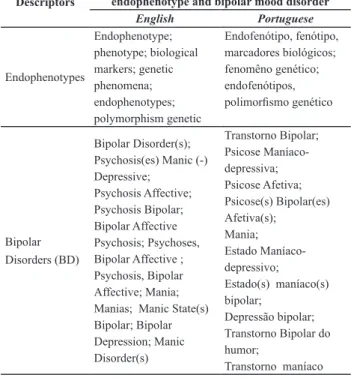
a) Selecion of databases and research documents Unique aricles in the PubMed/Medline databases were ideniied and selected by means of word associaion as fol -lows: bipolar endophenotype(s). The access and retrieval of documents formed a proile of research on endophenotypes and bipolar disorder. Among the results of these 290 speciic items with descriptors, we considered only those contained in the full text, with the number of aricles being 275. The terms were extracted from the Medical Subject Heading (MeSH) the -saurus of PMC (Pub Med Central), and the synonyms and de -rivaives were considered to recover any grammaical variants as well as the terms of the semanic family that have the same root. Table 1 shows the full list of terms found.
Table 1 - List of terms that characterize the model of endophenotypes
Descriptors
List the terms of the documents on endophenotype and bipolar mood disorder
English Portuguese
Endophenotypes
Endophenotype; phenotype; biological markers; genetic phenomena; endophenotypes; polymorphism genetic
Endofenótipo, fenótipo, marcadores biológicos; fenomêno genético; endofenótipos, polimorismo genético
Bipolar Disorders (BD)
Bipolar Disorder(s); Psychosis(es) Manic (-) Depressive;
Psychosis Affective; Psychosis Bipolar; Bipolar Affective Psychosis; Psychoses, Bipolar Affective ; Psychosis, Bipolar Affective; Mania; Manias; Manic State(s) Bipolar; Bipolar Depression; Manic Disorder(s)
Transtorno Bipolar; Psicose Maníaco-depressiva; Psicose Afetiva; Psicose(s) Bipolar(es) Afetiva(s);
Mania; Estado Maníaco-depressivo;
Estado(s) maníaco(s) bipolar;
Depressão bipolar; Transtorno Bipolar do humor;
Transtorno maníaco
The surveys were adapted to the idiomaic paterns and opportuniies for informaion retrieval from databas -es. Only texts with the following documentary typology were used: original research aricles, clinical notes, and reviews of literature in the period of 1992-2014. A man -ual review of documents was conducted concerning the itles, descriptors, keywords, and abstracts. Only empirical aricles items were separated, resuling in 37 aricles. b) Selecion of documents, standardizaion, and insituional collaboraion networks
We believe that the references of selected aricles were not used as a source, and since we only examined aricles writen in English, we removed seven aricles in French with elements that characterize the endophe -notype model. Likewise, a standardizaion process was performed by authors, year, criterion of researched sources, bibliographic database, and insituional data. We surveyed insituions, insitutes research centers, or hospitals that operate independently, with their own re -sources, or autonomously with their poliical scieniic, which depends on organizaions, universiies, ministries, or public agencies.
To characterize the themaic areas, we determined the frequency of occurrence of the descriptors and key -words ideniied in the documents dealing with bipolar disorder as an endophenotype model. Then, we sepa -rated the descriptors by the most constant themes with -in a larger group. For example, all the aricles that had the words, genes, loci, heritability, and heredity were grouped under the subject of geneic polymorphism and geneic vulnerability. By approaching content and quali -taive analysis, we have chosen the term polymorphism among others. Networks with the themaic relaions be -tween the terms were determined from the frequency of their joint appearance in the documents, as were repre -sentaions which determine the greater or lesser density of the various themaic groups, and the interrelaionship between them.
c) Network Diagramming
reSuLTS
In the end, we selected 37 aricles with full text and empirical research that ideniied the model of endophe -notypes in paients with bipolar disorder (BD). We formed a set in which nodes and lines arranged in pairs comprised a matrix. By posiioning the aricles and networks, instui -ional collaboraion and research themes were ideniied by the relaionships within the endophenotype model. When researching each aricle that characterizes bipolar disorder endophenotypes, we veriied the network de -scribed by Figure 1.
The analyic network indicates within research themes that the constructs and eiology of bipolar disorder seem to be more associated with psychological aspects (cogni -ion and personality) than the related environmental as -pects, such as stress, and that the biological mechanisms (neuroscience and geneics) complement the network. The current model of biopsychosocial health indicates that no factor alone explains psychiatric illness. In each network node is a blue square, and each digraph is associ -ated by means of a component adjacent to the discussion in the aricle for the systemaic analysis of the collected matrix. The themaic approaches addressed by diferent authors led to the qualitaive analysis and network forma -ion.
Graph 1- Key relationships between the content of articles that discuss the empirical endophenotype model
DiScuSSiON
In performing the study, we characterized the state of the art on the development of research on the model of endophenotypes as a model of health. It was possible to idenify the research groups and the main subjects stud -ied within a proposed group since 1973(1,5). This can be veriied empirically in the current year model(15).
The following points present the limitaions of the study: a) The search for an empirical research proile
may be the reason for the non-appearance of relevant aricles. b) Although other types of research were on the databases, the agglomeraion of themes and models was ulimately limited to journals of Medicine, Biology, and Psychology. Unveiling the contribuions of the humaniies and social sciences and their epistemological bases on the psychiatric disorder contribute litle to the discussion in the empirical context. c) The items that comprised the so -cial network analysis on the subject were work published in scieniic journals, excluding other document types such as books and book chapters, oral presentaions, re -ports, dissertaions, or doctoral theses. d) Only aricles in English were used due to a lack of indexing or to the low impact factor of journals in French, Japanese, or Scandi -navan(16). However, one can point out that the methodol -ogy applied is the most appropriate in relaion to the pur -pose of the study, since it allows for the recovery of the works of an area of knowledge characterized by a large dispersion among various journals and disciplines(11) in or -der to minimize the non-retrieval of relevant documents. Therefore, it appears that scieniic aricles are the most frequent document type, with bigger and beter impact. Thus, using only research journals gives validity to the ap -proach performed(38). This also veriies the character of qualitaive research(32).
Based on observaions found in the various themes, it becomes desirable to foster the causal inter-relaion among all types of research menioned, favoring commu -nicaion between diferent levels(12). The aim is to reduce the wateright increase the level of relaionship between the themes, since all types of research are fundamental to the advancement of knowledge and professional pracice. Therefore, the use of social network analysis to highlight what is being researched in psychiatric pathology shows the importance of these inter-relaionships, and we de -duce that they are also works of interest and usefulness to the scieniic community.
cONcLuSiON
Bipolar mood disorder (BD) has been studied by sev -eral researchers at diferent imes and in diferent areas of knowledge. The search for common characterisics in people without the condiion led us to the concept of en -dophenotype. The search for endophenotypes of BD aris -es from a number of eiological disease characterisics. When staring the theoreical literature review, we saw the dominance of nosographical characterisics, which are relevant. However, because it is such a complex process, the possible causes could be covert (geneic vulnerabil
-ity, stressors, changes in the circadian cycle, changes in neurotransmiters, cogniive deicits), because there is no single intermediate phenotype.
In this context, it is important to consider the in -dividual, the environment, and irst-degree relaives. How might the implicaions of the study be quesioned: What are the risks of a healthy person in an environment that causes them stress or trauma to develop a pathology. Are there changes or markers that could trigger the disease. Risk factors for the development of psychiatric disorders are sill largely unknown. The inluence of the endophe -notype has been recognized, and studies are seeking potenial biomarkers. The ideniicaion of such mark -ers could shed light on the discussion about developing the disorder. In addiion to compiling data for diagnosic manuals, risk factors could help predict and understand bipolar disorder and bring the concept.
AcKNOWLeDGeMeNTS
Support for the study was provided the University of Goiás (UFG) and the University of Minas Gerais (UFMG). E DFBR (Deleted for Blind Review).
reFereNceS
1. Gotesman II, Shields J. Geneic Theorizing and schizophrenia.
Br J Psychiatry.1973; (122): 15-30.
2. Goodwin FK, Jamison KR. Manic-Depressive Illness: Bipolar Disorders and Recurrent Depression [monograph online]. 2nd ed. New York: Oxford University Press, 1990.
3. Barondes SH.Mood Genes: Huning for Origins of Mania and
Depression [monograph online]. 1 st ed. Oxford: Oxford Uni
-versity Press, 2002.
4. Smoller JW, Finn CT. Family, Twin, and Adopion Studies of Bi
-polar Disorder.American Journal of Medical Geneics.
[Inter-net]. 2003[cited 2014 jan. 18]; 123C (1), 48–58 I Part C (Semin. Med. Genet) Avaliable from: htp://onlinelibrary.wiley.com/
doi/10.1002/ajmg.c.20013/abstract;jsessionid=1859C0E189D 138C75CE0084F8B3F8C53.f04t04?deniedAccessCustomised
Message=&userIsAuthenicated=false .
5. Gotesman II, Shields J. A polygenic theory of schizophrenia. Proc Natl Acad Sci, 1967; (58):199 –205.
6. McGue M, Gotesman II, Rao DC. The transmission of bipolar disorders under a mulifactorial threshold model. Am J Hum Genet [Internet] . 1983 [cited 2014 feb.4]; 35(6):1161–1178. Avaliable from: htp://www.ncbi.nlm.nih.gov/pmc/aricles/ PMC1685995/
7. Manji HK and Duman RS. Impairments of neuroplasicity and cellular resilience in severe mood disorders: Implicaions
for the development of novel therapeuics. Psychophar
-macol Bull. [Internet]. 2001 [cited 2014 mar 15];
35(2):45-49. Avaliable from: htp://www.ncbi.nlm.nih.gov/pub
-med/12397885
8. Mandelli L, Serrei A, Marino E. Interacion between seroto
-nin transporter gene, catechol-O-methyltransferase gene and
stressful life events in mood disorders. Int J Neuropsychophar
-macol.. [Internet]. 2007 [cited 2014 mar 15]; 10(4): 437–447.
Avaliable from: htp://journals-cambridge-org.ez27.periodi
-cos.capes.gov.br/acion/displayAbstract?fromPage=online&a id=1051056
9. Nestler EJ, Barrot M, Di Leone RJ, Eisch AJ, Gold SJ, Monteg
-gia LM. Neurobiology of depression. Neuron [Internet]. 2002 [cited 2014 apr. 2014]; 34(1), 13–25. Avaliable from: htp:// www.ncbi.nlm.nih.gov/pubmed/11931738
10. Frangou S, Haldane M, Roddy M, Kumari V. Evidence for
deicits in tasks of ventral, but not dorsal, prefrontal execu
-ive funcion as an endophenotypic marker for bipolar di
-sorder. Biol. Psychiatry. [Internet]. 2005 [cited 2014 feb.28];
58(10), 838–839. Avaliable from: htp://www-sciencedi
11. Öngür D, Drevets WC, Price JL. Glial reducion in the subgenu
-al prefront-al cortex in mood disorders. Proc Natl Acad Sci U S
A. [Internet].1998 [cited 2014 mar. 10]; 95(22), 13290-13295
.Avaliable from: htp://ww.pnas.org/content/95/22/13290.full.
12. Benedei F, Serrei A, Colombo C, Lorenzi C, Tubazio V, Smeraldi
E. A glycogen synthase kinase 3-beta promoter gene single nu
-cleoide polymorphism is associated with age at onset and res
-ponse to total sleep deprivaion in bipolar depression. Neurosci
Let. [Internet] 2004. [cited 2014 mar.13]; 368(2),123–126. Ava
-liable from: htp://www.ncbi.nlm.nih.gov/pubmed/15351432
13. Jones SJ, Hare DJ, Evershed K. Acigraphic assessment of circadian acivity and sleep paterns in bipolar disorder. Bipolar Disord. [Internet] 2005. [cited 2014 mar.13]; 7(2), 176–186. Avaliable from: htp://www.ncbi.nlm.nih.gov/ pubmed/15762859
14. Hasler G, Drevets WC, Gould TD, Gotesman II, Manji KH.
Toward Construcing an Endophenotype Strategy for Bipolar Disorders. Biological Psychiatry . [Internet] 2006. [cited 2014 mar.20]; 60(2), 93-105. Avaliable from: htp://www.ncbi. nlm.nih.gov/pubmed/16406007
15. Gotesman II and Gould TD. The endophenotype concept in psychiatry: etymology and strategic intenions. Am. J. Psychiatr. [Internet] 2003.[cited 2014 mar.13]; 160 (4), 636– 645. Avaliable from: htp://journals.psychiatryonline.org/ aricle.aspx?aricleid=176146
16. Bora E, Yucel M, Pantelis C. Cogniive endophenotypes of
bipolar disorder: A meta-analysis of neuropsychological de
-icits in euthymic paients and their irst-degree relaives. Journal of Afecive Disorder. [Internet] 2009.[cited 2014
mar.13]; 113(1), 1-20. Avaliable from: htp://www
--sciencedirect-com.ez27.periodicos.capes.gov.br/science/ aricle/pii/S0165032708002462
17. Glahn DG, Bearden DE, Niendam TA, Escamilla MA. The feasibility of neuropsychological endophenotypes in the search for genes associated with bipolar afecive disorder. Bipolar Disord. [Internet] 2004.[cited 2014 mar.13];6 (3), 171–182. Avaliable from: htp://www.ncbi.nlm.nih.gov/ pubmed/15117396
18. Hall H, Schulze K, Rijsdijk F, Kalidindi S, McDonald C, Bramon E, Murray RM, Sham P. Are auditory P300 and duraion MMN
heritable and putaive endophenotypes of psychoic bipolar di
-sorder? A Maudsley bipolar twin and family study. Psychol Med. [Internet] 2009.[cited 2014 mar.13]; 39 (8),1–11. “In press”.
19. Pezawas L, Meyer-Lindenberg A, Drabant EM, Verchinski BA, Munoz KE, Kolachana BS. 5-HTTLPR polymorphism impacts
human cingulate-amygdala interacions: A geneic suscepibi
-lity mechanism for depression. Nat Neurosci. [Internet] 2005. [cited 2014 mar.13]; 8 (6), 828–834. Avaliable from: htp:// www.nature.com/neuro/journal/v8/n6/abs/nn1463.html
20. Hirayasu Y, Shenton ME, Salisbury DF, Kwon JS, Wible CG,
Fischer IA. Subgenual cingulate cortex volume in irst-episo
-de psychosis. Am J Psychiatry. [Internet]. 1999.[cited 2014
mar.13]; 156 (7), 1091–1093. Avaliable from: htp://jour
-nals.psychiatryonline.org/aricle.aspx?aricleid=173577
21. McDonald C, Bullmore ET, Sham PC, Chitnis X, Wickham H, Bramon E. Associaion of geneic risks for schizophrenia
and bipolar disorder with speciic and generic brain struc
-tural endophenotypes. Archives of general psychiatry.
[Internet] 2004.[cited 2014 mar.13]; 61(10), 974-84. Ava
-liable from: htp://archpsyc.jamanetwork.com/aricle. aspx?aricleid=482068
22. Lara DR, Akiskal HS. Toward an integraive model of the spectrum of mood, behavioral and personality disorders
based on fear and anger traits: Implicaions for neuro
-biology, geneics and psychopharmacological treatment. Journal of Afecive Disorders. [Internet] 2006.[cited 2014
mar.13];94(1-3), 89-103. Avaliable from: htp://www.
sciencedirect.com/science/aricle/pii/S0165032706001303
23. Savitz JB, Ramesar, RS. Personality: is it a viable endopheno
-type for geneic studies of bipolar afecive disorder? Bipolar Disord. [Internet] 2006.[cited 2014 mar.13]; 8(4), 322-37. Avaliable from: htp://onlinelibrary.wiley.com/doi/10.1111/ j.1399-5618.2006.00309.x/abstract?deniedAccessCustomis edMessage=&userIsAuthenicated=false
24. Cloninger CR, Svrakic DM, Pryzbeck TR. A psychobiological
model of temperament and character. Arch Gen Psychia
-try. [Internet]. 1993 .[cited 2014 mar.13];50(12),975-990. Avaliable from: htp://archpsyc.jamanetwork.com/aricle. aspx?aricleid=496431
25. Savitz J, Van der Merwe L, Ramesar R. Hypomanic, cyclothy
-mic and hosile personality traits in bipolar spectrum illness: a family-based study. Psychiatr Res. [Internet] 2008.[cited
2014 mar.13];42(11),920-929.Avaliable from: htp://www
--sciencedirect-com.ez27.periodicos.capes.gov.br/science/ aricle/pii/S0022395607001823
26. Greenwood TA, Badnerb JA, Byerleyc W, Kecke PE, McEl
-roye SL, Remickg RA, Sadovnickh D, Kelsoea JR. Heri
-tability and linkage analysis of personality in bipolar di
-sorder. Journal of Afecive Disorders. [Internet] 2013. [cited 2014 mar.13];151(2), 748-755. Avaliable from:
htp://dx.doi.org.ez27.periodicos.capes.gov.br/10.1016/j. jad.2013.06.015
28. Lotus ST, Garno JL, Jaeger J, Malhotra AK. Temperament
and character dimensions in bipolar I disorder: a compari
-son to healthy controls. Journal of Psychiatric Research. [In
-ternet] 2008 .[cited 2014 mar.13];42(13),1131–1136. Ava
-liable from: htp://www.sciencedirect.com/science/aricle/ pii/S0022395607001926
29. Cloninger CR, Przybeck TR, Svrakic DM, Wetzel RD. The Tem
-perament and Character Inventory (TCI): A Guide to its De
-velopment and Use, Center for Psychobiology of Personality.
Center of Psychobyology of personality, Washington Univer
-sity: St. Louis, MO, 1993.
30. Keller MC, Coventry WL, Heath AC, Marin NG. Widespread evidence for non-addiive geneic variaion in Cloninger’s
and Eysenck’s personality dimensions using a twin plus si
-bling design. Behavior Geneics. [Internet] 2005.[cited 2014
mar.13]; 35 (6), 707–721. Avaliable from: htp://link.sprin
-ger.com/aricle/10.1007/s10519-005-6041-7#page-1
31. Lezak MD, Howieson DB, Loring DW. Neuropsychological As
-sessment. 4th ed. New York: Oxford University Press, 2004.
32. Kapczinski F, Quevedo J (editors). Transtorno Bipolar: teoria e clínica. Porto Alegre: Artmed, 2009.
33. Arts B, Jabben N, Krabbendam L, Van OSJ. Meta-analyses of cogniive funcioning in euthymic bipolar paients and their irst degree relaives. Psychol Med. [Internet].2008 .[cited 2014 mar.13];38 (6), 771-785. Avaliable from: htp://www. ncbi.nlm.nih.gov/pubmed/17922938
34. Bora E, Yucel M, Pantelis C. Cogniive endophenotypes of
bipolar disorder: A meta-analysis of neuropsychological de
-icits in euthymic paients and their irst-degree relaives. Journal of Afecive Disorders. [Internet] 2009.[cited 2014 mar.20];113(1), 1-20. Avaliable from: htp://www.ncbi.nlm. nih.gov/pubmed/18684514
35. Marínez-Arán A, Vieta E, Colom F, Reinares M, Benabarre A, Gas
-tó C, Salamero M, Cogniive Dysfuncions. Bipolar Disorder: Evi
-dence Of Neuropsychological Disturbances. Psychother Psycho
-som. [Internet] 2010 .[cited 2014 mar.13];69 (1), 2-18. Avaliable from: htp://www.ncbi.nlm.nih.gov/pubmed/10601830
36. Kapczinski, F.; Andreazza, A. C.; Salvador, M. Mediadores do
déicit cogniivo e comorbidades clínicas no transtorno bipo
-lar: análise de marcadores periféricos de estresse oxidaivo,
dano ao DNA e apoptose. Porto Alegre: UFRGS, 2008. Ava
-liable from: htp://200.18.45.28/sites/ppgp/images/docu
-mentos/texto%208.pdf
37. Zalla T. Execuive dysfuncions as potenial markers of fa
-milial vulnerability to bipolar disorder and schizophrenia. Psychiatry Researc. [Internet] 2004.[cited 2014 mar.13]; 21(3), 207-217. Avaliable from: htp://www.ncbi.nlm.nih. gov/pubmed/14675740
38. Pirkola T, Tuulio-Henriksson, Glahn AD, Kieseppä T, Haukka
J, Kaprio J, Lönnqvist J, Cannon TD. Spaial Working Me
-mory Funcion in Twins with Schizophrenia and Bipolar Disorder.Biological Psychiatry.[Internet] 2005.[cited 2014 mar.13];58(12),930-936. Avaliable from: htp://www.ncbi. nlm.nih.gov/pubmed/16112657
39. Paquali L. Psicometria. Revista da Escola de Enferma
-gem USP. [Internet] 2008; 43(Esp):992-999. Avalia
-ble from: htp://w