Luísa Jardim Corrêa de OliveiraI Marcos Britto CorreaI
Gustavo Giacomelli NascimentoI Marília Leão GoettemsI
Sandra Beatriz Chaves TarquínioI Dione Dias TorrianiI
Flávio Fernando DemarcoI,II
I Programa de Pós-Graduação em
Odontologia. Faculdade de Odontologia. Universidade Federal de Pelotas. Pelotas, RS, Brasil
II Programa de Pós-Graduação em
Epidemiologia. Faculdade de Medicina. Universidade Federal de Pelotas. Pelotas, RS, Brasil
Correspondence: Marcos Britto Correa Faculdade de Odontologia Universidade Federal de Pelotas Rua Gonçalves Chaves, 457 Sala 506 96015-560 Pelotas, RS, Brasil E-mail: [email protected] Received: 12/12/2012
Approved: 7/21/2013
Article available from: www.scielo.br/rsp
Inequalities in oral health: are
schoolchildren receiving the
Bolsa
Família
more vulnerable?
ABSTRACT
OBJECTIVE: To evaluate the association between being a recipient of the
Bolsa Família program and oral health conditions in Brazilian schoolchildren.
METHODS: A cross-sectional study was conducted with 1,107 schoolchildren aged between eight and 12 years from 20 public and private schools in Pelotas, RS, Southern Brazil. A list of all children receiving the Bolsa Família program was provided by the participant schools. Demographic, socioeconomic and oral hygiene information were assessed using a questionnaire completed by the schoolchildren and their parents. Dental exams were performed to assess the presence of dental plaque and prevalence of dental caries. Data were analyzed by Chi-square test, Chi-square test for linear trend and multivariate Poisson
Regression (prevalence ratio; 95% conidence interval).
RESULTS: Schoolchildren from non-nuclear families, with a DMFT ≥ 1 and
who had never visited a dentist were associated with receiving the Bolsa Família. Final model showed that caries prevalence was twice as high (PR
2.00; 95%CI 1.47;2.69) in schoolchildren beneiting from the Bolsa Família.
It was also showed that schoolchildren beneiting from the program presented
greater severity of dental caries compared to school children from private
schools (RR 1.53; 95%CI 1.18;2.00). After inal adjustments, the prevalence of
schoolchildren who have never visited a dentist was six times higher in children
who received the government beneit (PR 6.18; 95%CI 3.07;12.45) compared
to those from private schools.
CONCLUSIONS: Schoolchildren beneiting from the Bolsa Família program experienced more caries lesions and have less frequently accessed dental care services, which suggest the need to include oral health in the program.
In oral health, the main health problem is dental caries, a chronic, avoidable disease, which is
cumulative, and is considered a signiicant cause
of toothache4 and tooth loss in its most advanced stage.19,20 The etiology of dental caries is composed of a complex interaction between biological environ-mental and social conditions.21 Although the preva-lence of dental caries has decreased in Brazil over the last few decades, there are still large inequalities in its distribution.15 This phenomenon, named polar-ization of the disease, means that it is in the poorest segments of the population where almost the entire disease load is concentrated.12
The relationship between socioeconomic position and health conditions is clearly explained in the literature. Individuals with higher positions in the social hier-archy have better health conditions than those below, showing a social gradient in morbidity and mortality.9,10 Oral health is a strong socioeconomic and behavioral indicator21 and can be taken into consideration when studying social inequalities in health care.
Access to, and use of, dental services are also related to socioeconomic inequalities, one of the main obstacles both collectively and individually.14 Although use of dental services has increased at all levels of society in Brazil, this use is still very uneven, as the proportion of individuals who have never visited a dentist is eight times higher among the poorest.14
The Bolsa Família Program (BFP) is a Brazilian
government program that directly transfers income to households living in poverty and extreme poverty.
Receiving this beneit is linked to the authorities and to the household undertaking to fulil certain condi -tions, increasing these households’ access to their basic social rights, such as health care, education and social assistance.a The BFP had three dimensions: promoting the immediate alleviation of poverty by direct transferal of income, reinforcing the exercise of basic social rights in the area of health and education and coordinating complementary programs, so that the households manage to overcome their situation of vulnerability and poverty.
Programs to transfer income have positive impacts
on the health indicators of those who beneit from
them.6,13,18 However, some studies have failed to conirm
this positive impact or were inconclusive on their inlu -ence on children’s health.2,11
There are no studies that link distribution of income by the Bolsa Família Program with oral health problems,
INTRODUCTION
or which show the need to prioritize oral health care in the recipients.
The aim of this study was to analyze the association between receiving the BFP and oral health conditions in schoolchildren.
METHODS
A cross-sectional observational study was carried out with 1,107 children aged between eight and 12, enrolled in schools in the urban zone of Pelotas, RS, Southern Brazil, in 2010. The city has around 340 thousand inhabitants and is located in the south of the state of Rio Grande do Sul, Brazil.7
Of the 50,467 pupils enrolled in primary education in 2010 (44.7% in municipal schools, 43.1% in state
schools and 12.2% in private schools), 25,628 were in
the age band studied. The sample was obtained using a two-stage cluster sampling technique. The primary units
(schools) were randomly selected manually, weighted
according to the number of pupils enrolled in each school in 2009 and the size of the network (public and
private). Twenty schools were selected, guaranteeing
variety in the characteristics analyzed.3 There were nine
municipal schools, six state schools and ive private schools, relecting the proportion of types of schools
in the municipality. The pupils, the secondary sampling units, were selected from each school year, between 2nd and 6th grade, considering the age range studied. The EpiInfo 6.0 program was used to calculate sample size. As this was a multi-disciplinary study7 with different oral health outcomes being studied, the different prevalences of oral health problems reported in the literature were considered when calculating the
sample. The minimum sample necessary (n = 922) was
obtained using the following estimates and parameters: estimated prevalence of the health problem 10.0%,
acceptable error of three percentage points, 95% coni -dence interval, extra 20.0% to cover losses and refusals, and design effect estimated at 2.0. Pupils aged eight to 12 years in the 20 selected schools, in total 1,744 eligible pupils, were invited to participate in the study. Of this total, 24.0% did not take part and 6.7% were absent from school on the days data were collected,
giving a response rate of 69.3% (1,211 children). Two
public schools in the study did not provide an up-to-date list of pupils receiving the BFP and these children were excluded from the analysis. Thus, the total number
studied was 1,107 children (63.5%).
a Brasil. Lei Ordinária nº 10.836 de 9 de janeiro de 2004. Cria o Programa Bolsa Família, altera a lei nº 10.689, de 13 de junho de 2003, e dá
The parents or guardians of the pupils completed a questionnaire on the socioeconomic characteristics of
the household (maternal schooling and income) and use
of dental services. The pupils were interviewed, with the aim of verifying demographic (sex, age, household
structure) and behavioral factors. The schoolchildren
also underwent a clinical examination, carried out by six previously calibrated dental surgeons and graduate students acting as note takers, which took place in the classrooms using the school chairs and using individual
protective equipment (gloves, masks and aprons), artiicial light from a head lamp, dental mirror and CPI
dental probe. Inter-examiner concordance for dental
caries (DMFT index) was evaluated per tooth, using the weighted Kappa coeficient, and the mean value found was equal to 0.74 (range = 0.62-0.79).
Dental caries was veriied using the DMFT and dmft
indexes,1 assessing all of the teeth in the individuals’ mouth. Two categories were used in analyzing the data: prevalence of dental caries in permanent teeth (DMFT
≥ 1) and severity of caries in mixed dentition (DMFT + dmft). The clinical exam identiied the presence of visible
plaque on six teeth (four primary molars and central
inci-sors in diagonal quadrants), selected before the examina
-tion collected using the Visible Plaque Index (VPI).16
The use of dental services by the child was collected using the questionnaire sent to the parents or guard-ians, from the question “has the child ever been to the
dentist?” If responded to in the afirmative, there were
further questions on the time elapsed since the most
recent visit (more or less than one year).
Receiving the Bolsa Família was veriied using the
lists provided by the schools participating in the study. The variable was divided into three categories: private school pupils, public school pupils not receiving the BFP and public school pupils receiving the BFP. Socioeconomic data were obtained from the ques-tionnaire sent to the parents and guardians. Maternal schooling was collected as continuous data, in years of
study, and classiied into four categories (12 and over; from 9 to 11; from 5 to 8, 4 or fewer). Household income
was reported in reais and categorized into quartiles. In the interview with the pupils, data were obtained
concerning sex (male or female), age (8 to 12 years), and type of school (public or private). Fear of the dentist was identiied using the question “Are you afraid of going to the dentist?” (yes: no).
The data collected were double entered into the EpiData
program (The EpiDataAssociation, Odense, Denmark)
and evaluated for consistency. The analyses were carried out using the Stata 11.0 program (StataCorp,
CollegeStation, TX, EUA).
Descriptive analysis was carried out estimating absolute and relative frequencies in order to analyze distribution for the total sample and for recipients of the BFP. The Chi-square test and Chi-square test for linear trend were used to verify association of the variables studied with
receiving the beneit.
Poisson multivariate regression models with robust variance analysis were used to test the association between receiving the BFP and the exposure and outcome variables. The method used to select the variables was stepwise, with backward elimination.
Variables with p ≤ 0.05 were included in the inal model, the prevalence ratios and their 95% conidence intervals were estimated. The rate ratios (RR) were estimated for
the outcome severity of dental caries.
The research project was submitted to the Research Ethics
Committee of the Faculty of Orthodontics, Universidade Federal de Pelotas (UFPel – Record no.160/2010). The
parents/guardians signed consent forms.
RESULTS
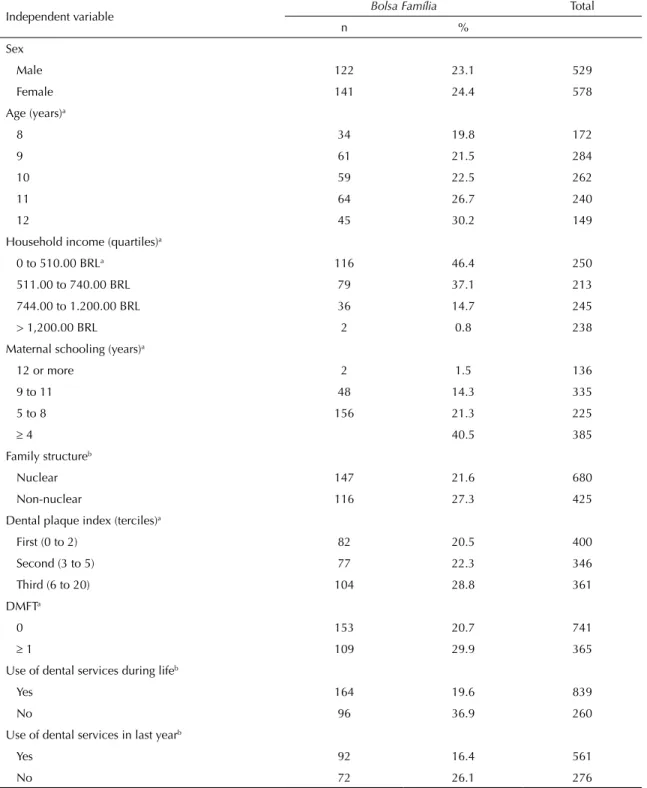
The proportion of pupils beneitting from the program
increased with age, lower household income, lower maternal schooling and higher presence of dental plaque. Pupils from non-nuclear families, with DMFT
≥ 1 and who had never made use of dental services
were associated with receiving the BFP. Of those pupils who had visited a dentist at least once in their lives, the prevalence of receiving the BFP was higher in those whose most recent visit was more than a year before, compared with those who had seen one within the year
preceding the study (Table 1).
The inal model, adjusted for age and the presence of
plaque, showed that the prevalence of caries was two
times higher (PR 2.00; 95%CI 1.47;2.69) in pupils
receiving the BFP compared with those in private schools. Pupils in public schools not receiving the BFP had a
higher prevalence of caries (PR 1.76; 95%CI 1.32;2.34),
although less severe, compared with those receiving the
BFP (Table 2). The inal model for the outcome severity of dental caries (Table 3) shows that pupils receiving the
BFP had more severe forms of the disease than those in
private schools (MR 1.53; 95%CI 1.18;2.00), and those
in public schools not receiving the BFP (MR 1.48; 95%CI
1.17;1.87). In the multivariate model, the prevalence of
pupils who had never visited a dentist was more than six times higher among children receiving the BFP (PR
DISCUSSION
The schoolchildren who received the beneit are those
who have the highest prevalence and experience of dental caries and those who use dental services less, compared
with those in private schools and other pupils in public
school not receiving the BFP. This is the irst study to
investigate the association between oral health condi-tions and receiving, or not, the BFP, which highlights
the relevance and originality of these indings.
Table 1. Description of the sample according to receiving the benefit and to socioeconomic. household. oral health and dental
service use factors. Relative (n) and absolute (%) frequencies. Pelotas, RS, Southern Brazil, 2010. (N = 1,107)
Independent variable Bolsa Família Total
n %
Sex
Male 122 23.1 529
Female 141 24.4 578
Age (years)a
8 34 19.8 172
9 61 21.5 284
10 59 22.5 262
11 64 26.7 240
12 45 30.2 149
Household income (quartiles)a
0 to 510.00 BRLa 116 46.4 250
511.00 to 740.00 BRL 79 37.1 213
744.00 to 1.200.00 BRL 36 14.7 245
> 1,200.00 BRL 2 0.8 238
Maternal schooling (years)a
12 or more 2 1.5 136
9 to 11 48 14.3 335
5 to 8 156 21.3 225
≥ 4 40.5 385
Family structureb
Nuclear 147 21.6 680
Non-nuclear 116 27.3 425
Dental plaque index (terciles)a
First (0 to 2) 82 20.5 400
Second (3 to 5) 77 22.3 346
Third (6 to 20) 104 28.8 361
DMFTa
0 153 20.7 741
≥ 1 109 29.9 365
Use of dental services during lifeb
Yes 164 19.6 839
No 96 36.9 260
Use of dental services in last yearb
Yes 92 16.4 561
No 72 26.1 276
BRL: Reais (R$) Brazilian currency at the time of research
According to the World Bank, income distribution is one of the causes of lessening social inequalities in Latin American countries.b The BFP is responsible for many of the most disadvantaged in the Brazilian population being able to move out of poverty or extreme poverty. Among the conditions imposed by the BFP is the use of health care services and attending school. Verifying attendance is done directly by the school, which sends attendance reports of the recipients to the Brazilian Ministry
of Social Development. The health care conditions depend on access to health care services, as the recipients need to regularly visit their reference unit so that the growth and development of children under seven is monitored.2
Even after adjusting for risk factors for dental caries, such
as maternal schooling and presence of visible plaque, pupils receiving the BFP have a higher prevalence and severity of dental caries, even when compared to students
Table 2. Crude (PRc) and adjusted (PRa) prevalence ratios for the prevalence of dental caries, recipients of Bolsa Família and other
independent variables in schoolchildren aged from eight to 12 years. Pelotas, RS, Southern Brazil, 2010. Poisson regression analysis. (N = 1,107)
Independent variable PRc 95%CI p PRa 95%CI p
Maternal schooling (years) 0.015 –
12 or more 1 –
9 a 11 1.31 0.89;1.94
5 a 8 1.81 1.23;2.66
≥ 4 2.16 1.50;3.11
Family structure 0.080 –
Nuclear 1 –
Non-nuclear 1.16 0.98;1.36
Sex 0.272
Male 1 – –
Female 1.10 0.93;1.29
Age (years) < 0.001 < 0.001
8 1 1
9 0.98 0.70;1.35 0.94 0.68;1.29
10 1.32 0.98;1.80 1.17 0.87;1.58
11 1.67 1.24;2.24 1.48 1.11;1.96
12 1.87 1.37;2.54 1.52 1.12;2.07
Presence of plaque (terciles) < 0.001 < 0.001
First 1 1
Second 1.23 0.99;1.54 1.28 1.02;1.60
Third 1.64 1.34;2.00 1.50 1.22;1.84
Fear of dentist 0.119 –
No 1 –
A little 1.26 1.03;1.54
Yes 0.82 0.50;1.35
Very much 1.06 0.73;1.53
Bolsa Família < 0.001 < 0.001
No (private school) 1 1
No (public school) 1.95 1.47;2.59 1.76 1.32;2.34
Yes 2.29 1.70;3.08 2.00 1.47;2.69
b Lustig N, Lopez-Calva LF, Ortiz-Juarez E. Declining inequality in Latin America in the 2000s: the cases of Argentina, Brazil, and Mexico.
in public schools who do not receive the beneit. Studies
have shown a strong association between socioeconomic factors and general and oral health conditions (including
dental caries) in populations of similar age groups.16,17
If, on the one hand, the beneit is correctly provided to
those on lower household incomes, these children have more dental caries as a consequence of lower income.
These indings are also explicable by the phenomenon
known as polarization of dental caries, observed in Brazilian schoolchildren,12 which consists of a lack of the disease in a considerable portion of the population, and a large number of cases concentrated in a small group of individuals.8,22 This polarization indicates that there is a distribution of lower disease loads, less uniformly, and increasing levels of inequality are noted.12
Recipients of the BFP make less use of dental services, even though they have greater need. Although there
had been a signiicant increase in access to dental
services in Brazil at all socioeconomic levels,14 there is a notable difference in use between groups with greater and lower purchasing power.5 The expan-sion of the Estratégia de Saúde da Família – Family Health Care Strategy and of Equipes de Saúde Bucal
– Oral Health Care Teams, the creation of Centros de Especialidades Odontológicas – Specialist Dental Centers and increased income in Brazil may explain this increase in use of services.14 Even so, in Pelotas, there is a high number of pupils who never use dental services, especially among those receiving the BFP, among whom the prevalence of never having visited a dentist is six times higher than in pupils in private
Table 3. Crude (c) and adjusted (a) rate ratios (RR) for severity of dental caries (DMFT+dmft), recipients of Bolsa Família and
other independent variables in schoolchildren aged 8 to 12 years. Pelotas, RS, Southern Brazil, 2010. Poisson regression analysis. (N = 1,107)
Independent variable RRc 95%CI p RRa 95%CI p Maternal schooling (years) < 0.001 < 0.001
12 or more 1 1
9 to 11 1.93 1.38;2.71 1.49 1.03;2.14 5 to 8 2.22 1.57;3.12 1.63 1.11;2.38
≥ 4 2.71 1.95;3.76 1.95 1.34;2.84
Family structure 0.372 –
Nuclear 1 –
Non-nuclear 1.07 0.93;1.23
Sex 0.272
Male 1 – –
Female 0.81 0.70;0.93
Age (years) < 0.001 < 0.001
8 1 1
9 0.85 0.69;1.04 0.79 0.64;0.97
10 0.70 0.56;0.87 0.66 0.53;0.82
11 0.52 0.41;0.66 0.48 0.38;0.61
12 0.56 0.43;0.73 0.46 0.35;0.31
Presence of plaque (terciles) < 0.001 < 0.001
First 1 1
Second 1.43 1.19;1.71 1.38 1.15;1.67 Third 1.65 1.40;1.95 1.57 1.32;1.87
Fear of dentist 0.146 –
No 1
A little 1.01 0.85;1.21 –
Yes 0.69 0.44;1.08
Very much 1.29 0.94;1.77
Bolsa Família < 0.001 0.007
No (private school) 1 1
No (public school) 1.82 1.46;2.26 1.48 1.17;1.87
schools. Social determinants can exert such a strong differential that even when children have access to a universal public dental health system, these differ-ences are not eliminated.5 The increase in the number of dentists in the public health care service in Brazil
is still not suficient to reduce inequalities in dental
service use, as their focus does not reach the most vulnerable and susceptible individuals.12 Presence of dental caries is associated with greater use of dental services. This raises the issue of the actual role of oral health care services, as their focus of action appears to be centered on the disease and not on
promoting health. In addition to increased access, the care philosophy also needs to change, such as strate-gies that deal with social determinants of health and promote tackling common risk factors.23
The relationship between poor socioeconomic condi-tions and inequalities in health care is clear, and inves-tigating the conditions that would enable this relation-ship, and, subsequently, social inequalities to decrease
becomes a priority. Schoolchildren beneitting from
the BFP have a higher disease load of dental caries and are those who make less use of dental services. These schoolchildren, in theory, attend health care services,
Table 4. Crude (c) and adjusted (a) prevalence ratios for not using dental services, receiving the Bolsa Família and other
independent variables in schoolchildren aged 8 to 12 years. Pelotas, RS, Southern Brazil, 2010. Poisson regression analysis. (N = 1,106)
Independent variable PRc 95%CI p PRa 95%CI p Maternal schooling (years) < 0.001 < 0.001
12 or more 1 1
9 to 11 2.73 1.34;5.57 1.26 0.63;2.50 5 to 8 4.23 2.09;8.58 1.71 0.84;3.47
≥ 4 6.41 3.23;12.70 2.02 1.01;4.05
Family structure 0.275 –
Nuclear 1 –
Non-nuclear 1.12 0.91;1.37
Sex 0.169
Male 1 – –
Female 1.15 0.94;1.41
Age (years) 0.319 –
8 1 –
9 0.96 0.70;1.30
10 0.99 0.73;1.35
11 0.73 0.51;1.03
12 0.89 0.61;1.28
Presence of plaque (terciles) 0.118 –
First 1 –
Second 0.92 0.71;1.18 Third 1.18 0.94;1.49
Fear of dentist 1 1.32;2.15 < 0.001 < 0.001
No 1.68 2.26;3.93 1
A little 2.98 1.54;2.93 1.55 1.19;2.00
Yes 2.13 2.56 1.90;3.45 < 0.001
Very much 1.77 1.27;2.48
Dental caries 1 0.58;0.93 0.011
No 0.74 1
Yes 0.63 0.50;0.80
Bolsa Família < 0.001 < 0.001
No (private school) 1 1
as monitoring their growth and development up to seven years of age is a key condition for continuing to
receive the beneit. There are dentists in most, although
not all, municipal primary health care networks in the country. Thus, it would be important to ask whether those oral health care services are really prepared to care for the sickest individuals and whether the door to these services is open to those who really need them.
1. Ainamo J, Bay I. Problems and proposals for recording gingivitis and plaque. Int Dent J. 1975;25(4):229-35.
2. Andrade MV, Chein F, Souza LR, Puig-Junoy J. Income transfer policies and the impacts on the immunization of children: the Bolsa Familia Program. Cad Saude Publica. 2012;28(7):1347-58. DOI:10.1590/S0102-311X2012000700013
3. Bennett S, Woods T, Liyanage WM, Smith DL. A simplified general method for cluster-sample surveys of health in developing countries. World Health Stat Q.
1991;44(3):98-106.
4. Boeira GF, Correa MB, Peres KG, Peres MA, Santos IS, Matijasevich A, et al. Caries is the main cause for dental pain in childhood: findings from a birth cohort. Caries Res. 2012;46(5):488-95. DOI:10.1159/000339491
5. Cypriano S, Hugo FN, Sciamarelli MC, Torres LHN, Sousa MLR, Wada RS. Fatores associados à experiência de cárie em escolares de um município com baixa prevalência de cárie dentária.
Cienc Saude Coletiva. 2011;16(10):4095-106. DOI:10.1590/S1413-81232011001100015
6. Gertler P. Do conditional cash transfers improve child health? Evidence from PROGRESA’s control randomized experiment. Am Econ Rev.
2004;94(2):336-41. DOI:10.1257/0002828041302109
7. Goettems ML, Correa MB, Vargas-Ferreira F, Torriani DD, Marques M, Domingues MR, et al. Methods and logistics of a multidisciplinary survey of schoolchildren from Pelotas, in the Southern Region of Brazil. Cad Saude Publica. 2013;29(5):867-78. DOI:10.1590/S0102-311X2013000500005
8. Macek MD, Heller KE, Selwitz RH, Manz MC. Is 75 percent of dental caries really found in 25 percent of the population? J Public Health Dent. 2004;64(1):20-5. DOI:10.1111/j.1752-7325.2004.tb02721.x
9. Marmot M. Historical perspective: the social determinants of disease: some blossoms.
Epidemiol Perspect Innov. 2005;2:4. DOI:10.1186/1742-5573-2-4
10. Marmot M. Health in an unequal world: social circumstances, biology and disease. Clin Med.
2006;6(6):559-72. DOI:10.7861/clinmedicine.6-6-559
11. Morris SS, Olinto P, Flores R, Nilson EA, Figueiró AC. Conditional cash transfers are associated with a small reduction in the rate of weight gain of preschool children in northeast Brazil. J Nutr. 2004;134(9):2336-41
12. Narvai PC, Frazão P, Roncalli AG, Antunes JLF. Cárie dentária no Brasil: declínio,
polarização, iniqüidade e exclusão social.
Rev Panam Salud Publica. 2006;19(6):385-93. DOI:10.1590/S1020-49892006000600004
13. Oliveira FCC, Cotta RMM, Sant’Ana LFR, Priore SE, Franceschini SCC. Programa Bolsa Família e estado nutricional infantil: desafios estratégicos.
Cienc Saude Coletiva. 2011;16(7):3307-16. DOI:10.1590/S1413-81232011000800030
14. Peres KG, Peres MA, Boing AF, Bertoldi AD, Bastos JL, Barros AJD. Reduction of social inequalities in utilization of dental care in Brazil from 1998 to 2008. Rev Saude Publica. 2012;46(2):250-8. DOI:10.1590/S0034-89102012000200007
15. Peres MA, Peres KG, Antunes JLF, Junqueira SR, Frazão P, Narvai PC. The association between socioeconomic development at the town level and the distribution of dental caries in Brazilian children.
Rev Panam Salud Publica. 2003;14(3):149-57. DOI:10.1590/S1020-49892003000800001
16. Peres MA, Peres KG, Barros AJ, Victora CG. The association between family socioeconomic trajectories from childhood to adolescence and dental caries and associated oral behaviours. J Epidemiol Community Health. 2007;61(2):141-5. DOI:10.1136/jech.2005.044818
17. Peres MA, Barros AJ, Peres KG, Araújo CL, Menezes AM. Life course dental caries determinants and predictors in children aged 12 years: a population-based birth cohort. Community Dent Oral Epidemiol. 2009;37(2):123-33. DOI:10.1111/j.1600-0528.2009.00460.x
18. Reis M. Cash transfer programs and child health in Brazil. Econ Lett. 2010;108(1):22-5.
19. Selwitz RH, Ismail AI, Pitts NB. Dental caries. Lancet. 2007;369(9555):51-9. DOI:10.1016/S0140-6736(07)60031-2
20. Susin C, Oppermann RV, Haugejorden O, Albandar JM. Tooth loss and associated risk indicators in an adult urban population from south Brazil. Acta Odontol Scand. 2005;63(2):85-93.
21. Thomson WM. Social inequality in oral health.
Community Dent Oral Epidemiol. 2012;40 (Suppl 2):28-32. DOI:10.1111/j.1600-0528.2012.00716.x
22. Tickle M. The 80:20 phenomenon: help or hindrance to planning caries prevention programmes?
Community Dent Health. 2002;19(1):39-42
23. Watt RG. Strategies and approaches in oral disease prevention and health promotion.
Bull World Health Organ. 2005;83(9):711-8. DOI 10.1590/S0042-96862005000900018 REFERENCES
This study was supported by the Ministério da Saúde/Conselho Nacional de Desenvolvimento Científico e Tecnológico – Edital MCT-CNPq/MS-SCTIE-DECIT/MS-SAS/DAB no. 32/2008 Saúde Bucal (Process no. 402350/2008-1).