RESUMO
A pesquisa teve por objei vo conhecer o núcleo central das representações sociais de pacientes e enfermeiras(os) acerca do signifi cado de cuidar e tratar. Consiste em um estudo de natureza qualitai va, base-ado na fundamentação teórico-metodoló-gica da abordagem estrutural das repre-sentações sociais. Pari ciparam do estudo 90 sujeitos. Aplicou-se um quesi onário ui lizando-se a técnica de livre associação. Os dados foram analisados com o auxílio do sot ware Evoc. Os resultados revelam que as representações sociais de pacientes e profi ssionais acerca dos conceitos de cui-dar expressam uma relação éi ca, sensível, solidária, afei va e compromissada com a vida humana amorosa. Entretanto, as re-presentações sobre o tratar apontam para diferentes signifi cados e disi ntas
expecta-i vas. Conclui-se que a discrepância entre essas representações é bastante preocu-pante e merece atenção especial da cate-goria. Tal discrepância denuncia que o ser-viço oferecido pelos profi ssionais não sai s-faz à demanda e ao desejo dos pacientes.
DESCRITORES Cuidados de enfermagem Humanização da assistência Relações interpessoais Competência profi ssional Relações enfermeiro-paciente
Social representations of caring and
treating: the look of patients
and professionals
*O
RIGINAL
A
R
TICLE
ABSTRACT
The objeci ve of this study was to learn about the central nucleus of the social representai ons of caring and treai ng for pai ents and nurses. This qualitai ve study was founded on the theorei cal-method-ological framework of the structural ap-proach of social representai ons. Pari ci-pants were 90 subjects, who answered a quesi onnaire using the free associai on technique. Data analysis was performed using Evoc sot ware. Results show that the social representai ons that pai ents and professionals have of the concepts of car-ing express an ethical, sensii ve, solidary, aff eci ve and commit ed relai onship with a loving human life. However, the repre-sentai ons of treai ng point at diff erent meanings and diff erent expectai ons. In conclusion, the diff erence between these representai ons is rather concerning and deserves special at eni on. Such discrep-ancy denounces that the service that the professionals have delivered does not meat the demand and desires of pai ents.
DESCRIPTORS Nursing care
Humanizai on of assistance Interpersonal relai ons Professional competence Nurse-pai ent relai ons
RESUMEN
La invesi gación objei vó conocer el núcleo central de representaciones sociales de pacientes y enfermeras/os acerca del sig-nifi cado de cuidar y tratar. Estudio de natu-raleza cualitai va, basado en fundamento teórico-metodológico del abordaje es-tructural de las representaciones sociales. Pari ciparon 90 sujetos. Se aplicó un
cues-i onario usando técnica de libre asocia-ción. Los datos se analizaron con ayuda del sot ware Evoc. Los mismos revelaron que las representaciones sociales de pacientes y profesionales acerca de los conceptos de cuidar expresan una relación éi ca, sensi-ble, solidaria, afeci va y compromei da con la vida humana amorosa. Mientras tanto, las representaciones sociales sobre el tra-tar apuntan hacia diferentes signifi cados y disi ntas expectai vas. Se concluye en que la discrepancia entre las representa-ciones es bastante preocupante y merece atención de la categoría. Tal discrepancia expresa que el servicio ofrecido por los profesionales no sai sface la demanda y el deseo de los pacientes.
DESCRIPTORES Atención de enfermería Humanización de la atención Relaciones interpersonales Competencia profesional Relaciones enfermero-paciente
Moema da Silva Borges1, Lilian Silva Queiroz2, Hellén Cristina Pereira da Silva3
REPRESENTAÇÕES SOCIAIS SOBRE CUIDAR E TRATAR: O OLHAR DE PACIENTES E PROFISSIONAIS
REPRESENTACIONES SOCIALES SOBRE CUIDAR Y TRATAR: LA VISIÓN DE PACIENTES Y PROFESIONALES
* Extracted from the study “O dilema da Enfermagem: cuidar ou tratar”, Undergraduate Research Fellowship Program at the University of Brasília, 2008.
1Professor, Nursing Department, Health Science Faculty, University of Brasília. Brasília, DF, Brazil. [email protected] 2Undergraduate student, Nursing
A lack of knowledge that caring is different from treating deviates the focus of nursing practice, dislocating its role from assisting
patients to assisting physicians.
INTRODUCTION
Every profession needs to jusi fy its service delivery, delimit its fi eld of competence and demonstrate its in-dispensability(1). However, at er more than one century
of professionalizai on, the ideni ty of nursing is si ll a goal to be achieved (1). There is a lack of clarity concerning the
meaning of nursing, which is infl uenced by many factors, among which the following stand out: gender issues that characterize the career as being female; a capitalist ra-i onale that regulates and permeates the organizai on of health services; educai on that gives priority to technical-ity focused on the disease; hegemony of medical power and knowledge in the context of health care with an em-phasis on healing to the detriment of caring(2).
In health facilii es, especially in hospitals, a lack of disi nci on between the concepts caring and treai ng fa-vored the meaning of the lat er to insidiously invade the fi rst, masquerading itself as it(1). The values and the
hierar-chical organizai on of care roles imply to society that nurs-ing care is only required in the presence of disease.
The establishment of the equai on nurse=disease creates obstacles for the ac-knowledgment of the nursing profession, which compromises the social value of nurs-ing work. A lack of knowledge that caring is diff erent from treai ng deviates the focus of nursing praci ce, dislocai ng its role from as-sisi ng pai ents to assisi ng physicians(1,3).
The result of this set of factors is trans-lated by a feeling of exclusion that propa-gates the (dis)value of work among the pro-fessionals themselves. And even though this aspect does not exclude the nurse from her/
his space of work, it leaves her/him in a vulnerable condi-i on. As an aggravai ng factor, pai ents and family members claim not to know what the real role and value of the nurs-ing work is(3-4).
The value of nursing care seems to be condii oned on two aspects: fi rst, on the proof that nursing care is an expression of an indispensable aci on in certain circum-stances in life, a service not provided by other profes-sionals(1); second, care should be off ered based on what
is signifi cant in someone’s life, understanding someone’s meaning, establishing bonds important for a given person.
From this perspeci ve, nursing care is complex and de-limited by an ample range of poteni al aci ons. Amid this complexity, one needs to consider that the fi eld of compe-tence for nursing rests upon an interseci on between the fi eld of pai ents’ competence and the physicians’ fi eld of competence, situated between care and treatment(1).
Care aci ons aim to trigger everything that mobilizes energy of life while treatment is intended only to limit the
disease, stop it, and mii gate its eff ects, limii ng its losses. If the funci on of an organ is impeded, medical knowl-edge helps nature to remove the obstruci on and nothing else, while nursing maintains the person in the best pos-sible condii on, so that nature can act upon her/him(5). It is
important to understand that one can live without treat-ment but not without care. Hence, care aci ons cannot to be put aside or excluded from treatment(1).
From this perspeci ve, it is esseni al to explicate the diff erences between the concepts of caring and treai ng. Not delimii ng the interseci ons and limits between car-ing and treai ng impedes the idenifi cai on of the fi eld of competence of the nursing care, as one confuses it with the medical work itself. In other words, we argue that a lack of clarity about the real meaning of caring and the disi nci on between it and treai ng masks nurs-ing care aci ons and compromises its representai on and praci ce.
However, the possibility of changing the representai on of nursing care necessarily implies in re-elaborai ng a new interpretai on of it. This is because social representai ons are both product and process of an aci vity of appropriai ng reality external to thought and a psychologi-cal and social elaborai on of this reality(6).
In this context, the representai on cerning care should permit nursing to con-fer meaning on its procedures, understand complexity of reality in the face of the sys-tems of references of people involved in the process.
According to one study(7), in structural
terms, a representai on is composed of its central and peripheral systems, which are presented as a double system in which each has a specifi c and complementary role.
The core system/core is given by the analysis of the history of life of a given group and its experiences, which corresponds to its historical, social and psychological bas-es. Hence, the central core assesses the characterisi c of stability to the representai on and marks its resistance to changes.
On the other hand, the system/peripheral core al-lows the representai on to anchor on current reality, eas-ily adapi ng to the current polii cally correct discourse. Therefore, its elements are more vivid, more concrete and with great mobility. Even though the peripheral system does not defi ne social representai on, it eff eci vely con-tributes to its organizai on.
The terms disease and treatment more readily and more frequently appear in response to the induc-ing word TREATING, indicatinduc-ing the likely central core of the patients’ representation. In the first periphery, the terms physician, remediate, responsibility and attention appear more readily and more frequently (Figure 2).
The 45 prof essionals had the following profi le: 12 (26.6%) were between 18 and 30 years old, 10 (22.3%) between 31 and 42 years old, 18 (40%) between 43 and 55 years old, four (8.8%) between 55 and 65 years old, and only one (2.2%) was older than 70 years old; 34 (76%) were women and 11 (24%) were men; 13 (28.8%) had a bachelor’s degree, 27 (60%) were specialists, two (4.4%) had a master’s degree and three (6.6%) had a doctoral degree.
METHOD
This is a qualitai ve study based on the theorei cal methodological basis of structural approach of social rep-resentai ons. Data were collected in Brasília, DF, Brazil between February and March, 2009 in health centers and hospitals in the region. A total of 90 individuals pari cipat-ed in the study: a) 45 users of health services randomly approached in waii ng rooms of health units; we opted for these services given the availability of these individuals to agree to provide informai on while waii ng; b) 45 nurs-ing professionals who performed their funci ons in health units and public hospitals; these professionals were cho-sen due to accessibility. Two instruments were used: 1) a quesi onnaire with closed quesi ons to ideni fy the pro-fi le of the pari cipants; 2) and a quesi onnaire in which the free associai on technique was used. It consists in preseni ng an inducing word corresponding to the repre-sented object and asking to them to express all the words, expressions, or adjeci ves that come to their minds. The inducing words were caring and treai ng and they were asked to express themselves about both the terms.
Inclusion criteria were being 18 years old or older and having received some nursing care. For the profession-als, criteria were being older than 18 years old and hav-ing a bachelor’s degree in nurshav-ing. Data obtained were transcribed and analyzed through the Evoc sot ware(8). Evoked words should more frequently consi tute central elements of representai on. The Evoc sot ware permits one to glimpse the central core given a double crite-rion: frequency and order in which words/phrases were evoked.
Based on the interseci on of the criteria frequency and evocai on, the relevance of the elements (words, phrases and expressions) associated with the inducing term is de-fi ned. These results are presented in four quadrants orga-nized in two axes. The veri cal axis refers to the frequency while the horizontal axis refers to the order in which the word was evoked(8).
The most relevant elements that emerge fi rst accord-ing to order of evocai on with a signifi cantly higher fre-quency (central core) appear in the upper let quadrant. The right upper and lower quadrants include the elements less clear in relai on to their role in the structure of rep-resentai on, though signifi cant in its organizai on. These quadrants consi tute the fi rst or closest periphery(8). In
the lower right quadrant the less frequent and less read-ily evoked elements appear, corresponding to the second periphery, which is not addressed in this study.
In accordance with Resolui on 196/96, data were col-lected at er the project was approved by the Ethics Re-search Commit ee at the Faculty of Health Sciences (pro-tocol 140/08). All the study’s pari cipants signed free and informed consent forms.
RESULTS
The pr ofi le of the 45 users was composed of: 26 (57.8%) individuals aged between 18 and 30 years of age; 14 (31.1%) between 31and 50 years and fi ve (11.1%) be-tween 51 and 58 years old; 26 (57.8%) women and 19 (42.2%) men; six (13.3%) reported to have completed pri-mary school, 14 (31.1%) completed secondary school, 14 (31.1%) did not complete higher educai on and 11 (24.4%) reported a bachelor’s degree.
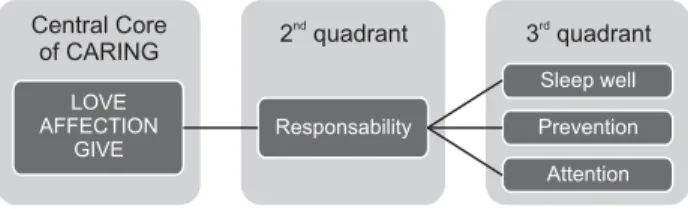
The terms love, affection, and give were more read-ily and frequently evoked in response to the inducing word CARING, indicating the likely central core of the patients’ representation. In the first periphery, the terms responsibility, prevention, attention andthe ex-pression sleep well were more readily and frequently evoked (Figure 1).
Figure 1 – Framework representing the terms that compose the
likely central and peripheral core in relation to the word CARING
Central Core of CARING
LOVE AFFECTION
GIVE
2 quadrantnd
Responsability
3 quadrantrd
Sleep well
Prevention
Attention
Figure 2 – Framework representing the terms that compose
the likely central and peripheral core in relation to the word TREATING
Central Core of TREATING
DISEASE TREATMENT
2 quadrantnd
Physician
3 quadrantrd
Remediate
Responsibility
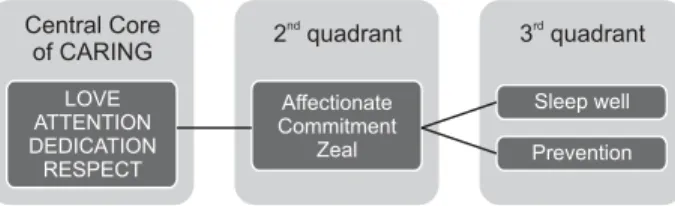
The terms love, at eni on, dedicai on and respect were more readily and frequently evoked in relai on to the inducing word CARING, indicai ng the likely central core of the professionals’ representai on. In the fi rst pe-riphery, the terms aff eci onate, commitment and zeal, being and pai ent were more readily and frequently evoked (Figure 3).
In this line of reasoning, we perceive that the central core of the users’ social representai ons concerning care, that is, the system resistant to changes, asks that the primary meaning of preservai on and promoi on of life – love – and the recovery of emoi ons and feelings, that have been devalued in the model of producing of health care are re-placed in the focus of nursing care.
We reiterate that the peripheral system does not de-fi ne social representai on, but eff eci vely contributes to its organizai on. Hence, the term responsibility evoked in the fi rst quadrant (Figure 1) includes the idea that love is a responsible act and implies the establishment of an im-portant and reciprocal relai onship between another and me. However, in the daily work roui ne, the coldness of protocols and i me pressure may lead professionals to de-personalize care. We ot en caught ourselves referring to pai ents as the ‘heart at ack’, or the ‘TBI’, forgei ng or ig-noring that beyond the diagnosis there is a human being just like us(11).
In the second quadrant, the terms sleep well,
preven-i on, and at eni on (Figure 1) indicate that the underlying content of each of these terms focus on the concept of health and consequently the noi on of wellbeing. This aspect indicates that care praci ce does disregard vital concerns for the maintenance and preservai on of life. Therefore, sleeping well, preveni ng diseases and paying at eni on to aspects that promote a healthy condii on of life revolve around the act of care, which requires paying constant at eni on to the vital needs of individuals.
The results reveal that the users’ structuring element of representai ons of caring meets the greater purpose of nursing care, which consists of permii ng pai ents to de-velop their ability to live or try to compensate for the harm to funci ons limited by disease, seeking to supply the defi -ciency in physical, aff eci ve, or social dysfunci on(1,5).
The term disease was the one that most stood out (Fig-ure 2). This result indicates the concept of disease as the likely central core of the representai on. The
representa-i on of disease is the opposite of what is good, it is some-thing unpleasant that aff ects the individual and disables, reveals something bad in itself(12). It then raifi es that only
in the face of the disease is a treatment required.
In general, the individual triggers a treatment when care aci ons that aimed to at enuate, compensate and im-pede the disease from worsening did not succeed. Given this aspect, users in general, hold the elements of any diagnosis, and during a medical consultai on, wait for a confi rmai on of the analysis they have already inii ated(1).
This aspect signals the need for a dialogical approach that considers the diff erent forms of construci ng the concepts of health and disease. Thus, beliefs cannot be disregarded because a richness of feelings that give meaning to the individuals’ experiences, constructed daily in the relai on-ships with the eni re social environment that composes the reality of individuals, resides in such beliefs(12).
Figure 3 - Fra mework representative of the terms that compose
the likely central core and the peripheral core in relation to the word CARING
Central Core of CARING
LOVE ATTENTION DEDICATION RESPECT
2 quadrantnd
Affectionate Commitment
Zeal
3 quadrantrd
Sleep well
Prevention
The terms knowledge and medicate were more readily and frequently evoked in relai on to the word TREATING. In the fi rst periphery the terms cure, medicai on and the expression being impersonal were more readily and fre-quently evoked (Figure 4).
DISCUSSION
The term love was the one that most stood out in Figure 1. This result indicates that the likely central core of the social representai ons of these pai ents revolves around the meanings of the verb to love. We can infer that according to the interviewees, the loving foundai on of care involves both the feeling of aff eci on and an ai tude of giving complementary to love, an esseni al basis for the care aci on.
It is important to highlight that love and care have been disi nguished as a commitment to humanizai on, as well as the maximum expression of ethics(9-10).
There-fore, it would be impossible to awaken the poteni al forces of each individual in the generai on of the self-healing process. Love is confi gured as the base of all car-ing processes as well of life itself. Based on which, we can (re)affi rm that, without care, from birth to the last moment of life, the human being disrupts, languishes, loses meaning and dies(10).
Figure 4 - Framework representative of the terms that compose
the likely central core and the peripheral core in relation to the word TREATING according to the professionals
.
Central Core of TREATING
KNOWLEDGE MEDICATE
2 quadrantnd
Cure Medication
3 quadrantrd
Disease
Responsibility
The term physician in the fi rst quadrant indicates that this is the professional responsible for treatment (Figure 2). It is the role of physicians to diagnose and prescribe treatment, which most of i me, is performed by the user himself/herself and/or family members. Only in more se-vere or complex situai ons there will be a need to seek a more specialized competence both to inii ate and follow-up treatment. In this case, this competence is delegated by the physician to nurses(1).
From this perspeci ve, the nursing staff needs to pay at eni on to two important aspects that deserve utmost considerai on: the fi rst highlights that no fi eld of profes-sional competence in health care can be privileged to the detriment of another type of knowledge, including the knowledge of users themselves. This line of reason-ing confi rms that the fi eld of nursing competence during treatment is in inter-relai onship with the fi eld of compe-tence of users and of physicians, sharing common areas with them(1).
The second emphasizes that when the responsibility of treatment is shared between the nurse and the physi-cian, the at eni on of the nurse should not be only fi xed on the disease. Especially in this situai on, nursing care is, on the one hand, related to everything that improves an individual’s condii on to favor preveni on and health pro-moi on, seeking to limit the disease; on the other hand, it is also related to everything that aids the recovery of and revitalizes the sick individual(1). These two aspects consi
-tute care during treatment.
Hence, even though treatment is object of medi-cal prescripi on, it is within the domain and inii ai ve of the nursing staff to put the prescripi on into praci ce, paying at eni on to the interaci on exisi ng between care and treatment(1). In this context, it can be called nursing
treatment.
The terms remediate, responsibility, and at eni on in the second quadrant reaffi rm that pai ents avoid ev-eryday a number of minor ailments through self-care and avoid the onset of disease(1). According to common
sense, to remediate means to repair or to correct disease or pain with medicai on. Hence, the representai ons of the terms responsibility and at eni on seem to comple-ment the idea that the use of medicai on requires focus on technical and relai onal competencies. In this con-text, it is prudent not to value one competency to the detriment of another.
Hence, we infer that, from the perspeci ve of users, treai ng does not only comprise technical procedures but, in an integral aci on, it has meanings related to the under-standing of needs of people in a given conjuncture.
The term love stood out, indicai ng the likely cen-tral core of social representai ons concerning caring for the nursing professionals (Figure 3). This result corrobo-rates research in which love also emerged as a likely
cen-tral core for the nursing professionals(3). In the view of
Humberto Maturana, when one embraces another, love emerges as a biological phenomenon. Hence, love as a biological phenomenon occurs given the dynamics of life, from the more primary to the more complex realizai ons. Love means accepi ng another with us, there is no social-izai on without love, and there is no humanizai on with-out socializai on (9-10).
The presence of the terms love, at eni on, dedicai on, and respect permit us to infer that the representai on of care for the professionals is organized around these four core elements. It is worth emphasizing that the manifes-tai on of feelings underling the word respect coincides with the maximum expression of love and translates the ability of embracing another, without judging what s/he feels, says or does. We then assert that love and care con-si tute the basis of social phenomena and are responsible for all the ethical implicai ons accruing from the biosocial dynamics.
In the fi rst quadrant the terms aff eci onate, commit-ment and zeal appear; these consi tute the philology of the word ‘care’. These terms confi rm that care means concern, diligence, zeal, at eni on and good treatment(10).
Hence, the expression of feelings implied in these words refers to the esseni al root of the profession, that is, love for others, whose main objeci ve was: a concern for the feelings of others, respect and compassion, direct contact with the pai ent, the search for human and spiritual val-ues, and a refl eci on on the human being and the
concep-i on of life(13).
The terms being and pai ence in the second quadrant rai fy the importance of being present in an autheni c manner, manifested by the ability to be real and show yourself to another in a genuine way, through words and acts. We note here the valorizai on of interpersonal rela-i onships and communicai ve skills (verbal and non-verbal communicai on) through messages that reveal at eni on and care.
The results indicate that according to the profession-als’ view, nursing care only occurs as the relai onship with another can facilitate the fl ourishing of care that truly hu-manizes: deep feeling, the desire to share and search for love(10).
These interpretai ons point to the Gordian knot of nursing praci ce, that is, the dilemma between caring and treai ng given the strangeness between one competency and the other. Here two issues require bet er understand-ing: 1) the administrai on of medicai on cannot be con-sidered by the professionals to be an isolated task in the context of care. Hence, in the face of disease, medicai ng only and exclusively represents an act complementary to nursing care and can only be performed based on the considerai on of the sick person and the person’s disease; 2) every care aci on requires mastering highly complex knowledge, whether by the ability of percepi on, under-standing, clarifi cai on of informai on, creai vity, etc.
Therefore, health care cannot, under any circumstanc-es, be simply considered an aci vity, because it has some-thing that goes beyond a professional’s praci ce. From this perspeci ve, the experi se of each professional should be appreciated as part of a strategy, that is, a set of aci ons that ensure the quality of life of individuals, minimizing the disrupi on caused by the disease.
Thus, there is no space for the submission or op-pression of nurses in labor in relai on to medical power. Nursing professionals are somei mes co-opted to perform tasks, not always appropriate, ot en related to standards and prescripi ons that were not complied with, or which should already have been changed and were not(14). It
is necessary to break with this asymmetry that ends up perpetuai ng losses to the value of nursing work and turns the nursing praci ce invisible within the health care context.
The profession should internalize the concept that nursing care is composed of what consi tutes its essence – interpersonal relai onship – and the accessory of the care praci ce – means (techniques, protocols, terminology, forms of organizai on, care contexts…)(15). Nursing needs
to transform care aci ons in a signifi cant help in which, both adjuvant and esseni al, dimensions are united(16).
Care aci ons can be lost in the unbalance between the esseni al and the accessory. In a total inversion of them, care withers and dies, resuli ng in total neglect and obliv-ion. If care dies, the human being dies as well(17). Hence,
the interaci ons exisi ng between care and treatment can-not be neglected. Both are embodied in knowledge and the epistemic matrix of care was, is, and will always be relevant to sustaining life and humanity.
The emergent terms in the fi rst quadrant, cure and medicai on, (Figure 4) explicate the mistake of looking at the treatment as a pari al task that characterizes an inter-veni on and not the care process. Despite the urgent ap-peal of the technological health approach, it is necessary to be clear that medicai on does not work miracles, hence medicai ng does not equal a cure. What really cures is the vital force exisi ng in each human being associated with
a desire to live, and it is the role of nursing care to help awakening such force(1).
The noi on of disease, a term that appears in the sec-ond quadrant, necessarily implies in the representai on of a sick person. Thus, thinking disease is related to thinking in a sick body that requires care. It is not appropriate in the context of nursing care to deal with or treat people as things […] in an objeci ve and detached manner(16). Hence,
impersonality is not jusifi ed in the presence of a pai ent under treatment.
Every border area, margin, limit or intercession occu-pied by nursing care between caring and treai ng requires a partnership between the pai ent and the professional. In this context, the relai onship is not established with the disease, but with the sick person. When the professional relates to the disease, s/he plays the role of an adversary – the one who fi ghts the evil. When one relates with the person, s/he plays the role of a partner(16).
The structural core of the professionals’ social repre-sentai ons refl ects a type of health care forged in a con-text of fragmented work with a low level of refl eci on, where nursing interveni ons are performed but care does not actually occur.
CONCLUSION
In the consensual universe of users and professionals, the likely central core of social representai ons concerning the act of caring keeps the same meaning. The represen-tai on for both aligns the idea of an aci on mediated by an ethical, sensii ve, caring, loving relai onship commit ed to humanized care.
However, users and professionals expressed disi nct views and expectai ons concerning the aci on of treai ng. While the fi rst long for a treatment that is not restricted to technical procedures but rather means integral aci ons encompassing an understanding of their needs, for the professionals treatment assumes a merely technical and impersonal character. These representai ons assume spe-cifi c aci ons for which they assign meanings with the force of reality.
Thus, this discrepancy reveals that the service off ered by nursing does not meet the demands and desires of us-ers. This quest requires imprini ng the mark of care within the cold conneci on of organizai ons and markei ng laws crystalized in health services.
REFERENCES
1. Colliére MF. Cuidar: a primeira arte da vida. 2ª ed. Loures: Lu-sociência; 2003.
2. Luz M. Fragilidade social e busca de cuidado na sociedade civil
de hoje: In: Pinheiro R, Mat os RA, organizadores. Cuidado:
as fronteiras da integralidade. Rio de Janeiro: Hucitec; 2004. p. 9-22.
3. Borges MS. Mel com fel: representações sociais do cui-dado de enfermagem e cidadania. Comun Ciênc Saúde. 2008;19(4):333-42.
4. Borges MS, Guilhem D, Duarte R, Ribeiro A. Representações sociais do trabalho de enfermagem: as abordagens estrutur-ais na visão da sociedade brasiliense. Ciênc Cuidado Saúde. 2003;2(2):113-22.
5. Ninghi ngale F. Notas de enfermagem. Loures: Lusociência;
2005.
6. Jodelet D. Les représentai ons sociales. Paris: PUF; 1989. Les
représentai ons sociales: un domaine en expansion; p. 32-61.
7. Abric JC. A abordagem estrutural das representações sociais. In: Moreira ASP, Oliveira DC. Estudos interdisciplinares de rep-resentações no Brasil. Goiânia: AB; 1998. p. 27-37.
8. Vergès P. L’évocai on de l’aegent: une méthode pour la
dé-fi nii on du noyau central d’une représentai on. Bull Pyschol.
1992;45(405):203-9.
9. Maturana H, Zoller G. Amar e brincar: fundamentos esqueci-dos do humano, do patriarcado à democracia. Trad. de
Hum-berto Marioi e Lia Diskin. São Paulo: Pala Athenas; 2004.
10. Boff L. Saber cuidar. Petrópolis: Vozes; 2004.
11. Baradel A. Os minutos da comunicação no serviço de saúde. In: Silva MJP, organizadora. Qual o tempo do Cuidado? Hu-manizando os cuidados de enfermagem. São Paulo: Centro Universitário São Camilo/Loyola; 2004. p. 29-38.
12. Coelho MS, Silva DMG, Padilha MIS. Social
representa-i ons of diabei c foot for people with type 2 diabetes
mel-litus. Rev Esc Enferm USP [Internet]. 2009 [cited 2010 Sept
15];43(1):65-71. Available from: ht p://www.scielo.br/pdf/
reeusp/v43n1/en_08.pdf
13. Oliveira CP, Kruse MHL. A humanização e seus múli
p-los discursos: análise a pari r da REBEn. Rev Bras Enferm.
2006;59(1):78-83.
14. Wey BH, Ayres JA, Lima MJR, Mendes RWB. Dilemmas and
affl ici ons of duty nurses evidenced in focal group. Rev Esc
Enferm USP [Internet]. 2010 [cited 2010 Sept
15];44(1):174-81. Available from: ht p://www.scielo.br/pdf/reeusp/
v44n1/en_a25v44n1.pdf
15. Watson J. Enfermagem pós-moderna e futura: um novo par-adigma da enfermagem. Loures: Lusociência; 2002.
16. Deslandes SF. Humanização: revisitando o conceito a pari r
das contribuições da sociologia médica. In: Deslandes SF, or-ganizador. Humanização dos cuidados em saúde: conceito,
dilemas e prái cas. Rio de Janeiro: FIOCRUZ; 2006. p. 33-48.