Objective: To translate, adapt and validate the Itch Severity Scale to a Brazilian version (ISS-Ped) in order to measure the severity of pruritus in children and adolescents with atopic dermatitis.
Methods: This is a methodological study of validation of an instrument following recommended protocols. The translated version was evaluated by a group of experts including one professional with experience in instrument validation, three English teachers, one linguistics teacher and seven allergists. After this, the scale was applied to 42 parents of children aged between 2 and 18 years old with atopic dermatitis, and 42 parents of children without pruritic diseases. Results were evaluated according to the severity of atopic dermatitis and disease control, and they were compared between groups with and without atopic dermatitis.
Results: More than 90% of the questions were clear to the parents. The ISS-Ped showed a strong positive correlation with the severity of atopic dermatitis (Pearson: 0.74; p<0.001) and a good correlation with the control of dermatitis (point-biserial correlation coeicient: 0.65; p<0.001). The scale showed excellent internal consistency (Cronbach’s α: 0.96) and adequate test and retest agreement (95% conidence interval of intraclass correlation coeicient: 0.89–0.99; p<0.001).
Conclusions: The ISS-Ped is a feasible, valid, reliable and satisfactorily equivalent. The translated scale was appropriate to assess the severity of itching in children and adolescents with eczema, allowing comparisons in the clinical practice and in the research setting. Keywords: Translating; Pruritus; Atopic eczema; Preschool child; Child; Adolescent.
Objetivo: Realizar tradução, adaptação e validação da Itch Severity Scale (ISS-Ped) para medir a gravidade de prurido em crianças e adolescentes com dermatite atópica.
Métodos: Estudo metodológico de validação de instrumento, seguindo protocolos recomendados. Após a deinição da versão traduzida, com participação de um proissional com experiência em validação de instrumentos, três professores de inglês, um professor de linguística e sete alergologistas, a Escala de Gravidade de Prurido (ISS-Ped) foi aplicada a 42 responsáveis por pacientes entre 2 e 18 anos de idade com dermatite atópica e a 42 responsáveis por indivíduos sem doença cutânea pruriginosa da mesma faixa etária. Resultados da escala foram comparados com a gravidade da dermatite atópica e o controle da doença, e entre os dois grupos.
Resultados: A clareza das questões foi maior que 90%. A ISS-Ped mostrou forte correlação positiva com a gravidade da dermatite atópica (Pearson: 0,74; p<0,001) e boa correlação com o controle da doença (coeiciente de correlação ponto bisserial: 0,65; p<0,001), além de ótima consistência interna (α de Cronbach: 0,96) e adequada reprodutibilidade pela concordância do teste e reteste (coeiciente de correlação intraclasse variando de 0,89 a 0,99 com IC95% e p<0,001).
Conclusões: A ISS-Ped apresentou-se viável, válida e coniável, sendo atingida equivalência satisfatória. A escala traduzida mostrou-se adequada para avaliar a gravidade do prurido em crianças e adolescentes com dermatite atópica, permitindo comparações na prática clínica e entre pesquisas de diferentes centros.
Palavras‑chave: Tradução; Prurido; Dermatite atópica; Pré-escolar; Criança; Adolescente.
ABSTRACT
RESUMO
*Corresponding author: E-mail: [email protected] (D.M.V. Bruscky). aUniversidade Federal de Pernambuco, Recife, PE, Brazil.
CROSS-CULTURAL ADAPTATION AND
VALIDATION OF THE ITCHING SEVERITY
SCALE IN CHILDREN AND ADOLESCENTS
WITH ATOPIC DERMATITIS
Adaptação transcultural e validação da Escala de Gravidade
de prurido em crianças e adolescentes com dermatite atópica
Dayanne Mota Veloso Bruscky
a,*, Ana Caroline Cavalcanti Dela Bianca Melo
a,
INTRODUCTION
Atopic dermatitis is the most common chronic inlammatory and relapsing skin disease in childhood, characterized by cutaneous xerosis and signiicant pruritus.1,2 It afects 10% to 20% of
chil-dren and 1% to 3% of adults worldwide. In Brazil, phase III of the International Study of Asthma and Allergies in Childhood (ISAAC) found an estimated prevalence of 13.1% in children aged 6 to 7 years and 8.4% in adolescents aged 13 to 14 years.3,4
It is a disease that negatively afects the patient’s health and quality of life, damages the quality of life of their family members, and imposes a high economic cost on families, especially in its most severe forms.5,6 he main complaints are: sleep and mood
alter-ation, social exclusion, children missing classes, as well as sleep deprivation and parents’ exhaustion. Persistent pruritus, which causes sleep and concentration impairment, in addition to social stigmatization, is one of the main components of the disease that contributes to social, psychological and economic efects.5-9
Pruritus, an unpleasant sensation that causes skin itchi-ness, results from the activation of non-myelinated nerve ibers (CMi ibers) in the papillary dermis and in the epidermis. After activation, these ibers synapse with secondary neurons, whose projections are part of the contralateral spinothalamic tract and ascend to various brain areas involved in sensitivity, emotion, evaluation, reward and memory.10,11 he
mecha-nisms that promote this activation are complex and still poorly understood within atopic dermatitis, since histamine released by cutaneous mast cells is only one of the mediators. In addi-tion to these and inlammatory cells, other substances such as neuropeptides, cytokines (mainly IL-2 and IL-31), tachykinins, tryptase, prostaglandins, platelet activating factor, leukotrienes, serotonin and eosinophilic proteins have been implicated in the pathophysiology of pruritus.2, 12,13
Currently, the most widely used instrument to assess pruri-tus is the visual analogue scale. However, although it is a valid instrument, it has a great limitation in that it only evaluates the intensity of the symptom and not how the symptom interferes in the life of the afected patient. Moreover, because it is com-pletely subjective and dependent on personal interpretation, the measurement of pruritus with this type of scale is individ-ual, and makes comparisons diicult between individuals and groups, mainly with diferent ethnicities, social and cultural conditions.14-16 he Itch Severity Scale (ISS) was developed and
validated from the Yosipovitch questionnaire to quantify the severity of pruritus. It was validated in English for patients aged 18 to 70 years with psoriasis.15 he Spanish version was
vali-dated for use in children and adolescents with atopic dermati-tis, and was composed of six questions and scores ranging from 0 to 18 points.17 However, there is no gold standard instrument
to measure pruritus yet, and it is widely recommended that at
least two instruments be used to reliably assess the intensity of the symptom in clinical trials.18
In order for an instrument to be used in a population other than the one for which it was developed and validated, trans-lation, cultural adaptation, and an analysis of the conceptual, item, semantic and operational equivalence are recommended. Additionally, tests that evaluate the measurement properties of these instruments in the new version, such as internal consis-tency, reproducibility, validity and viability are suggested.19-21
his study aimed to translate and adapt the ISS to Portuguese and Brazilian culture and to test its psychometric properties in children and adolescents with atopic dermatitis.
METHOD
his is a study of translation, cross-cultural adaptation, and val-idation of a questionnaire that assesses the severity of pruritus in children and adolescents with atopic dermatitis. he study was conducted between May and December of 2014 in the Allergy and Immunology and Dermatology and Pediatrics outpatient clinics of the Hospital das Clínicas of Universidade Federal de Pernambuco (HC-UFPE), by a single and properly trained interviewer, in a one-on-one interview, and with dura-tion of 10 to 15 minutes. On the day of collecdura-tion, data from the patient’s medical history about the severity of his or her atopic dermatitis, as well as his or her need for corticosteroids in the consultation, were noted.
he following participated in the study: a committee of experts (allergists, English teachers, a linguistics professor and a researcher with experience in instrument validation); the care-givers of patients aged 2 to 18 years with a clinical diagnosis of atopic dermatitis22,23 and who received care at the HC-UFPE
Allergy and Immunology clinic; the guardians of patients of the same age group without a pruritic cutaneous condition, and who received care at a general pediatric outpatient clinic in the same institution.
he scale consists of seven questions and its scores range from 0 (no pruritus) to 21 points (most severe pruritus), with a clini-cally important diference of two points. It has questions about description, frequency, intensity, and extent of pruritus, and how it afects sleep, mood, and sexual activity or desire. Each ques-tion is worth zero to one point, and the scale score is obtained by the sum of all questions multiplied by a correction factor (x3).
he validation process of the instrument was performed according to the steps described below20,21,24 and started after
the authors of the original scale gave permission:
2. Assessment of semantic equivalence, including two independent translations from the English language by two professionals luent in the language (Translation 1 and 2 - T1 and T2, respectively); A synthesis of the translations was made by an observer who is luent in English (T12); Two T12 back-translations were done, independently, by two native English teachers luent in Portuguese (RT1 and RT2) and a synthesis of the back translations was completed (RT12); A veriication of the equivalence was done by the committee of experts; hey compared T12, RT12 and the original versions (each evaluation had the following options to choose from: “Exactly the same meaning”, “Almost the same meaning” and “Diferent meaning”); A pilot study with the translated version, in which the clarity and degree of comprehension were evaluated according to whether each item was “not clear at all”, “ a little unclear”, “clear”, “very clear” or “completely clear” for each question.
3. Operational equivalence was performed by means of an evaluation of the format, order and layout of the questions and the manner the instrument was applied.
4. Initial psychometric properties were analyzed as follows:
• viability was assessed by the percentage of responses given by the patients;
• convergent validity, compared to the severity of the atopic dermatitis measured by the Scoring of atopic dermatitis (SCORAD) and with or without the disease controlled;
• for the divergent validity, scale values were com-pared between patients with the disease and chil-dren without pruritic cutaneous condition;
• reproducibility was examined by retesting the 7 to 14-day interval in ten patients at random;
• the internal consistency of the instrument was calculated.
he data was organized into tables in duplicate in Microsoft®
Excel®
2013 (Microsoft Corporation, Redmond, Washington, USA). he variables “age”, “sex”, “severity of atopic dermati-tis” and “disease activity” were analyzed. Additionally, the fre-quency of understanding of the questions was analyzed under “clarity of the items”, considering the sum of “Clear”, “Very clear” and “Completely clear” to be greater than 90% for each question as adequate. Semantic equivalence was deemed ade-quate by the sum of “Exactly the same meaning” and “Almost the same meaning” being greater than 80% in the form illed out by the committee of experts.
he inferential analysis was done with SPSS 18.0 software (SPSS Inc., Chicago, USA) in order to perform the following tests. Values of p <0.05 were considered signiicant:
• promax rotation exploratory factor analysis, after a test of the construct in relation to the adequacy of the sam-ple using the Kaiser-Meyer-Olkin index (KMO); val-ues above 0.80 were considered suicient; he Bartlett sphericity test was used in order to verify if the variables are correlated; the value of p up to 0.05 was considered adequate; 25
• feasibility, measured by the frequency of responses of the selected patients;
• comparison of the average scale between individuals with atopic dermatitis and those without pruritic cuta-neous disease using Student’s t-test;
• analysis of the correlation between ISS-Ped and the severity of atopic dermatitis (measured by SCORAD),26
using the Pearson correlation index; the complete SCORAD was used and was illed out by a medi-cal assistant during the consultation; it included an extensive evaluation of lesions, of intensity (erythema, iniltration/papule, crusting, excoriation, lichenii-cation and xerosis) and of the subjective symptoms (pruritus and interference in sleep using an analogic visual scale);
• evaluation of the correlation between the translated scale and the disease activity (controlled or uncontrolled), demonstrated by the need for the use of topical corti-costeroids in the consultation on the day of the inter-view, using the analysis of the point-biserial correlation coeicient ;
• reliability, assessed through internal consistency using Cronbach’s α coeicient (adequate when greater than
0.70) and through reproducibility and stability, mea-sured by an intraclass correlation between the test and retest.
his study was approved by the Research Ethics Committee of the Federal University of Pernambuco (UFPE) (report nº 610.734 and Certiicate of Presentation for Ethical Assessment nº 16628714.2.0000.5208). All participants aged 12 to 18 years and their caregivers signed the Informed Consent.
RESULTS
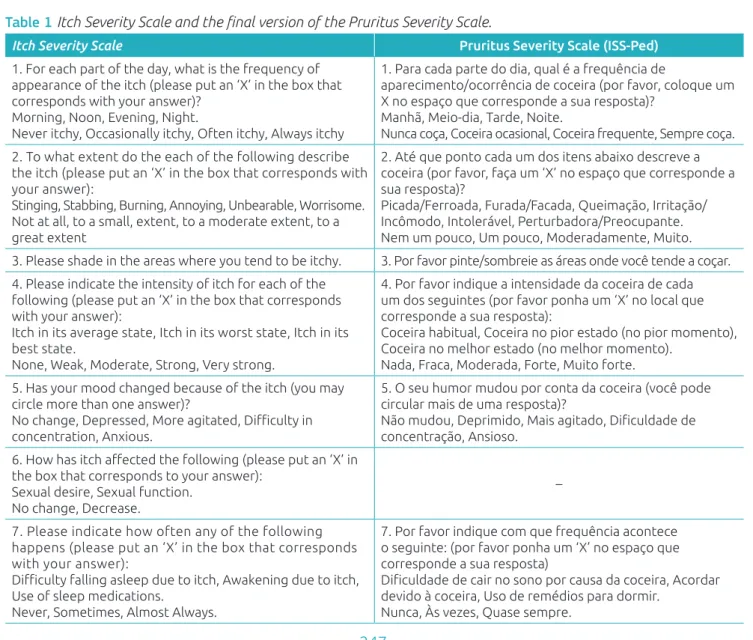
Semantic equivalence was performed through the evalua-tion of the original versions, T12 and RT12 by the commit-tee of experts, which was composed of three English teachers, one professor with experience in instrument validation, one linguistics professor and seven allergists from several regions of Brazil (one from the North, three from the Northeast, two from the Southeast and one from the Midwest). In this pro-cess, all of the questions were considered appropriate, with an equivalence of 100.0% for all items, except question 3, which obtained 91.7%. he original version and the ISS-Ped are shown in Table 1. here were modiications by adding syn-onyms in questions 1, 2, 3 and 4; some terms were changed in question 5 (“depression” for “depressed”, “more agitation” for “more agitated”, “anxiousness” for “anxious”), in addi-tion to the exchange of a word in quesaddi-tion 7 (“on account” exchanged for “because”).
In the pilot study, the translated version was applied to patients with atopic dermatitis and those without pruritic disease (of whom composed the inal group). he individuals under-stood the translated version of the scale, with the sum of “Clear”, “Very clear” and “Completely clear” above 90.0% for each ques-tion, as presented in Table 2. All questions were answered by the parents or caregivers of the children from all of the age groups. he children sometimes could or could not help with the answers.
A total of 43 patients aged between 2 and 18 years was recruited to participate in the study, and 42 (98%) caregivers answered the questionnaire, totaling 7 patients per each item of the scale. he average age of the patients was 7 ± 4 years, with 23 (55%) males. Regarding the severity of atopic derma-titis, 26 (62%) patients had the mild form of the disease and 10 (24%) had the severe form. Eczema was not controlled in 22 (52%) of the evaluated patients.
Table 1 Itch Severity Scale and the inal version of the Pruritus Severity Scale.
Itch Severity Scale Pruritus Severity Scale (ISS‑Ped)
1. For each part of the day, what is the frequency of appearance of the itch (please put an ‘X’ in the box that corresponds with your answer)?
Morning, Noon, Evening, Night.
Never itchy, Occasionally itchy, Often itchy, Always itchy
1. Para cada parte do dia, qual é a frequência de
aparecimento/ocorrência de coceira (por favor, coloque um X no espaço que corresponde a sua resposta)?
Manhã, Meio-dia, Tarde, Noite.
Nunca coça, Coceira ocasional, Coceira frequente, Sempre coça.
2. To what extent do the each of the following describe the itch (please put an ‘X’ in the box that corresponds with your answer):
Stinging, Stabbing, Burning, Annoying, Unbearable, Worrisome. Not at all, to a small, extent, to a moderate extent, to a great extent
2. Até que ponto cada um dos itens abaixo descreve a coceira (por favor, faça um ‘X’ no espaço que corresponde a sua resposta)?
Picada/Ferroada, Furada/Facada, Queimação, Irritação/ Incômodo, Intolerável, Perturbadora/Preocupante. Nem um pouco, Um pouco, Moderadamente, Muito. 3. Please shade in the areas where you tend to be itchy. 3. Por favor pinte/sombreie as áreas onde você tende a coçar. 4. Please indicate the intensity of itch for each of the
following (please put an ‘X’ in the box that corresponds with your answer):
Itch in its average state, Itch in its worst state, Itch in its best state.
None, Weak, Moderate, Strong, Very strong.
4. Por favor indique a intensidade da coceira de cada um dos seguintes (por favor ponha um ‘X’ no local que corresponde a sua resposta):
Coceira habitual, Coceira no pior estado (no pior momento), Coceira no melhor estado (no melhor momento).
Nada, Fraca, Moderada, Forte, Muito forte. 5. Has your mood changed because of the itch (you may
circle more than one answer)?
No change, Depressed, More agitated, Diiculty in concentration, Anxious.
5. O seu humor mudou por conta da coceira (você pode circular mais de uma resposta)?
Não mudou, Deprimido, Mais agitado, Diiculdade de concentração, Ansioso.
6. How has itch afected the following (please put an ‘X’ in the box that corresponds to your answer):
Sexual desire, Sexual function. No change, Decrease.
–
7. Please indicate how often any of the following happens (please put an ‘X’ in the box that corresponds with your answer):
Diiculty falling asleep due to itch, Awakening due to itch, Use of sleep medications.
Never, Sometimes, Almost Always.
7. Por favor indique com que frequência acontece o seguinte: (por favor ponha um ‘X’ no espaço que corresponde a sua resposta)
Diiculdade de cair no sono por causa da coceira, Acordar devido à coceira, Uso de remédios para dormir.
Forty-two caregivers of children who do not have pru-ritic cutaneous disease were also recruited, and all (100%) responded to the ISS-Ped. he average age was 7 ± 3.5 years, with 23 (55%) male patients. here was no statistical difer-ence between the group with atopic dermatitis and the control group in relation to age and sex.
he same layout, order and format of the questions from the original version was maintained. However, due to the population’s
diiculty in reading and understanding the scale, it was necessary to change the mode of its application. It changed from a self-ap-plied scale to a face-to-face interview. In the initial phase of the pilot study, the caregivers did not read the questions, chose answers at random, and failed to answer all of the questions. When con-irming if the items were clear, they demonstrated that they had not read the questions. Instruction was increased so that the care-givers of the minors could answer questions about the patient.
he average from the ISS-Ped in patients with atopic der-matitis was 8.0 ± 4.7 and, in patients without pruritic disease, 0.7 ± 1.1. his diference was statistically signiicant (p <0.001).
In the measurement equivalence process, the scale was con-sidered viable when in the form of an interview, since 98% of the caregivers of children and adolescents with atopic eczema and 100% of the caregivers of children without pruritic skin disease, responded to the whole scale.
he analysis of the main components of the scale, after con-irming satisfactory sample appropriateness (KMO = 0.85) and a correlation of the variables (Bartlett’s sphericity test with p <0.001), showed that a single component explained 69.1% of the variance, verifying the one-dimensionality of the translated version of the ISS.
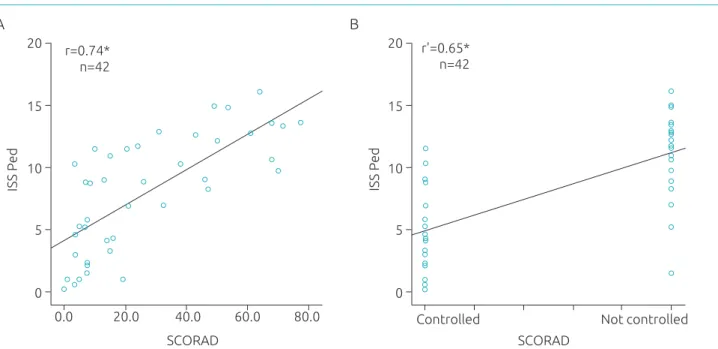
he ISS-Ped had a strong positive correlation with the severity of the SCORAD-measured dermatitis and a strong correlation with the uncontrolled disease for the studied sam-ple, which were both statistically signiicant. he correlation data is shown in the scatter plot contained in Figure 1.
Table 2 The atopic dermatitis and control groups’ assessment of the clarity of the items, by means of the sum of the answers “Clear”, “Very clear” and “Completely clear”.
Atopic dermatitis Control Clear +
Very clear + Completely clear
Clear + Very clear + Completely clear
n % n %
Scale title 39 93 40 95
1. Frequency 42 100 42 100
2. Description 41 98 41 98
3. Extension 42 100 42 100
4. Intensity 42 100 42 100
5. Humor 42 100 42 100
7. Sleep 42 100 42 100
Figure 1 Correlation between the Pruritus Severity Scale and the Severity scoring of atopic dermatitis (A) and the atopic dermatitis control (B).
ISS Ped
SCORAD 0
0.0 20.0 40.0 60.0 80.0
5 10
r=0.74* n=42
15 20
SCORAD 0
Controlled Not controlled
5 10 15
20 r'=0.65*
n=42
ISS Ped
*<0.001; n: Total number of patients in the sample; r: Pearson correlation index of 0.736; r’: point-biserial correlation coeicient; ISS-Ped: Pruritus Severity Scale; SCORAD: Severity scoring of atopic dermatitis; AD control: Controlled atopic dermatitis.
he internal consistency analysis of the scale was ade-quate, with a Cronbach’s α coeicient of 0.96. he
repro-ducibility was also good, with a consistency measurement, through the intra-class correlation coeicient, of 0.97 (95% CI: 0.89-0.99) for the total scale (p <0.001). he evalua-tion of the reproducibility for each item had an intraclass correlation coeicient greater than 0.80 and p <0.05 for all questions. he retest was performed at intervals of 7 or
14 days (70% of the time with an interval of 7 days) by the same interviewer.
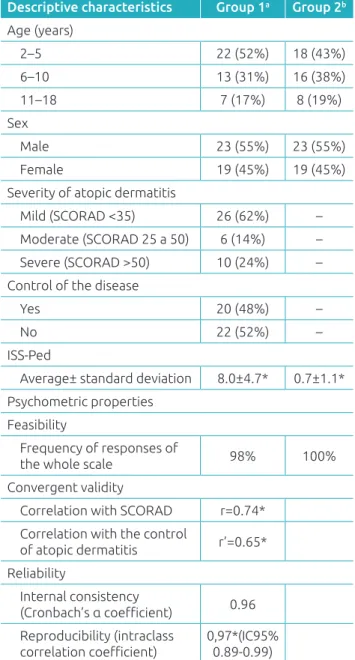
Table 3 shows the characteristics of the sample and the mea-surement properties of the ISS-Ped translated version.
DISCUSSION
his study demonstrated that the translated version of the ISS, the Pruritus Severity Scale (ISS-Ped), is valid for evaluating the severity of pruritus in children and adolescents with atopic dermatitis, and had measurement properties compatible with the original scale.
Satisfactory conceptual, item, semantic and operational equiv-alence were obtained. he removal of the question about inter-ference in sexuality had already occurred in the Spanish version of the instrument,17 and is a necessary adjustment for the
pedi-atric population. he stages of translation, back-translation and evaluation by the committee of experts were completed without major diiculties. Since the original scale is very clear, it allowed for the transference of concepts from the original instrument to the new version. Allergists from various regions of Brazil made up part of the committee in order to try to minimize the use of local terms that could not be understood in all regions of Brazil. he change in the modus operandi of the interview was neces-sary and did not interfere in the measurement properties of the scale, maintaining its efectiveness.21,27 he “interview” method
has the advantage of decreasing the frequency of blank responses and avoiding misunderstandings in interpretation. However, the disadvantage is that it requires a trained interviewer.25
Both the caregivers of atopic dermatitis patients and the caregivers of children without pruritic disease satisfactorily understood the “interview” version of the scale. here was an expected and signiicant diference between the severity of the pruritus assessed in these two groups: the group without pru-ritic disease had an average close to zero, indicating no pruri-tus and corroborating the validity of the scale.
he ISS-Ped is feasible, based on the high frequency of par-ticipation and the population’s response to all items, just like in the original version and the Spanish version.15,17
he convergent validity of the scale was performed through a comparison with SCORAD, which measures the severity of atopic dermatitis, and the control of the disease. he theoreti-cal model demonstrates that patients with a disease that is more severe and uncontrolled, and who, as a result, need therapy, have more severe skin inlammation and itching.1,2,6,7,9 he ISS-Ped
showed a good correlation with the severity of the atopic der-matitis (Pearson> 0.7), conirming that the greater the severity of the disease, the greater the severity of pruritus, since there is more cutaneous involvement and a more important pruriginous
Table 3 Description of the sample and the psychometric properties of the Pruritus Severity Scale for children and adolescents with atopic dermatitis.
apatients with atopic dermatitis; bchildren without pruritic skin disease; *p<0.001.
SCORAD: Severity scoring of atopic dermatitis; ISS-Ped: Pruritus Severity Scale; r: Pearson correlation index; r’: point-biserial correlation coeicient; CI: conidence interval.
Descriptive characteristics Group 1a Group 2b
Age (years)
2–5 22 (52%) 18 (43%)
6–10 13 (31%) 16 (38%)
11–18 7 (17%) 8 (19%)
Sex
Male 23 (55%) 23 (55%)
Female 19 (45%) 19 (45%)
Severity of atopic dermatitis
Mild (SCORAD <35) 26 (62%) –
Moderate (SCORAD 25 a 50) 6 (14%) – Severe (SCORAD >50) 10 (24%) – Control of the disease
Yes 20 (48%) –
No 22 (52%) –
ISS-Ped
Average± standard deviation 8.0±4.7* 0.7±1.1*
Psychometric properties
Feasibility
Frequency of responses of
the whole scale 98% 100%
Convergent validity
Correlation with SCORAD r=0.74* Correlation with the control
of atopic dermatitis r’=0.65*
Reliability
Internal consistency
(Cronbach’s α coeicient) 0.96 Reproducibility (intraclass
symptom. When ISS-Ped was compared with control of the dis-ease, there was also adequate and statistically signiicant corre-spondence. he original version had a moderate correlation with the “physical health” (r = 0.483) and “mental health” (r = 0.492) modules of the RAND 36 Health Status Inventory, and a good correlation with the Dermatology Quality of Life Index (DLQI) (r= 0.628),15 while the Spanish version had a good correlation with
the Pediatric Quality of Life Index in Dermatology (r = 0.69).17
In the exploratory factor analysis, the one-dimensionality of the translated version of the scale was observed, showing only the severity of pruritus. In the construction of the original scale, two dimensions were found in the initial stage. In ISS, after the removal of items, ive of the total items dealt with severity, and two of them with temporality.15 In this study and in the Spanish version, the
strength of the second item was insuicient, but the scale, which aims to measure the severity of the symptom, was not impaired.
he reliability of the instrument was demonstrated by the high Cronbach’s α coeicient (0.96), which was comparable to
the original version (0.80) and the Spanish one (0.84), proving that the diferent items of the scale are correlated and measure the same construct. he reproducibility was also satisfactory. It was evaluated by the correlation between the test and retest and included data that was already observed in the original ver-sion (Pearson correlation coeicient equal to 0.95 and intraclass correlation coeicient of 0.95)15 and in the previous validation of
the scale.17 It is believed that, because it allows for fewer skipped
responses, the operational modiication has been responsible for increasing the internal consistency of the instrument.
Some limitations should be considered in extrapolating the results obtained. Even with the attempt to reduce the inluence of colloquial language, and the revision of the scale by doctors from diferent regions of Brazil, the instrument was applied in a sample of patients from Pernambuco and cultural and socio-economic diferences should be considered. It is also necessary to emphasize that children aged above 10 years present a greater possibility of describing their pain, and ofer a more reliable description of the symptom. However, studies with pain and asthma show a good correlation between the responses of the patients and their caregivers,28,29 permitting such use.
In conclusion, it is considered that the Pruritus Severity Scale will be of great use in clinical practice to evaluate the eicacy of pruritus treatment and for future research on the evaluation of the treatment of atopic dermatitis in our population. Additionally, it allows for comparisons to be made between studies performed in diferent centers that use the instrument more efectively.
Funding
National Council of Scientific and Technological Development (CNPq).
Conflict of Interests
he authors declare no conlict of interests.
REFERENCES
1. Bieber T. Atopic dermatitis. Ann Dermatol. 2010;22:125-37.
2. Akdis CA, Akdis M, Bieber T, Bindslev-Jensen C, Boguniewicz M, Eigenmann P, et al. Diagnosis and treatment of atopic dermatitis in children and adults: European Academy of Allergology and Clinical Immunology/American Academy of Allergy, Asthma and Immunology/PRACTALL Consensus Report. J Allergy Clin Immunol. 2006;118:152-69.
3. Solé D, Mallol J, Wandalsen GF, Aguirre V, Latin American ISAAC Phase 3 Study Group. Prevalence of symptoms of eczema in Latin America: results of the International Study of Asthma and Allergies in Childhood (ISAAC) Phase 3. J Investig Allergol Clin Immunol . 2010;20:311-23.
4. Williams H, Stewart A, Mutius E, Cookson W, Anderson HR, International Study of Asthma and Allergies in Childhood (ISAAC) Phase One and Three Study Groups. Is eczema really on the increase worldwide? J Allergy Clin Immunol. 2008;121:947-54.
5. Alvarenga TM, Caldeira AP. Quality of life in pediatric patients with atopic dermatitis. J Pediatr (Rio J). 2009;85:415-20.
6. Chamlin SL, Frieden IJ, Williams ML, Chren M-M. Efects of atopic dermatitis on young American children and their families. Pediatrics. 2004;114:607-11.
7. Kini SP, DeLong LK, Veledar E, McKenzie-Brown AM, Schaufele M, Chen SC. The impact of pruritus on quality of life: the skin equivalent of pain. Arch Dermatol. 2011;147:1153-6.
8. Lewis-Jones S. Quality of life and childhood atopic dermatitis : the misery of living with childhood eczema. Int J Clin Pract. 2006;60:984-92.
9. Williams HC. Clinical practice. Atopic dermatitis. N Engl J Med. 2005;352:2314-24.
10. Yosipovitch G, Bernhard JD. Clinical practice. Chronic pruritus. N Engl J Med. 2013;368:1625-34.
11. Dhand A, Aminoff MJ. The neurology of itch. Brain. 2014;137:313-22.
12. Darsow U, Pfab F, Valet M, Huss-Marp J, Behrendt H, Ring J, et al. Pruritus and atopic dermatitis. Clin Rev Allergy Immunol. 2011;41:237-44.
13. Ständer S, Luger TA. Itch in atopic dermatitis - pathophysiology and treatment. Acta Dermatovenereol Croat. 2010;18:289-96.
14. Chen SC. Pruritus. Dermatol Clin. 2012;30:309-21.
16. Phan NQ, Blome C, Fritz F, Gerss J, Reich A, Ebata T, et al. Assessment of pruritus intensity: prospective study on validity and reliability of the visual analogue scale, numerical rating scale and verbal rating scale in 471 patients with chronic pruritus. Acta Derm Venereol. 2012;92:502-7.
17. Daudén E, Sánchez-Perez J, Prieto M, Roset M. Validation of the Spanish Version of the Itch Severity Scale: The PSEDA Study. Actas Dermosiiliogr. 2011;102:527-36.
18. Reich A, Szepietowski JC. Pruritus intensity assessment: challenge for clinicians. Expert Rev Dermatol. 2013;8:291-9.
19. Beaton DE, Bombardier C, Guillemin F, Ferraz MB. Guidelines for the process of cross-cultural adaptation of self-report measures. Spine (Phila Pa 1976). 2000;25:3186-91.
20. Beaton D, Bombardier C, Guillemin F, Ferraz MB. Recommendations for the Cross-Cultural Adaptation of the DASH & QuickDASH Outcome Measures. Toronto: Institute for Work & Health; 2007.
21. Reichenheim ME, Moraes CL. Operacionalização de adaptação transcultural de instrumentos de aferição usados em epidemiologia. Rev Saúde Pública. 2007;41:665-73.
22. Haniin JM, Rajka G. Diagnostic features of Atopic Dermatitis. Acta Derm Venereol. 1980;92:44-7.
23. Williams HC, Burney PG, Hay RJ, Archer CB, Shipley MJ, Hunter JJ, et al. The U.K. Working Party’s Diagnostic Criteria for Atopic Dermatitis. Br J Dermatol. 1994; 131:383-96.
24. Guyatt GH, Feeny DH, Patrick DL. Measuring health-related quality of life. Ann Intern Med. 1993;118:622-9.
25. Hair JF, Anderson RE, Tatham RL, Black WC. Análise fatorial. In: Hair JF, Anderson RE, Tatham RL, Black WC, editors. Analise multivariada de dados. 5th ed. Porto alegre: Bookman; 2005. p. 97-98.
26. No-referred authorship. Severity scoring of atopic dermatitis: the SCORAD index. Consensus report of the european task force on atopic dermatitis. Dermatology. 1993;186:23-31.
27. Guyatt GH. The philosophy of health-related quality of life translation. Qual Life Res. 1993;2:461-5.
28. Guyatt GH, Juniper EF, Griffith LE, Feeny DH, Ferrie PJ. Children and adult perceptions of childhood asthma. Pediatrics. 1997;99:165-8.
29. Melo LR, Pettengill MA. Dor na infancia: Atualização quanto à avaliação e tratamento. Rev Soc Bras Enferm Ped. 2010;10:97-102.