BRAZILIAN JOURNAL OF
OTORHINO
LARYNGOLOGY
Oicial Publication of the "Associação Brasileira de Otorrinolaringologia e Cirurgia Cervicofacial" (Brazilian Association of E.N.T. and Cervicofacial Surgery) Department of the Brazilian Medical Association
79 (5 Suppl 1)
SEPT/OCT2013
BRAZILIAN JOURNAL OF OTORHINOLARYNGOLOGY
Co-Editor Editor-in-Chief Co-Editor Managing Director
Eulália Sakano Wilma Terezinha Anselmo-Lima Mariana de Carvalho Leal Gouveia Ricardo Brandau
Associated Editors:
Carlos Takahiro Chone
HEAD AND NECK SURG.
Eduardo Tanaka Massuda OTOLOGY AND SKULL BASE SURG.
Regina H. G. Martins
LARYNGOLOGY AND VOICE
Edilson Zancanella
BUCCO-PHARYNGOLOGY AND SLEEP MEDICINE
Fabiana Cardoso Pereira Valera
PEDIATRIC OTOLARYNGOLOGY
Osmar Mesquita Neto
NEUROTOLOGY
José Eduardo Lutaif Dolci
FACIAL PLASTIC AND RECONST. SURG.
Shirley Shizue Nagata Pignatari
RHINOLOGY AND SKULL BASE SURG.
Editorial Board:
adalBerto novaeS Silva - mt adriana lima gurtler - Sp agnaldo J. graciano - Sc
alBina meSSiaSde almeida milani altemani - Sp andréde campoS duprat - Sp
antonio antuneS - pe arnaldo guilherme - Sp atilio maximino fernandeS - Sp Berenice diaS ramoS - rS
camilade giacomo carneiro BarroS - Sp carloS alBerto caropreSo - Sp carloS auguSto coSta pireSde oliveira - df carloS neutzling lehn - Sp
carloS takahiro chone - Sp celSo dall´igna - rS celSo gonçalveS Becker - mg cicero matSuyama - Sp claudia aleSSandra eckley - Sp claudio roBerto cernea - Sp claudiney candido coSta - go criStiane akemi kaSSe - Sp daySe manrique - Sp domingoS hiroShi tSuJi - Sp edilSon zancanella - Sp edSon iBrahim mitre - Sp
eduardo george BaptiStade carvalho - Sp eduardo tanaka maSSuda - Sp edwin tamaShiro - Sp ektor tSuneo oniShi - Sp eliSaBeth arauJo pereira - rS erich chriStiano madrugade melo - pB eulália Sakano - Sp
faBiana arauJo Sperandio - pe faBiana cardoSo pereira valera - Sp
faBio akira Suzuki - Sp faBio pinna - Sp faBrizio ricci romano - Sp fayez Bahmad Jr - df
fernanda louiSe martinho haddad - Sp fernando danelon leonhardt - Sp fernandode andrade quintanilha riBeiro - Sp fernando freitaS ganança - Sp fernando walder - Sp
francini greccode melo pádua - Sp geraldo pereira Jotz - rS gerSon Schulz maahS - rS gyl henrique alBrecht ramoS - pr helena maria gonçalveS Becker - mg ivan dieB miziara - Sp
ivo BuSSoloti filho - Sp Jair cortez montovani - Sp João aragão ximeneS filho - ce João ferreira mello Júnior - Sp JoSé a. patrocínio - mg JoSé eduardo lutaif dolci - Sp JoSé faiBeS luBianca neto - rS JoSe JarJura Jorge Jr. - Sp JoSe ricardo gurgel teSta - Sp JoSe victor maniglia - Sp leonardoda Silva - Sp leonardo haddad - Sp
leticia peterSen Schmidt roSito - rS lucaS gomeS patrocinio - mg luciana miwa nita watanaBe - df luciano rodrigueS neveS - Sp luiz carloSde melo BarBoza Junior - Sp luiz lavinSky - rS
luiz paulo kowalSki - Sp
luiz uBiraJara SenneS - Sp manoelde noBrega - Sp marcelo miguel hueB - mg márcio aBrahao - Sp marcio nakaniShi - df
marco antoniode melo tavareSde lima - rJ marco aurélio Bottino - Sp
marco aurélio rocha SantoS - mg marcoS luiz antuneS - Sp marcoS mocellin - pr marcoS raBelode freitaS - ce marcuS miranda leSSa - Ba maria Beatriz nogueira paScal - Sp maria Beatriz rotta pereira - rS marianade carvalho leal gouveia - pe mariana hauSen pinna - Sp mariana lopeS fávero - Sp mário greterS - Sp mauricio kurc - Sp
mauricio malavaSi ganança - Sp meliSSa a. g. avelino - go michel Burihan cahali - Sp michelle lavinSky wolff - rS miguel angelo hyppolito - Sp myriamde lima iSaac - Sp nédio Steffen - rS neyde caStro Júnior - Sp normade oliveira penido - Sp olavode godoy mion - Sp onivaldo cervanteS - Sp orozimBo alveS coSta filho - Sp oSmar meSquita neto - Sp oSwaldo laércio m. cruz - Sp otavio BeJzman piltcher - rS
patricia maria SenS - Sp
paulo antonio monteiro camargo - pr paulo fernando tormin BorgeS croSara - mg paulo roBerto lazarini - Sp
pedro luiz mangaBeira alBernaz - Sp priScila Bogar rapoport - Sp raquel Salomone - Sp
regina helena garcia martinS - Sp reginaldo raimundo fuJita - Sp reinaldo Jordão guSmão - Sp renata cantiSani di franceSco - Sp renatade almeida marcondeS - Sp renato roithmann - rS ricardo demarco - Sp ricardo miranda leSSa - Sp ricardo neveS godinho - mg richard louiS voegelS - Sp roBerta riBeiro de almeida - Sp roBerto campoS meirelleS - rJ
roBerto euStáquiodoS SantoS guimarãeS - mg rodrigode paula SantoS - Sp
rogério a. dedivitiS - Sp
romualdo Suzano louzeiro tiago - Sp ronaldo frizzarini - Sp
roSeli Saraiva moreira Bittar - Sp ruBenS vuono Brito neto - Sp rui imamura - Sp
Sady Selaimenda coSta - rS Shirley Shizue nagata pignatari - Sp Signe SchuSter graSel - Sp Silke anna thereza weBer - Sp Silvio caldaS neto - pe Siomara BamBirrade oliveira - df tanit ganz Sanchez - Sp
Scientific Papers Assessment Committee:
Edwin Tamashiro Reginaldo Raimundo Fujita
External Consultants:
Daniel Munhoz Eduardo Vellutini Guido Levi Paulo Carneiro Willian Chahade
ETHICS NEUROLOGY INFECTOLOGY CLINICAL PATHOLOGY RHEUMATOLOGY
International Board:
JameS palmer (eua) marcelo B. antuneS (eua) rodney SchloSSer (eua) noam cohen (eua) roBert k. Jackler (eua) guillermo campoS (colômBia)
charleS ford (eua) ricardo l. carrau (eua) hiroyuki fukuda (Japão) markuS heSS (alemanha) mark S. courey (eua) marc remacle (Bélgica)
richard roSenfeld (eua) vincent darrouzet (frança) olivier deguine (frança) JameS thomaS (eua) michael Strupp (alemanha) hamlet Suarez (uruguai)
manS magnuSSon (Suécia) mamoru Suzuki (Japão)
Indexing: MedLine, Exerpta Medica, LILACS (Index Medicus Latinoamericano), SciELO (Scientific Electronic Library Online), THOMSON SCIENTIFIC (ISI) : Impact Factor: 0.545
Seat of the Brazilian Association of Otorhinolaryngology and Neck-Facial Surgery (ABORL-CCF)
Av. Indianópolis, nº 1287, Planalto Paulista. CEP: 04063-002. São Paulo - SP. Telephone: (55 11) 5053-7500/Fax: (55 11) 5053-7512.
The papers cannot be transcribed in total or in part. There will be six regular issues per year, in February, April, June, August, October and December.
Freely distributed to ABORL-CCF members. For subscription, please contact the ABORL-CCF. The journal is not liable for the truthfulness of the data presented by the authors.
Periodicity: Bimonthly Circulation: 5.200 copies Print: Gráfica Eskenazi
www.gn1.com.br
Production/Review/Website coordination, paper conversion and marking for SciELO indexing:
ABORL-CCF Executive Board
agrício nuBiato creSpo (chairman) fernando ganança (1St vice-chairman) Sady Selaimen coSta (2nd vice-chairman) fernanda haddad (executive director - general Secretary) francini grecco de m. pádua (executive director - adJunct Secretary)
godofredo campoS BorgeS (executive director - treaSurer) JoSé eduardo de Sá pedroSo (executive director - adJunct treaSurer)
faBrizio ricci romano (director - programS and eventS) edilSon zancanella (director - communicationS)
eulália Sakano (director - BJorl)
renato roitmann (director - continuing medical education) otavio maramBaia SantoS (director - ethicS and diScipline) JoSé alexandre mediciS da Silveira (director - medical reSidency and training)
SUMÁRIO / CONTENTS
Evaluation and classification of residence programs in Otorhinolaryngology
Protocolo de avaliação e classificação dos programas de residência e de especialização em Otorrinolaringologia no Brasil
Agrício Nubiato Crespo
VOL. 79 Nº 5 SUPPL. 1 SEPT/OCT 2013
ORIGINAL ARTICLE
S6
BRAZILIAN JOURNAL OF
OTORHINO
LARYNGOLOGY
INTRODUCTION
S7
METHOD
S8
Classification of residency or specialization programs
S12
Institutionalization and process procedure - final stage
S12
Assessment Team and Visits Schedule
S16
A, B+, B, C+, C, D and E concepts assignments
S17
Institutionalization and process procedures - final stage
S17
Rating the programs and their graduating students
S17
Data Analysis
S17
RESULTS
S18
DISCUSSION
S24
CONCLUSIONS
S31
ACKNOWLEDGEMENTS
S32
Evaluation and classification of residence programs in
Otorhinolaryngology
Abstract
Agrício Nubiato Crespo1
1Senior Associate Professor (Head of the ENT Program - School of Medical Sciences of Unicamp (FCM - UNICAMP).
Send correspondence to: Agrício Nubiato Crespo. Av. Heitor Penteado, nº 1541. Taquaral. Campinas - SP. Brazil. CEP: 13087-000. Paper submited to the BJORL-SGP (Publishing Management System - Brazilian Journal of Otorhinolaryngology) on September 12, 2013;
and accepted on October 14, 2013. cod. 11113.
R
esidence training is defined in Brazil as a full time learning in practice process, developed in public health institutions, private hospitals and clinics, under surveillance of qualified medical staff.Objective: To present the development process of a protocol of evaluation of residence programs in otolaryngology and its classification by quality.
Method: Design a comprehensive protocol of evaluation to cover the broad aspects of medical education in otolaryngology. Classify the training programs by quality. Evaluate board certification performance of its residents. Analyze the correlation between program quality classification status and residents scores at the board certification exam.
Results: Eighty two residence programs were evaluated across the country in 2004, as follows: level A (12.20%), B+ (7.3%), B (19.5%), C+ (20.7%), C (17.1%), D (20.7%) and E (2.4%) p < 0.005.
Conclusion: The evaluation program was able to discriminate, quality-wise, the training programs. The grades from those who passed the ABORL-CCF Board’s Exam have the same ranking trend as that of their training institution. There was an improvement in the ranking of training programs after the program was implemented.
ORIGINAL ARTICLE Braz J Otorhinolaryngol.
2013;79(5 Supl 1):S6-S32.
BJORL
Keywords:
education;
education, medical, undergraduate; internship and residency; specialization.
.org
INTRODUCTION
ENT training can happen in Otorhinolaryngology residency programs accredited by the Ministry of Education and Culture (MEC), with an automatic right to the Board’s Title of Specialist; or ENT can be taught in Specialization Programs accredited by the Brazilian Association of Otorhinolaryngology and Neck and Facial Surgery (ABORL-CCF), which grants the Title of Specialist to those approved in its Board’s exam1,2 after they graduate from
the program.
Specialization programs, as well as medical residencies, are defined as graduate programs for physicians, and characterized as a full-time theoretical and practical on-the-job training (OJT), offered in public or private healthcare institutions linked to universities or not, under the guidance of highly qualified and ethical medical professionals1-3.
Program accreditation is conditioned on compliance with the minimum requirements established by MEC or the ABORL-CCF, which is more strict about the syllabus. The criteria established by MEC are more strict concerning the legal aspects of teaching, such as the mandatory payment of the scholarship, compliance with the established workload, having breaks and others3,4.
These requirements are intended to ensure the desired educational profile of an ENT specialist, a goal to be achieved at the end of training; involving a certain knowledge and skills that the students must acquire on the job, enabling them to properly perform in the specialty2.
The Commission on Higher Education Professional Development (CAPES ) evaluates and ranks Master’s and Doctoral programs through a rigorous and well-known process, which has continuously heightened the quality of research in Brazil3.
The National Commission on Medical Residency (NCMR) has not developed such an encompassing evaluation system, affecting the accreditation of residency programs to comply with “minimum criteria”. The NCMR criteria level off training programs at minimum parameters, do not highlight their quality, do not foster improvements, and thus do not stimulate the qualitative improvement of medical residency programs5.
Openings for medical residency in otorhinolaryn-gology offered by universities or medical schools do not meet the demand for this specialty. Approximately 50% of those enrolled to take the ABORL-CCF Board’s Title of Specialist Exam are alumni from training programs taken in general hospitals or private clinics. These training programs are numerically significant in the education of Brazilian otorhinolaryngologists and, consequently, in the specialty’s profile in Brazil. Of these, some are accredited
by MEC and others by the ABORL-CCF. For not being inside academic settings and, eventually, being taught by program coordinators without academic training, they some times may provide insufficient training to young specialists, without proper content oversight4-6.
It is likely that there are residency programs not fully integrated into the educational activities that focus on care practice and service delivery. In extreme conditions, perhaps not so uncommon, the residents act as mere low-cost workers, in exchange for some poorly qualified learning activity.
There are programs which preceptors are celebrated physicians acting in only one field of Otorhinolaryngology, exposing their students to a partial training, with focal excellence, lacking the teaching of the other fields of the specialty.
The new doctors, upon finishing their undergraduate programs, are usually unaware of the characteristics of the medical residency programs to which they are applying.
The reputation of the institutions, or even that of its members, are not full guarantees of the teaching provided there.
How do medical residency programs in Brazil compare to those developed in other countries? Data inaccuracy does not allow such comparison, contrary to what happens with our Master’s and Doctoral programs.
Just as we have a rampant opening of medical schools in Brazil, there is no control and service demand policy, and less so regarding geographic distribution4,6,7.
Having an assessment process based on specific and well-defined criteria, that considers comprehensive quantitative and qualitative aspects on the technical, scientific and ethical training, would provide conditions for continuous self-assessment of the programs by their leaders and also by the students. Programs admittedly deficient in specific areas may establish cooperation agreements with others as a means of complementing their underperforming educational stages. Identifying shortcomings will provide subsidies for the improvement of weak programs, providing for the establishment of quality goals and the possible disqualification of those training programs that can not reach them8.
The harmonization of national programs, together with a centralized control, based on full knowledge of supply and demand will enable the eventual adoption of a system to allocate program openings.
METHOD
From March to June of 2004, the author and the ABORL-CCF Teaching, Training and Residency Commission developed this Assessment Protocol, covering the following domains:
• General Description of the educational program
and academic environment;
• Infrastructure;
• Faculty;
• Training activities;
• Research and scientific production activities;
• Student assessment;
• Evaluation of the program by the student body;
• Program self-assessment.
Each domain covers specific items that characterize it. The values or points assigned to each item were determined by consensus from the members of the Teaching, Training and Residency Commission, who considered the importance of each item in the training of medical residents, often times in comparative ways. This comparison was based on the authors’ experience in coordinating residency programs, heading services, and dedication to education, healthcare and scientific research.
The items assessed in domain I (General Description of the Program) include the institution where the teaching program is taken, the academic environment, the institution’s level of complexity and geographic location (Chart 1).
Residency and specialization programs in the Northern region received a value of 10, due to the lack of regional training opportunities. Conversely, programs in Southeastern states received no score due to the excess of specialists and training programs. The programs located in other regions were given intermediate scores, according to the same criterion.
The items assessed in domain II (Infrastructure) are depicted on Chart 2.
The items evaluated in domain III (Faculty) are presented on Chart 3.
Note: Institutional Bond - Contractual relationship of the instructors as preceptor or medical worker. All preceptors must be qualified as a specialist in Otorhinolaryngology or in the related fields logged at the Brazilian Medical Association or the Regional Board of Medicine, of which 50% must have at least ten years of experience in that field of specialization.
To be an instructor in surgery for diseases of the head, neck, skull base surgery and in orthodontic, maxillofacial trauma, facial aesthetic and restoration surgeries, the preceptor must be an otorhinolaryngologist
with five years of experience in the field, or not an ENT but having a Title of Specialist in the field and who always works in the team with the ENT.
The score assigned for item: “Faculty Title” (item 2 of Chart 3) is obtained by the formula that indicates the sum of the percentages of each category, multiplied by their corresponding weights and then divided by 100. We have a value which ranges from zero to eight to score this item.
Institutions with a graduate program receive a score of two. A score of one is assigned when the instructors only participate in graduate activities at other institutions.
The aspects assessed in item IV (Training Activities) are depicted on Chart 4A-C.
Note: points are assigned according to the asses-sments of activities involving: lectures, meetings for the presentation of journal papers and to discuss cases - only when such activities are offered regularly and in separate sessions.
Chart 4C shows the training activities involving experimental surgery, scientific production of the residents or trainees and participation in conferences.
Note: in the first part of item 7 of Chart 4C, we considered the total volume of resident-borne scientific production in relation to the number of residents. In the second, we considered how many residents participated in the production, in relation to the total number of residents. This distinction helps avoid the possibility of only one resident being responsible for the entire production and the entire student body receiving credit for it.
The aspects assessed in Item V (Research Activities and Scientific Production at the Institution) are depicted on Chart 5.
Item VI (Student Body) evaluates the performance of graduates from residency or specialization programs at the Board’s Title of Specialist in Otorhinolaryngology exam, held by the ABORL-CCF. It is presented on Chart 6.
Chart 7 presents the items considered in the evaluation of the training program, carried out by the residents or trainees.
In item VIII (Training Program Self-assessment) there is room for the final remarks of the training program’s preceptor (Chart 8).
Items VII and VIII received no score. However, they make up an important set of information that allow examiners to analyze aspects of the residency or specialization program not covered in the completed protocol.
Chart 1. General Program Characterization (item I).
1 - Program Venue Value
a) Within a Medical School 10*
Within a hospital with internship 6*
Within a general hospital 4*
In a private clinic 1*
Score
b) Program held together with medical residency programs from other specialties:
Yes (5*)
No (0*)
Score
c) Complexity levels:
Primary 2*
Secondary 4*
Tertiary 6*
Score
d) Region (geographic distribution)
North 10*
Northeast 7.5*
Midwest 5*
South 2.5*
Southeast 0*
Score
2 - Scope, support services and special programs:
Oral mobility rehabilitation 1*
Neurotology 1*
Program in the ield of hearing impairment 1*
Hearing aid itting 1*
Cochlear implant 1*
Oto-neurosurgery 1*
Neonatal hearing screening 1*
Occupational otology 1*
Vestibular rehabilitation 1*
Language disorders rehabilitation 1*
Endoscopic sinus surgery 1*
Allergy program 1*
Voice rehabilitation program 1*
Facial framework surgery 1*
Stenoses 1*
Nasal plastic surgery 1*
Facial plastic surgery 1*
Ear plastic surgery 1*
Head and neck surgery 1*
Rehabilitation program 1*
Snoring and obstructive sleep apnea 1*
Traumatology 1*
Stomatology 1*
Skull base surgery 1*
Grade
Continued Chart 1.
The numbers with an asterisk correspond to the scores assigned to each item analyzed.
Chart 2. Infrastructure (item II).
1 - Outpatient ward
Number of stalls or ofices per resident 1 for 2 resid. 1 for 3 1 for 4 1 for more
4* 3* 2* 1* Score
Yes No
Treatment room 1* 0*
Nursing station in annex 1* 0*
ENT urgency room 1* 0*
Pathology department in the institution 1* 0*
CT scan in the institution 1* 0*
MRI in the institution 1* 0*
ICU in the institution 1* 0*
Clinical analysis lab in the institution 2* 0*
Score
2 - Teaching and scientiic activities
Number of international journals More than 5 3 to 5 1 to 3 None
3* 2* 1* 0* Score
Yes No
Library 1* 0*
Internet access 1* 0*
Video library 1* 0*
Auditory or meeting room 1* 0*
Multimidia capabilities 1* 0*
Dissection lab 2* 0*
Score
Regular Esporadic No
Promotion of scientiic events 2* 1* 0*
Score
3 - Outpatient ward equipment
Yes No
Microscope 1* 0*
Endoscopy system 1* 0*
Score
4 - Additional tests
Three Two One
Audiometric tests booth 3* 2* 1* Score
Yes No
Endoscopy system 2* 0*
ABR 2* 0*
ECOG 2* 0*
Otoacoustic emissions 2* 0*
Vecto-electronystagmography 2* 0*
Stroboscopy 2* 0*
Image documentation (video, photo) 2* 0*
Polysomnography 2* 0*
Score
5 - Surgical equipment of teaching usefulness
Yes No
Microscope with a camera 1* 0*
Videoendoscopy system 1* 0*
Score
Total score in item II
Continued Chart 2.
The numbers with an asterisk correspond to the score assigned to each analyzed item.
Chart 3. Faculty (item III).
1 - Number of instructors per irst-year resident (R1)
Value 1* 2* 3* 4* 5*
3:01 ( ) 4:01 ( ) 5:01 ( ) 6:01 ( ) + 6:1 ( )
4:02 ( ) 5:02 ( ) 6:02 ( ) 7:02 ( ) + 7:2 ( )
5:03 ( ) 6:03 ( ) 7:03 ( ) 8:03 (x) + 8:3 ( )
6:04 ( ) 7:04 ( ) 8:04 ( ) 9:04 ( ) + 9:4 ( )
8:05 ( ) 9:05 ( ) 10:05 ( ) 11:05 ( ) + 11:5 ( )
10:5 + ( ) 12:5 + ( ) 14:5 + ( ) 16:5 + ( ) + 16:5 + ( )
Score
2 - Faculty titling
Nº. Value
Nº. of MSc. 1*
Nº. of MSc. 3*
Nº. of PhDs 4*
Nº. of PhDs 8*
Total Nº. of Assistants Score
Titling: % MSc x 1 + % MSc x 3 + % PhD x 4 + % PhD x 8 = Score
3 - Participation in MSc and PhD programs’ activities
Yes Cooperation with Graduate programs Nº
2* 1* 0*
Score
Chart 4A. Training activities (item IV): lectures, meetings to discuss journal papers and regular discussion of clinical cases.
1 - Regular schedule of lectures
Yes No
Otology 1* 0*
Rhinology 1* 0*
Laryngology 1* 0*
Head and neck surgery 1* 0*
Snoring and sleep apnea 1* 0*
Plastic surgery 1* 0*
Traumatology 1* 0*
Skull base surgery 1* 0*
Stomatology 1* 0*
Buccopharyngology 1* 0*
Orthodontic surgery 1* 0*
Alergy 1* 0*
Pediatric ENT 1* 0*
Defense against malpractice 1* 0*
Score
2 - Regular meetings to discuss journal papers
Yes No
Otology 1* 0*
Rhinology 1* 0*
Laryngology 1* 0*
Head and neck surgery 1* 0*
Snoring and sleep apnea 1* 0*
Plastic surgery 1* 0*
Traumatology 1* 0*
Skull base surgery 1* 0*
Stomatology 1* 0*
Buccopharyngology 1* 0*
Orthodontic surgery 1* 0*
Allergy 1* 0*
Pediatric ENT 1* 0*
Score
3 - Regular discussion of clinical cases
Yes No
Otology 1* 0*
Rhinology 1* 0*
Laryngology 1* 0*
Head and neck surgery 1* 0*
Snoring and sleep apnea 1* 0*
Plastic surgery 1* 0*
Traumatology 1* 0*
Skull base surgery 1* 0*
Stomatology 1* 0*
Buccopharyngology 1* 0*
Orthodontic surgery 1* 0*
Allergy 1* 0*
Pediatric ENT 1* 0*
Score
Continued Chart 4A.
The numbers with asterisk correspond to the scores assigned to each analyzed item.
Weights were assigned to each domain evaluated, as per shown on Chart 10.
The points allocated to items contained in each domain are then summed up. The resulting value is converted into a score from zero to one hundred, applying the rule of three.
This value is then multiplied by its corresponding weight (Chart 10) to compose the score for each domain.
The training program’s final evaluation score varies from zero to one hundred, and is obtained by the weighted average of the scores assigned in all domains.
Classification of residency or specialization programs
Residency or specialization programs are classified according to the final grades in descending order intervals, in levels A, B+, B, C+, C, D and E.
Institutionalization and process procedure - final stage
The implementation of the Protocol for Assessment and Classification of Residency and Specialization Programs followed a routine bureaucratic and policy procedure, which ensured its acceptance, execution and implementation in the ABORL-CCF’s activities program:
Full presentation of the Protocol for Assessment and Classification of Residency and Specialization Programs to the ABORL-CCF Board for appreciation and approval;
Prior proposal of a reassessment, re-registration and reclassification schedule of the institutions according to their initial rank (Chart 11);
Presentation at the specialty’s Mini-Forum held on August 21, 2004 for appreciation, review and approval.
Note: The Mini Forum is a joint committee formed by the ABORL-CCF Board members, coordinators of all technical committees and guest opinion leaders. They meet regularly to present, discuss and work on the Association’s activities program.
Chart 4B. Medical care activities (item IV), residents participation in the surgeries performed.
4 - Volume of outpatient care:
Nº. of patients/resident/day
> 30
( ) < 10 ( ) 10-30 ( ) > 30
< 10
Value 10* 30* 10* Score
Volume of surgeries: Nº.of surgeries/resident/year 101-200 51-100 < 50
Value 40* 20* 0* Score
5 - Resident participation mode in the surgeries performed
Surgeon Assistant Observer No
Oral endoscopy 3* 2* 1* 0*
Abscess drainage 3* 2* 1* 0*
Adenotonsillectomy 3* 2* 1* 0*
Uvulopalatopharyngoplasty 3* 2* 1* 0*
Septoplasty 3* 2* 1* 0*
Turbinectomy and turbinoplasty 3* 2* 1* 0*
Maxillary sinusectomy 3* 2* 1* 0*
Caldwell-Luc procedure 3* 2* 1* 0*
External and intranasal ethmoidectomy 3* 2* 1* 0*
External and intranasal frontal sinusectomy 3* 2* 1* 0*
Sphenoidectomy 3* 2* 1* 0*
Partial and total Maxillectomies 3* 2* 1* 0*
Tympanic paracenthesis 3* 2* 1* 0*
Miryngotomy for ventilation tube placement 3* 2* 1* 0*
Tympanoplasty 3* 2* 1* 0*
Tympanomastoidectomy 3* 2* 1* 0*
Stapes surgery 3* 2* 1* 0*
Partial and total resection of the temporal bone 3* 2* 1* 0*
Rhinoplasty 3* 2* 1* 0*
Otoplasty 3* 2* 1* 0*
Blepharoplasty 3* 2* 1* 0*
Other facial plastic surgeries 3* 2* 1* 0*
Submandibular gland exeresis 3* 2* 1* 0*
Parotidectomy 3* 2* 1* 0*
Exeresis of congenital neck lesions 3* 2* 1* 0*
Exeresis of benign neck tumors 3* 2* 1* 0*
Neck dissection 3* 2* 1* 0*
Mouth and pharynx tumor resection 3* 2* 1* 0*
Partial and total glossectomies 3* 2* 1* 0*
Marginal and segmentary Mandibulectomy 3* 2* 1* 0*
Tracheal intubation 3* 2* 1* 0*
Tracheostomy 3* 2* 1* 0*
Laryngeal microsurgery 3* 2* 1* 0*
Laryngotracheoplasty 3* 2* 1* 0*
Endoscopic cordectomy 3* 2* 1* 0*
Thyroplasty 3* 2* 1* 0*
Total Laryngectomy 3* 2* 1* 0*
Nasal fracture 3* 2* 1* 0*
Maxillary fractures 3* 2* 1* 0*
Mandible fracture 3* 2* 1* 0*
Zygomatic arch fracture 3* 2* 1* 0*
Facial nerve surgery 3* 2* 1* 0*
Craniofacial dysfunction 3* 2* 1* 0* Score
Continued Chart 4B.
Score 3: Acts as the main surgeon; Score 2: Acts as the irst assistant; Score 1: Participates as ob server or instrument nurse; Score 0: Surgery
not performed in the institution. The numbers with an asterisk correspond to the scores assigned to each analyzed item.
Chart 4C. Training activities (item IV): activities in experimental surgery, research activities and participation in meetings.
6 - Activities in Experimental Surgery
Regular Esporadic No
Otology 10* 5* 0*
Rhinology 10* 5* 0*
Laryngology 10* 5* 0*
Score
7 - Activities in research (Presentation of free themes and
publications -average in the past 3 years) (+1 p/Res) (1 p/Res) (-1 p/Res) None
5 minute presentation by resident per year in the Triological or Brazilian Meeting 15* 10* 5* 0*
Scientiic paper published by resident in journal indexed at the
Lilacs or more 30* 20* 10* 0*
Score
51 to 100% 1 to 50% None
Residents who publish papers in scientiic journals 10* 5* 0*
OBS: We consider only one resident per paper Score
8 - Number of residents who participated in meetings (+ than 50%) up to 50% None
Brazilian Meeting of Otorhinolaryngology 5* 2* 0*
Meeting of the Triological Society of Otorhinolaryngology 5* 2* 0*
Score
Total score of item IV The numbers with an asterisk correspond to the score assigned to each analyzed item.
Chart 5. Institution’s research and scientiic production activities (item V) where the residency or specialization program happens.
The numbers in blue correspond to the weights assigned to each analyzed item.
Institution’s scientiic production and research activities (in the past 3 years)
Weight N Score
Papers published in MedLine-indexed journals 5*
Papers published in Scielo-indexed journals 3*
Papers published in journals of other indexations 2*
Book chapters 3*
Book authorship (book co-authorship) 5*
Book organization 3*
Abstracts published in meetings’s procedures 1*
Thesis dissertations 5*
Weight x the number of occurrences (for the program)
Total score of item V
Chart 6. Student body (item VI): assessment of performance in the ABORL-CCF Board’s Title of Specialist Exam.
Performance of those who passed the SBORL Board’s Title of Specialist Exam
Grade = (Nº. of passing applicants ÷ Total Nº. of applicants in a year) ÷ 10
Consider the mean in the past 3 years
Total grade in item VI
SBORL: ABORL-CCF’s denomination at the time of the assessment.
Chart 7. Assessment of the residency or specialization program made by the student body (item VII).
Period: _____/____/______ to _____/____/______
Assessment of the Training Protocol by the Student Body:
1) Were you informed about the goals at the beginning of the program?
( ) No
( ) Yes. Grade: 1 ( ) 2 ( ) 3 ( ) 4 ( ) 5 ( ) 6 ( ) 7 ( ) 8 ( ) 9 ( ) 10 ( )
2) Were the goals of the program reached?
( ) No
( ) Yes. Grade: 1 ( ) 2 ( ) 3 ( ) 4 ( ) 5 ( ) 6 ( ) 7 ( ) 8 ( ) 9 ( ) 10 ( )
3) Was the preceptor’s supervision adequate?
( ) No
( ) Yes. Grade: 1 ( ) 2 ( ) 3 ( ) 4 ( ) 5 ( ) 6 ( ) 7 ( ) 8 ( ) 9 ( ) 10 ( )
4) Was the recommended bibliography available at the library of the department or unit?
( ) No
( ) Yes. Grade: 1 ( ) 2 ( ) 3 ( ) 4 ( ) 5 ( ) 6 ( ) 7 ( ) 8 ( ) 9 ( ) 10 ( )
5) Concerning the program’s structure, was the volume of care adequate vis-à-vis the program goals?
( ) No
( ) Yes. Grade: 1 ( ) 2 ( ) 3 ( ) 4 ( ) 5 ( ) 6 ( ) 7 ( ) 8 ( ) 9 ( ) 10 ( )
6) Concerning the program’s structure, was the type of patients seen adequate vis-à-vis the goals of the program?
( ) No
( ) Yes. Grade: 1 ( ) 2 ( ) 3 ( ) 4 ( ) 5 ( ) 6 ( ) 7 ( ) 8 ( ) 9 ( ) 10 ( )
7) Was the theoretical program adequate? Consider the time, work load and quality.
8) Describe the positive aspects of the residency program.
9) Describe the negative aspects of the residency program.
10) Sugestions:
Chart 8. Program’s self-assessment (item VIII).
Chart 9. Documents to be shown during the visit.
Copies of the documents to be presented during the visit
The documents mentioned which do not have proven copies will not be considered and cannot be handed after the visit
Research activities (average of the last 3 years)
5-minute talks presented by resident per year in the Brazialian and Triological ENG Meetings
Scientiic papers published by residents in indexed papers Idenity the residents who published papers in scientiic journals
OBS: Only one resident per paper will be considered
Number of residents who participated in the Meetings
Brazilian Meeting of Otorhinolaryngology
Triological Meeting of Otorhinolaryngology
Institution’s scientiic production and research activities (in the last 3 years)
Papers published in journals index at MedLine
Papers published in journals indexed at SciELO
Papers published in other indexed journals
Book chapters
Book authorship (book co-authorship)
Book organization
Abstracts published in meetings’s proceedings
Thesis dissertations - Doctoral programs
Thesis dissertations - Master’s programs
Chart 10. Aspects assessed in the Protocol for Assessment
and Classiication of Residency and Specialization Programs
in Otorhinolaryngology in Brazil.
Aspects evaluated Weight
I - General program description and academic
environment 1
II - Infrastructure 2
III - Student body 2
IV - Training activities 2
V - Program’s Research and scientiic
production 1
VI - Student body 2
VII - Program’s assessment by the student body 0
VIII - Program’s self-assessment 0
Chart 11. Reassessment schedule of the training programs and sequential procedures.
Classiication Reclassiication
Level A every 5 years
Level B+ every 4 years
Level B every 4 years
Level C+ every 2 years
Level C every 2 years
Level D Immediate prohibition of receiving new applicants; report to MEC on the shortcomings of the residency program: annual re-registering;
Level E Immediate prohibition of receiving new applicants; report to MEC on the shortcomings of the residency program; Reassessment in 6 months, if it remains ranked as E in the second assessment the program shall be terminated and a new program and preceptor are prevented from reaccreditation for the next 4 years;
After final approval of the proposed methodology, the ABORL-CCF’s Protocol for Assessment and Classification of Residency and Specialization Programs and its rules were widely publicized, with special emphasis on the method’s impartiality. The purpose of this communication was to encourage its acceptance by the ENT community.
All preceptors of the training programs received a letter of invitation to enroll their residency or specialization programs in the ABORL-CCF’s Protocol for Assessment and Classification.
Assessment Team and Visits Schedule
They were all trained simultaneously in a five-hour long program, for presentation and detailed discussion of all items in the protocol and its possible deviations and inaccuracies.
Within a three-week period in August of 2004, all teaching programs were visited by pairs of evaluators, fulfilling a predetermined schedule. The institutions were numbered between 1 and 85.
After the visits were completed, all evaluators were simultaneously gathered for criteria homogenization, presentation of general impressions and pointing out difficulties with the protocol. They all reported their experiences, set comparisons and leveled off differing interpretations.
A, B+, B, C+, C, D and E concepts assignments
The three members of the ABORL-CCF’s Teaching, Training and Residency Commission reviewed all completed protocols, compiled, digitized and processed the data obtained in the software developed for this purpose. Then, in a consensus they assigned the final grades for each program and their corresponding classification: A, B+, B, C+, D and E.
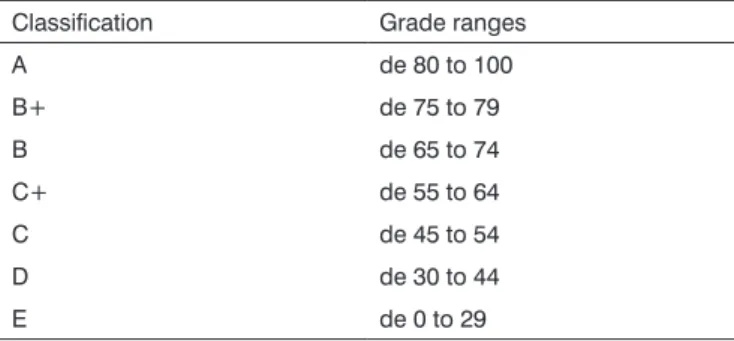
The programs are ranked by assigning concepts according to ranges of established grades (Table 1). The final classification included, in some cases, subjective aspects, mainly related to ethical issues in medical care and education, which are exclusive prerogatives of the ABORL-CCF.
Note: the decisions of this forum, which guide the ABORL-CCF actions, confirmed the Protocol for Assessment and Classification of Residency and Specialization Programs as a tool for defense against malpractice.
The protocol and its overall results, without identification of the participating institutions, were presented and approved at the ABORL-CCF General Assembly, held at the Brazilian Congress of Otorhinolaryngology in 2004. This official acceptance institutionalized the continuity of our Protocol for Assessment and Classification of Residency and Specialization Programs in Otorhinolaryngology in Brazil.
A letter was sent to all preceptors from participating institutions, containing the classification of their training program, their ranking in relation to the general classification, and information about how they ranked vis-à-vis the different items.
The preceptors of programs classified as D or E and all others who requested guidance and clarifications were summoned to a joint debate.
The programs classified as D and E were reassessed in 2006. Those which remained in this classification were reevaluated by the Teaching, Training and Residency Commission in 2007.
The programs initially classified as level C+ and C were reassessed in 2007.
Those ranked as A, B+ and B will be reassessed after 5 and 4 years, respectively, thus remaining unchanged for now.
The performance of these programs and their evolution in the ranking scale will be followed.
Rating the programs and their graduating students
The applicants’ performances in the ABORL-CCF Board’s Exam for the Title of Specialist in Otorhinola-ryngology was compared to the ranking of their training programs in 2007. We analyzed the mean values of the grades received by those who passed the exam, the percentage of failure and the order the candidates ranked according to the different levels of classification of their training programs.
Data Analysis
To compare the levels of classifications and assess whether there are differences between the average scores corresponding to the programs ranked as A, B+, B, C+,
C, D and E, we used the Studentt-test for independent
samples. We adopted a significance level of 5%.
Claim: The mean scores from A-ranked institutions are higher than the mean scores for B+ programs.
Test Type: single tail.
Table 1. Classiication levels and corresponding grade
ranges.
Classiication Grade ranges
A de 80 to 100
B+ de 75 to 79
B de 65 to 74
C+ de 55 to 64
C de 45 to 54
D de 30 to 44
E de 0 to 29
Intermediate or partial grades from each program were kept confidential, in the custody of the Teaching, Training and Residency and are not to be disclosed.
Institutionalization and process procedures - final stage
Hypothesis H0: The mean value of A-ranked programs is equal to that of the B+ programs.
Hypothesis H1: A-ranked programs mean value is higher than that of concept B+ programs.
H0 is rejected if the calculated p-value is less than 0.05.
To compare the mean scores of the applicants to the ABORL-CCF Board’s Title of Specialist Exam, and assess whether there are differences between them according to the classification of their training programs, we used the
Studentt-test for independent samples. We adopted the
significance level of 5%.
Claim: The mean scores of A-ranked program alumni is different from the mean scores of those alumni from grade B+ programs.
Hypothesis H0: The mean scores of A-ranked is equal to that of B+ programs.
Hypothesis H1: The mean scores of concept A programs is different from the mean scores of B+ programs.
Level of significance: 0.05.
H0 is rejected if the calculated p-value is less than 0.05.
Comparing performances in the ABORL-CCF Board’s Title of Specialist Exam, we calculated the correlation coefficient between the curve of the mean scores of the candidates with the curve of the average scores of their training programs.
The remaining data was analyzed in a descriptive fashion.
RESULTS
We found 85 residency or specialization programs in ENT in Brazil, of which 82 agreed to participate in the ABORL-CCF’s Protocol for Assessment and Classification, and were evaluated. Sixty were medical residency in Otolaryngology accredited by MEC; 25 were specialization programs accredited by the ABORL-CCF and 19 were residency programs accredited by both. Three educational institutions (33, 40 and 43) refused to participate in the evaluation and were accredited only by MEC.
In order to avoid misleading comparisons, the scores that determined the classification of each training program shall not be disclosed, by decision of the ABORL-CCF. The final grades of each training program were grouped by levels of classification.
The mean scores of the different levels of classifi-cation are presented on Chart 12.
To assess whether there are differences among institutions classified as A, B+, B, C+, C, D and E, we compared the scores achieved.
Chart 12. Mean values of the inal grades according to the
training program ranking in 2004.
Ranking Mean grades
A 84.8 B+ 76.3 B 68.7 C+ 58.9 C 54.8 D 38.9 E 28.0
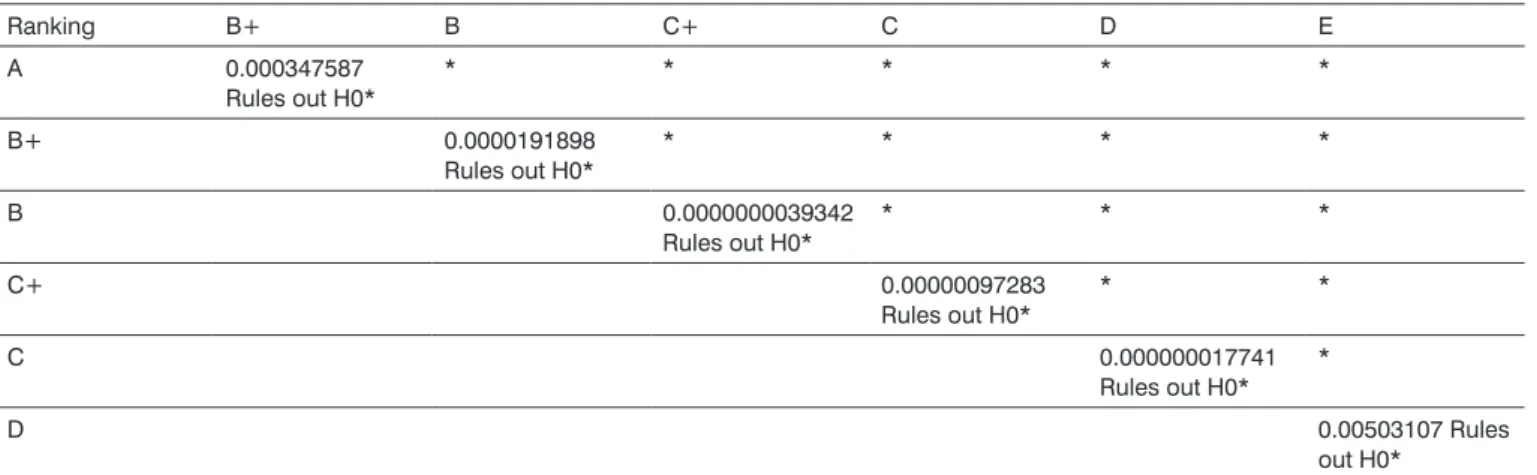
The statistical analysis comparing the mean scores of the programs, according to their classification is presented on Table 2.
The significant difference between the tests states that the classification system qualitatively discriminates the residency and specialization programs evaluated.
Chart 13 shows the training programs classified according to the established criteria.
The distribution of the general qualitative classification of medical residency or specialization programs in Brazil is presented in Figure 1.
The distribution of the qualitative classification of programs in Southeastern Brazil is presented in Figure 2.
The classification of training programs in Southern Brazil is presented in Figure 3.
The classification of programs in the Northeast of Brazil is presented in Figure 4.
The distribution of the qualitative classification of training programs in the Brazilian Midwest is presented in Figure 5.
The qualitative classification of the programs in the Northern region of Brazil is presented in Figure 6.
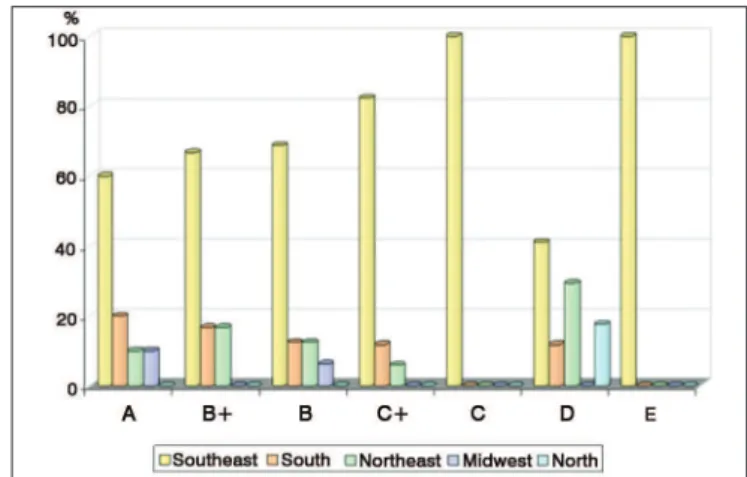
The comparative percentage distribution by qualitative classification and geographic region is shown in Figure 7.
The numerical and percentage distribution of programs by state, according to the ABORL-CCF’s qualitative classification in 2004 is depicted on Table 3.
The numerical and percentage distribution by state, of the qualitative ranking of the training programs is depicted on Table 4.
The state of São Paulo concentrates 60% of the country’s A-ranked programs. Overall, 70.5% of its 34 training programs have been ranked as A, B+, B or C+ in 2004.
Of the 13 accredited programs in the state of Rio de Janeiro, 69.3% were ranked as C or D.
Table 2. Statistical analysis of the comparison among the mean grades of programs ranked as A, B+, B, C+, C, D and E in 2004.
Ranking B+ B C+ C D E
A 0.000347587
Rules out H0*
* * * * *
B+ 0.0000191898
Rules out H0*
* * * *
B 0.0000000039342
Rules out H0*
* * *
C+ 0.00000097283
Rules out H0*
* *
C 0.000000017741
Rules out H0* *
D 0.00503107 Rules
out H0*
Signiicant values are marked with an asterisk.
Chart 13. Ranking of residency or specialization programs in Otorhinolaryngology according to the ABORL’s Protocol for
Assessment and Classiication employed in 2004. Ranking Training programs
A 10; 11; 18; 20; 37; 38; 39; 45; 65; 84
B+ 16; 17; 26; 36; 42; 81
B 1; 4; 19; 21; 22; 30; 32; 46; 48; 50; 52; 58; 63; 64; 74; 80
C+ 3; 5 14; 27; 47; 53; 54; 56; 68; 71; 72; 73; 75; 76; 79; 82; 83
C 2; 12; 15; 23; 24; 31; 35; 41; 44; 51; 55; 57; 61; 69
D 6; 7; 8; 9; 25; 28; 29; 34; 49; 59; 60; 62; 66; 67; 70; 77; 85
E 13; 78
Figure 1. Numerical and percentage distribution of the general qualitative classification of medical residency or specialization programs in ENT in Brazil in 2004.
Figure 2. Numerical and percentage distribution of the qualitative
classiication of medical residency or specialization programs in ENT
in Southeastern Brazil in 2004.
Figure 3. Numerical and percentage distribution of the qualitative
classiication of medical residency or specialization programs in ENT
Figure 4. Numerical and percentage distribution of the qualitative
classiication of medical residency or specialization programs in ENT
in Northeastern Brazil in 2004.
Figure 5. Numerical and percentage distribution of the qualitative
classiication of residency or specialization programs in ENT in the
Midwest region of Brazil in 2004.
Figure 6. Numerical and percentage distribution of the qualitative
classiication of medical residency or specialization programs in ENT
in Northern Brazil in 2004.
Figure 7. Comparative percentage distribution by regions of Brazil, the residency or specialization programs in Otolaryngology, according to
the qualitative classiication in 2004.
In the state of Rio Grande do Sul, with four residency programs, 100% were ranked as A, B or C+.
Sixty percent of the the five training programs in Paraná were ranked as A or B.
In Bahia, where there are five programs, 60% were classified as level D.
Qualitative, numerical and percentage distribution of residency or specialization programs in states with less than three accredited institutions can be seen on Tables 3 and 4.
The ratio between the training programs exclusively accredited by MEC or by the ABORL-CCF in 2004, according to their rating, is presented on Figure 8.
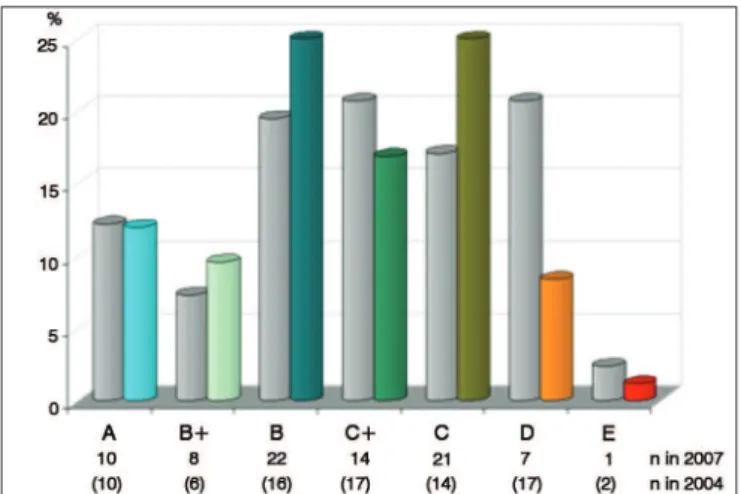
The comparative distribution of the programs previously classified as E, D, C and C+ in 2004, three years after the implementation of the Protocol of Assessment, is presented on Figure 9.
Figure 10 shows the proportional distribution of the applicants ranked among the top 50% and bottom 50%, who passed the ABORL-CCF Board’s Title of Specialist Exam, according to the qualitative classification of their training institutions in 2006.
Figure 11 shows the mean values of the grades obtained by successful applicants in the ABORL-CCF Board’s Title of Specialist Exam in Otolaryngology in 2007, according to the qualitative classification of their training programs.
The comparison among the mean scores of the applicants, according to their training institution, was statistically analyzed and the results are shown on Table 5.
Table 3. Numerical and percentage distribution per Brazilian state, in relation to the entire country, according to the qualitative ranking of residency or specialization programs in otorhinolaryngology in 2004.
Ranking
Region A B+ B C+ C D E
% n % n % n % n % n % n % n
Southeast
São Paulo 60.00 6 50.00 3 37.50 6 52.90 9 42.90 6 17.60 3 50.00 1
Rio de Janeiro - - - - 18.80 3 5.90 1 35.70 5 23.50 4 -
-Minas Gerais - - 16.70 1 12.50 2 23.50 4 21.40 3 - - 50.00 1
South
R.G. do Sul 10.00 1 16.70 1 - - 11.80 2 - - -
-Paraná 10.00 1 - - 12.50 2 - - - 0 11.80 2 -
-Northeast
Bahia - - 16.70 1 6.30 1 - - - - 17.60 3 -
-Pernambuco 10.00 1 - - -
-Ceará - - - - 6.30 1 5.90 1 - - -
-R. G. do Norte - - - 5.90 1 -
-Alagoas - - - 5.90 1 -
-Midwest
Federal District 10.00 1 - - -
-Goiás - - - - 6.30 1 - - -
-North
Amazonas - - - 17.60 3 -
-Brazil 12.20 10 7.3 6 19.50 16 20.70 17 17.10 14 20.70 17 2.40 2
Table 4. Rankings numerical and percentage distribution of residency and specialization programs in Otorhinolaryngology in 2004, per state in Brazil.
Region A B+ B C+ C D E Total
% n % n % n % n % N % n % n
Southeast
São Paulo 17.65 6 8.82 3 17.65 6 26.47 9 17.65 6 8.82 3 2.94 1 34
Rio de Janeiro - - - - 23.08 3 7.69 1 38.46 5 30.77 4 - 13
Minas Gerais - - 9.09 1 18.18 2 36.36 4 27.27 3 - - 9.09 1 11
South
R.G. do Sul 25.00 1 25.00 1 - - 50.00 2 - - - 4
Paraná 20.00 1 - - 40.00 2 - - - - 40.00 2 - - 5
Northeast
Bahia - - 20.00 1 20.00 1 - - - - 60.00 3 - - 5
Pernambuco 20.00 1 - - - 1
Ceará - - - - 50.00 1 50.00 1 - - - 2
R. G. do Norte - - - 1 - - 1
Alagoas - - - 100.00 1 - - 1
Midwest
Federal Disctrict 100.00 1 - - - 1
Goiás - - - 100.00 1 - - - 1
Norte
Figure 8. Numerical distribution of medical residency or specialization programs in Otolaryngology according to their accreditations from MEC
or ABORL-CCF and qualitative classiication in 2004.
Figure 9. Comparative distribution of the classiication of medical
residency or specialization programs in ENT in 2007 after the
reclassiication of programs previously ranked as E, D, C and C+
in 2004.
Figure 10. Proportional comparative distribution of the applicants ranked among the top 50% and the bottom 50% who passed the ABORL-CCF Board’s Title of Specialist Exam, according to the
qualitative classiication of their training institution. N/A: programs not
assessed.
Figure 11. Average grades in the ABORL-CCF Board’s Title of Specialist Exam according to the qualitative ranking of the applicant's training institution, in 2006.
the alumni from B-rated programs are different from the scores of those from C-rated institutions.
There was no statistically significant difference between the means of successful candidates in the ABORL-CCF Board’s Title of Specialist exam in 2007, when compared to the classification of their training programs, in the remaining comparisons.
Figure 12 illustrates the curve of mean scores from the successful candidates to the ABORL-CCF Board’s Title of Specialist Exam in 2006 and the curve of the mean scores assigned to their training programs. The training programs’ mean scores were divided by ten to make it easier to graphically compare them with the alumni mean scores.
In the graph, we can notice that the two curves have the same trend. As the institutions’ ranks decrease, the mean scores of their alumni also decrease.
We calculated the correlation test between the mean scores of the institutions and the mean scores of their alumni in the ABORL-CCF Board’s Title of Specialist Exam in 2007 and obtained a p = 0.92, which strongly indicates that the curves have the same trend.
Figure 13 shows the number of applicants who failed and the percentage of failures in the Exam that granted the ABORL-CCF Board’s Title of Specialist in 2006, distributed according to the qualitative classification of the training institution.
Graphically, we can see that the percentage of failure is minimal in A-ranked institutions and maximum in those who refused to participate in the ABORL-CCF’s Protocol for Assessment and Classification.
Table 5. Statistical analysis of the comparison among the mean grades of the graduates at the 2006 Title of Specialist Exam, according to the ranking of their training program.
Ranking B+ B C+ C D
A 0.276151 accepts H0 0.479883 accepts H0 0.143826 accepts H0 0.00056 rejects H0* 0.021284 rejects H0*
B+ 0.644867 accepts H0 0.892801 accepts H0 0.119467 accepts H0 0.107445 accepts H0
B 0.492737 accepts H0 0.016604 rejects H0* 0.084488 accepts H0
C+ 0.102699 accepts H0 0.16675 accepts H0
C 0.611638 accepts H0
D
The signiicant values are marked with an asterisk.
Figure 12. The mean grades curve of successful applicants to the ABORL-CCF Board’s Title of Specialist Exam in 2006 and curve of the mean scores assigned to their training programs.
Figure 13. Numerical and percentage distribution of the applicants who failed the ABORL-CCF Board’s Title of Specialist Exam in 2006, according to the ranking of the applicant's training program. N/A = programs not assessed.
Three institutions previously ranked as C and as C+ in 2004, did not accept the revaluation. Three other institutions, which had refused participation in the program in 2004, remained absent in the assessment protocol.
Chart 14. Qualitative evolution of residency and specialization
programs ranked as E, D, C and C+, after the reclassiications
in the corresponding periods.
Training program 2004 2006 2007
78 E D D
13 E E E
85 D C C
77 D C C
70 D C C
67 D C C
66 D C C
62 D C C
60 D C C
59 D D D
49 D D D
34 D D D
29 D D D
28 D C C
25 D C C
12 D Terminated
9 D C C
8 D C+ C+
7 D C B
6 D C C+
69 C C
61 C B
57 C C
55 C C+
44 C C
51 C C+
41 C Absent
35 C C
24 C Absent
23 C B+
15 C Absent
Training programs 2004 2006 2007
83 C+ B
82 C+ B
79 C+ D
76 C+ C+
75 C+ C+
73 C+ C+
72 C+ C
71 C+ C+
68 C+ D
56 C+ C
54 C+ C+
53 C+ B
47 C+ Absent
31 C+ C+
27 C+ B+
14 C+ B
5 C+ C+
3 C+ B
Continued Chart 14.
The programs marked in blue improved in the rating scale. The ones marked in red receded.
DISCUSSION
The entire assessment process is subject to errors, it must be changeable and continually improved. Although imperfect, it is better than no evaluation.
There are no published reports on methodical evaluation of medical residency or specialization programs prior to the Protocol for Assessment and Classification of Residency or Specialization Programs developed by the ABORL-CCF.
This process evaluated the training structure and the pedagogical proposal in its various aspects. Its objective was not to evaluate the quality of the service where it fits, but rather, the medical residency program developed there. Also, this assessment does not include the quality of the tutors, their reputations or medical activities.
In otorhinolaryngology, the previous lack of evaluation criteria, made previous opinions and impressions mere speculations. These were established concepts, without defined bases, influenced by the collective imagination formed from the projection of the services that offered residency or specialization programs.
Briefly, they were just favorable or unfavorable prejudices.
Habituation to the spontaneously adopted modus
operandi, added to the lack of quality metrics, were
hurdles to the development of teaching programs in medical residency. The performance of the applicants in the ABORL-CCF Board’s Title of Specialist exam was not considered an indicator of the residency programs’ quality, despite the evidence. The success or failure of an applicant on these tests was intuitively interpreted as evidence of his/her own merits. Their training institutions went unnoticed as directly responsible for such performance.
One of the merits of the Protocol for Assessment and Classification of Residency and Specialization Programs in ENT was to provide information that may correct this imbalance. Shielded on the good reputation of their preceptors, training programs which prioritized the mere provision of medical care in ENT cropped up, unaccompanied by a pedagogical offer and lacking focus on specialized training. This reality sometimes concealed weaknesses induced by the injudicious and mercantile order of unnecessary complementary medical tests, nonetheless being cash making machines. In specific circumstances, the students were trained in effective practices to extract undue advantage from the Brazilian Public Healthcare System (SUS). By decree and definition, medical residency is a mode of non-degree graduate program, characterized by on-the-job training at a full-time basis, in university settings or not, under the tutoring of highly qualified and ethical medical professionals.
The lack of information, the strenuous workload to be accomplished and academic isolation of some training programs hindered their self-assessment. These conditions limited the critical observation of the residents and preceptors on the appropriateness and adequacy of their training programs. An adverse reality that was often only perceived by the failure of their alumni in passing the Title of Specialist Exam, in those extreme cases.
It is forbidden to use the term “Medical residency” to designate any medical training program that has not been approved by the National Commission on Medical Residency (NCMR). These are termed “Specialization Programs” and are accredited by their own Specialty Societies.
Only those students coming from specialization programs are required to take the Board’s Exam to get the Title of Specialist, conferred by the Specialization Societies. Graduates from residency programs automatically receive the Title of Specialist, conferred by MEC at the end of their training, without the need for a Board’s Exam.
programs as potential metrics of the quality of the training program the student attended.
Master’s and Doctoral programs are periodically evaluated by CAPES with rigor and method, and they can be moved up the rankings that qualify them or be penalized with termination. As an education regulator, and despite the importance and complexity of the training of skilled professionals, the NCMR does not have a sensitive and effective assessment system, promoting qualitative improvement for the programs or penalizing poor performance. Granting the Tittle of Specialist occurs automatically to graduates from the programs accredited by MEC, with no criteria to assess proficiency at the end of training. The NCMR certainly decertifies a residency program that does not provide the mandatory regular scholarship pay or does not respect working hours, vacation time and other formalities, but hardly finds and punishes a program that does not develop an appropriate pedagogical program. It lacks structure, universal method to medical specialties, and it does not have enough workers trained for this purpose.
We believe that the NCMR plays a fundamental regulatory role in ensuring and maintaining the minimal institutional conditions that guarantee the legal development of residency programs and adequate working conditions for medical residents. However, the scientific and technical contents of the training, are not covered in depth by the general guidelines issued by the NCMR. This difficulty arises from the multiplicity of existing medical specialties and lack of compatible structure in the NCMR.
In July 2005, the NCMR published Resolution Nº. 2, which provides for its structure, organization and opera-tion. Standardized the invitation to representatives of the Medical Societies to join their Technical Assistance Body. This participation is an open channel to the progressive contribution of Specialty Societies. Also in this ordinance, it established the minimum requirements for the institution and for the residency program. These requirements are general guidelines essential to the functioning of the program, but do not include all the particulars of each medical specialty.
Through resolution NCMR 01 of January 2006, the NCMR discusses the structure, organization and functioning of the State Commissions on Medical Residency (SCMR), created in 1987. It confirms that the SCMR are agencies that report to the NCMR, with decision power regarding medical residency issues within each state. The SCMR is responsible for guiding and analyzing the processes of accreditation, reaccreditation, request for optional years, increase the number of openings, suggest measures that improve program performance, monitor the selection process, manage transfers and conduct on-site inspections to fulfill the aforementioned purposes. Additionally, it
oversees compliance with the minimum criteria established by the NCMR, reporting, propose sanctions, judge the penalties imposed by the local committee on medical residency (COREME) on the institutions that offer residency programs, hear appeals arising from the selection process and other functions.
When we consider the number of existing specialties, with their own and distinct characteristics, and the multiplicity of residency programs, it becomes clear the inability of these agents to assess the content of training and the practical aspects of the residents’ daily activities.
In December 2004, the National Commission of Medical Residency (NCMR), the Department of Medical Residency and Special Projects in Health at the Secretariat of Higher Education (SESu/MEC) and entities associated
with medical residency programs, organized the 1st
National Forum on Medical Residency. Among other issues, there was an intention to revisit the medical residency situation in Brazil and the criteria used to assess residency programs. At the time, they had a very generalized assessment, which only confirmed the need to setup criteria and their lack thereof, as well as the inability of MEC in performing assessments without the participation of the relevant specialty societies. Among the difficulties pointed out, one that stood out was the deep evolutionary difference between the medical associations as to the need to homogenize criteria, develop and apply evaluation methods. This inequality prevented the wides-pread participation of these associations in a joint action with the NCMR.
In September of 2006, the NCMR issued the Resolution NCMR Nº. 06, which provides for the assessment of medical residency programs.
It confirmed that a medical residency is a mode of graduate education, created and regulated by federal law, which purpose is to train doctors in service under proper supervision. It aims to meet the country’s needs for training of qualified professionals within the medical field. This educational mode should be regularly assessed through appropriate instruments in order to tailor and improve the content of educational and medical care programs. For this purpose, it must use qualifiers to provide for the maximum reliability and minimum injunctions outside its own evaluation.
It establishes that residency programs should be evaluated at least every five years, in order to renew their accreditation. The five-year assessments will cover the following areas: infrastructure, the educational program, the faculty, the student body and the contribution to the development of the local healthcare system.
The SCMR is responsible for appointing the Medical Residency Assessment Commission, which should be made, preferably, of at least one member of SCMR; one member appointed by the Specialty Society of the program whom, in turn, must be affiliated to the Brazilian Medical Association (AMB); a representative of the local public healthcare management system, appointed by the State Health Department, and one resident doctor appointed by the National Association of Resident Physicians (ANMR).
In weighting the points awarded to the evaluated aspects, the program content and infrastructure will account for 40%; 30% for the faculty and 30% for the student body.
Programs with performance index greater than 50% will be reaccredited for five more years. Those with variable performance between 25% and 50% will have their program submitted to diligence and should be reviewed before two years. If the performance index is less than 25%, the program will be terminated.
Just like with the NCMR, the SCMR lack sufficient structure, universal method concerning the medical specialties and enough trained workers.
This evaluation process is based on fulfilling the minimum requirements set by the NCMR. For being minimum, they should not be met short of full. There is a clear leveling at the minimum standards, which does not distinguish between excellence and minimum efficiency. Since it does not punctually identifies the deficiencies of the weaker program, it does not provide consistent benefits that can direct the improvement of the training program.
This commendable initiative, despite belated, attests, at most, minimal proficiency for teaching programs, but it does not rank them by quality as CAPES does for Master’s and Doctoral Programs.
The ABORL-CCF anticipated that resolution and developed its Protocol for Assessment and Classification of Medical Residency or Specialization Programs (PACRE). The development of this protocol included a series of technical and administrative procedures, all important to its implementation and effectiveness.
Initially, we created a protocol as an evaluation tool, complementary to the ABORL-CCF “Minimum Requirements” for the accreditation of specialization programs. During the preparation of this assessment protocol, we agreed on the need to redefine the minimum requirements for the accreditation of programs. Most existing programs could not meet those conditions, which therefore, could not be considered minimal.
The evaluation protocol was developed during three months, in weekly meetings of the ABORL-CCC Teaching, Training and Residency Committee, after rigorously insightful discussions and evaluations. They
considered various aspects that influence the quality of training programs in three major dimensions of its scope: teaching, care and research.
Within item: “General Description of the Program”, they also evaluated the academic environment.
Learning opportunities are different in a university hospital, with tertiary or quaternary levels of complexity, where there are other residency programs of different specialties, that promote the exchange of knowledge, the surveillance from ethics committees and the continuous search for qualification - a prerequisite of academic institutions. Even outside of universities, that have teaching and research as their main reasons for existing, general hospitals can develop effective training programs, by providing appropriate equipment and technology, excellence in its structures and standardized protocols that make up for the lack of academic organization. However, these do not seem to be the teaching conditions offered to the majority of medical residents or trainees in Otolaryngology in Brazil. Many specialization programs are provided in smaller hospitals and private clinics, mainly geared to providing specialized medical care, without having an environment that fosters learning, except the one generated by the vocation and dedication of their preceptors.
It is a fact that Brazilian universities, public and private alike, do not supply the demand for openings in otorhinolaryngology residency. Specialization programs developed in isolated hospitals and private clinics are numerically significant in the training of Brazilian ENTs. Having accurate outside guidance, geared to the conceptual and practical aspects of the professional training, as necessary even within the university environment, becomes essential outside of it, where issues related to education are not a priority. Adequate physical facilities, diagnosis equipment, treatment and rehabilita-tion are essential to good medical care and are important in professional training. Libraries; access to the Internet and to scientific publications are essential in a specialty training program.
However, an exquisite infrastructure, is no guarantee of effective training. There are situations in which equipment and technology are merely incentives for unnecessary complementary tests, which main purpose is to generate profits, which creates a moral deviation in the exercise of professional training.