Transcutaneous electrical neural stimulation for the
treatment of urinary urgency or urge-incontinence in children
and adolescents: a Phase II clinica
Authors
Amanda Carolina Almeida de Alcantara1
Maria Júlia Gonçalves de Mello2
Eduardo Just da Costa e Silva1
Bárbara Bernardo Rinaldo Silva1
José Pacheco Martins Ribeiro Neto1
1 Instituto de Medicina Integral prof. Fernando Figueira - IMIP. 2 Universidade Federal de Pernambuco.
Submitted on: 10/22/2014. Approved on: 02/24/2015.
Correspondence to:
Amanda Carolina Almeida de Alcantara.
Instituto de Medicina Integral Prof. Fernando Figueira - IMIP. Rua Albino Meira, nº 81, Parnamirim, Refice, PE, País. CEP: 52060-120.
E-mail: amandaalcantara6@ hotmail.com
Fundação de Apoio a Pesquisa do IMIP (FAPE).
I
NTRODUCTIONLower Urinary Tract Dysfunction (LUTD) is a term used to define lower urinary tract changes in children without neurological disorders.1 The
symptoms range from incontinence and/or increased urinary frequency, lower urinary tract infection, bladder-urethral reflux associated or not to changes in the intestinal system.2 A
study carried out with 590 children between 3 and 9 years old, living in the city of Pelotas (RS), Brazil, found that 22.8% had some type of voiding dysfunction, with higher prevalence among girls (35.8%), especially in relation to urinary incontinence and urinary urgency.3
In children, when a delay occurs in acquisition of cortical inhibition responsible for inhibiting the detrusor muscle4 during bladder filling, the
exacerbated increase of pressure within the bladder can cause the onset of symptoms such as urgency, urge incontinence, and nocturnal enuresis.4
These persistently uninhibited detrusor muscle contractions cause hypertrophy of the bladder muscle, decreased functional capacity and increased bladder instability.4
Behavioral treatment is the first step, in which the patient is instructed to control fluid intake and perform bladder training. However, the level of evidence and response to this treatment is low.5 Drug treatment DOI: 10.5935/0101-2800.20150065
Objective: To determine the effectiveness of 20 twice-weekly sessions of parasacral transcutaneous electrical neural stimulation (TENS) for treatment of urinary urgency and urge-incontinence in children and adolescents. Methods:
A Phase II clinical trial was carried out with patients with urinary urgency or urge-incontinence aged between 5 and 14 years. Twenty TENS sessions were conducted, twice weekly, using a Quark®
Dualpex 961 apparatus. The variables analyzed were daily micturition, dynamics ultrasonography of the lower urinary tract pre-and post-treatment and responses to a questionnaire on urinary leakage applied during each session. Results: The mean age of the 25 children participating in the study was 7.80 ± 2.22 years, most were female (92%) and had urge-incontinence (92%). The difference in urinary leakage pre- and post-treatment was statistically significant (p = 0.04); a decline in the symptom of urinary leakage was reported by all caregivers in children who completed the 20th session; the ultrasound parameters, although not statistically significant, showed a reduction in the percentage of children with detrusor contractions (from 62.5% to 43.5%); and a more adequate pre-micturition bladder volume of 4.2% post-treatment compared with 19.0% prior to treatment. Conclusions: The electro-stimulation carried out during the twice weekly sessions appeared to be effective and urinary incontinence declined in half of the patients from the 12th session onwards. However, there
is a need for a study involving a larger number of patients to confirm the results obtained.
A
BSTRACTis also a widely used tool, and antimuscarinic drugs such as tolterodine and oxybutynin are prescribed for oral intake.6,7 A study carried out
in Iowa investigated the response to treatment with oxybutynin in 81 children with urinary disorders. The average treatment duration was one year and they reported that 38.3% of the children were incontinent. However, 58% of patients reported side effects (18.5% constipation, 17.3% dry mouth, 13.6% flushed skin and 3.7% had heat intolerance).8
Transcutaneous electrical nerve stimulation (TENS) has been used for decades in the treatment of dysfunctions of the lower urinary tract (DTUI);9 when changes occur in the
supraspinatus and spinal pathways and in the activity of the post-central gyrus promoted by electrical stimulation of the sacral region (S3).9
Hoebeke et al.10 and Bower et al.11 were the first
to use this type of electrical stimulation applied daily in children with overactive detrusor muscle and highlighted that the advantage of the method was that it is not invasive. They reported healing in 51, 2% of children with overactive bladder. In a study carried out in Brazil,12 after 13 sessions
three times a week, 63% of patients no longer had symptoms of urinary urge incontinence and about 70% of patients after two years of treatment were still symptomless.13
The aim of our study was, without changing the total number of 20 sessions, to establish the effectiveness of parasacral transcutaneous electrical nerve stimulation in children and adolescents with urinary urgency and urge incontinence when held twice weekly. It also aimed to establish the minimum number of sessions reported to cause symptom regression.
M
ETHODWe carried out a phase II clinical trial in children and adolescents aged 5 to 14 with urinary urgency or urge incontinence diagnosis. The study was carried out in the Physical Rehabilitation Center of the Prof. Fernando Figueira Integrative Medicine Institute - IMIP, from December 2012 to October 2013.
To establish the prevalence of LUTD among children seen at the pediatric clinic, we used the Dysfunctional Voiding Scoring System (DVSS)14 questionnaire in a previous study.
LUTD diagnosis was confirmed after ruling out anatomical or neurologic abnormalities such as posterior urethral valve, ureterocele, neurogenic bladder, etc. All children were investigated and, when necessary, treated for urinary tract infection; those whose symptoms of urgency or urinary urge incontinence persisted were referred to the study.
After care in the nephrology clinic, the children with urinary urgency or urge incontinence diagnosis established by the clinic and/or dynamic ultrasound of the lower urinary tract (DUS - LUT) were referred for treatment with TENS. Parents or guardians of children and/or the children themselves answered a questionnaire with socio-demographic information. Data was obtained on the patient’s clinical history: beginning and frequency of symptoms of urgency and urge incontinence, whether the onset of symptoms was associated with a traumatic event (e.g., separation or family loss or caregiver loss, birth of a sibling). Constipation complaints to characterize the syndromes of dysfunction and elimination in these children followed Rome III criteria.15
We used the Quark® Dualpex 961 unit for the
improvement was considered when there were no more urinary loss events in 24 hours reported by the child and/or the caregiver.
At the end of the study, i.e. after the 20th session, patients underwent DUS - LUT to compare the results obtained prior to treatment. The urinary volume was classified as inadequate when lower than the volume calculated for the age16 [urinary volume = (age + 2) x 30]. Bladder
wall thickness, in a full bladder, was considered appropriate when measured up to 3 mm thick 17 and the empty bladder thickness up to 5 mm.17
The ultrasound examinations were performed by the same operator (EJ).
For data analysis, we used the SPSS 13.0 for Windows and Excel 2007. To analyze paired samples we used the Wilcoxon test, with a 5% significance level.
This study was approved by the Research Ethics Committee of the IMIP (number 07864812900005201) and recorded at the REBEC (Brazilian Clinical Trials Registry under number 111 485 950 U111). The study participants signed a consent term when they could write their name and the parent/guardian signed the consent form. The project received a grant from IMIP’s Research Support Foundation (FAPE) for patients living in the countryside, to ensure access to the service and higher treatment compliance.
R
ESULTSAmong the 26 children referred with a diagnosis of LUTD, one of them did not accept the first treatment session and presented incessant crying. Therefore, 25 children aged between 5 and 12 years (mean 7.80 ± 2.22) were selected for the study. Table 1 depicts some sample characteristics and shows that 92% of the children were females and 44% lived in the state of Pernambuco. Children attended the sessions mostly accompanied by their mothers (23/25) and the majority (76%) of the caregivers had more than eight years of education.
Symptoms of urinary urge incontinence were reported by 92% of the children. The guardians associated the onset of symptoms to caregiver
TABLE 1 DESCRIPTIONOFTHEBIOLOGICALAND SOCIODEMOGRAPHICCHARACTERISTICSOF
CHILDRENWITHURINARYURGENCYORURGE-
INCONTINENCESUBMITTEDTOEXTERNAL
ELECTROSTIMULATIONATTHEIMIP
REHABILITATIONCENTERBETWEENAUGUST
2013 ANDDECEMBEROF 2013
Variables n %
Gender
• Males 2 8.0
• Females 23 92.0
Origin
• Recife 8 32.0
• Metropolitan region of Recife 6 24.0
• Country side of Pernambuco 11 44.0 Guardian education
• Up to 8 years 6 24.0
• Over 8 years 19 76.0
Family members marital status
• Married or stable union 20 80.0
• Single or widow/er 5 20.0
Urinary symptoms
• Urgency 2 8.0
• Urge-incontinence 23 92.0
Intestinal constipation 14 56.0
Association with traumatic event 3 12.0
change (nanny), parents’ divorce and the birth of a sister among three children. Constipation complaints were described for 56% of children.
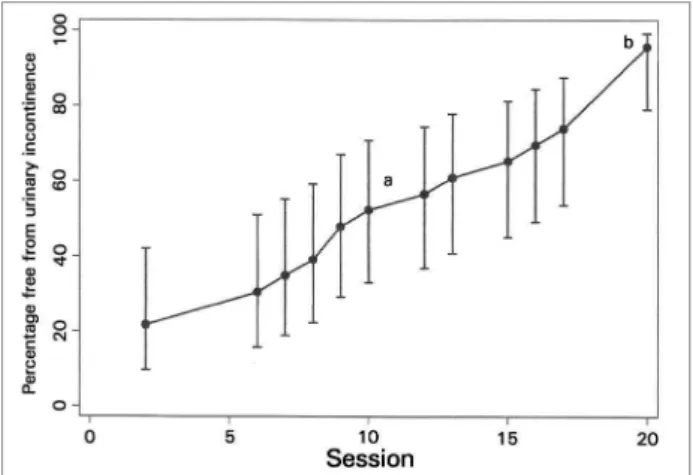
Among the 22 children with urinary incontinence, 47.1% of them (13) no longer had the symptom as of the 12th session. One (4%) abandoned the treatment
at the 12th session because of access difficulties and
illness in the family. Figure 1 shows the cumulative frequency of incontinence resolution in 95.7% of them at the end of the 20th session. Among those
who completed treatment, none of the 21 children had stress urinary incontinence any longer. Three months after the end of treatment, 68% remained symptomless and 28% continued having symptoms, but their parents reported a significant improvement.
Figure 1. Cumulative frequency and its respective 95% confidence interval, of the urinary incontinence according to the number of sessions. a 10th session 52.2% (IC 33.0-70.8) of the children no longer
had urinary incontinence. b 20th session 95.7% (IC 79.0-99.2) of the
children no longer had urinary incontinence.
we found a statistically significant difference in symptoms according to the record at every urination
p = 0.04 (Wilcoxon test for paired data).
Figure 1 shows the evolution of symptoms improvement in percentage terms according to each session.
It was possible to compare the dynamic ultrasonography of the lower urinary tract (LUT-DUS) obtained before and after treatment of 21 children (one did not do it before and three did not perform it after the treatment). We noticed a decrease in the frequency of detrusor contraction and increased bladder capacity in these children, 62.5% to 43.5% and from 4.2% to 19%, respectively. All the children had adequate pre and post voiding bladder wall thickness after the physiotherapy sessions. However, these parameters did not have statistical significance.
D
ISCUSSIONStudies previously published involving children with LUTD used the transcutaneous electrical nerve stimulation with a minimum frequency of three times a week. To our knowledge, this is the first clinical trial of type II on TENS in children and adolescents with urinary urgency and urge incontinence doing two sessions a week totaling 20 sessions.
In our sample, consisting of children with urinary urgency or urge incontinence, there were more females as described in the literature, where girls have a higher frequency of LUTD.10-19 The mean age
at first evaluation in our study (7.80 ± 2.22 years) was similar to that of the study by LORDELO et al.,12 also held in Brazil, in which the mean age was
7.5 ± 2.8 years.
Constipation, which was observed on 56% of our patients had also been studied by Hagstroem
et al.,9 in which 48% (13) of 27 children studied
showed this symptom. This data is important because the retention of feces in the rectum increases detrusor overactivity. According to the ICCS (International Children’s Continence Society),16
constipated children are afraid to use the toilet to urinate as well as to evacuate, which could further aggravate the bladder dysfunction of these children. Further studies should be carried out to evaluate the changes obtained with TENS in bowel habits of these children.
In our study, at the end of treatment, 77% of the parents reported that their children no longer had symptoms of urinary urgency and incontinence. In the study by Bower et al.,11 the parents of 15 children
with incontinence applied TENS twice a-day, and observed improvement in 73.3% of them. The treatment was individualized to monthly revisions and the end of treatment ranged from one to five months. In our study, half of the children showed no more urinary incontinence from the 12th session
and none of the ones that completed the 20th session.
This suggests that some children would not need 20 sessions to control urinary symptoms and eventually, after a certain number of sessions without reference to urinary loss, treatment could be suspended. However, it is necessary to do a study with a larger number of participants to confirm this finding and to establish the optimal time of treatment suspension correlating with the percentage of relapses occurring.
Lordelo et al.18 evaluated the results of long-term
Although there was clinical improvement in these patients, there were no statistically significant changes in the LUT-US. Previous studies have shown that electrical stimulation increases bladder capacity.9,10,12,19 No study assessed bladder wall
thickness, and we believe this is an important parameter which must be incorporated to further studies, since repeated detrusor contractions may cause bladder muscle hypertrophy, reducing functional capacity and increasing bladder instability, that when repeated creates a vicious cycle, increasingly aggravating hyperactive bladder.4
Watching our clinical practice, we realized that TENS was well accepted by children and adolescents because, besides being a painless treatment, it was carried out as a fun activity such as painting, drawing or reading. In addition, we observed that before they had difficulty complying with the TENS treatment, with a number of sessions equal to or greater than three times weekly. Since they dwelled in distant cities from our reference center, the children of our service had to wake up very early to travel, missing classes and, moreover, the family had an additional expense with transportation and food to spend the day off home to perform the treatment. We chose to reduce the weekly frequency to two sessions without changing the total number of 20 sessions described in the literature.
C
ONCLUSIONTranscutaneous electrical nerve stimulation performed in two weekly sessions proved to be effective in the total regression of symptoms of urinary urge incontinence, comparable to the study with three sessions described in the literature. Half of the patients had regression of urinary incontinence as of the 12th session;
however, it is necessary to increase the number of patients for greater result reliability.
R
EFERENCES1. Barroso U Jr, Nova T, Dultra A, Lordelo P, Andrade J, Vinhaes AJ. Comparative analysis of the symptomatology of children with lower urinary tract dysfunction in relation to objecti-ve data. Int Braz J Urol 2006;32:70-6. DOI: http://dx.doi. org/10.1590/S1677-55382006000100013
2. Schulman SL, Quinn CK, Plachter N, Kodman-Jones C. Comprehensive management of dysfunctional voiding. Pe-diatrics 1999;103:E31. PMID: 10049987 DOI: http://dx.doi. org/10.1542/peds.103.3.e31
3. Mota DM, Victora CG, Hallal PC. Investigação de disfunção miccional em uma amostra populacional de crianças de 3 a 9 anos. J Pediatr (Rio J) 2005;81:225-32. DOI: http://dx.doi. org/10.1590/S0021-75572005000400009
4. Franco I. Overactive bladder in children. Part 1: Pathophysio-logy. J Urol 2007;178:761-8. DOI: http://dx.doi.org/10.1016/j. juro.2007.05.014
5. Barroso U Jr, Lordêlo P. Electrical nerve stimulation for ove-ractive bladder in children. Nat Rev Urol 2011;8:402-7. DOI: http://dx.doi.org/10.1038/nrurol.2011.68
6. Foon R, Drake MJ. The overactive bladder. Ther Adv Urol 2010;2:147-55. DOI: http://dx.doi.org/10.1177/1756287210373757 7. Yoshimura N, Chancellor MB. Neurophysiology of lower
uri-nary tract function and dysfunction. Rev Urol 2003;5:S3-S10. 8. Van Arendonk KJ, Austin JC, Boyt MA, Cooper CS. Frequency
of wetting is predictive of response to anticholinergic treatment in children with overactive bladder. Urology 2006;67:1049-53. DOI: http://dx.doi.org/10.1016/j.urology.2005.11.060 9. Hagstroem S, Mahler B, Madsen B, Djurhuus JC, Rittig S.
Transcutaneous electrical nerve stimulation for refractory dayti-me urinary urge incontinence. J Urol 2009;182:2072-8. PMID: 19695629 DOI: http://dx.doi.org/10.1016/j.juro.2009.05.101 10. Hoebeke P, Van Laecke E, Everaert K, Renson C, De Paepe H, Raes
A, et al. Transcutaneous neuromodulation for the urge syndrome in children: a pilot study. J Urol 2001;166:2416-9. PMID: 11696801 DOI: http://dx.doi.org/10.1016/S0022-5347(05)65605-4
11. Bower WF, Moore KH, Adams RD. A pilot study of the home application of transcutaneous neuromodulation in children with urgency or urge incontinence. J Urol 2001;166:2420-2. PMID: 11696802 DOI: http://dx.doi.org/10.1016/S0022-5347(05)65606-6
12. Lordêlo P, Teles A, Veiga ML, Correia LC, Barroso U Jr. Trans-cutaneous electrical nerve stimulation in children with overacti-ve bladder: a randomized clinical trial. J Urol 2010;184:683-9. DOI: http://dx.doi.org/10.1016/j.juro.2010.03.053
13. De Gennaro M, Capitanucci ML, Mosiello G, Zaccara A. Cur-rent state of nerve stimulation technique for lower urinary tract dysfunction in children. J Urol 2011;185:1571-7. DOI: http:// dx.doi.org/10.1016/j.juro.2010.12.067
14. Farhat W, Bägli DJ, Capolicchio G, O'Reilly S, Merguerian PA, Khoury A, et al. The dysfunctional voiding scoring system: quantitative standardization of dysfunctional voiding symp-toms in children. J Urol 2000;164:1011-5. DOI: http://dx.doi. org/10.1016/S0022-5347(05)67239-4
15. Constipação: uma perspectiva mundial. World Gastroenterolo-gy Organisation Practice Guidelines; 2010. p.2-13.
16. Nevéus T, von Gontard A, Hoebeke P, Hjälmås K, Bauer S, Bower W, et al. The standardization of terminology of lower urinary tract function in children and adolescents: report from the Standardisation Committee of the International Children's Continence Society. J Urol 2006;176:314-24. PMID: 16753432 DOI: http://dx.doi.org/10.1016/S0022-5347(06)00305-3 17. Tafuro L, Montaldo P, Iervolino LR, Cioce F, del Gado R.
Ultrasonographic bladder measurements can replace urody-namic study for the diagnosis of non-monosymptomatic noc-turnal enuresis. BJU Int 2010;105:108-11. DOI: http://dx.doi. org/10.1111/j.1464-410X.2009.08735.x
18. Lordêlo P, Soares PV, Maciel I, Macedo A Jr, Barroso U Jr. Prospective study of transcutaneous parasacral electrical stimu-lation for overactive bladder in children: long-term results. J Urol 2009;182:2900-4. PMID: 19846164 DOI: http://dx.doi. org/10.1016/j.juro.2009.08.058