Demystifying Septoplasty in Children
Mariane Barreto Brandão Martins
1Rosa Grazielle de Lima
1Francis Vinícius Fontes de Lima
1Valéria Maria Prado Barreto
2Arlete Cristina Granizo Santos
3Ronaldo Carvalho Santos Júnior
41Department of Otorhinolaryngology, University Hospital, Faculty of
medicine, Universidade Federal de Sergipe, São Cristóvão, SE, Brazil
2Department of Otolaryngology, Universidade Fedreral de Sergipe,
São Cristóvão, SE, Brazil
3Department of Otolaryngology, University Hospital of Universidade
Federal de Sergipe, São Cristóvão, SE, Brazil
4Department of Otolaryngology, Universidade de São Paulo, São
Paulo, SP, Brazil; University Hospital of Universidade Federal de Sergipe, São Cristóvão, SE, Brazil
Int Arch Otorhinolaryngol 2014;18:54–56.
Address for correspondence Mariane Barreto Brandão Martins, Resident Doctor, Hospital Universitário da Universidade Federal de Sergipe, Rua Deputado Antônio Torres, 699, Bairro Pereira Lobo, CEP 49052050, Brazil (e-mail: [email protected]).
Introduction
Septoplasty in adults is a well-established surgery, but in children it is still a matter of controversy. Some authors contraindicate surgery before 17 to 18 years of age, because they think that early surgical intervention would influence the normal growth of the nose; others indicate surgery based on the explanation that the sooner septal deviation of a child is corrected, the greater chance of developing normal breath and therefore a suitable facial growth.1,2 The surgery has undergone technical changes since its introduction to minimize trauma to the nasal structure, thus reducing the possible postoperative complications.1 This study aims to present the experience of the
Depart-ment of Otolaryngology, University Hospital, in the surgical treatment of children with nasal septum deviation and debunk the concept that septoplasty should only be per-formed after 17 to 18 years of age.
Materials and Methods
This longitudinal cohort study had a sample of 40 patients, 24 (60%) boys and 16 (40%) girls, aged 4 to 12 years, with a mean age of 9 years, in the period from January 2005 to March 2012 (►Table 1). Patients underwent septoplasty and associated procedures such as adenoidectomy, tonsillectomy, and cau-terization of inferior turbinate, when indicated, in the same surgery. These were assessed clinically and through nasal
Keywords
►
nasal septum
►
face
►
growth and
development
Abstract
Introduction
Septum deviation in children may alter the early physiologic process of
breathing, causing obligatory oral breathing and consequently changing craniofacial
development and even intellect. Because of these consequences, septoplasty should be
performed as early as possible.
Materials and Methods
The retrospective study reviewed the results of septoplasty in
40 children under 12 years old who had follow-up after surgery for a maximum period of
7 years. The research was submitted to the ethics committee and approved with
protocol number 10331912.0.0000.0058.
Results
Forty patients underwent septoplasty, 39 (97.5%) had cauterization of inferior
turbinate and associated procedure, 20 (50%) had adenotonsillectomy, and 17 (42.5%)
had adenoidectomy.
Conclusion
Nasal septum deviation should be corrected early to provide the
harmo-nious growth of the face and to enable normal development of the child, without the
occurrence of nasal deformity.
received March 17, 2013 accepted August 11, 2013
DOI http://dx.doi.org/ 10.1055/s-0033-1358576. ISSN 1809-9777.
Copyright © 2014 by Thieme Publicações Ltda, Rio de Janeiro, Brazil
Original Article
endoscopy in the postoperative period at 10, 30, and 60 days, and annually thereafter, with the longest follow-up of 7 years.
Surgical Technique
1. With the patient under general anesthesia, asepsis and antisepsis procedures are performed.
2. Initially, a topically sterile cotton ball soaked in adrenaline concentration of 1:2,000 is placed in both nostrils with the aim of promoting vasoconstriction. After this, epineph-rine solution is infiltrated at a concentration of 1:80,000 in the septal mucosa of both nostrils.
3. A septal incision is performed on the left side, held at the mucocutaneous transition at nasal vestibule.
4. The septal mucosa is detached in subperichondrial and subperiosteal bilaterally after transfixation of the quadrangular cartilage.
5. Detachment is extended to the nasalfloor bilaterally to facilitate the removal of possible cartilaginous and bony deviations.
6. Cartilaginous and bony deviations are excised conserva-tively to preserve the growth of the septal cartilage, thereby avoiding abnormalities in nasal growth.
7. Hemostasis is reviewed. 8. The initial incision is sutured.
9. Splints and nasal packing are not used at the end of surgery.
10. All steps are performed with the endoscope at 0 degrees.
Results
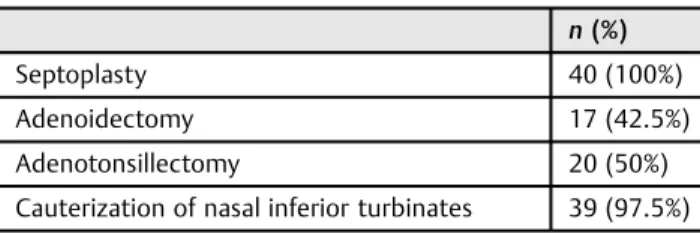
Forty patients underwent septoplasty; 39 (97.5%) of them had associated inferior turbinate cauterization procedure, 20 (50%) patients had adenotonsillectomy, and 17 (42.5%) ad-enoidectomy (►Table 2).
There were no intraoperative complications in any of the operated cases. All patients were evaluated by performing nasal dressings in 10, 30, and 60 days, observing possible adhesions and recurrence of the deviation, septal perforation, infection, and nasal deformity. After this period, annual follow-up was done with the maximum of 7 years.
None of the aforementioned complications were recorded during this monitoring period.
Discussion
There is controversy in the literature about the consequen-ces of septoplasty for septal deviation in children, and some studies have shown that when done early the procedure brought benefits in the short and long term.2 A study conducted with 80 patients aged between 4 and 14 years old who underwent septoplasty (65 patients), rhinoplasty (11 patients), and rhinoplasty (4 patients) showed postop-erative complications in only 13 of these patients (not specifying the surgery performed); the authors concluded that the benefits brought by these surgeries outweigh the occurrence of these minimal complications.2Dispenza et al3stated that more important than the age of indication for the procedure is the degree of nasal obstruction, placing it as an absolute indication, because nasal obstruction during infancy disrupts the normal development of the angle of the skull base and consequently the maxillofacial growth and may cause malocclusion and jaw protrusion with bone deformities, confirmed even with anthropometric meas-urements. Others4–7also claimed that delay defect correc-tion can bring negative effect on organ systems that play a role in somatic and psychic development of the child including voice changes and sleep disturbances, but specu-lated that in some situations monitoring should be done for real indication for surgical treatment. A study performed with 44 patients aged between 8 and 12 years old who underwent septal surgery (reconstructive rhinoplasty) showed efficacy in relation to nasal obstruction and dem-onstrated that surgery when performed conservatively does not harm the facial growth or promote nasal deformi-ties.8 In our study, all 40 patients were younger than 12 years old and underwent septoplasty surgery early, avoiding development of deformities resulting from mouth breathing. None of our patients had facial deformity at the
first visit and none had nasal deformity after surgery (maximum follow-up of 7 years).
Septoplasty can be performed safely without affecting the nasal and facial development in appropriately selected pa-tients, and delaying the procedure may cause asymmetry and craniofacial anomalies.9,10There are caveats, however, that surgery can negatively influence the growth of the nasal dorsum when done by an external approach and that before considering pediatric nasal septum surgery, a thorough clini-cal examination should be performed for a correct diagnosis and appropriate surgical indication.9
Research that showed convincingly that septoplasty in children causes nasal deformity could not be found in the Table 1 Patient characteristics (n¼40)
n(%)
Sex Female Male
Age at surgery (y) 4 5 6 7 8 9 10 11 16 (40%) 24 (60%) 3 (7.5%) 1 (2.5%) 5 (12.5%) 1 (2.5%) 4 (10%) 5 (12.5%) 5 (12.5%) 10 (25%)
12 6 (15%)
Table 2 List of associated procedures
n(%)
Septoplasty 40 (100%)
Adenoidectomy 17 (42.5%)
Adenotonsillectomy 20 (50%)
Cauterization of nasal inferior turbinates 39 (97.5%)
literature. Some studies even questioned the possibility of the occurrence of these deformities; however, most studies, like ours, showed that early surgery when indicated is beneficial. Thus, the studies found in the literature,1–10 whether anthropometric or clinical trials, corroborated ourfindings that septoplasty in children allows appropriate craniofacial growth and development, prevents abnormalities in somatic and psychic component of the patient, as well as demystifies the concept that septoplasty should only be performed after the age of 17 to 18 years old.
Conclusion
The nasal septum deviation should be corrected early to provide a harmonious craniofacial growth and appropriate child development, without the occurrence of nasal deformity.
References
1 Patrocíno JA. Septoplastia em crianças. Rev Bras Otorrinolaringol (Engl Ed) 1999;65(4):302–306
2 Maniglia JV, Molina FD, Maniglia LP, et al. Rinosseptoplastia em crianças. Rev Bras Otorrinolaringol (Engl Ed) 2002;68(3):320–323 3 Dispenza F, Saraniti C, Sciandra D, Kulamarva G, Dispenza C. Management of naso-septal deformity in childhood: long-term results. Auris Nasus Larynx 2009;36(6):665–670
4 Verwoerd CDA, Verwoerd-Verhoef HL. [Rhinosurgery in children: developmental and surgical aspects of the growing nose]. Laryng-orhinootologie 2010;89(1, Suppl 1):S46–S71
5 Verwoerd CDA, Verwoerd-Verhoef HL. Rhinosurgery in children: basic concepts. Facial Plast Surg 2007;23(4):219–230
6 Cupero TM, Middleton CE, Silva AB. Effects of functional septo-plasty on the facial growth of ferrets. Arch Otolaryngol Head Neck Surg 2001;127(11):1367–1369
7 Christophel JJ, Gross CW. Pediatric septoplasty. Otolaryngol Clin North Am 2009;42(2):287–294, ix
8 Ortiz-Monasterio F, Olmedo A. Corrective rhinoplasty before puberty: a long-term follow-up. Plast Reconstr Surg 1981;68(3): 381–391
9 Lawrence R. Pediatric septoplasy: a review of the literature. Int J Pediatr Otorhinolaryngol 2012;76(8):1078–1081
10 D’Ascanio L, Lancione C, Pompa G, Rebuffini E, Mansi N, Manzini M. Craniofacial growth in children with nasal septum deviation: a cephalometric comparative study. Int J Pediatr Otorhinolaryngol 2010;74(10):1180–1183