Prevalences of Tuberculosis
and
Other Respiratory
Diseases among
People over Age 15 in the Northeast
Sector of Medellin,
Colombia1
Luz
ZULUAGA,~ CENEIDA BETANCUR,~
MYRIAN ABAUNZA,~ & JAIME LONDO~O~
A survey was conducfed in 2988 to estimate the prevalence of respirafoy symptoms and pulmona y tuberculosis in people over age 15 in the Northeast Sector of Medellin, Colombia, an area suffering from severe socioeconomic depression. A cluster sample was selected for this purpose and 3,731 adults were inferviewed in their homes. Those classified as respiratory sympfomatics (ones reporting a cough lasting two weeks or more) were asked to provide samples for three sputum-smear examinations.
Tke prevalence of pulmonary tuberculosis found in this survey was 2.68 cases per 1,000 subjects, a rate substanfially greater than the prevalence of tuberculosis cases recorded in fke Norfkeast Sector, and fke prevalence of respiratory symptomatics was 70 per 1,000 subjects.
Of
eigkt subjects whose cases had been diagnosed previously, three said they had abandoned treatment. The prevalence of respirato y symptomafics was higher amongpoorly
educated subjects and among fkose sleeping in poorly ventilated andtor overcrowded quarters. Overall, the survey data suggest that the fuberculosis control program in Nortkeasf Medellin confronts a spectrum of problems ranging from low case-detection rates and high rates of abandoned treatment to social conditions and behavior patterns that foster host vulnerability and disease transmission.
T
uberculosis continues to be a public health problem in poor countries, where the number of cases has increased over the last three decades and the pop- ulation has doubled. The International Union Against Tuberculosis and the World Health Organization have indicated that a close relationship exists between so-‘Edited translation of the article “Prevalencia de tubercuIosis y enfermedad respiratoria en personas mayores de 15 arias de la comuna nororiental de Medellfn, Colombia,” published in Spanish in the B&fin de la Oficina Sanitaria Panamericana, Ill(~):
406-13, 1991.
%-riversity of Antioquia, Faculty of Nursing. Mail- ing address: Universidad de Antioquia, Facultad de Enfermerfa, Cursos Basicos y Complementa- rios, Apartado aereo 1226, Medellfn, Colombia. %anta Cruz Intermediate Unit, Medellfn, Colom-
bia.
cioeconomic status and tuberculosis incidence, partly because malnutrition, strenuous work, and shortage of leisure time all tend to decrease individual resist- ance to the infection (1). Poor housing and working conditions involving over- crowding and poor ventilation also in- crease the tuberculosis risk. In this vein, it should be noted that during the 1850- 1945 period preceding chemotherapy, countries such as the United Kingdom, Norway, Holland, and Sweden saw in- fant tuberculosis mortality drop from about 600 deaths per 100,000 live births to around 100 per 100,000. Socioeco- nomic development may have accounted for much of this decline (2).
It has also been suggested that socio- economic factors typically account for 60- 70% of the disparity between the tuber-
culosis incidence in different countries, while the quality of health services deliv- ered accounts for 10-20% and genetic and climatic factors, together with factors re- lated to the natural history of the disease, account for the remaining lo-30% (2-5).
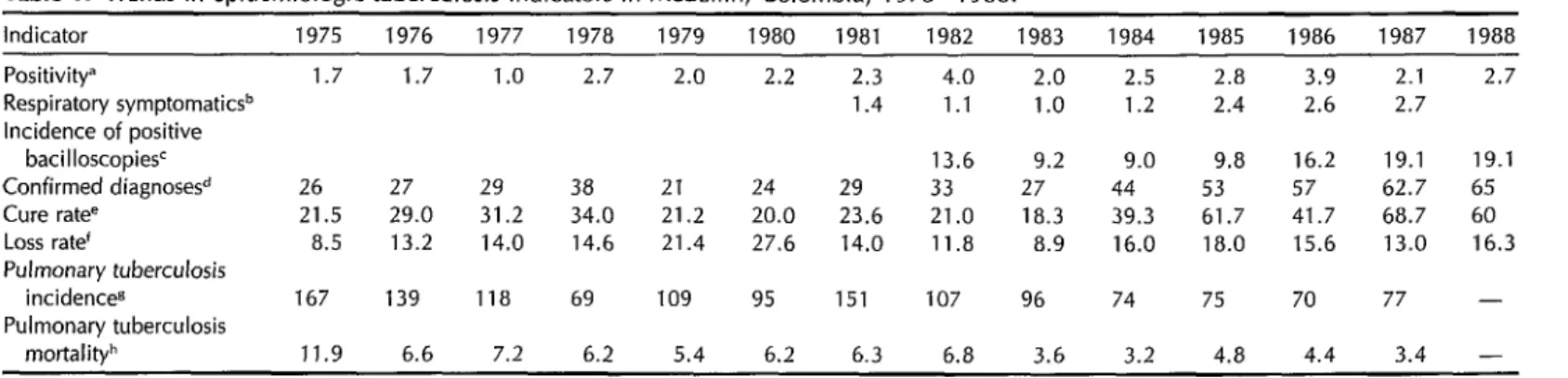
An epidemiologic analysis of various tuberculosis indicators in the city of Me- dellin, Colombia, during the years 1975- 1988 (6, 7) suggests that the tuberculosis program in that city has had little success in reducing prevailing levels of the dis- ease (Table 1).
During the period 1982-1986 Mede- llin’s Northeast Sector registered succes- sive annual tuberculosis incidences of 60, 61, 35, 52, and 40 (8). It was assumed that the risk of tuberculosis depended, among other things, on socioeconomic conditions. However, it was striking that the recorded incidence was lower in the Northeast Sector than in the rest of the city, since this subsection was character- ized by major socioeconomic depression compared to the city as a whole (7). This suggested that insofar as tuberculosis was concerned, demand for medical care among the Northeast Sector’s population far exceeded supply. It also suggested that the prevalence of respiratory symp- toms and pulmonary tuberculosis in that district should be assessed, along with the level of treatment abandonment, and that the prevalence of tuberculosis and respiratory symptoms among different age, gender, and socioeconomic groups should be compared.
MATERIALS
AND METHODS
In 1988 a total of 3,731 subjects were interviewed in order to estimate the prev- alence of pulmonary tuberculosis and other respiratory disease among people over the age of 15 and of low economic status in Medellfn’s Northeast Sector. The size of the sample was based on a theo- retical tuberculosis prevalence of 0.7 cases
per 1,000 inhabitants, a population of 203,734, a sample error of 0.9 per 1,000, and a 95% confidence level. A cluster sample method was used to select the survey population, considering each neighborhood within the sector as a clus- ter (6, 9). The text of the survey ques- tionnaire is shown in the Annex. An- swers to the questions posed were used to clinically classify the respondents ac- cording to whether or not they had res- piratory/tuberculosis symptoms and how they had been or were being treated; to define the respiratory symptoms in- volved; and to assess the respondents’ homes in terms of certain conditions fos- tering respiratory disease transmission.
1. Clinical classification. The survey participants were grouped into the fol- lowing categories: those with respiratory symptoms, those who were undergoing tuberculosis treatment, those who had abandoned such treatment, those who had been cured of tuberculosis, those who had never been diagnosed as having tu- berculosis, and those with cases that were diagnosed during the study (10). Irre- spective of other symptoms, subjects who reported having a cough for two or more weeks were considered to have respira- tory symptoms. Plans were made for all subjects with respiratory symptoms, as well as all others who said they had aban- doned tuberculosis treatment, to be given three direct bacilloscopies. The sputum samples needed for these examinations were collected at home by the respond- ents, who were given instructions re- garding their collection.
Subjects diagnosed as having pulmo- nary tuberculosis who were undergoing treatment, those who had interrupted treatment and continued to have symp- toms, and those who had one or more positive bacilloscopies were classified as tuberculosis cases (see Annex). All the tuberculosis cases and respiratory symp- tomatics were classified as respiratory
Table 1. Trends in epidemiologic tuberculosis indicators in Medellin, Colombia, 1975-l 988.
Indicator 1975 1976 1977 1978 1979 1980 1981 1982 1983 1984 1985 1986 1987 1988
Positivitya 1.7 1.7 1.0 2.7 2.0 2.2 2.3 4.0 2.0 2.5 2.8 3.9 2.1 2.7 Respiratory symptomaticsb 1.4 1.1 1.0 1.2 2.4 2.6 2.7 Incidence of positive
bacilloscopies’ 13.6 9.2 9.0 9.8 16.2 19.1 19.1
Confirmed diagnose& 26 27 29 38 21 24 29 33 27 44 53 57 62.7 65 Cure ratee 21.5 29.0 31.2 34.0 21.2 20.0 23.6 21.0 18.3 39.3 61.7 41.7 68.7 60 Loss rate‘ 8.5 13.2 14.0 14.6 21.4 27.6 14.0 11.8 8.9 16.0 18.0 15.6 13.0 16.3 Pulmonary tuberculosis
incidenceg 167 139 118 69 109 95 151 107 96 74 75 70 77 - Pulmonary tuberculosis
mortalityh 11.9 6.6 7.2 6.2 5.4 6.2 6.3 6.8 3.6 3.2 4.8 4.4 3.4 -
aTotal cases with positive bacilloscopy x 1OOltotal number of cases diagnosed.
bTotal respiratory symptomatics x lOO/number of first consultations among people ~15 years. CTotal tuberculosis cases with posrtrve bacilloscopy x lOO,OOO/general population as of 1 July. dTotal cases with positive bacilloscopy x lOO/total number of people studied.
%tal leaving program cured x lOO/number of existing patients + total leaving.
‘Total abandoning treatment x lOO/number of old patients + total leaving. sTotal pulmonary tuberculosis cases x lOO,OOO/general population as of 1 July. hTotal pulmonary tuberculosis deaths x lOO,OOO/general population as of 1 July.
cases. The latter group included all those who reported respiratory symptoms (two weeks with a cough, irrespective of other symptoms) but yielded no positive bacil- loscopy results.
2. Respiratory disease symptoms. An- swers provided by the respondents to a question (3.2 in the questionnaire) on res- piratory symptoms were used to single out those with expectoration, subjective fever, weight loss, and loss of appetite (see Annex).
3. Education and living conditions. Answers to question 1.3 (see Annex) indicated the respondents’ education (years of school completed), while an- swers to question 2 yielded information about two home conditions fostering res- piratory disease transmission-these being overcrowding (defined as three or more people sleeping in the same bedroom, a definition taking into account the small size of most bedrooms in Northeast Sec- tor homes) and poor ventilation (defined as cases where the number of windows in the housing unit divided by the num- ber of bedrooms was less than one or where the bedroom was used for cook- ing). The evaluation of living conditions was done by means of direct observation in accordance with World Health Orga- nization and Colombian Ministry of Health standards (22, 12).
The interviews were conducted by nurses who received prior training for this purpose from the staff of the Met- ropolitan Institute of Health (Instituto Metropolitan0 de Salud, also known as Metrosalud) and the authors. When the survey subject was not found at home, the interview information was obtained from the closest available family member. In a case where the survey subject had respiratory symptoms, material was left for the collection of sputum samples. Families in which respiratory symptoms were detected were visited on four suc- cessive occasions in order to retrieve spu-
tum samples. At the end of information collection, the families who did not pro- vide samples were visited again with a view to determining the reason.
Bacilloscopies were conducted at Me- trosalud’s central laboratory, and pa- tients diagnosed during the study were enrolled in the tuberculosis control pro- gram. Another bacilloscopy, a chest X- ray, and additional examinations di- rected at confirming a diagnosis were performed on subjects with negative ba- cilloscopies and clinical manifestations compatible with tuberculosis.
STATISTICAL ANALYSIS
Statistical analyses were carried out us- ing the Statistical Package for the Social Sciences (SPSS). Data calculated included tuberculosis and respiratory disease prevalences, the index of treatment aban- donment, and the percentage of subjects being treated. In addition, the observed prevalences of respiratory disease were compared for groups with different ages, genders, years of education, and living conditions. The chi-square test was used to assess observed differences and possible associations between the variables in- volved at the 95% confidence level. In or- der to analyze the differences between the values of binomial variables, a normal ap- proximation was applied to the binomial distribution (z test), taking into account the large size of the sample studied.
RESULTS
Of the 3,731 subjects interviewed, 1,641 (44%) were men and 2,090 (56%) women. The interview subjects’ distribution by age and sex did not differ significantly from that of the Northeast Sector’s adult pop- ulation, with the exception of the group over 70 years old (Figure 1).
The number of interview subjects found to have respiratory symptoms was 240
I I 8 I I i I I I I , 1
50 40 30 20 10 10 20 30 40 50 60
Men Women
/gj Sample 0 General population
Figure 1. Distribution by age and sex of the study subject population sample and the general population of Medellin’s Northeast Sector in 1988. The “p” values show the probability that the differences indicated are coincidental.
(6.4% of the total). Two or three bacil- loscopies were performed on 172 (71.7%) of these subjects; while despite the effort to collect samples at subjects’ homes on several occasions, only one bacilloscopy or none were performed on the remain- ing 68 subjects (28.3%).
Of these 68 people who abandoned the program, 32 (47.1%) were men and 36 (52.9%) women, a sex distribution that
was not statistically distinct at the 95% confidence level (p = 0.31) from that of the population studied. Likewise, no sta- tistically significant differences were ob- served in the age distribution of the pa- tients who were lost to follow-up as compared to that of the whole study pop- ulation (Table 2).
In all, 10 tuberculosis cases were de- tected, making the observed tuberculosis prevalence in the study population 2.68 cases per thousand subjects. Two of these were new cases; six of the cases occurred in men and four in women. Regarding age, most (six) of the cases were found in the 25-49 year age group, with two cases each occurring in the 15-24 and 50+ age groups. Of the eight subjects whose tuberculosis cases had been di- agnosed before the survey, three said they had abandoned treatment. In all, 260 (6.97%) of the interview subjects said they had been cured of tuberculosis.
Of the 240 subjects classified as having respiratory disease symptoms, 190 (79.2%) reported expectoration, 100 (41.7%) sub- jective fever, 86 (35.8%) loss of appetite, and 107 (44.6%) weight loss. In general, our data suggest that the risk of respi- ratory disease increased with age among adult subjects of both sexes. However, no significant differences were found be- tween the respiratory disease symptom prevalences in men as compared to women (Table 3).
Compared to the respiratory disease
Table 2. Percent distribution by age of the 3,731 survey subjects and of those who were lost to follow-up. Observed differences in the sizes of comparable age groups were not statistically significant.
Age in
Study participants
Subjects lost to follow-up
years No. % No. % z P
15-24 1,405 37.7 21 30.9 1.12 0.1314 25-49 1,718 46.0 31 45.6 0.07 0.4721 250 608 16.3 16 23.5 1.39 0.0823
Total 3,731 100.0 68 100.0
Table 3. Prevalences (cases per 1,000) of respiratory symptoms among men and women of different ages within the survey population.a
Age (in years)
Men Women
No. Prevalence No. Prevalence Z P
15-24 25 39.2 38 49.6 0.94 0.17 25-49 56 74.9 62 63.8 0.98 0.18 250 28 109.8 50 141.6 1.16 0.12 axz = 213.6; p < 0.001 for the differences between the recorded prevalences in the Indicated age
prevalence in the whole survey popula- tion, significantly higher respiratory disease prevalences were found among subjects who cooked in their bedrooms (p = O-03), among those whose bed- rooms had no windows opening to the outside (p = 0.0007), and among those sleeping in overcrowded dwellings (p = 0.05) (Table 4). In addition, a negative relationship was observed between the subjects’ educational level and the res- piratory disease prevalence (p < 0.0001).
DISCUSSION
AND
CONCLUSIONS
As the data in Table 1 show, tubercu- losis constitutes a major public health
problem in Medellin, one that has posed serious difficulty for the existing control program. This tuberculosis endemic can be explained by the presence of factors maintaining the chain of transmission. Among them:
l a high prevalence of sources of in-
fection (bacilloscopy-positive tuber- culosis cases) combined with a low rate of case detection;
l social conditions that facilitate ex-
posure (poor sanitary habits, over- crowding, inadequate dwellings);
l immune conditions increasing host
vulnerability (including age, malnu- trition, and accompanying diseases) (23-17).
Table 4. Likelihood of respiratory disease symptoms being detected among members of high-risk groups in the population studied.
No. of No. of cases
Risk factor Present subjectsa per 1,000 Z P
Food cooked in Yes 618 89.9 1.88 0.03 bedroom No 3,098 65.9
Bedroom with no Yes 692 101.2 3.18 0.0007 outside window No 3,037 62.3
Overcrowding: residents Yes 1,176 76.4 1.58 0.05 sleeping three or more No 1,963 63.2
to a room
Years of school 0 271 124.1 successfully l-4 1,034 96.7 completedb 5-10 807 73.1 210 331 18.1
aThe data on education and overcrowdmg are incomplete because the Information was collected by means of interviews, and some subjects declined to answer certam questions.
bx2 = 22.3; p C 0.0001.
It seems evident that the degree of pro- gram coverage provided in the zone studied was low. As of 31 December 1988, Metrosalud reported that it was treating 125 cases in this sector (6). However, the results of the study reported here indi- cate that an estimated 109 people in the sector had undiagnosed tuberculosis cases and an estimated 164 people with diag- nosed cases had abandoned treatment. This situation was maintaining the chain of transmission, making disease control difficult.
Together with abandonment of treat- ment, these findings suggest that a low case detection rate has been one of the biggest problems facing the control pro- gram in this zone. Contact research has been limited by a suspension of home visits prompted by the lack of personal safety prevailing in the zone and a high rate of delinquency. The problem was brought home in our study by realization that in 27.3% of the cases with respira- tory symptoms it was impossible to col- lect a sample to confirm the diagnosis. Such lack of cooperation by study partic- ipants can be attributed partly to low socioeconomic status (high rates of illit- eracy, unemployment, and delinquen- cy), partly to other sometimes related fac- tors such as alcoholism, drug addiction, and nighttime employment (of musi- cians, watchmen, prostitutes, waiters, etc.), and partly to fear of diagnosis.
But the problem goes deeper. If the tuberculosis control program is to be ef- fective, detection of respiratory symp- toms is not enough. A rapid procedure must be available for confirming the di- agnosis and commencing treatment; for we know that in many cases slow re- porting of bacilIoscopy results is the fac- tor responsible for failure to begin treat- ment (17).
At the same time, it should be noted that all the reasons cited by our study patients’ families for abandoning treat-
ment were social in nature (prostitution, addiction to drugs or alcohol, delin- quency, and homelessness). It thus seems clear that besides case detection and dis- ease treatment, care provided to tuber- culosis patients must include environ- mental control measures and modification of the social behavior patterns of those affected (18).
The high prevalences of pulmonary tu- berculosis (2.68 cases per 1,000 popula- tion) and respiratory symptoms (67 cases per 1,000 population) can also be attrib- uted in part to the low socioeconomic status of people living in the Northeast Sector, the high rate of unemployment (ll.B%), the high rate of mortality linked to homicides (215 per 100,000 popula- tion), and the fact that some 49% of the sector’s families lack an adequate supply of food.
The fight against tuberculosis must be waged on all fronts. Partial detection of cases, exacerbated by a high rate of aban- doned treatments, will not permit con- trol, much less eradication, of this dis- ease from the community (19). Rather, the occurrence of tuberculosis will only fall substantially when effective case de- tection and treatment solutions are inte- grated with measures taken in other fields of public action such as education, public works, and economics.
AcknowZedgments. The authors would like to thank the following people for their collaboration: Guillermo Londono, An- gela Maria Barrenche, Ruben Darfo Res- trepo, Carlos Robledo, Rudy Londono, Orfa Nelly Athehortia, and Clara In& Rico.
REFERENCES
1. World Health Organization. Tuberculosis control: report of a joint IUATIWHO sfudy group. Geneva: 1982. (WHO technical re- port series, no 671).
2. Styblo K, Sutherland I. Epidemiologia de
la tuberculosis infantil. Bol Union Inf Lucka contra Tuberc. 1982;57:134-41.
3. Ramirez H, Aristizabal G. TBC pulmonar. In: Reyes MA, Lea1 FJ, Artistizabal G, eds. lnfeccio’n, alergia y enfermedad respiraforia en el nitio. Cali: Prensa Moderna; 1986: 355-73.
4. Waaler HT. Tuberculosis en el mundo. Bol Union Inf Lucka contra Tuberc. 1982; 57:207-11.
5. Toman K. Coma desenmascarar la tuber- culosis. In: Koch ZOO: venter la tuberculosis akora y siempre. Geneva: World Health Or- ganization; 1982. (Interview).
6. Instituto Metropolitan0 de Salud. Pro-
grama de control de tuberculosis. Medellin: Metrosalud; 1975-1988.
7. Instituto Metropolitan0 de Salud. Mede- Bin: 1987. (Files of the Institution de Pro- gramas Especiales).
8. G6mez 0. lncidencia de T. B.C. cornuna nor- oriental de Medellin, 1984-1986. Medellin: 1987. (Unpublished document).
9. Colombia, Departamento National de Es- tadistica. Bunco de dafos: poblacio’n de Mede- llin por barrios segtin censo. Medellin: 1985. (Mimeographed document of Medellin neighborhoods).
10. Colombia, Ministerio de Salud. Tubercu- losis pulmonar: normas y procedimienfos, 2a
parte. BogotA: 1985:17-22.
11. World Health Organization. Housing pro- grammes: the role of public health agencies. Geneva: 1964. (WHO public health paper 25).
12. Colombia, Ministerio de Salud. Manual de vivienda. Bogota: Direction de Sanea- miento Ambiental, Sistema National de Salud; 1985.
13. Organization Panamericana de la Salud. Evaluacibn epidemiologica de la tuber- culosis: tendencia en algunos pa&es de America. Bol Epidemiol. 1987;8:1-5.
14. Styblock K. Estudio y evaluation epide- miologica de la situation actual de la tu- berculosis en el mundo y particularmente de1 control de la tuberculosis en 10s paises en desarrollo. Bol Union Inf Lucka contra Tuberc. 1988;63:41-47.
15. Roy RN. Education sanitaria sistematica de 10s enfermos tuberculosos y de la pob- lacibn. Bol Union lnf Lucka contra Tuberc. 1985;60:133-34.
16. Acmia HR. Seminario sobre tuberculosis: foro regional para intercambio de ideas y de experiencia. Bol Of Sanif Panam. 1980; 88:95-97.
17. Yanez A. Factores limitantes en la apli- cacibn de un programa de control de la tuberculosis. Bol Union Inf Lucka contra Tuberc. 1982;57:261-66.
18. Assaad F. Algunos aspectos referentes al control de la T.B.C. y las nuevas tecnol- ogias en el marco de la atencion primaria de salud en 10s pa&es en desarrollo. Bol Union Inf Lucka contra Tuberc. 1984;59: 76-81.
19. El Rahman H. Atencion primaria de salud y control de la tuberculosis. Bol Union Inf Lucka contra Tuberc. 1986;61:38-39.
ANNEX. Text of questionnaire used in the survey of tuberculosis and other respiratory diseases, Northeast Medellin, 1988.
1. Demographic data: first and family names, 2.3. Number of windows per bedroom telephone no., neighborhood, name of (number of windows divided by head of household number of bedrooms)
1.1. Age (years completed) 1.2. Sex (male, female) 1.3. Years of school completed
3. Clinical picture:
3.1. Cough present during two or more weeks (yes, no, no information) 3.2. If yes, ask if the following symptoms
present: 2. Residence:
2.1. Average number of people sleeping per room (number of people divided by number of rooms)
2.2. Food prepared within the bedroom (yes, no, no information)
3.2.1. Expectoration (yes, no, no information)
3.2.2. Subjective fever (yes, no, no information)
3.2.3. Weight loss (yes, no, no information]
3.2.4. Loss of appetite (yes, no, no information)
Ask if pulmonary tuberculosis has been diagnosed, and if treatment has been received, abandoned, or completed. Consider symptomatic anyone who answers “yes” to question 3.1.
if pulmonary tuberculosis was diagnosed, ask:
First and family names
institution where it was diagnosed and number of clinical history
3.3. With this information classify the respondent as: respiratory
symptomatic, case in treatment, case of abandoned treatment, cured case, never diagnosed, diagnosed during the study.
If the respondent was classified as a
treatment, order bacilloscopy. (Explain how the sample is taken: Drinking liquids the night before is recommended. The sample should be collected first thing in the morning, while fasting. Inhale deeply and then cough to expel secretions. Label the container with full name [do not use a red marker]. Put it in a cool place beyond the reach of children.)
3.4. Bacilloscopy ordered (yes, no, no information)
4. Results:
4.1. First sample (positive, negative, inadequate, no information) 4.2. Second sample (positive, negative,
inadequate, no information) 4.3. Third sample (positive, negative,
inadequate, no information)
Reasons the sample was not collected:
respiratory symptomatic or an abandoner of Interviewer’s name: