Artigo Original
Leonardo Wanderley Lopes1 Ivonaldo Leidson Barbosa Lima2 Eveline Gonçalves Silva2 Larissa Nadjara Alves de Almeida2 Anna Alice Figueiredo de Almeida1
Keywords
Speech language pathology and audiology Linguistics Speech Speech perception Television
Descritores
Fonoaudiologia Linguística Fala Percepção da fala Televisão
Correspondence address: Leonardo Wanderley Lopes Departamento de Fonoaudiologia, Centro de Ciências da Saúde Cidade Universitária - Campus I, Castelo Branco, João Pessoa (PB), Brasil, CEP: 58051-900.
E-mail: [email protected] Received: 08/24/2012
Study carried out at Department of Speech Language Pathology and Audiology, Universidade Federal da Paraíba – UFPB – João Pessoa (PB), Brazil.
(1) Department of Speech Language Pathology and Audiology, Universidade Federal da Paraíba – UFPB – João Pessoa (PB), Brazil.
(2) Undergraduate program in Speech Language Pathology and Audiology, Universidade Federal da Paraíba – UFPB – João Pessoa (PB), Brazil.
Conlict of interests: nothing to declare.
practice of speech language pathologists and audiologists
Sotaque e telejornalismo: evidências
para a prática fonoaudiológica
ABSTRACT
Purpose: To analyze the preferences and attitudes of listeners in relation to regional (RA) and softened accents (SA) in television journalism. Methods: Three television news presenters recorded carrier phrases and a standard text using RA and SA. The recordings were presented to 105 judges who listened to the word pairs and answered whether they perceived differences between the RA and SA, and the type of pronunciation that they preferred in the speech of television news presenters. Afterwards, they listened to the sentences and judged seven attributes in the contexts of RA and SA using a semantic differential scale. Results: The listeners perceived the difference between the regional and softened pronunciation (p<0.0001). They preferred the SA in the presenters’ speech in all variants studied (p<0.0001). There was an association between linguistic variants and the judgment of attitudes (p=0.002). The listeners regarded the presence of SA in the presenters’ speech as positive in all variants studied (p<0.0001). Conclusion: The listeners prefer and assign positive values to the SA in the speech of television journalists in all linguistic variants studied.
RESUMO
INTRODUCTION
The way of expressing oneself on television has changed over the last years, considering that speech follows society’s contexts and transformations, and it portrays the historical moment experienced by people in a certain epoch.
Nevertheless, the tradition of accent softening exists up to this day in the practice of improving the communication skills of professionals in television journalism, both in segmental and suprassegmental terms. Besides being a recurrent topic among professionals in this area, be them reporters, presenters, directors, editors-in-chief, or speech language pathologists and audiologists, accents are also one of the criteria in selecting new television journalists.
Often based on the communication model described in Information Theory(1), accents were previously considered
a noise in communication. It was believed that this type of noise interfered with the entire information route, hampering communicative eficiency. Thus, an urgent necessity was to eliminate the regional characteristics of speech in search of a uniform standard on a national level in order to prevent the viewer from diverting his/her attention from the news (content) to the “way” a reporter spoke.
Because of this, and also due to other factors, speech soft-ening is still regarded as a way of ascending in a reporter’s or presenter’s career. The comprehension of this process dates back to the historical moment of the emergence of television news in the country and to the valorization of certain linguistic variants as instruments of power and social ascension.
The practice of speech language pathologists and audiolo-gists focused on accent softening is still quite empirical and based on the identiication of accent characteristics shown by a certain individual, both in terms of pronunciation and prosody, followed by the manipulation of these parameters in search of a less “marked” locution style. On the other hand, little is known about the viewers’ perception and the way they judge the presence of different regional characteristics in the speech of reporters and presenters.
The authors of studies on speech and accent perception conducted in the last 10 years have sought to comprehend how listeners who have no knowledge of this issue process and interpret variation, and have reached the conclusion that people seem to use their perception of dialect to categorize and attribute values to the speakers(2-8). However, the real challenge
of these studies lies in comprehending to what extent different values (positive or negative) are attributed to linguistic variants in different contexts and styles of communication.
In the sphere of television journalism, we can infer that the viewer passes judgment about the locution standard of local reporters who may or may not present regional characteristics in their way of speaking, comparing them to standards conveyed by inluential network news programs, and establishing positive and negative judgment criteria.
Judgments of value concerning the pronunciation of sounds contained in speech are common and ingrained in people’s daily life, always coming to the surface in the most varied and unusual
environments and situations. They occur because the use of language implicates variation and, consequently, it prompts choices, which, in turn, are made based on cultural, dialectal, social, psychological, political, and pragmatic conditioning that inluences esthetic conceptions and choices.
Although the area of variation perception is a growing ield in sociolinguistics, the literature on this topic is scarce and points to the necessity of understanding how listeners per-ceive and, especially, how they utilize information in different contexts of communication based on representations of varia-tion and its social meaning in their memory. Naturally, variation allows listeners to codify details of indexical characteristics of the speech signal of a speciic listener or a group.
In this sense, the aim of this study was to analyze the pref-erences and attitudes of listeners in relation to the occurrence of linguistic variations particular to their region in the speech of presenters of television news programs.
METHODS
Study design
This study is explanatory, analytical, and transversal.
Sample
One hundred and ive listeners, native from and residents of João Pessoa, participated in this study. The individuals, aged between 18 and 38 years, were students attending between the irst and the sixth semester of the undergraduate program in Speech Language Pathology and Audiology at Universidade Federal da Paraíba. Out of the total sample, 24 were males and 81 were females who had no auditory complaints that prevented their listening to the audio-recorded material. Their participa-tion was restricted to listening to the speech excerpts and to illing out the Protocol of Assessment of Speech Preference, and the Scale of Evaluation of Attitudes Related to Speech.
Material
As research instruments, we used audio recordings, identii-cation cards for the listeners, the protocol of speech preference, and social scales with the purpose of measuring the listeners’ attitude in relation to stterns.
For the recordings, we used a standard text elaborated to contain all possibilities in regards to the variables studied. The speakers also read a sequence of carrier phrases with target words extracted from the text.
Next, we created a standard text that contained all the possibilities related to the variables studied. The selection of the words that represented each of these variables was based on the frequency of their occurrence in texts read in television newscast programs.
Moreover, all the words that represented the variants were inserted in sentences of the type “I say in a really low voice”. This procedure had the purpose of generating samples of speech inserted in similar phonetic and phonological contexts.
Three speakers, native presenters of television news pro-grams, recorded the carrier phrases and the text both with regional accent (RA) and softened accent (SA) pertaining the linguistic variables studied. Considering that the recordings were provided by three announcers, each word could have occurred up to three times, as shown in Chart 1.
During the process of recording, we controlled the supra-segmental aspect, especially in regards to intonation curves and speech rate, given that our goal was to analyze only the segmental aspects of variation. Therefore, we tried to pre-vent the speakers from uttering sentences with signiicant prosodic differences through characterizing their speech by the use of RA or SA, and from guiding the listeners’ judg-ment as a consequence.
For this purpose, we informed the speakers about these is-sues and provided a brief training session with vocal exercises and instructions about how to record the text and the sentences. Our aim was to obtain a more leveled intonation curve with less elevation of F0 in non-inal tonic syllables, and a less marked
difference of F0 between inal pre-tonic and tonic syllables and
post-tonic syllables.
We then edited the speech excerpts in the software
SoundForge, version 10.0. We isolated the target words, pre-serving all phonemes, and paired them in the same audio ile according to the speaker and the linguistic variable studied. For the latter situation, we conducted the pairing in random RA and SA sequences. In addition, we inserted ive pairs of identical words, both in RA and SA, which we called distractors.
We saved each ile as an audio track and organized them randomly for subsequent presentation to the listeners. The words were used to identify differences between the RA and SA, and for assessment of speech preference. The sentences were used to evaluate the listeners’ attitudes by the referees.
In order to validate the words and sentences that were used to obtain the listeners’ judgment, we presented the audio iles to four speech language pathologists and audiologists with ex-perience in the area of speech evaluation. Initially, they listened
Chart 1. Linguistic variables and their occurrence in the assessment of speech preference
Variable Words RA SA Number of occurrences (words) Number of occurrences (variables) Palatalization of /S/ in
coda
Mistérios [miʃ’tɛriws] [mis’tɛriws] 03
05 História [iʃ’tɔria] [is’tɔria] 02
Monophthongatization
Caixa [’kaʃa] [’kajʃa] 03
18
Bairro [’baɦu] [’bajɦu] 03
Peixes [’peʃis] [’pejʃis] 01
Feira [’feɾa] [’fejɾa] 03
Jornaleiro [ʒɔɦna’leɾu] [ʒɔɦna’lejɾu] 03
Chegou [ʃe’go] [ʃe’gow] 03
Começou [kome’so] [kome’sow] 02
Vocal harmonization
Policiais [pulisi’ajs] [polisi’ajs] 03
23 Perigosas [piɾi’gɔzas] [peɾi’gɔzas] 03
Menino [mi’ninu] [me’ninu] 03
Esquecia [iski’sia] [eske’sia] 02 Percebido [piɦsi’bidu] [peɦse’bidu] 03 Queria [ki’ɾia] [ke’ɾia] 03
Escutar [isku’ta] [esku’ta] 01
Acontecido [akũti’sidu] [akõte’sidu] 03 Resolvido [ɦizu’vidu] [ɦezo’vidu] 02
Palatalization of dental phonemes
Dias [’dias] [’dʒias] 03
18 Felicidade [felisi’dadi] [felisi’dadʒi] 02
Cidade [si’dadi] [si’dadʒi] 02
Tinha [’tĩa] [’tʃĩa] 03
Dívidas [’dividas] [’dʒividas] 03 Tradicional [tɾadisiõ’naw] [tɾadʒisiõ’naw] 03 Diálogo [di’alogu] [dʒi’alogu] 02 Assimilation of dental
phonemes
Cambaleando [kãbale’ãnu] [kãbale’ãdu] 03
06 Parecendo [parɛ’sẽnu] [parɛ’sẽdu] 03
Softening of /R/ in medial coda
Ricardo [ɦi’kaɦdu] [ɦi’kaɤdu] 01
03 Acordava [akɔɦ’dava] [akɔɤ’dava] 02
to each pair of words (RA versus SA), and we asked them to note whether or not they identiied differences in pronunciation and which one of them corresponded to RA and SA. The same procedure was employed with the sentences. When present-ing the material to the listeners, we considered only the pairs of words or sentences in which at least three of the referees detected differences between both forms of pronunciation.
A Protocol of Assessment of Speech Preference was elabo-rated with the purpose of evaluating if the listeners noticed differences between the linguistic variants (RA versus SA) and which of the variants was preferred in the speech of television news presenters.
In order to evaluate the listeners’ attitudes, the Scale of Evaluation of Attitudes Related to Speech was elabo-rated. It consisted of a scale of seven semantic differential points with seven attributes to be evaluated in each speech excerpt(9,10). With this technique, the listeners were asked
to evaluate the speakers’ personal attributes (reliability, clarity, competency, credibility, pleasantness, culture, and adequate pronunciation) based on the act of listening to RA and SA speech excerpts.
For the elaboration of this scale, we selected the 32 attri-butes that are most cited in the literature(10) and sent an e-mail
to 40 speech language pathologists and audiologists working in the area of television journalism in different regions of the country. Using a Likert Scale, they were asked to point the at-tributes that could or could not be applied to what is expected of the voice of a reporter/presenter of television news programs.
We sent the e-mail with a brief outline of the research proj-ect and the link to Google Docs where each speech language pathologist and audiologist could access and evaluate the items of the scale. Number “1” corresponded to “not applicable”, “2” to “partially applicable”, “3” to “applicable”, “4” to “expected attribute”, and “5” “very important attribute”. Fourteen speech language pathologists and audiologists replied, and the seven items with the highest scores were selected.
Procedures
Initially, we presented the pairs of words using a laptop and computer speakers in an intensity deemed comfortable and suf-icient by each listener, repeating them two times. We requested
the listeners to ill out the Protocol of Assessment of Speech Preference after listening to each pair, thus identifying the type of pronunciation preferred in the speech of television news presenters.
Next, we presented two sentences announced by two dif-ferent speakers for each linguistic variable using RA and SA. Each listener used the Scale of Evaluation of Attitudes Related to Speech for each sentence, judging the seven attributes as-sociated to speech in a semantic differential scale.
We conducted tests of proportion in order to analyze the data concerning the identiication of differences between the RA and SA, as well as the pronunciation preferred in the speech of television news presenters. In this manner, we veriied possible differences in the listeners’ answers.
We used Fisher’s exact test to verify if the linguistic vari-ants preferred in the speech of the presenters were related to the attribution of attitudes related to the RA and SA.
The signiicance level adopted for all analyses was 5%. The software utilized was R, which is cost-free and the most used by the statistics community.
This study was approved by the Research Ethics Committee of the Health Sciences Center at Universidade Federal da Paraíba, report number 17103. All participants signed the Informed Consent.
RESULTS
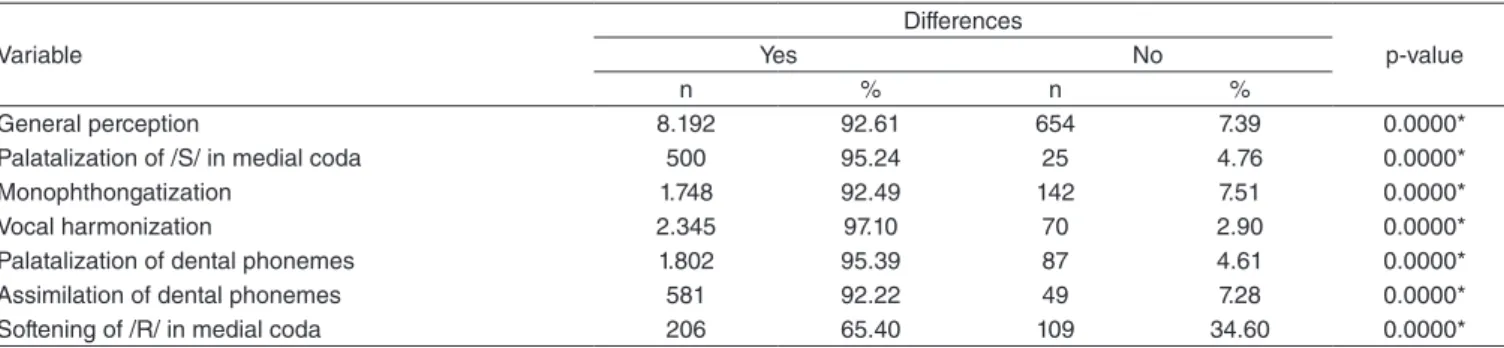
We observed that the listeners perceived differences between regional speech characteristics and the SA, both in general (p<0.0001) and for each linguistic variable studied (p<0.0001) (Table 1).
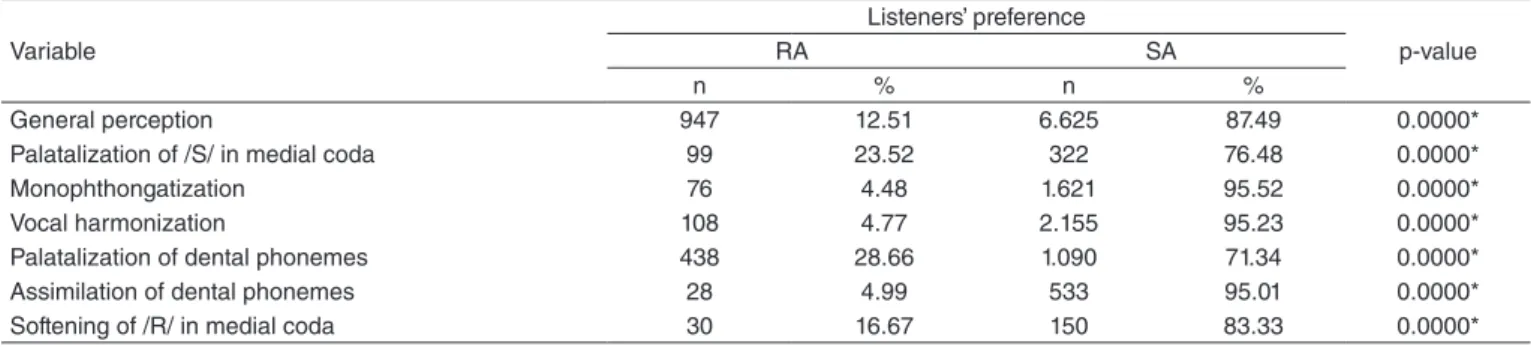
In this study, the listeners preferred the speech uttered without characteristics of RA, both in general (p<0.0001) and for each linguistic variable studied (p<0.0001) (Table 2).
The association between the listeners’ preferences (RA versus SA) and attitudes (positive, negative, and indifferent) in relation to the linguistic variables studied is displayed in Table 3. We found an association between the palataliza-tion of /S/ in medial coda (p<0.0001), monophthongizapalataliza-tion (p<0.0001), vocal harmonization (p<0.0001), palatalization of dental phonemes (p<0.0001), and assimilation of dental pho-nemes (p=0.0052), and the linguistic attitudes studied.
Table 1. Auditory perception of differences between the regional and softened accents in relation to the linguistic variables
Variable
Differences
p-value
Yes No
n % n %
General perception 8.192 92.61 654 7.39 0.0000*
Palatalization of /S/ in medial coda 500 95.24 25 4.76 0.0000*
Monophthongatization 1.748 92.49 142 7.51 0.0000*
Vocal harmonization 2.345 97.10 70 2.90 0.0000*
Palatalization of dental phonemes 1.802 95.39 87 4.61 0.0000*
Assimilation of dental phonemes 581 92.22 49 7.28 0.0000*
Softening of /R/ in medial coda 206 65.40 109 34.60 0.0000*
DISCUSSION
There are studies that evidence that, even without previous training, listeners are able to identify a speaker’s accent from short speech excerpts, to the extent of indicating his/her na-tive region and other social categories (profession, schooling, and economic situation), although they recognize the variants used in their region and surrounding areas more easily(6,7,11-18).
Other studies point that the listeners’ capability to catego-rize dialects correctly varied between 30 and 52% in tasks of compulsory choice among different dialects(15,19-21).
In this study, the listeners perceived the difference between the RA and SA in all linguistic variables studied (Table 1). This ability shows that the listeners have mental representations of the linguistic variables and of the different categories associated with them. The choices are not random, but based on cognitive categories of dialectal variation. Furthermore, individuals are able to determine whether or not a certain accent is particular to their region(5-7,14,15).
This indicates that listeners have expectations in relation to certain variants used by the speaker(22). They respond to a speech
stimulus based on references that are stored in their memory and associated to a speciic speaker that has a particular way of talking, always comparing the latter to the pattern expected for this type of speech.
This expectation is constructed through the listener’s ex-posure, over the years, to a standard of speech endorsed by television journalism, which contributed to the formation of a stereotype in relation to the speech of these professionals(22-24).
The fact that the speech without regional characteristics is preferred in a television news presenter indicates that the SA is one of the trademarks of this speciic type of speech.
One of the explanations for this is the fact that listeners have expectations and attribute values (positive or negative) in relation to certain variants used by the speaker. Speech percep-tion is inluenced and mediated by the listeners’ beliefs and attributions attached by them to a speciic speaker or group.
On the other hand, it is necessary to point out that this is a historical process in the sense that accent softening (and, some-times, neutralization) has been extremely valued in the speech of television news presenters. This, in turn, disseminates a standard of narration expected from them, either void of regional charac-teristics or softened. Consequently, local news programs have adopted these same “rules” for their reporters and presenters.
A style is precisely constructed through repetition, redun-dancy, and the speaker’s conscious or unconscious choice for stylistic resources. On the other hand, the recognition of a style is an exercise that involves contrasts. In regards to linguistic variation in television journalism, this style was created by the dissemination of a standard speech and by the incentive to accent softening in order to achieve success in this profes-sional category.
From the point of view of the listeners, when it comes to style, it is necessary to consider what is expected of each person or category (speech community). In general, speech accommo-dates this expectation in different contexts of communication. The use of speech with softened regional characteristics has become part of the style of oral communication constructed by
Table 3. Association between the listeners’ preference and attribution of attitudes to a presenter’s speech
Variable RA SA p-value
Positive Indifferent Negative Positive Indifferent Negative
Palatalization of /S/ in medial coda 379 112 202 1.076 512 666 0.0000*
Monophthongatization 240 99 41 5.639 1.567 899 0.0000*
Vocal harmonization 444 145 167 9.600 2.365 3.120 0.0000*
Palatalization of dental phonemes 2.585 294 187 5.426 1.043 1.161 0.0000*
Assimilation of dental phonemes 13 5 10 361 75 97 0.0052*
*Significant values p<0.05 – Fisher’s exact test
Caption: RA = regional accent; SA = softened accent
Table 2. Preference of the listeners in regards to the presence of regional or softened accent in the speech of television news program presenters in relation to different linguistic variables
Variable
Listeners’ preference
p-value
RA SA
n % n %
General perception 947 12.51 6.625 87.49 0.0000*
Palatalization of /S/ in medial coda 99 23.52 322 76.48 0.0000*
Monophthongatization 76 4.48 1.621 95.52 0.0000*
Vocal harmonization 108 4.77 2.155 95.23 0.0000*
Palatalization of dental phonemes 438 28.66 1.090 71.34 0.0000*
Assimilation of dental phonemes 28 4.99 533 95.01 0.0000*
Softening of /R/ in medial coda 30 16.67 150 83.33 0.0000*
*Significant values p<0.05 – proportion test.
reporters and presenters, and it carries a meaning capable of categorizing the group and the style.
The listeners’ expectations in regards to certain groups and styles form a lens through which a person’s attributes are interpreted and scrutinized. Although the interlocutors may go beyond the cognitive standard of stereotypes towards a more individualized impression, based on a person’s unique characteristics, stereotyped perceptions are much more common in daily relations.
One of the important conclusions we can draw is that this is a feedback system, considering that the choice for a certain variant continuously delineates and disseminates a speciic speech style, and, in turn, listeners create expectations in re-lation to this style, thus stimulating the permanence of these characteristics over time.
In summary, a listener may make his/her choice for the absence of regional characteristics in a presenter’s speech because he/she considers that these variables are stigmatized for a more formal type of speech, as in the case of a television news program. Or, simply, because he/she has expectations in relation to this speech style that perhaps involve the absence of these regional characteristics.
On the other hand, this “network-standard” of speech is propagated in television, thus generating in the spectator an impression about the way of speaking in television journalism and, consequently, an expectation about this speech.
The fact that the listeners attributed positive values to the presence of SA in the presenters’ speech (Table 2) evidences, once again, the expectation that television spectators have in relation to these professionals’ speech and the approval of certain speech characteristics in this context of communication.
Stereotypes have the role of shaping the cognitive processes involved in linguistic attitudes; in other words, they function as ilters, negative or positive, in the perceptions concerning an individual or group(10).
A study(24) demonstrated that speech perception was inluenced
by the expectations and attributions that listeners attached to speak-ers. The same synthesized vowel was perceived differently, depend-ing on where the listeners believed the speaker had come from.
Another study(25), which aimed at evaluating if the
com-municative situations interacted with the accent to determine the listeners’ judgment in relation to the speakers’ attributes, showed that the listeners’ attitudes varied according to the communicative context, even when speech characteristics were similar. This inding reinforces the fact that listeners have expectations in relation to the way of speaking of other individuals in speciic situations.
Therefore, the listeners’ judgment can be used to justify accent softening in the work of communication improvement conducted with journalists, given that their attitude is a response to speciic variants in speciic contexts, so that speakers tend to make use of what is more acceptable by interlocutors, especially in situations of professional communication.
Some studies(26-28) point that listeners generally evaluate
positively when there is a convergence between the expecta-tions they have in regards to an individual’s way of speaking and how the latter uses speech in communication.
Linguistic attitudes have a determining role in the modi-ications individuals make to the way they communicate(10,28).
For this reason, it is important for speech language pathologists and audiologists to be aware of television spectators’ linguistic attitudes in relation to the speech of television journalists, and to work with the latter’s communication skills and accents, thus improving the relations established between television journalists and the community through television.
The conduction of research using the judgment of listen-ers, both in regards to the perception of speech characteristics and to attitudes associated with these characteristics, aids in obtaining evidence about parameters that can be addressed when working with individuals in the context of professional communication with the purpose of reaching certain effects of meaning in speciic styles. In terms of dialectal variation (ac-cent), the studies in the ield of Speech Language Pathology and Audiology are few, especially in the context of communicative competence and of the development of individuals who utilize communication professionally.
The data collected in this study can make us relect about the real motivations behind the presence or absence of certain regional linguistic variants in television journalism. It would be simplistic to attribute this fact solely to linguistic prejudice. On the contrary, the main proposal of this study is to compre-hend the phenomenon studied based on style and the linguistic stereotypes associated with it, approaching the latter not in the negative sense of segregation and creation of dichotomies but in relation to what is expected of a certain speaker, inserted in a speciic context of communication and in a historical process.
We also realize that this is a fraction of reality in a speciic historical moment, so called post-modernity, in which individu-als have more opportunities for social and geographical change, and must, therefore, employ greater lexibility in communica-tion in order to achieve their goals. We can even afirm that, besides being vehicles of expressiveness, the stylistic variations that are part of post-modernity are also directed towards the market and consumption, if we consider the various situations of professional communication.
Thus, considering the high exchange of reporters and presenters between television networks and cities, the work of speech language pathologists and audiologists with linguistic variation in television journalism is focused on these indi-viduals’ professional development, in the sense that television spectators veriiably expect certain speech characteristics from this communication style. Therefore, considering social aspects and language variation, the work of speech language patholo-gists and audiolopatholo-gists alongside this public is guided towards the development of style and insertion in the job market, as well as toward the interlocutors, who have, as we have proved, expectations about their speech.
CONCLUSION
In addition, regarding the style of speech in television journalism, the occurrence of SA is associated with positive values related to the attitudes studied, except for the softening of /R/ in medial coda.
*LWL was responsible for data collection and analysis, and manuscript writing; ILBL collected data; EGS and LNAA were responsible for data collection and tabulation; AAFA revised the inal version of this article.
REFERENCES
1. Shannon CF, Weaver W. The mathematical theory of communication. Urbana: The University of Illinois Press; 1949.
2. Oliva MAA, Serrano MJ. Towards a comprehensive view of variation in language: the absolute variable. Lang Commun. 2012;32(1):80-94. 3. Campbell-Kibler K. The nature of sociolinguistic perception. Lang
Var Change. 2009;21:135-56.
4. Clopper CG, Bradlow AR. Perception of dialect variation in noise: intelligibility and classiication. Lang Speech. 2008;51(3):175-98. 5. Campbell-Kibler K. Accent, (ing), and the social logic of listener
perceptions. Am Speech. 2007;82(1):32-64.
6. Clopper CG, Pisoni DB. Effects of talker variability on perceptual learning of dialects. Lang Speech. 2004; 47(3):207-39.
7. Clopper CG, Pisoni DB. Some acoustic cues for the perceptual categorization of American English regional dialects. J Phon. 2004;32:111-40.
8. Clopper CG, Pisoni DB. The nationwide speech project: a new corpus of American English dialects. Speech Communication. 2006;48:633-44. 9. Al-Hindawe J. [Internet]. Considerations when constructing a semantic
differential scale. La Trobe Working Papers in Linguistic, Bundoora, 1996. [cited 2011 Feb. 3]. Available from: http://arrow.latrobe.edu. au:8080/vital/access/HandleResolver/1959.9/146207
10. Garret P. Attitudes to language. Cambridge: Cambridge University Press; 2010.
11. Kretzschmar Jr WA. Language variation and complex systems. Am Speech. 2010;85(3):263-86.
12. Clopper CG, Bradlow AR. Free classiication of American English dialects by native and non-native listeners. J Phon. 2009;37:436-51.
13. Fridland V. Regional differences in perceiving vowel tokens on Southerness, education, and pleasantness ratings. Lang Var Change. 2008;20(1):67-83.
14. Tamasi SL. Cognitive patterns of linguistic perceptions [Thesis]. Athens: University of Georgia; 2003.
15. Williams A, Garret P, Coupland N. Dialect recognition. In: Preston DR. Handbook of perceptual dialectology. Philadelphia: John Benjamins; 1999. p. 369-83.
16. Remez RE, Fellowes JM, Rubin PE. Talker identification based on phonetic information. J Exp Psychol Hum Percept Perform. 1997;23(3):651-66.
17. Preston DR. Perceptual dialectology: Nonlinguists’ views of areal linguistics. Providence: Foris; 1989.
18. Jacewicz E, Fox RA, O’Neill C, Salmons J. Articulation rate across dialect, age, and gender. Lang Var Change. 2009;21(2):233-56. 19. Munro MJ, Derwing TM, Burgess CS. Detection of nonnative speaker
status from content-masked speech. Speech Commun. 2010;52:626-37. 20. Van Bezooijen R, Gooskens C. Identiication of language varieties:
the contribution of different linguistic levels. J Lang Soc Psychol. 1999;18(1):31-48.
21. Van Bezooijen R, Ytsma J. Accents of Dutch: Personality impression, divergence, and identiiability. Belg J Ling. 1999;13:105-129.
22. Clopper CG, Pisoni DB. Perception of dialect variation: some implications for current research and theory in speech perception. Indiana: Indiana University; 2002.
23. Edwards J. Reining our understanding of language attitudes. J Lang Soc Psychol. 1999;18(1):101-10.
24. Kraljic T, Brennan SE, Samuel AG. Accommodating variation: dialects, idiolects, and speech processing. Cognition. 2008;107:54-81.
25. Heaton H, Nygaard LC. Charm or harm: effect of passage content on listener attitudes toward American English accents. J Lang Soc Psychol. 2011;30(2):202-11.
26. Nath LE. Expectation states: are formal words a status cue for competence? Current Research in Social Psychol. 2007;13:50-63. 27. Bourhis R, Giles H, Lambert W. Social consequences of accommodating
one’s style of speech. Int J Sociol Lange. 1973;6:55-72.