Neuropsychological profile of
Parkinson’s disease patients selected
for deep brain stimulation surgery
Flavia Amaral Machado1, Carlos Roberto Rieder1, Arlete Hilbig1, Caroline Tozzi Reppold1
ABSTRACT. Background: Parkinson’s disease (PD) shows symptoms involving motor and non-motor complications, including cognitive and behavioral changes, such changes might to contraindicate deep brain stimulation surgery (DBS). Objective: The aim of study was to investigate the neuropsychological profile of patients with PD in a waiting list for DBS. Methods: The neuropsychological evaluation was held in 30 patients of the ISCMPA Movement Disorders Clinic, with surgical indication based on the criteria of the responsible neurologists, in the period of 12 months. Instruments used: MMSE, FAB, MoCA, BDI, Semantic Verbal Fluency, PDQ-39, PDSS; and the UPDRS and Hoehn-Yahr scale. Results: The patients were mostly male (66.7%) with a mean age of 59.37 (SD 10.60) and disease duration 9.33 (SD 4.08). There was cognitive impairment in 56.7% of patients by FAB and 76.7% by MoCA. Conclusion: Even in the earliest stages of the disease, there is the incidence of non-motor symptoms, especially in those subjects who had an early onset of the disease.
Key words: neuropsychology, Parkinson’s disease, neurosurgery, deep brain stimulation.
PERFIL NEUROPSICOLÓGICO DO PACIENTE COM DOENÇA DE PARKINSON SELECIONADO PARA CIRURGIA DE ESTIMULAÇÃO CEREBRAL PROFUNDA
RESUMO. Embasamento: A doença de Parkinson (DP) apresenta sintomas que envolvem complicações motoras e não-motoras, entre elas alterações cognitivas e comportamentais, tais alterações podem contraindicar a cirurgia de estimulação cerebral profunda (DBS). Objetivo: O objetivo de estudo foi verificar o perfil neuropsicológico dos pacientes com DP candidatos à DBS. Métodos: Realizou-se avaliação neuropsicológica em 30 pacientes do ambulatório de Distúrbios do Movimento da ISCMPA, com indicação cirúrgica segundo critério dos neurologistas responsáveis, no período de 12 meses. Os instrumentos utilizados: MEEM, FAB, MoCA, BDI, FV Semântica, PDQ-39, PDSS; e as escalas UPDRS e Hoehn-Yahr. Resultados: Os pacientes foram, em sua maioria, homens (66,7%), com média de idade de 59,37 (DP 10,6) e tempo de doença 9,33 (DP 4,0). Apresentaram comprometimento cognitivo em 56,7% dos pacientes segundo os escores do FAB e 76,7% segundo o MoCA. Conclusão: Mesmo em fases mais iniciais da doença, percebe-se a incidência de sintomas não motores, principalmente naqueles sujeitos que tiveram um início de doença precoce da doença. Palavras-chave: neuropsicologia, doença de Parkinson, estimulação cerebral profunda.
INTRODUCTION
P
arkinson’s disease is a movement dis-order characterized by its main motor symptoms: bradykinesia, rigidity, resting tremor and postural instability.1 However, itis essential to emphasize that PD is consid-ered a systemic disease and thus presents a variety of non-motor symptoms involving
aspects such as memory loss, language/verbal luency changes and executive function and visual-spatial ability deicits, among others. hese cognitive and behavioral impairments negatively impact patient quality of life, can complicate treatment and represent signs of poor prognosis.2
Recommended treatments include
sur-This study was conducted at theUniversidade Federal de Ciências da Saude de Porto Alegre, Porto Alegre, RS Brazil.
1Universidade Federal de Ciências da Saude de Porto Alegre, Porto Alegre, RS Brazil.
Flavia Amaral Machado. Universidade Federal de Ciências da Saude de Porto Alegre – Rua Sarmento Leite, 245 / sala 117 / anexo II – 90050-170 Porto Alegre RS – Brazil. E-mail: [email protected]
Disclosure: The authors report no conflicts of interest.
Received July 06, 2016. Accepted in final form October 18, 2016.
gery, in which one of the techniques used is deep brain stimulation (DBS), available through the Brazilian pub-lic health system and considered a good alternative in refractory cases. In addition to improving the cardinal motor symptoms of PD, DBS surgery reduces the com-plications that accompany dopaminergic therapies, such as motor luctuations and dyskinesia.3,4 Indication is
thorough and includes an established PD diagnosis for at least ive years; absence of severe cognitive impair-ment or deimpair-mentia; absence of other comorbidities; and response to preoperative levodopa, which is considered a good prognosis for postoperative outcomes.5,6
he purpose of this procedure is to implant a deep brain stimulator to control motor symptoms. his approach has shown good results in managing motor complications of the disease. However, the efects of DBS on non-motor symptoms (mainly cognition and psychological functioning) are inconsistent.7
Several publications have provided recommenda-tions for surgical indication in PD 5,7,8 and debated the
early indication of DBS to beneit patients before they develop non-motor complications, especially cogni-tive impairment that contraindicates the procedure. In addition, some studies have assessed the non-motor areas involved in PD, where the most frequent cogni-tive aspects are execucogni-tive function, memory, language, and visuo-spatial skills.2,4,9 hese symptoms negatively
impact quality of life and may contraindicate DBS treat-ment, and early identiication is therefore important to allow necessary time for rehabilitation before the sur-gery. hese aspects are assessed using screening tests, such as the Mini-Mental State Examination (MMSE), and complemented by speciic tests that examine difer-ent compondifer-ents of cognitive ability, including executive function, memory, attention, and verbal luency.10,11
Given the importance of conducting neuropsycho-logical assessments in PD patients who are candidates for DBS surgery, the primary objective of this study was to determine the neuropsychological proiles (NP) of patients treated at the outpatient movement disor-der clinic of the ISCMPA and to explore the association between neuropsychological scores and age at onset of disease, disease duration, degree of motor involvement, quality of life, sleep quality and other variables.
METHODS
A cross-sectional study was conducted. All literate Parkinson’s patients receiving treatment at the Move-ment Disorder Clinic of the ISCMPA in Porto Alegre between August 2013 and August 2014 were asked to participate in the research project. he inclusion criteria
encompassed PD patients who had initially been ruled out for dementia diagnosis through an MMSE assess-ment using mean scores adjusted by educational level: 25 points for individuals with 1-4 years of education; 26.5 points for 5-8 years; 28 points for 9-11 years; and 29 points for more than 11 years of education.12 he
sample comprised 30 PD patients being followed at the same outpatient clinic, awaiting DBS surgery, previously screened by the neurology department. All patients were assessed during the “on” phase of medication.
Instruments. All instruments were used according to the
Movement Disorders Society (MDS) recommendations and can be described as follows:
Montreal Cognitive Assessment (MoCA):13 his
instrument assesses eight diferent cognitive domains. Included in the set of items that constitute this tool are ive of the six tasks most frequently used to screen for dementia. he Brazilian version of the MoCA is a valid and reliable instrument for screening for mild cogni-tive impairment among older individuals, validated by Memoria, 2012.14
Frontal Assessment Battery (FAB): his is a screening
tool to assess frontal executive functions (both executive and motor components) in a single instrument. he test has good psychometric properties and construct/criteria validity, according to a study by De Paula, 2013.15
Beck Depression Inventory (BDI):16A self-assessment
measurement of mood widely used in both research and clinical settings. he depression intensity classiication has the following range : minimal depression (0-9), mild depression (10-16), moderate depression (17-29) and severe depression (30-63). Validated in Brazil by Cunha, 2001.
Verbal Fluency Test (Semantic Category):17Checks for
the existence of semantic memory loss and impairment of search strategies related to executive function. he test was validated for the Brazilian population by Brucki, 2004.
Parkinson’s Disease Questionnaire-39 (PDQ-39):18his
has been indicated as the most appropriate instrument for assessing the QoL of PD patients and is suiciently robust to be used in trans-cultural studies. It assesses eight diferent domains: mobility, daily activities, emo-tional well-being, stigma, social support, cognition, communication and bodily discomfort. It was adapted to Brazilian Portuguese by the Health Services Research Unit (Department of Public Health and Primary Care - University of Oxford) in 2005.
Parkinson’s Disease Sleep Scale (PDSS):19 his is a
com-monly associated with PD. he instrument has been translated and validated internationally and its valida-tion was performed in Brazil by Margis, 2010.
Uniied Parkinson’s Disease Rating Scale revised by the Movement Disorder Society (UPDRS- MDS/2008): he UPDRS was created in 1987, revised and expanded in 2008, where the UPDRS- MDS/2008 has demonstrated high consistency both internally and correlated with the original UPDRS (ρ=0.96).20 It is a gold-standard tool for
assessing the disease’s symptoms as well as its impair-ments in research and clinical environimpair-ments.
Hoehn and Yahr Scale of Degree of Disability:21his
scale was developed in 1967. It is fast and practical for indicating a patient’s general state. A modiied version of the H&Y scale was developed more recently to include intermediate stages, and was used in this study. he H&Y scale is widely used and accepted for assessing the stages of PD.
Procedures. Patients who met the inclusion criteria were
invited to participate in the study after consulting with a neurologist at the outpatient clinic. Neuropsycho-logical data was collected at the ISCMPA Movement Disorder Clinic in a single session. All patients were assessed in the morning while they were in their optimal “on” state. he tests were performed in a spiraled order to avoid response bias and applied by researchers from the research group who had been previously trained for this assessment. he assessments performed indicated the neuropsychological proiles of the clinic patients and enabled the professionals involved to monitor the clinical evolution and surgical indication for each case. All individuals who participated in the study signed an informed consent form developed according to the criteria of the Research Ethics Committees of the UFCSPA and ISCMPA, where the research project was approved under CAAE 17123013.6.0000.5335.
Statistical analysis. Descriptive and inferential statistical
analyses were performed to characterize the sample. he descriptive analyses were expressed as mean, standard deviation (SD) and absolute and relative frequencies. he tests that had normal distributions were analyzed using Pearson’s correlation and results expressed as mean (SD). Data with non-normal distributions were analyzed using Spearman’s correlation and their results were expressed as median (25th and 75th percentiles).
he Correlation Tests were used because the aim of the coeicient is to identify the correlation between the two variables. To compare means, the t-test was used to assess whether or not characteristic symptoms of
that dimension were present. he SPSS v.21.0 statis-tical program was employed and the signiicance level for all tests was p≤0.05.
RESULTS
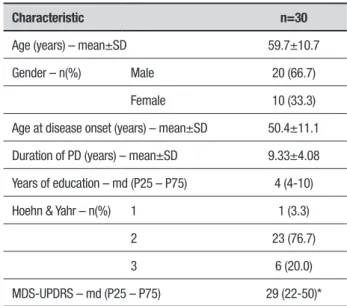
hirty PD patients were assessed at the ISCMPA Move-ment Disorder Clinic: 20 males (66.7%) and 10 females (33.3%) aged 28-77 years. Other sample characteristics are shown in Table 1.
Among the disease’s leading symptom, tremor was the most frequent (80% of the cases) while rigidity or bradykinesia were reported in 20% of the cases. Resting tremor was reported as a current symptom by 53.3% of the patients while rigidity or bradykinesia were reported by 46.7%. he mean staging of the disease using the H&Y scale was 2.17 (SD 0.46), with scores ranging from 1 to 3 (mild to moderate).
Section III of the MDS-UPDRS was concluded by 26 of the 30 patients and the median score for the 26 assessed patients was 29 points (25th to 75th percentiles:
22 to 50).
On a scale ranging from 0 to 100, the median (mean of 35.33%, SD 17.06) quality of life perceived by the patients was 31.5 (21.5 to 46.5) with highest scores related to mobility (23%) and ADL (28%) domains, indicating greater discomfort in these aspects. Mean perceived sleep was 99.3 (SD 31.11) on a scale ranging from 0 to 150, indicating moderate-to-good sleep.
Frequency and severity of symptoms on the neuro-psychological tests revealed impairment of frontal func-tions in 56.7% of the patients as measured by the FAB
Table 1. Sample characteristics.
Characteristic n=30
Age (years) – mean±SD 59.7±10.7
Gender – n(%) Male 20 (66.7)
Female 10 (33.3)
Age at disease onset (years) – mean±SD 50.4±11.1
Duration of PD (years) – mean±SD 9.33±4.08
Years of education – md (P25 – P75) 4 (4-10)
Hoehn & Yahr – n(%) 1 1 (3.3)
2 23 (76.7)
3 6 (20.0)
MDS-UPDRS – md (P25 – P75) 29 (22-50)*
and cognitive deicits in 76.7% of the patients on the MoCA. he patients exhibited low semantic verbal lu-ency on BDI scores in 30% of cases. On the mood assess-ments, 53.3% of the patients had no depression or had minimal depression, while 30% had mild-to-moderate depression, 13.3% had moderate-to-severe depression and 3.3% had severe depression. Data for each sub-item are shown in Table 2.
Table 2. Cognitive assessment.
Cognitive aspects n=30
FAB – mean±SD
Conceptualization (0-3) 2.5±0.6
Mental Flexibility (0-3) 2.0±0.9
Motor Programming (0-3) 2.7±0.5
Sensitivity to Interference (0-3) 1.9±0.9
Inhibitory Control (0-3) 1.6±1.1
Environmental Autonomy (0-3) 2.8±0.4
Total 13.6±3.4
FAB Classification – n(%)
<16 (with cognitive impairment) 17 (56.7)
≥16 (without cognitive impairment) 13 (43.3)
MoCA – mean±SD
Visuospatial/Executive Function (0-5) 2.3±1.5
Naming (0-3) 2.7±0.7
Attention (0-6) 4.6±1.6
Language (0-3) 1.5±0.9
Abstraction (0-2) 1.2±0.6
Delayed Recall (0-5) 2.6±1.4
Orientation (0-6) 5.9±0.3
Total 22.0±4.8
MoCA Classification – n(%)
<26 (with cognitive impairment) 23 (76.7)
≥26 (without cognitive impairment) 7 (23.3)
Semantic VF – mean±SD 12.0±4.3
Semantic VF Classification – n(%)
Low fluency 9 (30.0)
Normal fluency 21 (70.0)
SD: standard deviation; n: sample sizer; FAB: Frontal Assessment Battery; MoCA: Montreal Cognitive Assessment; VF: Verbal fluency.
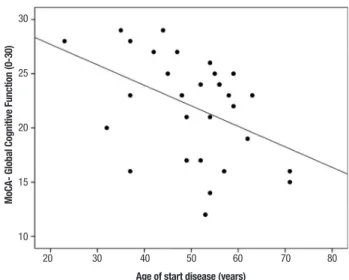
he correlation between age at disease onset and neuropsychological assessment scores showed sta-tistically signiicant results on the FAB tests for total score (r=–0.463, p≤0.01) and for the sub-items related to phonemic verbal luency (r=–0.511, p≤0.00), motor programming (r=–0.404, p≤0.02) and inhibitory control (r=–0.429, p≤0.01). Similarly, a signiicant correlation was detected between the variables cited above on the results for the MoCA total score (r=–0.437, p≤0.01) and its sub-items related to executive and visuo-spatial func-tions (r=–0.435, p≤0.01), as well as for semantic verbal luency score (r=–0.505, p≤ 0.00).
he disease duration and staging only showed sig-niicant results for the MoCA naming sub-item, with r=–0.469, p≤ 0.00 for duration and rs= –0.584, p≤0.00
30
25
20
15
10
MoC
A- Global Cognitive Function (0-30)
20 30 40 50 60 70 80
Age of start disease (years)
Figure 1. Correlation between total score on the Montreal Cognitive Assessment (MoCa) and age at disease onset (years).
17.5
15
12.5
10
7.5
5
FAB (0-18)
20 30 40 50 60 70 80
Age of start disease (years)
for severity on the H&Y scale. he quality of life ques-tionnaire mobility domain showed a negative correla-tion with total FAB (rs= –0.393, p≤0.03), the FAB
inhibi-tory control sub-item (rs= –0.395, p≤0.03), total MoCA
(rs= –0.448, p≤0.01) and the MoCA attention sub-item
(rs= –0.509, p≤0.00). In the stigma domain, there was a
correlation with the FAB motor programming sub-item (rs= –0.424, p≤0.02). For the communication domain,
there was a correlation with the MoCA executive and visual-spatial functions sub-item (rs= –0.363, p≤0.04).
he analysis included assessment of correlations between MoCA (inal score) and age (rs= –0.553, p≤0.00)
or education level (rs= –0.602, p≤0.00); FAB (inal score)
and age (rs= –0.545, p≤0.00) or education level (rs=
–0.452, p≤0.01).
As expected, all of the results described above dem-onstrate a moderately strong correlation among the variables. Correlations between NP indings and sleep quality, current rigid or tremor symptom, or initial tremor symptom were not statistically signiicant.
DISCUSSION
DBS surgery is indicated in speciic cases and can beneit a small percentage of PD patients. Many studies have shown that this type of surgical treatment can signii-cantly improve the motor condition of individuals with luctuations and dyskinesias.8,22,23
Selection criteria include: an established PD diagno-sis for at least ive years; motor complications; unsat-isfactory control or intolerance to drug treatment; age (since younger patients and those with the disease for less time show the most beneicial efects); and absence of dementia and severe depression.6,24 he subjects who
comprised this study’s sample had demographic charac-teristics that were compatible with these criteria. hey were patients in the initial stages of the disease, as shown by the H&Y scale; they had motor symptoms that impaired their mobility and daily activities, as evidenced by the PDQ-39; and most of the group had minimal or no depression.
However, over half of the patients assessed had cog-nitive symptoms (on both the FAB and the MoCA). he MoCA scores indicated cognitive impairment in 76.7% of the subjects. he most afected constructs were related to executive functions, supporting the indings of international studies25,26 in which persons with PD
had impaired executive functions even in the initial stages of the disease. In the Elgh, 2009 study, 30% of the subjects had cognitive deicits in the executive func-tion domain and 16% had impairments in two or more domains. All of these patients were at the initial stage
of the disease.25 Regarding Brazil, Campos-Souza
com-pared PD patients with subjects without the disease. he results showed worse performance for the experimen-tal group compared to the control group. On the Stroop test for inhibitory control, the control group had a mean score of 35.83 compared to 24.2 for the PD1 group. For visual-spatial construction, the control group had an average score of 30.84 while the PD2 group scored 26.2, as measured by the Rey Complex Figure Test. Results on the Wisconsin Card Sorting Test showed statistically sig-niicant diferences between the group mean scores for cognitive lexibility (CG= 27.50, PD1= 46.57 and PD2= 44.14). Nevertheless, few Brazilian studies have inves-tigated PD executive dysfunctions.27
It has been suggested that executive performance depends on the integrity of the prefrontal cortex and other related structures. Individuals with PD have less deactivation of the cortex and have shown an inverse pattern of activation and deactivation, accounting for their poor functioning speciically during executive function tasks. PD patients had low scores for atten-tion and inhibitory control (which are included in these functions) especially on the FAB, which measures com-petency in prioritizing a given item among a large num-ber of simultaneous stimuli. hese attention processes assist, enhance or inhibit other neuropsychological processes (such as memory, perception and language) to enable a task to be performed efectively.28
he fact that this study’s results showed such a high percentage of cognitive dysfunction points to the need for comprehensive and thorough assessments in the preoperative period because subjects screened for surgi-cal assessment using tools such as the MMSE may pres-ent impairmpres-ent in executive functions, language and memory that are not detected by the test. In addition, interventions can be introduced to maintain or improve this situation—namely neuropsychological rehabilita-tion and training tasks, which have only been studied recently and have received little attention nationally.29
it remains unclear whether this deicit is a predictor of dementia in the postoperative period.
It is currently being discussed whether to bring for-ward the time window for indicating DBS surgery in order to target younger patients with earlier disease onset and less time with the disease. he main goal would be to maintain the patient’s quality of life before motor and cognitive complications interfere with social aspects and activities of daily living or even contraindi-cate the surgery (in cases of cognitive impairment).5,30
One limitation of this study is the small number of sub-jects comprising the sample, as the surgical indication is meticulous and includes speciic cases. Another limita-tion is the absence of a control group matched for age and time with PD. his control pairing was considered but deemed unfeasible. he small sample and mild or moderate cases hamper grouping because only a few cases would be allocated to each group. his precludes comparison of means or logistic regression.
In conclusion, in recent years, interest in PD’s non-motor symptoms has been evidenced by a growing body of research on the subject. With speciic regard to neuropsychological factors, questions remain about which domains are most afected, whether there are better prognosis predictors and what efect DBS has on cognitive symptoms. In this context, the present study contributes to expanding results based on scientiic evidence.
Furthermore, this study has described the neuropsy-chological proile of patients who are candidates for DBS surgery, allowing clinical staf to assess the best clinical procedure to treat the disease in the pre-surgical period. his information will also serve as a control for moni-toring disease evolution and cognitive deterioration. his information is especially relevant for patients who will undergo the surgical procedure, as they will have a baseline against which to assess their postoperative condition.
Finally, this study points to the relevance of inves-tigating PD’s non-motor (especially cognitive) aspects and we propose a discussion of rehabilitation strategies linked to the indication of surgery at the most bene-icial time for the patient. his assessment should be expanded to other movement disorder centers using the control group as a basis for comparing neuropsychologi-cal indings.
Author contributions. All authors have contributed
signii-cantly and are in agreement with the content of the manuscript.
Acknowledgements. his study was supported in part by
the Conselho Nacional de Desenvolvimento CientÍico e Tecnológico (CNPq) and Coordenação de Aperfeiçoa-mento de Pessoal de Nível Superior (CAPES). here are no conlicts of interest.
REFERENCES
1. Jankovic J, Tolosa E (Eds). Parkinson’s disease and movement disor-ders. Lippincott Williams & Wilkins, 2007.
2. Muslimović D, Post B, Speelman JD, De Haan RJ, Schmand B. Cogni-tive decline in Parkinson’s disease: a prospecCogni-tive longitudinal study. J Int Neuropsychol Soc. 2009;15(3):426-37.
3. Silberman CD, Laks J, Rodrigues CS, Engelhardt E. The impact of depression on survival of Parkinson’s disease patients: a five-year study. J Bras Psiquiatr. 2013;62(10):8-12.
4. Tedrus GMA, Fonseca, LC, Letro, GH, Bossoni, AS, Samara, AB. Dementia and mild cognitive impairment in patients with Parkinson’s disease. Arq Neuropsiquiatr. 2009;67(2b):423-27.
5. Deuschl G, Schüpbach M, Knudsen K, Pinsker M, Cornu P, Rau J, et al. Stimulation of the subthalamic nucleus at an earlier disease stage of Parkinson’s disease: Concept and standards of the EARLYSTIM-study. Parkinsonism Relat Disord. 2013;19:56-61.
6. Tosta ED, Rieder CRM, Borges V, Neto CY e col. Doença de Parkinson: Recomendações. Academia Brasileira de Neurologia, 1ª ed. São Paulo; 2010.
7. Zahodne LB, Okun M S, Foote KD, Fernandez HH, Rodriguez RL, Wu SS, et al. Greater improvement in quality of life following unilateral deep brain stimulation surgery in the globus pallidus as compared to the subthalamic nucleus. J Neurol. 2009;256 (8):1321-9.
8. Machado FA, Reppold CT. The effect of deep brain stimulation on motor and cognitive symptoms of Parkinson’s disease: a literature review. Dement. Neuropsychol. 2015;9(1):24-31.
9. Janvin C, Aarsland D, Larsen JP, Hugdahl K. Neuropsychological Profile of Patients with Parkinson’s Disease without Dementia. Dement Geriatr Cogn Disord. 2003;15:126-31.
10. Sobreira E, Pena-Pereira MA, Eckeli AL, Sobreira-Neto MA, Chagas MH, Foss MP, et al. Screening of cognitive impairment in patients with Parkin-son’s disease: diagnostic validity of the Brazilian versions of the Montreal Cognitive Assessment and the Addenbrooke’s Cognitive Examination-Revised. Arq Neuropsiquiatr. 2015;73(11):929-33.
11. Beato R, Amaral-Carvalho V, Guimarães HC, Tumas V, Souza CP, Oliveira GN, Caramelli P. Frontal assessment battery in a Brazilian sample of healthy controls: normative data. Arq Neuropsiquiatr. 2012;70(4):278-80. 12. Brucki SM, Nitrini R, Caramelli P, Bertolucci PH, Okamoto IH. Sugges-tions for utilization of the minimental state examination in Brazil. Arq Neuropsiquiatr. 2003;61:777-81.
13. Memoria CM, Yassuda MS, Nakano EY, Forlenza OV. Brief Screening for Mild Cognitive Impartment: Validation of the Brazilian version of the Montreal Cognitive Assessment. Int J Geriatr Psychiatry. 2013; 28(1):34-40.
14. Dubois B, Slachevsky A, Litvan I, Pillon B. The FAB: a frontal as sessment battery at bedside. Neurology. 2000;55:1621-6.
15. de Paula JJ, Moura SM, Bocardi MB, Moraes EN, Malloy-Diniz LF, Haase VG. Screening for executive dysfunction with the Frontal Assessment Battery: psychometric properties analysis and representative normative data for Brazilian older adults. Psicol Pesq. 2013;7(1):89-98. 16. Cunha, JA. Manual da versão em português das Escalas Beck. São
Paulo: Casa do Psicólogo; 2001.
17. Brucki SMD, Rocha, MSG. Category fluency test: effects of age, gender and education on total scores, clustering and switching in Brazilian Portuguese-speaking subjects. Braz J Med Biol Res. 2004;37(12): 1771-7.
ocupa-cional na doença de Parkinson. In: Barros ALS, Costa EG, Costa MLG, Medeiros JS (editores). Doença de Parkinson: uma visão multidisciplinar. São José dos Campos: Pulso Editorial; 2006:115-128.
19. Margis R, Donis KC, Schonwald SV, Rieder CR. WHOQOL-OLD assess-ment of quality of life in elderly patients with Parkinson’s disease:influence of sleep and depressive symptoms. Rev Bras Psiquiatr. 2010;32(2): 125-31.
20. Fanh S, Elton RL and members of the UPDRS Development Committee. Unified Parkinson’s Disease Rating Scale. In: Fahn S, Marsden CD, Calne D, Goldstein M. Recent developments in Parkinson’s disease. Florham Park [NJ, USA]: Macmillan Healthcare Information;1987:153-63. 21. Hoehn MM, Yahr MD. Parkinsonism: onset, progression, and mortality.
(1967). Neurology. 1998;50(2):318-34.
22. Deuschl G, Schade-Brittinger C, Krack P, Volkmann J, Schafer H, Botzel K, et al. A randomized trial of deep-brain stimulation for Parkinson’s disease. N Engl J Med. 2006;355(9):896-908.
23. Weaver FM, Follett K, Stern M, Hur K, Harris C, Marks Jr WJ, et al. Bilateral deep brain stimulation versus best medical therapy for patients with advanced Parkinson disease: a randomized clinical trial. JAMA. 2009;301:63-73.
24. Saint-Cyr JA, Albanese A. STN DBS in PD: selection criteria for surgery should include cognitive and psychiatric factors. Neurology. 2006; 66(12):1799-1800.
25. Elgh E, Domellöf M, Linder J, Edström M, Stenlund H, Forsgren L. Cognitive function in early Parkinson’s disease: a population-based study. Eur J Neurol. 2009;16(12):1278-84.
26. van Eimeren T, Monchi O, Ballanger B, Strafella AP. Dysfunction of the default mode network in Parkinson disease: a functional magnetic reso-nance imaging study. Arch Neurol. 2009;66(7):877-83.
27. Campos-Souza IS, Campos-Sousa RN, Ataíde Jr L, Soares MMDB, Almeida KJ. Executive dysfunction and motor symptoms in Parkinson’s disease. Arquivos Neuropsiquiatr. 2010;68 (2):246-51.
28. Diamond A. Executive functions. Annu Rev Psychol. 2013;64:135-68. 29. Simon SS, de Oliveira Ribeiro, MP. Comprometimento cognitivo leve e
reabilitação neuropsicológica: uma revisão bibliográfica. Psic Rev São Paulo. 2011;20(1):93-122.