Artigo Original
Danielle de Lima e Melo1 Roberta Viviane Moreira Santos1 Tatiana Vargas de Castro Perilo2 Helena Maria Gonçalves Becker3, Andréa Rodrigues Motta4
Keywords
Speech Language and Hearing Sciences Health evaluation Mouth breathing Nasal obstruction Respiration
Descritores
Fonoaudiologia Avaliação em saúde Respiração bucal Obstrução nasal Respiração
Correspondence address:
Tatiana Vargas de Castro Perilo Av. Ressaca, 172/201, Coração Eu-carístico, Belo Horizonte (MG), Brasil, CEP: 30535-540.
E-mail: [email protected]
Received: 03/27/2012
Accepted: 02/18/2013
Study out at the Outpatient Service for Mouth Breathing, Universidade Federal de Minas Gerais – UFMG – Belo Horizonte (MG), Brazil.
(1) Universidade Federal de Minas Gerais – UFMG – Belo Horizonte (MG), Brazil.
(2) Post-Graduation (PhD) em Mechanical Engineering, Universidade Federal de Minas Gerais – UFMG – Belo Horizonte (MG), Brazil.
(3) Department of Ophthalmology and Otolaryngology, Universidade Federal de Minas Gerais – UFMG – Belo Horizonte (MG), Brazil.
(4) Department of Speech Therapy, Universidade Federal de Minas Gerais – UFMG – Belo Horizonte (MG), Brazil.
Conlict of interest: nothing to declare.
peak nasal inspiratory low
Avaliação do respirador oral: uso do espelho de Glatzel e do
peak nasal inspiratory low
ABSTRACT
Purpose: Purpose: To compare the use of the Glatzel mirror and peak nasal inspiratory low in the evaluation of mouth-breathing participants and to analyze the correlation between these instruments. Methods: Sixty-four children were evaluated — 32 mouth breathers and 32 nasal breathers; the children were aged 4 to 12 years. The mouth breathers were subdivided according to the cause of obstruction by a multidisciplinary team. The Glatzel mirror and peak nasal inspiratory low were used in both groups to evaluate patency and nasal airlow. Data were then subjected for statistical analysis. Results: The Glatzel mirror allowed us to differentiate the breathing mode considering gender, age, weight, height, and body mass index, but it did not help in identifying the cause of mouth breathing. The peak nasal inspiratory low did not allow differentiation of the breathing mode and identiication of the cause of mouth breathing. In our sample, there was no correlation between the instruments used. Conclusion: The Glatzel mirror was reliable in identifying participants with and without nasal obstruction, although it was not possible to differentiate subgroups of mouth breathers using this instrument. The peak nasal inspiratory low showed differences only between nasal breathers and surgical mouth breathers. Low correlation was found between these two instruments.
RESUMO
Objetivo: Comparar o uso do espelho de Glatzel e do peak nasal inspiratory low na avaliação de indivíduos respiradores orais, bem como analisar a correlação dos dois instrumentos. Métodos: Foram avaliadas 64 crianças, sendo 32 respiradoras orais e 32 respiradoras nasais, na faixa etária de 4 a 12 anos. Os respiradores orais, diagnosticados de acordo com equipe multiproissional, foram subdivididos de acordo com a causa da obstrução. Foram utilizados o espelho de Glatzel e o peak nasal inspiratory low nos dois grupos para avaliação da permeabilidade e luxo aéreo nasal. Os dados foram submetidos à análise estatística. Resultados: O espelho de Glatzel diferenciou o modo respiratório considerando-se os estratos gênero, faixa etária, peso, altura e índice de massa corporal da amostra. Entretanto, não foi capaz de dar indícios sobre a causa da respiração oral. Com o uso do peak nasal inspiratory low, não foi possível diferenciar o modo respiratório e tampouco a causa da respiração oral. Na amostra pesquisada, não houve correlação entre os instrumentos utilizados.
InTRODUCTIOn
Mouth breathing may bring many health problems such as changes in orofacial muscle tone, occlusal changes, chewing and swallowing pattern deviations, speech disorders, sleep disorders, learning disabilities, among others(1).
Good patient assessment and, thus, good diagnosis precede an effective speech therapy. Many professionals are responsible for assessment and treatment of mouth breathing patients, but the otolaryngologist is concerned with the deinition of the triggering factors of changes in the breathing pattern. However, many patients relying on the Brazilian Public Health System (SUS) have to wait long times for an opportunity to consult an otolaryngologist and to go through exams that can diagnose the causes of mouth breathing(2).
It is important that the speech therapist hold assessment tools that can identify possible nasal obstructions, thus dein-ing management and prognosis based on evidence(2);so the use of easy-to-manipulate, simple, and cheap, but accurate, instrument is necessary. Nowadays, different tools are used to assess nasal patency and resistance. The Glatzel Mirror (GM) is used in clinical practice to assess breathing mode, measuring the nasal airlow by condensation of the expired air, which helps in the identiication of nasal obstruction causes(3-7). The literature lacks studies on the validation of this method, so one can question the reliability of the measures it provides.
The peak nasal inspiratory low (PNIF) is another instrument that can aid in the detection of nasal obstruction causes(8-11), composed of a face mask attached to a graded low meter that measures the nasal airlow at forced inspiration(12). Both instru-ments are currently available in the market and can be easily acquired by Speech Therapists. It must be underscored that all instruments must be used in compliance with the manufacturer’s orientation and that the professional should be familiar with all beneits and contraindications related to their use.
Considering the high prevalence of mouth-breathing patients, the consequences of such disorder, and need for an effective evaluation, this study aims to compare the use of the GM and PNIF to assess these patients and to analyze the cor-relation of both instruments.
METHODS
The research project was approved by the Ethics Committee of four institutions, with protocol number 541/09, and all participants had to sign the informed consent form. This was a cross-sectional descriptive study conducted with a conve-nience sample comprising participants from an outpatient clinic for mouth-breathing patients and from Elementary and Middle schools of Belo Horizonte. The above-mentioned outpatient clinics admits 2- to 12-year-old children, but only those diagnosed with mouth breathing are followed-up by an interdisciplinary team comprised of otolaryngologists, aller-gists, orthodontists, and a speech therapist. All children were submitted to skin prick testing and nasoibroscopy.
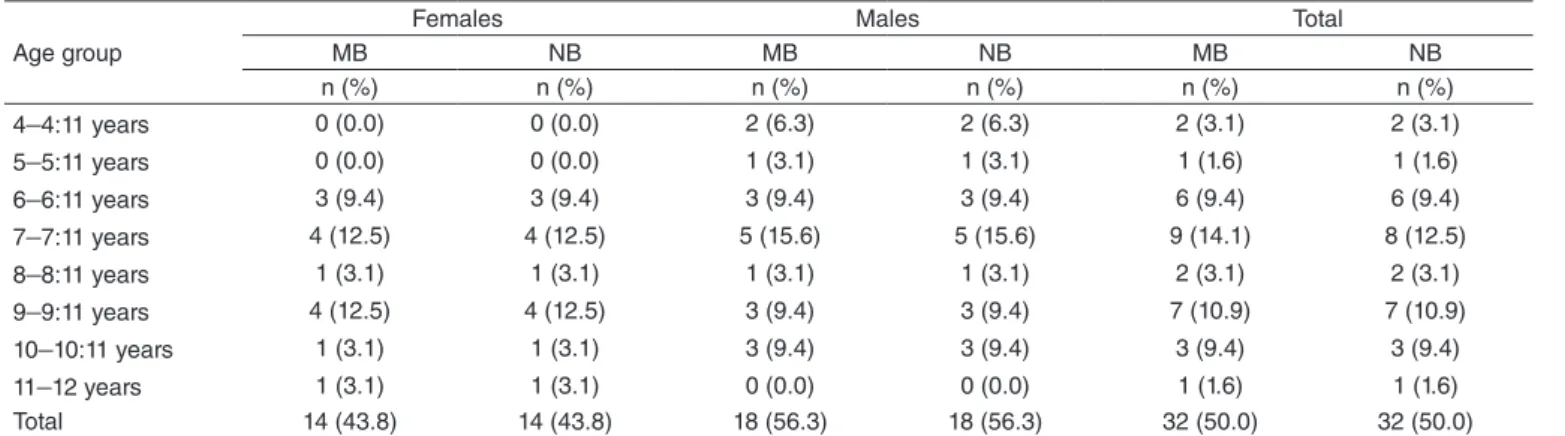
Sixty-four individuals of both genders and aging from 4 to 12 years were assessed, of which 32 were mouth-breathing patients (MB — case group) and 32 were nasal-breathing pa-tients (NB — control group). Panasal-breathing pa-tients were divided by gender, age, weight, and height in groups, for these are important variables for PNIF(2). Mouth-breathing patients were divided into four subgroups by cause of nasal obstruction — allergy, surgery, allergy-surgery, and function — after being classiied by an otolaryngologist and an allergist. This characterization is summarized in Table 1.
Inclusion criteria for the MB Group were patients from the outpatient clinics of the institution and, therefore, diagnosed by different professionals with mouth breathing. Inclusion criteria for the NB Group were children without complaint or evidence of nasal obstruction according to speech therapist evaluation(13), anamnesis and parents’ interview(14). Participants whose care-givers did not sign the informed consent form were excluded from both groups, as well as those who reported chronic use of nasal decongestants in the past 3 months, clinical picture of air-way infection upon anamnesis, chronic obstructive pulmonary disease, cardiovascular disorders, craniofacial abnormalities or neurologic disorders, self-debasing cognitive distortions, and those not capable of performing the peak inspiratory low maneuvers.
Exclusion criteria for control group patients who gave afirmative answers for one or more items of the anamnesis form: allergy, rhinitis, recurrent lu, waking up with dry mouth
Table 1. The sample according to gender, age, and breathing mode
Age group
Females Males Total
MB NB MB NB MB NB
n (%) n (%) n (%) n (%) n (%) n (%)
4–4:11 years 0 (0.0) 0 (0.0) 2 (6.3) 2 (6.3) 2 (3.1) 2 (3.1)
5–5:11 years 0 (0.0) 0 (0.0) 1 (3.1) 1 (3.1) 1 (1.6) 1 (1.6)
6–6:11 years 3 (9.4) 3 (9.4) 3 (9.4) 3 (9.4) 6 (9.4) 6 (9.4)
7–7:11 years 4 (12.5) 4 (12.5) 5 (15.6) 5 (15.6) 9 (14.1) 8 (12.5)
8–8:11 years 1 (3.1) 1 (3.1) 1 (3.1) 1 (3.1) 2 (3.1) 2 (3.1)
9–9:11 years 4 (12.5) 4 (12.5) 3 (9.4) 3 (9.4) 7 (10.9) 7 (10.9)
10–10:11 years 1 (3.1) 1 (3.1) 3 (9.4) 3 (9.4) 3 (9.4) 3 (9.4)
11–12 years 1 (3.1) 1 (3.1) 0 (0.0) 0 (0.0) 1 (1.6) 1 (1.6)
Total 14 (43.8) 14 (43.8) 18 (56.3) 18 (56.3) 32 (50.0) 32 (50.0)
or thirsty, mouth breathing, snoring, resonating, drooling on the pillow, excessive saliva, apnea, sleeping with the mouth open, asthma, sinusitis, and bronchitis. In addition, those who presented, at myofunctional evaluation, lowered mandible, clenching, tension at mouth closing, mouth ranging from open and closed, half-open or open were excluded. Patients who could not keep their mouth closed loosely during the 5-minute observation were also excluded. Participants excluded from the control group due to suspected mouth breathing were referred to otolaryngological evaluation.
The management of mouth-breathing patients was carried out at the outpatient clinics while they were waiting for the multipro-fessional evaluation. To compose the control group, invitations with the informed consent form and the anamnesis report were sent to 140 caregivers of students from Elementary and Middle schools of Belo Horizonte. In response, 109 forms and reports were returned, out of which six were not illed in and ive were not correctly illed in. According to the anamnesis report, 58 children were excluded from the study because they presented at least one characteristic indicating breathing obstruction and eight because they presented a clinical sign indicating alteration in breathing mode at speech evaluation.
Each child was taken to a room for evaluation, where they could be weighed, measured, and oriented to perform a nasal cleansing action(15) to eliminate the possibility of airlow obstruction due to excess mucous. Afterward, the child was supposed to remain sitting and breathe normally with eyes closed, while a researcher would perform the GM examination. The instrument was placed under the nose of the child, at the anterior nasal spine, and after 1 minute of habitual expiration and inspiration, the condensation area was marked on the mir-ror using a proper pen. Afterward, the indication was put on a reference note for the Altmann® mirror. The annotations were then scanned one by one in a HP PSC 1315 scanner, so the area could be measured in cm2 using the software AutoCAD 2009. The GM was sanitized with 70% alcohol.
The measures of peak inspiratory low were made us-ing the In-Check Inspiratory Flow Meter (Clement Clarke International). Patients were briely oriented about how to use the instrument; they were supposed to stand up, put on the face mask, covering the regions of the mouth and nose, breathe out and then breathe in at their utmost. We performed
three measures and considered the highest value for the analysis(9-12,16,17).
Data were analyzed using the SPSS statistical program, with signiicance level set at 5%. Age group, weight, height, and body mass index (BMI) were grouped according to the sample distribution, by quartiles.
To assess the distribution of quantitative variables, we used measures of central tendency and dispersion and the Kolmogorov–Smirnov normality test. The Mann-Whitney test was applied to compare medians and the Spearman’s coeficient to assess the correlation of PNIF and the GM results.
RESUlTS
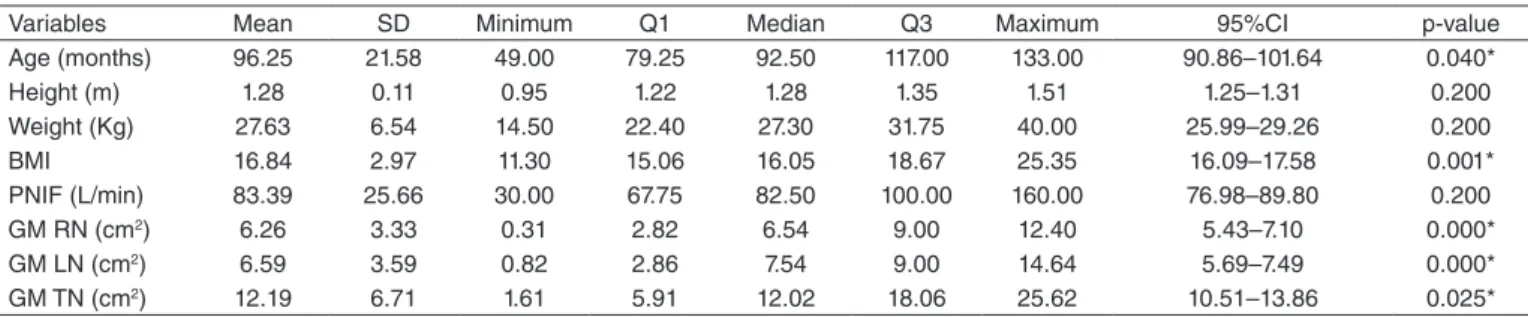
A descriptive analysis of the quantitative variables was made, and the Kolmogorov–Smirnov test showed a normal distribution only for the variables of height, weight, and PNIF measures (Table 2).
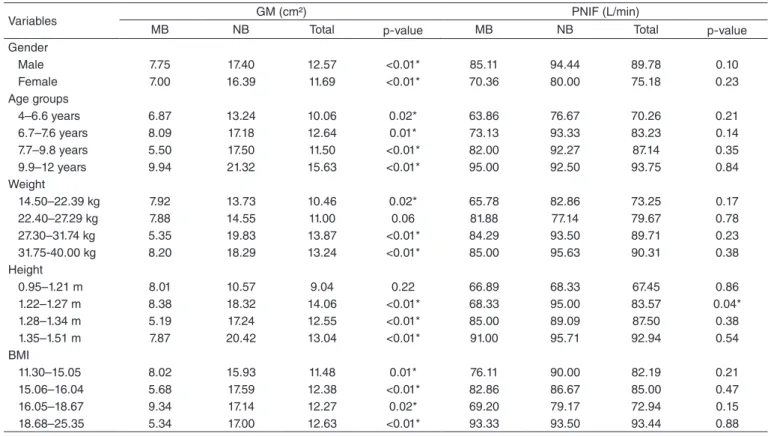
In the GM data analysis, we found a difference between mouth and nasal-breathing patients for all variables, except for one weight (22.40–27.29 kg) and one height band (0.95–1.21 m), being the nasal breathing higher. As to PNIF, only one height band (1.22–1.27 m) presented difference (Table 3).
Considering the subgroups, GM was able to distinguish al-lergic, surgical and allergic-surgical nasal-breathing patients, as well as allergic and functional mouth-breathing patients. PNIF was only able to distinguish surgical nasal-breathing patients though (Table 4).
Correlation between PNIF and the GM was analyzed for each group of individuals — divided as to breathing mode — and was proven low in all situations, with no evidence for signiicant association between them (Table 5).
DISCUSSIOn
After review, we found that the literature lacks studies on GM; so there are no reference values, standardization data, or proof of eficacy. This instrument has been used in some studies aiming to assess the nasal airlow(3-7,18-20). PNIF has been widely used in studies aimed at the assessment of nasal airlow, especially in allergic rhinitis patients. The studies found in the literature address data on sensibility,
Table 2. Descriptive analysis of variables (age, height, weight, body mass index) and measures by Glatzel mirror and peak nasal inspiratory flow
Variables Mean SD Minimum Q1 Median Q3 Maximum 95%CI p-value
Age (months) 96.25 21.58 49.00 79.25 92.50 117.00 133.00 90.86–101.64 0.040*
Height (m) 1.28 0.11 0.95 1.22 1.28 1.35 1.51 1.25–1.31 0.200
Weight (Kg) 27.63 6.54 14.50 22.40 27.30 31.75 40.00 25.99–29.26 0.200
BMI 16.84 2.97 11.30 15.06 16.05 18.67 25.35 16.09–17.58 0.001*
PNIF (L/min) 83.39 25.66 30.00 67.75 82.50 100.00 160.00 76.98–89.80 0.200
GM RN (cm2) 6.26 3.33 0.31 2.82 6.54 9.00 12.40 5.43–7.10 0.000*
GM LN (cm2) 6.59 3.59 0.82 2.86 7.54 9.00 14.64 5.69–7.49 0.000*
GM TN (cm2) 12.19 6.71 1.61 5.91 12.02 18.06 25.62 10.51–13.86 0.025*
*Significant values (p≤0.05) — Kolmogorov–Smirnov test
diagnosis accuracy, reproducibility, and reference values of the instrument(8-11,16,17,21,22).
Our sample showed higher prevalence of mouth-breathing patients in the age group of 6–10 years (Table 1), in agreement with indings of the literature(23,24) — even though some studies have not identiied differences concerning age(7,19). The domi-nance of mouth breathing among patients aging 6–10 years may be justiied by the occurrence of physiological tonsil hyperplasia (pharynges, palate, and tongue) at the ages of 4–12 years.
At this age, the structures go through atrophy along with an increase in the size of the upper airways(1). We did not perform
Table 4. Comparison of Glatzel mirror’s and peak nasal inspiratory flow’s values according to the classification of mode of breathing.
Measures Allergic MB Surgical MB Allergic-surgical MB Functional MB NB
Glatzel mirror
Allergic MB – 0.251 0.144 0.014* <0.01*
Surgical MB 0.251 – 0.587 0.100 <0.01*
Allergic-surgical MB 0.144 0.587 – 0.345 <0.01*
Functional MB 0.014* 0.100 0.345 – 0.112
Nasal breathing <0.01* <0.01* <0.01 0.112 –
PNIF
Allergic MB – 0.137 0.620 0.609 0.654
Surgical MB 0.137 – 0.419 0.472 0.007*
Allergic-surgical MB 0.620 0.419 – 0.479 0.240
Functional MB 0.609 0.472 0.479 – 0.820
Nasal breathing 0.654 0.007* 0.240 0.820 –
*Significant values (p≤0.05) – Mann-Whitney test.
Legend: PNIF = peak nasal inspiratory flow; MB = mouth breathing; NB = nasal breathing.
Table 3. Comparison between values obtained from Glatzel mirror and peak nasal inspiratory flow according to sample characteristics.
Variables GM (cm²) PNIF (L/min)
MB NB Total p-value MB NB Total p-value
Gender
Male 7.75 17.40 12.57 <0.01* 85.11 94.44 89.78 0.10
Female 7.00 16.39 11.69 <0.01* 70.36 80.00 75.18 0.23
Age groups
4–6.6 years 6.87 13.24 10.06 0.02* 63.86 76.67 70.26 0.21
6.7–7.6 years 8.09 17.18 12.64 0.01* 73.13 93.33 83.23 0.14
7.7–9.8 years 5.50 17.50 11.50 <0.01* 82.00 92.27 87.14 0.35
9.9–12 years 9.94 21.32 15.63 <0.01* 95.00 92.50 93.75 0.84
Weight
14.50–22.39 kg 7.92 13.73 10.46 0.02* 65.78 82.86 73.25 0.17
22.40–27.29 kg 7.88 14.55 11.00 0.06 81.88 77.14 79.67 0.78
27.30–31.74 kg 5.35 19.83 13.87 <0.01* 84.29 93.50 89.71 0.23
31.75-40.00 kg 8.20 18.29 13.24 <0.01* 85.00 95.63 90.31 0.38
Height
0.95–1.21 m 8.01 10.57 9.04 0.22 66.89 68.33 67.45 0.86
1.22–1.27 m 8.38 18.32 14.06 <0.01* 68.33 95.00 83.57 0.04*
1.28–1.34 m 5.19 17.24 12.55 <0.01* 85.00 89.09 87.50 0.38
1.35–1.51 m 7.87 20.42 13.04 <0.01* 91.00 95.71 92.94 0.54
BMI
11.30–15.05 8.02 15.93 11.48 0.01* 76.11 90.00 82.19 0.21
15.06–16.04 5.68 17.59 12.38 <0.01* 82.86 86.67 85.00 0.47
16.05–18.67 9.34 17.14 12.27 0.02* 69.20 79.17 72.94 0.15
18.68–25.35 5.34 17.00 12.63 <0.01* 93.33 93.50 93.44 0.88
*Significant values (p≤0.05) – Mann-Whitney test.
Legend: GM =Glatzel mirror; PNIF = peak nasal inspiratory flow; MB = mouth breather; NB = nasal breather; BMI = body mass index.
Table 5. Comparison between mean values of Glatzel mirror and peak nasal inspiratory flow according to breathing mode
Breathing mode GM PNIF CC p-value
Allergic MB 5.51 84.55 -0.04 0.92
Surgical MB 7.30 67.70 0.15 0.67
Allergic-surgical MB 8.49 77.50 -0.31 0.45
Functional MB 11.99 96.67 -1.00 –
Total MB 7.42 78.66 -0.07 0.69
Nasal breathing 16.96 88.13 0.33 0.07
* Significant values (p≤0.05) – Spearman correlation coefficient.
analysis regarding gender (Table 1) because the study was paired and, although the literature does not have reports on the association of gender with breathing mode(7,19), a study showed higher prevalence of males with such clinical picture(24).
In the comparisons between nasal and mouth breathing modes, all medians obtained from the MB group using GM (Table 3) were lower than those from the NB group, which agrees with the literature(7). Therefore, the GM was able to distinguish mouth-breathing patients from nasal-breathing patients according to gender, age group, weight, height and BMI. Median values provided by PNIF (Table 3), unlike the indings reported in the literature(10,11), were not considered different in the division by gender.
As to the remaining variables, PNIF did not show differ-ences between groups; the literature(12), on the other hand, reports higher values for nasal-breathing patients. Thus, the GM was proven more effective to assess a possible nasal obstruction compared to PNIF in samples stratiied by gender, age group, weight, height and BMI.
In analysis involving subgroups (Table 4), that is, Allergic MB, Surgical MB, allergic and Surgical MB, functional MB and NB, we veriied that the GM was not able to distinguish patients with no breathing changes from those with a func-tional picture. It happens because the absence of obstruction makes the measure closer to that of a nasal-breathing patient; hence the instrument is not considered reliable to distinguish MB subgroup patients.
The GM can be used to identify the presence of obstruc-tion, but not its cause. In a previous study(7), the GM was not considered reliable to assess nasal patency, for it was only able to distinguish nasal-breathing cases from allergic-surgical cases. It is important to mention that the aforementioned study considered nasal-breathing patients who had been submitted to surgical treatments for obstruction and later on adopted the nasal-breathing mode.
At PNFI between MB subgroups (Table 4), difference was found only between surgical MB and NB; therefore, it may not be considered reliable to identify most patients with nasal obstruction. The results found were unexpected, because PNIF is usually considered more reliable than the GM(2).
Mean values found by the GM in patients grouped accord-ing to breathaccord-ing mode do not agree with a study(7) that reported lower values mainly for nasal-breathing patients. In our study, we took the classiication of these studies’ samples, which diverge.
In literature review, we found a study involving two groups of children aging 4 years to 4 years and 8 months where nasal airlow was measured using the GM. In the irst group, submit-ted to removal of sucking habits, nasal aeration was increased from 10.70 to 18.10 and 18.40 cm². The second group, sub-mitted to both removal of sucking habits and to myofuncional therapy, showed increase from 14.10 to 26.40 and 26.50 cm²(4). Comparing these values with those of our study, considering the closest group age (4–6.6 years — 6.87 cm2 for mouth breath-ing and 13.24 cm2 for nasal breathing), we found a divergence with data from the literature.
A study addressed the variation of nasal obstruction using the GM after maneuvers of massage and nasal cleansing in
mouth-breathing children aging 4 to 11 years. An improve-ment in airlow was observed right after it, with measures of 16.6 cm2 before and 20.3 cm2 after(5). These indings are not in concordance with ours, which reports 7.42 cm2 for mouth-breathing patients and 16.96 cm2 for nasal-breathing patients. Differences in the marks of the GM may explain the results.
As to PNIF, we were not able to make comparisons with data from the literature because the studies that used the instrument did not stratify the sample in groups according to the cause of alteration in breathing mode.
In a study conducted with 526 participants aged 8 to 15 years, the researchers presented a mathematic model to calculate the expiratory low measured by PNIF as related to gender only(25). Another study, with 212 children aging 6 to 11 years, reported that PNIF results were only inluenced by age, the variables of gender, height, weight and ethnics being not decisive for values(26).
Another published study brought reference values for healthy participants, but with an adult-only sample(27). Overall, studies using PNIF describe the instrument as a simple, easy-to-handle, low-cost and fast tool that can provide important data for the management of patients with breathing disturbances, but there are divergences as to the normality pattern of results. In our study, when assessing the correlation coeficient of measures by both tests (Table 5), we veriied a low associa-tion in all situaassocia-tions, with no evidence of associaassocia-tion between groupings. This inding cannot be compared with the literature, because the studies published did not compare nasal obstruction measures by PNIF with those by the GM.
The lack of studies with samples with subgroups divided by breathing mode also hinders comparison. However, we found a study(22) that compared active anterior rhinomanom-etry, acoustic rhinomrhinomanom-etry, and PNIF and found that any of these methods can be used to assess nasal obstruction. PNIF is emphasized because of its low cost, good reproducibility and short measurement time.
The same author conducted a study(16) where he compared the measures by PNIF with anterior rhinomanometry in allergic individuals and concluded that PNIF is reliable for diagnosis and therapeutic follow-up in the ield of allergy. A study(6) compared the GM with nasopharyngoscopy and proved the validity of such correlation.
An editorial(28) addressing instruments used to measure nasal patency stated that the Glatzel and Gertner Mirrors, the peak nasal inspiratory or expiratory low, and oscilometry are tests intended to assess nasal patency, which have been used to identify nasal obstruction.
Nevertheless, the most speciic currently available tests are rhinomanometry and acoustic rhinometry. It’s important to mention that the most reliable way of measuring nasal patency is by associating instruments. Moreover, anamnesis data plus clinical examination can be useful in providing information about participants’ breathing mode(14,29).
Therefore, further studies are needed to increase the sample, in addition to the inclusion of a gold-standard exam such as Measurement of nasal patency. Speech therapists from SUS believe that it is important to use an instrument that is reliable and actually give evidence of obstruction while patients wait for the otolaryngologist’s assessment.
COnClUSIOn
The GM was proven able to identify patients with and without nasal obstruction regardless of the cause; however it could not point this cause. PNIF, on the other hand, was shown to be able to distinguish only nasal-breathing patients from surgical mouth-breathing patients; so its applicability is more limited. The correlation of PNIF and the GM was found low in the studied sample.
*DLM and RVMS: data collection and analysis; TVCP: data analysis and writing; HMGB: data collection and study design; ARM: study project and design, general orientation for study conduction, and writing.
REfEREnCES
1. Marchesan IQ. Avaliação e terapia dos problemas da respiração. In: Marchesan IQ. Fundamentos em Fonoaudiologia: aspectos clínicos da motricidade oral. 2a ed. Rio de Janeiro: Guanabara Koogan; 2005. p. 29-42.
2. Motta A, Bommarito S, Chiari BM. Peak nasal inspiratory flow: uma possível ferramenta para a motricidade orofacial? Rev Soc Bras Fonoaudiol. 2010;15(4):609-14.
3. Cunha DA, Silva GAP, Motta MEFA, Lima CR, Silva HJ. A respiração oral em crianças e sua repercussão no estado nutricional. Rev CEFAC. 2007;9(1):47-54.
4. Degan VV, Puppin-Rontani RM. Aumento da aeração nasal após remoção de hábitos de sucção e terapia miofuncional. Rev CEFAC. 2007;9(1):55-60.
5. Melo FMG, Cunha DA, Silva HJ. Avaliação da aeração nasal pré e pós a realização de monobras de massagem e limpeza nasal. Rev CEFAC. 2007;9(3):367-74.
6. Penido FA, Noronha RMS, Caetano KI, Jesus MSV, Di Ninno CQMS, Britto ATBO. Correlação entre os achados do teste de emissão de ar nasal e da nasofaringoscopia em pacientes com issura labiopalatina operada. Rev Soc Bras Fonoaudiol. 2007;12(2):126-34.
7. Bassi IB, Motta AR, Franco LP. Eicácia do emprego do espelho de Glatzel na avaliação da permeabilidade nasal. Rev Soc Bras Fonoaudiol. 2009;14(3):367-17.
8. Dufour X, Gohler C, Delagranda A, Fontanel J-P, Klossek J-M. Peak Nasal Inspiratory Flow: apprentissage de la méthode de mesure et reproductibilité. Ann Otolaryngol Chir Cervicofac. 2007;124(3):115-9. 9. Bermüller C, Kirsche H, Rettinger G, Riechelmann H. Diagnostic
accuracy of peak nasal inspiratory flow and rhinomanometry in functional rhinosurgery. Laryngoscope. 2008;118(4):605-10.
10. Papachristou A, Bourli E, Aivazi D, Futzila E, Papastavrou T, Konstandinidis T, et al. Normal peak nasal inspiratory low rate values in Greek children and adolescents. Hippokratia. 2008;12(2):94-7. 11. Andrade CR. Valores de referência do pico do luxo inspiratório nasal em
crianças e adolescentes [tese]. Belo Horizonte: Universidade Federal de Minas Gerais; 2009.
12. Held PA, Castro WM, Silva TLP, Silva KR, Di Lorenzo VAP. Treinamento muscular e da respiração nasal em crianças respiradoras orais. Fisioter Mov. 2008;21(4):119-27.
13. Genaro KF, Berretin-Felix G, Rehder MIBC, Marchesan IQ. Avaliação Miofuncional Orofacial – Protocolo MBGR. Rev CEFAC. 2009;11(2):237-55.
14. Wagnitz SJV. Avaliação do grau de coniabilidade do diagnóstico clínico do modo respiratório bucal [tese]. Curitiba: Pontifícia Universidade Católica do Paraná; 2000.
15. Krakauer LH. Terapia do respirador oral. In: Krakauer LH, Di Francesco RC, Marchesan IQ. Conhecimentos essenciais para entender bem a respiração oral: abordagem interdisciplinar. São José dos Campos: Pulso; 2003. p.119-20.
16. Pérez AO. La obstrucción nasal y su medida. Allergol et Immunopathol. 2004;32(6):361-7.
17. Starling-Schwanz R, Peake HL, Salome CM, Toelle BG, Ng KW, Marks GB, et al. Repeatability of peak nasal inspiratory low measurements and utility for assessing the severity of rhinitis. Allergy. 2005;60(6):795-800. 18. Borghi LC, Roldão FTF, Mariotto M. Postura habitual dos lábios mais
encontrada em crianças. Rev CEFAC. 2003;5:227-30.
19. Menezes VA, Leal RB, Pessoa RS, Pontes RMES. Prevalência e fatores associados à respiração oral em escolares participantes do projeto Santo Amaro-Recife, 2005. Rev Bras Otorrinolaringol. 2006;72(3):394-9. 20. Brescovici S, Roithmann R. A reprodutibilidade do espelho de
Glatzel modificado na aferição da permeabilidade nasal. Rev Bras Otorrinolaringol. 2008;74(2):215-22.
21. Prescott CAJ, Prescott KE. Peak nasal inspiratory low measurement: an investigation in children. Int J Pediatr Otorhinolaryngol. 1995;32(2):137-41. 22. Pérez AO. Validación de la determinación del lujo inspiratorio nasal.
Alergol Inmunol Clin. 2004;19:25-8.
23. Andrade CRF. Prevalência das desordens idiopáticas da fala e da linguagem em crianças de um a onze anos de idade. Rev Saúde Pública. 1997;31(5):495-501.
24. César AM, Maksud SS. Caracterização da demanda de Fonoaudiologia no serviço público municipal de Ribeirão das Neves – MG. Rev CEFAC. 2007;9(1):133-8.
25. Ibiapina CC, Andrade CR, Camargos PAM, Alvim CG, Cruz AA. Reference values for peak nasal inspiratory flow in children and adolescents in Brazil. Rhinology. 2011;49(3):304-8.
26. Spronsen EV, Ebbens FA, Fokkens WJ. Normal peak nasal inspiratory low rate values in healthy children aged 6 to 11 years in the Netherlands. Rhinology. 2012;50(1):22-5.
27. Ottaviano G, Scadding GK, Coles S, Lund VJ. Peak nasal inspiratory low: normal range in adult population. Rhinology. 2006;44(1):32-5. 28. Roithmann R. Testes especíicos da permeabilidade nasal [editorial]. Rev
Bras Otorrinolaringol. 2007;73(1):2.