Kyonayra Quezia Duarte Brito
I, Tarciana Nobre de Menezes
I, Ricardo Alves de Olinda
III Universidade Estadual da Paraíba, Postgraduate Program in Public Health. Campina Grande, Paraíba, Brazil.
II Universidade Estadual da Paraíba, Department of Statistics. Campina Grande, Paraíba, Brazil.
How to cite this article:
Brito KQD, Menezes TN, Olinda RA. Functional disability: health conditions and physical activity practice in older adults. Rev Bras Enferm [Internet]. 2016;69(5):773-80. DOI: http://dx.doi.org/10.1590/0034-7167.2016690502
Submission: 05-02-2015 Approval: 11-15-2015
ABSTRACT
Objective: to verify the prevalence of functional disability among older adults and how it can affect their health conditions and the regular practice of physical activities. Method: this is a household and cross-sectional study conducted with older adults of both sexes. We verifi ed the variables associated with functional disability by Poisson’s regression. Results: around 420 older adults participated in this study (68.1% of them being women). We observed a statistically signifi cant association between functional disability, the number of chronic diseases, self-assessed health conditions, and the practice of physical activities; the latter only being found among men.Older adults who reported presenting four or more chronic diseases, self-assessed their health conditions as poor, and were not used to practice physical activities, showing high prevalence of functional disability. Conclusion: considering the changeable character of these variables, we recommend that prevention actions be taken, mainly at primary level, to delay the emergence of disability.
Descriptors: Older adults; Weakened; Self-Assessment; Nutritional Status; Non-Communicable Disease.
RESUMO
Objetivo: verifi car a prevalência de incapacidade funcional entre idosos e sua associação com condições de saúde e prática de atividade física regular. Método: trata-se de um estudo de base domiciliar, transversal, realizado com idosos de ambos os sexos. As variáveis associadas à incapacidade funcional foram verifi cadas por meio de regressão de Poisson. Resultados: participaram deste estudo 420 idosos (68,1% mulheres). Observou-se associação estatisticamente signifi cativa entre incapacidade funcional e número de doenças crônicas, autoavaliação de saúde e prática de atividade física, essa última apenas entre os homens. Idosos que referiram quatro ou mais doenças crônicas, que autoavaliaram a saúde como ruim e que não praticavam atividade física, apresentaram elevadas prevalências de incapacidade funcional. Conclusão:considerando o caráter modifi cável dessas variáveis, recomendam-se ações de prevenção, principalmente em nível primário, que retardem o surgimento de incapacidades. Descritores: Idoso; Fragilizado; Autoavaliação; Estado Nutricional; Doença Crônica.
RESUMEN
Objetivo: verifi car la prevalencia de discapacidad funcional entre ancianos y su asociación a condiciones de salud y práctica regular de actividad física. Método: estudio de base domiciliaria, transversal, realizado con ancianos de ambos sexos. Las variables asociadas a la discapacidad funcional fueron verifi cadas mediante regresión de Poisson. Resultados: participaron del estudio 420 ancianos (68,1% mujeres). Se observó asociación estadísticamente signifi cativa entre discapacidad funcional y número de enfermedades crónicas, autoevaluación de salud y práctica de actividad física, esta última sólo entre los hombres. Los ancianos que informaron cuatro o más enfermedades crónicas, que autoevaluaron su salud como mala y que no practicaban actividades físicas presentaron prevalencias elevadas de discapacidad funcional. Conclusión: considerando el carácter modifi cable de estas variables, se recomiendan acciones de prevención, particularmente a nivel primario, con el fi n de retardar el surgimiento de discapacidades. Descriptores: Anciano Frágil; Autoevaluación; Estado Nutricional; Enfermedad Crónica.
Functional disability: health conditions and physical
activity practice in older adults
Incapacidade funcional: condições de saúde e prática de atividade física em idosos
Discapacidad funcional: condiciones de salud y práctica de actividad física en ancianos
INTRODUCTION
The increase in the number of older adults has been calling the attention of researchers from Brazil(1) and around the world(2) who are responsible for assessing the impacts of population ag-ing on families, communities, and on the various sectors of soci-ety, especially the ones concerning social security and health(3). Studies(1-5) have been evaluating the impact of aging in the life of older adults, since it is possible to note some biological, physi-cal, psychologiphysi-cal, and social changes along with the aging process, which could trigger several problems such as falls(4), non-communicable diseases (also known as chronic diseases)(1), nutritional changes(5), and functional disability(1-3).
In this context, the National Policy of Health for Older Adults advocates, among other things, that older adults’ global assess-ment becomes part of the daily performance of health profession-als in their health care. This assessment includes the evaluation of functional disability to promote prevention and recovery(6).
Having a functional disability means presenting difficulties when performing everyday activities, or even the inability to do them(7), which is related to higher risks of hospitalization(1), institutionalization(8), and death(9). Considering the impor-tance of assessing these functional disability in older adults and aiming to identify their prevalence rate, studies have been carried out in Brazil and in other countries(1-2,7-8,10-13).
A study conducted in Japan found a prevalence of 20.1% of functional disability among older adults(2). Another study(12), carried out in Chile using the Lawton and Brody’s Index, veri-fied a prevalence of 35.0% of older adults were functionally disabled. In Brazil, a study from Minas Gerais identified that 44.6% of older adults showed some kind of degree of disabil-ity(10), while another one from the Northeastern region of Bra-zil identified a prevalence of 42.2% of functional disability in non-institutionalized older adults(14). In a research with insti-tutionalized older adults, the prevalence of disability ranged between 13.0% and 31.2%(8).
Considering the aspects related to functional disability, these studies have been verifying a high prevalence of dis-abled older adults who do not practice physical activities regularly(10), who present nutritional disorders(11-12,15), a high number of non-communicable diseases(1-2), and also have self-assessed their health conditions as poor(8,10,16).
Taking the aforementioned into account, there is a need to identify health profiles that, in this context, include categories such as: nutritional status, number of non-communicable diseas-es, how these individuals self-assess their health, as well as the presence of functional disability, with the objective of stablishing which ones should be seen as priorities regarding prevention and intervention. Hence, this study aims to verify the prevalence of functional disability among older adults and its association with health conditions and the regular practice of physical activities.
METHOD
Ethical aspects
This research was approved by the Research Ethics Commit-tee of the State University of Paraíba. Older adults who have
agreed to participate in this research have signed an Informed Consent Form; we informed them on the main objectives of the study, the type of participation desired, and also on the fact they could give up on participating at any moment if they wanted to. We also assured them of the anonymous and confi-dential character concerning the information provided.
Design, study location, and period
This is a household and cross-sectional study with primary data gathering carried out in Campina Grande, Paraíba, Bra-zil, from August 2009 to May 2010.
Sample – Inclusion and exclusion criteria
Participants of the study were individuals of both sexes, aged 60 years or more who were registered in the Family Health Strategy from Campina Grande. We excluded from the study older adults who presented severe clinical weakness with no therapeutic possibilities, i.e., those at terminal-stage of illness, as well as those who were absent from Campina Grande for longer than the period of the field research in the Basic Unit of Family Health (BUFH) in the area where they were registered.
We made the sample calculation by estimating a preva-lence outcome of at least 25% with a confidence limit of 95%, admitting an error percentage of 6%. The sample was proportional to each Health District of the city, comprising a total of 420 older adults.
Study protocol
In each UBSF drawn, we carried out a survey to gather the number of registered older adults, which was followed by their random selection in a systematic and proportional way. We elaborated a list with the name of all registered older adults in each BUFH. We defined the number of people to be skipped until selecting the next one on the list of interviewed by analyzing the ratio between the total number of registered older adults and a determined number of older adults to be interviewed in a certain UBSF, thereby getting into the num-ber five. This way, to each selected old adult, we skipped four others on the list. The fifth older adult was the chosen one and so on, aiming at obtaining a better distribution and ensuring the whole list would be covered.
We conducted the process of data gathering at the partici-pants’ homes with the help of three pairs of interviewers (un-dergraduate students of the health field adequately trained by the professor who heads this research and other professors) and carried out a pilot research with 42 older adults (10% of the total to be interviewed), for possible methodological adjustments.
In this study, we used as independent variables: regular practice of physical activities, nutritional status, number of non-communicative diseases, and self-assessment of health. These last three variables are related, in the context of this research, to individuals’ health conditions.
We considered the regular practice of physical activity vari-able when participants reported practicing exercises at least three times a week for at least 30 minutes(17).
by the square of the body height (m) (W/H2). To make all measures we used a portable anthropometer. For weight measures, we used a portable digital weighing scale of plat-form type, with capacity for 150 kg and sensitivity of 100 g. For the BMI analysis (kg/m2), we used a classification sug-gested by the Pan-American Health Organization (PAHO): underweight (< 23 kg/m2), eutrophy (≥ 23 kg/m2 and < 28 kg/m2), overweight (≥ 28 kg/m2 and < 30), and obesity (≥ 30 kg/m2).
To verify the number of diseases listed, we asked the par-ticipants if a physician or other health professional have ever informed them about the possibility of they having some of the following diseases: high blood pressure, arthritis/arthritis/ rheumatism, heart problems, diabetes, osteoporosis, chronic pulmonary disease, embolism/stroke, and malignant tumor.
We analyzed the participants’ self-assessment according to their answers to the question: “How would you classify your health?”, having answer options such as: excellent, very good, good, regular, and poor. For statistical purposes, this variable was divided into: good self-assessment of health (excellent, very good, good) and poor self-assessment of health (regular and poor).
The dependent variable was “functional disability”, as-sessed using the Barthel Index, which comprises daily life activities such as: eating, dressing up, performing personal hygiene, putting on orthopedic device (if appliable), control-ling sphincters, using the toilet, walking (in case of the person being physically disabled, this one would be replaced by “us-ing the wheelchair”), go“us-ing up and down stairs. For each ac-tivity there are three options of answer: I can do it by myself, I can do it with someone’s help,
and I can’t do it at all. Each answer has a specific score that after being summed up it will be possible to reach a to-tal value from 0 to 100 points, corresponding to patients’ total dependence or total indepen-dence, respectively.
From the score, we used the following classification(18): in-dependent (100 points), light dependence (91 to 99 points), moderate dependence (61 to 90 points), severe dependence (21 to 60 points), and total de-pendence (0 to 20 points). For statistical purposes, we classi-fied older adults as it follows: functional disability (yes, no). We considered as functional disabled the older adults clas-sified by the Barthel index as light, moderate, severe, and to-tal dependents, while the ones without functional disability were classified as independents.
Results analysis and statistics
We obtained the statistical informations with the help of a statistical app named R (The R Foundation for Statistical Computing, Vienna, Austria). Firstly, to verify the statistical association between the dependent variable and the inde-pendent variables, we performed a bivariate analysis with the Pearson’s Chi-square test, using a level of significance of <5% with Yates’ correction when necessary. Next, we estimated the prevalence ratio (PR) with the respective confidence intervals (95%CI) using Poisson’s regression model with logarithmic link function, via Generalized Linear Models (GLMS).
After the bivariate analysis, we included all variables in the multivariate model. From the first model that included all vari-ables regardless of the value of p, we started to withdrawn the variables one by one considering the greatest value of p, until only the ones with a p smaller than 0.05 were left.
RESULTS
The sample of this study is consisted of 420 old adults (68.1% of them being women). The age of the participants ranged between 60 and 104 years, with an average of 71.6 years (SD = 9.19).
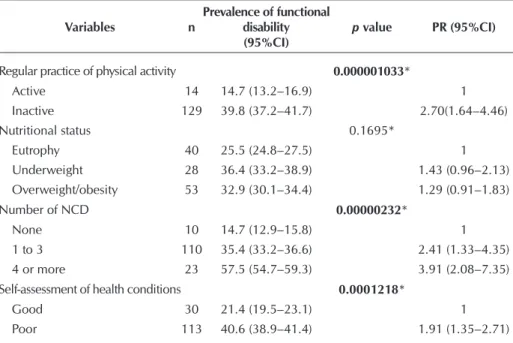
Table 1 presents the values of the bivariate analyses of the relation between functional disability, health conditions, and the regular practice of physical activity. From the variables studied, the ones that presented a statistically significant relation with functional disability were: regular practice of physical activ-ity (p=0.000001033), number of non-communicable diseases (p=0.00000232), and self-assessment of health (p=0.0001218).
Table 1 – Results of the bivariate analysis regarding functional disability and related factors (regular practice of physical activity, nutritional status, number of non-communicable diseases, and self-assessment of health) in older adults, Campina Grande, Paraíba, Brazil, 2009–2010
Variables n
Prevalence of functional disability (95%CI)
p value PR (95%CI)
Regular practice of physical activity 0.000001033*
Active 14 14.7 (13.2–16.9) 1
Inactive 129 39.8 (37.2–41.7) 2.70(1.64–4.46)
Nutritional status 0.1695*
Eutrophy 40 25.5 (24.8–27.5) 1
Underweight 28 36.4 (33.2–38.9) 1.43 (0.96–2.13)
Overweight/obesity 53 32.9 (30.1–34.4) 1.29 (0.91–1.83)
Number of NCD 0.00000232*
None 10 14.7 (12.9–15.8) 1
1 to 3 110 35.4 (33.2–36.6) 2.41 (1.33–4.35)
4 or more 23 57.5 (54.7–59.3) 3.91 (2.08–7.35)
Self-assessment of health conditions 0.0001218*
Good 30 21.4 (19.5–23.1) 1
Poor 113 40.6 (38.9–41.4) 1.91 (1.35–2.71)
Older adults who did not prac-tice physical activity showed prev-alence 2.70 times higher for func-tional disability when compared to older adults who did. Older adults who mentioned four or more non-communicable diseases showed prevalence 3.91 times higher for functional disability when com-pared to those who did not report-ed having any disease. Old adults who assessed their health as poor showed prevalence of functional disability 1.91 times higher when compared to older adults who have assessed their health as good.
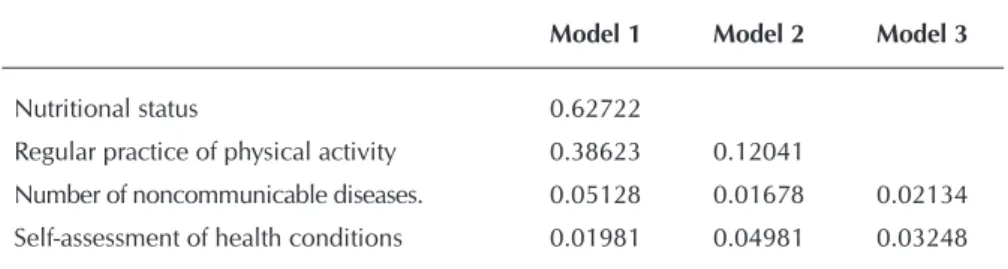
Table 2 presents the results of the Poisson’s regression, in which it was possible to note that, after the multivariate analysis, the prac-tice of regular physical activity lost statistical significance.
Table 3 presents the values of the bivariate analyses of the rela-tion between funcrela-tional disability, health conditions, and the regular practice of physical activity ac-cording to sex. Among men, we verified a statistically significant re-lation between the regular practice of physical activity (p=0.04121), the number of non-communicable diseases (p=0.005428), and self-assessment of health (p=0.02006). Men who did not practice phys-ical activity regularly had a preva-lence 1.23 times higher of being functionally disabled when com-pared to the ones that did. Con-cerning the number of non-com-municable chronic diseases, older adults who reported having four or more of the diseases showed a higher prevalence (PR = 1.7; 95%CI = 0.89–3.24) of functional disability when compared to those who reported not having any of the diseases pointed out. When it comes to the variable “self-assess-ment of health”, men who self-as-sessed their health as poor showed a prevalence 1.25 times higher of being functionally disabled when compared to men with a good self-assessment of health (Table 3).
Among women, we detected a statistically significant association
Table 2 – Poisson regression models. Variables associated with functional disability in older people, Campina Grande, Paraíba, Brazil, 2009–2010
Model 1 Model 2 Model 3
Nutritional status 0.62722
Regular practice of physical activity 0.38623 0.12041
Number of noncommunicable diseases. 0.05128 0.01678 0.02134
Self-assessment of health conditions 0.01981 0.04981 0.03248
Table 3 – Result of the bivariate analysis regarding the functional disability and re-lated factors (regular practice of physical activity, nutritional status, num-ber of non communicative diseases, and self-assessment of health) among men and among women. Campina Grande, Paraíba, Brazil, 2009–2010
Variables n
Prevalence of functional disability
(95%CI)
p value PR (95%CI)
Men
Regular practice of physical activity 0.04121*
Active 04 9.3 (6.7–11.3) 1
Inactive 24 26.4 (24.2–28.6) 1.23 (1.05–1.44)
Nutritional status 0.1718*
Eutrophy 12 19.7 (17.7–24.4) 1
Underweight 02 6.90 (4.0–9.20) 0.86 (0.74–1.01)
Overweight/obesity 09 24.3 (22.1–26.9) 1.06 (0.85–1.32)
Number of NCD 0.005428*
None 01 2.9 (0.4–4.2) 1
1 to 3 24 26.1 (22.7–28.1) 1.31 (1.15–1.5)
4 or more 03 42.9 (41.2–44) 1.70 (0.89–3.24)
Self-assessment of health conditions 0.02006*
Good 06 10.5 (8.4–12.6) 1
Poor 22 28.6 (26.8–31.9) 1.25 (1.06–1.48)
Women
Regular practice of physical activity
Active 10 19.2 (16.8–22.1) 0.001049* 1
Inactive 105 45,1 (42.0–47.5) 1.47 (1.23–1.75)
Nutritional status 0.01266*
Eutrophy 28 29.2 (26.8–30.9) 1
Underweight 26 54.2 (51.6–56.3) 1.55 (1.11–2.16)
Overweight/obesity 44 35.5 (33.3–38.8) 1.10 (0.91–1.32)
Number of NCD 0.01763*
None 09 27.3 (24.4–28.9) 1
1 to 3 86 39.3 (37.9–41.3) 1.20 (0.95–1.51)
4 or more 20 60.6 (57.6–62.7) 1.85 (1.15–2.96)
Self-assessment of health conditions 0.01285*
Good 24 28.6 (26.4–30.8) 1
Poor 91 45.3 (42.3–46.9) 1.31 (1.09–1.57)
between all variables studied and functional disability. Older women who did not practice physical activity regularly showed a prevalence 1.47 higher of being functionally disabled when compared to active older women. Those un-derweight (PR = 1.55; 95%CI = 1.11–2.16) and overweight/obese (PR = 1.1; 95%CI = 0.91–1.31) women showed higher prevalence of being functionally disabled when compared to eutrophic ones. Older women who reported having 1 to 3 or 4 and more diseases showed higher prevalence (PR = 1.2; 95%CI = 1.51 and PR = 0.95 – 1.85; 95%CI = 1.15–2.96, re-spectively) of being functionally disabled when compared to those who reported not having any of the diseases pointed out. Older women who assessed their health as poor showed prevalence 1.31 times higher of being functionally disabled when compared to older adults who have as-sessed their health as good.
Table 4 shows the results of Poisson’s regres-sions for men and women. Among men, it is possible to verify that the variables “nutritional status” and “self-assessment” of health lost sta-tistical significance. Hence, only the variables “practice of regular physical activity” and “num-ber of chronic non-communicable diseases” re-mained in the final model (Model 3).
Among women, variables such as “regular practice of physical activity”, “nutritional status” and “self-assessment of health” lost statistical sig-nificance, the variable “number of non-communi-cable diseases” being the only one remaining in the final model (Model 4).
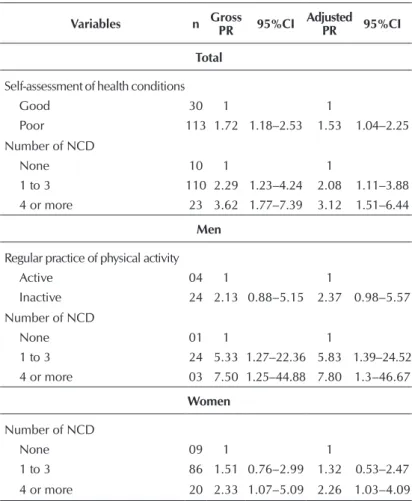
In Table 5, we present the final result, after its adjustment, both for the total group of older adults as for the group comprising only men and the oth-er comprising only women.
After the adjusted multivariate analysis, for the total of older adults, a poor self-assessment of health ended up being associated with the high-est prevalence of functional disability (PR = 1.53; IC = 1.04-2.25) when compared to the older adults who self-assessed their health as good. The presence of one to three NCDs increased the prevalence of disability in 2.08 times. When participants have four or more diseases, this per-centage increased to 3.12 times when compared to the group of older adults that did not report having any disease. Among men, prevalences as-sociated with one to three (PR = 5.83; 95%CI = 1.39-24.52) and four or more NCDs (PR = 7.80; 95%CI = 1.30-46.67) increased. Men who did not practiced physical activity showed a preva-lence 2.37 times higher when compared to the ones who did. Among women, those who report-ed having one to three NCDs (PR = 1.32; 95%CI
Table 4 – Poisson’s regression models Variables associated with functional disability in men and women, Campina Grande, Paraíba, Brazil, 2009–2010
Men
Model 1 Model 2 Model 3
Nutritional status 0.8383
Self-assessment of health conditions 0.1995 0.4123
Regular practice of physical activity 0.1338 0.0746 0.0562
Number of NCD 0.1373 0.0433 0.0245
Women
Model 1 Model 2 Model 3 Model 4
Regular practice of physical activity 0.9877
Nutritional status 0.5306 0.5287
Self-assessment of health conditions 0.0833 0.0818 0.1460
Number of NCD 0.3026 0.3019 0.0454 0.0334
Note: NCDs: Non-communicable Diseases.
Table 5 – Final result (gross and adjusted multivariate analysis) re-garding functional disability and socioeconomic and de-mographic related factors, Campina Grande, Paraíba, Bra-zil, 2009-2010
Variables n Gross PR 95%CI Adjusted
PR 95%CI
Total
Self-assessment of health conditions
Good 30 1 1
Poor 113 1.72 1.18–2.53 1.53 1.04–2.25
Number of NCD
None 10 1 1
1 to 3 110 2.29 1.23–4.24 2.08 1.11–3.88
4 or more 23 3.62 1.77–7.39 3.12 1.51–6.44
Men
Regular practice of physical activity
Active 04 1 1
Inactive 24 2.13 0.88–5.15 2.37 0.98–5.57
Number of NCD
None 01 1 1
1 to 3 24 5.33 1.27–22.36 5.83 1.39–24.52
4 or more 03 7.50 1.25–44.88 7.80 1.3–46.67
Women
Number of NCD
None 09 1 1
1 to 3 86 1.51 0.76–2.99 1.32 0.53–2.47
4 or more 20 2.33 1.07–5.09 2.26 1.03–4.09
= 0.53-2.47) and those who mentioned four or more (PR = 2.26; 95%CI = 1.03-4.09) showed higher prevalence for functional disability when compared to those who reported no chronic conditions.
DISCUSSION
Functional disability exert an important influence on the quality of life of older adults, being determined by several fac-tors among which we can mention those concerning health conditions(11,16) and the practice of physical activity(19). The association of these factors with functional disability has been investigated in different studies(1,8,10-11,16,19-22). From the health-related variables we have: nutritional status(11,21), the number of non-communicable diseases(1,6), self-assessment of health(8,13,16), and regular practice of physical activity(19-20,22).
In this study, the only variable that showed no significant statistical association with functional disability, both for the total group of older adults as for men, was “nutritional status”. However, we have to consider the high prevalence of older adults who had inappropriate nutritional status either by being underweight or overweight/obese.
A research conducted in Pernambuco verified that most overweighted older adults presented functional disability(11). Another study, carried out in Chile, concluded that under-weight among older adults is associated with the presence of functional disability(12). With that, we observed an inadequate nutritional status has an important association with functional disability. A concerning factor considering the high preva-lence of older adults with an inadequate nutritional status, as observed in several studies(1,23-24). This nutritional inadequacy, caused by a deficiency of calories and nutrients or by the ex-cess of calories interferes in the welfare of older adults and can lead to functional decline(11). Therefore, cooperation mea-sures for the maintenance of an appropriate weight in older adults should always be encouraged.
In this study, we verified the highest prevalence of function-al disability among older adults who did not practice physicfunction-al activity, had a inadequate nutritional state, had reported hav-ing four or more diseases, and had self-assessed their health as poor, when considering the total group of older adults and the ones for men and women, separately.
Regarding the practice of physical activity, the present study found a high prevalence of functional disability among older adults who did not practice physical activity, both in the total group of older adults as for the ones only for men and women. These data corroborate with the findings of other studies(20,22-23).
In a research conducted in the state of Goiás, Brazil, the prev-alence of functional disability observed was higher among older adults who did not practice physical activity than in older adults who did(19). However, to better explain this association, it would be necessary to keep up with these older adults to establish the cause of these phenomena, since it is possible that physical inac-tivity be associated with a prior functional disability condition.
Physical activity enables individuals to get physically condi-tioned, making them capable of performing daily life activities throughout life(23). In this sense, encouraging the regular practice
of physical activity is essential at all stages of life, because its benefits are unquestionable in the prevention of diseases, and in the promotion of health and quality of life(10). Older adults who have this habit must be encouraged to continue exercising and those who live a sedentary lifestyle should be aware of the need to start doing some kind of activity so that they can minimize the negative effects of physical inactivity.
From all the variables studied, the one that showed the highest values of prevalence ratio was “number of non-communicable diseases”, and we observed the highest prevalences among older adults who reported four or more non-communicable diseases, both in the total group of older adults as in the ones only for men and only for women. These data corroborate with the findings of other studies that have shown a association between number of non-communicable diseases and functional disability(1,10). A study conducted with older adults registered in a health insurance plan found that participants who reported four or more diseases had higher prevalence of being functionally disabled when compared to those who reported having only one disease(24).
Data from the Brazilian National Household Survey of 2008, showed high prevalence of older adults in Brazil that had some non-communicable diseases(25). Whereas the asso-ciation between chronic diseases and functional incapacity is confirmed by literature, the necessity of adopting effective measures for the prevention and health promotion, reducing the crippling impacts of that event(26). This measures must be focused on contributing to the natural history of the disease in a favorable way, and delay its evolution and complications, which might reflect on the maintenance and improvement of functional capacity. Taking this into account, health profes-sionals need to be prepared to previously detect non-com-municable diseases, monitor and direct appropriate interven-tions, considering the particularities of this population.
The association between the self-assessment of health and functional disability has been commonly studied(8,10,13,26). In the present study, poor self-assessments of health were associated with high prevalence of disability, both in the total group of old-er adults and the ones for men and women, separately. A study carried out in the state of Mato Grosso, Brazil, found that, most older adults who self-assessed their health as poor presented functional incapacity, whereas the prevalence among those with good health self-assessment was a little more than one third(8).
The self-assessment of health reflects the individual’s per-ception about the biological, social and psychosocial dimen-sion(10), therefore it must be considered during older adults care, mainly when it is wished to verify factors related to tional disability. It is likely that older adults who feature func-tional disability not assess their health condition so well(8), which can contribute to the worsening of such condition.
the case of the NCD’s, which enables the development of ef-fective interventions aimed at preserving functional capacity.
As an example, we can mention a longitudinal study conduct-ed with older women that found that, after the implementation of physical exercises during five weeks, it was possible to note an improvement in the performance of daily life activities(20). Consid-ering physical inactivity is a changeable factor, it is necessary to en-courage older adults to get some exercise and choose public and safe spaces, preferably with professional supervision, to work out.
Regarding non-communicable diseases, the main risk fac-tors for its development are: tobacco use, unhealthy eating habits, physical inactivity, and harmful consumption of alco-hol(27) These variables need to be considered in programmes of prevention of such diseases.
The self-assessment of health reflects the perception of individuals about their own health(28) and consists of a vari-able that made of subjective features, although it can be com-pared to objective measures of health(29). A study conducted in Campinas, São Paulo, concluded the self-assessment of health is associated with factors such as practice of physical activity, adequate nutritional status, and consumption of fruits and vegetables four times or more per week(30). This shows that changes in these aspects may contribute to a positive self-assessment of older adults about their health.
Now it is appropriate to state that these variables are con-tained in a multifactorial network associated with functional disability in older adults. This network present factors mainly related to a healthy lifestyle, and its prevention necessarily un-dergoes changes in behavior.
On one hand, at the moment individuals decide to adopt habits such as healthy eating, weight management, and regu-lar practice of physical activity, they decrease the risk of prob-lems related to physical inactivity, the chance to have a higher number of non-communicable diseases, and self-assess their
health negatively, which contributes to the preservation of their functional capacity.
On the other hand, when individuals have their functional capacity preserved, they have higher possibility to maintain the practice of physical activity, control non-communicable diseas-es, and better assess their health. Therefore, we can state that successful aging, with preserved functional capacity, depends on, among other factors, a healthy lifestyle, namely: maintaining an adequate weight by eating a balanced diet, practicing regular physical activity, and controlling non-communicable diseases.
A limitation verified in this study is related to its transversal design, which makes it impossible to establish temporal relation-ships between independent variables and functional disability. However, this kind of study contributes to revealing the func-tional disability charge in the population of older adults and re-lated factors, contributing to the elaboration of prevention mea-sures to the outcome in question, as it is the case of this research.
CONCLUSION
The results of this study lead to an association between func-tional incapacity, the number of non-communicable diseases, and self-assessment of health, regardless of sex. Among men, there is a specific association with the practice of physical ac-tivity, while among women there is with the number of non communicative diseases. Therefore, these characteristics must be observed during the overall assessment of older adults.
To preserve the functional capacity of older adults is a great challenge to public health; hence, it is necessary to ensure that public polities be satisfactorily implemented to meet the needs of factors related to functional disability. Besides, given the changeable character of these variables, we recommend prevention actions be taken, mainly at primary level, to delay the emergence of disability.
REFERENCES
1. Santos SAL, Tavares DMDS, Barbosa MH. [Socioeconom-ic factors, functional disability and number of diseases among the elderly]. Rev Eletrônica Enferm [Internet]. 2010 [cited 2014 Jun 27];12(4). Available from: http://revistas. ufg.br/index.php/fen/article/view/7628 Portuguese.
2. Yoshida D, Ninomiya T, Doi Y, Hata J, Fukuhara M, Ikeda F, et al. Prevalence and causes of functional dis-ability in an elderly general population of Japanese: the Hisayama study. J Epidemiol [Internet]. 2012[cited 2015 Jan 21];22(3):222-9. Available from: https://www.jstage. jst.go.jp/article/jea/22/3/22_JE20110083/_pdf
3. Geib LTC. [Social determinants of health in the elder-ly]. Ciênc Saúde Colet [Internet]. 2012[cited 2015 Jan 21];17(1):123-33. Available from: http://www.scielo.br/ pdf/csc/v17n1/a15v17n1 Portuguese.
4. Almeida LP, Brites MF, Takizawa MGMH. Quedas em ido-sos: fatores de risco. RBCEH [Internet]. 2011[cited 2015 Jan 21];8(3):384-91. Available from: http://www.upf.br/ seer/index.php/rbceh/article/viewFile/1543/pdf
5. Alvarenga MRM, Oliveira MAC, Faccenda O, Amendo-la F. Evaluation of the nutritional risk in elderly assisted by Family Health Teams. Rev Esc Enferm USP [Internet]. 2010[cited 2015 Jan 21];44(4):1046-51. Available from: http://www.scielo.br/pdf/reeusp/v44n4/en_27.pdf
6. Brasil. Ministério da Saúde. Portaria nº 2.528 de outubro de 2006. Aprova a Política Nacional de Saúde da Pessoa Idosa. Diário Oficial da União 2006; 20 de outubro.
7. Rosa TEC, Benício MHD, Latorre MRDO, Ramos LR. Fatores determinantes da capacidade funcional entre idosos. Rev Saúde Públ [Internet]. 2003[cited 2015 Jan 21];37(1):40-8. Available from: http://www.scielo.br/pdf/ rsp/v37n1/13543.pdf
9. Cruz APM, Pinto LRC, Lage YG, Nasrala MLS, Nasrala Neto E. Alterações da capacidade funcional de idoso du-rante a internação hospitalar. Rev Bras Fisioter[Internet]. 2011[cited 2015 Jan 21];3(3):22-9. Available from: http:// www.rbf-bjpt.org.br/article/5320a9ef5ce02a9f15000008
10. Nunes MCR, Ribeiro RCL, Rosado LEFPL, Franceschini SC. The influence of sociodemographic and epidemiological characteristics on the functional capacity of elderly residents in the city of Ubá, Minas Gerais. Rev Bras Fisioter [Internet]. 2009[cited 2015 Mar 21];13(5):376-82. Available from: http://www.scielo.br/pdf/rbfis/v13n5/en_aop053_09.pdf
11. Soares LDA, Campos FACS, Araújo MGR, Falcão APST, Lima BRDA, Siqueira DR, et al. Análise do desempenho motor associado ao estado nutricional de idosos cadas-trados no Programa Saúde da Família, no município de Vitória de Santo Antão-PE. Ciênc Saúde Colet [Internet]. 2012[cited 2015 Jan 21];17(5):1297-304. Available from: http://www.scielo.br/pdf/csc/v17n5/a23v17n5.pdf
12. Lara Jaque RA, López EMA, Espinoza LEC, Pinto SC. Activi-dades Instrumentales de la Vida Diaria en Personas Mayo-res atendidas en la rede de Atención Primaria de Salud en la comuna de ChillánViejo-Chile. Index Enferm[Internet]. 2012[cited 2013 Dec 21];21(1-2):23-7. Available from: http:// scielo.isciii.es/scielo.php?script=sci_arttext&pid=S113 2-12962012001100006&lng=es&nrm=iso&tlng=es
13. Mello AC, Engstrom EM, Alves LC. Health-related and socio-demographic factors associated with frailty in the elderly: a systematic literature review. Cad Saúde Pública [Internet]. 2014[cited 2015 Jan 21];30(6):1143-68. Available from: http://www.scielo.br/pdf/csp/v30n6/0102-311X-cs p-30-6-1143.pdf
14. França ISX, Medeiros FAL, Sousa FS, Baptista RS, Coura AS, Souto RQ. [Health conditions referred and functional dis-ability degree in elderly]. Rev RENE [Internet]. 2011[cited 2015 Jan 21];12(2):333–41. Available from: http://www.re-vistarene.ufc.br/vol12n2_pdf/a15v12n2.pdf Portuguese.
15. Moretto MC, Alves RMA, Neri AL, Guariento ME. Re-lação entre estado nutricional e fragilidade em idosos brasileiros. Rev Bras Clin Med [Internet]. 2012[cited 2015 Jan 21];10(4):1-5. Available from: http://files.bvs.br/upload/ S/1679-1010/2012/v10n4/a3034.pdf
16. Nogueira SL, Ribeiro RCL, Rosado LEFPL, Franceschini SCC, Ribeiro AQ, Pereira ET. Determinant factors of func-tional status among the oldest old. Rev Bras Fisioter [Inter-net]. 2010 [cited 2015 Jan 21];14(4):322-9. Available from: http://www.scielo.br/pdf/rbfis/v14n4/en_aop019_10.pdf
17. Pate R, Pratt M, Blair SN, Haskell W, Macera CA, Bouchard C, et al. Physical activity and public health: a recommenda-tion from the Centers for Disease Control and Prevenrecommenda-tion and the American College of Sports Medicine. JAMA [In-ternet]. 1995[cited 2015 Jan 21];273(5):402-7. Available from: http://jama.jamanetwork.com/article.aspx?articleid= 386766
18. Granger C, Albrecht G, Hamilton B. Outcome of compre-hensive medical rehabilitation: measurement by PULSES Profile and the Barthel Index. Arch Phys Med Rehabil [In-ternet]. 1979[cited 2015 Jan 21];60(4):145-54. Available from: http://www.ncbi.nlm.nih.gov/pubmed/157729
19. Pereira MAL, Rodrigues MC. Perfil da capacidade funcional
em idosos residentes no condomínio Vila vida em Jataí-GO. Rev Bras Ativ Fís Saúde [Internet]. 2007[cited 2015 Jan 21];12(1):27-33. Available from: https://periodicos.ufpel. edu.br/ojs2/index.php/RBAFS/article/view/803/812
20. Raso V, Greve JMD’A. Aerobic or resistance exercise im-proves performance in activities of daily living in elderly women. Rev Bras Med Esporte [Internet]. 2012[cited 2015 Jan 21];18(2):87-90. Available from: http://www.scielo.br/ pdf/rbme/v18n2/en_04.pdf
21. Freitas RS, Fernandes MH, Coqueiro RS, Reis JWM, Rocha SV, Brito TA. Functional capacity and associated factors in the elderly: a population study. Acta Paul Enferm [Internet]. 2012[cited 2015 Jan 21];25(6):933-9. Available from: http:// www.scielo.br/pdf/ape/v25n6/en_v25n6a17.pdf
22. Virtuoso Jr JS, Guerra RO. [Functional incapacity among low-income elderly women]. Ciênc Saúde Colet [Internet]. 2011[cited 2015 Jan 21];16(5):2541-8. Available from: http:// www.scielo.br/pdf/csc/v16n5/a24v16n5.pdf Portuguese.
23. Virtuoso Júnior JS, Guerra RO. [Factors associated to func-tional limitations in elderly of low income]. Rev Assoc Med Bras [Internet]. 2008[cited 2015 Jan 21];54(5):430-5. Available from: http://www.scielo.br/pdf/ramb/v54n5/ a17v54n5.pdf Portuguese.
24. Cardoso JH, Costa JSD. [Epidemiological characteristics, functional capacity and factors associated with elders in a pri-vate health insurance]. Ciênc Saúde Colet [Internet]. 2010[cit-ed 2015 Jan 21];15(6):2871-8. Available from: http://www. scielo.br/pdf/csc/v15n6/a24v15n6.pdf Portuguese.
25. Brasil. Ministério do Planejamento, Orçamento e Gestão. Instituto Brasileiro de Geografia e Estatística (IBGE). Pes-quisa Nacional por amostra de domicílios (PNAD 2008). Um panorama da Saúde no Brasil: acesso e utilização dos serviços, condições de saúde e fatores de risco e proteção à saúde. Rio de Janeiro: IBGE; 2010.
26. Gonçalves SX, Brito GEG, Oliveira EA, Carvalho DB, Rolim IB, Lucena EMF. Capacidade funcional de idosos adscritos à Estratégia Saúde da Família no município de João Pessoa – PB. Rev Bras Ciênc Saúde [Internet]. 2011[cited 2015 Jan 21];15(3):287-94. Available from: http://periodicos.ufpb.br/ ojs/index.php/rbcs/article/view/10566
27. Malta DC, Morais Neto OL, Silva Jr JB. [Presentation of the Strategic Action Plan for Coping with Chronic Diseases in Brazil from 2011 to 2022]. Epidemiol Serv Saúde [Internet]. 2011[cited 2015 Jan 21];20(4):425-38. Available from: http:// scielo.iec.pa.gov.br/pdf/ess/v20n4/v20n4a02.pdf Portuguese.
28. Friche AAL, César CC, Caiaffa WT. Fatores associados à lim-itação funcional em Belo Horizonte, MG. Rev Med Minas Gerais [Internet]. 2011[cited 2015 Jan 21];21(4):396-403. Available from: http://rmmg.org/artigo/detalhes/142
29. Martin LG, Schoeni RF, Freedman VA, Andreski P. Feeling better? trends in general health status. J Gerontol B Psychol Sci Soc Sci [Internet]. 2007[cited 2015 Jan 21];62(1):11-21. Available from: http://psychsocgerontology.oxfordjournals. org/content/62/1/S11.long