Do Shared Interests Affect the Accuracy of Budgets?*
Ilse Maria Beuren
Ph.D Professor, Department of Accounting Sciences, Federal University of Paraná E-mail: [email protected]
Franciele Beck
Ph.D Student, Department of Accounting and Actuarial Science, University of São Paulo E-mail: [email protected]
Fabiane Popik
Master, Department of Accounting, Barriga Verde University Center E-mail: [email protected]
Received on 11.10.2013 – Desk acceptance on 11.22.2013 – 3rd version accepted on 12.12.2014
ABSTRACT
The creation of budgetary slack is a phenomenon associated with various behavioral aspects. This study focuses on accuracy in budgeting when the benefit of the slack is shared between the unit manager and his/her assistant. In this study, accuracy is measured by the level of slack in the budget, and the benefit of slack represents a financial consideration for the manager and the assistant. The study aims to test how shared interests in budgetary slack affect the accuracy of budget reports in an organization. To this end, an experimental study was conducted with a sample of 90 employees in management and other leadership positions at a cooperative that has a variable compensation plan based on the achievement of organizational goals. The experiment conducted in this study is consubstantiated by the study of Church, Hannan and Kuang (2012), which was conducted with a sample of undergraduate students in the United States and used a quantitative approach to analyze the results. In the first part of the experiment, the results show that when budgetary slack is not shared, managers tend to create greater slack when the assistant is not aware of the creation of slack; these managers thus generate a lower accuracy index than managers whose assistants are aware of the creation of slack. When budgetary slack is shared, there is higher average slack when the assistant is aware of the creation of slack. In the second part of the experiment, the accuracy index is higher for managers who prepare the budget with the knowledge that their assistants prefer larger slack values. However, the accuracy level differs between managers who know that their assistants prefer maximizing slack values and managers who do not know their assistants’ preference regarding slack. These results contribute to the literature by presenting evidence of managers’ behavior in the creation of budgetary slack in scenarios in which they share the benefits of slack with their assistants.
Keywords: shared interests, budgetary slack, benefit of slack, budget accuracy.
DOI: 10.1590/1808-057x201512090
1 INTRODUCTION
subject of studies that aim to test the reporting beha-vior of unit managers when they provide information to corporate headquarters (Evans III, Hannan, Krishnan, & Moser, 2001). The benefit of slack translates into greater ease in achieving organizational goals; thus, if compen-sation is tied to organizational goals, slack may result in higher variable compensation for the manager and his/ her subordinates. In this context, the accuracy of getary reports, which is represented by the level of bud-getary slack, assumes that the higher the slack value, the less accurate the budget.
Because the perceived benefit of slack is analyzed from the perspective of the individual managers and su-bordinates, Church et al. (2012) conducted a laboratory experiment to assess the accuracy of budget reports in various circumstances. In this experiment, college stu-dents were exposed to scenarios that differed based on (i) whether the benefit of slack was shared between the manager (who was responsible for preparing the budget) and the assistant (who was not involved in budget prepa-ration); (ii) whether the manager had knowledge of the assistant’s preference regarding the inclusion of slack in the budget; and (iii) whether the assistant had knowled-ge of the budknowled-geted and actual costs.
Earlier studies addressed the impact of control system conigurations on the creation of budgetary slack. For example, Chow, Cooper and Waller (1988) observed that the budgetary process has lower levels of slack under a tru-th-inducing coniguration than it does under traditional conigurations. Evans III, Hannan, Krishnan and Moser (2001) found that the level of slack in the budget, which is associated with the honesty of the budget report, may depend on how the budgetary surplus is divided between the manager and the company. heir study revealed that the coniguration of employment contracts can inluence managerial behavior. Rankin, Schwartz and Young (2005) investigated whether the need to obtain budget approval from a superior afected managers’ creation of budgetary slack. he results indicated that slack is smaller when the manager has inal authority over the budget than when a superior’s approval is required.
he results of these studies show the impact of control system conigurations on individuals’ behavior. In addi-tion, there is evidence in the literature that certain condi-tions (e.g., whether budgetary slack is shared between the manager and subordinates and whether subordinates have knowledge of the manager’s creation of budgetary slack) can inluence the levels of budgetary slack (Bandura, 1990; Hsee, 1995). Based on the above discussion, there is the po-tential to develop additional research on the subject, parti-cularly regarding the ontological approach, theoretical and methodological perspectives, level of analysis, organizatio-nal type and other apparent research gaps.
Based on the theoretical and empirical indings discus-sed above, the following research question was elaborated: The budget is an integral part of the governance
structure and may be the management tool used most often by organizations (Davila & Wouters, 2005). The budget provides direction over a specific time period and is an important basis for evaluating the performance of the organization and its managers (Davila & Wouters, 2005; Frezatti, Nascimento, Junqueira, & Relvas, 2011). The latter purpose can lead managers to promote budge-tary slack to facilitate the achievement of goals that are established and quantified in the budget (Yuen, 2004).
Budgetary slack is described as the attempt to facili-tate achievement of budgetary goals by underestimating revenues, overestimating costs and/or exercising bias in setting goals. In this sense, slack represents the differen-ce between budgeted resourdifferen-ces and the resourdifferen-ces actu-ally needed to achieve the budgeted activities (Merchant, 1985; Moene, 1986; Lukka, 1988; Dunk & Nouri, 1998; Nouri & Parker, 1998; Kilfoyle & Richardson, 2011).
In the study by Church, Hannan and Kuang (2012), which is utilized as the basis for this study, laboratory experiments were conducted to evaluate the creation of budgetary slack by managers. he authors deined slack as the diference between estimated cost and actual cost, which is consistent with the understanding of slack as the overestimation of costs in the budget.
The positivist perspective, which is the predominant view in the literature on budgetary slack, maintains that to the extent that “slack results in unnecessary expro-priation of resources by the [sub]unit manager, it is not in the best interests of the overall organization” (Church, Hannan, & Kuang, 2012, p. 1). Thus, based on the con-cepts of organizational efficiency and effectiveness, bud-getary slack reflects an imbalance in the organization’s goals and should be inhibited, which requires knowled-ge of slack’s characteristics, motivations and effects.
Kilfoyle and Richardson (2011) note that the subject of the budget and its specific features, including budgeta-ry slack, have been discussed in the literature under vebudgeta-ry diverse theoretical approaches, including agency theory, institutional theory and contingency theory. These au-thors suggest that the subject of “how agents’ exposure to multiple institutional logics affects their experience of values conflict within budget processes” represents a fertile field of research concerning budgetary processes. he development of this subject has increasingly incor-porated elements of other theoretical approaches (Covaleski, Evans III, Lut & Shields, 2003). Research on budgetary slack from the behavioral perspective, which is based on attitudes, motivations, behaviors, perceptions and other factors, has been guided by psychological theories such as moral disen-gagement (Bandura, 1990) and elasticity (Hsee, 1995), which enables the analysis of managers’ inclination to create slack gi-ven diferent conigurations of organizational control systems.
How does the presence of shared interests in budgetary sla-ck afect the accuracy of budget reports in an organization?
hus, this study aims to test how shared interests in budge-tary slack afect the accuracy of budgets in an organization. Accuracy is measured in this study based on (i) budgetary slack, which is deined as the intentional overestimation in the budget of the costs and resources required to perform speciic tasks (Nouri & Parker, 1998; Church et al., 2012), and (ii) the degree of honesty in the budget (the closer the index is to 1, the greater the accuracy of the budget) (Evans III et al. 2001; Rankin, Schwartz, & Young, 2008). he re-levance of the present study is that it seeks to understand budgetary slack, a phenomenon that is intrinsically linked to the behavior of the individuals involved in the budgetary process within an organization.
his study contributes to the consolidation of the the-oretical principles underlying this research by developing empirical evidence of managerial behavior in the creation of budgetary slack. his research includes scenarios that
di-fer based on whether the beneits of slack are shared with subordinates, whether the subordinates have knowledge of the managers’ creation of slack, and whether the managers have knowledge of their subordinates’ preferences regar-ding budgetary slack. his study yields inferences about the efects of control system conigurations on the manager’s propensity to create budgetary slack based on the self-jus-tiication of slack (Bandura, 1990) and about whether the
elasticity of slack is afected by the manager’s perception of whether slack is accepted by his/her group (Hsee, 1995).
This study also has intrinsic methodological appe-al because it includes an experiment based on the de-sign adopted in Church et al. (2012). This technique is not yet widely used in Brazilian behavioral research on phenomena in the managerial accounting area. Also no-teworthy is the contribution of the experimental design, which is based on a hypothetical situation (Gall, Gall, & Borg, 2007; Smith, 2011) that simplifies the budgeting process in an organization under certain moderating conditions and uses a sample of professionals who are accustomed to or at least knowledgeable about the appli-cation of budgeting processes in organizational practice.
Rankin, Schwartz and Young (2008) note that studies regarding the creation of budgetary slack indicate that cor-porate culture can have a profound efect on this behavior.
herefore, the use of professionals from a single institution in the experiment, albeit under a laboratory setting, gene-rates important evidence because cultural elements will be maintained to a certain extent. hus, performing the ex-periment with a sample consisting of managers and other leaders of a cooperative, who are accustomed to a reward system based on goals and to the daily life of an organi-zation, contributes to the discovery of evidence about this phenomenon in organizational practice and in the speciic group studied.
2 BUDGETARY SLACK AND RELATED VARIABLES
According to Bruns and Waterhouse (1975), budgets are
inancial plans that provide a basis to guide and evaluate the performance of individuals, work teams, company di-visions and the organization as a whole. In addition, Bruns and Waterhouse (1975) assert that these plans, along with
irm leadership and organizational structure, have the po-tential to inluence organizational behavior. Yuen (2004, p. 517) warns that “the manner in which operational budgets are prepared and executed can have a signiicant impact on the attitudes, behavior, and performance of those involved”. Managerial behavior can be directed towards the propensity to create budgetary slack (Yuen, 2004). Ac-cording to Dunk and Perera (1997), budgetary slack is the intentional underestimation of income/productive capabilities and the overestimation of costs/required resources to ensure easier compliance with the budget. In addition, under the positivist perspective, budgetary slack is viewed as a dysfunctional aspect of the organi-zation; that is, it reflects a lack of control and/or distor-tions in the information used for decision making.
Although several variables related to budgetary slack are found in the literature, the predominance of the analysis focuses on variables from the economic paradigm and re-lies on agency theory assumptions (Covaleski et al., 2003).
Economic variables considered in the literature include the emphasis placed by the organization on the budget (Ste-de, 2000; Yuen, 2004), budgetary participation and infor-mation asymmetry (Merchant, 1985; Moene, 1986; Chow, Cooper, & Waller, 1988; Lukka, 1988; Waller, 1988; Dunk, 1993; Lal, Dunk, & Smith, 1996; Nouri & Parker, 1998).
hese three variables have intertwined relationships with each other that are manifest in other variables, such as the informational level, information technology, performance--based compensation and other aspects.
However, this study views the creation of budgeta-ry slack through the theoretical lens of psychology and thus focuses on the behavior and judgment of the indivi-duals involved in the budget process, considering factors such as ethics, honesty, the inducement of truth throu-gh budgetary participation and incentive plans, and the perception of what is acceptable or not by peers involved in the budget process (Chow et al., 1988; Evans III et al., 2001; Rankin, Schwartz, & Young, 2005; Maiga & Jacobs, 2008; Hartmann & Maas, 2010; Church et al., 2012).
truth-inducing compensation system that incentivized ma-nagers to set budgets equal to their expected performance. he experiment revealed that budgets prepared under this truth-inducing compensation scheme had lower levels of slack than budgets prepared under traditional pay schemes. Evans III et al. (2001) analyzed honesty in an envi-ronment where the managers of business units possessed superior information that headquarters needed to make eicient operating decisions; one manner in which this information was transmitted from managers to head-quarters was through budget reports. heir experiments revealed that the honesty of managers played an impor-tant role in the preparation of budget reports. he results suggest that managerial reports are inluenced by relative preferences for honesty and wealth and that the degree of managerial honesty may depend on how the total bud-getary surplus is divided between the manager and the company. hat study addresses budgetary slack from the perspective of agency theory and illustrates that the coni -guration of contracts can afect managerial behavior.
Following Evans III et al. (2001), Rankin et al. (2005) stu-died the creation of budgetary slack in situations that dif e-red based on whether the subordinate or a superior had the inal authority to approve the budget. hey observed that the slack is signiicantly smaller when the subordinate has inal authority over the budget than when the superior’s approval is required. his result demonstrates that the coniguration of control systems can afect individuals’ behavior.
his ield of research is expanding to “gain a better un-derstanding of how agents’ exposure to multiple institutio-nal logics afects their experience of values conlict within budget processes and how this afects the institutional logics that are embedded within budgets” (Kilfoyle & Richardson, 2011, p. 195). his topic raises the issues of organizational control system design and the perceptions and interactions of the individuals involved in the budgeting process.
According to Simons (1995), the managerial control sys-tem comprises four levers that together facilitate the achieve-ment of organizational goals. he irst lever comprises belief systems, which communicate the core values of the company and include the company’s mission and vision statements. Belief systems guide employees’ behavior by establishing or-ganizational expectations. he second lever refers to boun-dary systems, which are the organizational codes and proce-dures that employees must follow. he third lever consists of diagnostic control systems, which are embodied in various mechanisms used by the company to establish and monitor the achievement of organizational objectives. Diagnostic control systems include the organization’s budget and incen-tive system. he fourth lever refers to interactive control sys-tems, the purpose of which is to promote the identiication of opportunities and the development of emergent strategies. In the managerial control model proposed by Simons (1995), the organization seeks to align its goals with the means to achieve those goals. For example, incentive compensation policies are an important factor to be con-sidered in the budget process because these policies in-fluence the extent to which the benefit of slack is shared
between managers and employees (Church et al., 2012). The authors also indicate that organizations are increa-singly implementing group-based incentive plans.
A group-based incentive compensation scheme is cha-racterized by the fact “that compensation varies as a func-tion of performance achieved by a group of employees” (Hollensbe & Guthrie, 2000, p. 864). Accordingly, Church et al. (2012) conclude that the creation of budgetary sla-ck through the underestimation of group targets would yield shared beneits for the manager and employees of the afected unit. hus, the coniguration of the manage-rial control system and its speciications can inluence the behavior of individuals in an organization.
According to Bandura (2002), individuals in their dai-ly actions adopt standards of right and wrong that serve as guides and that are developed as a type of morality itself. Individuals monitor their conduct taking into account the conditions under which it occurs and judge that conduct ba-sed on their moral standards. he concept of moral agency (Bandura, 2002) is embedded in a broader socio-cognitive theory that encompasses self-regulatory mechanisms that are based on personal standards and linked to self-sanctions.
Osofsky, Bandura and Zimbardo (2005, p. 371) ex-plain that “in the exercise of moral agency, people refrain from behaving in ways that violate their moral standards because such conduct will bring self-condemnation.” In contrast, Moore (2008, p. iii) highlights Bandura’s (1990, 1999, 2002) moral disengagement theory, which des-cribes a contrary mechanism developed by individuals, namely, “the generalized tendency to evoke cognitions which suspend the self-regulatory processes that typi-cally direct our moral behavior.”
According to Church et al. (2012), moral disengagement occurs when a manager associates the inclusion of slack in the budget with a beneit that is shared with others (em-ployees). Put diferently, because the creation of slack does not beneit the manager alone but rather serves a common interest, the manager creates a self-justiication for his/her conduct. his common interest leads to less accurate re-ports that are characterized by higher rates of slack.
he process of moral disengagement by the individual takes into account the organization’s social context. Abul-Ezz and Dickhaut (1993, p. 17) explain that social norms can in-luence a group’s performance and can even prescribe “how a group member should perform in a given situation.” hese authors analyze the budget process and performance expec-tations when the budgetary results are shared by a group.
he intensity of individuals’ moral disengagement may be associated with elastic justiication, which is based on the theory of elasticity (Hsee, 1995, 1996). his theory addresses how a manager’s budgetary decisions are inl uen-ced by various justiiable and unjustiiable factors. Unjusti-iable factors refer to factors that the manager would like to take into consideration but knows that he/she should not.
nizational slack difered according to (i) the emphasis on reaching budget targets; (ii) the extent of information asymmetry between the general manager of the BU and the corporate controller; (iii) whether the controller of the BU had the authority to make decisions regarding em-ployee management and to make changes in technical and accounting procedures; and (iv) the autonomy of the BU. Buzzi et al. (2014) observed the relationship between bud-getary slack, managerial participation in the budget and orga-nizational emphasis on the budget and found evidence that managers tend to create greater budgetary slack when there is signiicant emphasis on the budget and information
asym-metry exists. he study by Lavarda and Fank (2014) indicated
that there is no relationship between the creation of budgetary slack and participation, information asymmetry or risk. hus,
the results of Brazilian research on this subject are inconclusi-ve, as previously noted by Junqueira, Oyadomari and Moraes (2010), which conirms the potential for the development of
research on this topic in the Brazilian context.
he studies discussed in this theoretical framework
fa-cilitate an understanding of the current status of budgeta-ry slack research in the managerial accounting literature, in both international and Brazilian contexts. Moreover, these studies provide elements that promote an unders-tanding of managerial behavior during the budget process and, in particular, how this behavior is inluenced by
whe-ther subordinates are aware of the manager’s budgeting behavior.
a smaller amount that the manager perceives as justiiable
(Church et al., 2012). hese decisions involve the manager’s
perception of whether this behavior is approved by his/her subordinates. hus, managers’ self-justiication in
prepa-ring the budget involves the selection of the best possible alternative.
Studies on budgetary slack are found in Brazilian jour-nals, but these studies reveal the recent emergence of this subject in the national context. Speciically, the Brazilian
stu-dies focus on mapping the key topics in the budgetary slack literature (Junqueira, Oyadomari, & Moraes, 2010; Pereira, Bruni, Lamb & Son, 2012) and identifying, from an interpre-tative perspective, the issues related to the creation of budge-tary slack in a company (Frezatti, Beck, & Silva, 2013).
Among the Brazilian studies that analyze factors asso-ciated with the creation of budgetary slack, as this study does, the following studies are highlighted: Aguiar and Sou-za (2010); Beuren and Paton (2013); Buzzi, Santos, Beuren and Faveri (2014); and Lavarda and Fank (2014). Aguiar and Souza (2010) conducted a study in a hospital and found that managers were inclined to create slack in the budget as a means of establishing easily achievable goals. he managers
were also inluenced by their understanding of the
dissocia-tion between budgetary goals and cost control.
Beuren and Paton (2013) examined the determinants of organizational slack from the perspective of business unit (BU) controllers at a company with a decentralized structure. he results indicated that the degree of
3 DESCRIPTION OF THE STUDY BY CHURCH, HANNAN AND KUANG
(
2012
)
he experiment conducted by Church et al. (2012) with
U.S. undergraduate students is discussed in detail below because that study substantiates the present study. Chur-ch et al. (2012) studied (i) the accuracy of budget reports when budgetary slack creates a beneit and (ii) the extent
to which budgetary accuracy depends on whether the be-neit is shared between the manager (who is responsible for
drating the budget report) and the assistant (who is not
involved in the preparation of the budget report).
The study of Church et al. (2012) had two objectives. The first was to investigate how shared interests affected the accuracy of budget reports or, more specifically, how sharing the benefits of budgetary slack between the unit manager, who prepares the budget report, and the assis-tant, who is not involved in its preparation, affected the accuracy of budget reports. The second objective was to investigate whether the manager’s behavior was affected by the manager’s knowledge of the assistant’s preference regarding the inclusion of budgetary slack. The authors conducted two behavioral experiments in laboratory settings to achieve these research objectives.
3.1 Experiment 1 - Sharing or not sharing the
benefit of budgetary slack/the assistant has
knowledge or does not have knowledge of the
manager’s creation of slack
In Experiment 1, Church et al. (2012) studied how shared interests between the manager and assistant affected the accuracy of budget reports.
Based on the moral disengagement theory of Bandura (1990, 1999, 2002), the authors noted that misreporting by the manager to create budgetary slack is considered morally unjustifiable and negative when it only benefits the manager. However, if the benefits of budgetary slack are shared between the manager and assistant, misrepor-ting to create budgetary slack tends to be viewed posi-tively because it serves a common interest, which justi-fies the misreporting and makes it morally permissible. Based on this understanding, the authors developed the first hypothesis regarding shared interest:
assistant’s condition as knowledgeable or unknowledge-able.
The experiment consisted of six separate steps; that is, the actual costs and budget reports in one step had no consequence on any other step. For better comparisons between managers, the actual costs were determined randomly for the six steps, and all managers received the same actual cost at every step. At each stage of the experiment, the same basic procedures were performed. After the six steps of the experiment were completed, the participants playing the role of managers completed a post-experiment questionnaire.
Two measures were calculated to assess the accuracy of the managers’ budget reports. The first, called “slack”, was computed as the difference between the budgeted cost and the actual cost. The second, called “accuracy”, was adapted from Evans III et al. (2001) and calculated with the following formula: 1 - [(budgeted cost - actual cost)/(6,000 - actual cost)]. This formula resulted in a value of zero to one. If a manager behaved honestly, re-porting the actual cost, the value was one; on the contra-ry, if the manager maximized self-interest by reporting the maximum possible amount (6,000 Liras, a fictitious currency used in the experiment), the value was zero.
To test the first hypothesis, the authors conducted analysis of variance (ANOVA) to compare the means of the two groups. The dependent variables were each manager-participant’s slack and accuracy in each of the six stages of the experiment. The results indicated that managers presented less accurate budget reports when the benefit of slack was shared with assistants than when the benefit was not shared; thus, H1 was confirmed.
In the post-experiment questionnaire, managers were asked whether they thought their assistants prefer-red a budget that included slack, preferprefer-red a budget in which the budgeted cost equaled the actual cost or were indifferent to the inclusion of slack in the budget. In their responses, most managers indicated that when the benefit of slack was not shared, they perceived that the assistants either preferred a budgeted cost equal to the actual cost or were indifferent to slack. However, when the benefit of the slack was shared, nearly all managers indicated that they thought that the assistant preferred a budgeted cost greater than the actual cost. This result demonstrated managers’ assumption that assistants pre-fer budgets with slack when the benefit of slack is shared. With respect to the second set of hypotheses, H2a (when the beneit of slack is not shared, assistants’ kno-wledge of the managers’ reporting behavior increases the accuracy of budget reports) was not conirmed. his in-dicates that managers have little concern about whether assistants perceive them as opportunistic and selish. Ho-wever, H2b (when the beneit of slack is shared, assistants’ knowledge of the managers’ reporting behavior does not afect the accuracy of budget reports) was conirmed.
The post-experiment questionnaire asked managers to indicate how concerned they were about the impres-sions they made on assistants. The responses indicated The managers’ concern about their assistants’
per-ceptions regarding the preparation of inaccurate budgets was also studied. Arguably, when the benefit of slack is not shared, the manager worries about whether the as-sistant perceives him/her as opportunistic and selfish. Thus, when the benefit of slack is not shared, the ma-nager would tend to report with greater accuracy when the assistant is aware of the manager’s choices. However, when the benefit of slack is shared with the assistant, the accuracy of the budget reports will likely be affected by the assistant’s knowledge of the manager’s choices. Thus, the authors formulated two hypotheses relating to the assistants’ knowledge of managers’ inaccurate state-ments in budget reports:
H2a - If the benefit of the budgetary slack is not sha-red, managers report with greater accuracy when the as-sistants are aware of the manager’s reporting behavior than when the assistants are not aware of the manager’s reporting behavior.
H2b - If the benefit of the budgetary slack is shared, the accuracy of the budget reports prepared by mana-gers is not affected by the assistants’ knowledge of the manager’s reporting behavior.
To test these hypotheses, the experiment was conduc-ted in a behavioral research laboratory. A report confi-guration similar to a “trust contract” (Evans III et al., 2001) was used in the first experiment because this type of contract allows researchers to investigate the effect of behavioral factors when participants have significant economic incentives to act opportunistically.
A total of 174 undergraduate students who were en-rolled in various majors at the Georgia Institute of Te-chnology in the United States participated in the expe-riment. The participants were located in the same room but interacted anonymously with each other. For the experiment, half of the individuals in the sample were assigned the role of unit manager and the other half were assigned the assistant role. Each unit manager presented a budget report to a hypothetical headquarters in which he/she requested funds to finance the unit’s production costs. The manager knew the exact cost of production before submitting the budget report, and headquarters provided funds equal to the budgeted amount as long as the amount was viable. The authors opted not to have any participants take on the role of headquarters.
that managers were not very concerned about assistants’ impressions of them. However, the results of the expe-riment suggest otherwise; specifically, the assistant’s knowledge of the creation of slack by the manager had no effect on the manager’s behavior only when the slack also benefitted the assistant.
3.2 Experiment 2 – The manager has knowledge
or does not have knowledge of the assistant’s
preference regarding the inclusion of slack in
the budget
In Experiment 2, Church et al. (2012) investigated whe-ther the manager’s budget reporting behavior was inl
uen-ced by whether he/she had knowledge of the assistant’s preference regarding the inclusion of slack in the budget. he authors based this experiment on Hsee’s (1995, 1996) theory of elasticity, which states that the degree to which an individual engages in opportunistic behavior depends on the elasticity to justify the opportunistic behavior. he evidence suggests that if managers know that assistants prefer more honest budget reports, the managers’ elastici-ty is reduced. hus, managers are less likely to manipulate costs in budget reports when their assistants prefer honest budgets than when their assistants’ preference is unkno-wn or when their assistants’ prefer to inlate the budget.
he authors formulated the following hypothesis:
H3 - Managers who know that their assistants prefer more honest budget reports demonstrate greater repor-ting accuracy than managers who are aware that their assistants prefer wealth maximization or managers who do not know their assistants’ preference.
Church et al. (2012) also tested whether the behavior of managers who know that their assistants prefer to inl
a-te the budget difers from the behavior of managers who do not know their assistant’s preference. he assumption was that the manager’s knowledge that the assistant pre-ferred to inlate the budget would have a limited
incre-mental efect on the manager’s reporting behavior. Howe-ver, because the authors did not have a basis on which to accurately predict the magnitude of this incremental efect, a fourth null hypothesis was proposed.
H4 - The level of reporting accuracy will not differ between managers who are aware that their assistants prefer wealth maximization and managers who do not
know their assistants’ preference.
The same configuration and conditions used in the first experiment were used in Experiment 2. A total of 90 undergraduate students enrolled in different majors at the University of Georgia in the United States participa-ted in the experiment. The experimental design focused on three levels of assistant preference: honest, selfish or unknown. The three levels were obtained by measuring each assistant’s preference using a questionnaire.
he experiment was conducted in two phases. he irst consisted of only assistants, and the second consisted of only managers. In the irst phase, participants were infor-med that they would be assistants and that ater being pai-red with a manager in a later session, they would be paid based on the manager’s decisions. Assistants were asked to indicate the extent to which they thought the budget should be inlated from the actual cost.
In the second phase, managers were told that they had been paired with an assistant and that the assistants would be paid based on the manager’s decisions. Managers whose assistants preferred honest or selish budgets were informed of that preference. hen, these managers received a cost re-port containing information about the actual cost (which was one of the costs used in Experiment 1) and decided the amount to budget. Finally, the managers completed a post--experiment questionnaire and were released.
ANOVA was used to test hypotheses H3 and H4 by comparing the means of the two groups. Budgetary slack and the honesty of budget reports were the dependent va-riables, and the assistants’ preferences (honest, selish or unknown) were the independent variables. he tests con-irmed both H
3 and H4, that is, if the assistant has a known preference for more honest budget reports, the manager’s reporting decision will be inelastic because the common interest provides less justiication for inlating the budget.
hus, the manager is less inclined to inlate the budget
in this situation. However, if the assistant’s preference is unknown or favors wealth maximization, the manager will be more inclined to inlate the budget.
The post-experiment questionnaire asked managers about the extent to which their assistants’ preference in-fluenced their reporting decisions. The responses indi-cated that the managers’ decisions were independent of the assistants’ preferences.
4 METHODOLOGY
To investigate how shared interests in budgetary slack affect the accuracy of an organization’s budget re-ports, the experiments developed and applied by Church et al. (2012) were used as a baseline. The study presented here is characterized as an experimental study because it involves the simplification of a situation (budget pre-paration) and allows the identification of the cause and
effect of the analyzed variables through observation in a controlled environment (Gall et al., 2007; Smith, 2011).
4.1 Study Sample
were randomly assigned to the participants, which is re-commended by the literature (Smith, 2011) and in line with the procedure used in the baseline study.
The selection of this sample was based on the coope-rative leaders’ accessibility and the managers’ and lea-ders’ availability to participate. In addition, cooperatives belong to a sector that remains relatively unexplored in academic research. Conducting the experiment using a hypothetical situation in an established organization is a contribution of this study, given that Smith (2011) notes the need for experiments conducted with experienced professionals in the field.
Note that the use of the same sample to conduct the two experiments in this study differs from the procedure adopted by Church et al. (2012). However, this differen-ce does not affect the analysis because the hypotheses for each experiment in the baseline study implied continui-ty rather than an intention to compare the results of the two samples.
4.2 Adjustments to the Experimental Design
Used in the Baseline Study
The data were collected through an experiment that was based on the designs of the two experiments in Church et al. (2012). To operationalize its application to a Brazilian organization, the study was translated into Portuguese and analyzed to establish the procedures ne-cessary to obtain the data and to perform further analy-sis. An experimental route was thereby established.
Because certain aspects of the experiments conduc-ted in the baseline study were only cursorily addressed by Church et al. (2012), it was necessary to draw certain inferences based on the limited descriptions of the pro-cedures used. The experiment conducted in this study follows the within-subjects factorial design, in which study participants maintain their respective roles (ma-nager or assistant) and perform the sequential steps es-tablished in the experiment (Smith, 2011). The experi-mental design is presented in Table 1.
Experiment Design
)LULÄ[VM:SHJR 2UV^SLKNLVM9LWVY[PUN)LOH]PVY
Accur
ac
y :OHYLK 5V[ZOHYLK (ZZPZ[HU[RUV^ZVMYLWVY[PUNILOH]PVY (ZZPZ[HU[KVLZUV[RUV^VMYLWVY[PUNILOH]PVY
:SHJR BSS BSNS AKR ADKR
Honesty BSS BSNS AKR ADKR
%*=J=CANOLNAOAJPHAOO=??QN=PA>Q@CAPNALKNPOSDAJPDA>AJAłPKBOH=?GEOOD=NA@SEPDPDAEN=OOEOP=JPOPD=JSDAJEPEOJKPOD=NA@
H1: Slack (BSS) > Slack (BSNS)
Honesty (BSS) < Honesty (BSNS)
%=&BPDA>AJAłPKB>Q@CAP=NUOH=?GEOJKPOD=NA@I=J=CANOLNAOAJPIKNA=??QN=PA>Q@CAPNALKNPOSDAJPDA=OOEOP=JPO=NA=S=NAKB
managerial reporting behavior than when assistants are not aware of managerial reporting behavior.
H2a: Slack (BSNS, AKR) < Slack (BSNS, ADKR)
Honesty (BSNS, AKR) > Honesty (BSNS, ADKR)
%>&BPDA>AJAłPKB>Q@CAP=NUOH=?GEOOD=NA@PDA=??QN=?UKBI=J=CANO>Q@CAPNALKNPOEOJKP=BBA?PA@>U=OOEOP=JPO=S=NAJAOOKB
managerial reporting behavior.
H2b: Slack and Honesty (BSS, AKR) = Slack and Honesty (BSS, ADR)
Accur
ac
y 4HUHNLY2UV^Z[OL(ZZPZ[HU[»Z7YLMLYLUJL
/VULZ[:SHJR0UKPMMLYLU[
:SHJR KAP (KAP-H; KAP-S; KAP-I)
Honesty KAP (KAP-H; KAP-S; KAP-I)
H3 - Managers who know that their assistants prefer more honest budgets present more accurate budget reports than managers who know that their assistants prefer budgets with slack or managers who know that their assistants are indifferent to slack.
H3: Slack (KAP-H) < Slack (KAP – S / KAP-I)
Honesty (KAP-H) > Honesty (KAP – F / KAP-I)
H4 - The accuracy of budget reports does not differ between managers who know that their assistants prefer budgets with slack and managers who know that their assistants are indifferent to slack.
H4: Slack and Honesty (KAP-S) = Slack and Honesty (KAP-I)
Vari
ab
les Slack: Budgeted Cost - Actual Cost. The lower the value of the slack, the greater the accuracy of the budget.
he conditions under which the experiment was con-ducted and the characteristics of sample participants ne-cessitated adjustments to the experiment’s design when it was conducted at the cooperative. For example, a symbo-lic compensation system was not used because the selec-ted sample consisting of managers and other leaders of an organization that has an incentive plan based on meeting budgetary goals. hus, symbolic economic incentives were not used in this experiment; rather, participants considered a realistic hypothetical situation of economic incentives.
Note that the literature on budgetary slack suggests that the creation of slack may be associated with the use of the bud-get as a basis for performance evaluation and compensation. herefore, the decision of Church et al. (2012) to include par-ticipant compensation in their experimental design was not only a means to make the experiment more appealing to un-dergraduates but also a way to test the predictions presented in the literature on the subject. Removing this variable from the present experiment may afect the results and thus any com-parison between the results of this study and the results of the baseline study must take this diference into account.
Another modiication was the consolidation of the two ex-periments in Church et al. (2012) into a single experimental design due to the limited availability of the participants. It is also acknowledged that the implementation of the experiment as a hypothetical situation within an organization may afect participants’ decisions due to the participants’ accumulated knowledge based on organizational experiences. However, although participants’ actions and the study results may be afected, this limitation is typical of experiments (Smith, 2011).
he literature regarding the application of this research method (Gall, Gall, & Borg, 2007; Smith, 2011) notes that it is important to detect potential problems created by the experimental design. For example, participants may chan-ge their behavior based on what they think is expected of them. Participants may also make presumptions about ex-pected behavior as they gradually learn the experimental design. Finally, fatigue can afect participants’ behavior.
We tried to mitigate the efects of these limitations by adding to the dependent variables (sharing or not sharing the beneit of slack/knowledge or no knowledge of slack) in every step of the experiment. hus, each budget report prepared by the managers and reviewed (or not reviewed) by the assistants contained a new element and thus difered from the budget report in the previous step. he addition of new elements to the budget reports was an attempt to obser-ve participants’ behavior regarding the creation of budgetary slack in these settings and to prevent the possible inluence of the experimental design on participants’ behavior.
he experiment was executed at the organization over approximately one hour. he researchers endeavored to conduct the experiment over a time period that was
su-icient for data collection and without prejudice to data quality, which made it necessary to avoid causing fatigue in the participants. hus, in addition to the active parti-cipation of the researchers, a support team of two people were responsible for the distribution, collection and orga-nization of budget sheets during the experiment.
Based on the nature of the actions performed in the expe-riment, it is believed that the characteristics of the inal data achieved the study’s objective and that internal validity was maintained in the experimental design. However, a comparison of the results of this study and the results of Church et al. (2012) requires caution in light of the diferences between them.
4.3 Experimentation Guide Based on Church,
Hannan and Kuang (2012)
he experiment was conducted in the cooperative’s fa-cilities, which enabled the participation of its managers and leaders and respected each individual’s willingness to participate. Among the individuals present when the ex-periment was conducted, three decided not to participate. Additionally, although participants were permitted to wi-thdraw at any time during the experiment, in accordance with ethical research protocol, all 90 participants comple-ted the experiment.
he assistance of a support team that was knowledgea-ble about the entire experimental design facilitated the per-formance of the experiment. he presentation of the study to the participants explained clearly that i) the objective of the experiment was to test how shared interests in budgeta-ry slack afect the accuracy of budget reports; ii) budgeta-ry slack referred to the diference between actual cost and budgeted cost, and the diference in value was considered a beneit to those involved in budget preparation; iii) in this experiment, it was assumed that the manager prepares the budget and that the manager always knows the exact cost of the products; iv) headquarters (the parent company) did not verify whether the budgeted amount was equal to the actual cost and would provide funds equal to the cost es-timated by the manager as long as that cost was within a certain range (the value of the hypothetical product was between BRL 4,000.00 to BRL 6,000.00); and v) if the slack was shared, 50% of the slack value was allocated to the ma-nager and 50% was allocated to the assistant.
Next, the sample was randomly divided into two sub-groups. he participants were instructed that the individu-als in one group would play the managers (responsible for budget preparation) and the individuals in the other group would play assistants (not responsible for budget prepara-tion). Each participant randomly received an identiication number that would be noted by the participant when reques-ted, and this number was used for all steps of the experiment. It was emphasized that the identiication number would be used solely for purposes of the experiment and that it would not have any relationship to the true identity of the partici-pant. Cross-identiication did not occur and in fact was not possible at any time during the experiment or data analysis.
Each group was directed to a diferent side of the room so that visual and auditory contact was precluded, except that all participants could see the researchers. he experi-ment then commenced.
4.3.1 First part of the experiment
The manager was given a cost sheet (with the actu-al cost actu-already determined) and was asked to fill in the budgeted amount and his/her identification number. At this stage, the manager was asked to assume that he alo-ne bealo-nefited from the slack and that the assistant did not know either the actual cost or the budgeted cost.
The information was filled in manager-participants over a short time period without any communication among them, after which the experiment team collected the cost sheets and proceeded to the second stage.
2nd stage: Manager does not share the slack and the assis-tant is aware of the manager’s reporting behavior
Once again, the manager received a cost sheet (with the actual cost already determined) and was asked to ill in the budgeted amount and his/her identiication num-ber. In this step, the manager was asked to assume that only he/she beneited from the slack and that the assistant was aware of both the actual cost and the budgeted cost. Ater the information was illed in, the experiment team
collected the cost sheets and proceeded to the third stage.
3rd stage: Assistant reviews the budget proposed by the manager in the 2nd stage
The assistants randomly received the sheets that were completed by the managers in the second stage. The as-sistant was asked to review the information provided in the sheet and to note his/her identification number where indicated. The sheets were then collected, and the fourth stage began.
4th stage: Manager shares the slack and the assistant is not aware of the manager’s reporting behavior
In this step, the manager was asked to assume that the benefit of slack was shared and that the assistant was not aware of either the actual cost or the budgeted cost. New cost sheets (with the actual cost already determi-ned) were provided, and the manager was asked to fill in the budgeted amount and to provide his/her identifica-tion number. The cost sheets were then collected and the experiment proceeded to the fifth stage.
5th stage: Manager shares the slack and the assistant is aware of the manager’s reporting behavior
he manager received a new cost sheet (with the actual
cost already determined) and was asked to ill in the
bud-geted amount and to provide his/her identiication
num-ber. he manager was asked to assume that the beneit of
the slack was shared and that the assistant was aware of both the actual cost and the budgeted cost. he completed
sheets were collected and the sixth stage commenced.
6th stage: Assistant reviews the budget proposed by the manager in the 5th stage
The sheets completed by the managers in the fifth stage were randomly given to the assistants. The assis-tants were asked to review the information and to record their identification numbers where indicated. After the
sheets were completed by the assistants, the managers were given a post-experiment questionnaire.
The post-experiment questionnaire contained two questions. The first question asked about the managers’ perceptions regarding their assistants’ preferences. Spe-cifically, managers were asked to indicate whether they believed that i) the assistant preferred that the budgeted amount exceeded the actual cost; ii) the assistant prefer-red that the budgeted amount equaled the actual cost; or iii) the assistant did not care whether the budgeted amount was greater than or equal to the actual cost. The second question asked managers to indicate their degree of concern about their assistants’ preferences regarding budget preparation on an 11-point scale, where 1 to 4 = Little, 5 to 7 = Indifferent and 8 to 11 = Very Much.
For better comparability, the actual costs provided to the managers were randomly determined and all managers received the same actual cost at each stage. To evaluate the accuracy of the managers’ budget reports, two measures (budgetary slack and honesty in budget reports) were cal-culated by replicating the formulas used in Church et al. (2012), which are described in section 3.1 of this study.
4.3.2 Second part of the experiment
he second part of the experiment began with the
administration of a questionnaire to the assistants. he
questionnaire asked the assistants to indicate the extent to which they agreed that the budget should be inlated in
relation to actual cost on an 11-point scale, where 1 to 4 = Should not be inlated, 5 to 7 = Indiferent and 8 to 11 = It
should be inlated to the maximum extent. Ater the
ques-tionnaires were completed, the responses were tabulated and classiied into one of three categories: Honest (Scale
1-4), Indiferent (Scale 5-7) and Slack (Scale 8-11).
A new experimental round was conducted in which the preferences indicated by each assistant in response to the questionnaire were recorded on individual cost sheets. The cost sheets were then randomly assigned to managers so that the managers could prepare the bud-get. Thus, the manager was aware of his/her assistant’s preference when preparing the budget.
Ater the manager prepared the budget and noted his/
her identiication number, the sheets were collected. hen,
a post-experiment questionnaire was given to managers.
he questionnaire asked managers to indicate the extent
to which they cared about the assistant’s preference re-garding slack when determining the budget. An 11-point scale was used, where 1 to 4 = Little, 5 to 7 = Indiferent
and 8 to 11 = Very much. Once the post-experiment ques-tionnaire was collected, all participants were thanked for their participation and the experiment concluded.
he data from the two parts of the experiment, which
were collected in May 2012, were separated according to the diferent variables and situations analyzed and were
then organized and tabulated according to the stage of the experiment. Descriptive statistics were used for mean slack and mean degree of accuracy. he parametric ANOVA test
test the hypotheses that were established by Church et al. (2012) and replicated in this study, albeit with some
adjust-ments to hypotheses H3 and H4, as previously described in the experimental design portion of this paper.
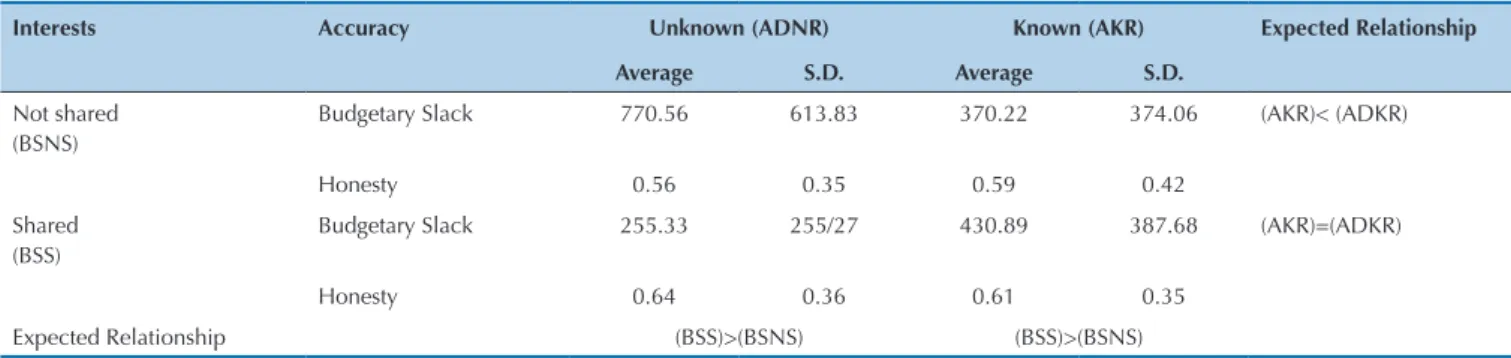
the accuracy of budget reports. Accuracy was measured in each of the six stages of the irst part of the experiment, resul-ting in the means and standard deviations shown in Table 2.
5 DESCRIPTION AND ANALYSIS OF THE RESULTS
5.1 Results of the First Part of the Experiment
he irst part of the experiment aimed to test the hypothe-ses of this study by investigating how shared interests afectedTable 2 shows significant variation in the means for each experimental condition. When the benefits of slack are not shared, managers tend to create greater budgeta-ry slack when the assistant is unaware of the creation of slack (mean slack of 770.56 and mean honesty index of 0.56) than in the situation in which the assistant is aware of the creation of slack (mean slack of 370.22 and mean honesty index of 0.59).
Although the mean honesty indices in these experi-mental conditions were similar (0.56 and 0.59), the stan-dard deviation shows that when the assistant is aware of the manager’s reporting behavior, the honesty index is up to 0.42 away from the mean index, which indicates high variability between the budgeted amounts. That is, although 18 managers presented budget reports without slack, 9 managers presented reports that included the maximum allowable slack. When the assistant is unawa-re of the manager’s unawa-reporting behavior, theunawa-re is a stan-dard deviation of 0.35. In this situation, only 6 managers opted for a budget without slack; the remaining mana-gers created slack in their reports at various levels within the permitted values.
When the manager shares the budgetary slack, the results show a higher mean slack when the assistant is aware of the manager’s reporting behavior (430.89). In this situation, 23 managers have an honesty index hi-gher than the mean index (0.61) and the other 22 ma-nagers exhibit lower indices, with a standard deviation of 0.35 relative to the mean honesty index. Under this experimental condition, managers showed greater accu-racy when the assistant was not aware of the situation,
with an honesty index of 0.64. Despite the variability of the indices observed in the standard deviation (0.36), 29 managers chose to prepare their budgets without slack in this situation, and only 6 created the maximum per-mitted amount of slack.
he higher means observed in situations in which slack is not shared and the assistant is not aware of the manager’s reporting shows that in the sample studied, the manager’s personal interest and his/her concern about the impression made on the assistants prevailed. hese results are incon-sistent with the fundamentals of the moral disengagement theory (Bandura, 1990, 1999, 2002), which suggests that the practice of increasing budgetary slack is attributable to the common interest justiication. his inconsistency re-quires a more in-depth analysis and discussion to determi-ne whether that hypothesis is rejected or not.
To test hypothesis H1, a t-test to assess the homosce-dasticity of the data was performed. he t-test showed signiicance at the 5% level for the slack variable. For the honesty variable, the t-test showed a high variability of variances between groups, without signiicance. Next, in line with Church et al. (2012), an ANOVA was conduc-ted with slack and honesty as the dependent variables and sharing and not sharing as the independent variables.
The statistical results are described in Table 3. Table 3 also presents the results of the Kruskal-Wallis test, whi-ch is a non-parametric tewhi-chnique that was used to con-firm acceptance or rejection of the hypotheses because certain data are not normally distributed for the two independent variables analyzed in this situation. This technique was also applied to test the other hypotheses.
Interests Accuracy <URUV^U(+59 2UV^U(29 ,_WLJ[LK9LSH[PVUZOPW
(]LYHNL :+ (]LYHNL :+
Not shared (BSNS)
Budgetary Slack 770.56 613.83 370.22 374.06 (AKR)< (ADKR)
Honesty 0.56 0.35 0.59 0.42
Shared (BSS)
Budgetary Slack 255.33 255/27 430.89 387.68 (AKR)=(ADKR)
Honesty 0.64 0.36 0.61 0.35
Expected Relationship (BSS)>(BSNS) (BSS)>(BSNS)
Source: Study data.
Table 3 shows signiicance at the 5% level for the con-dition in which budgetary slack is shared with the as-sistant, with an F-Statistic of 11.331 and signiicance of 0.001. With respect to honesty, the F-Statistic of 0.745 and signiicance of 0.389 did not reach the 5% level of signii -cance, indicating high variance of the indices between the situations analyzed. hese results were conirmed by the non-parametric test, which suggests a trend in the data.
Despite the smaller variation between the mean ac-curacy values (0.654 and 0.696) than between the mean slack values (684.34 and 413.93), the results suggest that managers report with less accuracy when the benefit of slack is not shared with assistants. Thus, hypothesis H1, which assumes that managers report with less accuracy when the benefit of slack is shared with assistants than when the benefit of slack is not shared, is rejected.
These results conflict with Bandura’s (1990, 1999, 2002) argument that shared interest in slack provides a justification for managers to create higher budgetary
slack values and prepare less accurate budget reports. The managers’ behavior in this study indicates that the creation of higher levels of budgetary slack is aligned with self-interest and not with self-justification based on the collective good, as proposed by the moral disengage-ment theory (Bandura, 1990, 1999, 2002).
The second set of hypotheses aims to test whether managers report with greater accuracy when their assis-tants are aware of the managers’ reporting behavior and the benefit of the slack is not shared (H2a) and whether the accuracy of the budget reports is unaffected by the assistants’ knowledge of the managers’ reporting beha-vior when the benefit of slack is shared (H2b). The t-test performed showed homoscedasticity of the data for both slack and honesty.
Table 4 presents the results of the statistical tests rela-ted to whether the accuracy of budget reports is affecrela-ted by the assistant’s ignorance/knowledge of budgetary sla-ck when the benefits of slasla-ck are not shared (H2a).
Table 4 shows that the ANOVA test presents a sta-tistical explanation for the variation between the condi-tions analyzed (does not know and knows), with an F--Statistic of 13.957 and significance of 0.000 for the slack variable. Therefore, if the benefit of slack is not shared with assistants and assistants do not know the managers’ reporting behavior, managers tend to have lower indices of honesty (0.665) than when assistants have knowledge of the managers’ reporting behavior (0.713). These re-sults do not allow the rejection of hypothesis H2a and are consistent with the results of Abul-Ezz and Dickhaut
(1993), which show the influence of social norms on in-dividuals’ behavior, and of Church et al. (2012), which highlight managers’ concerns about conveying an op-portunistic and selfish image to their assistants.
The analysis of whether the accuracy of the manager’s report is unaffected by the assistant’s awareness of the manager’s reporting behavior when the benefit of slack is shared (H2b) shows a homogeneous distribution for the slack variable but not for the honesty variable, due to the variability of variances, as shown in Table 5. Table 5 also shows the results for the non-parametric test. ,_WLJ[LK9LSH[PVUZOPW!
Slack (BSS) > (BSNS) Honesty (BSS) < (BSNS)
Mean
ANOVA Parametric Test Non-Parametric Test – Kruskal-Wallis
F :PN 9HURPUN Q :PN
Budgetary Slack Not shared (BSNS) 684.34 11.331 0.001 99.88 5.951 0.015
Shared (BSS) 413.93 81.12
Honesty Not shared (BSNS) 0.654 0.745 0.389 87.70 0.532 0.466
Shared (BSS) 0.696 93.30
Source: Study data.
Table 3 Accuracy in sharing budgetary slack
,_WLJ[LK9LSH[PVUZOPW! Slack (BSNS, AKR) > (BSNS, ADKR) Honesty (BSNS, AKR) > (BSNS, ADKR)
Mean ANOVA F :0.
Slack (BSNS)
Does not know (ADKR) 954.97 Between groups 13.957 0.000
Knows (AKR) 482.60 In group
Honesty (BSNS) Does not know (ADKR) 0.665 Between groups 0.125 0.724
Knows (AKR) 0.713 In group
Source: Study data.
he descriptive results and ANOVA test shown in Ta-ble 5 lead to the rejection of hypothesis H2b because the F-Statistic of 6.437 and signiicance of 0.013 indicate
sig-niicant coeicients for slack but do not show signii
can-ce for honesty, given the variability of the variancan-ce. he diference between the values of budgeted slack when the assistant is not aware of the manager’s reporting behavior (255.33) and when the assistant is aware of the manager’s reporting behavior (430.88) indicates that the accuracy of budget reports is afected by the assistant’s knowledge, even if the beneit of slack is shared.
The results for the second set of hypotheses (H2a and H2b) are in line with Hsee’s theory of elasticity (1995, 1996), which predicts that the manager’s reporting behavior is influenced by whether the assistant knows or does not know of the creation of slack, which affects the elasticity of the manager’s actions.
he rejection of hypothesis H2b is noteworthy. According to Bandura (1990, 1999, 2002), the sharing of slack provides self-justiication for the preparation of less accurate budget reports. However, the evidence in this study reveals that the managers were more concerned about group regulation (Abul-Ezz & Dickhaut, 1993; Rankin et al., 2005; Church et al., 2012) than about self-regulation (Bandura, 1999, 2002).
5.2 Results of the Second Part of the
Experiment
The second part of the experiment tested the theory of elasticity by analyzing whether the assistants’ prefe-rences regarding slack influenced managers’ reporting behavior (Hsee, 1995, 1996). To this end, the assistants were asked to indicate the extent to which they agreed that the budget should be inflated.
Of the 45 assistants participating in the experiment, 21 respondents indicated a preference for budgets wi-thout slack, fourteen respondents indicated a preference for budgets with slack, and 10 respondents indicated in-difference to the inclusion of budgetary slack.
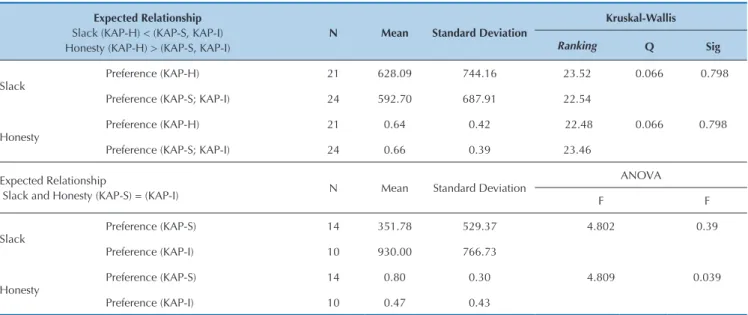
Each assistant was randomly assigned to a manager, and each manager was made aware of his/her assistant’s preference regarding slack. Then, the manager prepared a budget report with knowledge of the assistant’s opi-nion. A means test was conducted to determine the nor-mality of the variables and to guide the selection of the statistical technique that best fit the data. Table 6 pre-sents the results of the tests that contribute to the analy-sis of hypotheses H3 and H4.
,_WLJ[LK9LSH[PVUZOPW!
Slack and Honesty (BSS, AKR)=(BSS, ADKR) Mean
ANOVA Parametric Test Non-Parametric Test – Kruskal-Wallis
F :PN Ranking Q :PN
Slack (BSS)
Does not know (ADKR) 255.33 6.437 0.013 40.43 3.466 0.063
Knows (AKR) 430.88 50.57
Honesty (BSS)
Does not know (ADKR) 0.634 0.122 0.728 46.96 0.286 0.593
Knows (AKR) 0.607 44.04
Source: Study data.
Table 5 Accuracy when slack is shared according to assistant’s ignorance/knowledge of budgetary slack
,_WLJ[LK9LSH[PVUZOPW Slack (KAP-H) < (KAP-S, KAP-I) Honesty (KAP-H) > (KAP-S, KAP-I)
N Mean :[HUKHYK+L]PH[PVU
Kruskal-Wallis
Ranking Q :PN
Slack
Preference (KAP-H) 21 628.09 744.16 23.52 0.066 0.798
Preference (KAP-S; KAP-I) 24 592.70 687.91 22.54
Honesty
Preference (KAP-H) 21 0.64 0.42 22.48 0.066 0.798
Preference (KAP-S; KAP-I) 24 0.66 0.39 23.46
Expected Relationship
Slack and Honesty (KAP-S) = (KAP-I) N Mean Standard Deviation
ANOVA
F F
Slack
Preference (KAP-S) 14 351.78 529.37 4.802 0.39
Preference (KAP-I) 10 930.00 766.73
Honesty
Preference (KAP-S) 14 0.80 0.30 4.809 0.039
Preference (KAP-I) 10 0.47 0.43
Source: Data from study.
Table 6 shows that the managers who know that their assistants preferred honest budgets (mean 0.64 and stan-dard deviation 0.42) present less accurate budget reports (mean 628.09 and standard deviation 744.16). This fin-ding contradicts H3’s prediction that the budget reports prepared by managers who know that their assistants prefer honest budgets will be more accurate than the budget reports prepared by managers who know that their assistants either prefer slack or are indifferent to slack. However, according to the Kruskal-Wallis test (a nonparametric test, given the non-normality of the data), there is no significant difference between the three situations, which does not allow hypothesis H3 to be rejected.
herefore, the results indicate that the creation of slack by participant-managers in this experiment is not linked with self-justiication based on their assistants’ preferen-ces for slack, which contradicts the theory of elasticity (Hsee, 1995). he results difer from what is expected, namely, that slack would be smaller when the manager is aware of the assistant’s preference for honest budgets (KAP-H) than when the manager knows that the assistant prefers budgets with slack (KAP- S) or that the assistant is indiferent to the inclusion of budgetary slack (KAP-I).
Hypothesis H4 predicts that the accuracy of budget reports does not differ between managers who know that their assistants prefer the inclusion of slack in budgets and managers who know that their assistants are indi-fferent to the practice of slack. However, the application of the ANOVA statistical test (a parametric test, given the normality of the data) shows higher mean slack va-lues (mean 930.00 and standard deviation 766.73) and a lower honesty index (mean 0.47 and standard deviation 0.43) when the manager knows that the assistant is indi-fferent to slack. In addition, the difference between the observed situations is significant at the 5% level, which leads to the rejection of H4.
These results suggest that as in the previous situa-tion, the managers’ reporting behavior does not align with their assistants’ preference regarding slack, which is inconsistent with the theory of elasticity (Hsee, 1995). Thus, the result differs from the prediction that slack would not differ between managers who are aware of their assistants’ preference for budgets with slack (KAP--S) and managers who know that their assistants are in-different to slack (KAP-I).
In sum, the results obtained in the second part of the experiment are not consistent with either the moral di-sengagement theory (Bandura, 1990, 1999, 2002) or the theory of elasticity (Hsee, 1995, 1996). This inconsis-tency suggests that the budget process in the second part of the experiment may have been influenced by other va-riables, such as the above-mentioned limitations of the experimental design or even the specific characteristics of the study participants given the organizational culture of which they are part. This issue provides an interesting field for future research.
To finish the experiment, a post-experiment questio-nnaire was administered to the managers to determine the extent to which they cared about their assistants’ preferences regarding the creation of slack when prepa-ring the budgets. Of the 45 respondents, the vast majo-rity (38 managers) indicated that they considered their assistant’s opinion to be very important.
However, when comparing the questionnaire respon-ses with the statistics presented in Table 6, it appears that the highest slack means occur when the manager knows that the assistant prefers honest budgets (without slack), which indicates that the managers’ reporting behavior is based on their own interests and that the assistants’ preference for slack is not necessarily used as a justifica-tion factor for slack creajustifica-tion (Hsee, 1995). These results may reflect a unique characteristic of the sample, which indicates the need for further studies.
6 FINAL CONSIDERATIONS
This study investigated how shared interests in bud-getary slack affect the accuracy of budget reports. Ex-perimental research was conducted on a sample of 90 employees with management and leadership roles in a production cooperative in the South of Brazil. Data col-lection was accomplished using the procedures of the study by Church et al. (2012), with certain adjustments. In the statistical analysis of the data, the means and stan-dard deviations were calculated to determine the slack and the level of accuracy of the budgets, and ANOVA and Kruskal-Wallis tests were used to test the hypothe-ses in each of the two stages of the experiment.
he results of the irst part of the experiment show great variation among the means of each experimental condition. For example, when slack is not shared, the
ac-curacy index for budgets is lower (more slack was crea-ted) when the assistant does not have knowledge of the manager’s reporting behavior than when the assistant has knowledge of manager’s reporting behavior. When slack is shared, the results showed a higher mean slack when the assistant is aware of the manager’s reporting behavior.