Quality Determinants of Independent Audits of Banks
José Alves Dantas
Adjunct Professor, Department of Accounting and Actuarial Sciences, University of Brasília E-mail: [email protected]
Otavio Ribeiro de Medeiros
Full Professor, Department of Accounting and Actuarial Sciences, University of Brasília E-mail: [email protected]
Received on 03.14.2014 – Desk Acceptance on 03.19.2014 – 2nd version accepted on 07.23.2014.
ABSTRACT
Since DeAngelo’s study (1981) on audit quality, the latter has been a topic well discussed in the international accounting literature; however, there is little evidence about audit quality in the financial market. In Brazil, studies on audit quality began only in the 2000s, although without a specific focus on banks. The purpose of this study was to identify the quality determinants of audit work in Brazilian banking institutions. Using the practice of earnings management as a proxy for audit quality - more specifically, the discretionary accruals related to the process of the constitution of the Loan Loss Provision (LLP) - tests were performed based on the quarterly information of commercial and multiple-service banks and savings banks from 2001 to 2012. Empirical tests have shown that the quality of audit work has several types of relationships as follows: negative with the client importance level for the auditor; negative with the works after the sixth year of the contract; positive with the establishment of the Audit Committee by the banks; positive with the judgment of punitive administrative proceedings against independent auditors; and positive with the level of rigor of the regulatory environment. Of the tested hypotheses, three were not confirmed empirically. The first hypothesis predicted an association between audit quality and the auditor degree of specialization in the banking industry. The second hypothesis predicted that audit quality would be negatively correlated with the degree of concentration of audit activity within the National Financial System (Sistema Financeiro Nacional - SFN). The third hypothesis predicted that audit quality would be lower when the auditor-client relationship is of a short term. The results of the study contribute to the debate concerning the role of auditors in the transparency and solidity of the financial system, including their role as a complementary or auxiliary supervisor.
Keywords: Audit. Quality. Manipulation. Discretion. Banks.
1 INTRODUCTION
and the reliability of financial reporting is an essential condition for the functioning of the banking system, as financial institutions are exposed to the risk of “bank run” in the case of suspicion by depositors. In summary, there is an objective link between the mission of auditors to ensure the reliability of the information and stability of the banking system, given their significant impact on the national economy.
he importance of studies on audit quality in the i-nancial system, particularly in Brazil, can be exempliied by that among the most emblematic cases of audit failu-res discussed in the national media are the cases of fraud committed by banks, such as the cases of the Nacional, Noroeste and Panamericano banks, which resulted in questions relating to their auditors - KPMG, PWC and Deloitte, respectively.
Notwithstanding this situation and the ample space that the issue of audit quality has garnered in the inter-national accounting literature since DeAngelo’s study (1981), there is little evidence of studies that deal speci-ically with audit quality in the inancial market, as no-ted by Kanagaretnam, Lim and Lobo (2010) and Zagonov (2011). In Brazil, starting only in the late 2000s, studies concerning audit quality1 began to be conducted, but with
a speciic focus on banking institutions; Santos (2008) se-ems to be an exception.
Given this context, the present study aims to identify the quality determinants2 of the works undertaken by
in-dependent auditors at banking institutions of the National Financial System (Sistema Financeiro Nacional - SFN). By contributing to a better understanding of audit work in the banking environment, and illing a gap in the literature in this regard, the present study is supported by the precepts of the Basel Committee (BCBS, 2008) that the complexi-ty of the inancial market and demand for an increase in transparency suggest that clear and reliable accounting in-formation, supported by quality audits, is essential to incre-ase market conidence.
To conduct empirical tests, the present study uses data from the Quarterly Financial Information of commercial, multiple-service and savings banks, available on the websi-te of the Central Bank of Brazil (Banco Central do Brasil - BCB), considering the period 2001–2012.
he performance of independent auditors is deemed fundamental to the functioning of the inancial and capital markets based on the assumption that, by issuing an opinion on the reliability of accounting information, it contributes to a business environment characterized by trust and cre-dibility (Newman, Patterson & Smith, 2005; Ojo, 2008; Ba-sel Committee on Banking Supervision [BCBS], 2008; Za-gonov, 2011). However, with the corporate scandals at the start of the century, characterized by fraud and accounting manipulation, much has been discussed about the scope of responsibilities of auditors, given that opinion on inancial statements has not changed.
he most important reaction to these scandals was the enactment, in the United States (USA), of the Sarbanes--Oxley Act, which reduced the self-regulation power of auditors, creating the Public Company Accounting Over-sight Board (PCAOB) with the task of regulating the pro-fession, setting norms and enforcing professional discipli-ne (Cofee, 2004).
he irst large test of this regulatory framework was the global inancial crisis of 2008, when auditors were questio-ned for not anticipating the banking problems. In the asses-sments of the determinants of the crisis, the supervising au-thorities strongly questioned the role of auditors, and cited a “worrying lack of skepticism” of the profession (Sanderson, 2010). In the case of the crash of Lehman Brothers, for exam-ple, investigation reports indicate that the institution mani-pulated inancial reports using accounting artiices to hide debts, the reason why Ernst & Young (E&Y) was accused of serious mistakes that contributed to what had happened (BBC Brazil, 2010).
Concerns regarding the occurrence of audit failures in the banking system are discussed by the Basel Committee on Banking Supervision (BCBS, 2008), which highlighted the need for greater conidence by bank supervisors regar-ding the audited information and character of large audit companies, due to issues such as the increasing complexity of accounting norms and inancial instruments, as well as changes associated with the estimation of the fair value.
This concern by bank supervisors is justified, parti-cularly because the performance of independent audi-tors has a direct relationship with the purpose of ensu-ring the credibility of the financial reporting process,
1 This is the case, for example, of Souza (2007), Oliveira and Santos (2007), Almeida and Almeida (2009), Martinez and Reis (2010) and Silva and Bezerra (2010).
2 Importantly, audit quality is not necessarily a dichotomous situation—it has or does not have quality. In the present study, the use of this term intends to focus on grading the audit quality.
2 THEORETICAL FRAMEWORK
2.1 Audit Quality - Measurement.
As discussed, a quality audit is an essential tool for the functioning of the inancial and capital markets, contri-buting to an environment of conidence and credibility. However, what is a quality audit, and how is it
According to Dye (1993), audit quality is not infor-mation disclosed at the time it is performed, and even a posteriori, it is not made public for cases of clients who do not face inancial diiculties, considering that there will be no reason or evidence for questioning the auditors’ work. Reinforcing this understanding, Pae and Yoo (2001) em-phasize that the auditor is questioned only when (i) the statement prepared by management is distorted; (ii) the auditor provides a positive opinion on these distorted in-formation; (iii) the investor, relying on this information, makes a decision to invest in the company; and (iv) the ex-pected return is not conirmed. Only when these four con-ditions are observed is the auditor questioned.
his diiculty in measuring audit quality is reinforced by the statement of the BCBS (2008) that there are no tools to objectively measure audit quality, despite the continued eforts in this direction. he concern about the parameters for assessing audit quality can also be extracted from the conclusions of the United States Treasury Department’s Advisory Committee on the Auditing Profession (ACAP), established to formulate suggestions for strengthening au-dits. One of the recommendations is for the PCAOB to de-velop and monitor key indicators of audit quality (Carcello, Bedard, & Hermanson, 2009).
With this objective diiculty (or even impossibility) of simultaneously measuring and verifying audit quality, studies evaluating this issue need to use proxies, based on some information from the audit process (the few available ones), for market variables and accounting information.
2.2 “Real” Quality versus “Perceived” Quality.
Dang (2004) classiies the proxies for audit quality me-trics into two groups: those that seek to relect the “actual” audit quality and those summarizing the audit quality “per-ceived” by the market.
It should be emphasized that “actual quality” cannot be understood as an absolute. he term is used because quality is measured from ex post information, indicative of proble-ms in relation to statements such as: restatement determi-nations by the regulator, as in Dang (2004) and Braunbeck (2010); voluntary restatement as in Dang (2004); litigation against the auditor arising from lawsuits or administrative penalties, as in Palmrose (1988) and Braunbeck (2010); and inding material distortions in inancial statements without a modiied opinion in the auditor’s report, as in Geiger and Raghunandan (2002).
he premise for using these variables in the estimation of audit quality is that the very occurrence of these factors would be evidence that the auditor did not fulill his role properly. Although these ex post measures represent audit problems more objectively, they also have limitations. he irst is that they fail to capture evidence that serves to si-multaneously estimate the quality of the audit. he second is that, even a posteriori, they cannot capture all the pos-sible problems of low-quality audits - materially-distorted statements, if not discovered by regulatory bodies, are trea-ted as evidence of a high-quality audit. he third limitation is that the same audit can be treated as high or low
quali-ty, depending on the time when the study was conducted - whether before or ater a restatement or litigation. he fourth is that it is not always possible to identify the cause and efect relationship in these measures; a restatement de-cision, for example, may be due to an auditor’s caveat - i.e., the auditor’s performance is what may have induced the regulator’s action.
Although several studies have sought to measure “ac-tual” audit quality, what has prevailed in the literature, since DeAngelo’s study (1981), are the metrics that try to capture “perceived” audit quality, such as: (i) the auditor’s size, particularly big-N, as in DeAngelo (1981), Teoh and Wong (1993), Dang (2004), Gu, Lee and Rosett (2005), Behn, Choi and Kang (2008), Kanagaretnam, Krishnan and Lobo (2009, 2010), and Zagonov (2011); (ii) auditor specialization, as in Behn et al. (2008), Chambers and Payne (2008), Romanus, Maher and Fleming (2008) and Kanagaretnam, Krishnan et al. (2009, 2010); (iii) coei-cient of the response of the stock price to the accounting results, as in Teoh and Wong (1993) and Ghosh and Moon (2005); and (iv) errors in the projections of managers or analysts, as in Dang (2004) and Behn et al. (2008).
Despite the large number of studies with these proxies, particularly those that use the dichotomous variable big-N, the debate continues on their ability to capture the actual audit quality. Dang (2004) argues that audit failures reve-aled in cases such as those of Enron, Waste Management and WorldCom cast doubt on the positive relationship be-tween audit irm size and quality. Another problem is that, by using dichotomous variables as proxies for audit quality, according to Dang (2004), two problematic assumptions are made: the irst one is that the audit irm would perform audits for diferent clients and at diferent periods of time, with the same quality level; the second is that the quality of a group of auditors - big-N or non-big-N, for example - would be homogeneous.
2.3 Auditor Quality versus Audit Quality.
he issue concerning how to address quality proxies leads to another discussion in the literature on the to-pic: the quality of audit irms versus the quality of audit services. When DeAngelo (1981) deines audit quality as the probability perceived by the market that a given audi-tor will detect material disaudi-tortions (technical expertise) in the client’s statements and that the auditor will report such problems (independence to give opinion), the focus is obviously on the auditor.
2.4 Information Quality - Audit Quality.
If there is no consensus in the literature regarding the measure used as a proxy for audit quality, it is reasonable to state that audit quality should be linked to the quality of the statements. his is because any material distortions in the information produced by management would be previou-sly ixed by the action of auditors. herefore, one would assume that a measure that measures the quality of accoun-ting information also relects the quality of the audit.
In this regard, a measure widely used as a benchmark for audit quality is to identify the practice of earnings ma-nagement - more speciically, through discretionary accru-als. It integrates the set of the most listed measures in the literature on audit quality, along with the auditor’s size and expertise (Gul, Fung & Bikki, 2009). According to Braun-beck (2010), studies examining the quality of audits based on the quality of accounting information consider an intui-tive reasoning: the better the quality of the audit, the higher the quality of the information disclosed.
he use of this proxy of audit quality is based on the premise that the auditor is responsible for ensuring a true, fair and neutral inancial disclosure, avoiding opportunis-tic manipulation by management. Among the studies that used this variable somehow in the analysis of audit qua-lity, the following can be cited: Heninger (2001), Gover-nment Accountability Oice - GAO (2003, 2008), Dang (2004), Venkataraman, Weber, and Willemborg (2008), Chambers and Payne (2008), Kanagaretnam, Krishnan et al. (2009, 2010), Silva and Bezerra (2010), Kanagaretnam, Lim et al. (2010), and Siregar, Amarullah, Wibowo and Anggraita (2012).
Heninger (2001) advocates the use of earnings mana-gement as a proxy for audit quality because this practice compromises the quality of inancial disclosure, which has been worrying regulators. Kallapur, Sankaraguruswamy and Zang (2010) reinforce this understanding, arguing that it allows for a more comprehensive analysis of the problem, not limited to exceptional situations, such as cases of res-tatements or ongoing problems. Dang (2004) combines both measures, claiming that high-quality audits increase the possibility of detecting and preventing the practice of earnings management. According to this logic, if accoun-ting proits deriving from earnings management are seen as lower quality, then those auditors who do not detect and act to mitigate this practice should be seen as lower quality auditors. Evidence of the association between these pheno-mena can be inferred from the inding that auditors inten-sify eforts and increase the price charged for their services
when they identify evidence of accounting manipulation risk (Bedard & Johnstone, 2004).
Heninger (2001), without classifying earnings mana-gement as fraud, notes that this practice is a direct inter-vention in inancial disclosure, with the intent of gaining advantage for speciic agents, rather than a neutral me-chanism of disclosure. In this sense, agents interested in accounting information expect auditors to limit this prac-tice and reinforce fair and true inancial disclosure. If the manager inlates the results to hide unfavorable informa-tion, and the auditor does not mitigate this manipulainforma-tion, then the inancial reports do not provide warning of po-tential problems.
Finally, another aspect to be highlighted to demons-trate the relevance of quality measurements of inancial information for estimating audit quality is that even stu-dies using measures such as the size of the audit company (big-N) or auditor specialization as proxies of quality adopt a standard procedure to test the relationship betwe-en these measures and the level of discretionary accruals when they need to conirm the validity of these metrics. his was the case, for example, for Kanagaretnam, Krish-nan et al. (2009, 2010) and Martinez and Reis (2010), among others.
2.5 Auditors’ Responses to Earnings
Management.
Considering earnings management as a non-neutral inancial disclosure resulting from an intentional interven-tion of managers to produce some private gain (Schipper, 1989), associated with the precept that the auditor is res-ponsible for acting on the assumption of ensuring non mis-leading disclosure, it becomes evident that this professional is accountable for acting to restrict/limit the actions that may be characterized as manipulative of the actual econo-mic-inancial situation of the company.
his understanding of the role of auditors as agents mi-tigating the discretionary action of management on inan-cial disclosure is reinforced, among others, by Vincent et al. (2003) and Kanagaretnam, Lim et al. (2010).
Dang (2004) summarizes the relationship between audit and earnings management by stating that the role of the auditor is to mitigate the information asymmetry between the parties, which is why audit quality should be related to lower levels of asymmetry and uncertainty re-garding the performance of the entity. hus, the author concludes, audit quality should be negatively related to earnings management.
3. DEVELOPMENT OF RESEARCH HYPOTHESES
3.1 Auditor Specialization.
Using the assumption that knowledge concerning the client and his business increases the auditor’s ability to identify potential material distortion, authors such as Behn et al. (2008) and Romanus et al. (2008) use the level of
his understanding is reinforced by Gul, Fung and Bikki (2009) and Chambers and Payne (2008), in stating that au-ditor specialization in a given industry leads them to have a broader understanding of accounting practices and trends in the segment, increasing their ability to evaluate evidence and identify problems in the statements. he results found by Carcello and Nagy (2004) and Krishnan (2005) also indicate that auditor specialization is an element that enhances the quality of inancial disclosure and mitigates the probability of fraudulent statements.
Particularly, regarding the banking industry, Kanagare-tnam, Lim et al. (2010) emphasize that auditors who are experts in the banking industry can assess more appropria-tely the suitability of the information produced by mana-gement. An example of this relationship is given by Kana-garetnam, Krishnan et al. (2009) who, when examining the role of auditor reputation on audit quality perceived by the market, found a positive association between the discretion of the Loan Loss Provision (LLP) with the stock returns of banks audited by companies with greater expertise in the banking industry.
Given the above, the following research hypothesis is formulated:
H1: he quality of audits conducted in Brazilian banks is positively related to the degree of auditor specialization in the industry.
3.2 Importance of the Client for the Auditor
Portfolio.
Another aspect that can inluence audit quality derives from the airmation of Murcia and Borba (2007) that the conlict of interest in the relationship between the auditor and audited company, which hires and pays the auditor, can inluence, in some cases, the content of the report (opinion). Nelson, Elliott and Tarpley (2002) address this issue by no-ting that the requirement to maintain and expand busines-ses and client relationships may compromise objectivity and professional independence. he marketing issue is also hi-ghlighted by Cofee (2004) as a reason for the auditors, in certain situations and under certain conditions, to agree with the client, taking on the cost of any lawsuit losses and risk of some public humiliation.
One aspect that may explain this behavior, though not justi-iable, is the degree of importance of the client to the audit irm, making the irm more compromising with the client’s deman-ds. his perception is highlighted by DeAngelo (1981), Cham-bers and Payne (2008) and Amir, Guan and Livne (2010), in stating that the economic dependence between auditors and their clients may increase when one of these clients accounts for a relevant portion of the auditor’s income and may inluen-ce the independeninluen-ce and professional skepticism of the latter.
his concern is consistent with the evidence gathered by Nelson et al. (2002) from reports of earnings manage-ment attempts experienced by 253 auditors of the big ive. Among the indings, it was found that auditors are more likely to require adjustments of these attempts when they are attempted by smaller clients, indicating that the impor-tance of the client interferes with the auditor’s simpor-tance.
Speciically addressing bank audits, Ojo (2006) reinforces this understanding by emphasizing that the possibility of com-promising lucrative contracts may lead the auditor to think twice before issuing an opinion adverse to the interests of the institution.
Considering this context, the following research hypothesis is formulated:
H2: he quality of audits conducted in Brazilian banks is negatively related with the level of importance of the client to the audit irm.
3.3 Length of Contract between the Auditor and
Financial Institution.
By relating the issue of professional skepticism to audit quality, Lys and Watts (1994) argue that long-term auditor--client relationships tend to reduce professional indepen-dence, which should be relected in the quality of the audit. he interaction between auditor and client is also underlined by Demski (2004) as one of the elements that may be impor-tant in the performance of the audit work. To prevent such situations, the idea of a mandatory rotation of auditors has been discussed, the purpose of which would be, according to Nagy (2005), to limit the relationship between auditors and clients, assuming that when this relationship lasts a long time, professional independence could be compromised.
Siregar et al. (2012), however, note distinct nuances in relation to audit tenure. For them, the early years of contracts may be perceived as less effective, considering it takes time to evaluate audit risks, whereas maintaining the contract for a long period of time may compromise professional skepticism. Due to this duality, several stu-dies have tested the relationship between audit tenure and audit quality, without homogeneous results. As an example, Ghosh and Moon (2005) found a positive re-lationship between the length of the auditor-client con-tract and audit quality, defined by the response coeffi-cient of return-earnings regressions, while Dao, Mishra and Raghunandan (2008) found an inverse relationship between audit tenure and the ratification of auditors by shareholders, indicating that shareholders see the long length of relationships as an element that negatively affects the quality of the audit.
In the Brazilian market, some studies tested the im-pact of the quality of accounting information caused by the length of the auditor-client relationship, with a par-ticular emphasis on the rotation of auditors - for exam-ple, Oliveira and Santos (2007), Santos (2008), Silva and Bezerra (2010) and Martinez and Reis (2010) - without finding consistent results regarding the expected pattern that may be representative of a conclusive opinion on the subject.
Given this duality, two research hypotheses are formulated: H3A: he quality of audits conducted in Brazilian banks is negatively associated with the auditor-client short-term relationship.
3.4 Presence of the Audit Committee.
Given the essential condition of independence for the quality of the auditors’ works, an instrument that has been increasingly used, mainly since the Sarbanes-Oxley Act (SOX), in the sense of contributing for this indepen-dence to be effective, is the institution of the so-called audit committees. According to Borgeth (2007), the gre-at purpose of cregre-ating the committee is to mitiggre-ate the risk of connivance between management and indepen-dent auditors.
In this context, despite concerns about the efectiveness and objectivity of the Audit Committee (Smith, 2006), in-cluding the method of compensation of its members that may create incentives to overvalue the company’s shares or increase the proit (Magilke, Mayhew & Pike, 2009), it is expected that the Committee’s performance contributes to the quality of audits, strengthening the capacity related to implementing professional skepticism of the indepen-dent auditor. his provides support to the following rese-arch hypothesis:
H4: he quality of audits conducted in Brazilian banks is positively related with the existence of an Audit Commit-tee at the institution.
3.5 Concentration of Audit Market.
Although it is a historical characteristic, the concen-tration of the audit market has drawn the attention of the authorities. In the SOX, for example, it was determined that the Government Accountability Oice (GAO) would study the implications of the consolidation of this market regarding competition, the client choice process, the remu-neration charged by auditors and audit quality. he GAO (2003) concluded that although it found no evidence of restrictions on competition, relevant changes in the profes-sion may have implications for competition and choice of companies. Regarding the quality of the audits conducted, no statistically signiicant relationship with the degree of concentration was found. Five years later, the GAO (2008) conducted another study in which the indings of the irst one were repeated.
Regarding the impact of this concentration on the quali-ty of audits, Ojo (2008) highlights that while some evidence supports that concentration encourages specialization, re-ducing the risk of distorted statements, other indings show that having a greater number of audit companies reduces the risk that a dominant company may establish practices en-couraging low-quality inancial statements. Kallapur et al. (2010), however, examined whether market concentration would undermine audit quality, inding a positive associa-tion between the increase of concentraassocia-tion and quality of accounting information, a proxy of audit quality.
In the present study, it is assumed that market concentra-tion compromises the degree of auditor skepticism, conside-ring the potential “accommodation” resulting from the lack of competition, with the following research hypothesis being formulated, to be tested empirically:
H5: he quality of audits conducted in Brazilian banks
is negatively related with the degree of concentration of the audit market in the sector.
3.6 Litigation Risk.
In the early 1990s, Dye (1993) highlighted that the audit market in the USA was experiencing strong trans-formations, including a major increase in lawsuits against auditors. Regarding this litigation risk, Ojo (2008) em-phasizes that its efects may assume two forms. On the one hand, litigation risk may create economic incentives for auditors to relect on the consequences of their ac-tions, reducing the possibility of being indulgent in acts with negative consequences. On the other hand, it may increase the tendency to adopt a defensive audit - in whi-ch prescribed rules are interpreted, primarily by the exer-cise of subjective judgment.
he impact of litigation risk on the services provided by audit irms has been assessed over time, as exempliied in the studies by Dye (1993), Heninger (2001) and Talley (2006), acquiring more relevance with the problem of cor-porate scandals. his question is particularly important, gi-ven that, for the auditor, litigation risk is not only a inancial issue but also a reputational one, afecting their credibility.
hus, the following research hypothesis is formulated, to be tested empirically:
H6: he quality of audits conducted in Brazilian banks is positively related with the increased risk of litigation against auditors.
3.7 Rigor of the Regulatory Environment.
According to DeFond, Wong and Li (1999), although not suicient by themselves, it is expected that more ri-gorous norms, with more detailed procedures and assig-nments of responsibility forecasts, afect the behavior of auditors, making them less resilient to the clients’ pressures for aggressive disclosures.
For Besacier, Hottegindre, and Fine-Falcy (2011), au-dit quality is the core of the latest regulatory movements. For them, from a practical point of view, the inancial scandals of the early century, particularly involving Ar-thur Andersen, have demonstrated the inadequacy of the conceptual parameters that underpin audit quality based on the assumptions of independence and competence. For this reason, according to the authors, the regulations expanded the perception of audit quality, covering issues such as the auditor responsibility level, restrictions on consulting services, and characteristics and concentration of the audit market.
Most studies testing the relationship between the regu-latory environment and audit quality concluded a prepon-derance of positive efects of regulation, including Cohen, Dey and Lys (2008), Silva and Robles Junior (2008), Amir, Guan, and Livne (2010), and Read and Feldmann (2010), providing support to the following research hypothesis:
4. METHODOLOGICAL PROCEDURES
4.1 Model for Calculating the Audit Quality
Proxy.
Due to the reasons explained in Section 2, the audit qua-lity proxy used in this study will be based on identifying the practice of earnings management - more speciically, dis-cretionary accruals. he assumption is that opportunistic manipulation compromises the quality of the information and that the inding of this practice indicates that the audi-tor did not fulill their mission of preserving the neutrality of the statements.
Despite the relevance of the logic implicit in this rea-soning, it is important to emphasize some methodologi-cal limitations: (i) unusual non-discretionary factors may also inluence abnormal accruals (Bernard & Skinner, 1996); (ii) discretion by management in the production of information is not necessarily negative, when considering an informational component, which is the communica-tion of private informacommunica-tion of the entity (Kanagaretnam, Krishnan, & Wolf, 2009; Kallapur, Sankaraguruswamy, & Zang, 2010); and (iii) the reversal nature of accruals makes the assumption of a continuous, direct or inverse relationship of accruals with another variable untenable (Gu, Lee & Rosett, 2005).
To address these limitations, the calculation of the proxy will not consider the discretionary accruals, but the difference between two periods in a row - the first difference, in absolute value, according to equation (4.1). Thus, rather than seeking to identify the level of discretionary accruals allowed by the auditors, whether the practice of accruals recognition is changed from one period to another is evaluated. This procedure is
con-sistent with studies that argue for the persistence of ac-cruals as the most appropriate parameter to assess its reliability, as in Chambers and Payne (2008). Finally, this difference is multiplied by (-1) to adjust the metric to precept that, the higher the bias, the worse the audit quality will be. The use of the absolute value and mul-tiplication by (-1) to determine the audit quality proxy is inspired in Kallapur et al. (2010), with the difference that these authors did not work with the concept of the first difference.
AQ
i t,=
DAcc
i t,−
DAcc
i t,−1* ( 1)
−
4.1where: AQi,t is quality of the audit performed in bank i in period t and DAcci,t are the discretionary accruals that correspond the error term of the model (4.2).
he calculation of the variable DAcc, in turn, is based on the identiication of discretion practiced in relation to the LLP, which is the area that recorded the highest number of studies on the practice of earnings management in banks. his concentration is justiied by Kanagaretnam, Lobo and Mathieu (2003) because these allowances represent the lar-gest accruals of banks, playing a key role in decisions by managers about possible accounting manipulations. Ac-cording to Alali and Jaggi (2010), there is a widespread be-lief in the market that bank managers extensively use LLP to manipulate the results reported, which have been a focus of concern by regulators.
To identify this discretion, the model (4.2) developed by Dantas, Medeiros and Lustosa (2013) is used3:
3 The authors incorporated macroeconomic variables and attributes of the loan portfolio to models widely used in the literature and found that the ability to empirically identify the discretion practiced by banks in relation to the constitution of LLP is increased.
where:
LLPi,t: provision for loan losses of bank i in period t;
ΔLOANi,t: change in the value of loans from period t-1 to t of bank i;
NPLi,t-1: nonperforming loans in period t-1 of bank i;
ΔNPLi,t: change in the value of nonperforming loans from pe-riod t-1 to x of bank i;
LCOi,t: net loan write-ofs of bank i in period t; LLAi,t-1: loan loss allowance of bank i in period t-1;
INTi,t: average implicit interest rate of the loan portfolio of bank i in period t, corresponding to the ratio between re-venues from credit operations and the portfolio’s average balance;
GDPt: rate of change in Gross Domestic Product in basic prices, in period t;
<TYPi,t>: vector of control variables representing the propor-tions of loans of bank i in period t distributed into public sec-tor (PUB), private sector (PRV) and non-residents (NRES); <GEOi,t>: vector of control variables representing the
propor-tions of loans of bank i in period t located in the following geographic regions: Southeast (SE), other regions of Brazil (ORB) and overseas (EXT);
<MATi,t>: vector of control variables representing the propor-tions of loans of bank i in period t distributed according to the maturity of loans: up to 5 years (UP5Y), and exceeding 5 years (EX5Y);
<CNCi,t>: vector of control variables representing the propor-tions of loans of bank i in period t distributed in the one hundred largest customers (UP1H), and to other customers (EX1H); and
4.2
β ψ ψ ψ ψ ε
+ GDP + <TYP > + <GEO > + <MAT > + <CNC > +
t i t i t i t i t i t
ε
i t, is the error term, corresponding to the discretiorary portion of LLPi,t of bank i in period t.By adopting a common procedure in quantitative ac-counting studies, such as the one by Kanagaretnam, Lim et al. (2010), the variables LLP, ΔLOAN, NPL, ΔNPL, LCO and LLA are normalized by the total assets at the beginning of the period.
It is important to note that, although the tests are based on inancial information produced by Brazilian banking institutions, prepared in accordance with the standards de-termined by the BCB, which can be deined as rule-based, there is room for management discretion. Resolution 2,682 of the National Monetary Council (Conselho Monetário Nacional - CMN), of December 21, 1999, determines that loan operations should be classiied in an order of increa-sing risk, with a ratio of allowance for losses for each risk level, in accordance with a scale ranging from 0% for risk level AA to 100% for risk level H. As noted by Dantas et
al. (2013), subjectivity derives from the criteria adopted by management to deine this classiication. here is guidance, for example, for banks to consider, among other factors, the economic sector to which corporate debtors belong, as well as aspects relating to the loan operations, such as the nature and purpose of the loan and the amount and characteristics of the guarantee. It should also be noted that institutions may make allowances at a level higher than the minimum required for the rating of the operations, which characte-rizes an additional opportunity for discretion by manage-ment in the composition of the LLP.
4.2 Model for Identifying Determinants of Audit
Quality.
After identifying the audit quality proxy, the next step to test its determinants, based on the research hypo-theses proposed in Section 3, is based on the estimation of model (4.3):
4 To deine a long-term relationship, the parameter considered for the institution of auditor rotation by the Securities and Exchange Commission of Brazil (Comissão de Valores Mobiliários - CVM) is used as a reference—ive years.
5 Following GAO (2003, 2008) and Kallapur et al. (2010). where
AQi,t is the quality of the audit performed in bank i in period t, calculated in accordance with model (4.1);
ASi,t is the degree of auditor specialization in the inancial state-ments of bank i at period t, in the Brazilian banking indus-try, calculated based on the total assets of the audited banks; CIi,t indicates the relative importance of bank i for the
auditor’s client portfolio at period t, calculated according to the total assets of the banks (in the impossibility of ac-cessing the compensation charged from clients); STi,t indicates that, at the time t when the audit was
conduc-ted on bank i, the auditor-client relationship was of short term, assuming 1 for the audits performed during the irst year of contract and 0 for the others;
LTi,t indicates that, at the time t when the audit was conduc-ted on bank i, the auditor-client relationship was of long term, assuming 1 for the audits performed ater the sixth year of contract and 0 for the others4;
ACi,t indicates whether bank i in period t has an established Audit Committee, assuming 1 for entities that have the Committee and 0 for the others;
HHt relects the degree of concentration of audit services in the Brazilian banking industry at period t, calculated through the Herindahl-Hirschman Index5 and based on
the volume of total assets of the banks;
LRt translates the litigation risk against auditors at period t, calculated by the number of punitive administrative
pro-ceedings against the audit irm judged by the BCB and the CVM divided by the number of irms that audited banks during the same period;
<REt> is the vector of variables that measure the level of rigor of the regulatory environment of the audit ma-rket at period t. hree variables that assume dichoto-mous values (dummies) are considered: RE0102 for au-dits conducted between 2001 and 2002; RE0309 for audits conducted between 2003 and 2009, when the terms of CVM Instruction no. 381/2003 and CMN Resolution no. 3081/2003 came into force, establishing a series of requirements to ensure the independence and objectivi-ty of auditors; and RE1012 for audits conducted between 2010 and 2012, when the Federal Accounting Council (Conselho Federal de Contabilidade - CFC) resolution no. 1203/2009 came into force, establishing internatio-nal auditing standards in Brazil;
<CONTi,t> is the vector of control variables to bank i in pe-riod t, used to optimize the empirical evidence of the tests and represents the following: the proitability level - return on assets (ROA); the degree of capitalization - relationship between equity and total assets (CAP); nationality (NAT) - assumed as 1 for national banks and 0 for the others; the origin of the control capital (PUB) - assumed as 1 for banks under state control and 0 for the others; and the lis-ting on the stock exchange (BOV) - assumed as 1 for banks listed on the BM&FBovespa and 0 for the others.
5 CALCULATION AND ANALYSIS OF RESULTS
he empirical tests used data contained in the Quarter-ly Financial Information reports of commercial,
multiple--service and savings banks from 2001 to 2012, available on the BCB website. To ensure the robustness of the results, the
panel data models were estimated by SUR (seemingly unre-lated regression) ixed cross-sectional efects, which provides robust coeicients and standard errors, even in the presence of heteroskedasticity and contemporaneous correlations in the errors of the equations.
5.1 Calculation of the Audit Quality Proxy.
he irst stage of the tests consists of calculating the audit quality proxy, from the application of equation (4.1), which depends on the identiication of discretion in the process of constituting the LLP by the banks, based on model (4.2).
The results shown in Table 1 are consistent with those calculated by Dantas et al. (2013), where detailed analyses on the behavior of the variables can be found. In the present study, the estimation of model (4.2) has the purpose of calculating the variable representing dis-cretionary accruals (the error term), which will be the basis for calculating the audit quality proxy, through
equation (4.1).
5.2 Testing the Determinants of Audit Quality.
Ater estimating the audit quality proxy, the next step is to conduct tests of association of this measure with varia-bles representing auditor incentives, based on model (4.3), to test the research hypotheses.
continue
C ΔLOAN NPL(-1) ΔNPL LCO LLA(-1) INT
0.0111 0.0149 0.1481 0.1291 0.0517 0.0069 0.0047
(0.000) (0.000) (0.000) (0.000) (0.003) (0.375) (0.086)
*** *** *** *** *** *
GDP PRV NRES SE EXT UP5Y EX5Y
-0.0193 -0.0055 -0.0041 -0.0020 -0.0035 -0.0079 -0.0035
(0.000) (0.052) (0.187) (0.066) (0.011) (0.043) (0.000)
*** ** * ** ** ***
Period: 2nd quarter of 2001 to 4th quarter of 2012
Observations 7.007 R2: 0.4896 F Statistic: 29.5869
Banks: 208 adjusted R2: 0.4730 DW Statistic: 1.7539
Where LLP is the loan loss provisions; ΔLOAN is the change in the value of loans; NPL the value of nonperforming loans; ΔNPL the change in the value of nonperforming loans; LCO the net loan write-offs; LLA is the loan loss allowance; INT is the of the loan portfolio’s implicit interest rate; GDP is the rate of change of the Gross Domestic Product; <TYP> is a vector of variables representing the proportion of the loans portfolio distributed into public sector (PUB), private sector (PRV), and non-residents (NRES); <GEO> is a vector of variables representing the proportion of loans distributed in the geographic regions −
Southeast (SE), other regions of Brazil (ORB), and overseas (EXT); <MAT> is a vector of variables representing the proportion of loans portfolio distributed according to the maturity of loans – maturity up to 5 years (UP5Y), and maturity exceeding 5 years (EX5Y); and <CNC> is a vector of variables representing the proportion of loans portfolio distributed in the one hundred largest customers (UP1H), and to other customers (EX1H).
Signiicance of the parameters: 1% (***), 5% (**) and 10% (*).
Table 1 Estimation of the discretion of expenses with LLP – model (4.2)
L AS CI ST LT AC HH LR
- 0.0073 - 0.0005 - 0.0025 - 0.0002 - 0.0010 0.0010 0.0116 0.0040
(0.066) (0.701) (0.013) (0.651) (0.012) (0.058) (0.266) (0.094)
* ** ** * *
RE0102 RE1012 ROA CAP NAT PUB BOV
0.0006 0.0011 0.0589 - 0.0023 - 0.0034 - 0.0018 0.0002
(0.416) (0.006) (0.000) (0.243) (0.003) (0.285) (0.654)
*** *** ***
Period: 3rd quarter/2001 to 4th quarter/2012
Observ: 6.661 R2: 0.2017 F Stat: 7.4652
he compatibility of the results shown in Table 2 with the predictions of the research hypotheses reveals that, initially, no statistically signiicant relationship was found between audit quality and auditor specialization degree (AS) in the banking industry. hus, hypothesis H1, which predicted a positive rela-tionship between these variables, considering that specializa-tion would represent a broader understanding of accounting practices and trends in the segment, increasing the ability to assess evidence and identify problems in the statements, is not empirically conirmed. A potential explanation for this result may be that the most banks (92% in 2012) are audited by one of the big four, perhaps making it impossible to identify a signi-icant diference in relation to the audits conducted by compa-nies with less participation in the banking market.
Regarding the client importance (CI) for the portfolio of the irm, the prediction of a negative relationship with audit quality was conirmed, supporting the premise expressed in hypothesis H2 that the greater economic dependence of the auditor in relation to a client makes the auditor more exposed to opportunistic demands by management - i.e., the auditor tends to compromise more with the demands of his most im-portant clients.
Regarding the length of the contract between the au-ditor and inancial institution (audit tenure), the research hypotheses predict that audit quality is compromised for the following: in short-term relationships, considering that the auditor does not know in depth about the risks of the business, in addition to being more prone to opportunistic arguments by management to attract the new client; and in long-term relationships, considering that the self-coni-dence of the auditor can reduce their skepticism or incre-ase their ties with the client. he empirical tests conducted on the variable ST, which indicates the audits carried out during the irst year of contract, reveal that they are not signiicantly diferent from those conducted during other periods, rejecting hypothesis H3A. In the case of the varia-ble LT, which indicates the audits conducted ater the sixth year of the contract, a negative and signiicant relationship was found with the audit quality proxy, conirming the pre-dictions of hypothesis H3B.
he combination of these results - non-compromise of the audit quality when the auditor/client relationship is of short term and worsening of quality when the audit is conducted ater the sixth year of the contract between the auditor and the client bank - ofers evidence that reinforces the arguments of those who defend the institution of “au-ditor rotation”.
Regarding the variable AC, representing the establishment of an Audit Committee, the empirical tests conirmed its po-sitive and statistically signiicant relationship with audit quali-ty, conirming the expectations of hypothesis H4. his result is consistent with the role of the Audit Committee as an instru-ment of governance, particularly with regard to its relationship with the work of the independent auditors - it is expected that the establishment of the Committee creates conditions for the broader application of the auditor’s professional skepticism, in-creasing the quality of the audits conducted.
Regarding the impact of the concentration of the audit market on the quality of the services provided, the empi-rical tests revealed no statistically signiicant relationship
between the variables HH and AQ, not conirming the
predictions of H5. his result relects, in a way, the duali-ty discussed by Ojo (2008), for whom concentration may have two distinct potential efects: the irst efect shows that concentration encourages specialization, reducing the risk of distorted statements; and the second efect shows that greater competition (lower concentration) reduces the risk of an audit-dominant irm establishing practices that may encourage statements of poor quality. he lack of statistical signiicance in the tests also allows the conclusion that its alternative version, which would depend on a signiicant positive relationship between the variables under discus-sion, is corroborated.
According to the results, it is possible to infer that these two potential efects can act simultaneously, negating the signiicant statistical efects - i.e., there is no objective evi-dence of positive or negative efects of the concentration of audit activity on the quality of audits conducted within the SFN. his does not eliminate, however, other potential risks of a marked concentration, such as the impact on in-dustry competition, the client choice process and the com-pensation of the auditors.
he impact of the litigation risk on the quality of the au-ditors’ services is examined based on the hypothesis that the expectation of a punitive action creates economic and repu-tational incentives to act more restrictively in relation to the opportunistic behavior of management. Empirical tests sho-wed a positive and statistically signiicant association between the variables AQ and LR, corroborating hypothesis H6 - i.e., at the times when more punitive administrative proceedings are judged by the BCB and CVM against the auditors, audits have a better quality. hese results suggest, therefore, that auditors react to an environment with a greater risk of punishment with higher professional care when conducting the audits. It is continue
Banks: 205 adjusted R2 0.1747 DW Stat: 1.0646
AQ is the quality of the audit, calculated in accordance with model (4.1); AS is the degree of auditor specialization in the Brazilian banking industry; CI
indicates the relative importance of bank i for the auditor’s client portfolio; ST indicates that the auditor-client relationship was short term (irst year of
contract); LT indicates that the auditor-client relationship was long term (after the sixth year of contract); AC indicates whether the bank has an established
Audit Committee; HH relects the concentration degree of audit services in the Brazilian banking industry, calculated using the Herindahl-Hirschman
Index, with reference to the volume of total assets of the institutions; LR translates the litigation risk against auditors, calculated by the number of punitive administrative proceedings against the auditors judged by the BCB and CVM; <RE> is the vector of dummy variables that identify the different rigor levels
of the regulatory environment of the audit market—RE0102 for audits conducted between 2001 and 2002, RE0309 for audits conducted between 2003 and
2009 and RE1012 for audits conducted between 2010 and 2012; <CONT> is the vector of control variables, representing the return on assets (ROA), capi-talization degree (CAP), nationality (NAT) of the banks, origin of the control capital (PUB) and that the bank is listed on the stock exchange (BOV).
noteworthy that, among the research hypotheses conirmed, H6 showed the lowest statistical signiicance.
he last research hypothesis evaluates the impact of a more rigorous regulatory environment on the quality of audits. For this purpose, the period considered in the study is divided into three sub-periods, according to the level of rigor of the profes-sional norm in efect - from 2001 to 2002 (RE0102), from 2003 to 2009 (RE0309) and from 2010 to 2012 (RE1012). As it is assumed that these periods have increasing rigor levels, and the variables are of the dummy type, RE0102 and RE1012 are evaluated in the as-sociation tests with the audit quality proxies, for which negative and positive signs are expected, respectively, as a condition to the conirmation of the hypothesis.
he empirical tests in relation to the dependent variable showed the following: (i) a lack of statistical signiicance regar-ding the association with the variable RE0102, rendering it im-possible to state that the audits conducted between 2001 and 2002 - a period deined as less rigorous in reference to the regu-latory environment - have a better or worse quality than those conducted between other periods; and (ii) a positive and statis-tically signiicant association with the variable RE1012, demons-trating that the audits conducted between 2010 and 2012 - a period deined as more rigorous in reference to the regulatory environment - have a better quality than the others. he com-bination of these results, although not entirely consistent with hypothesis H7, due to the lack of statistical signiicance for the variable RE0102, provides evidence that greater regulatory rigor may be associated with audits of better quality.
Concerning the control variables, not objectively associa-ted with incentives for the performance of auditors, incorpo-rated with the purpose of improving the empirical evidence obtained in the tests in relation to the variables of interest, it was found that (i) institutions with a greater proitability level
show less evidence of manipulation of inancial information; (ii) the capitalization level of the entities does not afect the discretion degree of accruals in relation to the constitution of the LLP; (iii) banks whose control capital is of national ori-gin have higher variations in the discretionary components of expenses with LLP, which suggests a greater possibility of manipulation; and (iv) there are no signiicant diferences re-garding the discretion level in the constitution of LLP between state and private banks and between institutions of capital lis-ted on a stock exchange or not.
5.3 Additional Tests in Relation to
Auditor-Client Contract Length.
To test the efect of the length of the contract between the auditor and inancial institution on the audit quality, it was considered that the assumptions discussed in the literature on audit quality are compromised in short-term and long-term relationships - hypotheses H3A and H3B, respectively - characterizing a non-linear relationship between the variables. Given the implicit subjectivity in deining what relationships would be of short and long term, as well as that, during the period considered in this study, there were three schemes of incentives for issues related to the extent of the relationship between auditors and inancial institutions, mandatory rotation, suspen-sion of the rotation and termination of the rotation, an additional test was performed by modifying the form of measuring the variable audit tenure.
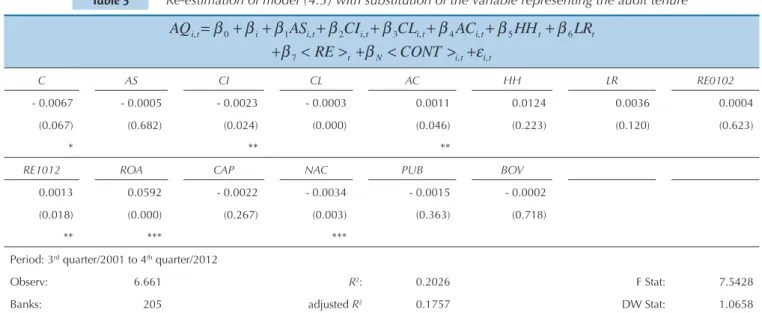
For this purpose, the estimation of model (4.3) was re-plicated, replacing the variables ST and LT by the contract length variable (CL), represented by the number of conse-cutive years of relationship between the audit company and inancial institution. he results are shown in Table 3.
C AS CI CL AC HH LR RE0102
- 0.0067 - 0.0005 - 0.0023 - 0.0003 0.0011 0.0124 0.0036 0.0004
(0.067) (0.682) (0.024) (0.000) (0.046) (0.223) (0.120) (0.623)
* ** **
RE1012 ROA CAP NAC PUB BOV
0.0013 0.0592 - 0.0022 - 0.0034 - 0.0015 - 0.0002
(0.018) (0.000) (0.267) (0.003) (0.363) (0.718)
** *** ***
Period: 3rd quarter/2001 to 4th quarter/2012
Observ: 6.661 R2: 0.2026 F Stat: 7.5428
Banks: 205 adjusted R2 0.1757 DW Stat: 1.0658
AQ is the quality of the audit; AS is the degree of auditor specialization on the Brazilian banking industry; CI indicates the relative importance of bank i for the auditor’s client portfolio; CL indicates the contract length between the auditor and inancial institution in number of years; AC indicates whether bank i
has an established Audit Committee; HH relects the concentration degree of audit services in the Brazilian banking industry, calculated using the Herindahl
--Hirschman Index, with reference to the volume of total assets of the institutions; LR translates the litigation risk against auditors, calculated by the number of punitive administrative proceedings against the auditors judged by the BCB and the CVM; <RE> is the vector of dummy variables that identify the different
rigor level of the regulatory environment of the audit market—RE0102for audits conducted between 2001 and 2002, RE0309for audits conducted between
2003 and 2009, and RE1012for audits conducted between 2010 and 2012; <CONT> is the vector of control variables representing the following: the return on assets (ROA), capitalization degree (CAP), nationality (NAT), origin of the control capital (PUB) and that the bank is listed on the stock exchange (BOV).
Signiicance of the parameters: 1% (***), 5% (**) and 10% (*).
he results initially demonstrate compatibility with those shown in Table 2. In general, all of the variables had the same signs and degree of signiicance despite the ob-vious residual changes in the coeicients. he diference was restricted to the variable litigation risk, LR, which, in the previous test, was signiicant at 10% and now has a p--value of 0.120.
With speciic regard to the audit tenure variable, the re-sults showed an inverse statistically signiicant relationship between audit quality and auditor-client relationship leng-th. hese results are consistent with the empirical evidence of the original tests that indicated a negative relationship between the audit quality and long-term relationship be-tween the audit irms and inancial institutions. hus, the results reinforce the evidence from the tests discussed in Section 5.2.
5.4 Sensitivity Analysis.
To validate the tests shown in Table 2, two additional tests were performed. In the irst additional test, model (4.3) was estimated with ixed cross-sectional efects but without the use of control variables. In the second additional test, the model is estimated using the method of double ixed efects - cross-section and time - which imposes the limitation of not considering the variables of temporal nature (HH, LR, RE0102 and RE1012).
With minor variations in the coeicients and p-values, these additional tests have conirmed the results found in rela-tion to the signs and statistical signiicance of the variables of interest, with one exception: the variable LR is not statistically signiicant in the model estimated with ixed cross-sectional efects and without the control variables. hese additional tests reinforce the reliability of the results presented in Table 2.
6 FINAL THOUGHTS
he reliability of inancial information is an essential con-dition for the proper functioning of markets - in particular, the banking market - given that its institutions are subject to the systemic risk known as “bank run” in the case of suspicion by depositors. One of the aspects that can contribute to an envi-ronment of trust is the work of independent auditors, histori-cally associated with the purpose of ensuring the credibility of the inancial disclosure process. he review conducted by the auditors assumes an even greater signiicance considering that the preparation of inancial information increasingly incorpo-rates subjective aspects of professional judgment, facilitating potential opportunistic behavior by managers in the sense of concealing an occasionally unsatisfactory inancial situation.
Considering this context, coupled with the lack of empiri-cal evidence on the audits conducted in the banking markets, particularly in the Brazilian market, this study aimed to iden-tify the determinants of the quality of audits of Brazilian banks conducted by independent auditors.
Empirical association tests of the audit quality proxy with the variables representing incentives for the performance of auditors have conirmed ive of the seven research hypotheses, revealing that audit quality has the following relationships: ne-gative with the level of client importance to the auditor; nega-tive with the audits conducted ater the sixth year of contract; positive with the establishment of an Audit Committee by the banks; positive with the judgment of punitive administrative proceedings against independent auditors; and positive with the level of rigor of the regulatory environment. Of the hypo-theses tested, two were not conirmed empirically. he irst of
the latter predicted an association between audit quality and the degree of specialization of the auditor on the banking in-dustry, and the second predicted that audit quality would have a negative relationship with the degree of concentration of au-dit activity within the SFN.
It is hoped that the identiication of the determinant factors of the audit quality of Brazilian banks contributes to deepen the discussion concerning the role that independent auditors can perform for an environment of transparency and solidity of the inancial system, including their role as a complemen-tary or auxiliary supervisor. his study carries even greater importance when considering that the preparation of inancial statements increasingly incorporates subjective aspects of pro-fessional judgment, possibly facilitating opportunistic behavior by management to conceal occasionally unsatisfactory inan-cial situations.
Naturally, the study is subject to limitations. he main one is that the phenomenon under study, audit quality, is not an externally veriiable factor - at least simultaneously to its per-formance - imposing the need to use proxies. It should also be stressed that the models developed here and concomitant construction of the variables considered the speciicities of the Brazilian banking market, not being applicable in another con-text without the necessary adaptations.
Alali, F., & Jaggi, B. (2010). Earnings versus capital ratios management:
role of bank types and SFAS 114. Review of Quantitative Finance and
Accounting, 36 (1), 105-132.
Almeida, J. E. F., & Almeida, J. C. G. (2009). Auditoria e earnings management: um estudo empírico nas empresas abertas auditadas
pelas big four e demais irmas de auditoria. Revista Contabilidade e
Finanças, 20 (50), 62-74.
Amir, E., Guan, Y., & Livine, G. (2010). Auditor independence and the cost of capital before and ater Sarbanes-Oxley: the case of newly issued public debt. European Accounting Review, 19 (4), 633-663. Basel Committee on Banking Supervision. BCBS. (2008). External audit
quality and banking supervision. BIS. Recuperado em 13 novembro,
2013, de http://www.bis.org.
BBC Brasil. (2010). Relatório: Lehman Brothers escondeu dívidas antes de quebrar. Recuperado em 30 junho, 2013, de http://www.bbc.co.uk/ portuguese/.
Bedard, J. C., & Johnstone, K. M. (2004). Earnings manipulation risk, corporate governance risk, and auditors’ planning and pricing decisions. he Accounting Review, 79 (2), 277-304.
Behn, B. K., Choi, J., & Kang, T. (2008). Audit quality and properties of analyst earnings forecasts. he Accounting Review, 83 (2), 327-349. Bernard, V. L., & Skinner, D. J. (1996). What motivates managers’ choice of
discretionary accruals? Journal of Accounting and Economics, 22 (1-3), 313-325.
Besacier, N. G., Hottegindre, G., & Fine-Falcy, S. (2011 April). he impact of recent regulatory changes on perceived audit quality as viewed by French auditors. Proceedings of the European Accounting Association,
Annual Meeting, Rome, Italy, 34.
Borgeth, V. M. C. (2007). SOX: Entendendo a Lei Sarbanes-Oxley. São
Paulo: homson Learning.
Braunbeck, G. O. (2010). Determinantes da qualidade das auditorias
independentes no Brasil. Tese de doutorado, Universidade de São Paulo, São Paulo, SP, Brasil.
Carcello, J. V., Bedard, J. C., & Hermanson, D. R. (2009). Responses of the American Accounting Association’s Tracking Team to the recommendations of the Advisory Committee on the Auditing Profession. Accounting Horizons, 23 (1), 69-84.
Carcello, J. V., & Nagy, A. (2004). Client size, auditor specialization and fraudulent inancial reporting. Managerial Auditing Journal, 19 (5), 651-668.
Chambers, D., & Payne, J. (2008). Audit quality and the accrual anomaly.
SSRN Working Papers. Recuperado em 20 dezembro, 2013, de http:// papers.ssrn.com.
Cofee J. C., Jr. (2004). What caused Enron? A capsule social and economic history of the 1990’s. Cornell Law Review, 89 (2), 269-309.
Cohen, D. A., Dey, A., & Lys, T. Z. (2008). Real and accrual-based earnings
management in the pre- and post-Sarbanes-Oxley periods. he
Accounting Review, 83 (3), 757-787.
Dang, L. (2004). Assessing actual audit quality. hesis Ph.D, Drexel University, Philadelphia, Pennsylvania, USA.
Dantas, J. A., Medeiros, O. R., & Lustosa, P. R. B. (2013). he role of economic variables and credit portfolio attributes for estimating discretionary loan loss provisions in Brazilian banks. Brazilian Business Review, 10 (4), 65-90.
Dao, M., Mishra, S., & Raghunandan, K. (2008). Auditor tenure and shareholder ratiication of the auditor. Accounting Horizons, 22 (3), 297-314.
DeAngelo, L. E. (1981). Auditor size and audit quality. Journal of Accounting and Economics, 3 (1), 183-199.
DeFond, M. L., Wong, T. J., & Li, S. (1999). he impact of improved auditor independence on audit market concentration in China.
Journal of Accounting and Economics, 28 (3), 269-305.
Demski, J. S. (2004). Endogenous expectations. he Accounting Review, 79
(2), 519-539.
Dye, R. A. (1993). Auditing standards, legal liability, and auditor wealth.
he Journal of Political Economy, 101 (5), 887-914.
Feldman, D. A., & Read, W. J. (2010). Auditor conservatism ater Enron.
Auditing: A Journal of Practice & heory, 29 (1), 267-279. Geiger, M. A., & Raghunandan, K. (2002). Auditor tenure and audit
reporting failures. Auditing: A Journal of Practice and heory, 21 (1), 67-78.
Ghosh, A., & Moon, D. (2005). Auditor tenure and perceptions of audit quality. he Accounting Review, 80 (2), 585-612.
Government Accountability Oice. GAO. (2003). Public accounting irms:
mandated study on consolidation and competition. Recuperado em 27 dezembro, 2013, de http://www.gao.gov.
Government Accountability Oice. GAO. (2008). Audits of public
companies: continued concentration in audit market for large public companies not call for immediate Action. Recuperado em 27 dezembro, 2013, de http://www.gao.gov.
Gu, Z., Lee, C. W. J., & Rosett, J. G. (2005). What determines the
variability of accounting accruals? Review of Quantitative Finance and
Accounting, 24 (3), 313-334.
Gul, F. A., Fung, S. Y., & Bikki, J. (2009). Earnings quality: some evidence on the role of auditor tenure and auditors’ industry expertise. Journal of Accounting and Economics, 47 (3), 265-287.
Heninger, W. G. (2001). he association between auditor litigation and
abnormal accruals. he Accounting Review, 76 (1), 111-126.
Kallapur, S., Sankaraguruswamy, S., & Zang, Y. (2010). Audit market
concentration and audit quality. SSRN Working Papers. Recuperado
em 5 dezembro, 2012, de http://papers.ssrn.com.
Kanagaretnam, K., Krishnan, G., & Lobo, G.J. (2009). Is the market valuation of banks’ loan loss provision conditional on auditor reputation? Journal of Banking and Finance, 33 (6), 1039-1047. Kanagaretnam, K., Krishnan, G., & Lobo, G.J. (2010). An empirical
analysis of auditor independence in the banking industry. he
Accounting Review, 85 (6), 2011-2046.
Kanagaretnam, K., Lim, C. Y., & Lobo, G. J. (2010). Auditor reputation and earnings management: international evidence from the banking industry. Journal of Banking and Finance, 34 (10), 2318-2327. Kanagaretnam, K., Lobo, G. J., & Mathieu, R. (2003). Managerial
incentives for income smoothing through bank loan loss provision.
Review of Quantitative Finance and Accounting, 20 (1), 63-80. Krishnan, G. V. (2005). he association between Big 6 auditor industry
expertise and the asymmetric timeliness of earnings. Journal of Accounting, Auditing and Finance, 20 (3), 209-228.
Lam, S., & Chang, S. (1994). Auditor service quality and auditor size: evidence from initial public oferings in Singapore. Journal of International Accounting Auditing and Taxation, 3 (1), 103-114. Lys, T., & Watts, R. L. (1994). Lawsuits against auditors. Journal of
Accounting Research, 32 (Supplement), 65-93.
Magilke, M. J., Mayhew, B. W., & Pike, J. E. (2009). Are independent
audit committee members objective? Experimental evidence. he
Accounting Review, 84 (6), 1959-1981.
Manita, R. (2009 junho). he quality of audit process: proposal of scaling measure.Anais do Congresso IAAER-ANPCONT, São Paulo, SP, Brasil, 3. Martinez, A. L., & Reis, G. M. R. (2010 julho). Rodízio de auditores
e o gerenciamento de resultados. Anais do Congresso USP de Controladoria e Contabilidade, São Paulo, SP, Brasil, 10. Múrcia, F. D., & Borba, J. A. (2007). Estrutura para detecção do risco
de fraude nas demonstrações contábeis: mapeando o ambiente fraudulento. Brazilian Business Review, 4 (3), 171-190.
Nagy, A. L. (2005). Mandatory audit irm turnover, inancial reporting quality, and client bargaining power: the case of Arthur Andersen.
Accounting Horizons, 19 (2), 51-69.
Nelson, M. W., Elliott, J., & Tarpley, R. L. (2002). Evidence from auditors
about manager’s and auditor’s earnings management decisions. he
Accounting Review, 77 (Sup.), 175-202.
Newman, D. P., Patterson, E. R., & Smith, J. R. (2005). he role of auditing in investor protection. he Accounting Review, 80 (1), 289-313. Ojo, M. (2006). Auditor independence – its importance to the external
auditor’s role in banking regulation and supervision. SSRN Working
Papers. Recuperado em 2 abril, 2013, de http://papers.ssrn.com. Ojo, M. (2008). he role of the external auditor in the regulation
and supervision of the UK banking system. Journal of Corporate
Ownership and Control, 5 (4), 1-21.
Oliveira, A. Q., & Santos, N. M. B. F. (2007). Rodízio de irmas de auditoria: a experiência brasileira e as conclusões do mercado. Revista Contabilidade & Finanças, 18 (45), 91-100.
Pae, S., & Yoo, S. (2001). Strategic interaction in auditing: an analysis of auditors’ legal liability, internal control system quality, and audit efort. he Accounting Review, 76 (3), 333-356.
Palmrose, Z. V. (1988). An analysis of auditor litigation and audit service quality. he Accounting Review, 64 (1), 55-73.
Resolução do Conselho Monetário Nacional n. 2.682, de 21 de dezembro de 1999. (1999). Dispõe sobre critérios de classiicação das operações de crédito e regras para constituição de provisão para créditos de liquidação duvidosa. Recuperado de: http://www.bcb.gov.br/pre/ normativos/res/1999/pdf/res_2682_v2_L.pdf>.
Romanus, R. N., Maher, J. J., & Fleming, D. M. (2008). Auditor industry specialization, auditor changes, and accounting restatements.